In 2008, Norman Rockwell was named the official state artist of the Commonwealth of Massachusetts, but he brought his finely detailed illustration technique far beyond his famed depictions of small-town America. He sometimes tackled Hollywood as a subject.
Currently at the Norman Rockwell Museum in Stockbridge, Massachusetts an exhibit called “Rockwell and the Movies” displays the artist’s work on original paintings, along with posters and lobby cards for films such as “The Magnificent Ambersons”, “The Song of Bernadette”, “The Razor’s Edge”, and the 1960 version “Stagecoach.” The collection includes 25 works on Hollywood subjects.
This exhibition also coincides with one currently shown at the Smithsonian American Art Museum in Washington, D.C. This collection displays 57 paintings and drawings done by Norman Rockwell on the movie themes, called “Telling Stories: Norman Rockwell from the Collections of George Lucas and Steven Spielberg.”
For more on the Norman Rockwell Museum exhibit, including photos of samples of his movie work, have a look at this website. For more on the Smithsonian American Art Museum exhibit, have a look at this website.
Monday, August 30, 2010


Thursday, August 26, 2010
Enter the Screenwriter
An article printed in The Scientific American in June of 1909 heralded a new change in American popular culture. The screenwriter. This blurb was reprinted in the magazine in June 2009.
Moving pictures are exhibited in about ten thousand theaters and halls in the United States. With the rapid spread of this new amusement has also come a marked change in the public taste. Spectators were once quite content with a view of factory employees going to and from their work, the arrival and departure of railway trains, and similar scenes. Nowadays, a more or less coherent story must be unfolded, for which reason the makers of moving pictures have been compelled to write plays (or at least to conceive them) and to have them acted before the camera.
“More or less coherent” is a quality which seems to have remained with screenplays a century later.
Moving pictures are exhibited in about ten thousand theaters and halls in the United States. With the rapid spread of this new amusement has also come a marked change in the public taste. Spectators were once quite content with a view of factory employees going to and from their work, the arrival and departure of railway trains, and similar scenes. Nowadays, a more or less coherent story must be unfolded, for which reason the makers of moving pictures have been compelled to write plays (or at least to conceive them) and to have them acted before the camera.
“More or less coherent” is a quality which seems to have remained with screenplays a century later.
Monday, August 23, 2010
More Cement, Take Two

For Jean Harlow, whose stardom seemed cemented after her soon to be nationally released “Dinner at Eight” (1933), it was case of “try, try again” when getting the star treatment at Grauman’s Chinese Theater.
On September 25, 1933, she was the main attraction on stage at the Chinese Theater for a live ceremony before a paying audience to watch her plunk her hands and her high-heeled shoes into a slab of wet cement. Presumably flashbulbs, presumably applause, and presumably a handy towel to wipe the gunk off her hands and shoes.
Not presumed at all was the quick-drying cement, which had dried so quickly that when the slab was attempted to be moved, it was dropped. Smashed to smithereens.
Take two. Four days later, a very game Jean Harlow repeats the ceremony, this time outdoors on the sidewalk, on September 29, 1933. “To Sid in Appreciation - Jean Harlow” she signed the new slab of wet cement, and presumably Sid Grauman appreciated her return engagement.
Jean Harlow, sadly, did not have too many more second chances in her young life. She died four years later in 1937, at 26 years old.
For more on the footprints in cement occasion, have a look at this website.
Thursday, August 19, 2010
Roz Russell's Waterbury Premiere

She wrote in her autobiography, “Life is a Banquet” (with Chris Chase, Random House, NY, 1977) “Nineteen fifty-five was my year for attracting natural disasters.”

The festivities were scheduled for August 18th. Roz (as she was referred in the local paper), was due to arrive by train along with her co-stars from the film, Fernando Lamas, Eddie Albert, and Gloria DeHaven (who we last saw in this post on “Summer Stock” - 1950)
According to author Bernard F. Dick’s biography, “Forever Mame - The Life of Rosalind Russell” (University Press of Mississippi, 2006), Miss Russell arrived the day before, visited with siblings and her elderly mother, and prepared to take on the public mantle of hometown hero.
Miss Russell remarks in her autobiography, “Waterbury authorities explained that I was the only motion picture star to have a theatre named for her (I don’t know whether they meant in Waterbury or in the United States or in the entire world, but how could such a declaration not go to a girl’s head?)”

The stars, along with the flock of Paramount newsreel men, the inevitable publicity department, and some 10,000 townspeople straggling on the sidewalks to watch the parade, would be taken from the railroad station to the Elton Hotel, the swank spot in town.

Dave Garroway (who is mentioned as having a problem with chimpanzees on the set of The Today Show in this post from Monday), showed up with his Today Show crew to film the festivities live on television from the Elton Hotel.
Roz’s take: “There was a big dinner at the great snob Waterbury Club, and my brother had to make a speech, and everything was to be televised - crews had been there for a week, setting up cameras all over the Waterbury green.”
They were in the right place to broadcast an even bigger surprise story the next day.

Roz writes in her autobiography that, “there was a drum and fife corps - that’s very big in Connecticut; they always wear tricorne hats.”

Limos downtown, and powerful spotlights sweeping the cloud-covered night sky. Nothing like it had ever been seen in this factory town. Nothing ever would again. By morning, the Rosalind Russell State Theater, like much of the downtown, would be under several feet of water.
That cloud-covered sky. It had been raining pretty steadily all day during the celebrations on the 18th. By late that evening, smaller brooks in the Naugatuck River valley would jump their banks. The mighty Naugatuck itself, which powered so much industry in Waterbury, would morph in the wee hours to a monstrous thing that scraped factories, stores, and homes to rubble before morning, and leave some 30 people dead in Waterbury and over 90 people dead or missing and presumed dead total in the towns of the Naugatuck Valley.

Roz fortuitously left right after the premiere, rented a car with her maid and a driver, and they made their way to New Haven while the bridges were being washed out in Waterbury.
From Roz’s autobiography: “I directed the driver - ‘Go up this hill, go down that lane, I know this town’ - because I realized if we could get to New Haven, we could get from there to New York. There was no hope of driving along the Naugatuck Valley toward Bridgeport; the Naugatuck River had overflowed.”
Her intention was to make it to the next publicity chore, the Ed Sullivan Show in New York City on the 21st, for an appearance with co-star Gloria DeHaven to promote “The Girl Rush.”
According to Mr. Dick's book, Miss DeHaven, however, got stuck in Waterbury temporarily until train service resumed.
Recovery took weeks, months, even years for some people. Some businesses, and people, never did recover.

According to this Cinema Treasures information, the State Theater had at various times, been called the Broadway, the Bijou, or the Rialto. It was torn down a couple decades ago. Currently, it is a parking lot.

This remarkable event was the last time Rosalind Russell ever visited Waterbury. Truly, the dual theatrical masks of comedy and tragedy were worn on this night.
For more on the New England Flood of 1955, have a look at tomorrow’s “New England Travels” blog.
Monday, August 16, 2010
Lester Colodny's Hollywood Memoir

Lester Colodny learned many things in the course of his career, such as Frank Sinatra did not like to rehearse. Mr. Colodny found this out by attempting to direct him in a commercial.
Mr. Colodny also found out that several chimpanzees let loose on live television is not a happy situation. He discovered this as an associate producer for “The Today Show”. Host Dave Garroway, whose idea it was, must have seen his error immediately as the chimps assaulted Mr. Garroway and the rest of his stunned cast, including Frank Blair, Jack Lescoulie, and a very young, beautiful, and horror-stricken Florence Henderson.
In his recently published memoir, “A Funny Thing Happened - Life Behind the Scenes: Hollywood Hilarity and Manhattan Mayhem” (SciArt Media, publisher) written by Mr. Colodny with Susan Heller, an amazing career of twists and turns, often under the silliest of circumstances, is chronicled by this now 85-year-old gentleman who currently directs community theatre in New England.
Lester Colodny has been a writer of plays, ad copy, of news précis, and screenplays. He stumbled into acting and stumbled into Mae West, touring with her show “Diamond L’il”. He worked as a literary agent, a talent agent, and director of television commercials. He won an Emmy Award for a special with Jack Benny he wrote, directed and produced. He won several “Clio” awards for his unique “Xerox” commercials. He created the television show “The Munsters”.
He recounts a Hollywood party where Rod Steiger and Lee Marvin endured a spectacular fistfight. Colodny worked with, and partied with, and shares his memories of such Hollywood luminaries as Lana Turner (whom he dated), Cary Grant, Lucille Ball and Desi Arnaz (and several other party crashers that would be a name-dropper’s paradise), Jerry Lewis, and the Beatles, among a score of others.
He would also direct another commercial with a very young Richard Dreyfuss.
For more on my interview with Mr. Colodny, have a look here at my New England Travels blog, and here at my Tragedy and Comedy in New England blog. To order your copy of this unique memoir by a very funny guy, have a look here at the SciArt Media website.
Thursday, August 12, 2010
Stanwyck Sings!
We mentioned a few days ago in the post about “The Man with the Cloak” (1951), that Barbara Stanwyck sings in one scene where she entertains at a party.
This former New York showgirl may not have had the range or vocal power of Ethel Merman (few did), but because Stanwyck is a delight to watch in everything else she did, her singing scenes are also a pleasant insight into the can-do attitude of this gusty actress.
Author Ella Smith notes in her “Starring Miss Barbara Stanwyck” (Crown Publishing, Inc., NY, c. 1985) that Miss Stanwyck also does her own singing in “Banjo on My Knee” (1936), “This is My Affair” (1937), and “Lady of Burlesque” (1943).
She is dubbed by other singers in “Ball of Fire” (1941), and “California” (1947). Ella Smith also writes that her “The Man with the Cloak” is dubbed, but I’ve read differently elsewhere. If she is dubbed here, it’s an awfully good match-up to her voice. I’d love to hear from anyone who knows more and can set us straight.
Below are a couple of clips of Barbara Stanwyck singing, first in “Banjo on My Knee” in a duet with Tony Martin, followed by “Lady of Burlesque”. Remember to scroll down to the bottom of the page first and mute the music so you can hear these clips.
This former New York showgirl may not have had the range or vocal power of Ethel Merman (few did), but because Stanwyck is a delight to watch in everything else she did, her singing scenes are also a pleasant insight into the can-do attitude of this gusty actress.
Author Ella Smith notes in her “Starring Miss Barbara Stanwyck” (Crown Publishing, Inc., NY, c. 1985) that Miss Stanwyck also does her own singing in “Banjo on My Knee” (1936), “This is My Affair” (1937), and “Lady of Burlesque” (1943).
She is dubbed by other singers in “Ball of Fire” (1941), and “California” (1947). Ella Smith also writes that her “The Man with the Cloak” is dubbed, but I’ve read differently elsewhere. If she is dubbed here, it’s an awfully good match-up to her voice. I’d love to hear from anyone who knows more and can set us straight.
Below are a couple of clips of Barbara Stanwyck singing, first in “Banjo on My Knee” in a duet with Tony Martin, followed by “Lady of Burlesque”. Remember to scroll down to the bottom of the page first and mute the music so you can hear these clips.
Monday, August 9, 2010
The Man with the Cloak - 1951

The Man with a Cloak (1951) is a deft melding of equal parts historical drama and film noir. Set in New York City in 1848, we follow the cloak-(literally) and-dagger schemes of a wealthy, aged, and dying rapscallion played with superb aplomb by Louis Calhern, and the sycophantic but secretly devious household staff.


In this film, Mr. Cotten plays a real historical figure. We get a few clues throughout the movie about his identity, but his name, finally revealed at the very end of the movie when his signature is scrawled on an I.O.U., may still come as a poignant surprise.

The bulk of the 19th century is carried on the shoulders of costumer Walter Plunkett. The costumes and sets seem both spot-on for the period.
The mood of Dickensian grimness and 20th century noir is woven together as well in the damp nights on cobblestone streets lit by gaslight, the layers of deception, the bungled plot that results in not one dead body but two, and a very crisp and literate script that concludes with a surprisingly wordless and violent fight scene.
Perhaps the signature of film noir is represented in this costume drama in the character played by Joseph Cotten, who is the original anti-hero, the man down on his luck, a slave to drink, who roams with bitter failure on his back, his own worst enemy, and yet who with cunning and cynical savvy, becomes Leslie Caron’s knight in shining armor.


Another fine aspect of this film is that it manages to be an ensemble piece. Jim Backus, as the philosopher bartender, who remarks, “Some men leave good will. Other just a will,” is as important to the plot as the brutish butler, and as important as Miss Stanwyck, who with her customary professionalism, seems content to be a team player. She also has the guts to play a woman of a certain age with fading charms, who desperately uses everything left in her arsenal.

Cotten remarks of Louis Calhern, “He was a roué in the grand manner. A connoisseur of wine, women, and wit. Now he’s an ancient ruin with one arm paralyzed and one foot in the grave.” Cotten, who sees through just about everybody, makes cutting, sarcastic remarks, but is a foremost gentleman who after each dig mumbles a perfunctory, “Forgive me” in between sips of wine.
One of my favorites is when he brushes by the hateful butler and murmurs, “Try to get the murder out of your face.”
While Joseph Cotten and Leslie Caron are attempting to protect the old man’s life against his murderous household servants, the old man pulls a fast one on everybody, writes a new will, and then attempts to end his life with poison.
In the grand manner of a horror tale, the poison is consumed accidentally by another, while Calhern, silenced by another stroke, must watch helplessly.
In the end, the reluctant hero solves the riddles, and the Parisian waif may return home triumphant, and the household staff…they receive a most ironic and fitting legacy from their master.
Thursday, August 5, 2010
Drive-in Theater, Rhode Island

In the daytime, there’s no magic.
This drive-in theatre, now called the Rustic Tri-view, was opened in 1951 in North Smithfield, Rhode Island. As mentioned in this previous post on drive-ins, there aren’t a lot left in New England, but this one’s managed to survive the decades. It is now the only drive-in movie theater left in the state of Rhode Island.
For more on the Rustic Tri-view (so named for its three screens), have a look at this website, and here.
Monday, August 2, 2010
Ruth Roman, Betsy Drake, and the SS Andrea Doria

In July 1956, the ocean liner SS Andrea Doria sank on the last night of its transatlantic voyage from Italy to New York City when another ocean liner, the MS Stockholm, collided with her.
It seems a watershed moment, almost as if morosely heralding the end of the leisurely elegance of ship travel (the first jet was to cross the Atlantic two years later), and the beginning of instant news as still photographers from Life magazine and others, newsreel cameramen, and reporters scrambled to the site to watch the vessel sink. Topping any newspaper “extras,” the film was developed and shown on television, a first.
Along with scores of immigrants making that journey, were the well-to-do and well-traveled, and two who made that fateful trip represented Hollywood. They were actresses Ruth Roman, (last seen here in our discussion of Invitation - 1951) and Betsy Drake. Their experiences on the last voyage of the Andrea Doria, along with the harrowing tales of many others, are told in Richard Goldstein’s fine book Desperate Hours - The Epic Rescue of the Andrea Doria (John Wiley & Sons, Inc., NY, 2003), from which much of the following information is taken.
Betsy Drake, and husband Cary Grant, had traveled on the Andrea Doria before, and other stars, as captured in the documentary Secrets of the Dead - The Sinking of the Andrea Doria (PBS 2006), include Kim Novak, Joseph Cotten, Orson Welles, Spencer Tracy, Joan Crawford, and Tyrone Power.
Hollywood has given us a glimpse of the ship, inadvertently, in the final moments of On the Waterfront (1954) when Marlon Brando and Eva Marie Saint are standing atop his apartment building. The ocean liner moving down the Hudson is the Andrea Doria, two years before the tragedy.
Her last voyage was to be a nine-day journey from Genoa, Italy to New York City in this era where travel was leisurely. Ocean liners had individual designs and décor (unlike planes which were stamped out pretty much one like another). Meals were extraordinary, and passengers dressed for dinner.
There were three classes on the Andrea Doria, 1st class, cabin class, and tourist class, each with its own gym, library, bar, dancing, movies, and swimming pools. The sumptuous ship was itself like an art museum with paintings and sculptures in airy solons with modern furniture, making it a most glamorous ship.

Betsy Drake joined the voyage at Gibraltar, where she left her husband Cary Grant making a movie in Spain and pursuing Sophia Loren, much to his wife’s distress.
The trip enjoyed clear weather, and a peaceful crossing until its final night, when it entered the notoriously fog-bound waters south of Nantucket off New England. There were the usual last night farewell festivities, with champagne and streamers, and a roast beef dinner, and “Arrivederci Roma” played by Dino Massa and Orchestra.
Many cut the evening short to head back to their cabins and get some sleep before the early morning docking in New York. Betsy Drake did, never being much for socializing, and preferring to climb into her bunk in her cabin to read.
Ruth Roman and companion Janet Stewart enjoyed a last drink in the Belvedere Observation Lounge, while her son slept in the cabin a lower deck with his nanny minding him.
Some people watched the movie Foxfire (1955) with Jeff Chandler and Jane Russell.
A little after 11 o’clock that night, the MS Stockholm, leaving New York for Sweden, accidentally rammed the Andrea Doria. To some passengers it seemed like a dull thud, to others a great jolt, depending on where they were on ship, and then the screeching sound of ripping metal. Ultimately, 46 people on this ship, and 5 on the Stockholm, died.
Betsy Drake’s cabin on the Boat Deck shook, and she immediately put her stylish suit back on, grabbed a life vest, and headed for the upper deck. Her jewels, and a semi-autobiographic novel on which she’d been working, went down with the ship.
Ruth Roman ran from the lounge to get to her son, and ripped her form-fitting dress up the back so she could move better on the stairs that were already at a treacherous angle due to the listing of the ship on its side. She took son, and nanny, and life vests, and ditched her high heels to manage the climb to the upper deck.
Distress signals went out. First on the scene were a commercial freighter, Naval ships, and another grand ocean liner, the Ile de France.
The Ile de France had left New York City that morning and was heading to England, but turned around at the Morse Code distress call.
The Doria was taking on water and ominously threatening to roll over. There were plenty of lifeboats on the Andrea Doria, a lesson well-learned from the Titanic disaster, but an unexpected problem arose. Because of the lurch of the ship onto its side, half the lifeboats could not be launched, and were useless.
Fortunately the Stockholm, though it had sustained severe damage to its bow, was in no danger of sinking. Several of its lifeboats were sent to fetch passengers from the Andrea Doria.
Ruth Roman found a deflated balloon left over from the party. She blew it up and amused her little boy with it, plunking him in a barricade of life vests and blankets on the deck, telling him they were having a picnic. Around them, scenes of chaos, courtesy, panic, selfishness, and selflessness.
The ship creaked, and slipped some more. About 2 a.m., Miss Roman and her gang slid down from the higher end of the deck to the lower side where they hoped to catch a rope to a lifeboat below. A young cadet sailor from the Andrea Doria took her son and strapped himself to Dickie, and climbed down a rope ladder to a waiting lifeboat.
The boat pulled away before Ruth Roman could climb in. The boy disappeared in the fog with a group of strangers. She, and nanny, and companion, waited for another opportunity to escape.
By 2 a.m., three hours after the collision, there were still around 1,000 people left on board the Andrea Doria awaiting rescue, the two Hollywood stars among them. No more division into classes; it was egalitarianism at its most miserable. Betsy Drake clung to the high side of the ship, took off her shoes for traction, and waited.
About that time the Ile de France approached. With sensitivity mixed with perhaps a certain Gallic élan, the captain ordered all the festive lights on the ship turned on so that the Doria survivors would see that help was coming. Among its strings of lights, there was the name lit up between its two funnels in great block letters: ILE DE FRANCE suddenly piercing the black gloom. More than reassuring, it seemed like something miraculous, a finale scene out of a movie.
Ruth Roman was taken in a lifeboat to the Ile de France. Her little boy was not here, and she could not find out to which ship among the seven rescue ships he had been taken.
Betsy Drake was also taken to the Ile de France. She had previously sailed on this ship under happier circumstances. (She had met Cary Grant when they sailed together on the RMS Queen Mary.) So many survivors were trying to send cables from the ship to loved ones, that she was unable to send one to Cary Grant.

Many of the passengers on the Ile de France donated clothing to the Doria survivors. A tennis professional named Eddie Hand gave Ruth Roman a pair of trousers, a white polo shirt, and woolen socks. A Life photographer who happened to be traveling with his family, brought her to rest in his cabin.
The Ile de France managed to scoop up 753 of the Andrea Doria’s passengers. When she entered New York Harbor, other boats blew whistles in tribute, and cheers rose up from the crowds gathering at the piers. Just after 5 p.m. on the 26th, she docked at Pier 88 off West 48th Street.
Betsy Drake, met at the pier by a friend, was still wearing her suit but also a pair of white sweat socks a sailor had given her. Many of the survivors had no shoes. Many of the immigrants had nothing left but the donated clothes on their backs.
Ruth Roman finally learned that her son had been taken to the MS Stockholm, which initially had trouble leaving the scene of the collision because its anchor chains had become tangled. It was still at sea when she arrived at the pier with the other Ile de France passengers.
Late the next morning, on the 27th, Miss Roman finally reunited with her son, as the Stockholm entered the harbor. Now that the media had come of age, or at least catching on to its exploitive possibilities in the reporting of instant news, the moment she picked her child up and hustled through a mob of reporters and cameramen was captured with all its excitement and cruel lack of privacy.

Article from "The New York Times", July 26, 1956, p. 1
The most remarkable aspect of the sinking of the Andrea Doria is that so many were saved due to an impromptu, but terrifically successful rescue operation. For more on the event, stop by at my New England Travels blog.
For Mr. Goldstein’s excellent book, including an excerpt describing the arrival on scene of the Ile de France, have a look here at his website.
Monday, July 26, 2010
Intermission
I'll be back next week. Somebody water the plants. (Don't forget to scroll down to mute the music first before playing the video.)
Thursday, July 22, 2010
Summer Stock - 1950

Summertime will always carry for many of us the intangible essence of freedom, the pursuit of dreams, and a sense of suspended work for play. There are plenty of tangibles that go along with this: the hot weather mainly. But if the livin’ is not always easy, the vague promise of a better life even in just a lawn chair or hammock for a handful of weekends seems like Shangri-la compared to rat race we’ve chosen for ourselves the rest of the time. I don’t know if we can really catch the idyll of summers of our childhood, but the memory of them, perhaps romanticized, is what probably pushes us to think we can.

Judy and Gene are grown ups, but this is the old “let’s put on a show” formula Judy had been playing since she was in pigtails. Her next musical four years later, “A Star is Born” would be much more grown up, if still from well-worn material.
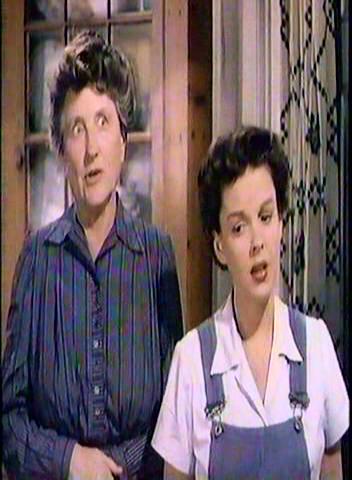
The farm is struggling. Judy’s two ancient farmhands are leaving her to go down to “Hartford way” in their Sunday suits to get jobs in factories. But, all is not lost, because kid sister is finally coming home to help on the farm. And Judy has a new tractor to help with the harvest.

The plot thickens. Spoiled kid sister brings home her boyfriend, Gene Kelly, and Mr. Kelly’s crew of actors and stagehands. He is a hopeful young director, and spoiled kid sister has promised him the use of Judy’s barn to put on his show.
We mentioned in this recent post about “A Stolen Life” (1946) how old movies depicting rural New England frequently demonstrate our apparent love of square dancing. But, as we see here, barns in New England (uh, that’s b-a-a-h-n-s), have another use. No, not for housing cows. That other use, summer stock, which is often called The Barn Circuit.

Before too long, however, this b-a-a-h-n dance turns to be-bop, as the rowdy acting company takes over, and this is only a small bit of havoc they wreak on the farm. Ray Collins is mostly incensed at their presence just because they are, well, actors. You know what theater people are like.

At some point in the 20th century, old prejudices died out enough for rural New England communities to take visiting actors as guests in their homes when they played at the local summer stock theater. There weren’t a whole lot of Ramada Inns or quaint B&Bs back in the day, so the theatre folk relied on a spare room where it was offered.

The women are separated from the men, of course, in the dormitory hay loft, with ever-vigilant Marjorie Main guarding their virtue with a double barreled shotgun. Yes, sir, all the comforts of home.
Back to Judy’s troubles. Wanting to support spoiled kid sister, she allows the show to go on, provided the actors help with the farm chores. Never ask Phil Silvers, who plays Gene Kelly’s inept and brutally annoying sidekick, to do anything for you.

And Judy and Gene fall for each other. Nobody wants to hurt anybody, but this is a musical, and everybody gets hurt.

Judy Garland was what many called a triple threat: she could sing, she could dance, and she could act. Anything she turned her hand to on stage, she did well, and often brilliantly. Here we see her precise comedic timing. She could do more with a look or a gesture than the other comics could do with pages of the best material.
She displays swift and sudden sadness, brittle disappointment, and her eyes tear as she speaks. She makes you believe her. Then she does the “Get Happy” number, filmed after the rest of the movie was in the can, having lost some extra pounds and looking fabulous. How many times had she pulled a rabbit out of the hat?

The acting company names itself “Falbury Farm Players” and their show is called “Fall in Love.” About the second most vague title in play-within-a-movie history, losing out to “Playing Around”, which was the show Bing Crosby and Danny Kaye produced in “White Christmas” (1954). Which was put on up the road in Vermont. In a b-a-a-h-n.


This film was made in 1950. For more on Hollywood actors appearing in real New England summer stock in the summer of 1950, have a look at yesterday’s post in my Tragedy and Comedy in New England blog.
Below, have a look at the trailer for “Summer Stock”, and also for Judy’s “Get Happy” number.
Monday, July 19, 2010
Movie Locations - Long Beach Airport

The Long Beach Airport in Long Beach, California, specifically its Art Deco style terminal building, has been used in a number of movies over the decades. Among the films with scenes shot here are “The Bachelor and the Bobby-Soxer” (1947), “Executive Suite” (1954), which we’ll discuss in more depth down the road, and “Key to the City” (1950). I believe some modern TV shows have also used this location.


I don’t suppose that shot is discussed that often as a “message image” in this landmark film on the homecoming of three servicemen after World War II, but for me this view of Dana Andrews walking, encumbered with his bag, across the map of the earth in his weary journey home is iconic.

In “A Stolen Life” there is no such greater meaning to the airport terminal, except that Bette Davis is meeting her cousin here while she is pretending to be her twin sister. It is a place of meeting and greeting and new beginnings overshadowed with foreboding.


The Long Beach Airport was built in the late 20s, and commercial aviation began at least by the mid-1930s. The Art Deco style terminal building was constructed in 1941.

For more on the Long Beach Airport, have a look at this website. For more on the history of filming in Long Beach, have a look here.
Subscribe to:
Posts (Atom)