Just a few posts I enjoyed recently, and I hope you do, too.
From “Bygone Brilliance”, Merriam lists her observations if real life were like a classic film.
From “Sidewalk Crossings”, DKoren posts a fascinating description of one of the “Barbara Stanwyck Show” episodes now available on DVD, with an especially astute analysis of the work of actor Vic Morrow.
“Allure” needs no particular post to recommend it; all of them are a bonanza for discussing the careers of early Hollywood actresses, many of whom I’ve never heard of, and providing the most diverse collection of photos there exists anywhere.
Raquelle at “Out of the Past” serves up the many menus of “Christmas in Connecticut” in a most creative, culinary post.
Monday, December 21, 2009


Friday, December 18, 2009
Jennifer Jones 1919-2009
We make icons of film stars, particularly those who suffer the tragedy of dying young. It is as if we mourn these stars more for losing them while they are at the peak of their beauty or talent, and their brilliance is frozen in time forever.
As irresistible as that is, there is a finer and more meaningful, if less glamorous, alternative.
Jennifer Jones was beautiful, and most certainly talented. She conveyed in her acting, even in the stronger and funnier roles, a vulnerability that sprang from her own quiet personality. There were also tragic incidents in her life where she might have died young. Had that happened, perhaps she would have been fast tracked to that transcendent icon status, and remained there. There would be no need to revive reasons many decades later since she stopped working, why she was so special. As it is, at 90 years old she has few contemporaries in the industry left to mourn and remember her. Whether she intentionally retired from films in middle age or was simply not in demand, or a combination of both, is a question less easily answered. She just seemed to have quietly slipped away.
Growing old is seldom forgiven by the movie industry, particularly where ladies are concerned. But with luck, and courage, and grace, she survived both the tragic incidents of her personal life and the awesome pressures of her film career, and applied herself in other directions in another kind of wonderful transcendence.
And that is the triumph of her life. Notoriously shy, (she was one of those actresses who took her work seriously, but hated stardom) Jennifer Jones devoted her later life to supporting art, and contributing both funds and her personal time to the treatment of cancer and mental illness.
The immeasurable significance that she died an old lady, in her own bed, with those she loved to say goodbye (what we should call a lifetime achievement award) may, understandably, be lost on young movie buffs just discovering a love for classic films based on a crush for beautiful young icons. We’ve just lost a great actress and a special lady whose greatest gift was neither her beauty nor her talent, but probably her resiliency.
Those who are unfamiliar with her work will likely have opportunity now, as always happens after the death of a star, to watch a number of her films. They may find themselves adding the incomparable, transcendent, Jennifer Jones to their list of favorites. She deserves this, and more.
As irresistible as that is, there is a finer and more meaningful, if less glamorous, alternative.
Jennifer Jones was beautiful, and most certainly talented. She conveyed in her acting, even in the stronger and funnier roles, a vulnerability that sprang from her own quiet personality. There were also tragic incidents in her life where she might have died young. Had that happened, perhaps she would have been fast tracked to that transcendent icon status, and remained there. There would be no need to revive reasons many decades later since she stopped working, why she was so special. As it is, at 90 years old she has few contemporaries in the industry left to mourn and remember her. Whether she intentionally retired from films in middle age or was simply not in demand, or a combination of both, is a question less easily answered. She just seemed to have quietly slipped away.
Growing old is seldom forgiven by the movie industry, particularly where ladies are concerned. But with luck, and courage, and grace, she survived both the tragic incidents of her personal life and the awesome pressures of her film career, and applied herself in other directions in another kind of wonderful transcendence.
And that is the triumph of her life. Notoriously shy, (she was one of those actresses who took her work seriously, but hated stardom) Jennifer Jones devoted her later life to supporting art, and contributing both funds and her personal time to the treatment of cancer and mental illness.
The immeasurable significance that she died an old lady, in her own bed, with those she loved to say goodbye (what we should call a lifetime achievement award) may, understandably, be lost on young movie buffs just discovering a love for classic films based on a crush for beautiful young icons. We’ve just lost a great actress and a special lady whose greatest gift was neither her beauty nor her talent, but probably her resiliency.
Those who are unfamiliar with her work will likely have opportunity now, as always happens after the death of a star, to watch a number of her films. They may find themselves adding the incomparable, transcendent, Jennifer Jones to their list of favorites. She deserves this, and more.
Thursday, December 17, 2009
More Movie Christmas Trees
As a follow-up to last year’s look at some movie Christmas trees, here are a few more to deck the halls.

“Peyton Place” (1957), discussed in this post, shows how fun Christmas can be with Hope Lange and her little brother until abusive stepfather Arthur Kennedy shows up and spoils the afternoon. Not only that, the tree gets knocked over (gasp!). And Arthur gets knocked off. But hey, pass the eggnog.

In “Bell, Book, and Candle” (1958), discussed in this post, we see perhaps the ultimate in artificial Christmas trees, a kind of tree-inspired metal sculpture around which some witches switch presents, which is fun for witches.

Here in “Stella Dallas” (1937), we get the old fashioned traditional enormous tree with visiting papa John Boles and daughter Anne Shirley sharing a brief happy moment in another traditional dysfunctional family.
That’s what Christmas is all about, Charlie Brown, making the best of it. And being grateful for the socks and underwear. Or, whatever is it those witches are giving each other.


That’s what Christmas is all about, Charlie Brown, making the best of it. And being grateful for the socks and underwear. Or, whatever is it those witches are giving each other.
Monday, December 14, 2009
Favorite Christmas Music Meme
Having been tagged by J. C. Loophole over at The Shelf (and bearing the angry red dodgeball welts on my forehead) to partake of a little favorite Christmas musical performances meme, mine are as follows:
When it comes to Christmas music in general, I’m partial to any performance, TV, CD, in person or otherwise by soprano Kathleen Battle accompanied by classical guitarist Christopher Parkening. But, since this is Another OLD MOVE Blog, I’m going to sort through only those performances you can find in old movies.
1. “I’ll Be Seeing You” (1945). Joseph Cotten, Ginger Rogers, Tom Tully, Spring Byington, and Shirley Temple all sit around the dining room table singing “O Little Town of Bethlehem.” It is homey, amateur night, and I like the way Cotten sings a little off the others. He is the stranger in the house trying to fit in, and he makes a game try with his touchingly pathetic warbling.
2. “Meet Me in St. Louis” (1944). Judy Garland pacifying little sister Margaret O’Brien after little Margaret freaks out and attempts a mass murder on the snowmen in the yard. Judy sings the really more-sad-than-cheerful “Have Yourself a Merry Little Christmas,” which says so much more about Christmas during wartime when the film was made than it does about St. Louis in 1904.
3. “White Christmas” (1954). Bing Crosby, Danny Kaye, Rosemary Clooney, and Vera-Ellen’s singing double singing “Snow”. I like it because it is staged like a Busbee Berkeley chorus number, yet nobody gets out of his seat. I also like it because it takes place on a train, and I love trains more than I love people. (Oh dear. That sounds a bit mentally unbalanced. It’s not true. I only love trains more than I love some people. Better?)
4. “The Bishop’s Wife” (1947) discussed here, I like this moment with the Mitchell Boys Choir coming together bit by bit as each boy arrives to take the individual parts and meld them into a choir. We should all work so well together.
5. “It’s a Wonderful Life” (1946). At the very end of the movie, James Stewart and gang sing “Auld Lang Synge” and by this time, I am usually sobbing and singing with them. The sobbing almost always starts when his brother Harry raises his glass and says, “To my brother George, the richest man in town.” Cue sob.
6. “Holiday Inn” (1942). Where Bing gives us “White Christmas” for the first time, tapping his pipe on the bell decorations on the tree.
7. “White Christmas” (1954). Where Bing gives us “White Christmas” for the second time, at the very end of the movie where the camera pans back and we see all the soldiers at the reunion table hopping, raising glasses, and little girls hugging their daddies.
8. “A Tree Grows in Brooklyn” (1945), discussed here, when James Dunn helps his kids lug the Christmas Tree up several flights of their tenement building, his wavering tenor leading everybody in “Silent Night” while the neighbors come out to enjoy the sight, and Peggy Ann Garner’s face lights up. I’m not sure I could sing while lugging a large tree up several flights of stairs, but I would give it my best try if somebody really needed me to.
9. “Meet John Doe” (1941), discussed here, in which rapacious and power hungry would-be despot Edward Arnold listens morosely, but perhaps pensively, to the soft chorus of Christmas carolers outside his mansion on Christmas Eve, and he puts a tip for them on his butler’s grog tray. The music is brief, but feels like a benediction. If only he would take it that way, rather than an annoyance.
10. “Christmas in Connecticut” (1945), in which Dennis Morgan sings "Oh Little Town of Bethlehem" at the piano while Barbara Stanwyck decorates the tree, but concentrating more on Morgan. It is the perfect Christmas scene, and it’s being fake to trick Morgan and Sydney Greenstreet, who are willing participants in this “Christmas play” only makes the scene more loveable.
People who celebrate Christmas should sing, no matter how lousy our voices, no matter if there’s no piano or Dennis Morgan. It is perhaps the only time anymore that many of us know the words to the same songs.
“Popular” music is no longer universal. There was a time when singalongs were easy because everybody knew the same songs. Now with so many types of popular music catering to different tastes, we’re not on the same page anymore, unless we happen to be in a room with people our age group, with our exact same musical preferences.
Christmas songs cater to neither young or old, city or rural. If you know some, you learned them as a child. For the rest of your life, you’ll fit into any makeshift street carolers or living room chorus, just like Joseph Cotten, who has a hard time fitting in any place after his bad war experience.
Just like James Stewart, who finds his way back to his community after a frightening “Twilight Zone” nightmare, and celebrates both his victory and his gratitude with a song.
Just like the old soldiers who sing at their reunion at Dean Jagger’s Vermont inn, who are far away from their homes this Christmas Eve, but the song “White Christmas”, sung anywhere, can instantly bring us home again.
Thanks to J. C. for tagging me for this fun meme. Off to pick up some salve for the dodgeball welts. I won’t tag anyone, because I’m still in the middle of wrapping presents and I ran out of tags.
When it comes to Christmas music in general, I’m partial to any performance, TV, CD, in person or otherwise by soprano Kathleen Battle accompanied by classical guitarist Christopher Parkening. But, since this is Another OLD MOVE Blog, I’m going to sort through only those performances you can find in old movies.
1. “I’ll Be Seeing You” (1945). Joseph Cotten, Ginger Rogers, Tom Tully, Spring Byington, and Shirley Temple all sit around the dining room table singing “O Little Town of Bethlehem.” It is homey, amateur night, and I like the way Cotten sings a little off the others. He is the stranger in the house trying to fit in, and he makes a game try with his touchingly pathetic warbling.
2. “Meet Me in St. Louis” (1944). Judy Garland pacifying little sister Margaret O’Brien after little Margaret freaks out and attempts a mass murder on the snowmen in the yard. Judy sings the really more-sad-than-cheerful “Have Yourself a Merry Little Christmas,” which says so much more about Christmas during wartime when the film was made than it does about St. Louis in 1904.
3. “White Christmas” (1954). Bing Crosby, Danny Kaye, Rosemary Clooney, and Vera-Ellen’s singing double singing “Snow”. I like it because it is staged like a Busbee Berkeley chorus number, yet nobody gets out of his seat. I also like it because it takes place on a train, and I love trains more than I love people. (Oh dear. That sounds a bit mentally unbalanced. It’s not true. I only love trains more than I love some people. Better?)
4. “The Bishop’s Wife” (1947) discussed here, I like this moment with the Mitchell Boys Choir coming together bit by bit as each boy arrives to take the individual parts and meld them into a choir. We should all work so well together.
5. “It’s a Wonderful Life” (1946). At the very end of the movie, James Stewart and gang sing “Auld Lang Synge” and by this time, I am usually sobbing and singing with them. The sobbing almost always starts when his brother Harry raises his glass and says, “To my brother George, the richest man in town.” Cue sob.
6. “Holiday Inn” (1942). Where Bing gives us “White Christmas” for the first time, tapping his pipe on the bell decorations on the tree.
7. “White Christmas” (1954). Where Bing gives us “White Christmas” for the second time, at the very end of the movie where the camera pans back and we see all the soldiers at the reunion table hopping, raising glasses, and little girls hugging their daddies.
8. “A Tree Grows in Brooklyn” (1945), discussed here, when James Dunn helps his kids lug the Christmas Tree up several flights of their tenement building, his wavering tenor leading everybody in “Silent Night” while the neighbors come out to enjoy the sight, and Peggy Ann Garner’s face lights up. I’m not sure I could sing while lugging a large tree up several flights of stairs, but I would give it my best try if somebody really needed me to.
9. “Meet John Doe” (1941), discussed here, in which rapacious and power hungry would-be despot Edward Arnold listens morosely, but perhaps pensively, to the soft chorus of Christmas carolers outside his mansion on Christmas Eve, and he puts a tip for them on his butler’s grog tray. The music is brief, but feels like a benediction. If only he would take it that way, rather than an annoyance.
10. “Christmas in Connecticut” (1945), in which Dennis Morgan sings "Oh Little Town of Bethlehem" at the piano while Barbara Stanwyck decorates the tree, but concentrating more on Morgan. It is the perfect Christmas scene, and it’s being fake to trick Morgan and Sydney Greenstreet, who are willing participants in this “Christmas play” only makes the scene more loveable.
People who celebrate Christmas should sing, no matter how lousy our voices, no matter if there’s no piano or Dennis Morgan. It is perhaps the only time anymore that many of us know the words to the same songs.
“Popular” music is no longer universal. There was a time when singalongs were easy because everybody knew the same songs. Now with so many types of popular music catering to different tastes, we’re not on the same page anymore, unless we happen to be in a room with people our age group, with our exact same musical preferences.
Christmas songs cater to neither young or old, city or rural. If you know some, you learned them as a child. For the rest of your life, you’ll fit into any makeshift street carolers or living room chorus, just like Joseph Cotten, who has a hard time fitting in any place after his bad war experience.
Just like James Stewart, who finds his way back to his community after a frightening “Twilight Zone” nightmare, and celebrates both his victory and his gratitude with a song.
Just like the old soldiers who sing at their reunion at Dean Jagger’s Vermont inn, who are far away from their homes this Christmas Eve, but the song “White Christmas”, sung anywhere, can instantly bring us home again.
Thanks to J. C. for tagging me for this fun meme. Off to pick up some salve for the dodgeball welts. I won’t tag anyone, because I’m still in the middle of wrapping presents and I ran out of tags.
Thursday, December 10, 2009
Boris Karloff as Captain Hook on Broadway

Moira Finnie came to the rescue and supplied this publicity photo of Boris Karloff in his role as “Captain Hook”. We discussed Karloff’s Broadway stint in “Peter Pan” in this post, part of Frankenstenia’s Boris Karloff Blogathon.
Thanks so much to Moira for this very theatrical image of the monster thespian in his stage makeup. Have a look at Moira’s “Skeins of Thought” here, and at the TCM Movie Blog.
By the way, having discussed a couple of Grace Kelly’s early television appearances in this recent post, we might also note that in 1952, Boris played Don Quixote opposite Grace Kelly as Dulcinea in an episode of the anthology series “CBS Television Workshop.”
Boris Karloff as Don Quixote, with Grace Kelly as Dulcinea.
Let me say it again just because I like how it sounds: BORIS KARLOFF as DON QUIXOTE, with GRACE KELLY as DULCINEA. Oh, please let there be a Kinescope of this one floating around somewhere.
Monday, December 7, 2009
"Navy Blues" - 1941

We mark Pearl Harbor Day with “Navy Blues” (1941), a slight musical which could probably be left to safely float off into oblivion, were it not for the lightning bolts of zeitgeist that make it a curiously eerie film today.

Jack Oakie and Jack Haley play bumbling sailors trying to get rich quick by betting on a gunnery target practice contest between ships, in which bumbling Herbert Anderson, a naïve hick from the cornbelt with a deadeye aim in the gun turret, is favored to win. Jack Carson, in what was something like his third film, plays the straight man to these clowns as their chief petty officer. One can see he displays a lot of screen presence even if he isn’t the one making the wisecracks. His time will come.

Ann Sheridan and Martha Raye play a couple of struggling show girls, whose outfits invariably seem to be variations on the sailor suit. Sheridan is the no-nonsense, brassy gal with a somewhat world-weary attitude and an unsuspected soft spot for romantic hog-calling Middle West types.

There are only a few songs in this movie, but each production number makes up for it by being quite long. The movie opens with the energetic “Navy Blues” and we are introduced to the girls who set the energetic tone and the idyllic scene here in the bamboo, palm fronds, and pineapple setting of Honolulu.
Knowing the film is set on Hawaii, and was released in September, 1941, just two months before Pearl Harbor, it is irresistible to look for clues in the calm before the storm.
In one quip, Martha Raye reminds Haley, “Hawaii happens to be in the United States.” He responds, “When did that happen?”
One of the most often repeated reminisces by Americans on the mainland of the bombing of Pearl Harbor by the Japanese Empire in 1941 was wondering “Where is Pearl Harbor?”
In another scene, Oakie and his sailor pals, trying to inspire gunnery champ Anderson to re-enlist (so they may exploit his fame by betting on him), recite the names of battleships, including the USS Nevada. In December, this would be one of the ships trapped in Battleship Row in Pearl Harbor. However, rather than being sunk, its crew made a valiant effort to get it clear, and though it was hit by bombs and a torpedo, the Nevada managed to survive the disaster. It was repaired, served in the Atlantic landing troops at Normandy, took part in the invasion of southern France, and on Iwo Jima and Okinawa.
At the end of the war it became a radioactive dump when used for testing of atomic bombs at the Bikini Atoll. The Nevada was finally destroyed as part of gunnery practice in 1948.
The ship on which the boys are stationed, the USS Cleveland was actually not commissioned at the time this movie was made. It would not be completed and launched until a couple months later, in November 1941. The film seems to be kind of a promo for the real ship.
There is some footage of actual sailors performing gunnery procedures, and this adds a slap of realism to a movie otherwise not terribly realistic. In contrast to the hardened real sailors, the bumbling characters in this movie are slap-happy, overweight almost to a man (except for Herbert Anderson), and represent the kind of sailor pre-war movies depicted, a happy-go-lucky stumblebum with the innate ability to dance. In another couple of months, rugged sailors-as-warriors would replace the idle image of Jack Oakie dragging Martha Raye around the bowels of a ship in a laundry bag.
In another bit of reflection on then current happenings, one scene prominently features sandwich board signs in front of a movie theater advertising two actual movies, “Affectionately Yours” released in May that year, with Merle Oberon and Dennis Morgan, and “Man Power”, released in August with Edward G. Robinson, Marlene Dietrich, and George Raft. Nothing like leveraging publicity sources.


We have a lot of Hawaii clichés about moonlit luaus, grass skirts and ukuleles. The movie seems like a pleasant vacation, at least until we have those shafts of foreboding about the Nevada, about the Pacific Fleet being docked in Hawaii, and it being close to the day our world changed, the day that for thousands of servicemen trapped in Battleship Row their world ended.
We sense this foreboding because we knew what happened next. But perhaps the audience watching this lighthearted fluff in September 1941 sensed something, too. As Ann Sheridan remarks to Herbert Anderson, “This is no time for a good gun pointer to be leaving the Navy.”
Thursday, December 3, 2009
Grace Kelly, Studio One, and Live TV

One recent evening, as part of its month-long salute to Grace Kelly, TCM showed two episodes of the 1950s television show “Studio One”, in which Grace Kelly appeared. They were shown in the wee hours, so unless one knew about them beforehand and set the recorder, I wonder how many people saw these hour-long shows. One must appreciate the impact these crudely technical shows made on the careers of future stars like Grace Kelly.
Miss Kelly was part of the new vanguard of actors, including Paul Newman, Anthony Perkins, James Dean, Lee Remick, Charles Bronson, who learned their trade on live (yes, that’s live) television before they went into films. “Studio One”, an anthology series where each episode was a different story, was only one of the groundbreaking new outlets for young talent. Other shows included “Conflict”, “Climax”, “Playhouse 90”, “Robert Montgomery Presents”, and a host of other shows, many produced in New York City at the time.

Many of these shows have been lost, many were simply broadcast once and never recorded, others, like the two “Studio One” episodes recently shown on TCM called “The Rockingham Tea Set” and “The Kill” were preserved on Kinescope. Few early shows were actually shot on film. Compare the quality of any episode you might have seen of “I Love Lucy”, which was shot on film and therefore is preserved in excellent quality, and any of the shows from the 1970s which were filmed on videotape. The ones from the 1970s are in comparison, fading in quality. (Though some series are now being digitally preserved on DVD.)
A few months ago a meme was traveling about the movie blogs in which bloggers listed books which had most influenced them as movie fans. My post on this was limited, as, though I’ve read many books on film, I could not directly answer the question on which had influenced me because I did not feel particularly influenced by any of them.
I never “discovered” old movies. They were always on in my home and I watched them from earliest memory. I was free from an early age to approach them from my own viewpoint (which usually involved a curiosity about what was happening in the world at the time the movie was made) and form my own opinions without really being influenced that much by critics.

Classic television, however (if we may use the term), was something I had to “discover”, as by the time I was growing up, old movies were being shown on television, but television was conspicuously ignoring its own separate heritage.
Though I could not list any particular books on film which influenced me, I can name at least one book on television that had a profound impact on me by opening up to me this whole world of shows which were produced in what now must be regarded by television executives as the Pleistocene epoch. (However, with the junkyard of “reality television” we experience today, I would say we’ve taken several steps backward. End of polite rant.)
The book which taught me a lot about the Golden Age of Television is How Sweet It Was by Arthur Shulman and Roger Youman (Bonanza Books, NY, 1966). Not just teeming with photos, but with brief paragraphs on each show, the good, the bad, and the entirely forgotten.

This photo is from the book, and is from the “Studio One” episode “The Kill” shown on TCM. The book captures the excitement of early television, the theatrical aspect to it, and is a well-documented and down-to-business tome, as well as a valentine, on the Golden Age of TV.
The two “Studio One” episodes likewise capture the excitement of live TV, in that they are very theatrical (in some aspects, rather bumbling like low-budget community theater) in nature. There were, quite obviously, severe technical limits on what the shows were able to do in their small studios. Sets were simple. There was usually only a two-camera setup. Close-ups, such as the photo of Grace Kelly at the beginning of this post, were often accomplished not by zooming in on an actor, but by the actor simply stepping closer towards the stationary camera. It’s cheesy, but I love it.

In “The Rockingham Tea Set”, Grace Kelly plays a nurse hired to care for a wealthy young invalid. She walks a tightrope navigating the moods of the manipulative and emotionally disturbed patient. In “The Kill”, she plays the wife of a man hunted like a dog by his neighbors. Both simple plots, simple dialogue, but dramatic and fun to watch for what television was able to do at the time and even for what it wasn’t able to do, and especially for the sublime pleasure to see Grace Kelly at 20 years old.
It has been noted by various biographers that during the shooting of her 1955 film “To Catch a Thief”, co-star Cary Grant was awed by Grace Kelly’s ability to deftly improvise a scene. She explained to him it was because of her early training in live television.

By the way, the original commercials for Westinghouse home appliances presented by Betty Furness are still included in the Studio One episodes, and they are as much fun, and as much an education, as looking through old magazine ads.
My hope is that TCM shows more of these live anthology shows from the 1950s which showcase that particular generation of actors who cut their teeth on them, and later came to have important careers in film. We have little other access to these shows, except for archives which are not easily available to most people. The Paley Center for Media in New York (and also Los Angeles) is an excellent museum in which visitors can view a collection of television broadcasts on private screens. But it’d be nice to be able to stay home and watch. On television.
For more information on early television have a look at these two great blogs: Television Obscurities, and The Classic TV History Blog. For more on the Paley Center for Media, have a look at this website.
Monday, November 30, 2009
Now Playing - Shadow of the Thin Man

Before we leave the holiday of Thanksgiving entirely behind us, here is a look at an ad for “Shadow of the Thin Man”, which opened in many theaters on Thanksgiving Day, 1941. In the days before watching football on TV (or watching hours and hours of TCM), the movie theaters were packed on holidays, and Thanksgiving was an opportune release date for a new movie. Probably a lot of sleeping in the theater, with all that tryptophan.
Myrna Loy and William Powell take another turn at Nick and Nora Charles, stylish and witty detectives and social inebriates. Donna Reed plays a receptionist in this film, in what was her second movie.
In less than two weeks, we would be at war. Nick and Nora Charles would soon come to represent not so much modern glitz as nostalgia for the good old days when the modern world was less scary.
Thursday, November 26, 2009
Roast Turkey Recipe

On this most American feast of feasts, there are inevitably questions, concerns, if not downright panic over how to properly prepare a Thanksgiving Dinner.
As an aid to our readers, I will elicit the help of two well-known chefs, Barbara Stanwyck, and Alan Hale, who, from “Stella Dallas” (1937), demonstrate for us the proper way to cook a turkey.
Pay attention. Take notes.
First: choose one extremely large turkey that has been hanging in the window of the butcher shop by its feet. Always buy a bird with the feet still on it. That’s how you know you have a good one. Never buy a bird that has been sealed in plastic. They don’t cook as well as an unwrapped turkey that you carry in your arms. This way, bits of fiber from your woolen coat sleeves stick to the skin of the turkey, and they taste good roasted.


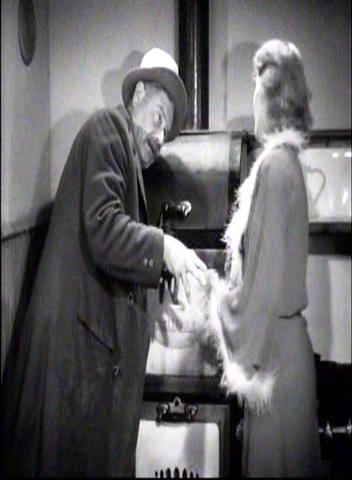
Try it today, and let me know how your Thanksgiving Dinner turns out.
Now, I’m off to wrestle with my turkey. Must fetch sports bra from the roasting pan.
Happy Thanksgiving.
Monday, November 23, 2009
Boris Karloff in the Macy's Thanksgiving Day Parade

The New York Times reported the scene in its Friday, November 24th edition the following day. The giant balloons in the sky were nothing that would be familiar to today's cartoon-watching, video-game playing children. Sailing above them, were the un-merchandised and generic Dachshund, a Gnome, a Clown, and a Fish. The St. Bernadette Cadet Corps “blared the approach” of Boris Karloff, “the ‘bad man’ of the films, who, this time, was garbed as the swashbuckling Captain Hook, in command of his pirate ship and flanked by his buccaneers.”
Then the reporter notes that the cheers for Karloff erupted into a huge “din” for Hopalong Cassidy, played by William Boyd, “in full regalia.” We’ll discuss a film that parodied the “Hoppy” phenomenon of the early 1950s at a later time. For now, we have the image of the aging icon Karloff perhaps surpassed by a newer hero. But only temporarily, for Hopalong Cassidy is remembered now only by older Baby Boomers, and Karloff has achieved immortality, curiously not only for the body of his work, but also for the single role of Frankenstein’s Monster that shot him to stardom in middle age.
That was the early ‘30s, but by the late 1940s Mr. Karloff’s career was seemingly on the wane. His last film in the previous year of 1949 was “Abbot and Costello Meet the Killer, Boris Karloff.” Despite the honor of having one’s name actually in the title of the movie, Mr. Karloff’s monster image now was poked fun at, his eerie screen persona perhaps demystified, if not actually debunked. It wasn’t that hard to do, for Mr. Karloff, as many have noted, conveyed a gentleness that brought a depth of humanity to his roles. We discussed Boris Karloff’s humanity, despite his monster image, a few weeks ago in this post. He wasn’t just Frankenstein’s Monster, he was Pagliaccio, Cyrano, and Hamlet, playing Frankenstein’s Monster. If Pagliaccio, Cyrano, and Hamlet did not speak majestic passages but, rather, grunted and stumbled around a lot.
He could also convey, superbly, heartrending innocence.
Boris Karloff’s stint on the parade route as Captain Hook was a day off from his current gig, which was to play the dual role of Mr. Darling and Captain Hook in the Broadway musical “Peter Pan”, opposite fellow Hollywood escapee Jean Arthur in the title role. “Peter Pan” opened at the Imperial Theater on April 24, 1950. In early October, the play moved over to the St. James Theater, where it remained until January 27, 1951, for a total of 321 performances.
Author Beverly Bare Buehrer in her Boris Karloff: a Bio-bibliography (Greenwood Press, Westport, CT, 1993) notes that the role was exhausting for a man of Karloff’s age (he would be 63 years old on November 23rd, Thanksgiving Day), with six costume changes, and three makeup changes. When the show closed in 1951, he then toured in the road production.
The opening night notices raved in delight at the turnabout for the old monster. The New York Journal American coyly noted, “Boris Karloff’s Captain Hook is no more scary than Boris Karloff’s Mr. Darling, who is no more scary than Tinker Bell.”
The New York Herald Tribune called Karloff “captivating.”
And the New York Times announced, “This is Mr. Karloff’s day of triumph.”
Did the kiddies waving at Captain Hook on the passing float know that? Or, were they just craning their heads, waiting for Hopalong Cassidy, who they knew from TV, a more intimate friendship because Hoppy was in their living rooms and not down at the neighborhood movie house (where he used to be the previous generation).
“He is at the top of his bent,” the Times crowed.
Did the parents of the kiddies pay special attention to the grand old thespian in the pirate costume, batting away the burst of snow flurries with his hook, and whisper to their children, “That’s him! That’s Frankenstein! That’s the Mummy!” while they disbelieved?
“Mr. Karloff is an actor of tenderness and humor, with an instinct for exact inflection,” so the New York Times lovingly paid the old monster tribute on his opening night on Broadway.
At the end of the parade route, Santa Claus, and parade marshal Jimmy Durante, and Hopalong Cassidy, and Boris Karloff extended their holiday greetings to the crowd in front of Macy’s. Perhaps that was the moment Karloff entered the pantheon of giants in the world of children, standing shoulder to shoulder with Hoppy and Santa, in front of a store with an enormous toy department.
He had entertained children before, on the screen, and privately in hospital wards, and on the Broadway stage. The recordings would follow, and his famous turn as the “Grinch”, which is still shown on television where Hoppy once ruled the roost but now no more. Boris’ magnificent “exact inflection” is heard every December by children sitting in front of…the television.
Perhaps in a way, that Thanksgiving Parade, rather than his opening night, was his “day of triumph”.
Happy Birthday, Mr. Grinch, and the same to Captain Hook.
Thursday, November 19, 2009
Pride of the Bowery - 1940
In “Pride of the Bowery” (1940), Leo Gorcey and the so-called East Side Kids ( aka Dead End Kids, aka Bowery Boys) in their fourth film leave the urban jungle for a different sort of rough-and-ready experience in a CCC camp.
When we discussed in this post about the seeming lack of coverage in films of the day about the Civilian Conservation Corps, blog reader Tony saved the day with an update that proves the CCC was not entirely ignored by Hollywood. Here is the link Tony provided to “Pride of the Bowery” now in public domain and free for viewing at the Internet Archive website.
This B-movie, only about an hour long, takes the boys out of the city into the rugged wilderness and the rough-hewn CCC camp as more of an escapade than a struggle to find employment. Gorcey plays Muggs, a Golden Gloves boxing hopeful, who gets unwittingly enrolled in the CCC by his pals to provide him with his much desired outdoor boxing training camp, like the pros have.
It’s a difficult adjustment for the bombastic showoff when he must submit to military-style discipline and hard work. We get pick and shovel scenes, and crystal mountain lakes, the regimentation of the mess hall and saluting the flag at sundown.
Surprisingly, but probably fortunately, the film avoids too much cheerleading about the virtues of the CCC and manages to fill the time with subplots of stolen money, revenge in the camp boxing ring against a rival, played by Kenneth Howell, and a day of freedom with a pass into town. At one point Leo Gorcey pushes Howell out of harm’s way when the boy is about to be crushed by a falling tree. The camp’s Captain approvingly remarks,
“I think this camp is going to be the means of you finding yourself.” Which is only about as much CCC propaganda as the film contains, but its enough, along with the occasional reminders that their folks are getting $22 a month, to remind the audience in this seventh year of the CCC’s existence that it was still kicking and still saving boys and their families from starvation.
One boy is pleased to be accepted into the cooks training program, and others are told they will be qualified for jobs in the U.S. Forestry Service when their hitch is up. At the time this film was made, the CCC did not need to be described or explained to the general audience. It would only exist about another year or so, when our entry into World War II provided young men with far more urgent duties.
The camp is given a fictional name, but though we only see sections of the camp, I have to wonder if this was just a set or if it was really filmed at an actual CCC camp? There is an authentic look about it. I haven’t been able to find any information on that yet, and I hope some of you who might know will help clarify that.
When we discussed in this post about the seeming lack of coverage in films of the day about the Civilian Conservation Corps, blog reader Tony saved the day with an update that proves the CCC was not entirely ignored by Hollywood. Here is the link Tony provided to “Pride of the Bowery” now in public domain and free for viewing at the Internet Archive website.
This B-movie, only about an hour long, takes the boys out of the city into the rugged wilderness and the rough-hewn CCC camp as more of an escapade than a struggle to find employment. Gorcey plays Muggs, a Golden Gloves boxing hopeful, who gets unwittingly enrolled in the CCC by his pals to provide him with his much desired outdoor boxing training camp, like the pros have.
It’s a difficult adjustment for the bombastic showoff when he must submit to military-style discipline and hard work. We get pick and shovel scenes, and crystal mountain lakes, the regimentation of the mess hall and saluting the flag at sundown.
Surprisingly, but probably fortunately, the film avoids too much cheerleading about the virtues of the CCC and manages to fill the time with subplots of stolen money, revenge in the camp boxing ring against a rival, played by Kenneth Howell, and a day of freedom with a pass into town. At one point Leo Gorcey pushes Howell out of harm’s way when the boy is about to be crushed by a falling tree. The camp’s Captain approvingly remarks,
“I think this camp is going to be the means of you finding yourself.” Which is only about as much CCC propaganda as the film contains, but its enough, along with the occasional reminders that their folks are getting $22 a month, to remind the audience in this seventh year of the CCC’s existence that it was still kicking and still saving boys and their families from starvation.
One boy is pleased to be accepted into the cooks training program, and others are told they will be qualified for jobs in the U.S. Forestry Service when their hitch is up. At the time this film was made, the CCC did not need to be described or explained to the general audience. It would only exist about another year or so, when our entry into World War II provided young men with far more urgent duties.
The camp is given a fictional name, but though we only see sections of the camp, I have to wonder if this was just a set or if it was really filmed at an actual CCC camp? There is an authentic look about it. I haven’t been able to find any information on that yet, and I hope some of you who might know will help clarify that.
Monday, November 16, 2009
Meanwhile, Back At The Blog...
Many of us read many different blogs, and with a crowded blogosphere, it’s easy to miss interesting posts. Here are a few of late that I’ve really liked. I hope you do, too.
David Fiore joins the analysis of “Vertigo” with a terrific essay.
Over at Carole & Company, our intrepid chronicler of all things Carole Lombard leads off with a great discussion of anachronisms in films, and caps with a jaw-dropping clip of Carole Lombard and George Raft doing a tango to Ravel’s Bolero.
Jonas Nordin over at “All Talking! All Singing!” provides his usual impressive research on the early days of sound film with the post “Colleen Bobs Her Hair” about Colleen Moore, which seems as equally touching as it is fascinating. Here again another great clip, of Moore’s terrific comedic talent.
Over at Caftan Woman, a bit of haiku dedicated to Charlie Chan that is just so simple and right it just cracks me up.
Finally, a reminder that next week over at Frankensteinia, the Boris Karloff Blogathon kicks off. Lots and lots of blogs have signed up for this extravaganza. If you’re a Karloff fan or just enjoy spending time with the undead, I hope you can visit some of them.
David Fiore joins the analysis of “Vertigo” with a terrific essay.
Over at Carole & Company, our intrepid chronicler of all things Carole Lombard leads off with a great discussion of anachronisms in films, and caps with a jaw-dropping clip of Carole Lombard and George Raft doing a tango to Ravel’s Bolero.
Jonas Nordin over at “All Talking! All Singing!” provides his usual impressive research on the early days of sound film with the post “Colleen Bobs Her Hair” about Colleen Moore, which seems as equally touching as it is fascinating. Here again another great clip, of Moore’s terrific comedic talent.
Over at Caftan Woman, a bit of haiku dedicated to Charlie Chan that is just so simple and right it just cracks me up.
Finally, a reminder that next week over at Frankensteinia, the Boris Karloff Blogathon kicks off. Lots and lots of blogs have signed up for this extravaganza. If you’re a Karloff fan or just enjoy spending time with the undead, I hope you can visit some of them.
Subscribe to:
Posts (Atom)