IMPRISON TRAITOR, PEDOPHILE, AND CONVICTED FELON TRUMP.

Thursday, March 21, 2013

The French Line - 1954


The French Line (1954) pairs Jane Russell and Gilbert Roland on a transatlantic voyage.  He’s a playboy Frenchman, she’s a wealthy Texan incognito trying to find somebody who’ll love her for herself and not her money.

There were other, more tawdry taglines to this Howard Hughes-produced film, originally shown in theaters in 3-D to more fully capture Jane’s most publicized attributes.  To her credit, her likeably good-old-gal charm rises above the costumes and dance routines designed to keep her bra size the main focus.

I had been meaning to cover this one sometime or other, but was spurred to move it up in the queue from the recent mention in the excellent TCM interview of Kim Novak, noting that this was her film debut.  She’s a chorus girl, and if you blink, you miss her.  She's on the left in this shot.

Other bit roles by actors who never quite reached Miss Novak’s fame include Charles Smith, who shows up as a reporter.  We’ve met him before in Dive Bomber here, and The Shop Around the Corner here.  

Kasey Rogers, who you’ll remember best as Louise Tate on TV’s Bewitched shows up as Jane Russell’s newly-married pal, whose marital bliss leaves Jane envious. 

Our old pal Arthur Hunnicutt, who we saw here at a prospector galoot in Split Second, shows up as an oil wildcatting galoot, and Jane’s guardian.  He’s a loveable old cuss, but a bit too loud.  HE SHOUTS EVERY LINE.

Craig Stevens has a minor role as Jane’s swell guy fiancé who breaks off the wedding because he’s too intimated by her money.  A pal reminds Jane, “You’ve been a corporation since you were three.”

This is Jane’s tale of woe.  Men are either attracted by her money, or overwhelmed by it.

Miss Russell sheds her Texas blue jeans and boots, and heads to New York to meet her buddy, fashion designer Mary McCarty, and heads with her to Paris.  McCarty’s on business to take her new line to a fashion show, and Jane pretends to be one of her models.

It’s a pleasure to see Mary McCarty in a comic relief role.  She pulls out a bottle of booze from her desk drawer and offers it to Jane, “Tea, darling?”  She’s probably more well known to theatre buffs, including a featured role in Follies in 1971, and a Tony nomination for Anna Christie in 1977.

Bess Flowers plays one of the sales ladies in her shop.  Go Bess!

The film is famous for getting into trouble with the Breen Office and with the Catholic National Legion of Decency.  It’s been cut and censored here and there, and the version you might see on TCM is considered the edited version.  One uncensored excerpt of Jane’s “Lookin’ forTrouble” number is here on YouTube.

The songs are mostly cute.  Jane bebops in a duet with her maid, Theresa Harris, with several peek-a-boo moments as she’s bathing.  Unfortunately, there’s no duet with Gilbert Roland, and there should be.

He’s my favorite part of the movie.  We’d noted his virile charm here in We Were Strangers.  Mr. Roland’s charming manner and smooth, rich baritone are really quite beautiful in “Wait Till You See Paris”, which he croons to Jane on shipboard—one of those movie moonlit nights, with couples gazing at the water over the ship’s rail.

“With a Kiss” is a kick-your-heels-up number he performs in a hotel room full of female fans, but my favorite is “Comment Allez Vous,” which is a sweet, waltz-time melody he croons with lullaby softness to a couple of kids fighting over a toy music box.  It’s really a lovely song, and he could have used it just as capably to seduce Jane as to quiet a couple of noisy kids.

The ship they’re sailing on is the Liberté, (French Line, of course), which had a busy year in 1954, as I think that was the same ship Audrey Hepburn took to France in Sabrina, which we covered here.

As long as we’re on the subject of Audrey Hepburn, their trip to Paris to attend a fashion show reminds one of Miss Hepburn’s voyage to Paris for the same purpose in Funny Face (1957). 
Also, there’s a shot in The French Line at the fashion show where a couple of guys toss rolls of fabric right at the camera, just like Kay Thompson did so famously in Funny Face.  I think Kay did it better.  She had a good arm, and lots of pizzazz.

There’s a subplot involving mistaken identities, and a bit where Mr. Roland attempts to cure Jane’s “mal de mer” with a mixture of stout and champagne, which he says will also cure asthma and chicken pox.

A frothy film, that could have been better with closer attention to the romance between the easy-going playboy and the reluctant heiress, but still worth it if only to swoon over Gilbert Roland.


A photo of a sticker I noticed once on an old suitcase....


*********

Jacqueline T. Lynch is the author of Ann Blyth: Actress. Singer. Star. and Memories in Our Time - Hollywood Mirrors and Mimics the Twentieth Century. Her newspaper column on classic films, Silver Screen, Golden Memories is syndicated nationally.

Thursday, March 14, 2013

Willie the Kid - 1952


“Willie the Kid” (1952) is a masterpiece, and one of my favorite cartoons.  It’s a kind of brilliant animated haiku, a snapshot of childhood and suburbia and the 1950s, so well-caught in the UPA studio style of limited animation.

It tells the story of some little kids who playact a typical Western scenario they might have seen on any number of B-movie or TV oaters.  The wonderful thing is that this Western story is superimposed on a suburban neighborhood.  We meet Willie, the cowboy hero, as he sits down to breakfast.  His father reads the newspaper, his mother nags his father to cut the lawn, and the neighbor boy Roger stops by.  I love how the mother knows it’s Roger before she opens the door.  Roger must come over every day at this time. 

When Willie and Roger leave the house to play outside, outside become the wild West.  Dogs are their horses.  Roger becomes the affable but less intelligent sidekick.

We have our villain, and we have our ingénue who must be saved from him, but Lillybelle has more moxie than a lot of B-move gals.  She insists on continuing her murdered father’s stagecoach line (a child’s toy wagon pulled by a dog), shouting with gusto, “Someday my stage line will be looked upon as an important contribution to the West!”

Later when the villain accosts her, she beats him repeatedly with her parasol, theatrically wailing, “Oh, if I were only a man!” 

The houses and backyard fences morph into rocks and buttes, but occasionally, reality breaks in on even the most intense imagination, and we see Willie’s dad talking over the fence with a neighbor.  In a minute, Dad becomes a cactus when the kids’ power of concentration returns.

At one point, Willie is having trouble reading the map to the bad guys’ secret hiding place, and he hollers for Mama, who pokes her head out of the side of the canyon.  It’s really the kitchen window.

The kids and the grownups tolerate each other, but their worlds rarely collide.  For the most part they ignore each other, and I wonder if that, in 1952, isn’t the most prescient observation on the future relationship between the Baby Boomers and their folks in a couple of decades to come.

The voices are done by Marvin Miller, Marian Richman, and Martha Wentworth, all old hands at radio and B-movies.  Robert Cannon directed.  One of the animators was Bill Melendez, who later went on to a successful partnership with Snoopy.

“Willie the Kid” can be seen in “The Jolly FrolicsCollection” on DVD here from TCM.  This is a fabulous collection of cartoons from the intelligent, stylistic and very arty UPA studio.  Mister Magoo, you may recall, came out of this studio, and so did Gerald McBoing Boing, who I love so much because he breaks my heart.  The original Madeline cartoon is also part of the collection.


Thursday, March 7, 2013

Film Stars on Stage - La Jolla Playhouse


I love the names across the top of this typical summer stock playbill.  We old movie buffs will recognize the names of Dorothy McGuire, Jane Wyatt, Mel Ferrer, Mildred Natwick—but here we find them in a different setting.  Not the end credits of a film, but each of them “above the title,” as it were, on a small-town summer stock program.  Appearing not in a film noir or “weeper,” but the English classic, “The Importance of Being Earnest” by Oscar Wilde.  The play is produced in the town’s high school auditorium, a couple of hours south of Los Angeles.  Time: 1949.   See here for production photos.

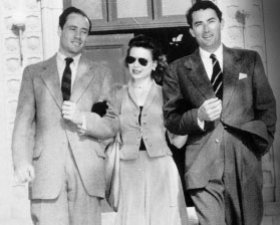
The La Jolla Playhouse was founded by Gregory Peck, Dorothy McGuire, and Mel Ferrer as an outlet to their passion for the stage, and their regret at being so imprisoned by film studio contracts that they were not allowed to perform on Broadway between films.

Starting a theatre company is always chancy, walking a financial tightrope and needing to find community support and audience as much as backers with money.  It was not always easy for the La Jolla Playhouse, founded in 1947.  The three producers juggled things for some years, aided by Miss McGuire’s husband, John Swope (whose own interest in theatre harkened back to the days of the University Players where he was pals with Henry Fonda and James Stewart—see this previous post on my blog Tragedy and Comedy in New England.)

The group disbanded in 1964, but was revived in 1983, and continues to produce quality theatre, with some famous names appearing at its new playhouse.  Have a look here for what’s doing at the La Jolla Playhouse these days.

The lure of the stage is very strong for serious actors who are passionate about the workshop atmosphere, about improving their skills, and the thrill of the flying-by-the-seat-of-your-pants experience that isn’t found in the controlled environment of film.  It was for Gregory Peck, who worked on the planning for this theatre company while he was shooting “Gentlemen’s Agreement” (1947).


Author Gary Fishgall in Gregory Peck-A Biography (NY:Scribner, 2002) pp. 125-126, notes that the cast rehearsed a play for a week, it ran for a week opening on Tuesday and closing on Sunday.  There were additional matinees on Wednesday and Saturday.  Sets were “struck” on Monday and the new set moved into the high school auditorium.  On Monday evening, the actors got their first dress rehearsal on stage for the opening the next night.  It was that hectic.  Since they were only being paid $55 per week plus hotel accommodation and two meals a day, as noted in Gregory Peck-A Charmed Life by Lynn Haney (NY: Carroll & Graf Publishers, 2003,  p. 157), we can only assume it was a very rewarding experience for these film actors who were normally paid thousands and thousands of dollars per year.

The La Jolla Playhouse put on 10 shows each summer.  The first one was “Night Must Fall” with Dame May Whitty, who re-created her film role.  (See this previous post on the movie.)  She had played the same role on the London stage and on Broadway.  Apparently this high school auditorium gig wasn’t too beneath her.  That’s an actress.


Others who performed with this fledging group, escaping their film shackles if only for a week, include Eve Arden, Una O’Connor, Robert Walker, Patricia Neal, Vincent Price, Joan Bennett, Charlton Heston, Laraine Day, Joseph Cotten, Jennifer Jones (the group also received considerable financial support from David O. Selznick).  Leon Ames trod the boards of La Jolla High School, June Lockhart, Wendell Corey, Craig Stevens, Teresa Wright, Raymond Massey, Mary Wickes, Marsha Hunt, Beulah Bondi, Pat O’Brien, Richard Egan, Fay Wray, Groucho Marx,  Allen Jenkins, David Niven, Jan Sterling, Olivia de Havilland, Kent Smith, and of course, the three founders: Mel Ferrer, Gregory Peck, and Dorothy McGuire.  There are lots more, and you can read the casts and productions here at the La Jolla Playhouse production history page.
 
 
According to the Mel Ferrer website, which also has some interesting facts and photos on the La Jolla Playhouse, co-starring for “The Voice of the Turtle” was a New York stage actress named Vivian Vance.  In the audience that evening was lady named Lucille Ball (stars not only appeared on stage at La Jolla, they made a grand audience as well), and she was so impressed with Miss Vance’s work, she invited her to become her sidekick on a new TV show she was about to produce with her husband, Desi Arnaz.  The show was “I Love Lucy,” and Ethel Mertz was born.

The neat thing about these old theatre programs is the actor bios.  Ellen Corby notes she spent 12 years in Hollywood as a script girl before making her first film.  Teresa Wright notes she got her first big break on Broadway as Dorothy McGuire’s understudy in “Our Town.”  La Jolla produced the show with Ann Blyth, Millard Mitchell and Beulah Bondi.


The bios frequently discuss the actor’s stage history first; later on at the end of the paragraph they’ll note, ah, yes, they made some films as well.  As if the latter was only to pass the time between stage engagements.

Stage work allowed them to stretch different acting muscles.  It allowed them to play against type: film heroes got to be stage villains, and minor film character actors got to be stars. 
 
 
Look on this playbill.  Florence Bates, perennial movie busybody, is right up at the top, a star in “Arsenic and Old Lace.”  Her cast bio in the program relates her interesting journey as the first female lawyer in the state of Texas, to antique shop owner, to investor in Mexican oil wells, to helping her husband run a bakery.  (More on Florence Bates in this previous post.) On a whim once, when she was already well on in life, she auditioned for a part at the famed Pasadena Playhouse (where so many young film stars were discovered), and got the part, though she had no experience.  Alfred Hitchcock discovered her shortly thereafter, and by time of this appearance on stage in La Jolla in 1950 she had appeared in some 60 films. 

But she wanted to be on stage again.  The communal experience shared by actors and technical staff and audience is unique to the theatre because it is live and simultaneous, and in the moment.  Once it’s gone, it’s gone, if forever remembered.
 
 
Even by someone stumbling across 60-year-old playbills from a small-town summer stock theater—who can only imagine.
 
***
 
As of a couple days ago, Another Old Movie Blog has reached its 6th anniversary.  Thank you all for the pleasure of your company.
 

***
 
Coming up: I'll be speaking at the Westfield Athenaeum, Westfield, Massachusetts on Tuesday, March 12th in celebration of Women's History Month. I'll be drawing from essays in my recently published States of Mind: New England. This, and some of my novels, will be available for sale at this event.


Thursday, February 28, 2013

Hollywood Commandos - 1997


“Hollywood Commandos” (1997) is a made-for-television documentary that classic film buffs, as well as students of World War II history, should see.  It tells the story of one Army Air Corps unit that profoundly altered the training of troops, how the war was to be fought, and documented the entire military experience of World War II from recruitment, to technology, to combat action, to the grisly discovery of Hitler’s concentration camps and the apocalyptic scenes after Hiroshima and Nagasaki.  Its home base of operations—Hollywood.
 
This Army Air Corp unit was called the First Motion Picture Unit, or FMPU.  Though the motion picture industry made many contributions to the war effort—in battle and home front pictures to boost morale, in welcoming servicemen at the Hollywood Canteen, and in the promotion of bond selling—FMPU was the motion picture industry’s greatest and most valuable participation.  We know that many film actors put their careers on hold to join the military during those years, but the FMPU was as if the industry itself put on a uniform.
We discussed “Resisting Enemy Interrogation” (1944) here last week as part of the Fabulous Films of the 1940s blogathon.  That film was produced by FMPU. 
FMPU had its start when the Warner Bros. studio, a step ahead of the other studios to openly denounce the fascist powers of Europe and acknowledge the coming storm, produced a series of shorts about the different armed services.  Army Air Corps General “Hap” Arnold contacted studio head Jack Warner and asked for a recruitment film.  As we mentioned in last week’s post, when the US entered the war we were far behind our enemies in combat strength and had a lot of catching up to do.
 
Jack Warner was made a Lieutenant Colonel (the unit would later be commanded by famed movie stunt pilot Col. Paul Mantz), and he, along with writer/producer (later Colonel) Owen Crump, launched production on “Winning Your Wings”.  James Stewart, who was already in the Army Air Corps as a pilot, was pulled off duty to star and narrate this film.  It was made in 18 days and rushed out to theaters and college campuses. 
It is reported that over 150,000 enlistees into the Army Air Corps can be traced directly to seeing this movie.
So the race began to catch up to the enemy, both in recruitment and in training, and FMPU was established in June 1942.  The unit soon moved to the old Hal Roach studio.  Where Laurel and Hardy bungled their way through odd jobs, and the Our Gang kids messily marched through childhood, the new 18th Air Force Base Unit churned out training films, recruitment and morale films, and trained combat photographers. 
 
Many Hollywood technicians were called into this unit: writers, directors, cameramen, carpenters, makeup men.  Most of the actors were starting their careers and were for the most part, unknown.  This was useful in depicting the trainees as average guys with whom their Army Air Corps audience could identify.  Stars tended to take away attention from the lesson.  Captain Ronald Reagan was the personnel officer for this unit, and appeared in a few films, including “Recognition of the Japanese Zero Fighter”.  In this, he plays a trainee who mistakenly fires at an American plane piloted by Craig Stevens, who is understandably grumpy about it.  This film was made because several friendly fire incidents needed to be addressed early in the war.
For the most part, Captain Reagan’s participation in these films was as a narrator.  Craig Stevens also appears as a pilot trainee in “How to Fly the B-26 Airplane” (1944).  Don Porter is his instructor.  It’s not as good a story as “Resisting Enemy Interrogation”, but if you can stick out watching it, you will most certainly know how to fly a B-26 airplane.
“Hollywood Commandos” is a terrific documentary that gives a glimpse into the making of these films.  Loaded with archival footage, there are also several interviews, with Owen Crump, with writers, directors, technicians, actors including Ronald Reagan, DeForest Kelly (whom we may most remember as Dr. "Bones" McCoy on the "Star Trek" TV series), and also Craig Stevens in what must have been his last appearance on film before his death a few years after this documentary was made.  Many anecdotes are told, some quite funny. 


Stevens comically relates his dread of appearing in “Three Cadets” which dramatized the dangers of venereal disease and the protocol for treatment.  Lt. (later Capt.) William Orr, the father of the writer/director/producer of this documentary, had a famous role “Three Cadets”, and he tells a funny story about it. 


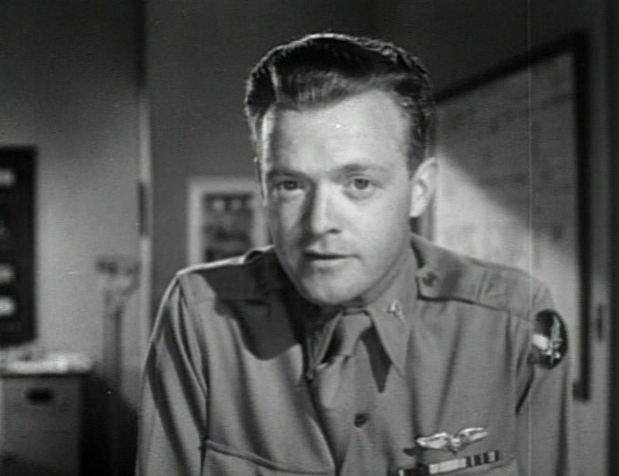
Other actors in this unit who later became more well-known include Arthur Kennedy, Van Heflin, George Reeves, and George Montgomery. 


Some of the actors in this unit who were already started or well along in their careers include Alan Ladd, William Holden, Ronald Reagan, of course, and Clark Gable was attached to the unit briefly and flew on combat missions to film documentary footage.
“Hollywood Commandos” has a fascinating segment on a top-secret project to create a huge scale model of Japan, all detail done by hand, and film a virtual “fly over” to educate flight crews who would be sent on missions over Japan.
There are dramatic segments on the “Learn and Live” and “Ditch and Live” films that instruct flights crews on how to survive a crash.  These lessons were the forerunners of the US military’s later survival schools.
 
Some of the training was done through animation, and much voiceover work was volunteered by the great Mel Blanc.
“Hollywood Commandos” points out in a chilling sequence that, as it was said at the time, the first shots of the war came not from a cannon or gun, but from a camera—and we see German director Leni Riefenstahl’s jaw-dropping Hitler spectacle of the Nuremberg rallies, “Triumph of the Will” (1935).  Film was now a weapon of war, and who mastered the art of filmmaking in terms of gathering and disseminating information would win the war.
FMPU, and other film units of the various branches of the military, played a huge role in our victory. 

It is poignant that Gregory Orr, the son of a member of this unit, created this documentary as a tribute to this mostly forgotten aspect of Hollywood history.  Likewise, it is poignant that Ron Reagan, the son of another member, Ronald Reagan, narrates.

I was able to see this film by special arrangement with Mr. Orr, but the rights to this documentary are owned by AMC, and unfortunately, they have not released it either on VHS or DVD.  It should be available to younger generations to see and learn about the immense value the film industry had to the generation that fought World War II.
Maybe you can help.  I would ask readers of this blog to contact the AMC network here: amccustomerservice@amcnetworks.com and request that they either broadcast “Hollywood Commandos” again, or make it available for sale as a DVD.
 
I leave you with one more film, and I urge you to watch it.  It’s not long, only about nine minutes, but here Ronald Reagan narrates “Wings for This Man” (1945).  It is about the Tuskegee Airmen, first unit of African-American pilots and flight crews in the Army Air Corps.  We may sometimes dismiss wartime films under the umbrella label of “propaganda”, but that label does a disservice to this film and any film that enlightens us on what we are, and more importantly, what we should be.
For more information on the First Motion Picture Unit, have a look here, and here.

Thursday, February 21, 2013

Resisting Enemy Interrogation - 1944


“Resisting Enemy Interrogation” (1944) is an intriguing film partly because of what it accomplishes, and partly because of what it represents.  It was a training film made by the Army Air Corps, but tells a story so skillfully that it was nominated for an Academy Award for best feature-length documentary.  Some well-known Hollywood stars appear in it, and some unknowns who later became stars.
This post is part of the Fabulous Films of the 1940s Blogathon hosted by the Classic Movie Blog Association.  Please visit the other blogs listed here at the CMBA website for more great films of the Forties.
“Resisting Enemy Interrogation” is a short film, only just over an hour, that shows a bomber crew being captured by the Germans.  The film begins with the narrator, Lloyd Nolan, who will also appear later on in the film as a US debriefing officer.  Nolan drones the comfortable opening words, “Tired of it all, gentlemen?” 
The camera pans on a pleasant pastoral scene, but an undercurrent of tension soon begins to filter through and we are brought to an interrogation camp in this idyllic countryside where the men of this crew, and us by proxy, will be put through a very serious test.  How much will they reveal to the enemy? 
 
The film was made by the US Army Air Corps First Motion Picture Unit (or FMPU).  We’ll discuss more about this unique unit of World War II American forces next week.  Hundreds of films were made by this unit, some were for raising morale, some were meant for recruitment, but most were like “Resisting Enemy Interrogation”, training films.
One of the marvels of US participation in World War II was our country’s speedy production of war materials (we had a lot of ground to make up when our enemies had spent a generation preparing for war), and also our speedy preparation of fighting troops.  We took hundreds of thousands of civilians with no military experience and en mass turned them into warriors.  Urgency and survival compelled us to act quickly.  One of the best tools for doing this turned out to be film.
The young people who became our fighting forces were the first generation to have grown up watching movies.  What better device to teach them?  This was a new tactic for teaching, not only for the military, and would lead to the use of multi-media in education ever afterward.
“Resisting Enemy Interrogation” was not just a series of do’s and don’ts.  It had a story, and what may be surprising to the audience is that the Germans here are not presented as bombastic, evil, stupid stereotypes.  They are the tricky enemy, to be sure, with no good intent.  But we look over their shoulders watching their efforts to deceive the Americans; we spend as much time observing their viewpoint as their captives'.  Their calm sleuthing is set against the Americans’ anxiety.  It makes for a fascinating story. 
 
As the American crew is led to their captivity, they are warned by co-pilot Don Porter, “We will not talk.”  He reminds them they are to provide to the enemy only their name, rank, and serial number.  As the movie unfolds, we see the many devious ways the Germans have of extracting more information from them—using trickery, kindness, intimidation, and even using simple small talk as a way of furthering how much information they acquire.
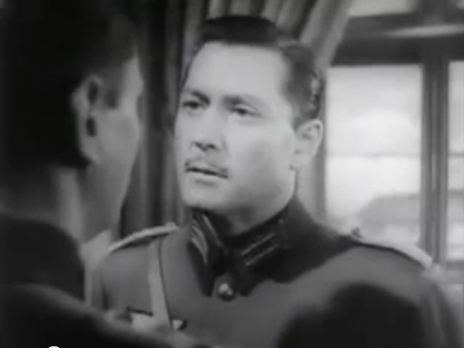
The German head of command, played by Carl Esmond, whom you may have seen in dozens of films and TV, is a clever, mannered chap who is teaching a new officer (and us) about interrogation.  He remarks, “Just as there is no such thing as an innocent question, there is no such thing as a valueless statement.”
Anything the American men say can be useful to the enemy.  One by one, through the course of this film, we see how they are tricked.  If we found ourselves in the same situation we might be fooled in the very same way.  It all seems so innocent.
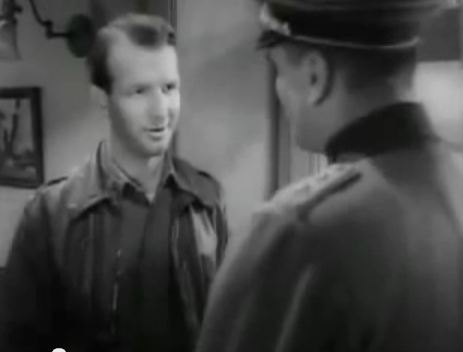
Like many of FMPU’s films, this had a cast largely of unknowns, some of whom would later become more familiar to us.  Don Porter plays an officer in the downed bomber crew, easy going, and genuinely surprised to be given a nice room and treated royally by his captors.  Later in the film when Commandant Esmond primes the pump by dropping hints that he already knows all about the bomber’s mission, Porter shrugs, figures, oh, well, if it’s common knowledge—and spills facts.
Kent Smith plays a German officer who was raised in the US, and so with his knowledge and his comfortable camaraderie with the American boys, tricks them into trusting him.
Hans Twardowski has minor role as a German Red Cross representative, also out to trick the men into filling out Red Cross forms that ask too much information.  You may remember him from “Casablanca” as a Nazi soldier.
James Seay plays the bomber crew Captain, most stalwart of the group, yet even he slips up and gives information he has no idea he’s giving.
Arthur Kennedy is a standout in the film as a cocky crewmember who thinks he’s going to outwit the Germans by giving them false info, but they are onto him and twist his words so that they find out the truth.  Kennedy gives a raw performance as man who is clearly rattled by these mind games.
It’s interesting to watch the Germans cleverly sort out the mystery of where the downed bomber came from, and where it was going.  By putting together small bits of information the men have unwittingly given them in unguarded moments, the Germans discover where the next raid of American bombers is likely to come from and where their next target is to be. 
When that next bomber mission occurs, the Nazis are waiting for them.  They shoot down most of the squadron of planes.  The footage, simulated obviously, of the American planes being shot down is not what that first generation of boys who grew up on movies would have ever expected to see.  It is brutal, with planes on fire, with machinegun fire ripping through crews, and images of blood spurting from the heads and faces of pilots and gunners.  The lesson about not talking is driven home graphically.
Only a few crews from this mission limp home.  They are debriefed by Lloyd Nolan, and bewildered over how the mission could have failed so badly. 
Rand Brooks has a small part as an American  back at the base, who grimly makes the accusation, “Somebody talked!”
George O’Hanlon, whom you might remember from a bunch of “Joe McDoakes” shorts also appears back at the base.  Mel Torme has a bit part as a pilot, though I confess I didn’t spot him.
Craig Stevens plays a returning pilot back at the base as well, interrogated by Lloyd Nolan after the disastrous mission.  Nolan, in that wonderfully edgy, serious tone that makes you pay attention to him no matter how quietly he is speaking, calms the men and tells them that the only information they are ever to give is their name, rank, and serial number.  Above all, don’t talk.
 
Then he looks right into the camera, right at us.  “Don’t talk.  Don’t talk.  Don’t talk.”
We may never talk again.
The FMPU was comprised of men from all the different Hollywood studios.  Some of them were not actually in the Army Air Corps, like Nolan, and like occasional guest actor Guy Kibbee.  The others who were, ranged from actors, writers, directors, cameramen, many of whom served their entire hitch here in Hollywood, and others who went on combat missions photographing the war, or to serve in other units.  More on that next week.
I’m not certain at this time the military rank of the men who performed in this film or many other FMPU training films.  I do believe Arthur Kennedy was a sergeant.  I believe Craig Stevens was a corporal.  Sgt. David Rose, incidentally, composed the music score for this film.
The AMC channel broadcast a documentary in 1997 made by Gregory Orr Productions called
“Hollywood Commandos”, about the First Motion Picture Unit, and we’ll be discussing that next Thursday.
“Resisting Enemy Interrogation”, now in the public domain, can be watched here on YouTube.

Related Products