IMPRISON TRAITOR, PEDOPHILE, AND CONVICTED FELON TRUMP.

Thursday, July 6, 2023

Mary Badham - from Scout to Mrs. Dubose


Mary Badham, famous for playing “Scout” in To Kill a Mockingbird (1962), is currently on tour with the stage version and has grown into playing the role of Mrs. Dubose.

The play recently came to my neck of the woods at the Bushnell in Hartford, Connecticut, but unfortunately, I was not able to attend.  If you google the tour dates you might find it coming to “a theater near you.”

Richard Thomas, who famously played John-Boy Walton and, like Miss Badham, knows something about a fictional role in youth following an actor forever, plays Atticus Finch.  In a recent interview of Mary Badham by Cori Urban for The (Springfield, Massachusetts) Sunday Republican, Badham praises Mr. Thomas in the role and as a cheerful castmate with “a great sense of humor.”

She is new to theater, and really hadn’t done much film work since her role as Jean Louise “Scout” Finch in the 1962 movie.  For that role, at the age of ten, she earned a Best Supporting Actress nomination.  She lost to Patty Duke, who at the ripe old age of 16, won for playing Helen Keller in The Miracle Worker.  The year 1962 was a great year for movies.  Consider the other nominees for just the category of Best Supporting Actress:  Shirley Knight for Sweet Bird of Youth, Angela Lansbury for The Manchurian Candidate, and Thelma Ritter for Birdman of Alcatraz.  You couldn’t go wrong with any of them.

I’ve never covered To Kill a Mockingbird in an essay on this blog yet, but I hope to remedy that someday.  For now, let’s consider the interesting prospect of the evolution of a young actress playing a spirited, inquisitive tomboy whose widowed lawyer father takes on the town bullies to defend an innocent man to playing, in her senior years, an elderly woman who is one of those bullies.

Mrs. Dubose would be called a minor character, but only in the sense she has less time on screen/stage and less lines.  Her being there is an important element to the story.  She is rude, bigoted, says nasty things at passersby from the exalted realm of her front porch. (Scout calls her “the meanest old woman who ever lived.”)  But she is granted leeway, if not respect, because of her age, and because she is ill.  The novel, as novels will, gives us a little more.

When she turns her venom on Atticus for defending a Black man, Scout’s brother Jem is so enraged, he destroys her garden.  But Atticus, wanting to teach his children to turn the other cheek, makes Jem read to the old lady as punishment and to make amends.

We find out that the old lady suffers greatly and is taking morphine for her pain but is weaning herself off the morphine in a streak of righteous independence, but it costs her, making her suffer more.  She and Atticus are not unlike in this respect: his taking a stance for decency is costing him and his family. 

We see the world of this small Southern town and its pleasures and pain, its guilt and its decency through the eyes of young Scout.  Mary Badham’s performance in the movie was indelible, natural, and heartfelt, like a kid who was just feeling, skipping along, forgetting stuff, remembering stuff, and not acting at all.  She and Gregory Peck, who played her father, Atticus, in the movie remained lifelong friends and she always called him Atticus when she saw him, and he always called her Scout.

Her connection with the film is like belonging to an honored society.  She attended a screening of To Kill a Mockingbird to celebrate the 50th anniversary of the film in 2012 as a guest of President Barak Obama at the White House.

(Photo from National Tour by Julieta Cervantes)


How must it feel to her to relinquish the identify of Scout for Mrs. Dubose?  It must be fascinating to play the role of a character so unlike herself.  A stretch like that calls for real acting.  Regarding bigotry, in her article Ms. Urban quoted Mary Badham, “It’s really sad that there are some people who still feel that way.  I think in this day and time we need to lift each other up, take care of each other, love each other and not put each other down.  That divisiveness is so wrong.”

Doesn’t sound like “the meanest old woman who ever lived.”  Atticus, and eventually Jem and Scout, came to acknowledge Mrs. Dubose’s courage in facing the monster of addiction and the enemy of ill health. 

If you are able to see this national tour of To Kill a Mockingbird in your neck of the woods over the remainder of 2023 and 2024, let me know your impressions.  I’d love to hear them.


Here’s a link to a montage of the current the touring play’s scenes - https://youtu.be/Xjn31EdXt0I


Sources:

Cori Urban, "'To Kill a Mockingbird' takes stage at Bushnell" The Springfield Sunday Republican, June 25, 2023 p. D7. 

Photo of Mary Badham as Mrs. Dubose by Julieta Cervantes, National Tour - To Kill a Mockingbird

  ************

Jacqueline T. Lynch is the author of Ann Blyth: Actress. Singer. Star. and Movies in Our Time - Hollywood Mirrors and Mimics the Twentieth Century and Hollywood Fights Fascism.  Her latest book is Christmas in Classic Films. TO JOIN HER READERS' GROUP - follow this link for a free book as a thank-you for joining.

Sunday, June 11, 2023

Gilbert Roland


Here is a young Gilbert Roland, another portrait from Stars of the Photoplay (1930).  His bio blurb here puts him at 25 years old in 1930, and we can see that he started out his career already a very handsome fellow.  But I think, as we saw covering some of his much later films like We Were Strangers (1949) here, and The French Line (1954) discussed here, and Our Lady of Fatima (1952) here, that Gilbert Roland only got more stunningly handsome with age.  

I particularly like to hear him sing.

Thursday, May 18, 2023

Greer Garson on Father Knows Best - 1957


Greer Garson chews the scenery—all in fun, on a visit to the Anderson family in an episode of Father Knows Best.  Originally broadcast November 13, 1957, it's "Kathy's Big Chance."


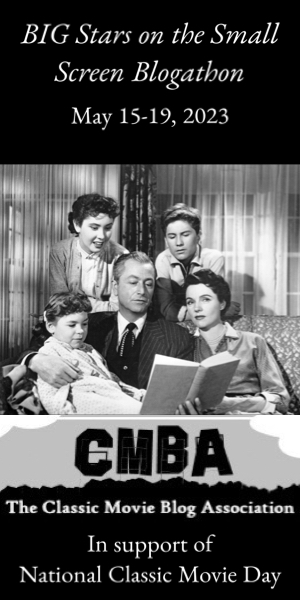
This is our entry for the Classic Movie Blog Association’s blogathon -- Big Stars on the Small Screen: In Support of National Classic Movie Day.  Have a look here for more great bloggers on the subject of classic film stars and television.

Though Miss Garson plays herself, touring in their Midwest town of Springfield to promote her latest film called “Rebel Lady,” the movie is fictional.  She never made such a film, but perhaps that gives her the freedom to act out such a comic and outlandish synopsis of the movie for the benefit of the Anderson’s youngest daughter.  A real movie she might be actually trying to promote would require more dignity.  Certainly, the studio heads would require it.  Greer throws dignity out the second-floor window of Kathy’s bedroom.


Kathy, or “Kitten” as her father calls her, played by Lauren Chapin, is the youngest of the three Anderson kids.  Billy Gray plays “Bud” the middle child, usually popping in and out of scenes with the funniest lines and the best comic timing.  


Elinor Donahue is the lovely eldest, Betty or “Princess” as Dad calls her.  Dad prefers nicknames (to the point where we may have forgotten that “Bud” is actually named for him—James Anderson, Jr.)  Miss Donahue, despite the trope of Big Sister Scorn she was forced to play in so many episodes, is probably one of the best “child” actresses in the enormous landscape of television families through the decades, who handled both dramatic and comedy scenes very well.


Mother is played by Jane Wyatt, who won three consecutive Emmy awards for her role as Margaret Anderson.  With her Eastern finishing school voice and manners, we may overlook that she is one of the most genuine of TV moms of the era in her relationship with husband and kids.  She gets mad and says so.  She is not always so understanding.  She even wears jeans and a sweatshirt once in a while.  She introduces herself to Greer Garson as “I’m the mother” but she’s a lot more than that on this show, if not this particular episode.

In an almost forerunner of what she would play on TV, Jane Wyatt starred as the mother of Ann Blyth in Our Very Own (1950) which we previously discussed here.


Robert Young plays Father, who actually began this role on radio in 1949, but the radio version of Jim Anderson was much more sarcastic and even mean, as radio tended to play in broader strokes for comedy.  When it moved to television, Mr. Young, who had a hand in production, wanted a warmer dad and a more loving family.  The show ran from 1954 to 1960, and became one of the iconic TV shows of an idealized suburban America in the 1950s.

Robert Young appeared with Greer Garson in That Forsyte Woman (1949), which we discussed in this previous post.  In that film, he is a prospective lover who ardently pursues Greer, but in this TV episode he only chases her for her autograph.  Young’s last film was made in 1954, and Greer Garson had also not made a film since 1954, though she had a few more in her, beginning with her turn as Eleanor Roosevelt in Sunrise at Campobello in 1960.  Until then, these two stars, like so many classic film stars and character actors, turned to the new medium of television for work.  They are middle-aged, but Young is the settled family man with the graying hair, and Greer is still glamorous, so much so that she mesmerizes the household, and is Kathy’s favorite actress.


Kathy must write an essay on the Civil War for school and has chosen to write on a new Civil War film starring Greer Garson called “Rebel Lady.”  She submits her essay to a contest, the prize for the several winners chosen is to visit Miss Garson in her hotel suite for cake and ice cream, and then accompany the famous actress to the theater to see the movie with her.


Kathy imagines what this will be like, and in her daydream, Greer Garson is dressed like a queen, complete with tiara, and their la-de-da dialogue Garson delivers with deadpan charm.   She tells Kathy, “You have such intellectual brains.”  Another actress gushing this would be cute, but spoken with Greer Garson’s regal intonation, it’s really funny.

Roused from her reverie, Kathy has a lot of work to put in on this essay, which is the most important essay anybody ever had to write.  She finishes it, sends it off, wins the prize, and then gets the measles.  Even in idyllic white middle-class suburbia, life dumps on you, apparently.

Measles, back in the day, could be a nuisance, or a sick-as-a-dog but you get over it illness, or serious complications, including death, usually from pneumonia.  Isolated populations with no immunity suffered cruelly, which an estimated 20 percent of people in the Hawaiian Islands in the 1850s and 40 percent in Fiji in 1875 killed by this sickness.  Millions of kids the world over died from measles every year, until vaccines were produced in the 1960s. 

We’re pretty sure Kathy will get over it, though.  She’ll probably be on the show next week.


Kathy, with nothing left to live for now that she can’t go to Greer Garson’s hotel room and eat ice cream and cake, sends dear old dad to her hotel to sign Kathy’s glamorous studio photo of Greer.  Dad, on the spot, reluctantly goes and stands in line with a bunch of clambering schoolgirls to get an autograph.  Supposedly, one of those kids is played by Kathy Garver, who later got to be older sister Cissy in Family Affair (1966-1971).  If you recognize her, let me know.

Just as he gets to the head of the line, Greer’s pen runs out of ink, and she is whisked away by her handlers.  Poor Jim Anderson has failed Kitten.  I love the line of the girl who, also denied an autograph, complains, “If that old man hadn’t hogged so much time.”  Robert Young has progressed from middle-age to old man.

Back in the sickroom, older sister Elinor Donahue aka Princess is trying to amuse the fretful Kathy with a game.  Kathy wants to know what’s taking Dad so long, and bitterly snaps, “Probably ran off with her.”  Another good line well delivered.  Yeah, there’s a few here and there even in a show with a rather too-sweet reputation.


Finally, Father returns, with Greer Garson herself in tow, and she compliments Kathy on her essay.  “It was so intellectual I could hardly understand part of it.”


Then, at Kathy’s request, she puts on a boffo performance of the entire movie in five minutes.  Flinging herself around the little girl’s bedroom, she mugs, she fires the opening salvo of the Civil War, she primps, she spies (her character is a spy for the Confederacy), she grabs the unsuspecting Bud, uses him for a prop as he unwittingly stands in for a Union sentry and later her husband, plants a lipstick smear on his forehead, to the gales of laughter from his parents, and finally, Greer delivers a message behind the lines to Stonewall Jackson, whom she also plays.


When it’s time for Greer to leave, Kathy says in sincere appreciation, “You’re such a good guy.”


Yeah, she is.

Remember to visit the other good guys blogging about Big Stars on the Small Screen here.


Notes:  "Migration and Disease" article Digital History site

            Fiji University National College of Medicine site.

 ************

Jacqueline T. Lynch is the author of Ann Blyth: Actress. Singer. Star. and Movies in Our Time - Hollywood Mirrors and Mimics the Twentieth Century and Hollywood Fights Fascism.  Her latest book is Christmas in Classic Films. TO JOIN HER READERS' GROUP - follow this link for a free book as a thank-you for joining.


Thursday, May 11, 2023

Upcoming blogathon!


I'm looking forward to participating in next week's blogathon hosted by the Classic Movie Blog Association.   Coincidental to the image in this banner, I'm writing about an episode of Father Knows Best from 1957 called "Kathy's Big Chance" which guest stars Greer Garson.  I hope you can join me next week and a family of other great classic film bloggers.

See you next week!


Thursday, April 20, 2023

Cartoons to feature presentations - bring back the roster


Celebrating Warner Bros.' 100th anniversary all this month on Turner Classic Movies has given us an enjoyable twist in their programming, and most especially for the showing of the famed Warner Bros. cartoons.

Many of us are old enough to remember Bugs, Daffy, Porky, Tweety, et al., as staples of Saturday morning, along with our cereal, until we could recite the dialogue verbatim.

I wish more cartoons could be shown on TCM showcasing the work of different studios.  It would be a nice experience, I think, to have for at least one morning or evening programming a slate that might be similar to the movie theater experience from the 1930s through 1950s, somewhat in the vein of the PBS program from the 1980s called Matinee at the Bijou (which I discussed in this previous post).


As we know, one did not just see a feature film, whether in the neighborhood movie house or the grand movie palaces downtown.  Before Humphrey Bogart or Bette Davis came on the screen, there was some other business to attend to.  First, as if to whet the appetite before the main course, the audience was given appetizers:  a cartoon, a newsreel, a short subject, a serial, a B-movie, and then the feature.  


(And the roster was continually repeated -- one could walk into a movie in the middle of the feature and just stay to watch the whole thing all over again when the projectionist rewound the whole business and showed it again.  For ten cents, or fifteen, or twenty-five, one could stay in the theater all day and night.)


If TCM could reproduce this roster of the old-time movie theater experience perhaps once per week, that would be great.  If they could find a way of delivering popcorn through the TV, that would be nice, too.  And uniformed ushers to kick us out of our living rooms in case we get rowdy. Just a suggestion.

************

Jacqueline T. Lynch is the author of Ann Blyth: Actress. Singer. Star. and Movies in Our Time - Hollywood Mirrors and Mimics the Twentieth Century and Hollywood Fights Fascism.  Her latest book is Christmas in Classic Films

TO JOIN HER READERS' GROUP - follow this link for a free book as a thank-you for joining.

Thursday, April 13, 2023

Donald Duck pays his taxes...


Here in The New Spirit (1942), which the Disney studios made for the U.S. Treasury Department to educate the public on how to pay their taxes, shows us that paying our taxes is patriotic.  People, and corporations, who cheat on taxes are unpatriotic creeps.

A modern cartoon explaining how taxes keep democracy strong today might be a good idea as a refresher course against the worst instincts of some people, and corporations, but I suppose Donald Duck destroying the Axis by sitting down to fill out his tax return (profession: actor) is a lot more dramatic.  

You have only a few more days to do your patriotic duty.  Have fun.

************

Jacqueline T. Lynch is the author of Ann Blyth: Actress. Singer. Star. and Movies in Our Time - Hollywood Mirrors and Mimics the Twentieth Century and Hollywood Fights Fascism.  Her latest book is Christmas in Classic Films. TO JOIN HER READERS' GROUP - follow this link for a free book as a thank-you for joining.

Thursday, April 6, 2023

Moses...Moses...Moses!


A blessed Passover and Easter to all who celebrate and watch classic films.  Anne Baxter reminds us who the main character is in The Ten Commandments (1956).

Thursday, March 30, 2023

Rochelle Hudson - new biography by David C. Tucker


Rochelle Hudson is the subject of David C. Tucker’s latest book, “largely because she deserved one.”

Miss Hudson’s career began in 1930 when she was still in her teens.  A 1931 WAMPAS Baby Star, the bulk of her film work occurred in the 1930s, when her roles ranged from sadder-but-wiser gun molls, nice girls, young brides, young mothers, tricksters and vamps, in an array of gangster films, action films set from the big city to the jungle, comedies, convict stories, and melodramas.   A beautiful actress, who could also sing and dance, nevertheless her career dwindled in the 1940s and her starring roles were usually in B-pictures; her finer films usually saw her in supporting parts. 

The author notes, “Even during her lifetime, however, there was a sense that she had been underappreciated.  By the mid-1940s, when her career was past its peak, columnist Ed Sullivan lamented (in 1944) -- “Rochelle Hudson should have been a much huger success.  She had everything.”

It’s a forlorn thought, but when picking through her films, as Mr. Tucker does so well, we see there are gems to remember her by most fondly:  As Shirley Temple’s big sister in Curly Top (1935), paired romantically with John Boles, she sings “The Simple Things in Life.”


Other important roles occurred in Imitation of Life (1934) as Claudette Colbert’s daughter, Les Misérables (1935) as Cozette with Fredric March, and four films with Will Rogers, the last released just after his tragic death.  She has a minor role in Rebel Without a Cause (1955).

I found it delightful to discover that she also, at least on some occasions, supplied the cartoon voice of Honey in the series of Bosko cartoons in the early Looney Toons from Warner Bros.  I excitedly mentioned this to my cartoonist twin brother, but he already knew.  He always already knows anything about cartoons.  (We have a set of cute ceramic Pilgrim figures, a boy and a girl, purchased decades ago in Plymouth, Mass., and though they look nothing like the cartoon characters, John immediately dubbed them Bosko and Honey.  It never fails that, taking them out of the box every November, one or the other of us will shout, “Hel-l-o-o, Bosko!”)


Okay.  Back to Rochelle.

Mr. Tucker has written several Hollywood biographies (listed below), and the reader will always learn something new.  What I especially enjoy is examining the twists and turns of a Hollywood career through the nuts-and-bolts information on life in the film industry, including contemporaneous critical reviews of movies and a look at what was happening at the same time in Hudson’s life. Mr. Tucker is meticulous and thorough.

Miss Hudson also starred in a short-lived TV sitcom, That’s My Boy (1954-1955) and she noted in an interview on the sometimes difficult irony of pursuing a television career when at the same time her much younger self was being shown in old movies on TV.  It’s an issue I’ve often wondered about, how film stars of the Golden Age, still working, were almost in competition with their younger selves and always needing to measure up to that more glamorous image.

The book contains a complete and detailed filmography, preceded by a biography that includes information on her personal life, with many great photos.  It can be purchased here at the McFarland website.

Have a look below for my posts on David C. Tucker’s previous books on Gale Storm and S. Sylvan Simon.  Also below is a list of links where you can purchase Mr. Tucker’s other books.


Another Old Movie Blog: Review of Gale Storm: A Biography and Career Record by David C. Tucker

Another Old Movie Blog: An interview with author David C. Tucker - Gale Storm: A Biography and Career Record

Another Old Movie Blog: Review: S. Sylvan Simon, Moviemaker - David C. Tucker's new book


Other books by David C. Tucker: 


Gale Storm: A Biography and Career Record

Martha Raye: Film and Television Clown

Eve Arden: A Chronicle of All Film, Television, Radio and Stage, Performances

Shirley Booth: A Biography and Career Record

Joan Davis: America’s Queen of Film, Radio and Television Comedy

Lost Laughs of ‘50s and ‘60s Television

Pine-Thomas Productions: A History and Filmography


Have a look here at David C. Tucker’s blog


Thursday, March 23, 2023

Regis Toomey in 1930


This photo of Regis Toomey, by Dyar, is another in the 1930 book Stars of the Photoplay.  The book is fascinating for two points: first, to discover who was considered either at the top or up and coming in 1930 in the film industry; and second, because there seemed to be no distinction, at least in these pages, between star and supporting players.  They were deemed equally important as far as their fan base was concerned.

Regis Toomey is quoted as once saying that he preferred the life of a character actor because their careers were longer, and he certainly proved that point with something like 200 movies and a few decades of TV appearances in his resume.

The caption above erroneously states he was born in California (he was born in Pennsylvania) and does not note that he apparently gave up singing early on due to severe laryngitis that threatened a singing career.  Nevertheless, here he is in 1930 at 32 years old with the whole world ahead of him.

 ************

Jacqueline T. Lynch is the author of Ann Blyth: Actress. Singer. Star. and Movies in Our Time - Hollywood Mirrors and Mimics the Twentieth Century and Hollywood Fights Fascism.  Her latest book is Christmas in Classic Films. TO JOIN HER READERS' GROUP - follow this link for a free book as a thank-you for joining.

Thursday, March 16, 2023

Porky Pig in "The Wearing of the Grin"


The Wearing of the Grin (1951) seems to have been Porky Pig's last starring role before being relegated to a mere supporting player.  It's one of my favorites, and though the above video is only a clip and not the entire cartoon, you get the idea of St. Patrick's Day, the trope of the scary deserted castle suggesting a horror film, but there's something else we don't see until farther along in the cartoon:  a brilliant parody of The Red Shoes (1948).  Only in this case, of course, they're green.

Happy St. Patrick's Day!

************

Jacqueline T. Lynch is the author of Ann Blyth: Actress. Singer. Star. and Movies in Our Time - Hollywood Mirrors and Mimics the Twentieth Century and Hollywood Fights Fascism.  Her latest book is Christmas in Classic Films. TO JOIN HER READERS' GROUP - follow this link for a free book as a thank-you for joining.
 

Tuesday, March 7, 2023

Anniversaries, time marches on.


A couple of anniversaries this week:  the 16th anniversary of Another Old Movie Blog, and most poignant for many of us, the first anniversary of the passing of our dear friend and classic movie blogger, Paddy Nolan-Hall, aka The Caftan Woman.  I think of her often, especially but not only while watching classic films.

Thank you, if I don't say it enough, not only to readers of this blog but to all other classic film bloggers for being a wonderful, special family.

Here are some past posts about The Caftan Woman:

Another Old Movie Blog: The Caftan Woman Blogathon -- NOW SHOWING

Another Old Movie Blog: The Case of Charlie Chan and The Caftan Woman

Another Old Movie Blog: Patricia Nolan-Hall, a.k.a. The Caftan Woman - Requiescat in Pace

Another Old Movie Blog: Paddy Nolan-Hall, a.k.a. The Caftan Woman

Another Old Movie Blog: A Canadian's Perspective: A Visit from Paddy Nolan-Hall

Visit Paddy's own blog, The Caftan Woman, here.

Thursday, March 2, 2023

The Moving Picture Girls series


The advent of silent movies had a profound effect on society in just about every way one could imagine.  While we classic film fans are well familiar with by-products of the film industry in the form of memorabilia and fads, I recently came across a series of children’s books published during the Silent Era called The Moving Picture Girls.

I’ve been researching, for too many years that I care to count, a book I’m working on (off and on) about children’s chapter books written during World War II with the war as a background.  These include the Dave Dawson series, the Cherry Ames series, and many, many that are lesser knowns today that reflected the anxieties of the youth of that time and were intended to involve them in a world at war and to inspire them.  In the process, I stumbled upon this interesting series for girls of an earlier generation.


I would think the Moving Picture Girls series might have inspired a few girls to head for Hollywood in those early, heady days; for the most part, they were reflective of a new medium, a new industry, a new art form, and a new career for young women.

The author is Laura Lee Hope, which is actually a pseudonym for a team of writers, whose most famous series might have been The Bobbsey Twins. The seven original books in the series were published from 1914 to 1916.  These are the books in order:

The Moving Picture Girls
The Moving Picture Girls at Oak Farm
The Moving Picture Girls Snowbound
The Moving Picture Girls Under the Palms
The Moving Picture Girls at Rocky Ranch
The Moving Picture Girls at Sea

The Moving Picture Girls in War Plays


In the first book, stage actor Hosmer DeVere struggles to find work and support his two teenage daughters, Ruth and Alice, when he has lost his voice and needs rest and medical treatment.  He accepts a job working in silent films, where he does not have to speak.  He accepts reluctantly, because, of course, he thinks the flickers are vulgar and beneath the stature of a stage actor. 

His daughters become involved in mysteries and hijinks traveling with him on location shoots through the series, and even become film actresses themselves.


Now in public domain, you can read these books through the Project Gutenberg website, or purchase in eBook here at Barnes & Noble, or you will probably find a few old copies on eBay, if your bent is collecting.  Have a look at this website for more descriptions of each book.


************

Jacqueline T. Lynch is the author of Ann Blyth: Actress. Singer. Star. and Movies in Our Time - Hollywood Mirrors and Mimics the Twentieth Century and Hollywood Fights Fascism.  Her latest book is Christmas in Classic Films. TO JOIN HER READERS' GROUP - follow this link for a free book as a thank-you for joining.

Related Products