
This post begins what, by
default, I’m calling The Year of Ann Blyth—because I’m going to be writing
about the career of actress Ann Blyth for pretty much the entire year.
About as simpleminded as calling another blog about old movies Another Old Movie Blog.
I’m not terribly clever.
This is also going to be a series, by default, about acting in the 20th century. Actors, from the beginning of the trade, have struggled to find work, struggled in their performing to find fulfillment in self-expression, and then struggled to find the next job. The 20th century, for the first time in the history of theatre, exploded with new outlets for actors beyond the proscenium. “The theatre” became “the media”.
Movies, radio, television—our
entertainment industry became America’s greatest export to the world, for
better and for worse. I want to examine
this watershed century in the acting profession and the media through the
career of one actress, and am particularly drawn to Ann Blyth for different
reasons; including that she moved comfortably between the different media and
excelled at each, and because long after she performed in her last movie she
continued to work when it suited her, on television and most especially, the
stage, including plays, musicals, concerts, night clubs and cabaret. Throw in a few TV commercials, and you can see she tagged all the bases.
And something else...something intangible and perhaps only evident when you stack her performances on a timeline: if you know Ann Blyth only through her frothy MGM musicals, you don't know Ann Blyth. In dramas she has morphed into the epitome of hateful, sensual, heartbroken, and shamed. If you know her only as the demon teen Veda in Mildred Pierce, you don't know Ann Blyth. The same colossal greedy train wreck of a girl who spit invective at Joan Crawford and smacked her in the jaw also performed a night club act to enthusiastic crowds in Las Vegas, bringing them to tears with the sentimental "Auld Lang Syne" and sang at the California state fair. If you only know her from The Helen Morgan Story or melodramas, you are missing her genuine gift for screwball comedy. Sinking herself intellectually, just as much as emotionally into these roles, she swims against the powerful and unrelenting current of studio typecasting .
And something else...something intangible and perhaps only evident when you stack her performances on a timeline: if you know Ann Blyth only through her frothy MGM musicals, you don't know Ann Blyth. In dramas she has morphed into the epitome of hateful, sensual, heartbroken, and shamed. If you know her only as the demon teen Veda in Mildred Pierce, you don't know Ann Blyth. The same colossal greedy train wreck of a girl who spit invective at Joan Crawford and smacked her in the jaw also performed a night club act to enthusiastic crowds in Las Vegas, bringing them to tears with the sentimental "Auld Lang Syne" and sang at the California state fair. If you only know her from The Helen Morgan Story or melodramas, you are missing her genuine gift for screwball comedy. Sinking herself intellectually, just as much as emotionally into these roles, she swims against the powerful and unrelenting current of studio typecasting .
The scene of her debut was radio
variety and drama, the true child of the 20th century that, with few
exceptions, became orphaned long before the century was over. It trained her to use her voice, not only as a singer, but as a character.
As Gary Merrill’s character says
in All about Eve: It’s all theatre.
This intro post to the series is
going to take a while. You might want to
call in sick to work.
Ann Blyth’s career is interesting
for its length—she began at six years old on radio; for its diversity—she
leapfrogged from radio to Broadway to Hollywood before she became an adult,
then jumped into a variety of screen roles in that common struggle not to be
typecast, and continued, during and after raising her family, to appear on
television and the stage. Along with her
seemingly effortless versatility, most especially laudable is her ability to
successfully keep in perspective her career and private life—yet nothing is
simple about the way we weave our lives, particularly for someone who juggled
so much even from a very young age.
Her ambition certainly, but also her self-discipline and work ethic, perhaps sense of responsibility to her mother, to directors, fellow performers, her husband and children, her faith--must have been enormous.
Her ambition certainly, but also her self-discipline and work ethic, perhaps sense of responsibility to her mother, to directors, fellow performers, her husband and children, her faith--must have been enormous.
Ann Blyth has been described in
the press that always looks for catch phrases, slug lines and labels, as a
devout Catholic, and she herself would credit her faith as being of major importance
in her life. Being labeled a Nice Girl
by the press eager to call her something
was probably better than getting tagged “The Oomph Girl” or “The Dynamite
Girl”, which Ann Sheridan and Alexis Smith, respectively, hated, but I wonder
if it may have sometimes been a detriment.
We’ll talk about that in a later post.
She has also been called reserved (to the point of driving some
interviewers crazy over her reticence to speak ill of coworkers), serene, “the
calmest person in Hollywood.”
Interviewer Clyde Gilmour of the Vancouver Sun wrote with humorous
exasperation that Blyth, “is one of the sweetest gals any columnist could ever
hope to talk with—and one of the most difficult to interview. No matter what you ask her, all she does is
smile and nod and chuckle and utter a series of gentle dove-like murmurs
indicating her total satisfaction with every phase of human existence on this
planet.”
That one cracked me up.
In her senior years, celebrated as
a veteran of old Hollywood at benefits or being interviewed at film festivals,
Ann Blyth is invariably described as elegant, classy, drawing awed remarks on
her still stunning beauty. Even more
thought-provoking is her character and the career choices she’s
made.
Ralph Waldo Emerson said, “The
only person you are destined to become is the person you decide to be.”


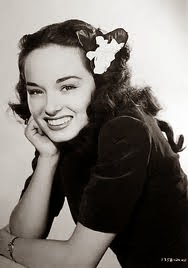
Look at the photo above,
which is striking for its sweetness of attitude—we may notice the girl is quite
pretty, but there is more to read in the glance she gives the camera. A slight lowered tilt of the head, a calm,
level gaze that invites as much as it withholds from the viewer. She's studying us as much as we are studying her. An actor’s audition headshot, or a publicity
photo from her Broadway turn in Watch onthe Rhine? I don’t know. But you can see the girl in this photo, young
Ann, is carefully tended.
She was the gently-bred daughter of an Irish immigrant, a mother she adored.
She was the gently-bred daughter of an Irish immigrant, a mother she adored.
For this year-long series, I’m
not going to dwell on Ann Blyth’s personal life too deeply, rather touching upon her private life only as it
bears upon her career. Nor am I going to
proceed in chronological order, for I want to present this series as snapshots
of moments. We’ll be leaping back and
forth across the years like time travelers playing hopscotch.
But today we need to start at the
beginning, if only for a foundation from which to leap first. She was born in Mt. Kisco, New York in 1928,
but never actually lived there. Mrs. Blyth was visiting her sister at the time of Ann’s birth. (Her name was Anne, but lost the ‘e’ on Anne when she went to Hollywood. Ann remarked in an interview that her surname also once carried an 'e' on the end. Perhaps for a previous generation? Silent vowels are easily misplaced in transit
if they are not firmly affixed.) Ann
grew up in a fourth-floor walkup by the river in the Lower East Side of Manhattan, a world narrowed to her mother and a
sister who was some ten years her senior (her father left the family when she was still a child), and a few city
blocks. They struggled financially. Her mother took in washing to
make ends meet. (One columnist would later
write that Mrs. Blyth once worked for actor Joseph Cotten as a housekeeper.)
In an interview quoted by author Karen Burroughs Hannsberry in Femme Noir-Bad Girls of Film, Ann recalls a "rather meager" childhood:
The fact that my father left my mother with two daughters to raise is, of course, something many families and children have to face...My mother faced it, as indeed anyone who knew her and loved her felt she would. And she always saw to it that my sister and I had enough to eat, and clean, pretty clothes on our backs--but I know that it wasn't easy for her.
Ann’s very early desire to sing
and perform, and perhaps a precocious talent for both, led Mrs. Blyth to seek
outlets for her daughter, which led to auditions and lessons, and soon,
jobs. Ann began singing and reciting on
New York’s WJZ (on the NBC Blue Network) at six years old in the middle of the
Depression. She was one of the regular gang for several years on a
children’s program called Coast
to Coast on a Bus, where the bus "conductor" was Metropolitan Opera announcer
Milton Cross...
“Coast-to Coast on a Bus—The White Rabbit Line jumps
anywhere, anytime!”
It was a show to discover talented children. Future Metropolitan Opera star Risë Stevens appeared here, and other kids on the bus included Billy and Florence Halop, Billy and Bobby Mauch,Walter Tetley and Jackie
Kelk. They sang songs and hymns and
recited poetry, and picked up guest “passengers” along the way. Other shows she did were The Sunday Show, Our Barn, and Jean Hersholt's Dr. Christian program. (On the other network, little Beverly Sills,
future opera star, was also doing a kids’ show.) WJZ also gave us Little Orphan Annie, Amos n' Andy, and Death Valley Days.
A teenage boy working as a pageboy in the same NBC building while little Ann was working at the microphone in one of the studios would meet her for the first time only many years later in California. His name was James McNulty, her future husband. Kismet, you might say. (Yeah, we'll get to that movie down the road.)
A teenage boy working as a pageboy in the same NBC building while little Ann was working at the microphone in one of the studios would meet her for the first time only many years later in California. His name was James McNulty, her future husband. Kismet, you might say. (Yeah, we'll get to that movie down the road.)
Of these early years, Ann gives
us a brief glimpse in an article syndicated in newspapers and published in a
collection of stories of faith conquering adversity, edited by Dr. Norman
Vincent Peale, and published as FaithMade Them Champions. (The chapter is posted at the SE Entertainment blog here.)
“Mother worked very hard and her tiny body wasn't nearly as big as her heart.”
Mrs. Blyth was Ann’s cheerful emotional
rudder, her advisor, and her close companion. It’s interesting
that for someone who did not come from a show business background that Mrs.
Blyth, with apparently no “stage mother” temperament, was still able to guide
her daughter through a world that was strange to both of them.
From an interview with The New York Times in 1952: "Life was one big struggle then, but mother managed somehow to keep me in parochial school and later in professional school. She provided me with singing and dramatic lessons besides."
From an interview with The New York Times in 1952: "Life was one big struggle then, but mother managed somehow to keep me in parochial school and later in professional school. She provided me with singing and dramatic lessons besides."
Ann was given minor children’s
roles with New York’s San Carlo Opera Company, in Carmen, Pagliacci, and LaBoheme, where she was introduced to the colorful and irresistibly larger than life storytelling world of opera. She became a lifelong fan. The opera company performed
during these years at the Gallo Opera House on West 54th Street, and
Ann’s world stretched a little wider, all the way uptown. (The opera house later became the site of the
disco era’s Studio 54 nightclub.)
She had some small parts in minor plays, along with her radio work, and actor, later agent, Richard Clayton, who knew Ann as far back as
their New York casting days and appeared on different radio shows with her, recalled for interviewer Sue Chambers in 1954 how
the stage mothers of other kids at auditions would look pityingly at Ann, “the
quiet, skinny little girl effacing herself in the corner. But when the time came to read for the part,
the other kids didn’t have a chance.”
But there were other jobs she did
not get, and the Depression rolled on while she attended parochial school, later
dramatic and singing lessons at the Professional Children’s School (then at
Broadway and 61st Street), and stood before the mic in the radio
station.
“When I tried for something better and failed, she would smile her
wonderful warm smile, put a pert new feather in my hat, and together we'd go to
St. Boniface's to pray.
‘Just have faith, my darling,’ she'd say cheerfully as we walked home in the fading light. ‘Something better will come.’ And it did. It came so fast it was like riding a giant roller coaster clear to the top. We two looked out over the whole world.”
‘Just have faith, my darling,’ she'd say cheerfully as we walked home in the fading light. ‘Something better will come.’ And it did. It came so fast it was like riding a giant roller coaster clear to the top. We two looked out over the whole world.”
Ann was called to the principal’s
office at school. Usually a
heart-stopping moment for any kid. Her
fate was behind the door, literally.
Herman Shumlin and Lillian
Hellman were there, asking if she would read for a part in Miss Hellman’s new play Watch on the Rhine. Ann Blyth was 12 years old.


Watch on the Rhine Playbill, September 1941, author's collection.

“Lillian Hellman has brought the awful truth close to home…Curious how
much better she has done it than anybody else by forgetting the headlines and
by avoiding the obvious approaches to the great news subject of today.”


Watch on the Rhine Playbill, September 1941, author's collection.
Cast members included Paul Lukas, Mady Christians, Lucile Watson, and George Coulouris. (Lukas, Watson, and Coulouris would, of course, reprise their roles in the 1943 film.) It was a monumental play, and if
Ann, who turned 13 during its Broadway run, was not mature enough to fully
appreciate the political message, she must certainly have been impressed by the
prestige the production garnered. Especially
when she, along with other cast members, was invited to the White House to meet
President Franklin Delano Roosevelt.
She could also appreciate that, as author Hannsberry quotes, "It meant that for the first time in years, my mother wouldn't have to work so hard."
She could also appreciate that, as author Hannsberry quotes, "It meant that for the first time in years, my mother wouldn't have to work so hard."

Postcard advertising the play, author collection. Ann Blyth is in the top right photo.
Here are some photos of the
production as published by Life magazine in April 1941.


Watch on the Rhine Playbill, September 1941, author's collection.

Watch on the Rhine Playbill, September 1941, author's collection.
The show closed in February 1942;
afterward it toured for nine months across the country, and Ann joined the
touring company. It was during this
period they gave a command performance for the President and had dinner at the
White House. She recalled for The New York Times in 1952, "I was so excited that I still can't tell anyone anything coherent about it. I still have a souvenir, though, which the President gave me--a beautiful green match box which has a ship embossed upon it with FDR worked onto the boat."
At the age of 14, her world grew wider still with every train stop in towns and cities across the continent. Finally, they played the Biltmore Theater in Los Angeles, where Henry Koster, a director for Universal, saw her and she was given a screen test. By the time she performed with the touring company in San Francisco, Ann was signed to the Universal studio.
Gossip columnist Hedda Hopper spread the word in February 1943: "Henry Koster has little Ann Blyth...who was so good in Watch on the Rhine...when talking to her, he discovered she could also sing."
Her first four films, all
released in 1944, were a series of small roles in B-musicals (which we’ll
discuss in later posts), and then the big break when she was allowed to test
for Mildred Pierce at the Warner
Bros. studio. (We’ll cover her role in
that film, also, in a later post.)

It was five days after wrapping
this major film that Ann Blyth experienced an horrific event, and would
spend her remaining teen years in a most heartbreaking series of personal
challenges.
Her mother took Ann and some
friends up to the Lake Arrowhead area in the San Bernardino Mountains to have a
few days’ holiday in the snow in April 1945.
Ann was injured in a toboggan accident.
From her article on the incident in Faith Made Them Champions:
“One minute we were sailing down the hard-packed icy hillside like snow
birds, then there was a crash and I fell on my back with a sickening thud.”
She was 16 years old. She had fractured her spine.
“I didn't cry out. The feeling was too big for that. Involuntarily, from long habit, my spirit reached out for faith and halting prayers rose to my lips.”
“I didn't cry out. The feeling was too big for that. Involuntarily, from long habit, my spirit reached out for faith and halting prayers rose to my lips.”
First newspaper reports called it
a “near-fatal accident.”
“At the hospital, the doctors were grave; my back was broken.”
She was told she might not walk
again.
“At first, I couldn't look at my mother. When at last I raised my head, I was startled.
Those warm, hazel eyes under her crown
of auburn hair were actually smiling.
‘Have faith, my darling,’ she said. ‘You'll walk.’”
‘Have faith, my darling,’ she said. ‘You'll walk.’”
Ann spent several months flat on
her back in a body cast.
“I concentrated on high school work, determined to graduate with my
studio class. But still there were those
long periods of just lying down. The
busy, exciting world I had known faded away and my life slowed down to little
things.”
It may be at this period that Ann
learned her later-to-be-celebrated patient demeanor. From a 1953 Miami News article she was: “…long noted as the most serene actress
in town…”
“A visit with her is like taking
a tranquilizer pill,” according to a producer interviewed for an article
syndicated in the Miami News in 1957.
“Miss Blyth is a singularly
soothing young lady to have around,” noted an article in The New York Times from 1952, that called her “serene and almost
childlike.”
And something else, a faith in
which she’d been trained since childhood began to evolve into a source of
strength that would take her into adulthood.
“I found myself blessed, for a new sense of prayer began to unfold to
me. Now there were not the busy times of
telling Him what I needed, but rather, times of listening communion, of
gathering strength, when my human strength and courage seemed to ebb away.”
After seven months, she was freed
from the body cast, put into a steel back brace from her neck to her lower back,
and allowed to take a few steps. She
spent several months in and out of her wheelchair, in therapy (which included
swimming in Joan Crawford’s pool) and finally did graduate with her studio
school class in her wheelchair.
Years later, her teacher at the Universal schoolhouse, Mrs. Gladys Hoene (pronounced "Haney"), was interviewed on what it was like to teach at the studio school by the syndicated columnist Bob Thomas, who noted that so many child stars had unhappy adult lives. Mrs. Hoene agreed, having seen first-hand the pressures faced by child stars and the peculiar circumstance of playing roles “that are far apart from reality. You can’t expect them to have a down-to-earth attitude toward life.”
Years later, her teacher at the Universal schoolhouse, Mrs. Gladys Hoene (pronounced "Haney"), was interviewed on what it was like to teach at the studio school by the syndicated columnist Bob Thomas, who noted that so many child stars had unhappy adult lives. Mrs. Hoene agreed, having seen first-hand the pressures faced by child stars and the peculiar circumstance of playing roles “that are far apart from reality. You can’t expect them to have a down-to-earth attitude toward life.”

Publicity still from Universal Studios in front of schoolhouse.
I believe Ann is 2nd from right, with Sabu just to the right. Can you name the others?
Mrs. Hoene was prompted to “tell tales
out of school,” as it were, on her former students. She recalled that, “When Ann and Donald
O’Connor were put together, they could cut up,” but she put Ann, who was reportedly one of her favorite students, in a different
category than the other kids who might grow to unhappy adults.
“I think the exception is Ann
Blyth…I would stake everything I had on her chances of success.”
She was not speaking of career
success. Nor did Ann, apparently, regard
career success as her only yardstick on happiness, though she certainly remained very
keenly ambitious and loved to work.
“Now, at last, my life was again the same. Only, not quite the same. I found within me an immense gratitude for
simple things. An acute appreciation of
all I might have lost, all the things I had accepted unconsciously before.”
There was a bright, shining
moment during her convalescence when she was nominated for an Academy Award for
Best Supporting Actress for MildredPierce (a heck of a get well card), and she attended the Oscars ceremony
with her mother, a sublime evening of personal triumph they both shared. The studio arranged for a special gown to be made for
her which would hide her back brace. The gown was pink, made of pre-war bengaline silk.

Ann & Mrs.Blyth at Grauman's Chinese Theater, March 1946,
from a newsreel of the 1945 Oscars
from a newsreel of the 1945 Oscars
What anguish Mrs. Blyth endured
over Ann’s injury and long recovery anyone can only imagine, but the dark days
were left behind by the renewed prospect of Ann’s return to good health and a bright future
as a Hollywood actress.
In April 1946, gossip columnist Louella Parsons remarked, "Ann is extremely ambitious. Her career comes first in her life, and I think you'll see that she'll go far...I couldn't look at the sweet young face of Ann Blyth without feeling that she was something very special, and is not the ordinary girl. She's well bred, quiet...."
In April 1946, gossip columnist Louella Parsons remarked, "Ann is extremely ambitious. Her career comes first in her life, and I think you'll see that she'll go far...I couldn't look at the sweet young face of Ann Blyth without feeling that she was something very special, and is not the ordinary girl. She's well bred, quiet...."
This happy, hopeful time was
cruelly brief, and in turn, eclipsed by another, greater tragedy.
Four months after the Oscars, over a month after Ann was
finally allowed to remove the back brace for good, only a few weeks after her
returning to work on a new movie, Mrs. Blyth died of cancer in July 1946.
Ann was 17 years old, less than a
month shy of her 18th birthday.
Despite sympathy from those around us, grief is inevitably an agony faced alone, even for the very young. The very depth of our mourning isolates us. Fortunately, her mother’s sister
and brother-in-law around this time gave up their home in Connecticut and moved
out to California to help during the family crisis, and stayed. As guardians and parent-figures her aunt and
uncle thereafter had a huge supportive part in her life.
Ann dealt—forever after would deal—with the loss of her mother through
the prism of her religious faith.
“There was an aching emptiness. Until it came to me, almost in a revelation,
that she had not left me. She had
prepared me for her going as she had prepared me for everything else I'd met in
life.
Reaching out again for my faith came the assurance that she would be by my side in every good, beautiful, and true experience, wherever I might go; a part of every decision, every success and every happiness –for they all stemmed from her inspired teaching. They would become the flowers of the mustard seed of faith she had placed in my heart.”
Reaching out again for my faith came the assurance that she would be by my side in every good, beautiful, and true experience, wherever I might go; a part of every decision, every success and every happiness –for they all stemmed from her inspired teaching. They would become the flowers of the mustard seed of faith she had placed in my heart.”
Now we jump ahead several
decades. Have a look below at the video
taken at the Castro Theatre in San Francisco July 6, 2006 for a special
screening of Mildred Pierce. Miss Blyth is interviewed on stage by Eddie Muller. She is 77 here, elegant, classy, gentle, stunningly
beautiful, and delightfully funny. She’s
slaying her audience. Note how
effortlessly she launches into imitations of co-star Butterfly McQueen and director
Michael Curtiz. She's good
with accents; we can imagine the first accent she ever learned to mimic as a child may have been
her mother’s Irish brogue. Her mother
was Nan Lynch of Dublin. (‘Tis a grand
name, to be sure, but I’m sorry to say I have no reason to believe we are
related.)
Note how, at the very end of the
video, she is prompted to sing a line from Kismet’s
“Baubles, Bangles and Beads” – the strength and loveliness of her voice, the
almost startling power of it. We have to
marvel at the still prodigious talent of a lady who, we sense, as Emerson said,
became the person she decided to be.
Consider as well that, unlike
everyone else in that theater, Ann Blyth has just watched the screening of Mildred Pierce not as a favorite classic
noir, but something more akin to a home movie of herself as a teenager only weeks before her life
so shockingly changed. The other actors on
screen were all friends and colleagues—and all of them, down to little Jo Ann
Marlowe who played her younger sister Kay, are all gone. They are ghosts on the giant screen. A thousand people in the theater have watched
the intimacy of her, a solitary survivor, watching her own past.
The whole interview is not
recorded on this video, but you can read a bit more of the conversation in a transcript
of the interview at Michael Guillen’s blog The Evening Class. Part 1 is here, and part 2 is here.
Come back next Thursday, and
we’ll talk about Ann Blyth’s underwater adventure, which included a four-foot
long fish tail with lead weights in it to make her sink, in Mr. Peabody and the Mermaid (1948).

Dunning, John. On the Air: The
Encyclopedia of Old-Time Radio (NY: Oxford University Press, 1998),
p. 162.
The Evening Class blog, July 28, 2007
The Film Daily, July 24, 1946, p. 2.
Hannsberry, Karen Burroughs. Femme Noir - Bad Girls of Film (Jefferson, NC: McFarland & Co. Inc.) pp. 32-33.
Ladies Home Journal, article by Cynthia McAdoo Wheatland & Eileen Sharpe, "Young Hollywood at Home", February 1957, p. 104.
The Film Daily, July 24, 1946, p. 2.
Hannsberry, Karen Burroughs. Femme Noir - Bad Girls of Film (Jefferson, NC: McFarland & Co. Inc.) pp. 32-33.
Ladies Home Journal, article by Cynthia McAdoo Wheatland & Eileen Sharpe, "Young Hollywood at Home", February 1957, p. 104.
Los Angeles Times, July 23, 1946, p. A8; also August 12, 2013, article by Susan King.
Miami News June 26, 1953, p. 6A; November 23 1957, p. 10B
The Milwaukee Journal, syndicated article by Sue Chambers, May 1, 1954,
p. 3
Muller, Eddie. Interview on stage with Ann Blyth, Castro
Theatre, San Francisco, July 6, 2006.
The New York Times, article by William Brownell, October 12, 1952,
p. X5.
Peale, Dr. Norman Vincent, ed. Faith Made Them Champions (Guidepost
Associates, Inc., 1954).
The Radio Annual, 1944, p. 732.
SE Entertainment blog, August 5, 2012.
Spokane Daily Chronicle, syndicated article by Dorothy Roe, July 29, 1955, p. 11.
St. Petersburg Times, syndicated article by Hedda Hopper, February 18, 1943; syndicated article by Louella Parsons April 21, 1946, p. 39.
The Tuscaloosa News, syndicated article by Bob Thomas, May 11,
1955, p 5.The Radio Annual, 1944, p. 732.
SE Entertainment blog, August 5, 2012.
Spokane Daily Chronicle, syndicated article by Dorothy Roe, July 29, 1955, p. 11.
St. Petersburg Times, syndicated article by Hedda Hopper, February 18, 1943; syndicated article by Louella Parsons April 21, 1946, p. 39.
Universal Studios Entertainment Tumblr site.
The Vancouver Sun, article by Clyde Gilmour, June 28, 1952, p. 45
UPDATE: This series on Ann Blyth is now a book - ANN BLYTH: ACTRESS. SINGER. STAR. -

Also in paperback and eBook from Amazon, CreateSpace, and my Etsy shop: LynchTwinsPublishing.

"Lynch’s book is organized and well-written – and has plenty of amusing observations – but when it comes to describing Blyth’s movies, Lynch’s writing sparkles." - Ruth Kerr, Silver Screenings
"Jacqueline T. Lynch creates a poignant and thoroughly-researched mosaic of memories of a fine, upstanding human being who also happens to be a legendary entertainer." - Deborah Thomas, Java's Journey
"One of the great strengths of Ann Blyth: Actress. Singer. Star. is that Lynch not only gives an excellent overview of Blyth's career -- she offers detailed analyses of each of Blyth's roles -- but she puts them in the context of the larger issues of the day."- Amanda Garrett, Old Hollywood Films
"Jacqueline's book will hopefully cause many more people to take a look at this multitalented woman whose career encompassed just about every possible aspect of 20th Century entertainment." - Laura Grieve, Laura's Miscellaneous Musings''
"Jacqueline T. Lynch’s Ann Blyth: Actress. Singer. Star. is an extremely well researched undertaking that is a must for all Blyth fans." - Annette Bochenek, Hometowns to Hollywood

Ann Blyth: Actress. Singer. Star.
by Jacqueline T. Lynch
The first book on the career of actress Ann Blyth. Multitalented and remarkably versatile, Blyth began on radio as a child, appeared on Broadway at the age of twelve in Lillian Hellman's Watch on the Rhine, and enjoyed a long and diverse career in films, theatre, television, and concerts. A sensitive dramatic actress, the youngest at the time to be nominated for her role in Mildred Pierce (1945), she also displayed a gift for comedy, and was especially endeared to fans for her expressive and exquisite lyric soprano, which was showcased in many film and stage musicals. Still a popular guest at film festivals, lovely Ms. Blyth remains a treasure of the Hollywood's golden age.
UPDATE: This series on Ann Blyth is now a book - ANN BLYTH: ACTRESS. SINGER. STAR. -
*********************
The audio book for Ann Blyth: Actress. Singer. Star. is now for sale on Audible.com, and on Amazon and iTunes.
The audio book for Ann Blyth: Actress. Singer. Star. is now for sale on Audible.com, and on Amazon and iTunes.

Also in paperback and eBook from Amazon, CreateSpace, and my Etsy shop: LynchTwinsPublishing.
"Lynch’s book is organized and well-written – and has plenty of amusing observations – but when it comes to describing Blyth’s movies, Lynch’s writing sparkles." - Ruth Kerr, Silver Screenings
"Jacqueline T. Lynch creates a poignant and thoroughly-researched mosaic of memories of a fine, upstanding human being who also happens to be a legendary entertainer." - Deborah Thomas, Java's Journey
"One of the great strengths of Ann Blyth: Actress. Singer. Star. is that Lynch not only gives an excellent overview of Blyth's career -- she offers detailed analyses of each of Blyth's roles -- but she puts them in the context of the larger issues of the day."- Amanda Garrett, Old Hollywood Films
"Jacqueline's book will hopefully cause many more people to take a look at this multitalented woman whose career encompassed just about every possible aspect of 20th Century entertainment." - Laura Grieve, Laura's Miscellaneous Musings''
"Jacqueline T. Lynch’s Ann Blyth: Actress. Singer. Star. is an extremely well researched undertaking that is a must for all Blyth fans." - Annette Bochenek, Hometowns to Hollywood

Ann Blyth: Actress. Singer. Star.
by Jacqueline T. Lynch
The first book on the career of actress Ann Blyth. Multitalented and remarkably versatile, Blyth began on radio as a child, appeared on Broadway at the age of twelve in Lillian Hellman's Watch on the Rhine, and enjoyed a long and diverse career in films, theatre, television, and concerts. A sensitive dramatic actress, the youngest at the time to be nominated for her role in Mildred Pierce (1945), she also displayed a gift for comedy, and was especially endeared to fans for her expressive and exquisite lyric soprano, which was showcased in many film and stage musicals. Still a popular guest at film festivals, lovely Ms. Blyth remains a treasure of the Hollywood's golden age.


