IMPRISON TRAITOR, PEDOPHILE, AND CONVICTED FELON TRUMP.

Monday, March 12, 2012

Trial - 1955


This week we take on two films which examine (or in Hollywood fashion, exploit) the era of communist witch hunts. Trial (1955) and Storm Center (1956) were both made after the most threatening period had ended, yet still timidly take a tentative stance on the violation of civil liberties. They both seek to make us understand the plight of the innocent caught in a web of social repression. However, neither takes the bold and rather obvious step to point out that nobody was ever indicted in this country of being a communist -- despite the showmanship of the McCarthy hearings -- simply because to affiliate oneself with communism is not illegal in a nation that guarantees no discrimination based on creed.

That neither of these films could address that is itself a testament to the intimidating politcal climate.

Trial (1955) is a film that is both typical of that era, and yet a bold move into new territory. Many complex issues are raised, including bigotry, political extremism on both the right wing and the left. Personal commitment is challenged, and the very idea of justice. The movie raises many questions, but supplies few answers. In this sense, it seems more modern than many of the films of its day in its cynical approach.

This fence sitting may make the film seem unsatisfying to classic film fans who are accustomed to enjoying simple resolutions. Fans of modern films will likely see this movie as an example of 1950s stereotypes and melodrama. The melodrama, I think, is part of what is fascinating about this movie. One downfall to the film is that it has so much going on. Issues too difficult to solve are dropped for other issues.

Ironically, what makes the film resonate to the modern viewer is the conflict between the right wing and the left wing, still so strong today. There are messages here against left wing extremism and they may make a liberal democrat offended (the image that by merely belonging to a labor union one might be considered a communist). There are also messages against a right wing extremism that may make conservative republicans offended (the image that town fathers, the sheriff, and other representatives of the establishment are racist and bloodthirsty for the death of a young Mexican boy).

If one is to take from this movie any singular message, it might be that all extremism is bad. However, most of us whatever our political beliefs, do not regard ourselves as extremists. It’s always the other fellow. This movie dramatizes cartoonist Walt Kelly’s famous slogan from his Pogo comic strip: “We have met the enemy, and he is us.”

Trial begins with a very 1960s feel to it in the opening title sequence, crashing at us with a rapid cymbal beats, piano riff and timpani rumbling that makes us feel we are heading into 1960s political divide.

Rafael Campos is a young Mexican boy. He wanders to a Southern California beach at night crowded with people necking, drinking and generally having a good, illicit time. A sign says this is a private beach. Rafael later tell us that what this means is it is a restricted beach. These night-time beachgoers are all Caucasian.

After the first flush of the bebop theme music we hear Campos calling for help and the camera zeroes in on a young girl lying at his feet. The girl is dead. He is Mexican and he is not supposed to be here.

We cut to Glenn Ford, a law professor being booted out of his faculty position because he has no criminal trial experience. We are told that he has an excellent war record, four battle stars and a silver star. That, and his determined pacing and his pressured speech, and his perpetually pained expression tell us that he’s the hero of the peace.

He needs to get some criminal trial experience to keep his professor’s position. Arthur Kennedy, in one of his best smarmy roles (he would receive an Oscar nomination for this role, and would win a Golden Globe for it), decides to hire him. Kennedy is slick, street smart and goes ambulance chasing for young Rafael’s case.

Kennedy’s gal Friday is Dorothy McGuire. McGuire is an interesting choice for this role. She carries a pedigree of being a lady. Her soft spoken, well-modulated voice indicates, just as Glenn Ford’s clean cut World War II hero image, that she naturally is the heroine. She’s smart, ladylike, decent, and a little sexy. So, why is she working for a snake like Arthur Kennedy?

We soon learn that she and Mr. Kennedy have much in common.

Arthur Kennedy plays a complex character. We may see him first as an irascible fighter for justice, the kind of lawyer whose brusque manners put everyone off, but if he’s your lawyer you love him because you know he’ll fight to the death for you.

Then, when he approaches Katy Jurado, the accused boy’s mother, to take their case he puts on a show with a bit too much fake bravado. There is a glint in his eye and a fire his belly. He’s a showman. He slips the sheriff 20 bucks to let him in the jail to see the boy. Glenn Ford sees him pay the bribe, and in only the first of many of Glenn Ford’s patented worried grimaces of disgust we begin to see the chipping away of an American hero. We begin to see the compromise of conscience.

Arthur Kennedy grills the boy and even slaps him around a little in an ugly scene to get him to tell the truth. The boy is scared and confused. He explains that he knew he was not supposed to be on the restricted beach, but when he saw the girl coming up the stairs she recognized him from school and they struck up a conversation. He says she became friendly with him, talked to him, held his hand, placed his hand on her knee.  When he tried to kiss her and touch her, she pulled away from him and ran up a set of wooden steps. Then she collapsed and died.

Because the girl was underage when she died, after a possible assault, the charge against him is murder. It seems a very difficult case, and is made even more difficult and more interesting by the fact that the girl had been known to have a weak heart due to rheumatic fever, and had collapsed only the year before and required months of bed rest.

In this circumstance, is Rafael Campos guilty of murder or manslaughter, or innocent of any crime? This issue at the very heart of the case gets dropped very quickly in the movie. We move on to other issues that are so big they linger today. Society steps in and the sharks are circling.

The town has a very virulent anti-Mexican bias. Hence the restricted beach. People are up in arms already that the girl died at the feet of a Mexican boy who put his filthy paws on her. They want to hang him.

Arthur Kennedy wants Glenn Ford to take on the trial, while he himself raises public awareness of the trial and raises money for the defense. We are introduced to the prosecuting attorney played by John Hodiak. He is teased at being called Jack Armstrong - the All American Boy (old radio show, if you’re unfamiliar with that), but he gets a good line here, teasing Kennedy:

“I may be a native-born white Anglo-Saxon Protestant, but in my heart I like to think I’m as good an American as if I just stepped off the boat.” There is much contemplation on racial perspectives in this movie. Later at a rally, Katy Jurado will complain to Kennedy that the obvious choice of Mexican food so often at the fundraisers is milking her heritage a bit too much. She sarcastically relates that she often just has meat, potatoes and vegetables at home like any white person. Kennedy exploits the symbolism of Mexican cuisine.

Arthur Kennedy and Glenn Ford persuade the mother of the dead girl to hold a private funeral, because they fear a public exhibition will rally the bigots in town and turn the case into a circus. Her parents are obviously heartbroken, but her mother is a brave, conscientious woman, sees the ramifications, and agrees to a private funeral. At the funeral the next morning as the services conclude by the gravesite and the mourners are walking away, the town’s bigots come to make a show of it. They ostentatiously wear black armbands, make a speech and rally round the grave. It is an ugly, threatening scene, where the vigilantes bully the minister into presiding over a prayer of revenge invoked over the grave that announces they are, “…going to see to it that people live with their own kind the way it used to be.” There are members here of the Ku Klux Klan, and other white supremacists. They bark the word “Amen” in the same crude, bloodthirsty manner that other people once said, “Heil Hitler.”

Then we have a scene at the courthouse where crowds attack the door with a battering ram to take Rafael Campos out of his cell and hang him. But, the jovial sheriff, played by Robert Middleton, is persuaded that he will look like a great guy if he a makes them go away. After all, the kid is probably going to lose the trial anyway and be hung legally. Otherwise, he could care less.

Robert Middleton often played these kind of oily roles, and he is as much a type as Glenn Ford and Dorothy McGuire are types. The minute we see him we know he is a man whose palm has to be greased before he’ll do anything. I can’t help wondering if it would be a more interesting picture it Glenn Ford played the corrupt sheriff and Robert Middleton played the hero law professor.

The movie is essentially a story about hypocrisy, but it is also a story about there sometimes being no right answers. We know in life that is sometimes true, but this does not always make a satisfying movie. The movie jumps around quite a bit it, so it appears convoluted. The traditional love story gets thrown in, in a most untraditional way.

Working late one night, Mr. Ford takes his suitcase and says he does not even have a hotel room. There is an interesting shot of Miss McGuire standing in the doorway silhouetted in the darkness, telling him to come on. Is she going to find him a hotel room or is she taking him home? We’re not given the answer, except in the querulous expression on Glenn Ford’s face.

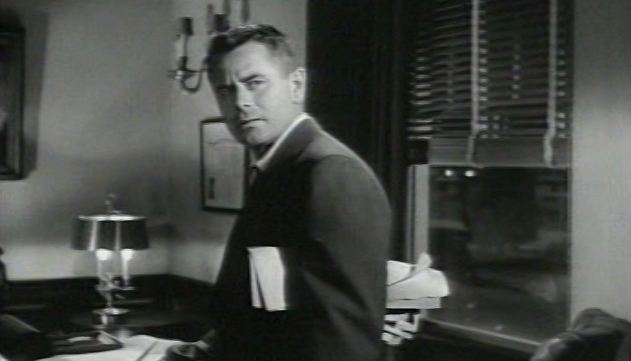


Arthur Kennedy offers Ford the use of his country cabin while the case is going on and Dorothy McGuire goes with him now to be his girl Friday.

At the cabin Ford works on his notes. He has trouble with an electric blanket, and Dorothy fixes it. She has experience with it. She has fixed it before for Arthur Kennedy. What else has she done for Arthur Kennedy?

“I used to help him. Used to. Not for over a year. Any questions?”

No, Ma’am, we don’t have any more questions. He kisses her, happy to take on both Kennedy’s trial and his old girlfriend. We are allowed to assume Ford and McGuire are sleeping together.

Suggestive as this may be for era, by far the boldest move taken by this movie is to have the role of the judge played by Juano Hernandez.  He is probably the first dark-skinned man to play a presiding judge in classic films. This opens up the question of bigotry one step further, but not from the bigoted whites in town as we might expect. A question on his impartiality is raised first by Rafael Campos, who overhears one of his jailers telling him that he is even more likely to be convicted by a black judge because a black judge will want to keep his job and impress the whites.

Glenn Ford will express his own doubts and suggest that he prefers not to have a black judge. Ford says, “I think you were selected so that after the conviction they can say, of course, the Mexican had a fair trial. Sure. He even had a Negro judge.” He is in profile saying his lines, so we are allowed to concentrate on Mr. Hernandez as the judge silently seethes next to him. The judge responds,

“I’m sure that you consider yourself completely without race prejudice, but you’d bar me from the bench in this trial because of the color of my skin.” He puts Ford put in his place.

But, I particularly like in gentler moments when the judge calls Glenn Ford, “boy,” the prerogative of an older man addressing a younger man. That simple line said in an affable manner probably made white supremacists in the audience choke, and I hope they did.

I also like the way Miss McGuire busily feeds Ford information during the trial like a catcher throwing signals to the pitcher. Too bad she’s not the lawyer, she’s the smartest person on Campos’ defense team.

Most of the movie is taken up simply trying to pick an impartial jury.

Another problem looms on the horizon. Glenn Ford is summoned to fly to Kennedy’s side to attend a rally in another part of the country. It is a fund-raising rally for Rafael Campos’ defense. In the auditorium, we see Kennedy approaching members of something called the “All Peoples Party Club” to raise collections. This is a communist front organization. Ford, with that squeamish expression on his face, protests to Kennedy that they should not be dealing with communists. Kennedy frankly tells him that money is money no matter who gives it and these people are willing to give it. Just as we had seen Kennedy slip the sheriff $20 early in the movie, we now see him making deals with organizers of communist groups and labor unions to split the money raised.

The rally is an impressive scene. It takes place in a public auditorium and is absolutely full to the rafters with extras. There are banners and songs, and it has the flavor of an old revival meeting. Glenn Ford is disgusted. When he tries to make a few statements in the microphone, Arthur Kennedy orders him cut off and it is almost like that scene in Meet John Doe (1941) discussed here, where Gary Cooper is silenced at the hands of fascists.

Then we see Kennedy work his magic with the crowd, a combination of Charles Foster Kane and Aimee Semple MacPherson. He tells the crowd to give their money, but tells them to not trust anybody. It is an anti-establishment shout, a forerunner of everything we will hear in the 1960s. We have another interesting shot of Glenn Ford slinking out of the arena in the bowels of the auditorium. Stylistically there are many fine camera shots in this movie.

Ford feels he has been duped, not only by the two-faced Kennedy but by McGuire. He wants to know just how deeply involved she is with communists. Apparently, her intimate relationship with Kennedy is no longer of interest in him. If it ever was.

She can be a woman of easy virtue, but her political beliefs are what taints her.

Dorothy McGuire next has a scene where she explains how she came to be involved with communists. She tells him that she drifted when she was in college. That she was “one of a thousand freshmen and I wanted to be different. And I found out they were clubs and meetings, and if went to them you were different. Suddenly people pointed you out and you became kind of campus curiosity… Suddenly you had friends who were going to change the world with you.”

It is a rather dishwater way to explain one’s move toward a new political perspective, even if for many it happened that way. Dorothy McGuire’s role, possibly simply because she was played by Dorothy McGuire the all-American girl type, was never meant to be a card-carrying communist. She is portrayed only as someone who was duped even as Glenn Ford has felt himself duped in this movie, who went astray and who regrets her actions.

She tells him that the communists dumped her. Because she was “…hopelessly bourgeois. They were right. I could never really accept the party line. The way it kept changing. Monday’s truth would be Tuesday’s lie.”

A great line, but the movie fails to consider the very irony that one of the biggest and most shameful actions of the McCarthy era is that people who had a minor role or even nothing to do with communism were painted with the same brush as the dictator Joseph Stalin. Stalin was unreachable to them, so they bullied and persecuted anybody at hand, usually for fame and profit. Indictments were slim in “un-American activities” trials; bribes were more common.

The movie moves on to the trial, after an arduous jury-picking process.

Mr. Ford questions the girl’s cardiologist about her weak heart. The doctor is played by Richard Gaines, who we saw before as the delightful bore in The More the Merrier (1943) as well as in Strange Bargain (1949) here. He can give no proof that her heart would not have given out anyway. A montage of witnesses testify. Glenn Ford intends to wrap up his defense quickly and not bring Rafael Campos to the stand because that would jeopardize the case, but Arthur Kennedy shows up to take over. He puts Rafael on the stand.

Meanwhile, a man stalking Ford turns out to be a Elisha Cook, Jr. in a minor role, who turns out to be a process server. It seems a local red baiter, a state congressman named Battle has subpoenaed Ford to testify before his own Un-American Activities Committee. Ford is really up to his ears in trouble now. Just by going to Arthur Kennedy’s communist rally he’s tainted himself.

We never get to see the character named Battle and that is a shame because it would be a much more courageous movie if this character were depicted. Today we might infer that Battle is meant to be an ersatz Joe McCarthy, and he is, but he really has a closer real life counterpart in a California State Senator named Jack Tenney. Tenney conducted anticommunist investigations in California in the 1940s and early 1950s. Among hundreds of people, the most famous entertainers he attacked were singer and actor Paul Robeson, and Edward G. Robinson. As is usual with these witch hunts not one single person in eight years of harassment resulted in one single indictment. It was a ploy to further his career, just as it was Joe McCarthy’s. Like Joe McCarthy, Tenney’s career petered out into oblivion eventually, but not until much harm was done.

Back to the trial and a very strange sort of grand finale. The jury finds Campos guilty of murder. The sentencing is put off until the next day. Glenn Ford decides to put an 11th hour bid to save the boy, runs off to the library (libraries feature big in our films this week, that haven of solutions -- I believe librarians are superheroes) and tries to find answers.

He addresses the court and raises an obscure ruling where Campos might, instead of being sentence to death, be committed to a juvenile offenders’ detention center for an undetermined period of time. Arthur Kennedy does not want young Rafael to be saved. He wants him to be hung as a martyr to the communist cause. He tries to scuttle Ford’s tactic.

We are never sure in this movie if Kennedy is a dedicated communist or whether he is just a flimflam man on the make for bucks. He attacks the judge with racist remarks, trying to make the judge angry, calling Hernandez a “handkerchief head” and an “Uncle Tom.” But, Judge Hernandez will not be baited.

In another switch, John Hodiak, the prosecuting attorney, agrees with Ford that sending Campos to the detention hall is the right thing to do. The judge so orders, and Campos is saved. Arthur Kennedy gets 30 days in jail for contempt of court.

We are also told that the red baiter Battle will drop his case against Glenn Ford because Ford is a fighter, and Battle only takes on fights he can win. A convenient end, and a cop-out.

This movie attempts a great deal, but if it were really bold it would have attempted it in the early 1950s or late 1940s when this movie is set. It would have featured Battle. Or more to the point, it would have answered one last question for us…

If Rafael Campos was really innocent, as we are made to believe he was, why is it right that he should go to a detention center, still having a criminal record to his name? The movie is not really about justice, but about expedience, and how sometimes we trade one for the other.

Come back Thursday for more fellow-travelers and red baiters, and libraries, in Storm Center (1956).


*********

Jacqueline T. Lynch is the author of Ann Blyth: Actress. Singer. Star. and Memories in Our Time - Hollywood Mirrors and Mimics the Twentieth Century. Her newspaper column on classic films, Silver Screen, Golden Memories is syndicated nationally.

Thursday, March 8, 2012

FREE - "Classic Films and the American Conscience" - FINAL DAY

Just a reminder that this is the FINAL day that "Classic Films and the American Conscience", my collection of essays from this blog, goes FREE on Amazon.  Have a look-see here.

Whenever I offer free ebooks, I always think of that guy in the cartoon "One Froggy Evening"  (1955), who, when he's trying to get people into the theater to see this singing frog (that only sings for him) -- puts out a sign:  FREE.  Still, nobody comes.  So next, he puts out a sign: FREE BEER!  Then everybody flocks to the theater.

Free beer was my next option to tempt you into downloading the book.  Or singing "The Michigan Rag" with top hat and cane.

My thanks to everyone who commented on Monday for the 5th anniversary of this blog.  I'm deeply touched and very grateful.  Next week, back to work with a couple of dramas that take us to the communist witch hunts of the early 1950s with "Trial" (1955) with Dorothy McGuire and Glenn Ford, and "Storm Center" (1956) with Bette Davis.

Must start cranking out those screen caps.

See you Monday.

Monday, March 5, 2012

Happy Fifth Anniversary

Five years ago, I did not use screen captures. I have since become addicted to them. I find them helpful in illustrating a particular scene, or showing atmosphere. After all, the topic at hand is a visual art. All my purple prose isn’t going to stand up to one glint in James Cagney’s eye, or the shadow of the villain on the wall.

Five years ago, my posts were short, barely 300 words. I had read some “rules” of blogging on other established blogs at the time to the effect that short posts were best and readers would never read a long post. I have since written posts of several thousand words. (Insert evil laugh here.)

I have read that a blog post should not take much time to write, that an hour was too much time to compose a post. I have since spent several hours writing posts, and several months in preparation of topics.

Once upon a time I used to work as an assistant editor of a monthly magazine, and I have never gotten the “let’s go to press” feeling out of my blood. My blog is like a magazine to me and I am the sole staff. I write the articles, I select the pics, and do the paste up and layout. Back when dinosaurs roamed the earth, we used rubber cement, and the layout was done by hand, draping strips of typeset on the card stock “boards”, and shooting halftones in the darkroom. I loved it. The blue pencil that would not photograph edit marks, and the X-acto knife that shaved off the messy bits like a surgeon’s scalpel performing delicate cosmetic surgery.

When I hit the icon to publish the blog post, to me it is putting the magazine “to bed” and sending it “to press”.

One of my favorite lines in “Funny Face” (1957) is when Kay Thompson says, “A magazine must be like a human being. If it comes into the home, it must contribute. It can’t just lie around.”

I hope this blog, this virtual magazine, has contributed in some way to your enjoyment of classic film.

This is the fifth anniversary of Another Old Movie Blog, and as mentioned last week, I am offering my new eBook, a collection of essays selected from the blog for FREE for the next four days.

“Classic Films and the American Conscience” is available exclusively through Amazon for at least the near future, and then may be offered at other online shops at some point.

It is a long book, well over 300,000 words (no kidding, they mumble and all roll their eyes to the ceiling). Some short essays, some long ones, but enough words, I hope, to show that blogging need not be necessarily a lightweight endeavor, or even impermanent, simply because it is virtual. Nor is blogging “dead” just because Facebook and Twitter require very little work, and make it far easier to connect to a network of strangers.

I have dedicated the book to my fellow classic film bloggers. Most of us are strangers, but together we share a unique bond, and come from all walks of life. This year a silent black and white film has won the industry’s highest award, and we are smug. Rightly so, for the rest of the time we seem to be regarded as a nostalgia-crazed fringe group, somehow naïve G-rating worshipers, clustered around TCM like wanderers in the wilderness around a campfire.

I can remember some 30 years ago when classic films were regularly shown on broadcast television, and not just on the late, late show. I did not think of them as old movies, just as movies. They were still very old, but they did not seem as if they were from a different world, if only because they were so easily accessible in my world. TV gave me them to me, for free, on Saturday afternoon when I was 12, on Friday night when I was 15, just after school on weekdays, or right after the news. At any time, Humphrey Bogart or Shirley Temple might be in the living room. No big deal.

A person growing up in the 1960s and 1970s had a greater chance to become a fan of classic films because they were always on some channel when you flicked the dial.    Enough so that a kid in the end of year variety show at my high school could do impersonations of Katharine Hepburn as her act, and everybody knew who she was imitating.

I can’t imagine a high school kid getting a laugh today in their school show with the old “The calla lilies are in bloom again” line. Sound of crickets chirping in the school auditorium.

There were only four stations, not much else to distract you.  And many actors from Hollywood's heyday got work on TV comedies and dramas as guests, or even starred in their own shows.  You learned the players, just by absorption.

The 1970s also saw a burst of the first nostalgia craze, and that drew a lot of attention to old movies. This might find its way into a future blog post.

When "Gone with the Wind" was first shown prime time on broadcast television in 1976, the world seemed to stop.

Today, I think it is harder for younger people to become accidentally introduced to old movies.  There are hundreds of channels now, and infomercials are more profitable fillers.  One has to purposely tune in to TCM (if their cable network offers it), or hunt for titles on Netflix, or be introduced to classic films by someone they know with a large collection.

TCM provides a treasure trove, and the opportunity for those of us who love them to see films we’d never known about; but newbies have to find the way there first. We veterans know what we’re looking for, and many resources to find it.

I wonder how many are finding their way to old movie fandom through blogs? If they are, I hope one of them is this blog.

Hop over to Amazon here to download your FREE copy of “Classic Films and the American Conscience.”

And thank you, most sincerely, for the pleasure of your company for the last five years.

Now, let's go to press.

Thursday, March 1, 2012

Classic Films and the American Conscience - introduction

More today on Classic Films and the American Conscience, my new book, a collection of essays from this blog.  Have a look here at Monday's post for the launch of this new project.

Offered here at Amazon.com as an ebook, the book will be FREE for four days next week, Monday, March 5th through Thursday, March 8th.

Here's a bit of the introduction from the book:

This book is dedicated to my fellow classic film bloggers.


These essays are the product of five years of blogging. When I began “Another Old Movie Blog” it was an outlet for my love of classic films and interest in popular history. They go together. It is very difficult to separate these films from the eras in which they were made. We shouldn’t always try to lift them like an object from a curio cabinet to examine them out of context. The society which produced them does not, in large measure, exist anymore. That is all the more reason to study and enjoy these ghosts from the past...

This book is divided into several sections. The first section is comprised of one of my favorite features in the blog, the series. Every now and again I match up two, or three, or four films and discuss what is alike about them, or what together they tell about the subject which unites them.
Other sections of the book deal with holiday-themed posts (There may not be many of us in the country that regard Amtrak’s “National Train Day” as a holiday).

Then there are special topics, and special people. I don’t really concentrate on the big stars that much because so many other blogs handle that really well, and because I’m more interested in the minutiae of old movies -- what they say about America, those days, our conscience as a society, i.e., what we were thinking.

The rest of this book is divided into genres: comedy, Noir, etc. Obviously many films overlap different dramas. Westerns are omitted as a genre but Western movies are included as comedies or dramas.

The final section, Drama, is organized as a kind of timeline of human history as seen through the movies -- not by film date, but in order of the time the movie is set. We begin with reign of King John in England with Errol Flynn as Robin Hood. We end with Kirk Douglas and Kim Novak in a hopeless attempt to escape 1960 Suburbia in “Strangers When We Meet”. I think the time-travel feel of this section is particularly poignant for showing us perhaps not really what was, but what the movies told us. It is a flawed view, sometimes still revealing because it is flawed. The American conscience.

The movies discussed should not be taken for my opinion of a definitive list of American film; they are just the ones I’ve blogged about so far.

These essays, the blog, this book, should not be viewed only as an exercise in nostalgia, for anyone who studies and writes about history knows the past is not the cozy place lovers of nostalgia think it is. I would rather be living today than at any other time. The past is there to teach and to entertain. Ignore it, and we deprive ourselves.

I hope you enjoy these essays. I enjoyed writing them.


Next week the book goes FREE.


But before I leave you, I have some other proud news to share.  My dear twin brother, John, has just published his first book of cartoons.  They are sweet, silly, wry, and family-friendly.  Kindly have a look at Arte Acher's Falling Circus, now available at Amazon.com.

Monday, February 27, 2012

Classic Films and the American Conscience


This is to announce the publication of Classic Films and the American Conscience, which is a collection of essays from this blog.  

They are not all verbatim from the posts you read on this blog; some are tidied up a bit, sporting a brand-new hair ribbon, but all are pulled from the past five years of blogging here.

Next Monday, March 5th, marks the fifth anniversary of Another Old Movie Blog.  I am that much older, not much wiser, but I've enjoyed every moment and most especially your comments over the years.  I've made some friends through this blog, and for that I'm truly grateful.

Classic Films and the American Conscience is currently up for sale exclusively at Amazon.com (for at least the time being) as an ebook.   However, as much as I appreciate the dimes and nickels tossed my way, if you are interested in purchasing this book I would suggest you wait until next week when it goes FREE for four days - from Monday, March 5th through Thursday, March 8th.  If you don't have a Kindle, you can download Amazon's free PC for Kindle and read it on your computer.

The four-day free offering is my fifth anniversary present to you.   I'm sorry, there won't be any cake. 

I'll be talking more about the book this Thursday, and certainly next week, so you'll have your full of it soon enough.  Don't worry, though, I'll get back to regular business on Monday, March 12th. 

That week I hope to get around to some real meat-and-potatoes blogging with "The Trial" (1955) with Glenn Ford and Dorothy McGuire, and "Storm Center" (1956) with Bette Davis and Brian Keith.

What better way to cap a celebration than with trials, book burnings, Communists, and a spinster librarian?  I always say.

Thursday, February 23, 2012

Cowboy Canteen - 1944


“Cowboy Canteen” (1944) is Columbia’s answer to the Warner’s Bros. wartime all-star revues “Hollywood Canteen” and “Stage Door Canteen”. We can have a look at the latter two at another time, as “Cowboy Canteen” really doesn’t compare much.

It’s a short, fun look at cowboy swing in an era when it was just beginning to take off in popular music, but the plot of this movie is paper thin. Charles Starrett, who played in about a zillion B-movies, mostly Westerns, and mostly as guys named “Steve”, is the boss of a ranch. However, he and his sidekick played by Guinn “Big Boy” Williams are off to give Hitler what-for, so they need people to step in and run the ranch for them while they’re in the Army.

A troupe of entertainers takes up the job, including Jane Frazee, Max Terhune as the ventriloquist of the bunch, and Vera Vague (in real life, Barbara Jo Allen), the stock man-chasing comedienne. Look for Dub Taylor as “Cannonball”, a comedy relief character he also played in a zillion B-movies.

Starrett and “Big Boy” are assigned by the C.O. to organize a camp show, so there we are. One funny bit, so brief you miss it if you blink, is when Vera, struggling with her purse and a heavy suitcase, hands a big galoot her luggage. He grabs her purse instead, tucking it under his arm and walking away.

What makes this B-movie fun are a few of the featured acts, including the great Tex Ritter, he of the mournful ballads of A-Westerns, like “High Noon” (1951) and “Trooper Hook” (1957), reviewed here.

The Mills Brothers make an appearance, but they seem a little too polished and classy for this crowd, with “Up a Lazy River” and “Paper Doll”, which were huge hits for them.

I really get a kick out of Roy Acuff, “The King of Country Music”, performing “Wait for the Light to Shine” and “Night Train to Memphis”. The Smoky Mountain Boys and Girls accompany him. Their sound is special, completely genuine, raw and spirited music, free of any Hollywood gloss. Their rollicking hillbilly hymn is a joyous reminder that war or no war, people were still having fun somewhere.

Monday, February 20, 2012

Abraham Lincoln - 1930


“Abraham Lincoln” (1930) plays out like fragmented memory, in this case the collective memory of a nation’s lore -- but with the unmistakable imprint of its director, D.W. Griffith. As is the case with most movies dealing with history, this film tells us as much or more about the era in which it was filmed rather than the era it depicts.


We celebrate Presidents Day with a look at a figure so wrapped up in folklore that his true nature, thoughts, accomplishments and legacy have been so long diminished in the bright glare of his legend. President Abraham Lincoln, and D. W. Griffith, both.

The movie is rich in folklore and is, like all of Mr. Griffith’s films, a huge project made even bigger by his reverence for the subject. In this case, his reverence is magnanimous considering his own father was a colonel in the Confederate army and Mr. Griffith grew up in an atmosphere of reverence for the Lost Cause. His family heritage and his Southern heritage influences his most famous, or infamous, film, “The Birth of a Nation” (1915). Perhaps his film covering the life of Lincoln is an attempt to balance the scales in his tarnished reputation where racial stereotypes and promotion of the then Southern viewpoint are concerned. “Abraham Lincoln” certainly carries an impressive pedigree unique for films of that era -- first, the subject matter; second, the great director who influenced a generation of filmmakers and established the artistry of the flickers; and third, the writer of the screenplay.

This is Stephen Vincent Benet, the poet who only the year before, in 1929, won the Pulitzer Prize for his epic poem “John Brown’s Body”. Mr. Griffith was careful to add literary legitimacy to the movie, which was to be his first sound film.

Most interesting about “Abraham Lincoln” is not its subject matter or artistic cache, but that it is filmed like a silent movie. In view of this, it’s even more ironic that, due to scenes or sound tracks being missing, in the new restoration of this film, the opening scene has no sound. The restoration team added subtitles to give us the dialogue. There are a couple of other scenes in the movie where this also occurs. Therefore, when the film starts, we are on familiar ground with D.W. Griffith, settling into his usual brand of storytelling. When the restored sound finally begins some minutes into the film, it comes almost as a jolt.

As much of a jolt as the sound era was to prove to Mr. Griffith’s artistic sensibilities and his career.

Griffith added sound to his film, but seemed to do little else to adapt to the new era in filmmaking. His scenes are sketched out as historical vignettes, almost tableau at times. His actors, not allowing for the intimacy that sound movies would create between the actors and the audience, are still mouthing starch-stiff platitudes and over-emoting, at times veering into the old pantomime style. Griffith apparently did not discourage them from this because he knew no other way.

Walter Huston plays Abraham Lincoln, and for most part does quite well. He is a strong actor, looks like Lincoln, and is particularly impressive in showing how Lincoln ages through the years, in appearance and manner. At first we see him a robust frontier youth, “wrassling” in a tavern and courting Ann Rutledge (where his lip makeup could be toned down a little. Too much silent movie image here. Heck, too much Pola Negri here.), and through the years, his grief and his burdens age him prematurely. As, unfortunately, they do most Presidents.

Una Merkel has her first major role in films as Ann Rutledge. We’re used to seeing her as the wisecracking sidekick of the Great Depression, so this is an interesting turn for her in her brief scenes as Lincoln’s first love. Her death scene is melodramatic, but again, that is D. W. Griffith’s sensibilities at work here.  For more on Una Merkel's hometown tribute, have a look at this previous post.

Kay Hammond is good as Mary Todd, and Ian Keith plays a very over-the-top John Wilkes Booth, but anytime we see him on film he is over-the-top. He is always the frustrated actor-as-assassin.  Have a look here for John Derek as Booth in this previous post on "The Prince of Players".

Lincoln has his archetype, too. He is Honest Abe, the Great Emancipator, the rail-splitter, the frontier lawyer who entertains his audience and exacerbates his opponents with homespun witticisms. Griffith makes a valiant attempt to cover pretty much all of his life, which may have been too much to bite off. We see that Mr. Griffith, typical of his generation and of that era, is of the school that history is the product of great men. His Lincoln is the old-time schoolroom copybook saint. Lincoln was not seen this way even in 1865 at the time of his murder. By 1909 we had a penny stamped with his likeness and grand temple of a monument, the Lincoln Memorial in Washington, D.C., in 1922, only eight years before this movie was made.

These days we are more apt to pay less attention to great men of history in favor of the average fellow, who may not have made history but certainly got in the way. Perhaps this makes us uneasy these days producing films about historic figures, to the point where so-called revisionist history endeavors to bury old folklore. Neither method of biography is perfect, but the pendulum swings back and forth in fashion, as it will.

D.W. Griffith was meticulous in his settings, his reenactment of the assassination in Ford’s Theater, just as he did with “The Birth of a Nation”, is as realistic as we know the event to be. This being a sound film, we also get to hear the lines from the play “Our American Cousin” that Lincoln was watching from his box. Remarkably, it lends an eeriness to the scene, another layer to the tragedy to come that could not be portrayed in a silent film.

This is not to say that all his historical facts in this movie are always right on the button; they’re not. They’re not too hard to pick out, either, so I won’t bother.

Although, I must say, the actors look the part. One of my favorite things about watching historical films is to see if the actors look like the real-life people they are portraying. This film does that pretty well, from General Ulysses S. Grant, to General Winfield Scott. General Robert E. Lee is close enough. I was surprised at Booth’s fellow conspirators -- one actor looks very much like George Atzerodt.

As regards Mr. Griffith’s expunging his reputation for using racial stereotypes, his success here is a mixed bag. The opening scenes, those silent ones mentioned earlier, take place on a slave ship where we see the misery of the slaves in chains below decks. They appear to be played by African-Americans in a realistic setting with a sympathetic message.

However, much later on in the film there is a scene where a group of white Southerners, John Wilkes Booth among them, gather to express their shock over John Brown’s capture of the Harper’s Ferry arsenal and his intended revolt. A single black man among them affirms that he wants no part of John Brown’s raid, and says he threw away the gun he was given. He is a “good” black. He is also a white man wearing blackface makeup.

Mr. Griffith was evidently not able to take one step forward without taking two steps back.

But, Abraham Lincoln fares well in his hands. He is given his due as a great man of history, and at his passing, the movie ends with a chorus of “The Battle Hymn of the Republic”, and then a very moving, if artificial-looking, camera pan across the woodland childhood home, the log cabin model, and then to another set designer’s model of the Lincoln Memorial. These are the bookends to his life, the log cabin and the classical shrine.

D. W. Griffith made only one more movie after this, a financial flop, and then he retired from filmmaking still only in his mid-fifties. Hollywood had finished with him. One can see why the great stories of ages past appealed to Mr. Griffith. They brought comfort to him, and do to many for whom the present is an even greater struggle.

What made Abraham Lincoln one of our greatest Presidents, I think, was his present-mindedness. He did not lean too heavily on the past as a crutch. Nor did he fear the future, except perhaps for the famous premonitions of his own tragic end.

“Abraham Lincoln” is now in the public domain. You can see the movie here in its entirety on YouTube.

Thursday, February 16, 2012

Sing and Like It - 1934


Sing and Like It (1934) is one of the best examples of parody in an era probably remembered more for melodrama, serious social commentary, gangster flicks, and the beginning of the Production Code. A few Busby Berkeley chorus numbers may have turned our heads with either suggestiveness or silliness, but most movies of the day were products of an industry that took itself pretty seriously. In Sing and Like It, we see a movie of unexpected sophistication in the way it gently mocks the movies’ most treasured lead characters.

The wonderful ZaSu Pitts heads the cast of players all who parody some type or other.  Directed by William A. Seiter, the movie blends a gangster theme with the world of theater, tackled with tongue-in-cheek silliness. It is not the kind of very demonstrative humor that tries too hard to be funny, not screwball or slapstick (although there are some elements of this as well). It’s wry rather than witty, personified in the way ZaSu Pitts plays her role, Annie Snodgrass, a bank teller who, after work is the leading lady of the Union Bank Little Theater Players.

She of the Olive Oyl demeanor takes herself utterly seriously. She casts her large eyes to the heavens, wrings her fluttery hands, and declares her passion for the art of acting.

“No woman that has known the triumph that I knew when I played Lady Windermere’s Fan in the Fall River High School Senior Play can ever get theatre out of her blood.”

First of all, what a choice for a high school play.

ZaSu is self-absorbed in a way that is more serene than obnoxious. No one can puncture her dream world or rattle her self confidence. She is sweet, and pathetic, blissfully unaware of how untalented she is, and we love her for it, perhaps even envying her peace of mind.

John Qualen, that terrific character actor we once discussed here, plays her shy, but devoted fiancé. He wants to take her away from the sordidness of life as an actress in the Union Bank Little Theater Players (I love that name). He plans a quiet life growing tomatoes.

But, she must see her dream through, first. She gets help from an unlikely source.

Nat Pendleton plays a mobster, who is about to rob the said Union Bank with his gang, which includes the cigar-chomping sarcastic Ned Sparks. Sparks also serves as Pendleton’s interpreter when the less than eloquent mob boss needs an explanation. “He says ‘Nerts!’”

Just as they are about to blow the vault in the bank, they hear rehearsal going on, and ZaSu singing her song about mother love. She gives it her all in that anemic manner (and sings the song several times in the movie, so you’ll have it down pat by the end).

Pendleton listens, and tears form in his eyes and roll down his mobster cheeks. Da song is jus’ be-oo-ti-ful.

He decides the world must hear this voice and this song. He threatens theatrical producer Edward Everett Horton to put ZaSu in the lead of his newest production. Or else.

Mr. Horton is not his usual squirming, befuddled and helpless creature here. He’s fed up, angry, and barks at people. He is used to being in control. A theatrical producer with numerous photos of stars on his office wall, but a photo of himself on his desk.

Meanwhile, Pendleton’s moll, played by Pert Kelton, also has designs on the stage, but he refuses to allow her a career. He places ZaSu in her care, and the jealous Miss Kelton would like to scratch her eyes out for getting the opportunity she wants.

If you’ve only seen an older Pert Kelton in The Music Man (1962) as the Widow Paroo, tossing around her lusty Irish accent while little lisping Ronny Howard spits at her, you may find her sexy, other-side-of-the-tracks routine here as quite a shock. And funny as heck.

She tosses verbal hand grenades to ZaSu, but is ineffectual against the protective wall of ZaSu’s own marvelous stupidity. ZaSu imagines that Pert is jealous of her beauty and talent, fearful of having the gangster boyfriend lured away. ZaSu is a parody of the worldly actress.

“If I were an ordinary woman, I wouldn’t come between you, but I am an actress and I must…I’ll try not to lead him so far away that he cannot find his way home. Try not to hate me too much.”

Pert sees the only way to communicate with ZaSu is to join her in her fantasyland. She delivers the capitulation ZaSu expects in a flat voice and a kind of sarcasm ZaSu will never understand, “You’re a voluptuous siren and an artist, but deep underneath somewhere, I know there’s a good woman. Yes, Annie, I understand.”

This movie must have been such fun to do. There are a lot of very wry, funny lines, a little racy here and there, and bits of business, that it takes at least a couple of viewings to catch it all.

Pert Kelton gets herself appointed ZaSu’s understudy, and of course tries to do her in, finally resulting to kidnapping. John Qualen is a faithful, stubborn swain, and Pendleton has a heart underneath the gun in his inside coat pocket.

To ensure his leading lady is a success (in a play that has been rewritten by one of his goons who thinks he’s funny), Pendleton has his boys threaten the town’s leading theatre critic with a gun during the performance, making him laugh in all the right places.

Except for ZaSu’s mother song, which leaves the gangster sobbing once again.

When the performance is over and ZaSu is the toast of the town, she feels obligated to the gangster, and as perfunctorily as if she were paying a bill announces to the mobster, “Come take me, I am yours.”

He is shocked in a rather Puritan, un-gangster-like way. “I ain’t that kind of heel. What I done was for art!”

Some cute bits include Pendleton’s complaining of Pert Kelton always chewing gum and leaving her old gum stuck all over the place. Once she kisses him and he is startled to find her gum transferred to his mouth. At the end of the film when he makes up with her (after a couple of un-PC but very funny black eyes he has given her), he takes out a stick of gum, breaks it in half for them to share. He pops hers into her mouth.

They’re all having fun with “types,” teasing the way the movie industry usually presented these types. Good parody always has a ring of truth to it.

It is purely a matter of coincidence, I’m sure, that Miss Pitts’ character’s home town of Fall River (Massachusetts), established its own little theater two years after this movie was made, in 1936. The Little Theater of Fall River is still going strong, even without the help of ZaSu’s warbling of “Your Mother”.

Monday, February 13, 2012

Romance at the Drugstore


In a nod to Valentine's Day tomorrow, we pay tribute to that most romantic location...the drugstore.

Oh, my, how we've seen time and again that first flush of passion amid the nostrums and patent medicine, and comic books, and tuna melt sandwiches at the lunch counter. 


Only recently we were witness to the lusty scene of forbidden love over the costmetics counter in Richard Basehart's drugstore in "Tension" (1949).  Here, in that sexy white coat, he woos Cyd Charisse with acne cream.  Or something.


Dana Andrews, again in that sexy white coat, which is bona fide chick magnet, seduces Teresa Wright in the drugstore with perfume in "The Best Years of our Lives" (1946).


Even the very young are not immune to the romance of the drugstore.  Puberty strikes young George Bailey and young Mary Hatch pretty hard in "It's a Wonderful Life" (1946).


She whispers into his deaf ear as he prepares a sundae for her, "I"ll love you 'til the day I die."  Garbo never uttered more sultry words.


The drugstore is a place not only for romance, but for romantic rivalries.  No nightclub was ever so rife with players in the game of love.


Makes you want to slip out for some Vick's Vap-O-Rub or disposable razors, doesn't it?   Better doll up a little.  You never know what chance meeting may occur in the prostetics aisle to change your life.

Happy Valentine's Day.


Related Products