IMPRISON TRAITOR, PEDOPHILE, AND CONVICTED FELON TRUMP.

Saturday, May 9, 2020

From the Mailbag...or email inbox...

Just a few odds and ends today...first, Happy Mother's Day to all moms!

Second, I was recently contacted by actress Beverly Washburn, whom we've mentioned several times over the years on this blog for her wonderful work as a child in several major films and her work on the second Loretta Young television series, but also for her interesting memoir on her acting career Reel Tears, here in this post.  It was very kind of her to reach out, and I enjoyed our email exchanges very much. Her warm and friendly personality is every bit as evident as it is in her book.

Last, I want to share with you a request from a reader who emailed me regarding a very dim memory from childhood he has of a film and asked if I could name what it was.  Unfortunately, I couldn't; so I'm passing it on to you with his permission to see if any of you can name the movie for him.  Here's what he has to say:
I just came upon your blog segment about Sinclair Lewis' "It Can't Happen Here". (See this post here.)

For years I've been puzzling over a bit of a 'wayback memory, that I'm placing at 1947 +/- . I was born in 1942, and in the memory I'm just a little kid.

My parents had taken me to a movie. It must have been a double feature, but I don't recall what we had gone to see. The film ended, another started and, suddenly, my parents were very hurriedly dragging me out of the auditorium. That dragging is what locked in the memory.

What I'm remembering is two guys have been out in the woods and are finishing up a fishing trip, hiking back out. The come into a small
town, are puzzled that there doesn't seem to be anyone around, notice that there are banners hanging from all the light poles. They hear an amplified voice coming from somewhere, follow the sound, and find an
auditorium with all the townspeople inside being harangued by a speaker, again with the hall festooned with banners. That's all because then the auditorium  doors closed behind us as mom and dad dragged me away. I don't know if those banners bore swastikas or if my mind has painted them in later. Just a bit of the film's overture; very little to paint the real plot. Could it have been "It Can't Happen Here"? But you say no production ever came to fruition. Any ideas?


Please let us know if you remember what movie this is.  Thanks!


Sunday, May 3, 2020

Rationing - 1944


Rationing (1944) pokes fun at a wartime home front nuisance while at the same time staunchly upholding support for this act of civilian sacrifice.  It is one example of many from that era where decency was expected, sometimes enforced, and lauded as noble in a way that was genuinely and charmingly American. 

Wallace Beery, whose career was an example of that rare character actor-as-star, runs a general store in a small town. Wartime rationing is his nightmare and having to deal with irate customers is the sacrifice he makes to his country during wartime. 

Marjorie Main, in a role unlike her usual crusty maids and aunties, plays the humorless administrator of the local Office of Price Administration, which regulated the ration system and issued books of ration stamps and tokens. They are adversaries and constantly spar, but there is more to their fractious relationship—they were once headed for the altar, but when her mother did not approve, Wallace married someone in France when he was in the Army in World War I, and she married someone else because he was reported missing.

Beery, who makes deliveries to his customers in his car, drives by road signs that illustrate how pervasive rationing has become to society: mile markers are replaced by signs that tell us how many gallons is it to the next town.  Poor Wallace runs out, and has to push his auto.  
Here are some gasoline ration stamps from that era.  Each state issued its own.  Here we have a set from California, and another from Connecticut. The owner of the vehicle wrote the license plate number on the stamps, and they could not be used by anybody else.  See this previous post on gasoline rationing stickers on cars in the movies.

Back at the store, customers clamor for meat, which, of course, could be purchased only if one had the required number of red meat tokens.  Blue tokens were for milk and cheese.

Marjorie Main’s office is next door at the post office.  Wallace petitions her for more gas coupon books.  She won’t give them to him. She lives behind the post office.  Not her usual frumpy role, Miss Marjorie looks quite stylish in her upsweep hairdo and business suit.

She is a model of efficiency, gives him forms to fill out in triplicate and cautions him that he must not sell any merchandise in his store that require tokens, or “points’ without the customer turning in those points with the payment.  The audience at that time surely could relate and smile.

Marjorie Main, a widow, has a daughter played by Dorothy Morris, who is in love with Wallace Beery’s adopted son, played by Tommy Batten. He is preparing to go into the Army.  They want to marry right away, and though Uncle Wallace doesn’t object, they are all afraid Marjorie Main will not give her consent. Marjorie actually does approve of the marriage, but want to make sure practical matters are addressed: What if Tommy is killed in the war and Dorothy is left with nothing, what if she has a child alone.   He must have savings put by before they can marry. Tommy agrees they should wait; it is Dorothy who wants to marry immediately, and they fight. There is a touching moment when Wallace gives him the medal he won in World War I as a good-luck piece before he goes off to war.

Young Richard Hall plays Teddy, a boy whose mother is away looking for work in a war plant, so Wallace his minding him and entertaining him with the rationing book version of Little Red Riding Hood.   His tangled tale gives us an idea of the complexity of the rationing book system.

The movie has villains far worse than the wolf, two of them.

Donald Meek is the equivalent of a home front villain: he is a hoarder.  Wallace admonishes him, and all the crabby ladies who come in for meat and such that the country must save its resources for the fighting troops.

A subplot involves a lady barber with whom Wallace is comically infatuated.  She’d like to wheedle a rationed rubber girdle from Wallace, who must sneak one under the watchful eye of Marjorie Main (and will later have to sneak it back). Marjorie comes to him for a preparation for a toothache, and he sarcastically teases her.  The two old pros play well off each other.

Fed up with the OPA rules, and Marjorie, Wallace takes a train to Washington, D.C., to visit with his senator, who is also his old Army pal, to loosen up the rationing rules for his store. 

The senator reminds him of the vital patriotic nature of rationing, and appoints Wallace to work alongside Marjorie on his local board.  Now the shoe is on the other foot and his added responsibility turns him from a guy who wants to bend rules to a guy who has to make sure the rules are upheld.

And he runs smack into a black market plot right under his nose.  In an effort to raise money for his son to marry, he sells half interest in his store to Howard Freeman, who as it turns out, runs a local black market ring. He is the second villain. In a two-fisted he-man confrontation at the local ice house, Wallace proves himself to be a hero as he uncovers the black market ring and he pummels Mr. Freeman with blocks of ice.  His ex-partner’s share in the store is now bought by Marjorie Main – Wallace’s once and future partner in life.  To avoid a 72-page form to dissolve the partnership in the store, Wallace takes the lesser of two evils: he signs a marriage license instead.

The movie is a lighthearted look at what was really a pain for Americans on the home front, but in reminding them through films, ads, and cajoling by their favorite stars on radio, the civilian population was also painted as heroic and patriotic for cooperating.  It was an effective program for giving the populace a sense of mission.  This is not to say that there wasn’t plenty of irritation felt by people, or that they had a Pollyanna-ish attitude toward rationing.  
Woody Woodpecker in Ration Bored (1943) is, as usual, unrepentant in his exaggerated antics to get enough gas for his car, and a prolonged fight with a cop in a junkyard after he is caught siphoning gas from the cop car, results in the two of them being blasted to kingdom come. We have to assume moviegoers took the hint even if they cheered for Woody.

Masters of the obvious will refer to this movie as dated.  Indeed, for in today’s world where we will die and kill others by not cooperating with simple social distancing restrictions, we have to marvel at how many people in this country put self over country.  And how the more despicable of them do it waving a Nazi flag.


*********

Jacqueline T. Lynch is the author of Ann Blyth: Actress. Singer. Star. and Memories in Our Time - Hollywood Mirrors and Mimics the Twentieth Century. Her newspaper column on classic films, Silver Screen, Golden Memories is syndicated nationally.

Thursday, April 9, 2020

Nash-Kelvinator Goes to War


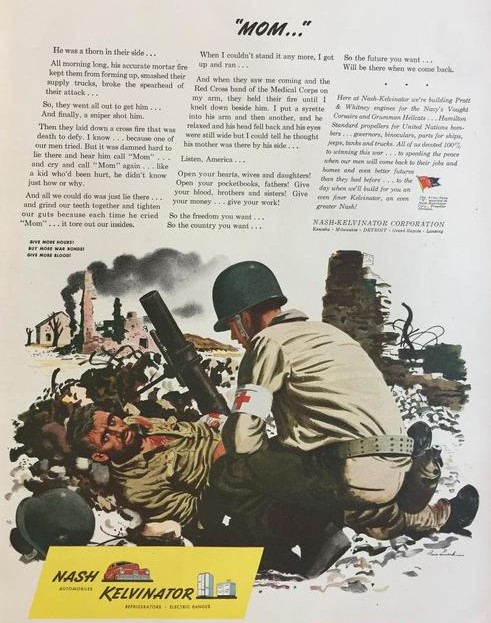
Their eyes lock with yours. That’s the first thing you notice, and the raw emotion of the background starts first from the face that is speaking to you and the eyes that make contact with you. It’s striking and even startling that you’re really looking at a magazine advertisement for a car company.  The cars are not in the picture, because the company isn’t making them anymore.

It was World War II, and car companies, along with appliance and many other manufacturers had turned from making their regular products to producing material for the war effort.  They were making tanks and planes now, uniforms, and all manner of military items.  These could not be sold to the public, so they had nothing to sell.  But they needed to keep their names in the public eye until the war was over.  So ads were published to encourage buying bonds (and thereby saving for the day when they could buy a new car, which Americans did, in large number).

My favorite among those ads were the Nash-Kelvinator. Each one told a little story. It was first person, usually the rambling stream-of-consciousness thoughts of the main figure in the ad talking directly to the reader.  The nurse who, in the midst of a frantic triage on a Pacific Island jungle discovered her own brother among the wounded.  
The man who, lost at sea in a lifeboat talks to himself, encouraging himself to not give up – because he wants to return to marry his sweetheart and return to his job, and to an America where he is free and has opportunity to work.

The guy wounded in the jungle who is fading in and out of consciousness, bleeding on the stretcher, “Somehow, I never thought it would end this way. I never thought I’d go home like this.”

The hollow-eyed POW who finally got a letter from home.  The guy standing on the train depot, just home from the war, not jubilant but wary, demanding direction – what happens now?  Each of the narratives drops you into a story already in progress, and you never get to know the ending.  You are left to imagine it and wonder, and that may be the best storytelling of all.  

There is, of course, in all the ads the suggestion that manufacturing is a big part of our war effort and therefore is a big part of American democracy.  We hear about the rights of a man to return to a job and rise according to his abilities, but we are not inspired about workers’ rights, civil rights, or any of that messy stuff.

But it was an era, too, of messy stuff.  What many may forget today, particularly if they are classic film buffs and have a rather sentimental view of American patriotism during World War II, is that we were really not unified up until Pearl Harbor and not even afterwards.  People who lived during that time can tell you different, but we are losing more and more of the Greatest Generation every day, so intimate knowledge of those days is being lost, and their valuable ephemera—diaries, letters, oral histories—is often overshadowed by the more glamorous movies of the era which tell us everybody was on the same side.

Manufacturing, for instance, was not.  There was great resistance to President Franklin D. Roosevelt’s call for war production, especially by the car companies.  What won them over was that the government promised them “cost-plus” contracts which meant that they would never lose money, they were guaranteed profits.  So much for patriotism.

Today, we see the workers – not the management – of General Electric pushing for that company to shift to making ventilators for the COVID-19 crisis.  They are demonstrating in plants in New York, Texas, Massachusetts, and Virginia to shift from making aircraft components, turbines and their normal production to medical equipment.  Otherwise, GE is in the process of laying off thousands of its employees due to the current economic recession, which could find us in depression soon.  

Though American manufacturing may have needed to be dragged to the war effort in World War II, nevertheless, manufacturing, in large measure, won the war.   America and its allies would never have succeeded without the massive and vigorous juggernaut of American manufacturing.  The car companies were a big part of that.  

President Roosevelt’s wartime production policies were the basis of the 1950 War Production Act signed by President Harry Truman during the Korean War, and it is this act which Traitor Trump is being urged to fully implement to force General Motors to produce ventilators. So far, under pressure to use the DPA, he has signed an order for FEMA to acquire N95 masks from 3M. 

When teaching history to children we must always emphasize that history is never just the past.  It always shines a light on the present.

Nash-Kelvinator was formed in a merger in 1937 between the Nash Motors and Kelvinator Appliance Company.  We may recall the Nash Rambler and the Kelvinator refrigerators.  The company merged with Hudson Motor Car and the appliance division was later sold off to a company that would produce White-Westinghouse, Gibson, and Frigidaire products.  The car division ultimately became American Motors Corporation.

I first discovered these ads as a child, probably at about 10 years old.  In my elementary school classroom, there was a bookcase in the back of the room filled with old books and National Geographic magazines from the 1940s.  I suppose they might have been donated.  If we were done with our assignments and had some free time, we were allowed to take a book or magazine from the back of the room to our desks.  I loved those magazines for the ads.  I wasn’t too interested in the articles – world geography had changed quite a bit in the 1960s and early 1970s so that the social studies classes of my era bore little resemblance to the information in the old magazines – but World War II-centric ads were fascinating. They were even more educational. So much so that some years later when a librarian told me the town library was sending its old National Geographics to be bound into book volumes and tearing out the ads, I blurted, "They're the best part!"  She looked at me like I had two heads.

They were like the old movies that I loved.  They plunked you down into a specific moment in time.  They were dramatic.  They made you wonder.


*********

Jacqueline T. Lynch is the author of Ann Blyth: Actress. Singer. Star. and Memories in Our Time - Hollywood Mirrors and Mimics the Twentieth Century. Her newspaper column on classic films, Silver Screen, Golden Memories is syndicated nationally.

Thursday, April 2, 2020

Doing Our Bit in Isolation - The 1940s House


In the midst of the pandemic that requires us to be supremely careful, courageous, and compassionate, those of us in the classic film fan community likely have our own recommendations for favorite films to comfort and inspire.  We have favorite films for almost any occasion, actually.  You forgot to pick up your dry cleaning before non-essential businesses shut down?  There's probably a movie for that.  Clinton Sundberg, Charles Lane, and Bess Flowers are probably in it.

But today I'd like to refer you to The 1940s House, another source of comfort and inspiration, and a great learning tool, in the form of a television miniseries that takes us back to World War II in Great Britain. Or rather, it takes a modern British family back to those days and puts them through the paces to see how they cope with rationing, making do, being creative in the midst of adversity, pulling together to cope with a national calamity, and most of all--isolation.  It's a very entertaining and often quite funny glimpse into the old "what would I do if it were me?" game.

Perhaps you remember watching The 1940s House here in the U.S. on PBS back in 2002 - a time when we were still reeling and coping with the aftermath of 9/11.  It's available here on DVD, but you can watch it as well in four parts on YouTube.  If you're looking for something to binge-watch, this is a good pick.  It's not Mrs. Miniver (1942), but it's a nifty bit of time traveling. What I find most especially poignant is how the experience changed them and what it brought to their lives once the experiment was over.  If you do watch it, I'd love to know what you think.

There's another British family that has made a hit on social media this week for their hysterical version of "One Day More" from Les Misérables.  I leave you with them for an even more modern method of coping.
*********
Jacqueline T. Lynch is the author of Ann Blyth: Actress. Singer. Star. and Memories in Our Time - Hollywood Mirrors and Mimics the Twentieth Century. Her newspaper column on classic films, Silver Screen, Golden Memories is syndicated nationally.

Friday, March 27, 2020

John Greco's THE LATE SHOW


Hat's off to fellow classic film blogger John Greco of Twenty-Four Frames for publishing his newest collection of short stories.  The Late Show - And Other Tales of Celluloid Malice offers readers a shadowy world where eight tales of crime and horror share a tantalizing link -- there is in each of them a hint, or taste, or even an obsession with movies.

Some of the stories have an ironic, Hitchcockian sense of humor to them, some have a surprise ending, and all are geared to fans of crime fiction who also have a familiarity with the pop culture world of film, especially classic film.

Here's a preview of coming attractions (or what we in the book biz call a blurb):

Eight dark short stories all with two things in common - Movies and Malice! Murder, revenge, greed and more are now playing. In the title story, Margaret Allen's husband is addicted to movies and she cannot take it anymore. Frankie Bosco's on the run after killing two people. With the cops chasing him he ducks into a movie theater showing two James Cagney films. Plus six more stories that may make you change your movie habits.

Congratulations to John on this new short story collection!  The book is on sale here at Amazon in either eBook or paperback.  

For more information, have a look here at John's website.  

He is also a talented photographer whose work can be viewed and purchased on this site.

Saturday, March 21, 2020

FREE eBook - Meet Me in Nuthatch

To help pass the time during the pandemic emergency, please accept my offer of a FREE eBook...


Meet Me in Nuthatch - here's the story:

A whimsical, poignant tale about a practical joke-turned-publicity-stunt that fires up the small town of Nuthatch, Massachusetts, in a desperate attempt to attract tourists.

Christmas tree farmer Everett Campbell proposes turning the clock back to 1904 and reviving the town’s cozy past, an idea he gets from watching his young daughter’s favorite classic movie, Meet Me in St. Louis. She is thrilled at being allowed to dress up and pretend, but not everyone in town is enchanted with the nostalgic promotion—including Everett’s moody teenage son.

The media, and the tourists, do come, but the scheme also attracts a large theme park corporation that wants to buy Nuthatch 1904.

Everett now stands to lose his town in a way he never imagined, and his neighbors are divided on which alternate future to choose.

A local drug dealer, Everett’s boyhood enemy, may hold the future of the entire town in his hands unless Everett can pull off one of his most spectacular, and dangerous, practical jokes.


The eBook is FREE at Apple, Barnes & Noble, Scrbd, 24 Symbols, and Playster all at this link.

And it is FREE here at Kobo at this link.

Bless you all and best wishes for better months ahead.

Tuesday, March 17, 2020

Happy St. Patrick's Day!


Happy St. Patrick's Day from the Our Gang kids - who are not practicing social distancing in this photo.  That's okay.  Keep calm and watch classic films is our motto!

Saturday, March 14, 2020

Ben Model's Silent Comedy Watch Party


Go here to join Ben Model and his online house party for a special silent film screening - Sunday, March 15th at 3 pm EDT.  Have a look here at his blog for more info on his Silent Comedy Watch Party!

Thursday, March 5, 2020

Another Old Movie Blog 13th Anniversary


Like migrant birds returning in the spring, I seem to revisit The Best Years of Our Lives (1946) every year about this time.  Perhaps it is the message of a cautious, wary rejuvenation and pragmatic rebirth. Slowing becoming aware of the sounds, the scents, the pale light of a reluctant spring and adjusting to the surprise that life will go on.

Also marking the 13th anniversary of this blog.  Thank you for the pleasure of your company.

Saturday, February 22, 2020

Sullivan's Travels - 1941 - The Butler's Admonition


Sullivan’s Travels (1941) is a madcap romp and not-so-incidental grim social commentary—a most striking combination.  Writer/director Preston Sturges deftly constructs a screwball comedy around the framework of a sensitive and serious examination of poverty—while lambasting Joel McCrea’s naïve character for even seeking a social message.  As he begins his exploration of what it is to be poverty stricken so that he may produce a deep and profound message film instead of his usual comedies, Joel McCrea’s first and perhaps best admonition against such a quest comes from his butler.

“I have never been sympathetic of caricature of the poor and needy, sir.”

This is our entry in the Butlers and Maids Blogathon hosted by Rich at Wide Screen World and Paddy at Caftan Woman.  For more on butlers and maids, please see these posts by some terrific bloggers.

Robert Greig plays film director Joel McCrea’s butler in this movie, and Eric Blore his valet.  So intentionally anonymous are they that they are not given names, only referred to in credits as Sullivan’s Butler and Valet.  Both men spent much of their film careers playing butlers.  Mr. Greig, born in Australia in the 1870s, and Blore born in London in the 1880s, were perhaps destined for a life of genteel servitude on film in the caste system of Hollywood character actors.  Their accents, their ages, their physical types certainly recommended them for the job, and that indefatigable knack of being silly and supremely dignified at the same time, their very dignity being the springboard of their comedy. They died a year apart from each other in the late 1950s, an era when the British butler was becoming scarcer in Hollywood.

The movie begins ridiculously enough with Joel McCrea, a director fed up with producing comedies and seeking a serious subject worthy of a work of art, announces to the aghast studio heads played by Robert Warwick and Porter Hall his intention not to direct any more comedies.  Mr. McCrea is starving for satisfaction in his work, takes himself and his art very seriously, and having been raised with all the financial and social advantages of the monied class, is completely innocent about the harsh world of poverty.

Quite unexpectedly, the silliness is deflated like a balloon pricked with a pin early on in the movie when the fast-talking McCrea is brought short by the sonorous tones of his suddenly serious butler, Robert Greig.  Greig, unlike most Hollywood butlers, gets the honor of a closeup and a thoughtful soliloquy.

“If you’ll permit me to say so, sir, the subject is not an interesting one. The poor know all about poverty, and only the morbid rich would find the topic glamorous.”

Mr. McCrea defends his intentions, “But I’m doing it for the poor….”

To which Mr. Greig adamantly responds, “I don’t think they would appreciate it, sir. They rather resent the invasion of their privacy—I believe quite properly, sir. Also, such an excursion can be extremely dangerous, sir.”

This is not the “walk this way” nose-in-air schtick of the Hollywood butler.

“You see, sir, rich people and theorists, who are usually rich people, think of poverty in the negative, as the lack of riches as disease might be called a lack of health, but it isn’t.  Poverty is not the lack of anything but is a positive plague, virulent in and of itself, contagious as cholera, with filth, criminality, vice, despair as only a few of its symptoms. It is to be stayed away from even for purposes of study. It is to be shunned.”

Baffled and rebuffed, McCrea responds, “Well, you seem to have made quite a study of it.”

Mr. Greig answers, “Quite unwillingly, sir.  Will that be all, sir?”

Eric Blore, his valet, cleverly conceals identification in the soles of McCrea’s shoes like a mother protecting her boy at camp with nametags in his clothes, and in a phone call pretending to be a gentleman rather than a gentleman’s gentleman, he manages to trick a railroad clerk to tell him how and where a hobo might hop a freight.  He knows he cannot dissuade McCrea from his mission, but he does his best to pave the way for him.

We might like to know more about the butler’s past that would make him so articulate on the subject of poverty, but the story is McCrea’s, a well-meaning but essentially innocent and perhaps even pompous man who discovers the grim world of Depression-era poverty in a very personal way and learns to find his way back to the safety and blessed relief of comedy.

Veronica Lake is his companion on the trip, and as funny as the slapstick gets on their journey, it is astoundingly interspersed with almost documentary-like scenes without dialogue or narration of breadlines, crowded filthy flophouses, desperate Hoovervilles, and soul-crushing chain gangs. Some scenes are reminiscent of The Grapes of Wrath, and of I Was a Fugitive from a Chain Gang.

Comedy and tragedy, after dancing around each other for a bit, finally intersect at the end of the film in a sweet, sad, and gentle scene in a crude wooden southern Black church, led by minister Jess Lee Brooks, a figure of dignity and nobleness of spirit.  After services, they are to have the special treat of showing a film and have invited the inmates of the local prison to join them.  The preacher reminds his flock, “Neither by word, action, nor by look to make our guests feel unwelcome, nor draw away from them, nor act high with them, for we’s all equal in the sight of God.”  The prisoners, shackled, file in – McCrea among them, who has been mistakenly arrested for murder—as preacher Brooks sings in his majestic bass voice, “Let My People Go.”

The oil lamps on the wall sconces are turned down, and the projector is started up, and a Mickey Mouse cartoon featuring Pluto, who struggles with flypaper stuck to him, entertains the congregation and their guests. McCrea observes the pleased reaction of everyone around him, how they laugh, and finds himself laughing.  He has discovered the magic of comedy in the war against poverty. Real-life director Sturges is far more successful than fictional director McCrea, for he has managed to combine tragedy and comedy in a way that validates both and trivializes neither.

The butler and valet are not present at Joel McCrea’s moment of epiphany.  We could not imagine them guffawing at Pluto with flypaper on his tail.  Perhaps they might have smirked only slightly with disciplined propriety and uttered to their master in clipped speech, “Very good, sir.”
*********
Jacqueline T. Lynch is the author of Ann Blyth: Actress. Singer. Star. and Memories in Our Time - Hollywood Mirrors and Mimics the Twentieth Century. Her newspaper column on classic films, Silver Screen, Golden Memories is syndicated nationally.

Thursday, February 20, 2020

Blogathon!


Come back Saturday the 22nd when we visit the Butler and the Valet in Sullivan's Travels (1941) as part of the Butlers & Maids Blogathon hosted by Paddy and Rich!


Thursday, February 6, 2020

Requiescat in pace - Kirk Douglas


It is rare these days for the world of the classic film fan to intersect with news of modern pop culture, for our heroes were of the past, in a studio system long gone and by most, forgotten. When we mourn the passing of a figure from Hollywood's heyday, as happens more frequently as the years pass, non-classic film buffs may say, "Who?" and wonder cynically at our bereavement. 

The passing of Kirk Douglas yesterday gives occasion to remember a great actor known not just to a nostalgic and narrow old movie fandom but also a man who by his long career and longer life is still identifiable as a celebrity, which is certainly unusual.

He was 103 years old when he passed, and remained in the public eye long after his last TV role some twelve years ago.  We old movie buffs know he began his career in 1947, supporting Barbara Stanwick, no less, in The Strange Love of Martha Ivers.  He was soon cast as leads, and he never looked back. His career stretched from film noir of studio system days to big budget blockbusters in the fifties and sixties, to eventual character parts and comedy cameos. He wrote his memoirs. He was a humanitarian. But just remaining in the public eye for so long and allowing us to see him age, rather than retreat into private life, is a testament to his vigor and his sociability, despite serious health events over the years. He was joined in the business by his famous actor son, but never replaced by him.  It was good to witness in a society that tends to marginalize the aged.  

We discussed his work in Strangers When We Meet (1960) here, and Seven Days in May (1964) here.

Related Products