Join me at the 5th annual Easthampton Book Fest where I'll be selling my books in the Literary Marketplace with a host of other writers in this town-wide cultural event.
The date is Saturday, April 13th, from noon to 5 p.m. at the Eastworks building on 116 Pleasant Street, Easthampton, Massachusetts.
A variety of other activities and vendors will be located also at the Cottage Street Cultural District and at the Historic District at Main & Union streets.
My twin brother John and I will be there with all our books, including our newest venture - Bob the Bear's A-B-C Coloring Book! If you like to color and have forgotten the alphabet, this is just the thing for you.
Or give it to a child. You'll look less ridiculous. See you in Easthampton, Saturday, April 13th!
"If I have offended you by this rather mild account of Buchenwald, I am not in the least sorry."On April 15, 1945, journalist Edward R. Murrow entered the Buchenwald concentration camp with the American Army and broadcast what he saw.In this disgusting era of attacks on journalism and journalists, and the appalling ignorance of the facts of the Holocaust, and the evil of its deniers, it is imperative to speak the truth, to hammer the truth home to those who are too lazy, too stupid, or too corrupt in their hearts to want to listen. Listen as well to what people said to him about President Franklin Delano Roosevelt, who died only a few days earlier on the 12th. Listen to when the world recognized moral American leadership and was grateful, in an era when we realized the democracies of the world were our friends and we knew we couldn't do it without them.
I am inclined to think fans of classic films have a better grounding in the study of history than those who do not watch classic films, but I really don't know that for a fact. I do know that those fans of classic films who indulge only in the fantasy aspects will deny themselves the greater value, and the greater privilege, of learning about the sometimes hard and gritty bedrock of the world in which those films were made.
This month marks the 12th anniversary of Another Old Movie Blog, and, having passed over 2 million pageviews, I'm grateful take this opportunity to once again thank you for the pleasure of your company.
The Search for Bridey
Murphy (1956) created a 1950s fad and fascination with reincarnation,
spawning books, records, jokes, and “come as you were” parties. It is based on a true
story, and its docudrama presentation is used to grab the audience
in a way more effective than if the subject were sensationalized. Pop culture in later decades churned out
almost an entire industry around unexplained phenomena, and this movie, which
did not really stand the test of time despite the huge splash it made, explored
taboo fears in an unsettled postwar world.
The story is based on the book of the same name, published
in the same year, by Morey Bernstein. He was a businessman who developed a
fascination with hypnotism. It became something of a hobby and something of a parlor
game. On one such occasion he hypnotized a Colorado housewife named Virginia Tighe
(to protect her identity in his book and in the movie, she is called Ruth
Simmons). Through hypnosis, he took her back in time to her childhood and as an
entertaining experiment, tried to see how far back in her conscious he could
take her. Unexpectedly, she began to speak of memories of her experiences in
the previous century in Ireland, and she spoke with an Irish accent. She identified
herself Bridey Murphy, who lived from the late 1700s through the early 1800s.
In several hypnotic sessions with him, she told of experiences of her childhood
in Ireland, her marriage, and even her death. Bernstein and their circle of
friends were astounded. They had stumbled upon, so it seemed, evidence of a
case of reincarnation.
Bernstein wrote a book about their sessions and it became a
bestseller and spawned a great deal of talk, speculation, and fascination with
her story. But since neither were after fame or notoriety, Virginia Tighe
preferred to live her life out of the spotlight, for the most part, and
Bernstein gave up hypnotism and went back to his business. They both died a few
years apart from each other in the 1990s.
The movie is amazingly powerful despite its low-key
simplicity. Teresa Wright stars as Ruth Simmons, the woman who appears to have
reconnected with her reincarnated self, Bridey Murphy. This would not be Miss Wright’s final film
but it would be her last leading role. She was now in an era where Hollywood
tended to turn away from its big female stars once they had reached their 30s and a
new crop of younger nubile actresses came along. But I suspect the role itself appealed her and was a different sort of challenge than she had had in other
films in her career. She actually spends most of the movie lying on a couch
with her eyes closed, but despite the lack of movement, she is in close-up most
of the time and we are riveted to her changing expressions and to the soft lilt
of her Irish accent. She acts out responses to Bernstein’s questions, at turns
haughty, dismissive, irritated, delighted all while being under the haze-like
influence of hypnosis. On one occasion, she is asked to do a jig she has
described and she stands and performs a graceful Irish dance. Unlike in most
stunts that hypnotists ask their subjects to perform, she does not look silly.
The quiet moment leaves the viewer somewhat awestruck and Bridey Murphy becomes
not a joke or a parlor game but an eerie unknown which is equal parts intriguing and somewhat frightening.
Louis Hayward plays Morey Bernstein in this movie. We last
saw him as Philip Lombard here in And ThenThere Were None (1945). Hayward and the other members of a rather large
cast are really actors and actresses with minor careers and after this movie
invariably did a great deal of television. Richard Anderson, who plays a
doctor, is among them. He probably had a more prominent career than anyone else
of the supporting players.
Using a cast of predominantly little-known players in a documentary format gives the movie a certain quiet, sober feel
that perhaps producers felt added to its authenticity. It allows us to take the
subject more seriously than if it were an overblown soap opera plot with a cast
of stars.
The movie opens with Louis Hayward standing behind flats on
a movie set. He breaks the fourth wall and speaks directly to the audience,
describing to them what is about to happen. Suddenly, he walks onto the living
room set and starts speaking as if the action has started and he is Morey
Bernstein. It’s an interesting effect that seems seamless, like the drifting
between past and the present in this movie, like the swing from conscious to
unconscious, he moves from reality to make believe in an instant and it is kind
of a metaphor for what is about to happen.
He is a businessman invited to the home of some friends
where he sees a man attempting to hypnotize the lady of the house. It is all in
fun and like any nightclub hypnotist of the day, he gets her to do silly things
and the other guests at the party laugh. Bernstein thinks it’s all nonsense
and he volunteers to be hypnotized but it doesn’t work on him. The doctor,
played by Richard Anderson, tells them that not everyone can be hypnotized and
this intrigues Bernstein. He learns as much about hypnotism as he can, starts
trying it out on other people and finds he has a knack for it. He even helps
Richard Anderson in his clinic for people who suffer from disability.
Bernstein’s own skepticism tumbles away when he sees that he is able to help
people walk, or take away migraine headaches purely by hypnosis. He practices
on his own wife and it gives him the courage to practice on other people.
At another house party, a guest talks about another famous
case of hypnosis used in medicine by renown clairvoyant Edgar Cayce, who was
called The Sleeping Prophet. Cayce had died the previous decade and had become
famous for his ability under a hypnotic trance to diagnose the illnesses of
people and to describe how they should find a cure. Also, to the Cayce story is
the aspect of reincarnation.
When we are told about Edgar Cayce, we are given a flashback
scene acting out a very eerie instance where Cayce describes an old-time remedy
that even the druggist doesn’t know he still has on his shelf that cures a
boy’s leg. Bernstein is so fascinated, he travels to Virginia Beach, Virginia, to meet
Cayce’s son Hugh who runs the Edgar Cayce research center. He comes to believe
that Cayce was not a fraud. Bernstein still doesn’t believe in reincarnation
but he’s very interested in seeing if he can take a person back in time through
their subconscious to as far as childhood.
At another party, Teresa Wright, with her husband’s
permission, volunteers to be the next guinea pig. Her husband is played by
Kenneth Tobey, stalwart, solid, middle management 1950s suburban dad who is
freaked out by all of this and wishes she would just stop, but he is indulgent
and allows her to play the game. Bernstein hypnotizes her and takes her back to
events that happened when she was seven years old. It’s quite convincing.
A couple of days later they pick up the session and he takes
her back to one-year-old and he audiotapes her conversation with him. Through
successive sessions he tries to take her back farther and farther –suddenly we
tap into…Bridey Murphy.
Bridey Murphy is four years old and she lives in Cork, Ireland, and
Teresa Wright speaks in Bridey’s Irish accent. She is eight years old. She is
15 years old. She is 18 years old in the year 1806. She talks of her family and
her childhood experiences with her parents and siblings. The flashbacks occur
in a foggy haze with other actresses playing Bridey and her circle.
Teresa Wright sings a brief little song a cappella and it is sweet and it is
eerie.
Her husband is annoyed, and Bernstein’s wife, played by
Nancy Gates, is also a little jealous of their time together. Teresa Wright lies
supine, serene under a blanket, her pearl choker nestled against her neck. She
is utterly helpless in the hands, psychologically, of Louis Hayward.
We learn about Bridey's life, of her parents, how she
married at 20 and lived with her husband in Belfast and had no children.
She describes many aspects of what it was like to live in Ireland at that time.
Her husband puts his foot down once again to stop. There is
a religious debate with a priest and a minister. The priest, when challenged by the concept of
reincarnation as the basis of the Buddhist faith replies, “Any sincere faith manifests
its strength by its tolerance of other faiths.” These are noble words to live
by and they have a philosophical discussion. At first, Teresa Wright is freaked
out by the notion that there is someone else living in her psychic memory, but
now she is curious and her husband lets her go ahead. Richard Anderson
hovers by, also concerned about some unseen danger that we don’t know.
Professors and a publisher take note.
Then we have the death of Bridey Murphy, which is, after all,
the point on which reincarnation hinges. A person cannot be reborn unless they
first die. Bridey is 66 years old and she breaks a hip. She lingers in bed
while her husband takes care of her. He goes to church (there is some
discussion of their religions because he is Catholic and she is Protestant) and
she has died while he is gone and he was very upset to have not been with her
at her death. These are really sad and haunting scenes.
Hallene Hill plays Bridey at 66. She had a career of minor
roles usually “old lady.” She, like all the other cast members in the flashback
scenes, does not speak. There is only pantomime with Teresa Wright’s narration
over what they are doing and saying. When Bridey dies, Hallene Hill, ghostlike,
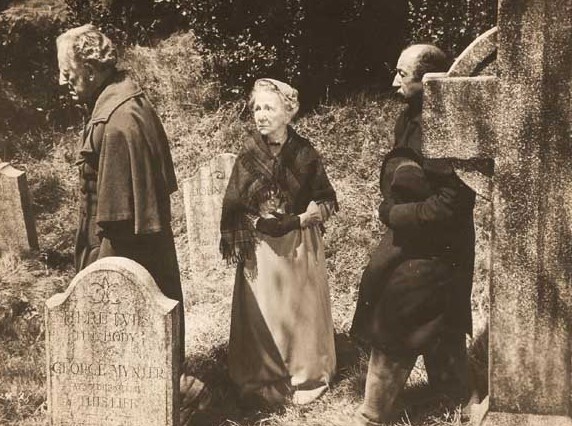
sees her own funeral, her own burial plot at the graveyard, and Teresa Wright
reads the stone. The ghost of Bridey hovers in her own home to watch her
grieving husband and is sad that she cannot reach him, he does not hear her, he
does not know she is there. She visits the home of her brother but he does not
see or hear her either, and she spends a lonely existence in an afterlife.
And then Teresa Wright says she is born yet again in America, another person. Whoa.
Their session stops only after Bridey seems to not want to
let go. Bernstein tries to awaken her from her hypnotic sleep but every time he
does, gives her the command to wake up, she's still
Bridey. Bernstein panics, her husband panics, everyone in the room panics as, time and time, again he orders her to be Mrs. Ruth Simmons but Bridey won’t let go.
It is a sedate and quiet moment in the living room but it is
more frightening than any monster movie you’ve ever seen. She keeps speaking in
that accent, running over and over again on a frantic loop, her memories as Bridey Murphy. At
last, finally, Ruth breaks through and comes back.
The doc says this has to stop. Bernstein is only too happy
to stop now; he’s ready to have a nervous breakdown.
A publisher has become interested in the book and the wheels
are in motion to print Bernstein’s audio transcripts of his sessions with
Teresa Wright. First, however, they must do some checking to see if they can
verify the facts as they have come to know them about Bridey Murphy. William J. Barker, who first wrote of the sessions in a series for the Denver Post, plays himself in this movie, and co-wrote the book.
But under the glaring light of celebrity, this is where the fancy crumbles; not in the movie, butin real life.
In the aftermath of the book’s popularity, facts from the
transcripts were investigated and it was difficult to find evidence of a Bridey
Murphy living in the place and time that was described. Some aspects of her
stories were proven but others could not be substantiated. In some circles, the debate continues to this day. It was discovered that
the real Ruth Simmons,/Virginia Tighe, had at least one aunt and also a
neighbor, who came from Ireland whom she knew as a very small child and she could have been repeating memories they told her. There were some accusations of this all being
a hoax.
However, scientists and psychologists have decided that this
really was a case of cryptomnesia, rather than a paranormal experience or a
hoax. It was really an equally fascinating aspect of our subconscious that
allowed her to remember stories told her from her earliest childhood, that she
had forgotten, and that she had subconsciously borrowed. Something had been planted in her memory and
she could not control it but lived it through hypnosis as if it had been her
own experience.
However, the mournful scenes of a ghostly Bridey Murphy watching her
grieving family from beyond are of some of the most powerful in this movie and
they don’t seem to be explained by the researchers, so I’m not sure if this was
something the writers of the movie threw in, because I have not read the book. Maybe someone can set us straight with an explanation for that.
The Search for Bridey
Murphy is a piece locked in time—in the 1950s, not necessarily in 1800s
Ireland, where existential worlds collided and the sane normal was shattered in the mundane and iconic 1950s suburban living room. It is a movie probably forgotten these days, but it is well worth a
look for its interesting avenue of storytelling and for Teresa Wright’s
ethereal performance. Currently, you can see it on YouTube.
Maureen O'Hara appears on page 49 of Big Star Album, no. 1, Winter 1943, a large magazine from the Dell Publishing Company. The paper is not glossy, being the wartime stock, but the issue is loaded with full-page portraits of the stars of the day. One is struck by the repeated references to Miss O'Hara's Irish birth, not as a matter of biography but rather, it seems inferenced, as a selling point, an important part of her studio publicity.
To have been foreign born is naturally exotic to us, and to have trained in Dublin's illustrious Abbey Theater is certainly impressive, but her blurb is filled with Blarney Stone and leprechaun references, of being an Irish colleen. Did Marlene Dietrich's German heritage, Ingrid Bergman's Swedish heritage, or Greer Garson's English heritage matter as much to their careers? Were they selling points, or merely interesting trivia?
The article stresses that despite her beauty, Miss O'Hara was an accomplished actress, that she was not just building a career on her charm. Indeed, she was a splendid actress, nor did she lean on predominantly Irish roles, which would have limited her career, though she was obviously proud of her ancestry and even recorded an album of Irish folk songs. Even charming tropes are still tropes, and one must wonder if they weren't occasionally an exhausting burden.
Deanna Durbin had a secret life, at least as evidenced by her two adventures told in children's novels: Deanna Durbin and the Adventure of Blue Valley, and Deanna Durbin and the Feather of Flame. These began a popular, if sometimes rather odd, series of girls' books by Whitman Publishing Company of Racine, Wisconsin. We learned about the adventures of other stars as well in exploits never told in fan magazines.
These two books were published in 1941 and spearheaded the collection that would be known as the Whitman Authorized Editions, though whether any star actually authorized these stories is quite doubtful. They do stand as creative examples of not only the studios' ownership of its stars, but its wide-reaching commercial exploitation of the stars as its products.
One of the more interesting of the series was Ginger Rogers and the Riddle of the Scarlet Cloak, which was actually written by her mother, Lela E. Rogers, so Ginger must have at least known about the novel even if she didn't authorize it. The story has Ginger dealing with a rough relationship with her mother, meeting her father for the first time, and in her job as a night switchboard operator for a hotel, ferrets out enemy spies in the aftermath of Pearl Harbor. A full day's work.
Most, but not all, of the books in the series were written by Katheryn Heisenfelt.
We see by the titles that many stars had a lot going on in their lives. There is:
Bonita Granville and the Mystery of Star Island
Jane Withers and the Hidden Room
Ann Rutherford and the Key to Nightmare Hall
Betty Grable and the House with Iron Shutters
Jane Withers and the Phantom Violin (Jane Withers was very busy.)
Betty Hutton and the Romance of Palmetto Island
Ann Sheridan and the Sign of the Sphinx (Look at her casting that wry eye at the whole idea.)
Jane Withers and the Swamp Wizard (Jane's back again in a weird swamp story.)
Judy Garland and the Hoodoo Costume
Shirley Temple and the Spirit of Dragonwood
Shirley Temple and the Screaming Specter (because why should Jane Withers have all the excitement?
Gene Tierney and the Invisible Wedding Gift (I find this title the most intriguing.)
Dorothy Lamour and the Haunted Lighthouse
And just so you don't think the ladies have all the fun, we have:
John Payne and the Menace at Hawk's Nest
Gregory Peck and the Red Box Enigma
Van Johnson, the Luckiest Guy in the World.
If any of you have read any of these books, I'd like to hear your book report.
*************
In this previous post from 2010, I discussed some children's novels that were centered around World War II and published in that era. I'll be writing a book on this subject, something that's been on the back burner for, obviously, a very long time. My to-do list is so long it sometimes strangles me, and I have to shoot it. But I'd like hear your input as well on books like the Cherry Ames series, the Dave Dawson series, the Ann Bartlett series, etc., all the pre-teen novels about the war. I'll post more on this down the road.
Stage Door Canteen
(1943) and Hollywood Canteen (1944)
served a dual purpose: They were
examples of the entertainment industry supporting the war effort, and they also
allowed the entertainment industry to show
that it was supporting the war effort.They were marvelously successful on both counts.
Both films are all-star extravaganzas of featured acts and
cameos of actors and actresses, with a thin plot moving the story along.Stage
Door Canteen is set in the famous Broadway canteen established by the
American Theatre Wing in March 1942.A
free nightclub to servicemen and allied service personnel, the military got
free entrance to see the stars, free food, and hostesses to dance with and chat
with and maybe even more, as both films suggest.
Broadway was the leader in pop culture in many ways.Most of the songs on the radio were theatre
tunes, many of the actors, writers, and directors in Hollywood got their start
in theatre.“The Great White Way” was a
phrase known by everyone, even in the smallest towns.World War II gave theatre another stage, so
to speak, and another opportunity to lead the way.Their Stage Door Canteen, located in the
basement of an old Shubert Organization theater on 44th Street, was
a unique and exciting way to show support for the troops.It was the forerunner for many other service
personnel canteens that followed in other major cities, including one in
Hollywood, as we noted in our previous post here.
The Stage Door Canteen was such a phenomenon it spawned a
radio series, and a popular song, “I Left My Heart at the Stage Door Canteen.”That song was featured in the Army-produced stage
show and film This
is the Army (1943), which we discussed here.
The movie, Stage Door
Canteen, features a fictional young woman, named Eileen, who is a volunteer
hostess who meets a particular soldier and their lives are changed forever.Maybe.
In this case, Eileen is an ambitious young actress, played
by Cheryl Walker.She is a newcomer to
the canteen, and really more interested in meeting play producers than soldiers
or sailors. Her two friends, played by Marjorie Riordan and Margaret Early, are
also young actresses attending auditions, but they are more dedicated to the
canteen.
William Terry plays Dakota, an aloof soldier who is the gentle
lead of his buddies. Michael Harrison, whom we will later come to know as
Sunset Carson, plays Tex. Frederick Brady plays Jersey, who has a fiancée he
visits, so we don’t see too much of him at the canteen.Lon McCallister plays California, whose
biggest worry, apart from going overseas, is that he has never kissed a
girl.
They come to the Stage Door Canteen on a few successive
nights on their last leave before being shipped to Europe.As thin as their storyline is, it is still compelling.Dakota has no family and no one to write to
him, so he has learned to be loner and is satisfied, but despite his aloofness,
Eileen has caught his eye.She is too self-involved
to be anything but irritated by him.Jersey has to get permission from his commanding officer to arranged a
rushed wedding at a justice of the peace with his fiancée.We don’t know too much about Tex, except he
wants to be with a Southerner like himself, and luckily, he finds vivacious
Margaret Early.
Lon McCallister is left to Marjorie Riordan’s comforting
understanding on his dilemma about not ever being kissed.She does not laugh at him, and neither should
we.Many such young men who had never
even left their hometowns before they were shuttled to all corners of the earth, and
many to their deaths.I remember a World
War II vet I interviewed over thirty years ago lamenting this when he discussed
his comrades in North Africa.“Some of
those boys were just as green as apples.They didn’t know what life was or wasn’t.”He was near tears as he spoke, thinking of it.I think he thought of it a lot, for the rest
of his life.
But the boys coming to the canteen—anonymous in their “state”
nicknames—are there not just for a fun time, but to take us along to see the
stars.
They are from the theatre and also from radio.Some make only a cameo appearance, like Aline
McMahon, and some get a few lines, like Paul Muni.Some perform, like Gypsy Rose Lee.Just as small-town folks knew about the
phrase, “The Great White Way,” they also had heard about, even if they had
never seen, Gertrude Lawrence, Jane Cowl, Cornelia Otis Skinner, Tallulah Bankhead,
and Katherine Cornell.
When Lon McCallister stands in the food line, he meets
Katherine Cornell serving behind the counter, and when he tells her of his high
school production of Romeo and Juliet,
she recites the lines from the balcony scene.It was her most famous role, and it is quite moving, sweet and
poignant.It was also Miss Cornell’s
only appearance on film, and for that we can certainly be grateful for this
movie.
We see the greats Alfred Lunt and Lynn Fontanne in the
kitchen, and George Raft washes dishes, and Alan Mowbray is a busboy.Dame May Witty and Helen Hayes are greeters
at the door, and Ray Bolger performs, as does Gracie Fields.Ethel Merman belts out a song, and the big
bands play.One of them, Count Basie’s
orchestra, backs Ethel Waters.Miss
Peggy Lee is smashing with “Why Don’t You Do Right?” with Benny Goodman’s
orchestra.
Sam Jaffe speaks Russian to a small group of Russian soldiers,
including a woman and calls them “our fighting allies.”It was an innocent remark then, only now do
we see the irony as we recall Mr. Jaffe being blacklisted in the next decade
when such sentiments were suspect.
Chinese troops are sent off with a chorus of “Auld Lang
Syne,” and any night any unit may be called out to the troop ships.There is a live-for-the-moment feeling that
is energetic and yet wistful.At the
end, Katharine Hepburn gives “the speech” to buck up Eileen.“We’re in a war and we’ve got to win…”
The movie is now in public domain, and you can see it
here.From the first moments of the theme
song, played throughout as a background instrumental, is the song “We Mustn’t
Say Goodbye,” which was nominated for an Academy Award.It is an especially lovely song that tears at
the heart and embodies the spirit of that moment when the partings come.One verse:
Don’t you know the
memories we gather
Can never, never die.
We mustn’t say
goodbye.
It is emotion expressed in a way unique to that generation,
who were “green as apples.”If you
follow the link to the film, go down toward the end at 1:41:29 and listen to
vocalist Lanny Ross (whose real name was Lancelot, and I think he should have
used it), sings in his magnificent tenor.
The song is so much a part of Stage Door Canteen, that it pops up, again as background, in Hollywood Canteen, made the following
year.You will hear it as a leitmotif
between Robert Hutton and Joan Leslie.
UPDATE: Here's a clip of Lanny Ross singing "We Mustn't Say Goodbye" --
I expect part of that heartbreaking wistfulness of Stage Door Canteen was because it was
directed by Frank Borzage, who as we know, specialized in that kind of lovely
torment.The script was by Delmer Daves,
whom we might remember better for his splashy soap-opera type dramas of the
1950s.He also wrote the script for Hollywood Canteen, and this time
directed it as well.It follows roughly
the same template as Stage Door Canteen,
but there is a note of flashiness here that comes from either Mr. Daves’ showier
sensibilities with a film under his complete control, or because Hollywood is
just made that way.
Stage Door Canteen
was not actually filmed in New York; that canteen ran seven nights a week, so
there was no opportunity for filming there.It was replicated on a soundstage. In Hollywood
Canteen, we leave the New York theater basement and drop in to the old barn
on Cahuenga Boulevard and a new crop of West Coast stars.
We meet the soldiers played by Robert Hutton as Slim and
Dane Clark as Brooklyn—more anonymous “everyman” nicknames—while they are still
in the jungles of New Guinea.Hutton’s
girlfriend has not written to him in over a year, and he takes the hint they
are off.Instead, these days he fantasizes
about the Hollywood actress Joan Leslie, whom he sees on films played in
camp.At one such showing, outdoors in
the pouring rain, the sound goes off and the men choose to continue watching
without the sound, just so they can see the pretty girls in the musical
starring Joan Leslie.It is probably the
most poignant moment of the film.
Hutton and Clark are being sent home on furlough on a
hospital ship because they have each been wounded.After a few weeks in hospital and rehab, they
have a pass to see Los Angeles.Hutton goes
sightseeing, but finally makes his way to the Hollywood Canteen, and we learn
as he does that the food and the fun is for free if you’re in uniform.
We get another roster of servers and greeters and kitchen
staff—Jack Carson, Sydney Greenstreet, Peter Lorre, Joe E. Brown, Joan Crawford,
Barbara Stanwick, Paul Henreid, Alexis Smith and her husband Craig Stevens,
Zachary Scott, Ida Lupino, and many more.Some of the specialty acts here are on a grander scale than in Stage Door Canteen.“You Can Always Tell a Yank” turns into a
huge production number, with the audience of soldiers filing in for a grand
march at the finale.Roy Rogers rides Trigger
onstage for a song.Each act has its own
set.
Two of the best acts are The Golden Gate Quartet and Joan McCracken,
fresh from Broadway in Oklahoma!Miss McCracken does a fabulous be-bop ballet
as a youngster in a dance hall.
The quartet, whose perfectly blended voices sing of the
nation’s diversity in its fighting ranks is an example of the way both movies celebrate
diversity as the American ideal of democracy. Though the military was still segregated,
the canteens were not, and while not all Americans enjoyed the benefit of true
democracy, one can see the nation’s heart wanted to idealize that notion even
if we had a hard time living up to it.We
saw ourselves as being better for living up to standards that were higher than
our enemies’.
Robert Hutton meets Joan Leslie, gets a kiss from her set up
by Bette Davis and John Garfield, visits her home, meets the folks, and wins a
weekend with her for being the millionth man at the canteen.(I love Alan Hale’s horrified expression
listening to two servicemen discussing whether to go inside the canteen or meet
dates elsewhere as they blow the chance to be the millionth man.)That a romance with a movie star was improbable
for a soldier visiting the Hollywood Canteen was evidently the reason Ann
Sheridan, who was originally offered the Joan Leslie role, turned it down. She thought the premise ridiculous, and it is,
but that never stopped Hollywood before.
Hollywood Canteen
tends to be a little more self-congratulatory and self-aggrandizing than Stage Door Canteen, Hollywood clapping itself
on the back for doing a good turn.For
all the fun of searching out familiar faces among the stars, you’ll see only talent
from Warner Bros.Actors from all the
studios helped out at the Hollywood Canteen, but studios were more generous
about lending their employees to Uncle Sam than they were to lending them to
another studio.
Both films are fun to watch for the parade of stars and their
awkwardness of trying to be themselves in a fictional scenario, that, when the
cameras weren’t rolling, was not fictional at all.I doubt there will ever been another film
again with as huge a cast of stars and character actors so well known to the
public that showing them being like regular folks was almost irrelevant,
because we already thought we knew them.They were, just as our democratic ideals, what we wanted to be like at
the time.