IMPRISON TRAITOR, PEDOPHILE, AND CONVICTED FELON TRUMP.

Thursday, September 1, 2016

Aurora & Classic Movies and More Interview

Time for Part Nine in our monthly series on the current state of the classic film fan.  


Today, we visit with Aurora Bugallo, whose blog Once Upon a Screen is a delightful gallery of info and photos on our favorite classic films and TV.  A prolific contributor to social media (who takes my favorite photos -- of the top of her head below some famous tourist attractions or at some event -- I really think she should put out a coffee table book on these hysterical pics), and whose latest venture is a dynamic and entertaining series of podcasts on YouTube called Classic Movies and More, which she hosts with Annmarie Gatti and Robert Medaska.  

Here’s our discussion on classic movies…and more:

JTL:  How did you, Annmarie Gatti, and Robert Medaska come to know each other, and then come together to plan this venture and to facilitate it?

AB:  Well, let’s see…I first “met” Annmarie on Twitter.  She was one of the first people I connected with on the platform.  After I visited her site I was blown away by its scope and we had plenty to discuss there so it was a seamless connection. She’s also always been incredibly supportive of my blog.  When we met in person at the 2013 Turner Classic Movie Film Festival it was as though we knew each other.  Among the things we’d discussed almost since we met is the possibility of collaborating in some way on a classic movie-related project, but we couldn’t quite put our finger on what. 

Rob and I met at a faculty meeting about three years ago.  We both teach at the same university and the program director couldn’t wait to introduce us knowing we had classic movies in common.  Soon after we met Rob stated mentioning the possibility of collaborating on something classic movie related.  About a year later I thought it would be a great idea to introduce Annmarie and Rob knowing they had similar interests.  I knew I could only benefit from being around the two of them.  As a filmmaker Rob has impressive technical knowledge and Annmarie is a master of all things social media.  It really took no time for the three of us to decide on the YouTube show idea.

JTL:  In one article on my series this year of the current state of the classic film fan, I mention how technology has allowed us to move beyond the movie theater, the home viewing, and extend our classic film viewing onto the Internet. Here, we not only watch movies, but we connect with other fans. In a do-it-yourself world of self-publishing of music and of books, it seems a natural that classic film fans would want to also move to a do-it-yourself realm of programming. From my post in April:

There are also some intriguing home-grown programming—such as Dana Hersey, who hosted The Movie Loft on Boston-area TV-38 in the 1980s is launching an Internet classic movie streaming channel. Other hosts of online podcasts demonstrate that being a classic film fan is continually evolving according to the technology that allows us to appreciate old movies.  No longer content to be “programmed to”, the classic film fan is now taking the reins and doing the programming. 

Do you see CLASSIC MOVIES AND MORE as a part of this trend? And what do you hope to accomplish with the project?

AB:  I absolutely do.  That trend is the primary reason why Rob insisted on this type of show.  I’m a big fan of classic movie podcasts and subscribe to several that I enjoy immensely, but – mostly thanks to Rob – we wanted something a little different where we can offer the sights as well as the sounds of people and places that mean something to our classic film community.

As far as what we would like to accomplish – as we mention in the pilot episode of “Classic Movies and More” we have lofty goals.  We’d like to go everywhere and talk to everybody.  We base everything that we’ve laid out so far on our own interests as fans and the show being “by fans, for fans” is central to why we decided to do it.  We want to talk to the fans that play a role in keeping the movies and stars alive.  We want to promote authors (like you) and others who put in extraordinary time and effort to ensure the people whose work we admire stay relevant.  Aside from allowing the three of us a new way to express how much we love these movies we want to have a forum for all fans to do so as well.  Of course that includes historians, projectionists, accompanists, theater owners, bloggers and what have you because at the core of most of their work is a fan. 

JTL:  It's terrific that you've covered the small but significant stories that I think are not given much play elsewhere - the Biograph episode, the Bob Furmanek interview.  I especially enjoyed the three-part series with Meredith Ponedel on her father and aunt, Dottie Ponedel, who had such an impact on the industry and such warm connections with so many stars as a makeup artist. (From a technical aspect, I also would like to mention that I thought the camera, the editing, and the patter of the interview was extremely well done.)  I would love to see some of your episodes broadcast on TCM to achieve a wider audience.  How do you investigate these story ideas, or how do they come to you?

Also, in the pilot episode, the possibility of future podcasts on visiting classic film-related museums was mentioned. I'd love to see that.

AB:  I’m so glad to know you enjoyed those episodes.  Meredith Ponedel was a happy accident who came to our attention thanks to Kelly Kitchens who runs the “Going to TCMFF” Facebook page.  Meredith was excited to talk to us and we were riveted by her stories. Naturally we thought other fans would be as well.  I agree that Annmarie did a fantastic job with that interview.  As for Bob Furmanek – he’s a tireless advocate for classics particularly true in his efforts to save 3-D films.  Bob and I have become friends and I love what he’s doing.  I’m hoping we can promote any and all projects he has on the horizon.  Finally, the Biograph segment came about because Professor Ultan who’s the Bronx Borough Historian also happens to teach at the same university that I do.  He’ll be featured in another piece soon where we visit Woodlawn Cemetery in The Bronx.  All I can say about him is that if I lived five lifetimes I wouldn’t know what he knows so it’s thrilling to be in his presence.

We’ve been lucky so far with the people we’ve been exposed to through the classic film connections we’ve made.  I expect that these connections can only get deeper and larger in scope.  We come up with ideas in a variety of ways, but consult on an overall plan that focuses on what we can do locally first and branch out from there.  We have so much film history in our own backyard so to speak that there’s no rush to travel the world - although eventually we want to.  We’ll soon be incorporating Skype interviews/discussions as part of the programming, which will certainly increase the number of people we can talk to and topics we cover.  Rather than covering “newsy” topics we prefer (perhaps) more obscure things that are not necessarily found in other places and museums are definitely in the cards.  That said, we loved doing the pre-TCMFF review and a pre-Capitolfest commentary was also released prior to that festival, which enables us to stay topical in some ways.  As for our content ever appearing on TCM – well, we’d love that!!  Who knows?


JTL:  The Holy Cross Cemetery episode was poignant, not only for its tribute to the stars, but to see that tribute expressed by classic film fans and bloggers Laura Grieve and Kellee Pratt.  Classic film fans themselves taking respectful ownership of the chronicling of classic films is a huge aspect of the advent of blogs.  Watching favorite films is our main activity as old movie fans, but it is a passive participation.  Blogging -- and producing your CLASSIC MOVIES AND MORE series  -- is an active, and proactive response to the love of old movies. Do you see fans as becoming more proactive in their love of old movies -- supporting restoration, etc.?  What is your mission in producing this series?

AB:  It’s difficult to gauge fandom in general, but as far as our community of classic film fans goes there’s no doubt that we are active participants when it comes to lauding the movies, people and eras we dedicate time to.  Of course being proactive has been facilitated by social media and I’m constantly taken aback by how passionate fans are or how much time they dedicate to what may be a small part of their lives.  Our connecting en masse across mediums definitely tends to make us even more prone to reaching out and taking part in classic movie related activities, donate to restoration projects and many other ways of spreading the word well beyond simply watching a film.  In the same fashion those who have projects related to film restoration, special screenings, new book releases and so forth can reach out to a targeted audience immediately and often.  That was my long-winded way of saying yes, by virtue of the connections I think fans are definitely taking a proactive approach to fandom in a variety of ways. 

We have a few specific goals for ‘Classic Movies and More,’ but in reality the world of classic movies is our oyster.  As I mentioned, the “for fans, by fans” is important to us, but beyond that spreading the word about something we care about deeply is our primary focus.  The people we want to talk to are legion and the places we want to visit are numerous.  I feel like we’re kids in a candy store thanks to the many passionate, knowledgeable people we know about thanks to the active roles they now take across social media.

If you don’t mind, I’ll circle back to the idea of connections with regard to the Holy Cross Cemetery episode we did.  What makes that special for us and certainly has a lot to do with our decision to do this show is the fact that we were there together and were able to express our appreciation for these people who we never met, but who have nonetheless touched our lives in significant ways.  Knowing others share these feelings makes it all that much more rewarding.

JTL:  You and Annmarie did a preview of the TCM festival this year. Will you cover other classic film festivals in future episodes?

AB:  The pre-TCM festival was hilarious because we couldn’t decide on anything, which is what most TCMFF attendees go through.  It was loads of fun to do as well.  The answer is yes we will do as much festival coverage as possible, which may come slowly given current time restrictions with regard to traveling to different parts of the country. We also did a pre-Capitolfest commentary and hopefully many more are coming in the future.

JTL:  What are some challenges of producing a video series like this?

AB:  Oh, challenges!  I don’t want to speak for either Annmarie or Rob so these are challenges as I see them.  The first would be technology.  Rob runs circles around Annmarie and me on the technology front so it hasn’t been easy to ensure that I hold up my end in that regard.  I’m working on it and will get better, but it’s a slow process.  The other challenge is finding the time to spend together.  We are all juggling many things including full-time jobs, other projects and Rob has two young sons so putting other things aside to concentrate on ‘Classic Movies and More’ is not always easy.  This endeavor is fairly new and I think we’re still finding our footing in some ways, but the major plus is that we all want the same things and are equally excited about the possibilities.

JTL:  Will you have more interviews with fans in future? Or, have you approached others, like Meredith Ponedel, who are connected with the film industry, or TCM?

AB:  We will absolutely do more fan interviews in the future and have a few almost ready for release.  The fan interviews are what I’m most excited about.  We have a long list of people we want to reach out to and will be doing so as soon as we figure out the logistics and timing.  These include bloggers, podcasters, authors and several others with classic movie connections on many levels.  We have not reached out to TCM, but needless to say we’d enjoy interviewing a number of people at the network.

JTL:  What do you have planned for future episodes?

AB:  There’s a variety of topics coming up.  Rob and “little” Rob just started a monthly Svengoolie review series, we have several interviews with fans/bloggers already “in the can” (aren’t you impressed with my movie lingo?), an interview with accompanist Gary Lucas, another classics related historical tour with Lloyd Ultan and several other things that I think will be fun for people to see.  You’ll also like additional footage we taped with Meredith Ponedel, which will be released as supplemental material in the coming weeks.

JTL:  If I could take a step back from your series for a moment, I mentioned Tiffany Vazquez, the new TCM host in a recent blog post, and I'd love to know your opinion on the following excerpt:

It has been noted that she is the first woman to be hired as a regular TCM host, and her Puerto Rican heritage has been commented on as setting her apart as representing a new demographic. But before we skew this into some Madison Avenue pie chart of something up-market, we should remember that  the classic film fan “demographic” has little to do with age, gender, race, or ethnicity, and is remarkably diverse.

AB:  I agree with you as far as how I think things should be.  I’m not sure it’s how things are. 

In my opinion the vast majority of classic movie fans – using the widely accepted definition of “classic” meaning “old” in this instance - are not twenty-something years old.  And I don’t think they will ever be in numbers that make a huge difference.  We have several extremely dedicated, passionate, knowledgeable younger fans in our community who live for classics in every sense of the word.  I marvel at their passion for classic movies, which by the way is most consistently for early talkies and pre-codes, but those fans are exceptions.  The vast majority of classic movie fans are, shall we say, not twenty-something.  They’re the ones who make up the core TCM audience who have been with the network since it went on the air.  They are made up of a varied ethnicity, but their average age is a tad above twenty-something.  I’ll add this because it’s been discussed throughout social media – many have noticed that TCM is skewing toward a younger audience, and while I may not necessarily like it I understand it.  TCM is a for-profit network and commercial-free programming has to cost a pretty penny so ensuring longevity should be a goal.  That said there is always the danger of watering down a brand that has become the network everyone believes is the primary arbiter for classic movies.

About Tiffany – There’s no doubt your Madison Avenue pie-chart had something to do with TCM’s decision to hire her as should be the case.  I am both a woman and a Latina so the fact that Tiffany is both of those thrills me.  I imagine that her age also played a factor in her becoming a TCM host.  That said I like to think that Tiffany also being a classic movie fan had a lot to do with it.  Yes, she is not a film historian or author like Robert Osborne was when he became TCM host and her last name is not Mankiewicz, which Ben himself has stated played some role is his becoming a host.  But, as I assume is the case with many others, I didn’t fall in love with Robert Osborne because he was a film historian and I couldn’t care less what Ben’s last name is.  I have been happy to welcome them both into my home for over two decades because they speak to me like fellow classic movie fans.  I’ve met Tiffany and I know she has that in spades.  If she’s able to convey that love of movies to an audience who is passionate and loyal I think she’ll have a long, successful career on the network. 

JTL:  There are many aspects of classic films which are difficult for younger people to swallow because they are so obviously out of tune with today's concepts of race and gender.  Even for those of us who are more familiar with the eras in which the classic films were made, we still cringe at many scenes, even if we are able to process them in context.  Your thoughts?

AB:  There’s no doubt that classic movie fans make a decision to ignore the offensive material inherent in those movies in order to appreciate them.  We accept that they are products of their time and therefore put aside what we would normally have issue with.  I think it’s a requisite to watch them, in fact, so anyone – younger or older – who is not familiar with what to expect to a certain degree would have a difficult time with what was being served.  And, for that matter, understanding how the rest of us could enjoy entries that so blatantly insult women and minorities. 

JTL:  With respect to the above passage, who is your audience?  Younger fans more in tune to looking for info in the Internet? Diehard fans who can't get the stories you present anywhere else? What has your response been to the series so far?

AB:  I’d like to think our audience is the classic movie fan of any age.  Or hopefully will be.  Fans of classic movies or anything retro, for that matter, are more predisposed to search for classic material on the internet because we have limited outlets that offer it.  I don’t think that practice is limited to younger audiences in our community. Or at least that’s true in regards to major social media platforms like YouTube, Twitter and Facebook.

We hope to be able to offer those fans an outlet to promote their blogs, tell their classic movie stories and so forth in a way other outlets don’t do.  In that way we’ll be a connection to classics not offered anywhere else.  If we are successful in presenting topics and people with professional connections to classic movies that offer unique insight or we take people to a place where others have not been then I think people will tune in.  Original content is important and we’ll try our best to provide it. 
***
My sincere thanks to Aurora for taking the time to participate in this interview, and for her always thoughtful and intelligent perspective on classic film.  Please visit her blog, and also Classic Movies and More on YouTube, you’ll love them both.

*******************************
Past posts in this series here:

Part 1 of the year-long series on the current state of the classic film buff is here: A Classic Film Manifesto. 

Part 2 is here: Cliff Aliperti’s new book on Helen Twelvetrees.

Part 3 is here: An interview with Kay Noske of Movie Star Makeover.

Part 4 is here: Evolution of the Classic Film Fan.

Part 5 is here: Gathering of the Clan at Classic Film Festivals.

Part 6 is here: John Greco’s new book of film criticism: Lessons in the Dark.

Part 7 is here: Tiffany Vazquez, new TCM host.


Part 8 is here:  Planet of the Apes at the Cineplex.


****************


The audio book for Ann Blyth: Actress. Singer. Star. is now for sale on Audible.com, and on Amazon and iTunes.


Also in paperback and eBook from Amazon.


Thursday, August 25, 2016

Last Days of Summer Quiz

A

My deathless prose has been rather heavy and intense these several weeks.  Let's take a break, throw a picnic basket, our swimsuits, and maybe a fishing pole in the back of the car and enjoy these last days of summer.

B

See if you can name the folks, and their movies in these screen caps. 

C


D


E

Thursday, August 18, 2016

Seven Days in May - 1964


SevenDays in May (1964) uses a most meaningful and chilling biblical term in the crackling dialogue: “false prophets”. It is this phrase, so well known, and occasionally exploited by religious fundamentalists, that we hinge this post on, and not so coincidentally, this election year.

This is the fifth and last movie we will discuss in our series on the treatment of fascism in classic films. The previous four films were The Mortal Storm (1940), Address Unknown (1944), Storm Warning (1951), and Keeper of the Flame (1942).

“False prophets” is the term used by star Fredric March to describe General Edwin Walker, a real-life figure, who attempted a political career, unsuccessfully, after President John F. Kennedy accepted his resignation in November 1961. Walker, an outspoken critic of political figures and members of the government he felt were communist sympathizers – naming, in his accusations, President Harry S. Truman, former First Lady Eleanor Roosevelt, and others in government, used his position in the Army to impose his extreme right-wing views and attack those who did not agree with him.  Crossing the line of propriety, not to say prudence, among military figures who desire political power is nothing new. General Douglas MacArthur, also frustrated in political aspirations, was removed from his position by President Truman when he attempted to sidestep the authority of the President and run the Korean War in his own manner, which included his intention to escalate a full-scale war with China.

Adolf Hitler was a soldier in World War I who blamed Germany’s defeat on the politicians, and thought he could run things better, too.

The story in Seven Days in May is fictional, but that it was, and is, entirely plausible makes the movie an important voice not only of those tense days of Cold War crisis when nuclear weapons raised the ante in a war of words with the Soviet Union, but remains relevant today. Nuclear weapons have not gone away. A new demagogue has risen from the dark corners of a free and tolerant society to exploit it. Donald Trump, however, was not a soldier or representative of our arms services. He has declined membership and avoided the draft on several occasions. But he has more support and free range than any false prophet in our history. The lazy, shallow, and inept media, and a moronic legion of extreme right-wing supporters, has allowed this. They even celebrate it.

Though we have seen much in this election year alone to make us jaded, nevertheless I don’t think that keeps us from feeling the power of Seven Days in May, the shock of the characters facing an unimaginable threat to our democracy.  Though it was made at the height of the Cold War, and is set in a vague not-too-distant future of the early 1970s, the theatricality of the movie (it is really a series of “drawing room scenes”); the sharp, literate dialogue; the fast-paced plot; and the stellar acting make this movie as equally relevant today as it is a timepiece from an era when the media wasn’t so much a “loose cannon” as it is today, providing a showcase for other loose cannons.

I first read the novel on which the movie is based when I was in high school, and re-read it before preparing for this post. I understand much more about politics and government, and life, than I did at sixteen – but the eerie chill that something like this could happen remains just as profound in middle age as it did in my teens, but the movie works even simply an entertaining thriller of Cold War intrigue, if one is unaware of how real it is.

Directed by John Frankenheimer, everything in the film is a purposeful tool, right down to the credits which count off to seven numerals superimposed over the Articles in the Constitution. The arrows in the talons of the eagle on the presidential seal, they are weapons. They are a threat – but not to foreign enemies. They also resemble missiles.

We begin with an orderly protest of marchers carrying signs in front of the White House. We, today, might be first struck that the protesters are well-dressed, conducting themselves with cordial dignity. Compared to protest mobs today, it looks like a country club cotillion. We are not sure exactly what they protest, but soon there is a group of counter protesters. They are for the president. They are against the president. They are for a nuclear weapons treaty. They are against the treaty. In another moment, the scene becomes less strange and more familiar to us – the two factions get loud, ugly, and start to beat each other up.


Fredric March is a beleaguered President, who has just signed a pact with the Soviet Union over the use of nuclear weapons. His ratings in the polls has dropped. His doctor warns him about his high blood pressure. He is a man of principle, but he is discouraged and fed up.

Among his confidants is a Southern senator played by Edmond O’Brien, terrific in the role as an acerbic, no-nonsense career politician. He also has a drinking problem, which he recognizes with a mixture of sadness and amusement. Martin Balsam is an adviser. The movie is so jam-packed with the best actors of the day, just picking them out is entertaining.


Burt Lancaster shines as a General of the Joint Chiefs of Staff who has come to The Hill to testify to a senate committee that he feels the treaty with the Soviet Union is a bad idea, that it makes our country vulnerable. He makes several impassioned points. “There hasn't been a single piece of paper written in the history of mankind that could serve as a deterrent to a Pearl Harbor. I sometimes wonder why we haven't learned that lesson by now. Every twenty years or so we have to pick ourselves up off the floor bleeding and pay for that mistake. Those mistakes are delivered to us C.O.D. by peace loving men. And bought and paid for with the lives of other men. Men in uniform.”


Kirk Douglas is Lancaster’s aide, a Marine Corps colonel who agrees with Lancaster’s view that the disarmament treaty isn’t worth the paper it’s printed on. Mr. Douglas will soon become embroiled in a mystery, a political controversy, and inevitable disillusionment in the man he most admires – Burt Lancaster – when he discovers that Lancaster is planning to take over the government and appoint himself as dictator in a military coup.

It begins, innocently enough, when Kirk Douglas discovers betting slips left by the members of the Joint Chiefs of Staff on the coming Preakness horse race. He is amused by this, and especially amused that an admiral is too cheap to cough up a ten-dollar bet.

Soon, the young aide who let this funny gossip slip, as well as the code used by the betters: ECOMCON, has suddenly been reassigned. He’s there one day, gone the next.


An old friend of Douglas, played by Andrew Duggan, is a colonel who has been assigned to a new secret base in Texas, and he confesses to Douglas that he is baffled by the mission for which he and his men are training: not defense, but seizure of the government. Douglas, fearing something is going on behind his boss’s back, keeps his eyes and ears open. We follow him to a Washington cocktail party, where he meets up with Ava Gardner, who happens to be Lancaster’s former mistress, whom Burt has dumped.

We follow Douglas as he tails the car of a firebrand right-wing senator to Lancaster’s home in the middle of the night. We follow Douglas through a darkened parking garage, and through the halls of the Pentagon. We come to understand, as he does, eventually, that Burt Lancaster is plotting to take over the country. Lancaster has established the secret base, unknown to the President and other members of the government, and will take over all the media first, shut them down, and then throw the treaty out.

Douglas, choked by his suspicion, brings it to the President, but neither Fredric March nor his staff believe him at first. Still, they look into the matter.

Edmond O’Brien is dispatched to Texas to find out where this secret base is. He is kidnapped and held in confinement at the base. Knowing his problem with alcohol, O’Brien is brought a steady supply of whiskey to quiet and disorient him, which he heroically pours down the toilet. Andrew Duggan checks on the prisoner, and O’Brien manages to convince him about the plot to overthrow the government. Duggan fires on his own men to free O’Brien in a daring nighttime escape. Then Duggan disappears.

President Fredric March was slated to attend scheduled war games exercises in a secluded bunker with Lancaster, but he declines to go, insisting he is going to go to his fishing camp instead. He doesn’t; he cleverly remains safe at the White House, and it is discovered that Lancaster’s henchmen arrived at the fishing camp on a mission to kidnap March.

Martin Balsam is sent to an aircraft carrier in the Mediterranean to obtain the confession of the admiral who knew about the plot, but decline to place his “bet”. He is played, in his acting debut, by John Houseman. A masterful scene, as Houseman squirms, wishing he  had more time. His gentlemanly guilt turns our stomachs.  But the pot is not foiled just yet. The tables are turned when Balsam, signed confession in hand, dies in a plane crash. Houseman will later lie and insist he never signed any confession document.


Douglas is sent to New York to woo and con Ava Gardner out of her love letters from General Burt Lancaster in an attempt to use anything against him to stop him from taking over the government. It is a chore that sickens him.

It’s a nail-biting finish, but an 11th-hour lucky break for the doomed democracy occurs, and Fredric March, proof in hand, demands the resignations of all the Joint Chiefs of Staff.  Lancaster, with that steely-eyed glare that bores through the unfortunate person to whom he is speaking, arrogantly declines, and openly declares his intentions to take charge. He insults the President, and the presidency, and declares war on democracy to get what he wants. 


Their firey exchange:

Lancaster, resplendent in his uniform, his broad shoulders, his ramrod straight posture of a proud, accomplished man. He is filmed from a low camera angle, so he looks even taller, mightier:  “I'm here to tell you face to face, President Lyman, that you violated that oath when you stripped this country of its muscles, when you deliberately played upon the fear and fatigue of the people and told them they could remove that fear by the stroke of a pen. And then when this nation rejected you, lost faith in you, and began militantly to oppose you, you violated that oath by not resigning from office and turning the country over to someone who could represent the people of the United States.”


President Fredric March, sitting, older, looking defeated and horrified, “And that would be General James Mattoon Scott, would it? I don't know whether to laugh at that kind of megalomania, or simply cry.”

Lancaster, addressing himself in the third person, the telltale sign of the depth of his conceit: “James Mattoon Scott, as you put it, hasn't the slightest interest in his own glorification. But he does have an abiding interest in the survival of this country.”

March responds “Then, by God, run for office. You have such a fervent, passionate, evangelical faith in this country, why in the name of God don't you have any faith in the system of government you're so hell-bent to protect?”

But with evidence in hand, and a still-free press in place, and men in the military—like Kirk Douglas and Andrew Duggan—who may not agree with politicians, but who agree that as military men their purpose is to defend the Constitution and not to circumvent it—Lancaster’s coup collapses. Lancaster accuses Kirk Douglas of being a Judas. “Are you sufficiently up on your Bible to know who Judas was?”


Douglas, at attention, looks him in the eye and answers, calmly, without any passion, “Yes, Sir, I know who Judas was. He was a man I respected and admired—until he disgraced the four stars on his uniform.”

It has been noted that the Pentagon did not want this movie made, but that President John F. Kennedy supported it, through his press secretary, Pierre Salinger, and “conveniently” left for weekends at Hyannis so the film crew would be free to film exteriors in front of the White House.

Fredric March offers a summary of the evil of the day: “He's not the enemy. Scott, the Joint Chiefs, even the very emotional, very illogical lunatic fringe: they're not the enemy. The enemy's an age, a nuclear age. It happens to have killed man's faith in his ability to influence what happens to him. And out of this comes a sickness, and out of sickness a frustration, a feeling of impotence, helplessness, weakness. And from this, this desperation, we look for a champion in red, white, and blue. Every now and then a man on a white horse rides by, and we appoint him to be our personal god for the duration. For some men it was a Senator McCarthy, for others it was a General Walker, and now it's a General Scott.”

I would suggest, however, that this is not a sickness specifically of the nuclear age. Hitler’s rise to power was not a product of the nuclear age, nor Napoleon’s, nor any dictator through history who exploited misery, spread lies, and relied upon the ignorance and bigotry of an easily-manipulated populace to steal power. The only distinction between the dictators or would-be dictators of history and Donald Trump is Trump has the advantage of a media enamored of “reality” television, who regards him as entertainment and thus has given him a platform and stature he would not have so easily attained in another age. He has been given a free ride to fame. He has learned through the process that he can do whatever he likes, the more obnoxious he is, the more attention he gets.

The truth is what he decides it will be. His rabid followers will not complain so long as they agree with him. When he goes after them, they will have no one to turn to for help—except any trace of democracy that might be left to shield them.

Benjamin Franklin announced at the close of the Philadelphia Constitutional Convention in 1787 that his colleagues had created “a Republic—if you can keep it.”

President Barack Hussein Obama told the delegates assembled in the same city at the Democratic National Convention this year that “democracy works, but we’ve got to want it.” As regards Trump, the President noted, “We don’t look to be ruled,” he said. “Anyone who threatens our values, whether fascists or communists or jihadists or homegrown demagogues, will always fail in the end.”

It is up to us to make sure they fail, those “false prophets.”

Returning to that term, for those extreme right-wing fundamentalists who are so fond of looking ahead, almost gleefully, to Armageddon, a warning of “false prophets” occurs several times in the Bible.  We use the imagery of the Bible too much like a Rorschach test, seeing what we want to see.  Look hard and see if you can recognize Donald Trump.

In Matthew 7:15 (quoting from the King James Bible):

Beware of false prophets, which come to you in sheep’s clothing, but inwardly they are ravening wolves.

And from John 8:44:

 He was a murderer from the beginning, and abode not in the truth, because there is no truth in him. When he speaketh a lie, he speaketh of his own: for he is a liar, and the father of it.

This concludes our five-part series on how fascism was depicted in classic films. I would like to conjecture why modern filmmakers don’t cover, intellectually and passionately, the issues of our own times, instead of wiping them away with allegorical stories of space warriors and fictional superheroes. But I don’t know the answer. Perhaps the wish to be “politically correct” has made seeming to take a partisan editorial stance in a film too uncomfortable, leaving one too open to criticism, sort of "damned if you do and damned if you don't," or is just unprofitable. 

Or maybe our society, and especially our movies and media, just needs to grow up.
**************


The audio book for Ann Blyth: Actress. Singer. Star. is now for sale on Audible.com, and on Amazon and iTunes.


Also in paperback and eBook from Amazon.


Thursday, August 11, 2016

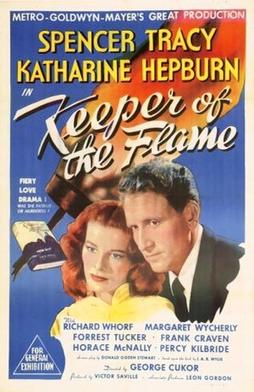
Keeper of the Flame - 1942


Keeper of the Flame (1942) is a daring examination of the existence of fascism in this country. We had come late to the fight against fascism in Europe, and in wartime it was easy to identify those monsters.  But this movie takes a hard look at American fascism. We were not safe from it then; we are not safe from it now.  However, Hollywood, that fantasy factory that brought us so many upbeat, escapist movies prettied up by the Production Code, could still be remarkably vigilant when it came to the depiction of American ideals on screen—when they were being maintained and when they were not.

This is the fourth film in our series on the treatment of fascism in classic films.  We’ve already discussed the foreign-born variety in The Mortal Storm (1940), Address Unknown (1944), and then our home-grown variety among racist thugs in Storm Warning (1951).  Today we take up a film that tackles the notion that the bad guys aren’t always the ones in the propaganda posters, and that fascism often comes to us from the minds, and wallets, of rich and powerful people.  Evil in our midst is always a tricky subject. The audience does not like being preached to; the studio does not like being accused of taking a partisan political position, in order to protect its bottom line.  It was reported that studio head Louis B. Mayer was not happy with this film, feeling it equated fascism with wealth.

But Keeper of the Flame, directed by George Cuckor, brilliantly transcends that with an eerie mystery story, a moody and atmospheric setting, and stellar acting. It is an early example of film noir.


Spencer Tracy stars as a reporter, a foreign correspondent just back from Europe where things have become too hot for him to remain. Though we had many terrific political correspondents back in that era, for me he brings to mind William L. Shirer, whose Berlin Diary was published soon after Mr. Shirer left his political beat in Germany when things got too hot for him. His voice was one of the earliest to warn a complacent America on the danger of Adolf Hitler’s powers of seduction.

This post also serves as our entry into the TCM Summer Under the Stars blogathon, hosted by Kristen Lopez at Journeys in Classic Film. Today is Spencer Tracy day on Turner Classic Movies, and though Keeper of the Flame is not on the roster, this move is a great example of his cool, understated acting, and of how Tracy, however troubled he was in private life, or what private demons he fought ( or didn't fight), embodied the image of the decent American. He was quiet, cool, contemplative, intellectual in a sort of masculine regular-guy way. He could be wry, sarcastic, but his characters were basically humble, even if he didn't take any guff from anybody.

It was as if he could see straight through any situation and see the truth of it.

But in this movie, he has a little trouble getting down to the truth.  Keeper of the Flame is probably my favorite in the Tracy-Hepburn partnership.

Yes, Kate’s in this one, too, and I think it is one of Katharine Hepburn’s best roles, though many feel she is too passive a character here. I like her work in this film for its hesitancy, its reserve. We are used to seeing her bounding through a set like a gazelle. In an unusual twist, she commands our attention by trying to avoid it. We don't know if she's stuffy, haughty, reclusive, or just deeply hurt.  She’s photographed beautifully here, and her grieving widow is, like Tracy, played in an understated manner that complements her enigmatic character.

The cinematography is splendid, and the telling of the story reminds one of Citizen Kane (1941).  We begin with screaming headlines and the sudden, shocking death of Robert Forrester, a much-beloved national figure, as his car plunges into a ravine one stormy night. We don’t know much about him, but bit by bit through the film the layers are peeled away and we have a better picture of him through the people that knew him best: his employees, his household staff, his mother, and his wife—Katharine Hepburn.  Even the great man’s home, a large, remote, wooded estate, is reminiscent of the “Shangri-La” of Charles Foster Kane.  Yet, there are even darker tones here, and it is not just the stormy weather.

Spencer Tracy comes to the nearby town where the great man lived where tributes are being paid, and a flurry of reporters are trying to beat each other’s time to get inside scoops, spinning flowery prose on the loss to the country.  The funeral is witnessed by thousands. Tracy, a great admirer of the great man, is also here to pay his respects.  He is not here to write any stories; he has had enough of politics in Europe.  He’s back home in the U.S. for the first time in years, and he’s looking forward to kicking back and relaxing.

His reporter colleagues include a competitive Stephen McNally, who we’ve covered in previous villain roles, but here he was in his first year of film acting, in, amazingly, his 11th bit part of 1942.

Especially delightful is Audrey Christie as a wisecracking “girl reporter,” who teases the Production Code by helping out Tracy, who needs a room, by inferring to the desk clerk at the local hotel that she and Tracy are married.  The flippancy of the reporters adds a lot of fizz and sparkle to the early part of the movie and throws us off the scent.  We might be prepared to think we are entering a romantic comedy, but very soon, and quite unexpectedly, a mystery pops up.

It is entirely due to Tracy’s powers of observation. In all the throng watching the funeral procession, he is most curious about a young boy, clinging to a lamppost to get a better view, sobbing over the death of the great man.  Tracy comforts him, befriends him, and soon finds himself roaming around the great man’s estate because the boy has found a secret entrance for him.

The boy, very well played by Darryl Hickman, is the son of the great man’s gatekeeper, played by Howard Da Silva.  He is making himself sick over a sense of guilt because he did not warn the deceased that the bridge was out, which led to the great man’s auto crash. Soon, Tracy finds himself on a hunt for some truth—but he doesn’t know what. He only senses that there is a greater story going on, one that he is reluctant to cover, but that he cannot ignore.


Through the mysterious, rather bitter, remarks of the gatekeeper, through a bizarre stolen interview with the great man’s vague mother, played by Margaret Wycherly, and through the careful wall put up by the grieving widow, Tracy slowly finds himself smack in the middle of a huge conspiracy. The great man may have been murdered. At least, that’s what his mother thinks. “Men like Robert aren’t killed by accident. They’re stabbed in the back.”  She doesn’t like her daughter-in-law at all.

Now Tracy is compelled to ferret out the truth he can no longer ignore, not just because he is a reporter and that’s his job, but because he admired this man so deeply, that it is a matter of honor to avenge his death by bringing the murderer to justice.

But his mother also drops another odd remark: “Big people have big houses and little people work for them.”  It turns out to mean a lot more.

Clues point to the grieving widow.

Spoiler time.  Go get yourself a snack if you don’t want to hear.  But if you’re going to stay and listen, then pour yourself a stiff drink.

Kate knew the bridge was washed out that night.  She could have warned her husband.  She chose not to.

Tracy, who has been falling for her a little bit, impressed and almost transferring his hero worship from the deceased to his valiant widow, is gobsmacked and disgusted. He’s only too happy to turn over this venomous—but wait. There’s more.

It doesn’t come out all at once, that’s the brilliance of this film.  Like Tracy, we must become observant searchers of the truth.  We cannot just sit back and be entertained with a mystery story, we are obligated to participate, to assemble the jagged puzzle pieces in our mind and come to terms with what we cannot possibly believe.


Kate unwillingly, as one sickened, relates to Tracy her realization in the early years of her marriage her discovery of her husband’s populist fascism. “They didn’t call it fascism.  They painted it red, white, and blue and called it Americanism.”

His supporters were private individuals who wanted power, but couldn’t get it democratically.  The campaign was a tapestry of hates. Hates for Jews, for city dwellers, for Catholics, for blacks, which appealed to the Ku Klux Klan.

“What was really shocking to me was the complete cyniscm of the plan. Each of the groups was simply to be used until its usefulness was exhausted.”  Again, as we mentioned earlier in this series, the cannibalistic nature of fascism that attacks its own.

“In the end, all the poor little people who never knew what the purpose they were lending themselves would be in the same chains.”

Tracy, coming to terms with the shock of this news about his hero, merely whispers his name, “Robert Forrester.”

Miss Hepburn adds, like a whimper, “He envied the dictators.”

Tracy whispers again, in horror, “Robert Forrester.”  His hero.

Hepburn’s further revulsion intimates a greater, more personal horror for her in her humiliating marriage, where she was, “A poor creature who couldn’t give him sons.” It’s a long speech, which she delivers delicately, with levels of awe and shame.

When she failed to warn her husband of the collapsed bridge, it was a moment’s decision. His paid saboteurs were waiting for his cue to begin the plan of taking over the government. His chief lackey and henchman is his oily and conniving secretary, played by Richard Whorf, who is terrific in the role.


Also look for Percy Kilbride as a laconic cab driver, and Forrest Tucker as Kate’s ne’er do well cousin in an excellent supporting cast.

“Now he’s in your hands,” she tells Tracy.  The great man’s legacy, as well as the weakness of a great society to be exposed is a terrible crisis. She tried to keep his murder secret not to protect herself, but to protect the country from tumbling off into the ravine, too, in its blind devotion to a con artist.

Tracy counters, “People are not children. Sometimes they act like children when you get them scared or confused, but down in their hearts they know and they’re not afraid. They want the truth, and they can take it.”

It is a speech for the ages, and the hope on which I pin the outcome of the coming presidential election and the millions of Trump supporters who are apparently blind to his lack of integrity, his lack of intelligence, and the evil of the man.  Are they, too, lacking in integrity and intelligence?  Are they, too, evil?  I don’t know.  Like Hepburn, I, too, am horrified at the danger my country is in.  But like Tracy, I have hope in the basic decency of the American people, and I feel that courage is needed now more than ever to face the crisis.

Hollywood faced this issue unblinkingly with a fictional character. (We see another treatment in director Frank Capra’s Meet John Doe, covered previously here.) Movies today ignore the elephant in the room.

It ain’t over ‘til it’s over.  The evil henchmen step in to salvage the planned takeover of the government, and Tracy and Hepburn are trapped by fire, shot at, and one is them is murdered.  The ending gives us a comforting bit of flag-waving as the bad guys are exposed and the country is safe now that it knows the truth.

But our country knows the truth, and yet it is not safe. There are too many who do not care about the truth.  Fascism is too appealing to them.

Hitler would have been right at home at the Republican National Convention. It would have been a bizarre, but strangely comforting, homecoming for him. Trump campaign signs hammered into American front lawns would have made him smile.

Come back next week when we wrap up this series with Burt Lancaster and Kirk Douglas in a frightening and fascinating treatment of a planned military coup in Seven Days in May (1964) here. 


****************


My audio book version of Ann Blyth: Actress. Singer. Star., narrated by Toni Lewis, is now for sale on Audible.com, and on Amazon and iTunes.
 

Thursday, August 4, 2016

Oh, my God, I’m home! You maniacs! You blew it up!


I recently saw Planet of the Apes (1968) on the big screen at the local cinema as part of the Fantom Events partnership with Turner Classic Movies. This has apparently been a popular series, with several releases every year for the past few years, bringing the novelty of classic film viewing back to the big screen.

This is part eight of our year-long monthly series on the current state of the classic film fan.

Though I regard a 1968 film as “too new” to be a classic, in this respect, I think I was not alone: the age demographic of the audience surprised me. I had expected a larger audience of young male sci-fi geeks. Instead, there were mostly middle-aged and senior citizens, I would say equally divided as to gender. Along with a younger couple that brought a few kids, the total audience numbered probably 25 people. 

It was a fun experience, and Ben Mankiewicz’s interview with “Dr. Zaius” before and after the movie made me laugh.  Except for the crack about Dr. Zira going to Smith College, which brought a few chuckles from the audience (Smith College is in my neck of the woods), I think I was the only one really laughing my head off through the whole thing. A rather dour mob. New Englanders. Probably brooding over the winter to come.

The other thing that surprised me was how the themes in this much-parodied pop culture movie-turned-“franchise” have remained relevant: the ape council’s rejection of science because it threatens the power of a fundamentalist government, the refusal to acknowledge truths that are not politically convenient, the cycle of prejudice and subjugation. Rod Serling wrote the script based on Pierre Boulle’s novel, and Serling's introspective and intellectual imprint is all over this movie.  There is a late 1960s feeling of the exhilaration of rebellion, without all the tired dystopian bilge we are beaten over the head with today.

When Charlton Heston comes upon the half-buried Statue of Liberty and screams his last lines, I’m sure all in the theater were quite familiar with the end of the movie, but there was still an awed silence, then the audience erupted in applause.  Though I enjoyed Mr. Mankiewicz’s and “Dr. Zaius’” vaudeville act at the end, it sort of wrenched one out of the really stunned moment at the end of the movie.  I think I would have preferred the TCM studio-filmed epilogue played straighter and not for laughs at this point, maybe an interview with someone connected with the production.

I have seen the other “apes” films, including the newer ones that are really nothing but CGI, lightweight and without the, forgive me, “human” feeling of the original series, and missing the theatricality of the original.  I can remember seeing one of them where computer animated characters bounced through a traffic jam of cars on a bridge, and the image was so irritating – like someone flicking something in your face to grab your attention – I closed my eyes. I like being able to explore the screen, drink in the image, and not have to flinch at constantly flashing images created by people who apparently have attention deficit syndrome and must think I do, too. 

I don’t.  Knock it off.

They are meant to appeal to a younger generation where video games are the main entertainment, and who apparently have a fondness for gray tones.  And revenge.

I wonder how many other people in the audience were regular viewers of TCM? Were any of them wondering who this guy was interviewing “Dr. Zaius”? Would the teen and twenty-something male sci-fi geeks whom I had expected to be there have any familiarity with TCM? Would they understand that I could enjoy the novelty of seeing a movie from my childhood nearly 50 years ago, on the big screen, and yet not call it a classic because it was too new?

How many of you have attended any of these Fantom Events series of classic films in your local cinemas? What did you think?

My local cinema is actually in another town.  My town once had some four or five second-run movie theaters, favorite haunts of three generations, small quaint palaces of enchantment, and all gone now.  We had a drive-in, too, once, but gone now.  I drive back across the river to my own town without any movie theaters.  (“Oh, my God, I’m home! You maniacs! You blew it up!”)

Just the word “Cineplex” depresses me.

Not that I mind watching classic films on TV; that’s where I first discovered them.  I think I’ve mentioned here before that when I was a very young child, I imagined what would be my perfect old movie watching experience: I would have a big cardboard box where there would be a screen inside on one wall, and a little low seat inside for me to sit and watch.  A door I could close.  I could press a button and watch any movie in the world I wanted.  There would be another button to push that would dispense any kind of candy.

I think I came up with this idea when that inevitable sadness overtook me after watching a movie to the end credits and knowing I might not ever see it again.

What strikes me is that I seem to have envisioned something like a VCR-function of this box to play movies at will; and that I apparently created what would be a solitary environment, though there were many movies (like the Three Stooges shorts) that I preferred to watch with my twin brother.  I could never have imagined watching them on a big screen with many other people in the audience, like in the old days.

The candy angle to my invention needs no explanation.

If you had your druthers, and could watch a classic film in any format, what would you like?  A subscription service where you could pick your choice out of hundreds of titles?  Watching on your computer, your iPad, your TV? Do you prefer Blu-ray, or DVD? Is large screen, or portability more important to you?

Would you attend classic film festivals if they were smaller, less expensive, and closer to your hometowns? What would you like to see programmed at these festivals?

Or would you just rather sit inside a cardboard box and watch Manhattan Melodrama (1934) in complete solitude, with any kind of candy you want?  Do you want to do the programming?

Past posts in this series here:

Part 1 of the year-long series on the current state of the classic film buff is here: A Classic Film Manifesto. 

Part 2 is here: Cliff Aliperti’s new book on Helen Twelvetrees.

Part 3 is here: An interview with Kay Noske of Movie Star Makeover.

Part 4 is here: Evolution of the Classic Film Fan.

Part 5 is here: Gathering of the Clan at Classic Film Festivals.

Part 6 is here: John Greco’s new book of film criticism: Lessons in the Dark.

Part 7 is here: Tiffany Vazquez, new TCM host.

******************
Come back next week when we continue our series on the depiction of fascism in classic films with Keeper of the Flame (1942).

****************


My audio book version of Ann Blyth: Actress. Singer. Star., narrated by Toni Lewis, is now for sale on Audible.com, and on Amazon and iTunes.


Related Products