IMPRISON TRAITOR, PEDOPHILE, AND CONVICTED FELON TRUMP.

Thursday, July 14, 2016

The Mortal Storm - 1940


The Mortal Storm (1940) is about fascism.  It is about young love—and fascism.  It is about family values—and fascism.  It is about career dreams—and fascism.  We may consider these ideals to be separate from fascism, even opposing, but they are not.  So many people in the course of history have woven them together at their own peril.

For the next few weeks, we’re going to be talking about fascism, a particularly appropriate theme with the coming of the Republican Party convention and the rise in the media and in American politics of Donald Trump.  He is a fascist.  Too many people perhaps equate the word fascism with something old-fashioned, belonging to the twentieth century, and think it is a foreign aberration, since Adolf Hitler made it his slogan and source of power.  They might think that use of the word today is cliché and overused, but it is as powerful and meaningful a word and a strain of political thought today as it ever was from the 1920s through the 1940s.  It is with us still, and the most poisonous aspect of fascism is it becomes chameleon-like.  We do not see it for what it is, unless we force ourselves to concentrate and look.

Classic films forced us to look at fascism.  During World War II, of course, the films were patriotic, and even propagandist, and it was very easy to pick out the villains in the movies because they were wearing Nazi uniforms.  But in that strange, tense era just before our involvement in World War II, the studios utilized their art and their industry with courage not seen today, and with a social conscience not seen today, they examined fascism.

Because of so many screen Nazi bad guys, we may have come to believe that fascism is a product of Europe, and is as out of sync with the modern world as high waisted trousers, fedoras, and clip-on earrings. The movies we’re going to examine will take us out of that notion, and into an interesting exercise of where we must look to examine how fascism starts, how it spreads, and what do we do about it?

Along with The Mortal Storm, in future weeks we will be discussing Address Unknown (1944) here, Keeper of the Flame (1942) here, Storm Warning (1951) here, and Seven Days in May (1964) here.  This brings us up to the 1960s, when our world became far more interested in the Cold War against communism, and the space race, and the dizzying parade of social ills and revolutions.  But fascism remained, always there, like a smoldering ember at a campfire that has been carelessly left, and will start a forest fire if the prevailing winds allow it.

TheMortal Storm (1940), was produced by MGM, with great trepidation.  We were not at war with Germany yet (indeed we would not go to war with Germany until two days after they already declared war on us in December 1941), and the studio was wary about producing a movie that could be considered inflammatory.  The German market was especially important to Hollywood, and offending the German government could be disastrous when it came to distribution of the film in Europe.  Moreover, the studio heads were sensitive about pushing the subject of fascism when, as most of them were of Jewish heritage, were afraid to appear as if they were politicizing their product.  It had been their practice, as most of them were European immigrants to this country, to assimilate to their new country and to adapt to its culture, its language, and even, if necessary, to concede to its long-standing prejudices.

We may recall from these previous posts (part 1 and part 2), that Gentleman’s Agreement (1947) was avoided by many studios and was finally produced by Darryl F. Zanuck of 20th Century Fox—a major studio head who happened to be not Jewish, but who had guts, and took on the story.

We may applaud MGM for moving forward with The Mortal Storm, risks and all, but their fears were justified.  The German government under Adolf Hitler was incensed that this film was made, and banned that and any future MGM movie from being shown in Germany.  That MGM was blacklisted by the Nazis may have been worn as a badge of courage by the studio in future years when the war was going on, but at the time it was seen as a misfortune.

However, the film is quite mild by today’s standards, at least of depicting the savagery of Hitler’s regime.  It is still a powerful movie, and that is because it deals with people.  Ideals, and political jargon are bandied about, of course, and people take sides, but first and foremost it is a movie about a single family and what happens to them when forces beyond their control knock on their door and take over their lives.  It is gentle, and it is scary.

Frank Morgan plays a university professor in Germany.  The year is 1933.  Irene Rich is his wife.  Her two grown sons by a previous marriage are played by Robert Stack and William T. Orr. They are very close to their stepfather, Frank Morgan, and when the film opens with Morgan’s 60th birthday celebration, they take him aside to give him their present personally and to thank him for being such a wonderful father to them.

From Mr. Morgan’s marriage to Irene Rich there are two younger children, a daughter played by Margaret Sullavan, and a son barely in his teens played by Gene Reynolds.  At the university where Mr. Morgan teaches, a surprise celebration in his lecture hall greets him when his students and the other members of the faculty, who clearly respect him and love him very much, present him with a gift and sing Gaudeamus Igitur in his tribute (which is pretty impressive watching the cast sing it in Latin).  We’ve heard the song in zillions of old movies and cartoons whenever a scene is set at a college. It’s like playing “California, Here I come,” or “The Sidewalks of New York.”

Two of those students are played by Robert Young and James Stewart.  Mr. Young, Mr. Stewart, and Miss Sullavan have been friends since childhood.  When these two gentlemen come home with the family to have a birthday dinner for Mr. Morgan, we see that Robert Young is even closer to Margaret Sullavan, and impetuously asks her to marry him.  With his exuberance, and the whole family watching, he makes it difficult for her to say no and she accepts.  Everyone in the family is jubilant, except for James Stewart, whose expression ever so slightly falls to the floor and we see that he has harbored an unspoken affection for Margaret.

But the birthday party turns on its head when we hear from the radio that Adolf Hitler has just been elected Chancellor of Germany.

Fascism, in its most vile form, is brought to a nation in a democratic election.  There is nothing so virulent a germ as a political movement which serves to appeal to the most base, crude, and ignorant in a society, inflating them with a power they do not have, and then taking it away like a shell game. Alexis de Tocqueville, nineteenth century historian who made many keen and valuable observations on America in its formative years noted especially of our eagerness to follow the mob, despite our boasts of individual freedom:

In times of equality, no matter what political laws men devise for themselves, it is safe to foresee that trust in common opinion will become a sort of religion, with the majority as the prophet.

Robert Young, Robert Stack, and William T. Orr are overjoyed at the radio announcement and celebrate, saying that Hitler will bring the country back to greatness.  He will make Germany great again.

James Stewart has no political convictions; he still seems to be reeling by the idea that Margaret Sullavan is going to marry somebody else.  Frank Morgan and his wife are hesitant to be quite as jubilant as the boys. They hope for the best, but as a university professor, Morgan is unimpressed with Hitler’s designs on the country and his methods for achieving greatness.  Morgan is a man devoted to logic, and this is all too illogical for him.

But there is more to his concern.  We come to find out later in the film that Frank Morgan is Jewish.

In the movie his Jewish heritage is never mentioned by name, he is instead called “non-Aryan,” and at first we may think this is MGM pulling a punch, trying not to get too ethnic, too personal, too political.  It probably was. But time tends to leave a patina, on ideas as well as on objects, and I think perhaps that “non-Aryan” sounds here more inclusive of all the millions of people who suffered under Hitler’s regime.  

When people who deny the Holocaust, or just as perverse, people who do not deny it, but who simply prefer not to think about it, hear the figure of 6 million Jews being murdered, I wonder if they forget that also there were at least 9 million non-Jewish citizens of the Soviet Union murdered in death camps, and nearly 2 million non-Jewish Poles, and millions of other people whom the Hitler regime regarded as non-entities: Gypsies (properly referred to now as Roma), non-Jewish Czechs, Serbs and other peoples of occupied Europe, and people within Germany who protested including Catholic priests, Protestant ministers, Jehovah’s Witnesses, the infirm, the mentally challenged, convicts, and homosexuals—a variety of targets in addition to the millions of suffering Jews.

It is staggering.  And because it is staggering, the human mind recoils, unless the heart is brave and the mind has a bigger conscience than it has a fear of discomfort.  Only a moron and a coward would deny the Holocaust, and though we may equate the Holocaust with fascism, we must remember that fascism did not start there.

“Non-Aryan,” means everybody who was not considered to be “us.”  And fascism resulted in millions of “thems.”  Us and them.  That’s where it always starts.

The movie moves swiftly from this point, with Robert Young, Robert Stack and William T. Orr becoming more immersed in the Nazi culture, wearing uniforms, giving the Nazi salute, and their boyish jubilation has turned to stern, dogmatic, and slavish obedience to their new leader. (Look for a young Dan Dailey as an especially vicious Nazi youth leader.)  Hitler has given them an identity, and they draw apart from their family because of it.  They become distant with Frank Morgan, and Robert Young’s preoccupation with his new Nazi youth organization duties has left Margaret Sullavan alone and puzzled at the change in him.


James Stewart, who has come to the university to learn veterinary medicine, has grown up on a farm on the outskirts of town.  His mother is our favorite Maria Ouspenskaya, who seems to see no werewolves in the vicinity.  Young Bonita Granville is their hired girl, and Bonita has a crush on James Stewart.  Before the movie is over, she will be terrorized by Nazi thugs trying to get information out of her about where James Stewart is hiding.

Stewart has pulled away from his university pals; he wants none of this Nazi business.  When he sees them beating up an old teacher, James Stewart runs to his aid, and Margaret Sullavan helps. She refuses to stop seeing Stewart as friends, even though Robert Young warns her to stay away from him, not so much because of romantic jealousy, but because Stewart is getting a name for himself as an enemy of the state.  It does not take much to be an enemy of the state.  James Stewart has made no political speeches, he assiduously avoids talk of politics at every turn; he just wants to be left alone.  But he will not join the boys in their Nazi youth organization, and this makes the boys furious.  He will not play with them, so now James Stewart has stopped being “us,” and has started to be “them.”


Frank Morgan, formerly beloved by one and all, has become an even more serious “them.”  He is not political either, but he was born to be a “them,” because he is a non-Aryan.  He is sent to a concentration camp.

James Stewart and Margaret Sullavan show the most courage and the most moxie of anyone in the movie because of their stubborn refusal to be one of the gang, because they defend a victim of that gang, and because Miss Sullavan openly claims her heritage.  When she hears Robert Young disparage non-Aryans, she calls them “my people,” though her mother most certainly is Aryan and if she wanted to, Margaret Sullavan could be safe even in this Nazi regime, by denying her father and ignoring her Jewish heritage. She breaks off with Robert Young.

An exciting climax builds when, after Frank Morgan dies in the concentration camp (which must have been at least surprising, if not shocking, to audiences of the day), she, her mother, and her young brother try to escape from Germany as James Stewart has already done before them.  Mother and younger brother make it, but Margaret is held at the border.  Stewart comes back for her and leads her through a treacherous mountain pass, with Robert Young and the boys on the chase. Just Stewart and Sullavan are skiing down a wintry slope approaching the Austrian border, the patrol under the orders of Robert Young, shoots Margaret Sullavan down like a dog.

Mr. Stewart scoops her up in his arms and continues to ski for the border, but she dies before he can reach it.

That had to be equally strong stuff for the audiences of the day.  The Nazis here are not punished, they are not foiled.  World War II is barely six months old, and it would be another year and a half before we became involved.  This is a tragedy we cannot reach.  Is it any of our business?  Some Americans on the sidelines (and in the movie theaters) said yes, some said no, some were cheering for the Nazis and resented them being presented as the bad guys.

Robert Young has always impressed me with his sensitive acting ability, I think I like him better in dramas than in comedies, though he could certainly do both well.  Here he is not so much a brainwashed Nazi, as someone who is trying to convince himself that he hasn’t made a mistake, and his pride is too great to admit that he could be wrong. 

We see this so often today.  People so slavishly devoted to an idea, or political party, or a candidate, and refuse to entertain any niggling doubt that might indicate they are wrong in their choice, that there are holes in the story they want to believe.

Robert Young does still love Margaret Sullavan, and we can see he is choked up and appalled by her murder (he even helped her earlier by finding out what camp her father was taken to), but we do not know if this is going to change him and make him step back from being a Nazi.  It probably won’t.  He would have to admit he was wrong.

Robert Stack is also appalled by his half-sister’s murder, and he is the most sensitive to the horror of it.  It’s possible he would step back from being a Nazi if he could, but he is too weak.  It is not his pride that keeps him in the grip of fascism; it is his weakness.

The younger brother, William T. Orr, is the one most flagrantly dogmatic about fascism, to the point where he does not mourn his sister’s murder.  He slaps Robert Stack in the face for entertaining thoughts that they have made a mistake.  Orr has embraced fascism out of lack of maturity, a lack of intelligence, and because of the sensational high it gives him, and he is perfect fodder for the new regime.

Frank Morgan, before he is taken to the death camp, refuses to submit to Nazis, not because he is a non-Aryan, but because he is a teacher and a scientist and in both professions truthfulness is more important than fashion, or should be.  He takes umbrage about the concept of racial purity in his lecture hall when students protest when he insists that the blood of different races is the same.

“Scientific truth is scientific truth, unchangeable and eternal.  It cannot be altered to suit the politics of the hour or the clamor of immature hoodlums.”

Later he will say, “I’ve never prized safety for my children, I’ve prized courage.”

These are great lines.  They are just as apropos today.  We began this year with this post on the relevance of classic films today, particularly as we examine how our society is buffeted in turbulent times.  I mentioned Donald Trump as both an aberration of our time, and a consequence of it.  I admit, I did not think he would get this far, that the media would have raised him to the level of a celebrity; or that the party of Abraham Lincoln, of Teddy Roosevelt, of Dwight D. Eisenhower would have embraced this pig.  But fascism has its mysterious and confounding allure.  We cannot depend on modern films to tackle the subject.  They are too busy with juvenile stories.  Luckily, we have classic films.


Come back next week when we discuss Address Unknown here with Paul Lukas. This time, we see the allure of fascism not to impetuous youth, but to an educated and cultured man in middle age, and two immigrant American families that are touched by long-reaching ideology from a foreign source, caught in its web even from the supposed safety of American shores.

**********************


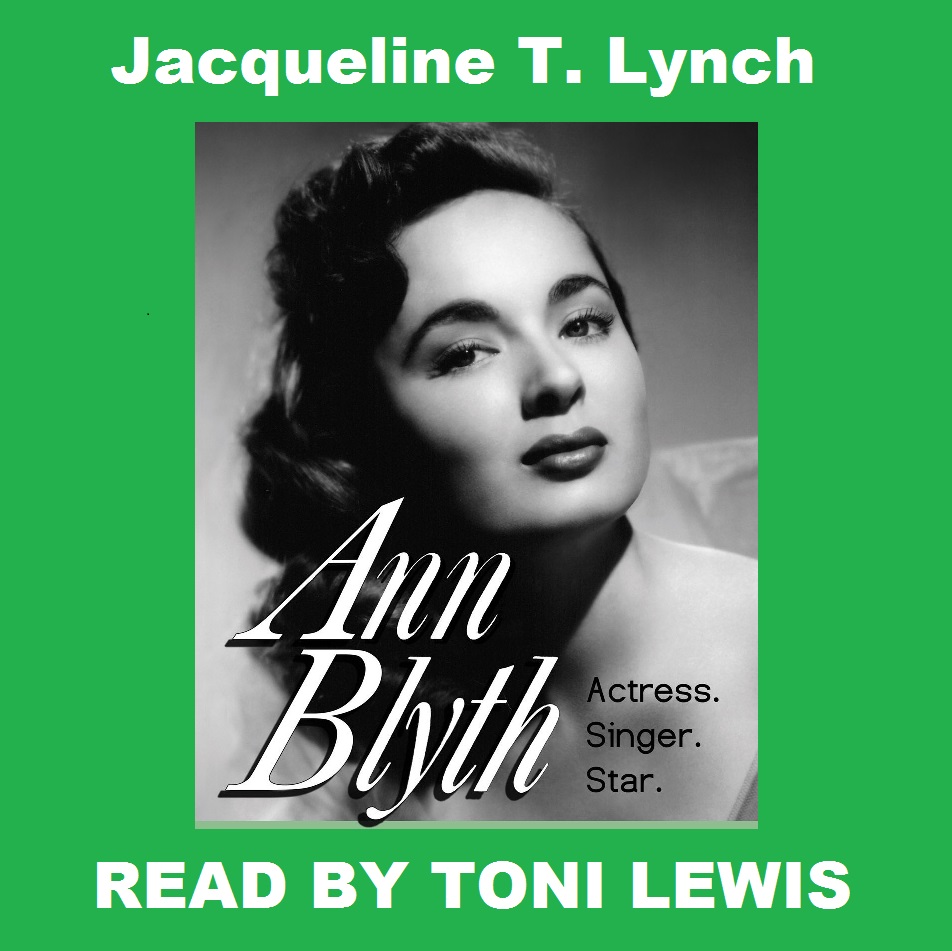
My audio book version of Ann Blyth: Actress. Singer. Star., narrated by Toni Lewis, is now for sale on Audible.com, and on Amazon and iTunes.


*********
Jacqueline T. Lynch is the author of Ann Blyth: Actress. Singer. Star. and Memories in Our Time - Hollywood Mirrors and Mimics the Twentieth Century. Her newspaper column on classic films, Silver Screen, Golden Memories is syndicated nationally.

Thursday, July 7, 2016

Tiffany Vazquez - New TCM Host - Part 7 of The State of the Classic Film Fan Series


Tiffany Vazquez, the new host on Turner Classic Movies is a reassuring promise of the future of the classic film fan. She appears to have entered the job with many laudable attributes, but this may be chief of all.

This is part seven in our year-long monthly series on the current state of the classic film fan.

When Ms. Vazquez was announced as the new Saturday morning host, many longtime TCM viewers voiced concern that this was another of the network’s unfortunate drift from its classic film roots. 

The plan to attract a young demographic, though practical in business terms, has its downside—there is the temptation to gear programming specifically to that demographic. While I confess, I dislike some of TCM’s shift to post-classic films, I have never been concerned about the youth of a new host. Indeed, I was an “old” old film buff at ten years old, and I’ll bet I was more familiar with classic films at that tender age than many young people (Tiffany, now 29, reportedly came to classic films late—not until college).  I am delighted, always, to come across a young person who enjoys classic films.

Though we may recall that Ben Mankiewicz met some resistance by fans when he was hired for hosting duties in 2003, unfairly principally for not being Robert Osborne, it was never his being younger that bothered me. Indeed, he’s only about four or five years younger than I. What first annoyed me about Mr. Mankiewicz was what I perceived at the time as flippancy and sarcasm in his delivery, and TCM’s pointed efforts to package him and Robert Osborne as a kind of Odd Couple. The young hip dude and the old guy.

Since then, with his growing into the job, I’ve come to like Ben Mankiewicz. I look forward to his intros, and he now comes off as a person as interested in the movie as me, and with respect for the people who made it. That’s all I ask. Also, I think I started to warm up to him about the time he began to shave and wear ties.  I like grownups to look and act like grownups.  At least insofar as they are guests in my home.

Remember how in the days of comedy/variety shows on TV when the host would sign off at the end of the show and thank us for allowing them to come into our homes? A gracious act. We don’t see that anymore. The people on TV just barge into our homes like The Desperate Hours (1955) and assault us with their crudeness. If we turned our back on them for one minute, they'd eat everything in the refrigerator, spit on the floor, and then maybe kill us.

What we love so much about Robert Osborne isn’t necessarily his knowledge of classic film (though that certainly is extensive), but his class.

Which brings me back to Tiffany Vazquez. Her polish, her well-spoken delivery, her professional appearance all tell me this is a young woman of intelligence, of taste, of maturity. What classic film means to most of its fans (okay, maybe excluding monster flicks and the Marx Brothers) is a sense of elegance and glamour not seen today. TCM has chosen wisely in a young woman who, by her manner and appearance, reflects that appreciation by its fan base for class. This is why we like Robert Osborne so much: he likes the movies as much as we do, he respects them, and he respects us. He looks, talks, and acts like a gentleman.

This is something that should not be undervalued by TCM. The classic film fan is your demographic, TCM, no matter the age.  It’s a very special demographic.

But Tiffany Vazquez is more than a lovely young woman who likes old movies. She hold two graduate degrees, one of them in film studies from NYU, and she interned at the Film Society of Lincoln Center. This most certainly recommends her for the job. If she did not grow up with Saturday afternoon matinees or The Million Dollar Movie like many of us, she still comes with her own pedigree and a special perspective.

It has been noted that she is the first woman to be hired as a regular TCM host, and her Puerto Rican heritage has been commented on as setting her apart as representing a new demographic. But before we skew this into some Madison Avenue pie chart of something up-market, we should remember that  the classic film fan “demographic” has little to do with age, gender, race, or ethnicity, and is remarkably diverse. We’ll comment more on that in future posts in this series.

What is remarkable is not so much that an educated young woman of Puerto Rican ancestry should like old movies, but rather that she does in the face of the overwhelming odds against many young people ever having an opportunity to discover classic films, or if they do, that any appreciation for old movies will be nurtured in a society that has little regard for the elegance and glamour they represent. Especially for a young woman.  Just one case in point:

I recently came across a clothing store website. I think I must have Googled “vests” (I don’t remember why or what now), but the page featured photos of some 12 or 16 models wearing various kinds of vests. Three of them were young men, the rest women, all were from their late teens to early twenties. The boys wore vests as part of a three-piece suit. They did not wear their jackets, but just appeared in shirtsleeves, their ties loosened, their shirts pulled out from their pants and shirttails hanging, their arms crossed. They glared at the camera to send the message of their hipness, their utter unconcern for what we think about them or the vain stubble on their baby faces.  They looked like preppie punks, but each conveyed an image of power. They were confident.

The girls all looked like prostitutes.

They wore vests that were not stylish or businesslike, just various scraps of material to decorate almost as an afterthought the real merchandise—the sexualized, barely of legal age, female. Each by the skimpiness of her unflattering outfits, and mostly by her vulgar posing, represented the old adage “sex sells”. Their dreary Goth-made up faces wore the same look of hip indifference as the boys, but where the boys looked like future executives (God help us), the girls looked like prostitutes. They were not given an image of control as the boys; they were assigned the role of object to be possessed. They were meant to be ogled, but for most of us, their photos are too tragically disgusting to look at. This image was apparently conceived by an ad agency as good business. This image was apparently approved by the store chain as good business.

Neither clearly give a damn about young women.

We often hear in our society today complaints that there are not enough women in Congress, not enough women in business, etc. Well, we’re not exactly encouraging them to wear business suits, are we?

And now TCM has a female host.  I have watched Tiffany Vazquez give her movie introductions for a few weeks now, and I am more than pleased—I am relieved. The future of the classic film fan is going to depend on young people who admire classic films enough not to regard them with snark or condescension, but who will empathize with the long ago generations that made them. They may even want to copy a little of what they see and adopt it for their own personal style. Image, even as those soulless ad agencies and store chains know, is a very powerful tool because it is a personal imprint.

Where the ad agency and the store chain make their mistake (and have bludgeoned our society for the last couple of generations) is trying to bait a younger demographic by imitating that demographic's immaturity, instead of trying to uplift them to something better.

I like Tiffany Vazquez’s style. If she had appeared like one of those repugnant store chain models, and saying, "Like, ya know, awesome," I would not have cared how enthusiastic she was about old movies: I'd have canceled my cable subscription.

I look forward to a future occasion where she might express her opinions on classic films, more than just introduce them. I’m interested to hear what she has to say. When she remarked in an interview that she had a habit of “introducing” films in the shower, where some people sing, I had to laugh because I identify with that.

Not that I ever introduce movies in the shower. I just wash up, sing a couple of show tunes, write my initials in steam on the glass shower door, and I’m out of there.

But I do have a habit of thinking about movies and writing descriptions and opinions and analysis in my mind. It was from that habit that this blog was born. I got tired of talking to myself.

Good luck, Tiffany. Congratulations on your new job. See you Saturday.

********
Part 1 of the year-long series on the current state of the classic film buff is here: A Classic Film Manifesto. 

Part 2 is here: Cliff Aliperti’s new book on Helen Twelvetrees.

Part 3 is here: An interview with Kay Noske of Movie Star Makeover.

Part 4 is here: Evolution of the Classic Film Fan.

Part 5 is here: Gathering of the Clan at Classic Film Festivals.


Part 6 is here: John Greco’s new book of film criticism: Lessons in the Dark.

****************


My audio book version of Ann Blyth: Actress. Singer. Star., narrated by Toni Lewis, is now for sale on Audible.com, and on Amazon and iTunes.
 

Thursday, June 30, 2016

Olivia de Havilland - 100th Birthday


Olivia de Havilland did not want to be Scarlett O'Hara.

So many actresses, from veterans to newcomers, yearned for that role, fought for it tooth and nail. But Olivia de Havilland wanted to play Melanie.

The mug shot and her surname misspelled on the placard may reflect the assembly line nature of The Golden Age of Hollywood, but they do not detract from the elegance, the power of the woman who knew who she was, and who knew who Melanie was.

We take a moment today to marvel at the 100th birthday tomorrow of this glorious actress, and to recall at least one quality that made her different.  As regards her role as Melanie in Gone with the Wind (1939), Olivia responded in an interview for the Academy of Achievement.

Jack [Warner], for example, said, "Oh, you don't want to play Melanie. You want to play Scarlett." I said, "I don't want to play Scarlett. I want Melanie." It's because I was so young. I had for four years been earning my own living, going through all the problems of a career woman, self-supporting and even contributing to the support of others, which is what Scarlett did. That's what Scarlett did. So, I knew about being Scarlett in a sense, but Melanie was someone different. She had very, deeply feminine qualities. Scarlett was a self-absorbed person. She had to be. Career women have to be, that's all there is to it. But, Melanie was "other people-oriented," and she had these feminine qualities that I felt were very endangered at that time, and they are from generation to generation, and that somehow they should be kept alive, and one way I could contribute to their being kept alive was to play Melanie, and that's why I wanted to interpret her role. 


Happy Birthday, Olivia de Havilland. There is much to celebrate in your career.  Thank you.

***********************

The audio book for Ann Blyth: Actress. Singer. Star. is now for sale on Audible.com, and on Amazon and iTunes.


Thursday, June 23, 2016

ON SALE NOW - ANN BLYTH: ACTRESS. SINGER. STAR. - THE AUDIO BOOK


The audio book for Ann Blyth: Actress. Singer. Star. is now for sale on Audible.com, and shortly will be on Amazon and iTunes.  Here's the sales page where you can purchase a copy.

Or, if you'd like to review the book on Amazon for a free copy, let me know because I still have a few promotional codes available.  Email me with REVIEW in the header.

Don't forget to email me to enter the raffle for a FREE AUDIO DOWNLOAD.  Just write GIMME THE AUDIO BOOK in the header.  I'll be picking the winner next week.


Five lucky winners will also be drawn from readers who subscribe to my mailing list here.


Thursday, June 16, 2016

FREE AUDIO BOOK

Who wants a free audio book?

ANN BLYTH: ACTRESS. SINGER. STAR., narrated by Toni Lewis (see last week's interview here) will soon be available at Amazon, Audible, and iTunes.  I will pick one reader from this blog to receive a FREE download.  The audio book will be for sale shortly.

I will also give a free audio book download to the first eight people who agree to review the book on it's Amazon page here.

If you want to put your name in for the raffle for a free audio download, send me an email with the subject line: GIMME THE FREE AUDIO BOOK to: JacquelineTLynch@gmail.com.

If you want to review the book in exchange for a free copy, send me an email to the same address, but the subject line should be REVIEW BOOK.

It was just about this time last year that I published my book on Ann Blyth's career (June 18th, actually), and I don't think any writing project I've ever done has meant more to me.  Thanks for being part of the journey.

Thursday, June 9, 2016

AUDIO BOOK UPDATE - Ann Blyth: Actress. Singer. Star.


This is to remind you of my upcoming AUDIO book version of Ann Blyth: Actress. Singer. Star.  I expect it to be available for purchase very soon. Later this month I'll hold a random drawing for a free copy of the audio book.  I will also offer a free copy to the first eight people who agree to review the book on Amazon in exchange for a copy.

Los Angeles area actress Toni Lewis is doing the narration, and her work is brilliant.  She kindly participated in an interview with me, and here’s what we discussed:

***

JTL:  I was struck by your adopting different “voices” and adding personality to the many quotes in the book.  I had never heard that done in an audio book before, and I marvel at what an acting challenge that must be—to find the element, the key in a passage to give you a hook to the character of that voice.   I like the lower, dryer tone of speech for Madge Tucker, as if illustrating this is a kindly, genteel, but harried woman dealing with children on live radio, with a touch of New York businesswoman inflection. There is playfulness in your characterizations, including the funny “Bert Lahr” voice for the mountie he played in Rose Marie, and so many occasions where your reading of a quote stands out from the narrative and gives splashes of color to this rather long book.  Speeding up the speech of the old Hollywood critics and gossip columnists, to emulate the staccato radio news delivery of the day, I thought was pretty neat.  Some line readings brought me to tears, or shocked me.  You mentioned to me about the script that you “treated it like a piece of music with shading and tempo,” which is delightful.

The voice you use for Ann is chosen very wisely, I think.  The tone is quiet, demure, but not an attempt at an exact imitation of her voice—which I think is appropriate.  And practical—because I don’t think it’s really possible to imitate her. She displayed such a keen ability to change her voice from film to film that she never had any vocal “tics” that one could caricature.  Katharine Hepburn, or Humphrey Bogart come to mind as films stars who were always easily imitated by comics who exaggerated the peculiar speech habits of these actors.  Your “Ann” in the audio has a clean sound, is a lovely example of sensitive and judicious narration.  Was her voice a particular concern or challenge to you?

TL:  For the most part (except for Ann Blyth), I didn't go out of my way to listen and study the real person's voice, because it was more fun to create the voice myself.   After being introduced to Ann through the book, I sought out a few interviews online to get the feel of her personality.  I was able to find some excerpts of Mildred Pierce and watched Mr. Peabody and the Mermaid in its entirety (but she didn't speak!).  Her softness was balanced by her faith and confidence (both powerful and firm), which gave her the strength to navigate the rough waters of Hollywood.  A person gets a sense from the book that acting was her destiny.  I wanted to convey all of that in the voice I gave her.  She was and still seems to be a calm and steady force.

JTL:  You mentioned in an email to me that you were sorry to come to the last chapter because you had fallen in love with Ann Blyth, and were  a new convert to Turner Classic Movies.  That really touched me, and I hope you enjoy many years of discovery of old movies.  I would not be surprised if you knew very little about her career before you started narrating the book, because since her last movie was made decades ago, she has fallen off the radar in pop culture—though in the late 1940s and 1950s she was as famous as anyone could be in Hollywood.  You are an actress yourself, you’ve played roles on television.  I think that gives you an insight, an appreciation of the challenges of her career that I don’t have, that many of our listeners/readers won’t have.  You’ve gone on auditions, performed, rehearsed, and worked with directors, technical crew, dealt all the business aspects to the career.   Do you agree that your familiarity with the acting profession may give you empathy in your approach to your narration on the career of this actress that a non-actor might not have?

TL: You're right.  I knew nothing about Ann Blyth before this book came along.  As an actress, I could totally relate to her career and the challenges she faced as a woman in this business.  She faced it all with grace and I admire her for it.  At times I saw myself in her shoes.  I'm a singer as well, so her musical theatre experience is something I relate to strongly.  While reading, I could visualize the environment because of my experience on stage and in front of the camera.  I recognize the desire to keep your private life just that…private.  Her approach to the craft and her work ethic is an example of how hard work pays off and I'm struck by how successful she was, while not allowing the Hollywood machine to change the essence of who she was.  As with many projects in the course of a career like this, you grow attached to your subject matter.  It was bittersweet to see my time with Ann draw to a close.  I got choked-up.  I had spent so much time walking in shoes that resembled mine it felt more personal.   A career is what you make it.  She made a wonderful career and was one of the lucky few to do that.  It's great to see a woman have it all or at least as much as she wants.

JTL:  Ann Blyth: Actress. Singer. Star. is a big book.  I’m so impressed by how you navigated some of the ridiculously long sentences (listening to you has really made me see my faults as a writer).  I have a tendency to begin very long compound sentences, plunking in a semicolon, and then go have a cup of tea or bring in the mail, or have the oil changed in my car—and then I come back to finish the sentence.  No, really.  That’s why they ramble on like that.  Is fiction different for you as a narrator than non-fiction, does it require a different approach or a different set of muscles, so to speak?

TL: Yes, a different set of muscles is right.  I find that non-fiction books require more of a smile in the voice and a little higher register in order to hold the attention of the listener.  This produces a more pleasant experience, especially for long-form books. Because fiction is often suspenseful, a lower register is used to draw the listener in.  I just finished a novel by Warren Adler called CULT.  It was like night to the daylight of Ann Blyth.  Both amazing projects but performed from opposite ends of the spectrum.

JTL:  How did you get into audio book narration, and what are some of the challenges and pleasures of doing this kind of work?  Can you describe what it’s like to narrate a book?  Do you use a local studio, or do you have a home studio with the technical wizardry to record and edit tracks?

TL:  Like Ann Blyth, I am no longer twenty-something and I wanted to continue to perform and create, so after years of pounding the pavement, I thought I would combine my love of reading with my love of acting.  I set up a sound booth in my home and started auditioning in my pajamas.  It's been so wonderful.  The freedom of performing and producing books gives me such joy!  I usually record in the evening because of daily environmental noise.  I do the recording myself in sessions that usually last five to six hours each.  Before recording, I read the book, make notes, breakdown the characters and try out different vocal registers for each.  Sometimes a voice will just come to me.  Others, I have to play around with to make sure they have their own sound/accent. The hard part is keeping the voices consistently vivid.  Some days the environment affects the voice, so I have to do a longer warm-up and keep the vocal tea flowing.  I use a wonderful editor who is a wizard at making me sound great. My life is happier and I have a calm I've never felt before.  This work just fits my lifestyle.  I'm happy and my family is happy.

JTL:  Are there any upcoming projects you’d like to share, either as an actress or narrator?

TL: I mentioned Warren Adler's book CULT.  It should be coming out soon on Amazon as well.  That was a fun project with a lot of voices (mostly men).

JTL:  Please feel free to any anything you’d like to discuss that I may not have touched upon.

TL:  I could tell that Ann Blyth was a labor of love for you and after four months, I love her story as well.   My hope is that I was able to bring another dimension to the work and help listeners of the book feel uplifted and more knowledgeable about that time in Hollywood's history.  Who better to give us that perspective than someone like Ann Blyth who came out on the other side happy and prosperous?
*******************
My deepest gratitude to Toni Lewis for her marvelous performance as narrator on Ann Blyth: Actress. Singer. Star., and for sharing her sensitive and articulate comments here.  I feel extremely lucky to have been able to work with her on this audio project, and I am in awe of her talent.

***

Ann Blyth: Actress. Singer. Star. is, of course, already available in eBook and in paperback from Amazon and CreateSpace.

A star of films, stage (including Broadway), television, radio, nightclubs and concerts, Ann Blyth is a stellar example of talent and professionalism, and her journey through the entertainment industry of the twentieth century is colorful and fascinating.

The most interesting aspect about her acting is that unlike most stars of the day she was not content to play the same kind of roles over and over again. She swam against the powerful and unrelenting current of studio typecasting. It was usual for studios at that time, which controlled the kinds of movies that their actors played in, to promote an actor in a particular kind of role and to assign them similar roles thereafter.  An actor was marketed to the public as a heavy or the hero, or weepy heroine, or a stumbling foolish comic. Usually they played the same character over and over again.

Today we have someone like Meryl Streep, who is very versatile and we expect that of her.  When we go to see a Meryl Streep movie, we expect her to sound different and look different.  She’s working in an environment today where she is free to adopt that kind of versatility.  Indeed, it’s become her calling card, her trademark, but back in the day when Ann Blyth was one of the most famous stars of her era, her versatility was certainly admired and appreciated, but I don’t think it was used to its best advantage by the studios.  A confounding set of circumstances has made Blyth’s unique career largely unfamiliar among younger classic film fans

To appreciate how ironic that is we need to note that back in the late 1940s and 1950s she was one of the most famous stars of her day, featured on countless magazine covers, pursued by columnists, receiving thousands of fan letters every week.

Ann Blyth remains a mystery to newcomers to classic film who know little about her, perhaps for two reasons: she made 32 movies in her career but most of them are not on DVD and most of them are not being shown on Turner Classic Movies.  This is because most of the movies you see on Turner are Warner Bros., or MGM movies, or Columbia -- many different studios, but a lot of Ann Blyth’s movies were made for Universal and Turner does not show a lot of Universal movies or a lot of Paramount movies.  Today, Turner Classic Movies is pretty much the main channel that we would go to watch a classic film.  We have hundreds of channels on our cable television, but very few show old movies these days.

My hope is Ann Blyth: Actress. Singer. Star. will help newcomers to classic film discover the work of this marvelous actress, and to remind those of us more familiar with the classics not to overlook this quiet, lovely champion.

The AUDIO book will be soon available through Amazon, Audible, and iTunes.  It runs some 18 hours long (it’s a hefty book), but is delightful and entertaining thanks to actress/narrator Toni Lewis. 

Thursday, June 2, 2016

Lessons in the Dark by John Greco


Lessons in the Dark by John Greco is a thoughtful, contemplative collection of short essays on film.  Classic films are the focus, but two interesting devices are used to make the old favorites sharp and relevant to today’s social ills: first, using simple themes of War, Discrimination, Social Injustice, and the Media (the unit heading alone deliciously inferring that the media is, or can be, another social ill).  Second, comparing a classic film to a newer or modern film of the same subject.  I would suggest that comparing a classic film to a similar modern film may probably be a better way to introduce younger people, who are not classic film fans, to old movies.  It becomes not so much a contest as to which is better, but rather it serves as a bridge to understanding.

This is part six in our year-long monthly series on the current state of the classic film fan.

Author John Greco is known to many of us classic film bloggers for his excellent blog, Twenty-Four Frames. Here are a few of his interesting observations:

On I Was a Fugitive From a Chain Gang:

“An interesting point is the modernity of James Allen’s thinking after getting out of the Army. His mother and Reverend Brother want him to go back to his factory job, however, James doesn’t want to be tied down to a boring job he has no interest in. His brother calls him ungrateful for not accepting his former bosses offer to get his job back, but James wants something more exciting and wants to find himself. His mother actually uses these words after she comes around to his way of thinking. Finding oneself is such a modern notion, I was somewhat surprised to hear it spoken in a 1932 film.”

On High Noon:

“Ironically, over the years, people and even countries from both sides of the political spectrum have come to find their own personal values in this film. The former Soviet Union accused the film of being “a glorification of the individual.” Pro-McCarthyites saw the film as communist propaganda and anti-American. Yet, President Ronald Reagan loved the film for its lead character’s “strong sense of and dedication to duty and law.” Both Presidents Eisenhower and Clinton loved the movie. Clinton ran the film no less than 17 times while in office! He even recommended it to then incoming President Bush. So the question becomes, how can one film be interpreted and be satisfying to both sides of the political fence?”

John discusses the Pre-Codes, the Depression, M*A*S*H, and Lenny, and ties them together.  There’s Invasion of the Body Snatchers, and Black Legion.  (My thanks to John for referring to my book on Ann Blyth in his essay on Brute Force, which is part of his Films of Social Injustice chapter.)  I was especially taken with his filmography of Orangey, a cat who most of us know from Breakfast at Tiffany’s, playing “Cat,” but who actually had a few other films under his belt.  Er, collar.

John and I discussed the notion that we are on the threshold of a new era of film criticism in classic film:

JTL:  I wondered, first, what you think about the idea that film criticism and film history are now in the hands of so-called (and I use this possibly disparaging word intentionally) amateurs -- because of blogs and the rise of self-publishing?  There was a time, and may still be among professional critics and academics, that film, theatre, drama critique was a rarified world.  It has now become gloriously egalitarian.  But there are pitfalls to that as well as a huge boon to compiling the chronicle of our pop culture.  What are your thoughts on that?

JG: I think it’s been both liberating and problematic. Self-publishing has opened up doors for many writers. Overall, I think it's a great opportunity for writers to get their work out there. If they go that route they should be professional and responsible for and with their work. Of course, like in so many other endeavors there is the good and the bad. Film history like all history can be distorted if not reported correctly. As you know yourself, being an historian, writing about film history like any subject requires a lot of research, and fact checking that research to see how accurate it is. You see a lot of misinformation out there. You got to do the investigative work. I’ve seen it even in books. You read one book and it states one fact. Another book says something completely different on that same subject. How do you incorporate this sometimes contradicting information into your own work?  For me, when I am writing an article with historical background I want to make sure I get the facts correct and check as many resources as possible. I hope all writers do this.  

Film criticism today runs rampant. You’ve heard the term everyone’s a critic and today that’s true more than ever before. Film criticism came into its own in the 1960’s with people like Pauline Kael, Andrew Sarris and others. They took film seriously as an art form. They analyzed it and told you why it was a good film or not. Film criticism became legit, on the same level, with other arts. Today with the internet, the “everyone’s a critic” thing has become a reality and most of the time it’s things like “this film sucks” or “it’s awesome!” Maybe not in those words but what is said is no deeper than that. You see it all the time on IMDB or Letterboxd. To be a serious film critic or film historian one must have a good knowledge of the subject. One should read and study the reviews of critics like Kael, Ebert, Sarris and others. You can learn what to look for just by reading their work. Studying the technical aspects of filmmaking is important: editing, photography, lighting, etc. Film historians do their research, film critics need to do the same. You can’t just write about what you like saying how awesome it is. There’s got to be more.

JTL:  I was very intrigued with your taking a handful of topics - war, racism, etc., that are timeless and can be used on an equal footing to compare classic films with newer films.  It's a great template and I think could be used to introduce younger people to classic films more successfully than just saying, "Here's an old movie I love.  You should watch it too."  By comparing older and newer films on the same subject, you've hit upon a very useful model.  I'd love to hear more about your views on that.  You have one foot in the world of the newer or modern films, and I do not, so that is a great advantage and I admire that.

JG:  Thank you. When I first began to think about this book it was going in a completely different direction. Then, like I mention in my introduction, a few years back, I was writing a column for a now defunct pop culture on-line magazine. One of the publishers saw my blog, liked it, and asked if I would be interested in writing a column on classic films. His only caveat was I had to relate the films I wrote about to our world today in hopes of connecting with its target audience, today's youth market.  After thinking about I realized how life repeats itself and there were plenty of old films where we can learn modern day lessons. One of the first films I wrote about was Ace in the Hole. At the time, there were a couple of scandals going on about news reporters falsifying or creating stories presented as facts. It was perfect. The more I looked into this the more I found how so many classic films still talk to us today. You just have to listen. The absurdity of war is brought to the front in both Duck Soup and M*A*S*H.  More recently, a powerful film like “Spotlight” shows you investigative journalism at its best. Just like it did in All the President’s Men. These two films can be compared to more devious newspaper films like Blessed Event and Five Star Final which shows journalism in a much darker light. All art is timeless. People just have to be open to it. I recently watched Brian DePalma's Casualties of War and came away from it seeing it as not just another war film about Vietnam, but as a morality tale and the cost of war on the human spirit. Every soldier comes home from war damaged.  It's a price we are still paying for today.


***

John Greco’s Lessons in the Dark is available in eBook from Amazon.  My thanks to John for allowing me to review his book here in exchange for a reviewer’s copy.  You can read his blog Twenty-Four Frames here.

********
Part 1 of the year-long series on the current state of the classic film buff is here: A Classic Film Manifesto. 

Part 2 is here: Cliff Aliperti’s new book on Helen Twelvetrees. 

Part 3 is here: An interview with Kay Noske of Movie Star Makeover.

Part 4 is here: Evolution of the Classic Film Fan.

Part 5 is here: Gathering of the Clan at Classic Film Festivals.


Related Products