IMPRISON TRAITOR, PEDOPHILE, AND CONVICTED FELON TRUMP.

Thursday, September 5, 2013

I'll Never Forget You (1951) and Berkeley Square (1933)


I’ll Never Forget You (1951) is one of those quiet movies that if you catch it on a rainy day, the gentle memory of it will stay with you for a long, long time.  It’s a time-travel romance, and like all time-travel stories, from Edward Bellamy’s Looking Backward: 2000-1887, which was published in 1887 and has never been made into a movie, to Portrait of Jennie, to Somewhere in Time, the “present” depicted as the point from which the story is launched is as integral to the adventure as the final destination.  The “present” is the locale—or state of mind—from which the protagonist is trying to escape, and interestingly, because the past is fixed for us, the “present” is the part of the story that inevitably becomes dated. 
Long post.   Best to make some toast and let the dog out now.  Also a few well-meaning spoilers, for which I beg your pardon.
The “present” for I’ll Never Forget You is post-World War II, and the protagonist is a nuclear physicist.  The movie is a remake of Berkeley Square (1933), the “present” for which was 1933.  It was based on a play of the same name that was produced in London in 1926, and on Broadway in 1928, so the “present” from which to escape was one of Jazz Age frenzy, of motor cars and shallow society, and the memory of the Great War. 
The Broadway version of John L. Balderston’s play was co-directed by Leslie Howard who also starred.  It was a hit, and Mr. Howard reprised his role in the 1933 movie, for which he was nominated for an Academy Award.  I’ll Never Forget You is one of those times where the remake is better than the original, partly because of technological advances in filmmaking, and partly because I think the story benefitted, was really fleshed out, when launched from a more somber and mature “present”.  The 1933 version shows a fitful, restless dissatisfaction with the “modern age,” but the 1951 version has nuclear annihilation as its “present,” with the prospect of no future at all.  Curiously, I’ll Never Forget You is a brighter, more hopeful movie despite this.
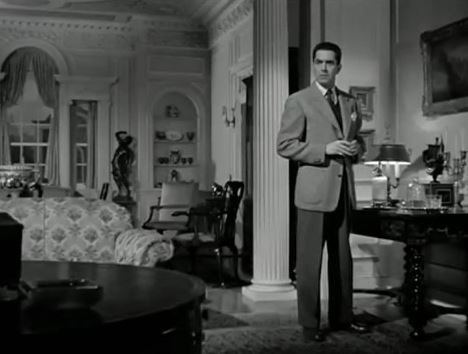
Tyrone Power plays Peter Standish, the atomic scientist burdened with guilt and despair over the enormous ethical and moral consequences of his work.  The story is set in London.  He is an American helping with the British nuclear program, and he lives in an 18th century townhouse in Berkeley Square, a home he inherited from a distant cousin.  The furnishings of the house are original, and with the exception of modern plumbing and electricity, the rooms look pretty much as they did in the late 1700s.
On the wall above the fireplace is a large painting of his distant relative, painted in 1784, a man also called Peter Standish.  He looks exactly like Tyrone Power.
One of the intriguing aspects to the movie is that we never really slip off into a ghost story, though it feels like this could happen any moment.  However, Tyrone Power finds reality far more haunting than any supernatural elements of the story.  Tyrone orchestrates his trip to the past as carefully as he would conduct an experiment in the lab—or nearly so; he does make mistakes, and they cost him. 

Along with the furnishings, he has discovered this 18th century Peter Standish’s diary, which tells of his life in this house.  He was an American, too, a veteran of the Revolutionary War.  In 1784, the war over, he traveled to Britain to meet his cousin, Kate Pettigrew to complete an arranged marriage with her.  It was through his marriage to her that he came to live in this, her family home.
The last few entries of the diary are strange, as this Peter Standish fancies he has seen into the future, experienced life in the 20th century. 
Tyrone Power, so absorbed by the past of this house, and armed with the diary of Peter Standish, concludes that he and Standish will switch places, that it is inevitable that they do so, for a limited time.  Then, as noted in Standish’s diary, Standish will return to his own time and marry Kate, have children, and live his life here.  Tyrone Power therefore believes that he, too, will return to his own time, but not before he enjoys one heck of an adventure.
He needs some time off, anyway.  He’s been working too hard.
We begin at the lab, with concrete walls and eerie glowing dials, an experiment in some reaction of two substances that cast off a white glare, gauges that measure in Röntgens, and serious men doing unfathomable science.  It’s a slow start to the movie, but curiously intense.  At one point, Tyrone pushes an experiment to the danger zone, and his boss has to remind him not to take chances.  He thinks Tyrone needs some downtime.
Handsome Michael Rennie is his co-worker and the closest thing Tyrone has to a friend.  Mr. Power is a loner, and his socially awkward manner with Rennie, who has also been trying to introduce him to his sister, is a really good fit for the character.  (In Berkeley Square, Leslie Howard just seems like a boyish eccentric with too much nervous energy.  Tyrone Power’s brooding introspection is more appealing.)

But having said that, I love the comic moment when Leslie Howard delightedly discovers his pony tail.
“What about going away for a while?”  Rennie asks companionably.  Power replies, “I am.”  It’s a long shot with the room, cavernous, foreshadowing his portal to the past.  He confesses his theory about his upcoming time travel to 1784.  He explains, much as other writers have sought to explain, that time is not a straight line, the way we might draw a chronology of events.  It co-exists in another dimension.
“I believe the 18th century still exists.  It’s all around us if only we could find it.”  What particularly appeals to him is the break from nuclear annihilation, although, despite the scary lab at the beginning, this is never spoken, only implied, as are the horrors of World War II, and the Holocaust.  The director knows the audience doesn't need reminding.  Indeed, they've come to the movie theater to forget the front page.  Similarly, Tyrone Power looks forward to returning to “The age of reason, of dignity and grace, of quietness and peace.”

A thunderstorm is brewing outside, and the lights go out.  Tyrone lights a candelabra and takes Mr. Rennie upstairs to see the diary.  Creepy music as they climb the stairs—shades of a ghost story, but not quite.
Michael Rennie thinks he’s nuts, but he’s a tactful guy and worried.  He implores Tyrone to leave the house, as it seems to have cast a spell on him.  Tyrone sees him to the door, and stands outside a moment on the steps as a thunderstorm moves in.  Time travel in this story is done by thunderstorm. 
A clap of thunder, a bolt of lightning, and Tyrone falls, collapsing on the landing.
The camera draws our attention to the door of the house, as the metal mail slot begins to disappear.  Then an arm reaches up from the landing—Tyrone’s arm, grasping for the knob to pull himself up.
 
 
A tuft of lace protrudes from the sleeve of his coat, a striped pattern—and it's--in color!  Upon opening the door of his own home, he sees Kate, his intended, here played by Beatrice Campbell, lowering herself to a deep curtsey in a hall of soft colors and the muted gentle sound of a harp playing a light air (or ayre, we are in London).  Tyrone’s in 1784.  (Oooh!  Pretty!)
This Wizard of Oz-style use of a dreary black-and-white existence and escape into a Technicolor world is only one of the technological improvements on the original Berkeley Square of 1933, though to be sure, it is the most spectacular. 
Counting the original stage play, these three incarnations of the story are interesting for what their medium allows them to convey.  The original stage script is tight and very witty, with one character, Kate’s brother Tom, who is a rogue, getting a crack at some risqué dialogue.  One can sense the inventive use of present/past on a fixed set.  I don’t know if this old chestnut is staged anymore, but I’d love to see it.  I enjoyed reading the lively script very much.  (By the way, I understand there was a TV version in March 1949 with Richard Greene and Grace Kelly in the lead roles.  Wish I could see this.)
Berkeley Square the movie is toned down both in language (less saucy) and action, and has a somewhat confusing beginning showing Leslie Howard as the original Peter Standish enjoying the fellowship of his new friends in a pub.  Then we must work to accept him as the 20th century version.  The movie attempts to follow the play, with only a few scenes out of the house, but what might be called stagey I think is really just downright static.  There is very little movement, and we could attribute probably a lot of that to early sound camera issues which kept the actors practically bolted to where the mic was.  As it is, the sound is scratchy and the film quality is somewhat poor.
I’ll Never Forget You takes up the script from the previous movie and the stage play and to a much farther place, a poignant, dreamlike scenario that is continually punctuated, as all time-travelers find out, with the ultimate knowledge that the past wasn’t such a great place.
Tyrone Power meets the family he’s pretending, as the 1784 Peter Standish, to marry into, and we can see his interest, his sense of adventure, even his latent sense of humor warming to the occasion.  He has trouble relating to people in his own time, but here he is allowed to be a different man, and he bravely attempts sociability like a shy boy eager for friends at a party.
Irene Browne plays Lady Anne, Kate’s mother, who, like any good mother in a Jane Austen novel of the period is desperately trying to marry off her daughters.  Her husband is deceased and left them with debts.  Her rascal son, the indolent gambler, drinker, and chaser of servant girls, Tom, is played with irresistible panache by Colin-Keith Johnson. 
“What do you call the colonies now?” he asks Tyrone.
“The United States of America.”
“Trifle pompous, don’t you think?  But after all, it’s only temporary.”  He refers to constantly putting his boot-in-mouth, but we sense that saying the wrong thing at the wrong time is Tom’s favorite hobby.  He is particularly pleased to have Tyrone marry his sister, because Peter Standish is said to have 10,000 pounds a year income.  Tom wants to mooch off him.
Then Tyrone is introduced to the younger sister, Helen, about whom he knew nothing, as the original Peter Standish did not write of her in his diary.  She is played here by Ann Blyth, who becomes an ally of Tyrone’s when she generously covers for him as he blunders about knowing something he really can’t have known.  Before long their curiosity for each other turns to love.  At first she resists, because he is to marry her sister, but when she learns from him—and more importantly, believes—that he is a different Peter Standish from the future—she allows herself to enjoy a sweet, passionate, and ultimately hopeless love for him.
Miss Blyth is fascinating to watch—all the cast are excellent—but she has a lot to convey and make us believe and she has to do this under acting restrictions that the other more emotional and physically expressive characters don’t have.  Her character is sheltered, demure, gentle, all qualities which can only be indicated by her posture, her voice, and disciplined economy of movement.  She walks softly, sits and stands with a ramrod-straight back, lowers her eyes at moments of mature discretion, a minimalist way of telling us who she is and what her world is like.  Her lovely face melts into a smirk at one of Tyrone’s naïve attempts to “catch on” to this old way of life.  She also has intelligence, and a sense of humor, making her the most reasonable and capable member of her family.  In trusting Tyrone and his tales of a future world, she is also the most courageous.  Like Tyrone, she silently carries burdens, the chief of which is the pressure by her mother to marry a much older man who is also a self-important jerk.
He is played by Raymond Huntley.  Something about the voice was tantalizingly familiar, and then I remembered him from the BBC series Upstairs/Downstairs.  You’ll recall he was the family solicitor, Sir Geoffrey.  Here he is a man always clinging to this family, trying to work his way in, and becomes jealous of Tyrone’s easy friendship with the beautiful young woman he had culled out of herd for himself.  His resentment will lead to revenge.
By the way, the role of Helen was played on Broadway with Leslie Howard in 1928 by Margalo Gillmore, who we met here as the superior officer in Skirts Ahoy from 1952, the year after I’ll Never Forget You was released.
Tyrone navigates through parties where he meets the greats of the age, including James Boswell and Samuel Johnson, and sees enough of the wretched filthy streets of London, including a glimpse of children being abused in a workhouse, to understand that life in the 18th century was not without its misery.  He becomes disillusioned. 
 
He also makes more and more blunders, and people begin to pull away from him in fear of his seeming ability to predict events.  He becomes just as isolated as he was in his lab (feeling comfortable in the lab environment, he even attempts to recreate it by performing simple experiments in a rented basement).
The date in Peter Standish’s diary that marks the end of the adventure is drawing near, but Tyrone does not want to leave Ann.  The authorities, when he has been accused of sorcery, will have the ultimate power over him.
Director Roy Ward Baker tells the story with exquisite cinematography and actors that are beautifully choreographed, not just the requisite Austen-like ball scene, but in ordinary circumstances.  When Tyrone Power hands Ann Blyth out of a coach, her long dress ripples to the ground, dripping down the metal fold-out coach steps. 
Shots of the rooms in the house, the stairway, the halls, convey mood and the house becomes like another character in the story.  The muted colors are lovely.  A bowl of colorful flowers catches our eye in the foreground as the actors stand behind, held together by the pastoral scenes on the wallpapered panels in the background.  The outdoor shots of London streets, of the quiet square, of the peaceful countryside, of Tyrone Power gazing out the window at night with satisfaction on his first day in the Age of Reason.
 
 
I like how Tyrone and the other men have a slight five-o’clock shadow in the color sequences that looks very much like men in the 18th century oil paintings.  This is a really nice piece of detail.  I don’t think this would have shown up well in black and white.
There are some major scenes that are handled differently in I’ll Never Forget You than they were in Berkeley Square, with very good effect, and turn the ending from a flat tragedy to a more hopeful, romantic, if equally gut-wrenching ending.
First, the crux ansata (more commonly known as an ankh) is a symbol of eternal life and was a trinket brought back from Egypt by Helen’s deceased father.  In Berkeley Square, Leslie Howard has this item from the beginning of the story as something he found in the house and wonders what it is.  Later on in the story, when he is in 1784, the Helen character shows it to him, and says she will leave it in the house as a symbol of their eternal love and connection.  At the end of the story, when he has returned to 1933, he holds it mournfully as a symbol of his lost love.
I’ll Never Forget You uses the crux ansata in a more romantic and suspenseful way, when at the point Ann Blyth realizes Tyrone Power must return to his own time, she shows him the object, tells him of its significance, and demonstrates that she will hide it in a secret compartment in a desk for him to find one day as a reminder of her.  At the end of the story, when Tyrone is back in 1951, he has a fleeting few time-travel hangover moments where he thinks his adventure was all a hallucination. 
Then—aha!  He remembers the object, and runs to the hiding place.  He fumbles a few moments, not able to locate the hidden drawer.  Will he find it?  Is it there?  Please let this not be a dream!  (If we just wasted 90 minutes of our life on a dream sequence we are not going to be happy.)  And then—bingo!  His recovery of the crux ansata is joyful.
Another scene played very differently is when the Helen character, who hints that she has envisioned Peter coming to her before they met—she had a vision of him walking down the staircase holding a lighted candelabra as we saw him in modern times—and she wants to see into the future.  She looks into his eyes and through what is, I guess, meant to be a telepathic communication between them, she sees fleeting images of his world as he thinks of them.  In Berkeley Square, Helen is played by Heather Angel (We last saw her here in Cry Havoc), who though a lovely young woman, has a bit of a deer-in-the-headlights look in this movie which I think is meant to be shorthand for her soulfulness.  Her visions are splashed on the screen as stock footage of skyscrapers, locomotives, racing cars (racing cars?) biplanes, warships, gangsters, and finally World War soldiers in gas masks, bayonets drawn, flamethrowers—and she is horrified.
“Devils!  Devils!  God, would not put us here to suffer for a race of fiends like that to come after us!”
Powerful sentiment, and the image of gas masks, that iconic, ultimate horror of World War I, lingers even today as we lately hear about the threat of chemical warfare.
I’ll Never Forget You has a drastically different take on this scene.  Instead of the horrors of World War II and the nuclear age, Ann Blyth sees only beautiful cities lit by electric lights in Tyrone Power’s dark, sad eyes.  There is no stock footage superimposed over her beatific expression, we have only the trust we have invested in her, and the trust she has invested in him, to know that her wondrous visions are real. The message here is not to pound us with our recent horrors, but to count our blessings. 
“What a beautiful dream of heaven.  Who would want to leave a world such as that?”
Tyrone returns to his own world, by force, when magistrates drag him down the staircase, off to the lunatic asylum, and we see a magnificent shot from Ann Blyth’s vantage point on the upper landing to the hall below.  The great double doors close behind Tyrone Power and his captors. 
 
 
Then more flashes of lightning, and the warm colors fade into crisp black and white.  The door slowly opens again, and Tyrone is in modern dress, his hair cropped, his arm tentatively reaching for the light switch.  As he enters the house, looking all around at these rooms that have not changed with the centuries, we hear a soft, plaintive reprise of an 18th century flute piece.  Truly, the past is alive around us if we are perceptive to it.
How we perceive our own times is the spectrum through which we judge the past.  How fascinating that the modern Peter Standish’s perspective of his own era (or rather, the filmmaker's perspective) could change so much in the eighteen years from 1933 to 1951. 
There is more to the ending that I won’t spoil for you, but it is open to our imagination, and imagination is the very essence of time travel. You can watch both Berkeley Square and I’ll Never Forget You on YouTube.  I’d love to know what you think.

Our friend Laura at Laura's Miscellaneous Musings discusses I'll Never Forget You here.


Thursday, August 29, 2013

Madison Avenue - 1962


Madison Avenue (1962) is a less slick, more cumbersome Mad Men ancestor that does not expose the hypocrisy and shallowness of the world of corporate advertising as much as it merely makes a polite nod to its existence.  It is a plodding movie, but there is something striking about the way Dana Andrews chain-smokes, wields a ready cocktail (as does everybody in this movie), and openly and publicly leers at women, condescends to them, and conveniently uses them whether he knows them or not.  If we were watching the television show Mad Men, we might grin and shake our heads at the faux-1960s parody before us.  But Madison Avenue was made in 1962 and it’s the real thing.  What may shock us more is not the behavior we titter over on Mad Men, but that we know full well it was filmed with absolutely no intent to shock us.  Nobody in the theater in the 1962 was surprised by any of it, and probably didn’t notice the sexism, or stop to count the cocktails.
This is our annual post in anticipation of Labor Day.  We’ve covered two similar films in the past here:  Executive Suite, and I Can Get it for You Wholesale.  We do not encounter in Madison Avenue any hint of the contributions of organized labor, as we do a bit the previously mentioned films, but since Madison Avenue, the New York advertising institution, plays such a huge role in our economy, for better or worse, it’s worth a look—and so is this movie, even if it does not have the energy and bite of the other films.


Dana Andrews is a cunning ad man.  We get his measure in the opening moments of the film when he in the office of a client—the CEO of a milk association, played by David White, who most of us remember as Larry Tate on Bewitched.  Mr. Andrews leers at Mr. White’s nubile secretary, speaks all the sycophant kiss-ass bilge he can to David White, and heartily sips a glass of milk to please his client with the rapture of a baby enjoying it for the first time.  Andrews is an up and coming man, we are told, but he is due for a heavy fall.


His boss, sneering, cigar in hand, played by Howard St. John, stabs him in the back over a new account because he feels threatened by Dana’s success and wants to keep him under his thumb.  Dana spends the rest of the movie trying to steal back Mr. St. John’s top account.


To do this, he enlists old girlfriend Jeanne Crain and uses her shamelessly, which she knows.  She’s disgusted with him, but stuck on the guy.  She remarks sardonically, “I just got promoted from a person to a contact.”  There is the point of the movie in a nutshell.  She’s a reporter for a Washington newspaper, and against her better judgment, does a favor for him by setting up a series of articles that will promote Dana’s new client, a small Washington-area dairy.  This is his first steppingstone to swiping the big client—David White—back from Mr. St. John.

Dana starts by attaching himself like a barnacle to a small, dying ad agency run by Eleanor Parker.  Her only employee is played by the wonderful Kathleen Freeman, who, as Dana Andrews says, “She greets people as if they were stepping into an open grave.”


One of my favorite scenes in this movie is when Dana is led by Miss Freeman back to Eleanor Parker’s office.  He passes slowly through a large, dim room with empty desks and drafting tables.  We see this business is failing, with almost all employees let go, and the lights turned down to save energy.  It is deathly quiet.  I think there may be nothing more haunting and depressing than a business that looks like it’s going under, or already has.  Haunted houses are not more ominous.

This scene, and a couple scenes that show the New York City skyline from the enormous windows of an executive office—which denotes power as much as Eleanor Parker’s dingy office denotes failure—are really the only times that setting moves the story along.  This movie was shot in CinemaScope, and really didn’t need to be.  Most of the action takes place in a bar.  Because of this widescreen camera process, we have very few close-ups—they didn’t look good in CinemaScope—and we have actors placed several feet apart from each other when delivering their lines.  The space needs to be filled up, you see, so CinemaScope becomes the master of the film instead of the director.
 
 
As for bars, if we’re not in the bar, we’re talking about going to a bar at the airport, or downtown.  Even a later bowling alley scene has the neon sign “Cocktails” right over the shoulders of the actors.  In 1962, it seems people needed a lot of refueling.
Dana, taking stock of Miss Parker’s office, decides to join her firm like a rainmaker promising a shower to a desperate farmer.  His message is hardly friendly; it is downright rude, but strikingly honest and ultimately helpful to her:
“You need light walls behind you, maybe one of those French grays that looks neutral that vibrates with life; low, modern furniture, paler than your hair; thick, cream-colored carpets; indirect lighting, with a few hidden spots directed at you.  That’s an old stage trick.  Concentrate light, you concentrate attention.” 
 
 
Then he proceeds to tell her what a mess she looks like.  “You look like a refugee from a nursing school or a novel by Louisa May Alcott.”  He suggests a new outfit, makeup, a little blush and lipstick two shades darker.  He wants soft wools, nothing frilly, that fits well but not too tightly, with the sheerest hose she can find and high heels.  No jewelry, or very little.  “The average businessman wants the deal, not the dame.  When a man is doing business with a woman, he doesn’t want her sex thrown at him.  It’s distracting.  On the other hand, he resents it if she throws her sex out the window.”  He writes her a check to fix herself up.
 
 
What a fine tightrope the ladies in business walk, but one wonders if good taste can really be taught, let alone be manipulated to a commercial advantage.  The advertising world of today clearly has no use for good taste.

Just when we may despise him for  his arrogance, he treats Kathleen Freeman with greater tact, moving her from the receptionist’s job—because he wants an attractive, younger woman there—and appoints her as his personal secretary.  No young chippie for him to sit on his lap.  He’s got work to do and realizes she has experience.  He gives her a raise, and they become pals.  His one gesture of flirtation is to tell her that “Thelma” is a very pretty name.  We see it makes her whole day.
 
 
Miss Parker, after initial resentment, takes Dana’s advice and comes into the work the next day in a whole new outfit, her hair coifed, and ready for action.  They converge upon the owner of the dairy, a simpleton, child-like oaf who inherited it from his father.  He is played in a very cute and deceptively deft way by Eddie Albert.  They meet him in his executive office.  He plays with toys, and wears a white milkman’s uniform, because he likes to take his own route for fun.  The business of the company is left to sour-faced Henry Daniell, who is kind of wasted in the small role.
 
 
Eddie Albert takes a shine to Miss Parker, which Dana notices and he exploits.  Soon they have the account, and Dana, in his campaign to win back David White’s business, creates two Frankenstein monsters: Eddie Albert and Eleanor Parker.

Mr. Albert’s shy reticence soon turns to bombastic egoism with every speech he’s encouraged to make before members of his industry.  He sounds like a fool, but he speaks with absolute belief in the blather he says.  Confidence, it seems, is the path to power, and real substance doesn’t matter.  His business increases, but more important to him, his fame and power increases and soon we see he may be invited to run for public office—shades of A Face in the Crowd (1957) here, another great movie showing the hypocrisy of the advertising world and political evil of manipulating public opinion.   (But as we see, not even ad men are immune to the spell of their own message -- Dana confesses he smokes too much because he got hooked on the habit when he worked for a cigarette account.)
 
Eleanor, who, after some vigorous chasing of Dana realizes he’s not the marrying kind, transfers her intentions, if not actual affections, to Eddie Albert who looks as though he’s going places.  She began as an earnest and hardworking ad woman, who like Mr. Albert, inherited the family business, but given a taste of the glamorous life, wants to keep it by hook or crook.  In a strange way, they really are meant for each other.
 
 
The movie culminates with a series of double-crosses.  Jeanne Crain wants to take Dana down by writing an exposé on his tactics and the nefarious ad world.  Dana, realizing he’s responsible for foisting Eddie Albert on the American public, plots to knock him out of high position even at the cost of his own career.  That move, and his relationship with Kathleen Freeman are the only indications we have that deep down, Dana is a mensch. 
He tells Mr. Albert, “I’m tired of inflating balloons.  I’m tired of seeing good men held back while mediocrity like you are catapulted to the top.”
 
 
And of Miss Parker, he regrets that he, “kicked her up the ladder, now all she wants to do is kick other people in the face.”  Curiously, all the people Dana has touched in this movie are the worse for it.  Ironic for man who’s supposed to have the Midas touch.
 
 
Dana Andrews was in his early fifties when he made this film, and looks older than a freewheeling bachelor cad who is supposed to be up and coming in his career.  The two leading ladies are in their late 30s, and all of them are nearing the end of the film careers (though Eleanor Parker gets to make one more big splash as the nasty countess in The Sound of Music- 1965).  The 1960s will belong to younger actors with fewer moral dilemmas.
Only plucky, indispensible Kathleen Freeman would have a longer active career in film, TV, and the stage as a character actor we’re not supposed to notice but we always do.  She was working on Broadway in the musical version of The Full Monty in 2001 (a role for which she was nominated for a Tony), when she died of lung cancer only five days after she resigned her part.  She was 82. 
That’s a trouper.
We never really know where Dana stands with Jeanne Crain until the last few moments of the film, when he proposes.  I don’t think we really believe him at this point, but Jeanne does.
 
 
One other scene I like occurs in a bowling alley, where Dana brings an out-of-town client to entertain him.  The client is played by our old pal Grady Sutton.  Here’s our previous post on Grady.  It’s also nice to see that Mr. Sutton actually got screen credit; he usually did not.
In way, I suppose it’s appropriate that Dana’s unresolved relationships keep us off balance, because that reflects his personality, and the CinemaScope-required arm’s-length distance between characters also suggests the isolation and lack of warmth, of genuine connection between the characters.  We just can’t seem to get close to these people, but maybe it’s for the best.  There’s really not much there.  Both reflect Madison Avenue and the modern world where insincerity, shallowness and opportunism are the way to prosper.  Mad Men is intentionally nostalgic; Madison Avenue is unwittingly prophetic.
 

Thursday, August 22, 2013

Chain of Fools - a book review


Chain of Fools is one of the finest books ever written on silent film comedy.  It is a guide to an art form and a technological revolution, and a survey of popular history in a most exciting era where the scientific wizardry of the film industry fed the demands—and put on a pedestal—the desires of the common man as it never has since.
The author is Trav S.D. a theatre historian whose previous book No Applause, Just Throw Money: The Book That Made Vaudeville Famous—well, everything you need to say about that is pretty much all in the title.  Our erstwhile guide—you may sometimes see him in an appropriate pith helmet as would a proper guide wear—also writes an exceptional blog, “Travalanche.”  He is also a performer and playwright, and has written for a number of publications, and is also a public speaker and radio guest.
Chain of Fools is notable not only for its extensive and impressive research, but that the scholarly tone is frequently punctuated like a pie in the face with the author’s humor, as well as his thoughtful reverence for this era of film.  What is most pleasing is that this is, to great extent, no longer a “lost” art form.  In his opening passages, Trav S. D. recounts his early interest in silent comedy as a young man which, like for so many of us back in the day, was an infrequent treat on a television that only got three channels.  Then the deluge of the VCR, the DVD, the Internet—and (as we bow our heads and genuflect) TCM.  As Trav joyously puts it.
Silent comedy lives more vigorously now than at any time since it passed out of favor over eighty years ago.  Ironically today’s film buffs are in the enviable position of being far closer to the great silent comedians than were the audiences in the immediate wake of silence’s demise in the late 1920s.
For those just learning to appreciate silent film comedy, Chain of Fools is a delightful and fascinating compendium, and a valuable tool for film bloggers and those who are more familiar with the history of silent film.  I especially like that he sets the films and their movie clowns in the context of the era, explaining in a natural way how each influence the other.  Here you have the back stories on Chaplin and Fairbanks, and the “Our Gang” kids.  Here you have the triumphs and a few tragedies of the lesser knowns. 
Referring to the ultimate demise of silent film as “The Dialogue Diaspora” (I really like that), the author takes us past tired clichés of the whys and wherefores, and brings us to a new and thoughtful understanding of how these silent film veterans influenced comedians for decades to come, through the early days of television and beyond.
I am impressed with Chain of Fools, and enjoyed the rollicking prose that lures the reader into this remarkable world of silent comedy, its roots, and its legacy.


NOTE:  This review was written in exchange only for a review copy of the book provided by the author.

Thursday, August 15, 2013

Crack-up - 1946


Crack-up (1946) takes us to the art world, not usually the sphere of film noir, but this brooding little mystery is unabashed in its take on salons of high culture and waterfront thugs.  Especially appealing is abating this quirkiness by casting veteran priest-coach-boring nice guy Pat O’Brien as the hero.  Pat was 47 when this picture was made, seems a bit long in the tooth for some of the stunts he (or rather his stunt double) is required to do, but his brand of sly, knowing maturity is particularly suitable for this protagonist who must solve the mystery with his brains and his expansive knowledge of art.
I also like that the plot hinges on a phone call he gets regarding his ailing mother, and how he rushes to see her in the hospital.  Real men worry about Mom.
Since this is a mystery, I’ll try to side step the spoilers, but there are some interesting scenes that push the plot along for their atmosphere.  First, we have the pulsating theme music over the opening credits and sounds like the rhythmic pounding of train wheels. A train figures prominently in the mystery.  Look at the lettering on the title.  Just that tells you we’re in for real noir.  Them’s real noir fonts.

We begin with Pat O’Brien in a crazed fit, smashing his fist through the glass doors of a New York City museum, tangling with a cop—in a hall of marble statues where a broken figure of a nude male topples to the floor and smashes—there’s a little artistic symbolism for you.  Pat passes out, psychotic or drunk, we don’t know.  Pat works at the museum.  The museum administrators, in a late meeting, are shocked and try to hush the matter up when detective Wallace Ford wants to haul him in.
Good old Wallace Ford.  He deserves a post of his own someday, for many reasons.
Ray Collins is a doctor on the board of the museum, the voice reason in this mess.
Claire Trevor is a society dame and magazine writer who appears in a different outfit and a different hairdo every time we see her.  She sparkles, but she’s a regular dame.  We gather she and Pat were an item once, and he’s still interested enough in her to be jealous and sarcastic of any man who takes her to dinner, like Herbert Marshall. 
Our old favorite Mr. Marshall is typically elegant and eloquent here as an international man of mystery.  We don’t really find out who he is or what his game is until nearly the end of the movie.  Mr. O’Brien does not disguise his distrust and disdain for him.
Pat is a docent at the museum and gives lectures on art.  (How many cool film noir guys do that?)  We are told that the museum curators regard Mr. O’Brien as revolutionary—in their eyes not a good thing—and that if it weren’t for his service record, they might have sacked him long ago.
This being film noir, nine times out of ten, the protagonist is a war vet trying to adjust to this weird new world he’s come home to but doesn’t recognize.  Especially interesting is that later we get some background on O’Brien’s war record—he worked for the Allied Reparations Committee investigating the Nazi theft of precious works of art. 
We trace Pat O’Brien’s psychotic disturbance to a train wreck he claims he was just in, though there are no reports coming to Wallace Ford that a train wreck has occurred.
Now we go to the requisite flashback as Ray Collins asks Pat to tell them what he remembers happened to him today.
We pick up from Pat’s docent job and his lecture, and the call about his mother.  When Pat rushes to the train station to start his frantic journey to see his mother in the hospital, we follow him pretty much step-by-step—the ticket line, the empty commuter car filling with nighttime stragglers getting off work late, a sarcastic butcher boy selling fruit, magazines and cigarettes.  There’s a guy half-dragging his buddy who appears to have had a little too much to drink.
The train car is already a place of tension because of Pat’s anxiety about his mother and trying to reach her as soon as possible.  He glances with impatience at the people around him, not studying them with interest, but as if they are adding to his annoyance and tension.  We hear the omnipresent sound of the train wheels, which seem to grow louder.  Pat seems to grow acutely aware of all the sounds and images around him, and so we, too, focus on these sensations.
He looks out the moisture-tinged train window, and sees in the distance, around a kind a bend in the track, a beam of light.  To his horror and ours, it appears to be another train on the same track.  Look at Pat’s frozen expression as he’s mesmerized by the sight, a sense of unavoidable doom.  Suddenly, the train whips around the bend and heads right toward us.  The flash of light splashes across his train window, and we hear screams.


Then the flashback ends and we are back in the present.  He is physically and mentally exhausted.
He is told by Wallace Ford that his mother is fine.  She was never in the hospital.  There was no train wreck.  They all think Pat is cracking up, and his clothing reeks of alcohol.
Poor Pat, baffled and shaken, and doubting his own sanity, is released by Ford for the time being, but the museum fires him.  You can’t have a loony giving lectures on Salvador Dali in the gallery.  Pat fears he really is cracking up, like other ex-GIs he’s known.  He confesses, “It’s the one fear everybody had.
Claire Trevor and her apparent new beau, Herbert Marshall, take Pat back to his apartment.  It’s all messed up, as if somebody has overturned everything looking for something.  We also see Pat is being tailed.
Pat, scared, but wanting to get to the bottom of this, even if it means he proves he’s a nut, tries to retrace his steps according to what scraps he can remember.
He goes to the train station, rides the same train, tries to track down the same butcher boy or others who might remember seeing him.  Nobody saw him, nobody remembers him.  We are filled with the same sense of tension as before, afraid another “wreck” will happen.  Just at the pivotal moment, that train that looks as if it’s on the same tracks comes barreling at us again, and Pat is panicked.  Then-whoosh!  It passes by.  It was a double track.  The conductor calls out the name of the next stop.
Aha.  Pat realizes this was the moment something must have happened to him.  He gets off at that stop, and the station master in this tiny, empty depot remembers him from the night before, as a drunk guy being dragged off the train and into a car.
Now he knows he’s not crazy, but he’s in somebody’s way.  Mr. O’Brien is mad and on the hunt.
A murder occurs meanwhile, and he’s implicated, and Wallace Ford is after him, so Pat takes it on the lam.  We are taken to a penny arcade where he meets up with Claire Trevor trying to help him hide.  It’s a neat setting, showing what typical urban penny arcades were like in the day, a place for grownups and not kids—see the “No Minors” sign—because there’s nickelodeon peep shows and stuff.
 
Pat slugs people.  He x-rays masterpieces.  He appeals to the mousy secretary of his museum boss to help him investigate a forgery connection to the museum.  Even Mary Ware, played by Mary Ware, is not what she seems.
We go to a cocktail party, end up at a rusty freighter at the wharf, where Pat saves a valuable canvas from a fire.  Ultimately, we have a showdown between Pat and the mastermind of the mysterious gang, and we discover the reason for his psychotic episode at the beginning of the film.  It might seem like a slightly goofball ending after all that noir atmosphere, but it’s a fun movie, especially for being offbeat.  Keep an eye out for Ellen Corby as a maid.
But, especially keep your eye on the graying middle-aged action hero with the knowledge of art history, a devotion to his mom, and a growing paunch at his belly.  Pat O’Brien was lucky to get the part with so many younger pretty boys in Hollywood, but none of them would probably be as interesting.  He earned it, because he gives it not so much an “edge” as a burnished shine. 
 
Besides, film noir protagonists are supposed to be world-weary and haunted—and who is more tired and cynical, and has as deep a back story as a middle-aged man?
As we discussed in last week’s Adventure in Manhattan, also about art theft, the surprise mystery or what we do not expect from a film doesn’t have to be a shocking plot device.  It can just be a little quirk that sticks out and fools us—and intrigues us.
 
***
 
Here's a preview of the cover of Dismount and Murder - number three in my cozy mystery series.  The book will likely come out in November, and I'll post more about that in weeks to come.  The artwork here is by the amazing Casey Koester, the Noir Girl.


Related Products