IMPRISON TRAITOR, PEDOPHILE, AND CONVICTED FELON TRUMP.

Thursday, December 6, 2012

Cry Havoc - 1943


Cry Havoc (1943) transports us to a strange world.  We cling to what little seems familiar, and are forced to either bravely face the terrifying unknown, or just close our eyes to it, waiting to submit to it when it catches up with us.  A compelling stage play/film, it teeters between the rigid spatial boundaries of theatre, and the anything-is-possible artifice of Hollywood.  Most unusual, we are given a glimpse at world where the courage and fortitude of women are honored, and men are largely absent or helpless victims dependent on the women.
Tomorrow is the anniversary of the bombing of Pearl Harbor, and we continue our four-part look at women in the armed services, begun here Monday with Keep Your Powder Dry (1945).  Where that film shows us the sorority atmosphere of basic training for the new Women’s Army Corps (WAC) in the clean and orderly world of stateside army posts, Cry Havoc drops us in the maelstrom of the Philippines during the Japanese invasion. 
Even the title card means business.  I won’t go play by play, but there’ll be some spoilers.
Only two of the women here are military.  Fay Bainter and Margaret Sullavan play Army nurses.  The rest of the ladies are refugees, most Americans, two British, and one Filipina, from towns farther north who were evacuated to the last American stronghold on Bataan.  They become volunteers at the jungle hospital.
It’s a varied lineup.  Marsha Hunt as the head volunteer with hospital experience to show them the ropes.  Ella Raines is a glamour girl, Ann Sothern is a smart-mouthed dame down on her luck who loves to give the others a hard time.  Joan Blondell is the sassy ex-stripper with the heart of gold.

We have the usual innocent Southern Gal played by Diana Lewis, with the most adorable dimples.  She reminds me of Judy Holliday.  Wife of William Powell, it was her last film before she retired from acting. 

Two sweet, gently bred British sisters played by Heather Angel and Dorothy Morris, both students of art and music seem more suited to a rose garden than this hell on earth. 

Connie Gilchrist is on board as the camp cook, dishing out sympathy and lots of rice.
Young Robert Mitchum has a brief spot as a wounded soldier, but the men are the little seen in this film. 

However, it’s worth noting that among the men they treat in the camp hospital are several Filipino soldiers.  The most intriguing male is one we don’t see, except in a distance shot. He is the lieutenant in charge of the communications shack.  We see his name painted roughly on his crude office door in the hut where the women relay radio messages.  Ann Sothern is interested and visits him in his lair, but learns she has competition for his affections from Margaret Sullavan.
It’s not really Sullavan’s film, despite the top billing and the character of central importance that she plays — the head nurse in charge of the women.  Her screen time is intermittent; we spend a lot of time on the back stories and interactions between the other women.  However, Margaret Sullavan captures our attention, and our understanding, every time she pops her head in the room. 

Miss Sullavan brings her long stage training with her; you can see she does not play to the camera, rather she plays off her other scene partners.  That’s a trait among stage-trained actors.  Also, because she is stage-trained, she uses her whole body to express herself, whereas screen actors of the time with no stage experience tended to emote more with the face, which was sort of a technical requirement, and style then, anyway.
She did not make many films, as she really preferred the theatre, but what a great thing it is watch her move from patient to patient when we first see her.  Slumping, slouching, no rigid graceful posing from her.  Nothing seems choreographed.  Her movement is completely natural and appears unrehearsed.  A quick, impatient glance at a chart, a darting glance around the hospital hut.  When she smiles briefly at a patient or a fellow worker, it is a flash, a sparkling nanosecond of some self-deprecating mirth that tells us there is a great deal of charm and a possibly a goofy sense of fun buried in this overworked, intensely focused woman.
We would never know she is dying of malignant malaria.
As we mentioned in the previous post, “Cry Havoc” has many similarities with So Proudly We Hail, but Sullavan is a far more stressed leader than the always-elegant Claudette Colbert, and her charges are far more ill-equipped to this life of service.
Though we have scenes of soldiers lying in the dirt by the hospital tent awaiting treatment, and huts in the background ablaze from the latest bombing run by the Japanese, most of the movie takes place in the underground bunker that serves as the women’s dorm.  Crude bunk beds around a common table, a few lanterns hanging from the log roof.  We can sense the dankness and chill in this room, even in the heat of the jungle.
The women have their personal struggles to overcome: the need to conquer fear, the need to feel useful, the need to give back, the need to prove themselves.  Ann Sothern comes the farthest in her character development.  She starts out as rather sullen and bitter, ever spoiling for an argument.  A poignant scene where she must collect the personal belongings of deceased patients and catalogue them for shipment back to their families in the States helps to knock the chip off her shoulder a little.  She is not completely converted to a mensch until the very end when she and Sullavan face some hard truths.
The younger British girl gets to give “The Speech” about why we are fighting, in a soft-spoken, cultured voice that is notable for its matter of factness in someone who seems to have had such a sheltered life.  She talks of the survival of the free people of the world, and her words may echo in our heads when she is lost during a bombing raid.  She is found, days later, half crazed in a tangle of dead bodies.
Her anguished older sister can hardly bear the heartache, but amazingly rebounds with a warrior’s enthusiasm when she grabs an anti-aircraft gun from a wounded soldier and shoots down an enemy plane (off camera).  She glows when she describes her deed to the others, like she’s won a carnival prize.  If this were an English foxhunt back home, we might say she had been “blooded.”  No one ceremoniously smears blood on her forehead, but it seems as if someone should.
Just as in Keep Your Powder Dry we have another scene of water nymphs bathing in the river.  No Cokes to drink here; just strafing from the enemy that results in the murder of one the girls.
We get “The Speech” again at the end of the film, this time a hard-as-nails version from Ann Sothern, who uses a map of the Pacific as a visual aid for her show-and-tell.  No dewy words of inspiration this time.  The ladies, by now, understand full well that the only way to win the war is to make the enemy work twice as hard for every inch of ground.  “A delaying action,” Claudette Colbert put it in So Proudly We Hail, but here the reality is put more bluntly.  The Japanese are getting closer and closer to their position, and there is no longer any hope of escape, or of reinforcements to wage battle.  They are starving, the hospital is overrun with wounded and malaria cases, and General MacArthur left for Australia.  The ladies will be killed or taken prisoner in a matter of days.  The most noble sacrifice they can make for the war effort is to just wait for it.
Earlier Miss Sullavan gave them the chance to escape to Corregidor (not much of an escape it would prove to be anyway), but they all refused.  As Joan Blondell replies, “A man died in my arms tonight, and now I wouldn’t leave if I knew it was my last day on earth.”
Sullavan remarks to Fay Bainter, “They’re Americans.  They believe in happy endings.”
Miss Bainter responds quietly, “I’m an American.  I don’t.”  She is the picture of a career nurse, an officer in the Army who has seen too much to believe in miracles, but carries on with thoughtful, gentle stoicism.
The Japanese invasion of their camp is dramatically effective, the more so because we do not see caricatured villains.  We see nothing; we only hear single rifle shots, snipers in camp.  The ladies, gathered in their underground quarters, perk their ears and listen.  They know what it is.  Then a sudden burst or two of machinegun fire, and they know the enemy is “mopping up” outside.  Then a shout, an order for them to identify themselves and come out.
That the movie ends with the slow procession of tired, dirty females, arms raised, quietly submitting to a fate they’ve been imagining for the last hour and a half is a tribute to all the times this actually occurred in war zones all over the world, to women all over the world.  I suppose we can’t blame Hollywood for throwing in a few strains of “The Battle Hymn of the Republic” as former enemies and romantic rivals Ann Sothern and Margaret Sullavan walk out together.  Most of the film has been fairly schmaltz-free.
Another scene admirable for its restraint — when the male lieutenant is killed, and we have already been told that he is really Margaret Sullavan’s husband, she quietly enters his crude office and we see his world without him in it.  Maps, documents, radio equipment — and his officer’s cap left on a shelf.  Sullavan, a picture of stunned grief and stillness, regards his cap.  It represents him in this matriarchal jungle world where men are hardly seen.
There could have been a greater dramatic exploitation of the story of these women, and would be if this were filmed today — however, that’s one of the elements of this movie that makes it refreshing.  But it was not the director’s forbearance keeping the movie from showing more fear, more vulnerability, more skin, more torture, more rape.  It was the studio’s delicacy in fearing to offend the public.   
What we do see are a group of women we never really get to know well, but we know enough.  Sullavan is an intriguing mystery.  The others are too weary and too wary of attachment with death hovering in the bush to get to know each other that well.  We settle for a few common gripes, and a few helpless tears.  We never really get to know what happens to them when they leave the bunker at gunpoint.
Maybe it’s better that way.
Though we are presented these women as flawed but ultimately grand girls representing the best of civilized democratic nations — most of them American, we are not given the same idealistic message we see in so many other war films of the period.  Instead, we are haunted by what we see, and if that’s not a reason to buy war bonds, I don’t know what is.
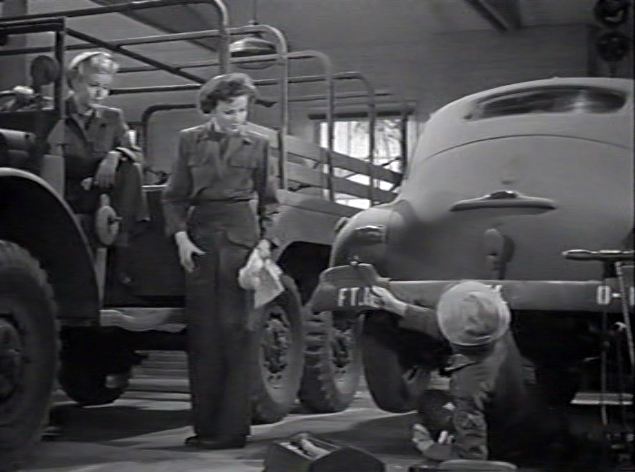
Also refreshingly absent are condescending platitudes about women taking only gender-appropriate roles in the war.  These kids may have arrived in summer frocks with Panama hats or picture hats with floppy brims, but they slip into over-sized coveralls and spend the rest of the film with their hair tied back and a constant grimy film of perspiration on their faces.  No crisp uniforms for them, they look like garage mechanics. 
The well-trained WACs of Keep Your Powder Dry only wore such outfits when they were fixing the general’s car on the post.  Even if they serve overseas, will likely never find themselves close enough to the battle lines to be overrun by the enemy. 
Both films, along with So Proudly We Hail, for any flaws we see at the distance of more than six decades, lend dignity to their varied representations of women in war.  Next week, we’ll take two films made in the early 1950s, Never Wave at WAC (1953) and Skirts Ahoy (1952).  Though the Korean War was going on at the time, these films do not present a serious discussion of women serving their country, but rather take a lighter tone.  The first is a comedy, the second a musical.  We might never know we were at war.

*********

Jacqueline T. Lynch is the author of Ann Blyth: Actress. Singer. Star. and Memories in Our Time - Hollywood Mirrors and Mimics the Twentieth Century. Her newspaper column on classic films, Silver Screen, Golden Memories is syndicated nationally.

Monday, December 3, 2012

Keep Your Powder Dry - 1945


“Keep Your Powder Dry” (1945) shows a sorority-like atmosphere in the Women’s Army Corps of World War II, but poignantly tells a back story greater than the lightweight scenario on the surface.  This movie, like the WAC when it began, walks a tightrope between what the public would accept, and what enlightened possibilities could be explored for women.  The Army brass was more supportive of the program than the doubtful congressmen who argued the legislation to permit it, and more than the flippant journalists who treated it as a carnival act, and more than the ladies’ fellow male GIs, who were suspicious of the virtue, and femininity, of WACs. 
The Army brass, such as Generals Eisenhower and Marshall, knew how desperately they were needed in a two-front war.
This week and next we’ll be discussing women in the armed services through a range of drama, comedy, and musical.  Today it’s “Keep Your Powder Dry”, which hovers between comedy and drama, and “Cry Havoc” (1943), a drama in the manner of “So Proudly We Hail” (1943), which we covered in this previous post.
Next week, it’s a lighter tone in the post-World War II world of “Never Wave at a WAC” (1953) with Rosalind Russell, and “Skirts Ahoy” (1952) with Esther Williams.
“Keep Your Powder Dry” stars Lana Turner, Laraine Day, and Susan Peters as three WAC recruits.  We start the show with an operetta lyric over the opening credits that reminds us, “…for the WAC is a soldier, too.” 
It sounds like a college cheer and we might meet Andy Hardy somewhere.  The title card looks like a Nancy Drew book.
How desperately needed more “manpower” was in the service is illustrated in a strikingly more matter-of-fact manner by Bing Crosby on his Kraft Music Hall radio program on October  7, 1943 when he made this pitch:
“If you’re a woman between 20 and 50, if you’re not now in a war job, if you have no children under 14 and if you’ve had two years of high or business school the Army’s got work for you, work that’s vital for victory…that means more soldiers for combat while members of the WAC take over technical jobs in communications, transport and air force, and x-ray photography, and medical and dental labs, in 155 different branches of Army service that the WAC is trained to handle.  The Women’s Army Corps trains you, the career is yours forever.  The pay is that of a soldier of equal rank.  It’s a really important job waiting in the WAC for every gal who is anxious to serve her country at home or overseas.  The WAC has a recruiting office not far from you.  So do your part in hastening the ultimate victory of our forces.  So, speed them back, join the WAC.”
The movie is less direct.
Lana Turner is a spoiled rich girl who parties and wakes up with hangovers (we get an intro shot of the teasing trail of her clothes on the floor) while her best friend, the parasitic Natalie Schafer (yes, yes, I know, Mrs. Thurston Howell III), wakes her up and begs her once again to get her lawyer to release the REST of her inheritance so they can party even more.
Miss Turner’s lawyer reminds her that the trustees of her inheritance will not release her money until she proves to be more responsible.  So, she joins the WAC, thinking it’ll look good and she can always duck out later.
 Susan Peters is a young wife who, in an unusual goodbye scene, helps her husband pack for Army duty while he tenderly wishes her luck on her upcoming basic training.  She, too, it appears is bound for the WAC, as something productive to do while her husband is away.  She believes she will help the war effort and bring him home sooner.  This was a common reason for lots of WAC enlistees to join.
The third member of the trio is Laraine Day, who is an Army brat, chomping at the bit to join the WAC and be a soldier like her officer papa.  He is pleased, and not a bit worried about her virtue or femininity.
A reassurance to a skittish American public, perhaps, who truly wondered if they were tearing the fabric of American womanhood apart by allowing this audacious thing of women into the Army, even in gender-segregated units.
I don’t suppose this film was shown overseas to the boys on the battlefields, but it might have done them good to see an earnest film about earnest young women in uniform not unlike the girls they left behind. 
Certainly no threats to their manhood here, though I smile at the scene late in the movie where Miss Turner looks like one of the GIs with her shirt open and her tie draped loosely around her neck as if she were about to open a deck of cards for poker. 
It’s easy to dismiss much of the film as schmaltz unless you get that society at the time was uneasy about a woman wearing pants, let alone learning mechanical and technical skills.
We see the women briefly wrestling in hand-to-hand combat training (in work dresses), but most of their time is spent marching and…archery?  The marching cadence in soprano voices.
The initiation into the WAC world of military discipline, and helpfulness in the war effort, is filtered through a fine sieve as most of the movie centers on the personality conflicts of the girls and how they overcome challenges.  Lana Turner, who tops her class in identifying aircraft not because she studied the material but because she dated so many pilots, has discovered a new sense of purpose in the Army.  Never taken seriously before, she rises to the occasion and becomes a good soldier, with only two problems: her old martini-soaked friends won’t leave her alone, and Laraine Day is a thorn in her side.
Laraine Day, in her capacity as having grown up on Army posts, becomes the camp know-it-all on how to do things.  She might get as irritating to the audience as she is to Miss Turner, except that Miss Day is so very good in her role.  She’s almost pathologically bossy and interfering, and we see — and by the end of the movie she will confess — that she feels threatened by the glamour girl Turner.  Her authoritarian attitude over the other girls is due to her insecurity at being bested by outsiders who know nothing of her cherished world of Army life.  Her self-revelation at the end where, crestfallen, she faces the truth about her overbearing behavior is a strong, heart-tugging scene as we watch her crumble inside.
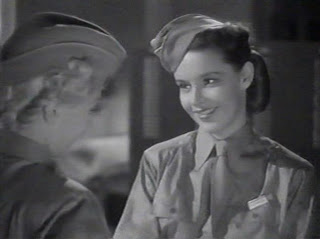
Both Miss Day and Miss Turner would have killed each other long before the movie ended were it not for their mutual love of Susan Peters, the peacemaker of the trio.  Susan Peters displays here again that quiet sensitivity and luminous screen presence that was launching her into a promising film career.  Unfortunately, it is difficult to recall Peters without also recalling her tragic end, which began shortly after this film was completed and a few months before it was released.
As many film buffs are aware, Susan Peters was accidently shot during a hunting trip with her husband, Richard Quine, and some friends.  She was permanently paralyzed from the waist down, and though attempted with astounding courage to make an acting comeback in a wheelchair, died in 1952 from a combination of ailments and crushing depression that completely destroyed her will to live.  She was only 31.
Miss Peters’ character is the least confident of the trio, and her lesson by the end of the film is to achieve through hard work and diligence, and find self-confidence at last.  All of these women go through a pre-feminist era experience of empowerment (catch the scene where the girls fix the general’s broken down car for him), and Hollywood does not begrudge them or belittle them. Not this time.  Not when the country was looking for women recruits.  What a safe incubator Hollywood could be from the real world.
Except, of course, for the burning question of the day as to what a WAC’s panties look like.  We are told they are olive drab, but we do not get a long look at the unmentionables.  If we think this scene is frivolous to the point of eye-rolling, then remember that for the smart-ass journalists covering the first WAC recruitment (which started as the WAAC, Women’s Auxiliary Army Corp before they achieved regular Army status), their most common questions were what color was the girls' underwear, and whom could they date?
The dating question is considered in the film, too.
The title of the film comes from the famous quote from the 1834 poem by William Blacker who, writing about Oliver Cromwell “quotes” Cromwell: “Put your trust in God, my boys, and keep your powder dry!”
Of course, in the cheeky manner of studio writers, not unlike smart-ass journalists, the title in this case also refers to a woman’s cosmetics.
Things to note: Agnes Moorehead as company commander is a woman of quiet, ladylike authority.  Her scene where she gives sad news to Susan Peters is both dignified and gently understated.  She is clearly helpless to do anything more than offer kindness from a respectful distance.
I like the camera shot of Peters alone in Moorehead’s office, shot from above.  It’s an instant image of despair and loneliness.
The girls ride off in a truck on which is painted the words “Wolf Trap”.  Apparently the men in the Army Air Corps weren’t the only ones who could paint sexy slogans on their machines.
Many scenes were filmed in Des Moines, Iowa and Camp Oglethorpe, Georgia, which were actual training places for the WAC. 
The girls do a lot of walking and marching in front of rear screen projection of other troops.  This is why the Allies won the war.  We scared the enemy with our rear-screen projection of thousands and thousands of soldiers following right behind us.
Lee Patrick as the ex-vaudevillian who becomes an Army cook.
June Lockhart as the resident Southern Gal.
They drink a lot of Coke.
A scene of swimming at a pond, like water nymphs basking in the sun, drinking their Coke.  Evidently the WAC has time for picnics, too.
For more on the realities of WAC service, their importance to the war effort during World War II (some 150,000 women served) have a look at this article by Judith A. Bellafaire.  It will fill you in on some remarkable circumstances and achievements of the women who served, and will profoundly increase your respect for the ladies who were pioneers among women in the military.  The WAC was discontinued in 1978, and women serving in the Army from that point served along with men.
On Thursday we’ll have a look at “Cry Havoc” which, though much more serious and troubling in nature due to the extreme danger faced by the women on Bataan during World War II, nevertheless caused less public controversy because these women were Army Nurses.  That a female nurse dying in a jungle was more socially acceptable than a female truck mechanic working in the motor pool is just one of those things we need to discover if we are to lump these two disparate films together as equally important artifacts from World War II.  They are, as you’ll see, quite different.
In the meantime, let us not forget that Her Majesty, Queen Elizabeth, while she was still Princess Elizabeth, served in Britain’s counterpart Auxiliary Territorial Service as a truck mechanic and driver.  Have a look at the Pathé newsreel clip below:

Thursday, November 29, 2012

The Adventures of Mark Twain - 1944


The Adventures of Mark Twain (1944) features a central figure so familiar as to be legendary, and the film leans heavy on legend.  We mark tomorrow’s anniversary of Mark Twain’s birth.
What we discover about Mark Twain through this movie is not so much facts about his life (particularly when the facts are toyed with and not in the order of their appearance), but rather how he fits into, and even represents, the grand mosaic of 19th century American culture.  This is a rich story of a vibrant era. 
We are also treated to the rarely-presented world of history through literature. 
Bret Harte, William Dean Howells, Longfellow, Whittier, Emerson, Rudyard Kipling all parade before us.  They are cameos, but they are presented as giants.  I particularly like that the film expects us to know who they are. 
A modern film might throw the answers to an ignorant audience the way a fellow student slips test answers to a pal beside him, which is ignominious, and unflattering both to ourselves and the great writers.
Mark Twain’s greatest struggle, apart from money worries, is to measure up to these literary lions.  That he finds his own place in popular literature and that the 20th century lauds him with movies and stage plays and television programs, and does not do so for the aforementioned first-string players — this would astonish Twain more than anyone.
This is a film more of style than of substance, and for those dismissive of it I would suggest they consider that in classic film, a biopic is less like a Ken Burns documentary and more like an interpretive dance.
Yes, I am being facetious.
The movie is a series of events like tall tales, and even the introduction to the film cheekily warns us not to be too judgmental.  First we are on a hill watching Halley’sComet awe and terrify the townspeople as Samuel Langhorne Clemens is born into this world.  He will joke repeatedly throughout his life that he came in with the comet and will surely leave the earth when the comet is due to return in the next century.  In a life of quips and witticisms, and wry observations, that he actually did die on the occasion when Halley’s returned in 1910 is probably the biggest joke of all.
But a lot happened in the meantime, and the movie is stuffed with scenes that roll out a long carpet of experiences and adventures.  The director plunks us down in the 19th century with beautifully staged settings, many of them artful miniatures, of the majestic Mississippi, its riverbanks bathed in moonlight.  We see the long gambling salon on the riverboat (too long to be realistic, but this isn’t a documentary, it’s a pop-up book), and the lordly riverboats that young Sam so admires.
We know he took his eventual pen name, “Mark Twain” from the call of the riverboat men who are testing the depths of the water for channels deep enough for the riverboats to pass safely.  Two fathoms is a safe depth, so when they mark “twain” on the measure, it is two fathoms.  The sing-song call, “MARR-R-K…T-W-A-A-A-I-I-N-N!” is used stirringly at dramatic moments, and is replicated in notes on the musical score of the film, a clever reprise.
Unlike most movies about great men, Mark Twain is not shown as a man born to greatness.  On the contrary, he’s a stumblebum who runs off to join a riverboat crew because he can’t stand working in his brother’s print shop setting type by hand.  (His aversion will later move him to invest, disastrously, in an early mechanical typesetter.)  He runs off to the western mining camps to get rich, and doesn’t.  He delivers a stand-up routine at a dinner for the aforementioned literary giants, and, trying too hard to be funny, insults them in a kind of Friar’s roast.  His act tanks and we see his panic as he makes a fool of himself.  We begin to wonder if this guy will ever do anything right.
His one stroke of luck seems to be catching a glimpse of a fellow traveler’s photo of a beloved sister.  Twain falls in the love with the picture, and eventually the woman, who as his wife will help him achieve lasting success as a writer.
Twain has a lower estimation of his talents, and wants to write something great and important, but the audience sees, even if Twain does not, that the body of his work adds up to a chronicling of America in its most expansive, confident, chest-thumping and stumblebum charm.
Fredric March, who we last saw here in I Married a Witch (1942), is the adult Mark Twain, in a spot-on performance.  It can’t be easy creating a character so well known, and relying in good part on mimicry and imitation.  It’s a tightrope to walk.  With the help of makeup man Perc Westmore, Mr. March is the very image of Mark Twain.  One of the fine achievements of this movie is the way the characters, Twain in particular, age so gradually and so realistically we may feel amazed by the end of the film that so much time has passed.  The aging of characters in other films of this era is usually something of a jolt, and artificial-looking. 
Alexis Smith plays his wife, and though we may note it’s another woman-behind-the-great-man role where she has little challenge, it’s still a nice piece for her.  This is a much softer role in contrast to the sophisticates she often played, and with little makeup in the early scenes, her natural beauty is quite lovely, more stunning than her glamour roles.

Miss Smith is a one-woman cheerleading squad for Mark Twain, but in real life Mrs. Clemens did more than just encourage him.  She actually edited most of his work and he came to rely on her judgment.
Alan Hale is along for the ride as Twain’s prospector pal in his patented jovial scamp gig.  John Carradine gets a marvelous brief scene as the writer Bret Harte who, in the famed contest between the jumping frogs, exhorts his frog, “Daniel Webster” with the plea, “If you love me…”  And repeated calls, “Flies!  Flies!” to encourage the magnificent amphibian to hop.  I don’t know if Mr. Carradine ever played a scene so intense with a human.
Donald Crisp is at Twain’s elbow as his manager, who also gets the impressive aging treatment.  Walter Hampden is great as Alexis Smith’s disapproving father in a scene where he tries to remove Twain from his home.
C. Aubrey Smith delivers a magnificent address at the end of the film when Mark Twain is honored at Oxford.  His scene is a standout.  That beautifully craggy face and his meticulous speech.
Joyce Reynolds, who we last saw here in The Constant Nymph (1943), plays Twain’s daughter, Clara, horrified at spotting the return of Halley’s Comet.
A few scenes of note:  I love when the teenaged Samuel Clemens is getting his first lesson in piloting a riverboat by grumpy Robert Barrat.  Dickie Jones is the youth, who has very few lines, but the scene is marvelous.  It runs quite a long time, with close-ups on the boy’s face as he nervously reacts to the dangers of the river and Mr. Barrat’s constant barking at him. 
He’s shaking in his shoes, and when at last he manages to pull into a safe channel and the crewman sings, “M-A-A-R-R-RK…T-W-A-A-I-I-N-N-N!” we see the tears glisten in his dark velvet eyes with wonder and gratitude, and love of this river.  I don’t suppose it’s necessary to the story as a whole, but I imagine director Irving Rapper kept the attention focused on Dickie Jones for so long because he fell in love with the boy like I did.  I think it’s one of the most powerful close-ups I’ve ever seen.
The anxious expression in his soft boy’s face, on the verge of manhood.  We last saw Dickie as a much younger child here in Mr. Smith Goes to Washington (1939) where he played the congressional page.
The scene where Mark Twain does one of his very first public speaking jobs.  Look at the hall filled with extras, and look at their costumes.  Such attention to the style and setting of an era is wonderful.  There don’t seem to be many shortcuts taken, as we sometimes see in other films where the sets or costumes, or hair is judged by the studio evidently as being “close enough.”
We may gag at Twain’s grotesque, “well done, good and faithful servant” joke, and note how African Americans, particularly the unfortunate Willie Best as a butler, get the stereotypical treatment in this film.  However, there is an aspect to their presence in this movie that I admire, and that is that they are indeed present.  We see them on hill watching Halley’s Comet, and as passengers on the riverboat.  They work on the river, and live on the river, and they are the boys on the raft.  If their story is not told yet, at least we see they are not invisible.  We see they are part of the mosaic that makes up America.  For Hollywood at this time, this is something.
We get a glimpse of Mark Twain’s house in Hartford.  See my post on my New England Travels blog for more on his home, which still stands a museum today.  This weekend, another actor famed for portraying Mark Twain, Hal Holbrook, will be honored at the Mark Twain House when a hall is dedicated in his name. 
As Mark Twain’s life unfolds it gets busier.  He and his wife lose a baby son.  They have three daughters.  He travels the world to earn money to pay back debts.  He saves the fortunes of Ulysses S. Grant when the former Union general and President is dying of cancer, and struggles to write his memoirs to provide for his family.  Twain, in his own fledgling company, publishes them.
March has a moving scene when he sings “Swing Low, Sweet Chariot” at the piano as his wife lay dying.  Decades later in an interview Alexis Smith noted that Fredric March’s work in this movie was underrated.  In an article at the time of filming, she commented that she had a hard time, even though she was supposed to be dead, to keep from peeking at March to watch him in his scene.
Back to the pop-up book nature of the movie — the scenes where tiny figures of Huck Finn, Tom Sawyer, and Jim superimposed on the written page, or revisit Twain at the moment of his death and take him by the hand to a distant sunset are imagery we would not see in a biopic today. 
But this is a tale, not a documentary.  It captures the mood and the tragedy, and optimism of this man’s era.  We may be witnessing more Currier and Ives than Vital Records, but that is the nature of interpretive dance.
Remember also that during World War II the movies were reaching back to a comfortable American image to appeal to a frightened audience.  Twain’s speech, “our tolerance will never become indifference, and our freedom never come license.  Let’s respect each other’s rights…” reflects not only his progressive views, as cantankerously as he sometimes phrased them, but also speaks to a nervous America on the precipice of doom.
For more on The Adventures of Mark Twain have a look at Cliff Aliperti’s two posts on his terrific Immortal Ephemera blog here and here.  The movie was filmed in 1942, but not released until 1944.  For a more detailed explanation why, have a look at Harold Sherman’s “Behind theScreenplay” here.
*********

Monday, November 26, 2012

Thanksgiving leftovers...


Joseph Cotten snacks on a leftover leg from the icebox in “Since You Went Away” (1944).  Claudette Colbert is about to get him a glass of milk.  Today we acknowledge the post-Thanksgiving tradition of leftovers.
Being thankful for one’s blessings softens the otherwise somewhat obscene nature of a holiday where we do nothing but eat until we are sick.  And then enjoy leftovers for days afterward.  In a world where millions go hungry, we surely must also be thankful that we have leftovers that last for days.

Alexis Smith seems thankful to have that turkey leg here in “One More Tomorrow” (1946).  That’s Dennis Morgan pouring her a cocktail.  I, too, like to eat leftovers in evening clothes, wearing white opera gloves as I chow down on a turkey leg.  A gentleman in white tie and tails pouring me champagne is one of the things I am most thankful for.

My word, but she’s enjoying that turkey leg.  She gnaws on it all during the conversation like a junkyard dog.
 
Even when debating on who gets the next dance, Jack Carson or John Loder, she still lugs around that turkey leg, seemingly unwilling to part with it just to fox trot.  Oh, what to do?


We’ll visit with Alexis on Thursday when we celebrate the anniversary of Mark Twain’s birth in “The Adventures of Mark Twain” (1944), starring Fredric March.  One hopes she’ll have done eating by then and we can get down to business.


Thursday, November 22, 2012

Happy Thanksgiving


This is to wish all American followers of this blog a Happy Thanksgiving.  Curly of The Three Stooges helped me in the kitchen this morning getting the turkey stuffed. 

Just a reminder that my humorous short story, "Constancy" is still FREE on Amazon for today and tomorrow.

And today begins a FREE run for the next five days for my recently published States of Mind: New England book of essays and photographs on New England history.  Help yourself and Happy Thanksgiving.

Did I ever tell you about the time I was nearly crushed by a giant balloon during a Thanksgiving parade?

It wasn't Macy's parade in New York, though I've attended that one as well, which I enjoyed very much and was not threatened by any balloon in any way.

This occurred in another city which with ladylike discretion I shall not name.  It happened years ago (cue film noir flashback scene), when my twin brother and I were barely out of our teens.  We had watched this parade, and when it ended, and a sea of humanity flooded the streets from all directions, I paused, wondering which was the best way to go to get back to where we parked the car.
Nearby a grand set of steps leading to a kind of raised piazza seemed to be a good place to stand to get our bearings over the crowd.  As we puzzled the situation, we noticed a dark shadow spread over us.  It had been a sunny day, and this sudden darkening seemed ominious.  I looked to the sky for rain.

Directly above us was the large bottom of Felix the Cat.  Descending upon us.  Apparently, the very spot we had chosen to stand was the place where they were deflating Felix to put him back in a truck.

Have you ever heard that expression, "paralyzed with laughter"?  It seems odd that someone could actually be paralyzed by laughter, but that is exactly what happened.  Brother John and I were so overcome with fits of laughing, that we couldn't move, while Felix's giant plastic fanny came nearer and nearer, soon to obliterate us.

I shudder at the thought of the undignified headline announcing our tragic death.

At the last possible moment, we managed to gather our wits and our remaining strength, and stumble out of danger just as Felix plopped down on the piazza like a toddling baby who plops down, bottom first, on his well-padded diaper when his chubby legs give out.

It is a scenario I play over in my mind every Thanksgiving when I see those giant balloons on TV.

Happy Thanksgiving.


Monday, November 19, 2012

States of Mind: New England


This is to announce the publication of STATES OF MIND: NEWENGLAND, a collection of essays from my New England Travels blog, which has reached its fifth anniversary this autumn.
The smashing cover was created by Casey Koester, your friend and mine from the blog, Noir Girl.
The book has nearly 200 photographs.  It covers events and experiences from the early 19th century through the middle of the 20th century.  It’s currently available on Kindle (with a move toward other ebook publishers in the new year) and the paperback version will be on sale in December.  It’s going to be a coffee table-sized 8½x11 book, so I wouldn’t call it a stocking stuffer, but it could make a nice holiday gift.
The Kindle version will be offered FREE for five days only starting this Thursday, Thanksgiving, and running through Monday, November 26th.   Have a look and see what you think.  After that, it goes back to its list price of $7.99.
Here’s a blurb from the foreword:
This is a collection of essays I posted on my New England Travels blog (and a couple from another blog on theatre: Tragedy and Comedy in New England), which at the time of this publishing has just passed its fifth year.  Some of the articles were also previously published in magazines and newspapers. 

This book is a small slice of New England Travels, but there are no travelogue posts here, no photos of lighthouses or covered bridges.  Perhaps that might do for a future volume.  This book is not about New England the place as much as it is about New England the idea, and the ideas that came out of New England, specifically events that happened in the 19th century that shot us into the 20th century.

The photo on the cover is of the Mark Twain statue that stands in front of the library in Hartford, Connecticut where he made his home in later years and wrote his most famous novels.  It’s a good image, and a good metaphor for what this book holds for the reader: a titan of American literature, and in the rugged image hewn in bronze, a representation of the artistry and industry of this region.  I like how the 19th century figure is flanked by the modern 20th century steel-and-glass Hartford Public Library. 

“My subject is the New England mind, as it has found expression in the lives and works of writers,” Van Wyck Brooks wrote in his preface to The Flowering of New England 1815-1865, which like its sequel, New England: Indian Summer 1865-1915, has gone out of fashion as literary criticism, but that did not stop me from enjoying them in younger years.  My subject, too, is the New England mind, but though some writers are represented here, such as Louisa May Alcott, they are not given preference over industrialists or inventors, or soldiers.  All are presented in the context of greater things going on around them, or greater things yet to be.

Alcott is shown not as the famous author of Little Women, but as a young Civil War nurse.  Francis Lowell is shown not just as one of the founders of America’s industrial revolution, but in the context of how that revolution gave women a rise in society and economic and political power.  He was the first, after all, to give preference in hiring women over men in his mills, ostensibly so that he could pay them less. 

Annie Sullivan and Helen Keller are not presented as Teacher and her severely handicapped pupil, but as a New Englander and a Southerner whose partnership was the first and most successful union between North and South after the Civil War.

Melzar Mosman, largely forgotten as one of the foremost founders of bronze statuary in this country, is shown not just as the foundryman, artist, and sculptor, but as a Union Army private, an experience he would re-live with every bronze statue of a solider standing picket duty that came out of his foundry to find a home on town commons across New England, and of generals across America.  Mr. Mosman, incidentally, will be the subject of a future book.

The 19th century chapters seem to illustrate the spawning of ideas and inventions which made history; the 20th century seems to show us reacting to events, like hurricanes, and juggling consequences. In the 19th century, through the Industrial Revolution, we drew upon a new workforce (women), and created a market for manufactured goods.  In the early 20th century—we shopped—in grand, family-owned department stores just as paternalistic as the factories of the previous century.

These then are slices of New England, not just the place, but the idea and social movement, and the force that largely determined what America would be like in the 19th and 20th centuries.  You can find its representation in the bricks and mortar of a factory building, or in the hobnailed boots of the mill girl who found both exhaustion and independence there. 
 
In other news, my short story, "Constancy" is going free for the next few days on Amazon.  You can download it here if you like.

Thank you for your kind attention.  Now back to our regularly scheduled blog.


Related Products