IMPRISON TRAITOR, PEDOPHILE, AND CONVICTED FELON TRUMP.
Thursday, January 6, 2011
Here Comes the Groom - 1951
“Here Comes the Groom” (1951) can be viewed through a prism of different spectrums, first and foremost perhaps, as the first in the last handful of movies directed by Frank Capra. There are pieces of Capra’s canon here: a smidgen of screwball comedy, a bit of social commentary. But, as if not too deeply touched by the great director, the film summons up all its parts and walks away on its own, flawed but triumphant just for getting there.
Maybe you could say the same for Frankenstein’s monster. It got up and walked away on its own, too. But, I have a fondness for the monster, and I have a fondness for this pretty delightful movie that tries hard to be more than it is.
Here we have Bing Crosby as a happy-go-lucky foreign correspondent in Paris writing about war orphans. Capra reminds us that we are still in the mopping up stage in the aftermath of World War II, when some six years after the war ended, Americans are getting a bit weary of it.
“The war orphan racket’s milked dry. It’s not news anymore,” Bing’s editor says, played by Robert Keith, who we last saw here in “I Want You” (1950). Words like UNESCO, the United Nations, the Atlantic Charter are bandied about, reminding us of the timeline this movie places us.
We even get a generous dose of the young Anna Maria Alberghetti as a blind orphan (her mother refused to “entertain” the enemy, we are told) singing “Caro None” from Verdi’s “Rigoletto” in an audition to be adopted by Alan Reed and Minna Gombell.
She is very sweet, and very good, and Alan Reed (AKA Fred Flintstone, as if you didn’t know), an opera impresario, adopts her and promises her not only a home but a bright career. The movie is barely ten minutes old and we already have our first happy ending.
(Does anybody else automatically think of the old line from the “Mary Tyler Moore” show, “Anna Maria Alberghetti in a taxi, honey…”?)
Perhaps Mr. Capra, too, is weary of the aftermath of World War II, because this is all that constitutes social commentary in this breezy musical, and we move on, tentatively, to the screwball comedy.
Bing Crosby, despite his efforts at finding homes for war orphans, is not really as much a hero as a lazy fellow for whom things always work out. Doing good comes as a coincidence.
Two of his orphan friends become his own adopted children (eventually): a rascally little boy played by Jacques Gencel, who displays admirable stewardship over the ever-adorable Beverly Washburn, who being younger and not really being French, doesn’t have much to say. We saw her last, I think in this post on “Old Yeller”, where she was a bit older and had a bit more to do.
I like little Jacques’s mimicking of Crosby on the phone.
Crosby receives a letter in the form of a recording, an interestingly used holographic image, from Jane Wyman, the gal he left behind. If he doesn’t high-tail it home, she’s going husband-hunting elsewhere.
Crosby flies home to stop her, with his two orphans, and we get a sudden smidgen of vaudeville right out of left field when several passengers erupt into song with Bing on the plane. “Misto Cristofo Columbo” is a bouncy, fun song about discovering America, as the orphans are about to do, and opening up freedom’s door for war refugees. It is sung by real-life impromptu USO troupe of Frank Fontaine, Phil Harris, Cass Daley, Dorothy Lamour, and Louis Armstrong. Nothing fun like that ever happens when I fly.
When he arrives with the kids in Boston, he discovers that Miss Wyman’s already bound for the altar that week with a millionaire, played by Franchot Tone. Mr. Tone makes a refreshing nemesis; he is handsome, intelligent, kind, and superior in every way. Crosby realizes he has his work cut out for him and he must be especially devious to steal Wyman away from this great guy.
But there is chemistry between Miss Wyman and Mr. Crosby that we discover right off the bat, despite her criticism of his maddeningly casual take on life. When she brings him to the office building of her real-estate investor employer, who is also her fiancĂ©, to help Bing find a cottage for his young-uns, they demonstrate rapport and sparkling musicality in the number “In the Cool, Cool, Cool of the Evening”, which they warble from the office, to the elevator, and out into the street.
The song immediately became a big hit on the radio. Some of the audience then, and perhaps more so today, who had become used to thinking of Jane Wyman as a dramatic actress may have forgotten she started out a chorus girl and could belt a song out with the best of them.
Another fun “the gang’s all here” kind of aspect is engendered by so many familiar faces getting a piece of the action: James Barton and Connie Gilchrist as Jane’s “wrong side of the track” parents. (It was disapprovingly noted in a recent viewing of this film by one of my relatives that though Jane’s family is from Gloucester, Mass. and the movie takes place in Boston, nobody here has the proper accent. I don’t hold it against anybody, though. I can be big.)
We also have dear old Adeline De Walt Reynolds, who we featured once in this post, who gets a couple of funny lines. Charles Halton, who last showed up as the detective in “The Shop Around the Corner” shows up here as an immigration agent. H.B. Warner is one of Franchot Tone’s stodgy wealthy uncles.
The magnificent (so says anyone carrying a torch for him) Charles Lane as the FBI agent makes my day.
Chris Appel, who surprisingly made only two films, appears here as the frantic wedding arranger who cannot get anyone to cooperate during the wedding rehearsal.
Check out Jane Wyman’s wedding apparel, particularly the tiara and recall our series on the 1950s princess here, here, and here.
I’m saving the best for last. Alexis Smith. She plays the distant cousin of Franchot Tone who agonizingly harbors a secret crush on him. Her awkward, blue-blood tweediness has left her ignored by him and her family, until Bing Crosby takes her in hand and teaches her how to flirt, and how to wrestle, in order to give her the confidence to go after Franchot Tone, so that Crosby may have Miss Wyman to himself. Though it’s a preposterous scene, it’s also touching when we realize that Crosby is the only one to understand her feelings and to give her the confidence she desperately needs.
“You are beautiful. You’re a knockout,” he says, and especially compliments her height, something all shy tall girls need to hear.
Alexis Smith blooms under his rough-and-tumble tutelage, and becomes a bombshell. Later she will wrestle with Miss Wyman (or the stunt doubles will, actually), and declare her worthiness both as a member of the clan, and as an object of lust. She even gets to sing her own verse of “In the Cool, Cool, Cool of the Evening” a cappella.
I like when editor Robert Keith, who is a conspirator in her “education”, leaves to head back for the office and one of Miss Smith’s stockings snags a ride on the back of his hat.
At the 11th hour, amid busybody government officials, wisecracking newspapermen, a congregation of elite Boston society at the televised wedding of the year, Crosby’s conniving plans gel as everything else falls apart. Franchot Tone and Jane Wyman choose other partners, and it’s a happy ending where nobody is foiled, not really, because there were never really any bad guys.
Have a look below for “In the Cool, Cool, Cool of the Evening”. Note how it’s sung “live” and not lip-synched.
Below that, our USO troupe singing “Miso Cristofo Columbo”.
(Don’t forget to scroll down to the bottom and mute the music so you can hear the video.)
Monday, January 3, 2011
Preview - Film Noir Blogathon
To start this year off right, let’s first remind all readers and fellow bloggers of the second film preservation blogathon hosted by Ferdy on Films, and by the Self Styled Siren, with some details here.
This year’s blogathon is scheduled for February 14th through 21st, and the topic is Film Noir. Please have a look at those two ladies' blogs in February for what I’m sure will be a fabulous list of blog posts, and please donate to support the Film Noir Foundation. Send your contributions here.
And though it’s a little early, I’m calling dibs on “The Prowler” (1951) with Van Heflin and Evelyn Keyes. I expect to post it on Monday, February 14th. Nothing says “Happy Valentine’s Day” like killing your girlfriend’s husband on the front lawn while he’s in his jammies.
Did I give too much away? Doah!
This year’s blogathon is scheduled for February 14th through 21st, and the topic is Film Noir. Please have a look at those two ladies' blogs in February for what I’m sure will be a fabulous list of blog posts, and please donate to support the Film Noir Foundation. Send your contributions here.
And though it’s a little early, I’m calling dibs on “The Prowler” (1951) with Van Heflin and Evelyn Keyes. I expect to post it on Monday, February 14th. Nothing says “Happy Valentine’s Day” like killing your girlfriend’s husband on the front lawn while he’s in his jammies.
Did I give too much away? Doah!
Thursday, December 30, 2010
Monday, December 27, 2010
Off Topic - Children's Books during World War II
This is to pick up the thread of a conversation we began in the comments section of this post a month ago that introduced the series on home front “war stories”. I’ve had another project on the back burner for some time with which some of you might be able to help.
This involves a possible book about children’s books written during World War II, about that war. We’re not talking about any classics of children’s literature here, no Caldecott or Newbery Award winners; what I mean are those series books, the pulp novels that engaged teens and pre-teens with a weird combination of childlike adventure and all-too adult angst about the consequences of not doing one’s patriotic duty during the war.
Some of these were a series featuring the same character, like the “Dave Dawson” books, where he and his pal, Freddie Farmer, fought the enemy pretty much all over the globe. Likewise “Red Randall” who began his teenage trial by fire at Pearl Harbor. Both series were written by R. Sidney Bowen.
“Cherry Ames” went from nursing school into the Army, served in Panama, some non-disclosed islands in the South Pacific, flew through a hailstorm of gunfire over Germany, and finished up her tour of duty as a nurse in a veteran’s hospital. I won’t guess how many girls pursued nursing careers because of this series, but I know there are some out there who admit to it.
Other series followed a theme of wartime service but featured different characters. Whitman Publishing, who practically cornered the market in children’s series books at the time, produced several pulp novels under their “Fighters for Freedom Series”. This gave us “Nancy Dale - Army Nurse”, “Dick Donnelly of the Paratroops”, “Norma Kent of the WACS,” “Sally Scott of the WAVES”. “Kitty Carter of the Canteen Corps” showed us we didn’t necessarily have to be in the military to help the war effort.
The publisher touted these as “Thrilling novels of war and adventure for modern boys and girls.”
It was a tough being a modern boy or girl when war might be all you remembered, and would determine a future you could not imagine, a future which seemed to hang precariously on whether or not you displayed your full measure of devotion and courage. Just eating your vegetables wasn't good enough anymore.
There are several elements to these stories which are quite striking. One is the, in some cases, unsparing description of death and cruelty, and the fatalistic manner in which the tone of these stories seems to indicate the young reader should accept these conditions. Nancy Dale’s troop ship is torpedoed, and she spends several days in a lifeboat with a handful of other nurses and crew members. One dies and they dump the body overboard.
At one point in the story she receives word her brother is missing in action and presumed dead. A family friend, comforting her, tells her not to hold out much hope of his survival. “Don’t let wishful thinking keep you from facing reality, my dear. There’re many things worse than death in this war.” How would a kid, who had relatives in the war, take this message?
On the frontispiece of “Red Randall at Pearl Harbor”, published by Grosset & Dunlap, we are reminded that “This book, while produced under wartime conditions, in full compliance with government regulations for the conservation of paper and other essential materials is completed and unabridged.” Even the book itself has the imprimatur of self sacrifice.
If you find these books today, the pages are yellowed, few of them have book jackets left intact, but many of them have the signatures of the children to whom they belonged. Or, in this case of this flyleaf of “Norma Kent of the WACS” - “To Shirley from Grandma - December 25, 1944”.
What I’d like to know from you is your memories of reading these books, how you discovered them, and what impressions they had upon you. Perhaps you were, like Shirley, a child at Christmas. Perhaps you were Shirley’s younger sister or brother, getting her hand-me-down books five or ten years later, when the aftermath of the war was known and the wartime service remained a badge of honor out of reach for this first succeeding generation. Maybe you were her daughter, or grandson, and found these books in an attic. You could have read them when the war was current events, or something that came alive for you one rainy afternoon in the 1970s.
I’d like to know about that particular American generation, who became adults in the early 1950s, perhaps still “shell shocked” by a childhood of vicarious victory and defeat, who found themselves taking places of responsibility in a society where, though regimented, not everyone played by the rules.
I’d like to hear from the all the nurses, the sailors, the fliers, who became what they did because of a book they’d read when they were fourteen.
I’d like to hear from the romantic nostalgic buffs who learned history from flea market artifacts like a written-to-formula kid’s novel about a world turned terrible where the monsters were real, and you never read “and they lived happily ever after” at the end.
If you have any thoughts to contribute, please email me at: JacquelineTLynch@gmail.com, with the understanding that any communication might be used for possible publication, though all requests for anonymity will be honored. No email communication will be published on this blog.
Thanks.
Thursday, December 23, 2010
"Holiday Affair" - 1949
“Holiday Affair” (1949) could almost be an extension of the “war stories” series we did a couple weeks ago, with its examination of a war widow still fighting the good fight on the home front. The trouble is, the war’s over and she cannot make herself move on.
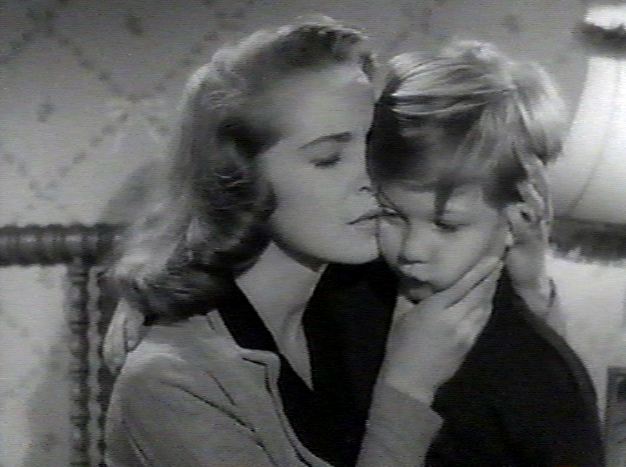
Janet Leigh plays the single mother of little Timmy, played with all-American boy golly gosh sweetness by young Gordon Gebert. Master Gebert has a cute line when, given a present he especially wanted, replies, “I’m so happy if I was a dog, my tail would be wagging.” It’s something a six-year would say.
A war widow, Janet Leigh still keeps the lamp in the window by subconsciously, and sometimes consciously, raising her boy to be a replacement for his father, and by not allowing a new husband and father a place in her heart.
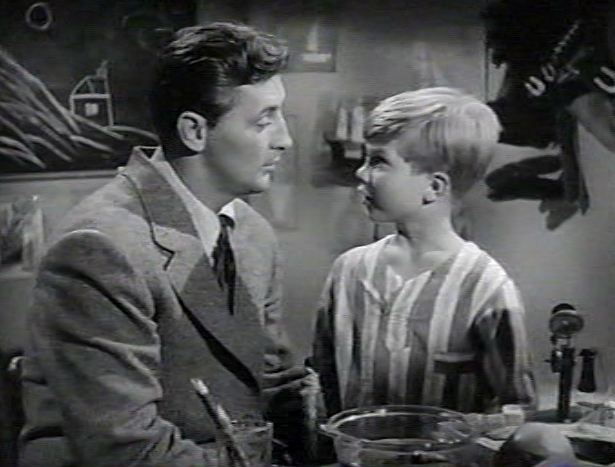
Not that Wendell Corey isn’t trying. He plays her attorney beau, a steady, nice guy with an easy, intelligent manner who waits patiently for her to accept his marriage proposal, washes the dishes with her, and meanwhile works hard at being Timmy’s pal. Timmy is ambivalent, for his mother is raising him to be, like her, self sufficient and needing nobody but each other.
Enter Robert Mitchum, just as good at being a charming sweetie as he is being a sadistic scary guy. Who’d have thought? He and Miss Leigh cross paths in a department store, and continue to cross paths throughout the movie in situations both coincidental and contrived. He wins Timmy over first with his playfulness and man-to-man camaraderie, but Janet Leigh is more resilient. He has to hammer home some painful truths to her before she allows the war to be finally over.
I like the scene where Mitchum and Corey ruminate on how it doesn’t seem to snow as much as when they were kids, and how Corey muses it might have something to do with the atom bomb.
As we mentioned in our last post on “The Shop Around the Corner”, we’re looking at a commercial Christmas in these posts. What had been a cozy and quaint 1930s gift shop on a snowy Budapest side street in that movie becomes a bustling downtown post-war department store here. The kind of scene for which many old movie buffs are, in these days of mega malls and online shopping, nostalgic for, despite how the inconvenient dressing up and taking a cab downtown would seem today.
We love this old stuff, but I wonder if we have the guts and stamina, and patience for it?
Particularly clever is the use of electric trains, the iconic Holy Grail of Christmas presents, and also a foreshadowing of a cross-country train trip Mr. Mitchum intends to take to start his life over.
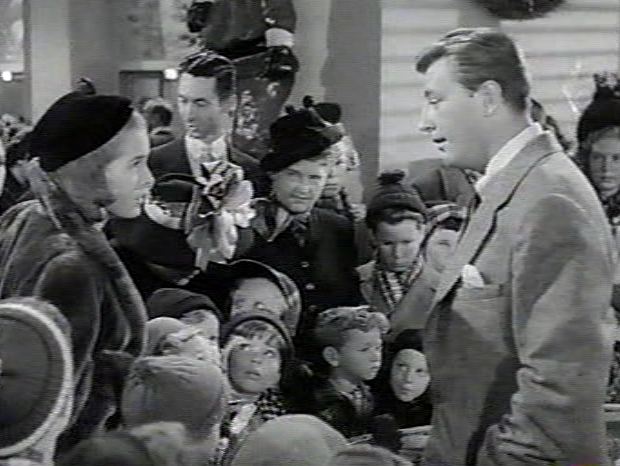
When the opening credits roll, we are shown a train barreling by, and as the camera pans back from the countryside, we see that it is nothing more than a toy electric train setup in a store toy department. Robert Mitchum takes center stage, part Pied Piper and part pitchman, as he demonstrates the marvelous toy trains to the rapt audience of kids. He is a salesman here, a hero to his young customers, a bane to the suspicious floorwalker who keeps an eye on him.
Janet Leigh buys a train, but not for her little boy who would kill for one. She is a comparison shopper incognito, a kind of commercial spy who investigates prices, quality of merchandise, buys trains and then returns them. Mr. Mitchum is on to her, but when he fails to report her to the manager, his floorwalker nemesis turns him in, and he’s fired. Out of job at Christmas.
His dream is to travel to California and work at a boat building business, but he needs the dough to get there. Still, he buys Timmy the train he won’t otherwise get for Christmas, and puts himself next in line behind Wendell Corey for Janet Leigh’s hand in marriage. If she can just realize the fact that she’s free to marry.
A couple of good scenes are the Christmas dinner with Janet Leigh’s in-laws, a kindly elderly couple, played by Esther Dale and Griff Barnett, doting on the grandson who reminds them so much of their deceased son. Wendell Corey and Robert Mitchum also have seats at the table, and for a while it’s very pleasant how these grownups behave so grown up, suppressing their own angst and desires for the sake of Christmas.
They give toasts, and when it’s Mr. Mitchum’s turn, he frankly states his case, in lawyer-like fashion, to the lady and her lawyer that he wants to marry her. Rarely has a personal confrontation come off as so classy.
It’s also a punch in the gut for Wendell Corey to have to sit through it, for Janet Leigh who fears it, and for her in-laws, who gamely suffer the logical discussion of who is better to be their grandson’s next father, a replacement for their son.
Another good scene is when Mitchum calmly blasts her between the eyes with self knowledge at its most uncomfortable, of what she is doing to herself and her son by not letting go of her widowhood.
Likewise when Wendell Corey breaks off with her, acknowledging to her what he has known for some time, she just doesn’t love him. It’s killing him, but he faces it stoically. Neither men try to beat each other’s time; they just want the facts which Janet Leigh is too frightened, or guilty to face.
Just before the end credits roll, we see a real train trip and watch Robert Mitchum take off on his new life adventure, but not alone. Just as at the beginning, the camera pulls back and the train cleverly becomes a toy again on a new train setup with tiny palm trees of his California destination. It’s like “Holiday Affair Meets Gumby.”
By the way, this film was released on Christmas Eve, 1949. In this previous post, we covered how most Christmas-themed movies were not released during the holiday at all.
Thanks for shopping with me this week. And for carrying the packages. You can put them down, now. For those who celebrate Christmas, I wish you a peaceful and pleasant holiday.
For all readers of this blog, I have a gift (should you choose to accept it, as they used to say on “Mission Impossible”). For today only you can order my novel “Meet Me in Nuthatch” FREE from Smashwords. This is an ebook, which can be downloaded to any ebook reader in different formats, and can also be downloaded to your computer and read on your computer without needing any Kindle or Nook or other ereader. When you go through the checkout, put in this coupon code: JQ29S -- and your book will be free.
Merry Christmas.
Janet Leigh plays the single mother of little Timmy, played with all-American boy golly gosh sweetness by young Gordon Gebert. Master Gebert has a cute line when, given a present he especially wanted, replies, “I’m so happy if I was a dog, my tail would be wagging.” It’s something a six-year would say.
A war widow, Janet Leigh still keeps the lamp in the window by subconsciously, and sometimes consciously, raising her boy to be a replacement for his father, and by not allowing a new husband and father a place in her heart.
Not that Wendell Corey isn’t trying. He plays her attorney beau, a steady, nice guy with an easy, intelligent manner who waits patiently for her to accept his marriage proposal, washes the dishes with her, and meanwhile works hard at being Timmy’s pal. Timmy is ambivalent, for his mother is raising him to be, like her, self sufficient and needing nobody but each other.
Enter Robert Mitchum, just as good at being a charming sweetie as he is being a sadistic scary guy. Who’d have thought? He and Miss Leigh cross paths in a department store, and continue to cross paths throughout the movie in situations both coincidental and contrived. He wins Timmy over first with his playfulness and man-to-man camaraderie, but Janet Leigh is more resilient. He has to hammer home some painful truths to her before she allows the war to be finally over.
I like the scene where Mitchum and Corey ruminate on how it doesn’t seem to snow as much as when they were kids, and how Corey muses it might have something to do with the atom bomb.
As we mentioned in our last post on “The Shop Around the Corner”, we’re looking at a commercial Christmas in these posts. What had been a cozy and quaint 1930s gift shop on a snowy Budapest side street in that movie becomes a bustling downtown post-war department store here. The kind of scene for which many old movie buffs are, in these days of mega malls and online shopping, nostalgic for, despite how the inconvenient dressing up and taking a cab downtown would seem today.
We love this old stuff, but I wonder if we have the guts and stamina, and patience for it?
Particularly clever is the use of electric trains, the iconic Holy Grail of Christmas presents, and also a foreshadowing of a cross-country train trip Mr. Mitchum intends to take to start his life over.
When the opening credits roll, we are shown a train barreling by, and as the camera pans back from the countryside, we see that it is nothing more than a toy electric train setup in a store toy department. Robert Mitchum takes center stage, part Pied Piper and part pitchman, as he demonstrates the marvelous toy trains to the rapt audience of kids. He is a salesman here, a hero to his young customers, a bane to the suspicious floorwalker who keeps an eye on him.
Janet Leigh buys a train, but not for her little boy who would kill for one. She is a comparison shopper incognito, a kind of commercial spy who investigates prices, quality of merchandise, buys trains and then returns them. Mr. Mitchum is on to her, but when he fails to report her to the manager, his floorwalker nemesis turns him in, and he’s fired. Out of job at Christmas.
His dream is to travel to California and work at a boat building business, but he needs the dough to get there. Still, he buys Timmy the train he won’t otherwise get for Christmas, and puts himself next in line behind Wendell Corey for Janet Leigh’s hand in marriage. If she can just realize the fact that she’s free to marry.
A couple of good scenes are the Christmas dinner with Janet Leigh’s in-laws, a kindly elderly couple, played by Esther Dale and Griff Barnett, doting on the grandson who reminds them so much of their deceased son. Wendell Corey and Robert Mitchum also have seats at the table, and for a while it’s very pleasant how these grownups behave so grown up, suppressing their own angst and desires for the sake of Christmas.
They give toasts, and when it’s Mr. Mitchum’s turn, he frankly states his case, in lawyer-like fashion, to the lady and her lawyer that he wants to marry her. Rarely has a personal confrontation come off as so classy.
It’s also a punch in the gut for Wendell Corey to have to sit through it, for Janet Leigh who fears it, and for her in-laws, who gamely suffer the logical discussion of who is better to be their grandson’s next father, a replacement for their son.
Another good scene is when Mitchum calmly blasts her between the eyes with self knowledge at its most uncomfortable, of what she is doing to herself and her son by not letting go of her widowhood.
Likewise when Wendell Corey breaks off with her, acknowledging to her what he has known for some time, she just doesn’t love him. It’s killing him, but he faces it stoically. Neither men try to beat each other’s time; they just want the facts which Janet Leigh is too frightened, or guilty to face.
Just before the end credits roll, we see a real train trip and watch Robert Mitchum take off on his new life adventure, but not alone. Just as at the beginning, the camera pulls back and the train cleverly becomes a toy again on a new train setup with tiny palm trees of his California destination. It’s like “Holiday Affair Meets Gumby.”
By the way, this film was released on Christmas Eve, 1949. In this previous post, we covered how most Christmas-themed movies were not released during the holiday at all.
Thanks for shopping with me this week. And for carrying the packages. You can put them down, now. For those who celebrate Christmas, I wish you a peaceful and pleasant holiday.
For all readers of this blog, I have a gift (should you choose to accept it, as they used to say on “Mission Impossible”). For today only you can order my novel “Meet Me in Nuthatch” FREE from Smashwords. This is an ebook, which can be downloaded to any ebook reader in different formats, and can also be downloaded to your computer and read on your computer without needing any Kindle or Nook or other ereader. When you go through the checkout, put in this coupon code: JQ29S -- and your book will be free.
Merry Christmas.
Monday, December 20, 2010
The Shop Around the Corner - 1940
The Shop Around the Corner (1940) nostalgically shows us the finely delineated everyday moments that are more trying, require more patience and courage, give more delight and a bigger emotional rush than even the most hectic modern countdown to Christmas. Reportedly director Ernst Lubitsch’s favorite film, it is no one wonder, for there is so much of his personally constructed GemĂĽtlichkeit. It begins with the lilting, breezy dance orchestra music we hear at the opening and closing credits.
We’re going shopping this week with a look at the commercial aspect (though incidental) of Christmas as seen through this film, and on Thursday, with Holiday Affair (1949) here.
There are so many charming aspects to The Shop Around the Corner, most especially that the minor character actors play major roles, including many beautiful solo moments that complement the major stars here: Margaret Sullavan and James Stewart.
You’ll remember Felix Bressart from a slew of films, even if you don’t know his name. Here he is the elder shop clerk who assiduously avoids the blustering boss with whom he knows he can’t win, and seems to bring the warmth of his simple home where he is “Papa” to his wife and children, into the gift shop where he and his fellow employees have a kind of second home. We last saw him in this post on Portrait of Jennie (1949) where he played the befuddled movie projector operator.
You’ll remember Sara Haden as Aunt Milly from a long parade of Andy Hardy movies. She is the old maid secretary here instead of the old maid aunt. Charles Halton is the detective, also seen in dozens of movies in minor roles, probably you’ll recall him as the bank examiner in It’s a Wonderful Life (1946).
William Tracy is a standout as the clownish, clever delivery boy, likable and conniving, who eventually gets a promotion and lords it over the new delivery boy.
The new boy is played by a young Charles Smith, who could tear our hearts out with his gentle innocence and hopefulness.
Josef Schildkraut, who won the Best Supporting Oscar for The Life of Emile Zola (1937), continues to prove his versatility as the two-faced sales clerk always trying to stab his fellow employees in the back (we’ve all known them).
There is Frank Morgan, just off The Wizard of Oz (1939), who skillfully trades his customary comic confusion for a more dramatic role as the fussy boss, Mr. Matuschek, whose personal anxieties and ultimate near-tragedy affect his entire staff.
All these players make the movie seem like an ensemble piece, where the last shall be first. Still, there is a major plot line for the two stars apart from the goings on in the store.
Especially good in his role is James Stewart, the head sales clerk, a man who must be a buffer between the mercurial whims of the boss, and the helpless junior staff. Mr. Stewart has the ability to play that kind of young man who, while being street-wise and knowing the odds of life are stacked against him, manages to balance his wry pragmatism with a brave idealism that buoys him. He walks a fine line in his relationship with his boss, and with his secret love, a woman he knows only by her letters. We saw recently with Love Letters how much can be won, and lost, in precious correspondence and the allure of a well-turned phrase.
Margaret Sullavan plays the newest member of the staff, who cleverly and with chutzpah manages to charm a disinterested lady customer into buying unmovable merchandise, thereby getting herself a job and starting her role as a thorn in the side of James Stewart. They are combative throughout the film, but each has a secret. Eventually, we come to understand that the anonymous pen pal letters they write to prospective sweethearts are actually written to each other.
The story has been remade in several incarnations, including the post here on In the Good Old Summertime (1944). But this version has a charm all its own, and I think a good part of it is Lubitsch’s setting the story in Budapest during the Depression. I love the signs all written in Magyar, including our many peeks at the currency tabs on the cash register.
Miss Sullavan, with her Dresden doll features and her precise stage speech with her throaty voice seems to carry the illusion of Europe, as does, ironically, James Stewart. We may see him usually as his “Mr. Smith” icon, the all-American idealist. But there was also something, as mentioned above, of a practical, doubting, soberness to James Stewart’s portrayals, as if he is someone who was fooled once and is determined not to be taken in again. His gentlemanly reserve fits well here in this middle European gift shop.
I love Felix Bressart’s low bows when shaking hands. The Americans and the Europeans in the cast seem to blend well together, without parody.
Made in 1940, while World War II stripped away the independence and the lives of many, many Europeans, we may well guess that this is Mr. Lubitsch’s tribute, and perhaps farewell, to a more peaceful era in Europe. Hitler may have been well forming his plans in the 1930s, but there is still in this movie something decidedly nostalgic, something Habsburgian about this setting. It might be the cigarette boxes that play “Ochi Tchornya” (Dark Eyes), or the courtly shrug of the shoulders attitude that one must make the best of things in this troubled world.
The commercial aspect of Christmas here is gently expressed. Certainly, Frank Morgan exhorts, and bullies, his employees into gearing up for the hoped-for Christmas rush. Christmas Eve, a light snow without sleet or the slightest breeze falls on the shoulders of the shoulder-to-shoulder crowd in the street, teased by decorated window displays. Mr. Morgan’s gift shop does the best business since 1928, the last Christmas before the Wall Street crash.
I like James Stewart’s line to Felix Bressart when they discuss the excitement of getting a bonus, the anticipation of opening the pay envelope and wondering how much. “As long as the envelope’s closed, you’re a millionaire.”
We sense the boss is made the happiest when, after inquiring after the Christmas Eve plans of his employees, who all have somewhere to go, his newest staff member, young Rudy, is all alone this night. Boss, alone himself, joyfully invites delivery boy to a first-rate restaurant feast as Mr. Morgan learns the true spirit of Christmas, not from ghosts, but by his own errors, his near-tragedy, and his gratitude that life does go on in spite of how much of a mess we make of it sometimes.
If you’ve not seen The Shop Around the Corner, TCM is showing it tonight.
Come back Thursday for Robert Mitchum and Janet Leigh in a much larger department store setting in Holiday Affair here.
We’re going shopping this week with a look at the commercial aspect (though incidental) of Christmas as seen through this film, and on Thursday, with Holiday Affair (1949) here.
There are so many charming aspects to The Shop Around the Corner, most especially that the minor character actors play major roles, including many beautiful solo moments that complement the major stars here: Margaret Sullavan and James Stewart.
You’ll remember Felix Bressart from a slew of films, even if you don’t know his name. Here he is the elder shop clerk who assiduously avoids the blustering boss with whom he knows he can’t win, and seems to bring the warmth of his simple home where he is “Papa” to his wife and children, into the gift shop where he and his fellow employees have a kind of second home. We last saw him in this post on Portrait of Jennie (1949) where he played the befuddled movie projector operator.
You’ll remember Sara Haden as Aunt Milly from a long parade of Andy Hardy movies. She is the old maid secretary here instead of the old maid aunt. Charles Halton is the detective, also seen in dozens of movies in minor roles, probably you’ll recall him as the bank examiner in It’s a Wonderful Life (1946).
William Tracy is a standout as the clownish, clever delivery boy, likable and conniving, who eventually gets a promotion and lords it over the new delivery boy.
The new boy is played by a young Charles Smith, who could tear our hearts out with his gentle innocence and hopefulness.
Josef Schildkraut, who won the Best Supporting Oscar for The Life of Emile Zola (1937), continues to prove his versatility as the two-faced sales clerk always trying to stab his fellow employees in the back (we’ve all known them).
There is Frank Morgan, just off The Wizard of Oz (1939), who skillfully trades his customary comic confusion for a more dramatic role as the fussy boss, Mr. Matuschek, whose personal anxieties and ultimate near-tragedy affect his entire staff.
All these players make the movie seem like an ensemble piece, where the last shall be first. Still, there is a major plot line for the two stars apart from the goings on in the store.
Especially good in his role is James Stewart, the head sales clerk, a man who must be a buffer between the mercurial whims of the boss, and the helpless junior staff. Mr. Stewart has the ability to play that kind of young man who, while being street-wise and knowing the odds of life are stacked against him, manages to balance his wry pragmatism with a brave idealism that buoys him. He walks a fine line in his relationship with his boss, and with his secret love, a woman he knows only by her letters. We saw recently with Love Letters how much can be won, and lost, in precious correspondence and the allure of a well-turned phrase.
Margaret Sullavan plays the newest member of the staff, who cleverly and with chutzpah manages to charm a disinterested lady customer into buying unmovable merchandise, thereby getting herself a job and starting her role as a thorn in the side of James Stewart. They are combative throughout the film, but each has a secret. Eventually, we come to understand that the anonymous pen pal letters they write to prospective sweethearts are actually written to each other.
The story has been remade in several incarnations, including the post here on In the Good Old Summertime (1944). But this version has a charm all its own, and I think a good part of it is Lubitsch’s setting the story in Budapest during the Depression. I love the signs all written in Magyar, including our many peeks at the currency tabs on the cash register.
Miss Sullavan, with her Dresden doll features and her precise stage speech with her throaty voice seems to carry the illusion of Europe, as does, ironically, James Stewart. We may see him usually as his “Mr. Smith” icon, the all-American idealist. But there was also something, as mentioned above, of a practical, doubting, soberness to James Stewart’s portrayals, as if he is someone who was fooled once and is determined not to be taken in again. His gentlemanly reserve fits well here in this middle European gift shop.
I love Felix Bressart’s low bows when shaking hands. The Americans and the Europeans in the cast seem to blend well together, without parody.
Made in 1940, while World War II stripped away the independence and the lives of many, many Europeans, we may well guess that this is Mr. Lubitsch’s tribute, and perhaps farewell, to a more peaceful era in Europe. Hitler may have been well forming his plans in the 1930s, but there is still in this movie something decidedly nostalgic, something Habsburgian about this setting. It might be the cigarette boxes that play “Ochi Tchornya” (Dark Eyes), or the courtly shrug of the shoulders attitude that one must make the best of things in this troubled world.
The commercial aspect of Christmas here is gently expressed. Certainly, Frank Morgan exhorts, and bullies, his employees into gearing up for the hoped-for Christmas rush. Christmas Eve, a light snow without sleet or the slightest breeze falls on the shoulders of the shoulder-to-shoulder crowd in the street, teased by decorated window displays. Mr. Morgan’s gift shop does the best business since 1928, the last Christmas before the Wall Street crash.
I like James Stewart’s line to Felix Bressart when they discuss the excitement of getting a bonus, the anticipation of opening the pay envelope and wondering how much. “As long as the envelope’s closed, you’re a millionaire.”
We sense the boss is made the happiest when, after inquiring after the Christmas Eve plans of his employees, who all have somewhere to go, his newest staff member, young Rudy, is all alone this night. Boss, alone himself, joyfully invites delivery boy to a first-rate restaurant feast as Mr. Morgan learns the true spirit of Christmas, not from ghosts, but by his own errors, his near-tragedy, and his gratitude that life does go on in spite of how much of a mess we make of it sometimes.
If you’ve not seen The Shop Around the Corner, TCM is showing it tonight.
Come back Thursday for Robert Mitchum and Janet Leigh in a much larger department store setting in Holiday Affair here.
*********
Jacqueline T. Lynch
is the author of Ann Blyth: Actress.
Singer. Star. and Memories
in Our Time - Hollywood Mirrors and Mimics the Twentieth Century. Her newspaper
column on classic films, Silver Screen, Golden Memories is syndicated
nationally.
Thursday, December 16, 2010
Now Playing - "I'll Be Seeing You"
Here's an ad for "I'll Be Seeing You" (1944), which we covered in this previous post. We've got the soldier, the beautiful girl, and a hint of scandal (prison) and romantic intrigue one wartime Christmas. But, we smack a great big photo of teenaged Shirley Temple in case the names of Selznick, Cotten, and Rogers aren't enough. Always hedge your bets.
Monday, December 13, 2010
Off Topic
Book review blog, “MotherLode” has recently reviewed my novel “Meet Me in Nuthatch”, available as an ebook through Amazon.com, Barnes & Noble, and Smashwords.
Thursday, December 9, 2010
War Stories - Part 3 - "Love Letters" - 1945
“Love Letters” (1945) is our third and last in the series of “war stories”. It’s a love story, and a mystery that doesn’t really need The War as a backdrop, but this was a time when so many letters were written, and relationships begun on the strength of a chance meeting.
In many families, the wife said goodbye to the husband (or sweetheart) at the train station. She said welcome home to him (if she was lucky), three or four years later. The only way to communicate in the years between were by letters. They might meet again -- to resume their lives and their relationship -- as near strangers, unless the letters were particularly heartfelt, and the communication between them was open and honest.
I doubt in our age of instant, but often weak and meaningless, communication does the power of language ever come close to matching the importance it had during World War II.
Note: Ayn Rand co-wrote the script with the writer of the novel on this story is based, Christopher Massie.
Joseph Cotten, again here in his trademark role of the troubled, romantic loner, is an officer with the British Army in Italy. He pens the letters that his fellow officer, Roger Moreland, sends to his girlfriend. Roger, played by Robert Sully, is a boorish, self-centered cad, who, though unfaithful to this woman, is amused by the idea of winning her through Mr. Cotten’s tender prose.
Cotten is sick of the idea, and disgusted with himself for doing the chore, partly because he knows Roger is an ass, and partly because he fears he is falling in love with the woman who writes sensitive replies to his letters. He has a fiancĂ©e of his own, and he is growing apart from her. He seldom writes her, saving his deepest thoughts for Roger’s friend, Victoria.
“I was able to write to her all the things I was never able to say to any woman I know.” He says, and felt the ruse was innocent as long as the girl didn’t care. “But Victoria cared, understood.” He realizes Victoria has fallen in love, not with Roger as she believes, but with his letters.
“She’s in love with a man who doesn’t exist.”
Mr. Cotten demands the charade stop. He won’t write anymore, wants to know nothing more about her. When Cotten is seriously wounded and placed in a military hospital in Italy, he gets a letter from Roger, who has returned to England for training. Roger has married Victoria.
When Cotten is sent back to England to convalesce he learns from another pal that Roger is dead, not in the war but from an accident at home. This news nags at Mr. Cotten, because it means this Victoria is now a widow, and free, and a temptation in spite of himself. He also feels guilt for making possible what he suspects must have been a bad marriage. In a way, though it is never couched in these terms, it's as if he prostituted this earnest, romantic woman to a callous stranger.
He still wants no part of the charade he committed, and wants to distance himself from what he has done. But when his brother takes him to a party at a friend’s flat, Cotten meets Victoria even though he is not aware of it, mainly because she is not aware she is Victoria.
Victoria is played by Jennifer Jones in their second pairing after last year’s “Since You Went Away.” She goes by another name, because she has lost her memory. There is more intrigue to come, and we get bits and pieces a little at a time. I won’t give a play-by-play on the plot, that would ruin it, but we do learn that Roger was murdered, and Mr. Cotten discovers his letters played a part in a tragedy and the great mystery of Miss Jones’ amnesia.
Jennifer Jones is by turns ethereal, and also teasing and free spirited. This is also something of a trademark role for her, the fey innocent, but she appears more at ease in this film and less fragile than in some of her other work.
Ann Richards plays her friend, a woman who took Jones into her flat and cared for her when she was unable to take care of herself. Ann Richards also had minor roles in “Random Harvest” (see this post) and in “Sorry Wrong Number” (see this post here and here), but her film career ended in the early 1950s.
It’s difficult to believe she could not have been given better promotion by a studio in Hollywood and enjoyed a longer film career, as she has an engaging presence in this film. Her role is minor, but she shows a range of emotion and great chemistry with Joseph Cotten. Until Cotten falls in love with Jennifer Jones, one might suspect, and even wish, that she would get together with Cotten.
Notice the scene where, when Ann Richards wants to discuss the tragedy/mystery privately with Cotten, she sends Jennifer Jones to the store to get some porridge. She hands her their ration book. Since the UK imported most of their cereals (and a lot of other products), rationing was more severe there and lasted well beyond the war. Though the US had its own rationing program, I don’t think we rationed oatmeal (porridge). Maybe somebody can set me straight on that. Being the so-called “bread basket of the world” had its compensations.
We don’t see too many ration books of the day in the movies, and I’m not sure why. Possibly the government requested the cooperation of the film industry not to make too big a joke of them so that people would follow the rules and take their use seriously. Possibly they did not want to harp on (though an English setting in this movie, this was still an American-made movie for an American audience), shortages to an audience weary of them and doing its utmost to sacrifice.
Mr. Cotten takes up residence in a country cottage left to him by his deceased aunt, where he is looked after by rustic family retainer Cecil Kellaway (whom we saw in “Portrait of Jennie”, see here). Ian Wolfe plays a vicar, and Harry Allen a local farmer, both character actors who you might remember from “Mrs. Miniver”, which we reviewed in the second post on this series.
Gladys Cooper, who also teamed up with Jennifer Jones in “Song of Bernadette” (1943), see this previous post, plays Miss Jones’ guardian. She plays prominently in the tragedy/mystery, and she’s a shadowy figure for most of the film. It’s not until the very end we get her story and the truth about Victoria. It’s a good scene between Jones and Cooper, where they both reach back into their memories and describe a particular pivotal event, each finishing the other’s sentences.
The war in this movie, unlike in “Mrs. Miniver” and “The More the Merrier” is less on the surface of everyday life for these country dwellers and more in the fog-shrouded background, though there is one scene where Cotten, driving with Jones on winding lanes, does mention the gas rationing, “Since you love motoring so much, we’ll travel to the end of our coupons.”
Also, there is a scene with a wedding in what appear to be the bombed-out ruins of a church, evocative of the end of “Mrs. Miniver.” The war is still present in this movie, but it seems to be sliding into the background.
And I think that portrait of the little boy which figures in a couple of scenes that Joseph Cotten says is him as a child really was him. There is a similar photo in his autobiography, “Vanity Will Get You Somewhere” (Mercury House, Inc., San Francisco, 1987). In that book, he states that the photo was also used in “Shadow of a Doubt”.
The war is mostly represented in the letters he has written to her, and in his depression on coming home. He tells her, “Ever since I came back from the war, I’ve wanted to be alone. I’ve been miserable with other people. You’re the first one with whom I feel at peace.”
She replies, “That’s because you’re broken up inside almost the same as I am. You’ve been through the war and you can’t bear to look back.”
In this movie, and as World War II drifted into the past (the film was released in August 1945, after the Japanese surrender but before the formal surrender ceremonies in September), the generation that fought the war seemed to decide in large measure not to talk about it anymore. Many servicemen, like Joseph Cotten in the film, preferred not to look back.
Much of that war is documented in letters, and the intriguing notion that two people can fall in love without ever meeting each other…I would not hazard a guess as to how many times that actually happened. I don’t doubt that it did.
This is the end of our series on “war stories”. The all-clear has been sounded. Now get out of my cellar. I'd better not be missing any cans of SPAM.
In many families, the wife said goodbye to the husband (or sweetheart) at the train station. She said welcome home to him (if she was lucky), three or four years later. The only way to communicate in the years between were by letters. They might meet again -- to resume their lives and their relationship -- as near strangers, unless the letters were particularly heartfelt, and the communication between them was open and honest.
I doubt in our age of instant, but often weak and meaningless, communication does the power of language ever come close to matching the importance it had during World War II.
Note: Ayn Rand co-wrote the script with the writer of the novel on this story is based, Christopher Massie.
Joseph Cotten, again here in his trademark role of the troubled, romantic loner, is an officer with the British Army in Italy. He pens the letters that his fellow officer, Roger Moreland, sends to his girlfriend. Roger, played by Robert Sully, is a boorish, self-centered cad, who, though unfaithful to this woman, is amused by the idea of winning her through Mr. Cotten’s tender prose.
Cotten is sick of the idea, and disgusted with himself for doing the chore, partly because he knows Roger is an ass, and partly because he fears he is falling in love with the woman who writes sensitive replies to his letters. He has a fiancĂ©e of his own, and he is growing apart from her. He seldom writes her, saving his deepest thoughts for Roger’s friend, Victoria.
“I was able to write to her all the things I was never able to say to any woman I know.” He says, and felt the ruse was innocent as long as the girl didn’t care. “But Victoria cared, understood.” He realizes Victoria has fallen in love, not with Roger as she believes, but with his letters.
“She’s in love with a man who doesn’t exist.”
Mr. Cotten demands the charade stop. He won’t write anymore, wants to know nothing more about her. When Cotten is seriously wounded and placed in a military hospital in Italy, he gets a letter from Roger, who has returned to England for training. Roger has married Victoria.
When Cotten is sent back to England to convalesce he learns from another pal that Roger is dead, not in the war but from an accident at home. This news nags at Mr. Cotten, because it means this Victoria is now a widow, and free, and a temptation in spite of himself. He also feels guilt for making possible what he suspects must have been a bad marriage. In a way, though it is never couched in these terms, it's as if he prostituted this earnest, romantic woman to a callous stranger.
He still wants no part of the charade he committed, and wants to distance himself from what he has done. But when his brother takes him to a party at a friend’s flat, Cotten meets Victoria even though he is not aware of it, mainly because she is not aware she is Victoria.
Victoria is played by Jennifer Jones in their second pairing after last year’s “Since You Went Away.” She goes by another name, because she has lost her memory. There is more intrigue to come, and we get bits and pieces a little at a time. I won’t give a play-by-play on the plot, that would ruin it, but we do learn that Roger was murdered, and Mr. Cotten discovers his letters played a part in a tragedy and the great mystery of Miss Jones’ amnesia.
Jennifer Jones is by turns ethereal, and also teasing and free spirited. This is also something of a trademark role for her, the fey innocent, but she appears more at ease in this film and less fragile than in some of her other work.
Ann Richards plays her friend, a woman who took Jones into her flat and cared for her when she was unable to take care of herself. Ann Richards also had minor roles in “Random Harvest” (see this post) and in “Sorry Wrong Number” (see this post here and here), but her film career ended in the early 1950s.
It’s difficult to believe she could not have been given better promotion by a studio in Hollywood and enjoyed a longer film career, as she has an engaging presence in this film. Her role is minor, but she shows a range of emotion and great chemistry with Joseph Cotten. Until Cotten falls in love with Jennifer Jones, one might suspect, and even wish, that she would get together with Cotten.
Notice the scene where, when Ann Richards wants to discuss the tragedy/mystery privately with Cotten, she sends Jennifer Jones to the store to get some porridge. She hands her their ration book. Since the UK imported most of their cereals (and a lot of other products), rationing was more severe there and lasted well beyond the war. Though the US had its own rationing program, I don’t think we rationed oatmeal (porridge). Maybe somebody can set me straight on that. Being the so-called “bread basket of the world” had its compensations.
We don’t see too many ration books of the day in the movies, and I’m not sure why. Possibly the government requested the cooperation of the film industry not to make too big a joke of them so that people would follow the rules and take their use seriously. Possibly they did not want to harp on (though an English setting in this movie, this was still an American-made movie for an American audience), shortages to an audience weary of them and doing its utmost to sacrifice.
Mr. Cotten takes up residence in a country cottage left to him by his deceased aunt, where he is looked after by rustic family retainer Cecil Kellaway (whom we saw in “Portrait of Jennie”, see here). Ian Wolfe plays a vicar, and Harry Allen a local farmer, both character actors who you might remember from “Mrs. Miniver”, which we reviewed in the second post on this series.
Gladys Cooper, who also teamed up with Jennifer Jones in “Song of Bernadette” (1943), see this previous post, plays Miss Jones’ guardian. She plays prominently in the tragedy/mystery, and she’s a shadowy figure for most of the film. It’s not until the very end we get her story and the truth about Victoria. It’s a good scene between Jones and Cooper, where they both reach back into their memories and describe a particular pivotal event, each finishing the other’s sentences.
The war in this movie, unlike in “Mrs. Miniver” and “The More the Merrier” is less on the surface of everyday life for these country dwellers and more in the fog-shrouded background, though there is one scene where Cotten, driving with Jones on winding lanes, does mention the gas rationing, “Since you love motoring so much, we’ll travel to the end of our coupons.”
Also, there is a scene with a wedding in what appear to be the bombed-out ruins of a church, evocative of the end of “Mrs. Miniver.” The war is still present in this movie, but it seems to be sliding into the background.
And I think that portrait of the little boy which figures in a couple of scenes that Joseph Cotten says is him as a child really was him. There is a similar photo in his autobiography, “Vanity Will Get You Somewhere” (Mercury House, Inc., San Francisco, 1987). In that book, he states that the photo was also used in “Shadow of a Doubt”.
The war is mostly represented in the letters he has written to her, and in his depression on coming home. He tells her, “Ever since I came back from the war, I’ve wanted to be alone. I’ve been miserable with other people. You’re the first one with whom I feel at peace.”
She replies, “That’s because you’re broken up inside almost the same as I am. You’ve been through the war and you can’t bear to look back.”
In this movie, and as World War II drifted into the past (the film was released in August 1945, after the Japanese surrender but before the formal surrender ceremonies in September), the generation that fought the war seemed to decide in large measure not to talk about it anymore. Many servicemen, like Joseph Cotten in the film, preferred not to look back.
Much of that war is documented in letters, and the intriguing notion that two people can fall in love without ever meeting each other…I would not hazard a guess as to how many times that actually happened. I don’t doubt that it did.
This is the end of our series on “war stories”. The all-clear has been sounded. Now get out of my cellar. I'd better not be missing any cans of SPAM.
Subscribe to:
Posts (Atom)