IMPRISON TRAITOR, PEDOPHILE, AND CONVICTED FELON TRUMP.

Monday, July 12, 2010

A Stolen Life (1946)


“A Stolen Life” (1946) is one of those movies that does not seem to equal the sum total of its parts, but its parts are interesting. Break up the separate themes of this film and I suppose you could have at least three separate movies, so adventurous is the life of the unadventurous character Katie Bosworth, played by Bette Davis. She also plays Katie’s identical twin sister, Pat. Herein lies the main plot device that links the episodes in this film.

While I believe I can be objective and unprejudiced about most issues, I have to state right off that I detest “evil twin” stories. They are mind numbingly trite. I also find them insulting, preferring, like most twins, not to regard myself as a freak of nature.

It’s common to compare twins, to search out something that makes them different from the other. At best, it becomes a benign parlor game of visiting relatives marveling at different interests of the twins.

At worst, it becomes an onslaught of labeling each twin as the one who has better grades in school, which twin is more gifted athletically, which twin is actually better looking or at least has fewer flaws than the other twin. God help the twins if one, or even both of them, is handicapped. What God has put together, the world insidiously tries to pick apart.

In movies, there is a cruel assumption that one twin must have all the positive attributes and the other all the negative. I doubt writers and producers have any idea of the angst this causes in many twins who, if they are lucky, can laugh at the ridiculousness of such a theme, or if unlucky enough to be hit with insensitive comparisons, and self doubt, in real life, must be reminded yet again of the burden of being the “different” one in a society where movies tell them they are freaks automatically.

“A Stolen Life”, however, gives us a slightly more acceptable situation in that Pat is not really evil. She’s self-centered and shallow, but she’s not maniacal. Katie, too, is not exactly perfect. She is quite capable of wheedling her way into what she wants; it’s just that her wants are more simple and wholesome than Pat’s. Their relationship is not completely adversarial, and they seem to mostly live their lives apart. It could have been a film with more depth if it explored this more, as well as issues of co-dependency, instead of just hinging everything that happens to Katie based on her being the “good” twin.

What this film does have going for it is a whole lot of atmosphere, which I suspect is a draw for a lot of its fans. Taking place on an unnamed island off the Massachusetts coast, we get lots of majestic seascape, crashing waves on the rocky New England coastline, a lighthouse that figures prominently in the story, sailboats, a ship in a bottle, and a cozy cottage. Lobstah traps on the wh-a-a-a-h-f, ayuh.

The changeable sea can be dark and threatening at one moment, or gloriously beautiful and serene the next. It’s a great place to set a movie with moods and undercurrents. The isolation of the island can be a haven, or it can be a trap.

The other draw for this film is the remarkable technical achievement of filming Bette Davis as two people in the same scene. It’s done pretty well, and not overdone to the point of milking it. Most scenes have the two women separately, so we get used to thinking of them as different people. In the scenes where they are together, it is like electricity, a tantalizing achievement by the technical crew as well as Miss Davis.

The film starts with a map of New England, zeroing in on New Bedford, on Buzzard’s Bay. The Bay State has a lot of bays. I like movies with maps as much as I like movies with trains. Does it seem like Warner Bros. films have map graphics in them more than the other studios?

Bette Davis as Katie enters rushing from a taxi to meet the last steamer of the day leaving for “the island,” swinging her suitcases with the stickers on them. Not only are there lots of bays, there are lots of islands, but I guess since even a fictional name is not applied, we might infer she’s heading for Martha’s Vineyard. She’s supposed to reach there in two hours, so I don’t think it’s supposed to be Nantucket, which would be a bit longer journey.

Martha’s Vineyard is usually referred to by New Englanders as “The Vineyard.” It’s not a vineyard, it’s an island, but with so many islands, nobody would know what you mean if you said you were going to “the island”. I suspect Hollywood neither knew nor cared about this. And although there is a shot of her sailboat against some bluffs that look like a reasonable facsimile of the western part of Martha’s Vineyard called Gay Head or Aquinnah, the lighthouse in the movie (which is off a point called Dragon’s Head), does not resemble the real Gay Head/Aquinnah lighthouse). See my post on this lighthouse in my New England Travels blog for the real one.

So, right off we’re heading into a mix of fantasy and reality the way Bette heads right into the mysterious fogbank. I would love to know where some scenes in this film were shot. Some of the quaint New England seaport village stuff is obviously back lot, but there’s enough real coastline that teases us.

By the way, the airport scene was filmed at the actual Long Beach, California airport. Other movies were, too, and we’ll have more on that next week.

The lighthouse is particularly intriguing. Close-ups of its front door may be a partial replica built anywhere. Distant shots against a backdrop of glistening ocean could be a miniature model on a scaled down set. However, there are mid-range shots of Bette actually hopping off a boat, trotting up the dock up to the lighthouse, which makes me think at least some of this is an actual location. I’ve read somewhere that Laguna Beach, California was one filming location, but I’d love to know more detail on that. One of the other interesting aspects of this movie is how well they splice visuals together.

Katie, missing the ferry steamer, hitches a ride to “the island” from Glenn Ford, who is the lighthouse keeper’s assistant just about to leave the wharf with a motor launch full of supplies. On the way she sketches him, and we learn she is an artist, a woman who is sensitive and playful, yet down to earth.

Mr. Ford is handsome as can be here, a rugged but gentle and introspective chap who has forsaken a promising career as an engineer to work as Walter Brennan’s assistant at the lighthouse because of the simple life and freedom it offers. Mr. Brennan in his usual role of the comically crusty old codger doesn’t really have too much to do in this film, but he adds as much atmosphere as the lighthouse and the fog. His natural born eastern Mass. accent fits nicely with his role, no phony Yankee here.

For that matter, our Miss Davis hails from Lowell, Mass., so she seems to fit naturally among the all the pseudo New Englanders populating this faux community. We see her striding about in her casual trousers and flats, the wind tussling her hair carelessly, or in jeans and sneakers, and sweater, doing away with Hollywood glamour in this role. She seems pleasantly authentic, a woman/actress on her own turf.

With the lighthouse scenes, we might also muse on the film’s efforts to recapture a romantic past, or at least to ignore the realities of the present. We see painted above the door of Walter Brennan’s lighthouse “U.S. Lighthouse Service”. When this film was made in 1946, there was no U.S. Lighthouse Service. This government bureau was ended in 1939, capping an era throughout the 1920s and 1930s when more and more lighthouses were being automated, discontinuing the need for lighthouse keepers. In 1939, the U.S. Coast Guard took over the management of lighthouses. This post-war movie continues the romantic fantasy of the lonely intrepid lighthouse keeper, ignoring the possibility that Walter Brennan would have been downsized.

We are not given much back story on Katie and Pat, except that Charlie Ruggles is their cousin and their guardian. They are visiting him in a cottage on “the island” which he has rented for the summer. Mr. Ruggles is ever the delight in his films, with that finely drawn mixture of kindly bumbler and sharp-as-a-tack gentleman of the old school.

Katie relates that this is her first time to “the island”. However, she’s learned to sail somewhere, and she wastes no time taking out her sailboat to visit Walter Brennan at the lighthouse. She wants to paint his portrait and bribes him with a ship’s model he covets to do so, but it is a ploy so she can spend more time with Glenn Ford, with whom she has fallen in love.

(Small point here, but I like the way she handles the paintbrush, deftly rolling it in her fingers, changing her grip on it as she concentrates on the detail of her portrait of Mr. Brennan. It looks like she knows what she’s doing.)

We see that, far from being the perfect “good” twin, Katie can be cunning, duplicitous, and secretive, but we can also see that she has a very understanding heart. She earns our sympathy from the beginning with her confessions of loneliness and her quiet charm.

The movie pulls a nice trick on us by not revealing Katie has a twin until she enters her bedroom at the cottage after a date with Glenn Ford, to find her sister Pat lazily lounging in a chair. Pat peeks her head around to notice Katie in the foreground of the shot, still in the half shadow. Her voice is familiar. They chat companionably, and in another moment, Bette Davis walks over to the chair where her sister sits, turns on the lamp. GASP! There are two of her! Then she hands her twin a match so the sister can smoke a cigarette. One senses this shot was most gleefully done by everybody involved.

Notice however, that Katie does not light Pat’s cigarette, but reaches down to put the match in Pat’s hand, which rests on the arm of the chair. They are cleverly covering the joined exposures here. In another moment, Katie is in bed, and Pat flops on the other side to chat a bit more, seeming to pick at Katie’s sleeve as she speaks. Another good matching of exposures here. There’s not too much of this in the film, it would detract from the story, but it’s a lot of fun to watch.

Pat, we discover, is more worldly than Katie, more sophisticated, bored with “the island” and her wealthy friends in Hyannis on Cape Cod. Perhaps it is her boredom which leads her to make a play for Glenn Ford, tricking him into thinking she is Katie.

Mr. Ford is a good sport at first when he realizes he’s been fooled. Then decides it is Pat he really loves. Considering we are set up to believe he and Katie are meant for each other, and we are also set up to accept Pat as a self-centered man trap, it seems a bit of a stretch that his swell guy would fall for what seems so obviously artificial to us. But, fall he does, preferring as he says “the frosting” rather than the cake, as he also says most men will.

“Must you always let that sister of yours get ahead of you?” Charlie Ruggles demands of Katie, wanting her to fight for what she wants. She avoids being competitive with her twin (more could be made of this), but she determinedly side steps the bridal bouquet Pat later merrily tosses to her. We see Katie has a recalcitrant side.

Pat’s conquest of Mr. Ford happens rather swiftly at the local barn dance. New Englanders, you see, love square dancing. You can tell by how many Hollywood movies have New England square (sq-way-uh) dances in barns or at the town hall. We see it in “Christmas in Connecticut” (1945) (where we also see our penchant for riding in sleighs, see this previous blog post) and “Summer Stock” (1950), and so we have to have one here. A good old b-a-a-h-n dance. The other thing we do with b-a-a-h-ns is turn them into playhouses for the local summer stock company. Like in “Summer Stock”. Summer stock in New England is sometimes referred to as The Barn Circuit (or The Straw Hat Circuit).

In fact, our Bette Davis in real life got her start in such a barn at the Cape Playhouse on Cape Cod, where she was an usher before graduating to bit parts. Have a look here in my Tragedy and Comedy in New England blog. (Come to think of her, her hometown of Lowell now has a first-rate professional regional theatre, the Merrimack Repertory Theatre. She’d be pleased. Except it’s not in a barn. Uh, that’s b-a-a-h-n.)

By the way, Mr. Lippincott, who owns the b-a-a-h-n, is played by silent screen actor Monte Blue, according to the IMDb website. Other silent screen stars have uncredited roles as well, including Snub Pollard, who also shows up at the b-a-a-h-n dance. He appeared in eight movies in 1946, all in bit parts that must have kept him eating. Creighton Hale is also listed as an extra.

Pat sweeps Glenn Ford off his feet at the b-a-a-h-n dance, and they get married. Katie heads back to the family mansion in New York to brood and paint. She is not alone. Dane Clark shows up to brood and paint, and bully her with insults, which Kate takes with astonishing serenity.
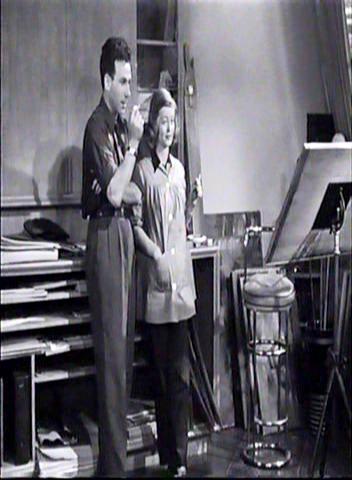
Here is where we have a branching off of plot that could make a separate movie. Dane Clark is a starving artist of, we are told by him, great talent. His role is similar to John Garfield, the dismissive pianist in “Four Daughters” (1938), see this previous post, who was also poor and talented, with a really lousy attitude.

Mr. Clark, however, does not seem to have the same knack John Garfield had for drawing our sympathy. Clark’s character is without any humor about others or himself. His arrogant proletariat rudeness toward Katie makes her seem far more a doormat than she ever was when Pat stole her boyfriend. A person living in the shadow of a more glamorous or accomplished sibling is a common story, in the movies and in real life, but here we wobble uncertainly as to what is the cause of Katie’s malaise.

Dane Clark’s explanation is simple and cruel, “You two disliked each other from the time you were born. It’s a perfectly natural antagonism.” This presumptuous and ignorant conclusion is what drives most “evil twin” stories and is perhaps one of the other reasons I dislike them so much.

Mr. Clark, who seems to thrive on antagonism himself, criticizes her painting, making a further accusation, “I bet you’re not even a woman.”

When she asks him for clarification, he sneers like a little boy who has thrown a rock at a bird and delights in having hit it. “That always gets ‘em,” he says.

From the time Pat is said to have “frosting” to the time Mr. Clark indicates Katie is not a “ball of fire”, we are seemingly meant to infer that Katie’s reticence is more than just a meek acceptance of stolen boyfriends and angry artists. She may not be sexually experienced, which may explain Clark’s ridicule. She is hardly shy; it is she who pursues Glenn Ford, but she is not sexually aggressive in the way Pat is, and perhaps we are being told this is one of her flaws.

According to the Hollywood on Twins Playbook, if being oversexed is Pat’s character trait, then Katie must be afraid of sex, for as we seem to be told, tiresomely and yet again, that twins, individually, are not whole people, that only together they have all the attributes of a human being. Individually, they are only fragments of a person. When the egg in the womb splits their chances at ever being a complete person evaporates.

There’s probably a lot more dime store Freud in here that I’m missing, but you get the idea.

But, Katie, passive or not, seems to impart a kind of courage, a stoic survivor’s attitude, bearing up under Pat’s callousness, under Walter Brennan’s blustering, under Dane Clark’s insults, and even under Glenn Ford’s hideously thoughtless request that she help him pick out intimate apparel for Pat’s present on their birthday.

The older men in this film are more interesting than the younger men. Ford and Clark act like pinheads hijacked by their own insensitivity, who are either manipulating or being manipulated.

Katie seems to get some of her moxie back when she efficiently rebuffs Dane Clark’s rough advances. He actually looks crushed and his scowl departs for about two seconds. Unfortunately, she also declares herself a third-rate artist in comparison to his talent, and we must wonder if she is giving up her art because she cannot be the best.

Katie heads back to “the island”, unexpectedly finds Pat there also seeking refuge, and the twins companionably head to the wharf to go sailing, striding through town in their jeans like a Doublemint commercial. This is a long shot with Bette and a double. The split-screen close-up was done in the studio with rear-screen projection.

Pat has become outdoorsy like her sister, perhaps feels more than she actually expresses of her regret in marrying Glenn Ford, and they get caught in a storm. I realize this entire post has been a spoiler, as all my posts are, but if you don’t want to know what happens next, you’d better go down to the corner for a newspaper. Bring me back a candy bar, any kind.

Did they leave? I thought I heard the screen door slam. Okay. For those of you who have remained, I’m going to assume you know I’m going to tell you that one of them drowns. It’s Pat. Here’s where the plot splits again and could be the story for another entirely separate movie.

The scenes of the twins sailing in the storm are skillfully done, with Bette and a double alternately blocked by the swinging boom. She, and the double, had to film this scene separately as Pat, and as Katie, being battered by wind and soaked by waves. It’s all stitched together quite well, even more impressive when you realize it was filmed on a set.

Katie, who though distressed at the loss of her sister does not express anywhere near enough the realistic anguish of the situation, impulsively decides to say nothing when she is mistaken for Pat. Her rescuers think it was Katie who drowned. Katie plays along, thinking this is her chance for happiness being the wife of Glenn Ford.

(The scene with the beleaguered sailboat smashing against the rocks of the lighthouse ledge reminds me of “Portrait of Jennie” (1949). You wonder for a moment if Joseph Cotten and Jennifer Jones are going to scramble over the rocks.)

Assuming the identify of a deceased person is also not a new plot idea to film, but using identical twins makes an interesting twist because Katie now moves about incognito, disguised in plain sight. As such, she is comforted by Walter Brennan and others who tell her that her sister Katie was such a wonderful person. It’s like being at her own wake. Very eerie and emotional, and more could have been done with this.

Even Dane Clark displays his own belligerent sense of grief when he shows her that he has painted a portrait of Katie from memory.

Now, Katie must run an obstacle course of fitting into Pat’s life. The easiest part is making Pat’s dog, Mike, accept her even though Katie doesn’t smell like Pat. Mike is not fooled. Mike is the smartest character in this movie.

But, she gets around him with treats. Even Mike, it seems, can be bought.

However, Katie’s game of pretend comes crashing down on her head when irony akin to an O. Henry story slams her in the chops. Glenn Ford wants to divorce her because Pat has had affairs with other men. Katie runs back to safety of “the island”, where Charlie Ruggles figures out her secret, because he’s almost as smart as Mike. We are given one of those slapped-on happy endings because somebody must have noticed they were running out of film and it was time to end the movie.

It’s still a fun movie, for all the tangled plot threads, but especially for the technical achievements, and the atmosphere. It makes an attempt to carve out an old stock melodrama using film technology and good old film theatrics. But there’s a story missing in all this contrivance. It’s the twinship that never gets told, that Hollywood never seems to get a handle on.

And I’m not even going to mention the Carol Burnett parody.

For a look at the striking scene where Bette Davis meets up with herself, have a look below. (Don’t forget to scroll down to the bottom of the page and pause the music.)

Thursday, July 8, 2010

The Slow Burn

Whatever happened to the “slow burn”? That look Moe gave to Curly just before he was going to sock him with a sledgehammer. That peeling mask of disgust and chagrin on Alfalfa’s face when he realized that he’d messed up on “Believe Me If All Those Endearing Young Charms”. Again.

Raspberries! Why, I oughta...

You know that look. It was more likely to crop up on a disgruntled sidekick or character actor like Ward Bond or Henry Travers than a star, but every so often you’d see it on James Cagney, on James Stewart, on Ann Sheridan, and Gary Cooper.

It was Acting 101, once upon a time.

Below, here is a scene from “Duck Soup” (1933) with Chico and Harpo Marx, and Edgar Kennedy, who was called “The Master of the Slow Burn.” (Don't forget to scroll to the bottom of the page to pause the music.)

Monday, July 5, 2010

Off Topic - "Interfacing"


A brief plug for “Interfacing”, my short story, previously published in print and online magazines, is now available in e-book format from Smashwords.

It’s humor. It’s about communication. It’s about 2,000 words. It’s about 99 cents. If you don’t own an e-reader like Kindle or Nook, etc., you can still download it here and read it right off your computer. Here’s the blurb…

Susan, saved by her Heimlich maneuver-performing dog from death by choking, must remain silent until her infected throat heals. Shutting up has never been easy for her. Her job as a customer service supervisor, and her already strained marriage are on the line. Susan must learn to communicate before she goes crazy, or kills somebody, or both.

Thursday, July 1, 2010

The Howards of Virginia (1940)

“The Howards of Virginia” (1940) is one of not-very-many movies Hollywood made about the American Revolution. It’s a good effort in some respects, and fails dismally in others, but that may be not just to acting or direction. Sometimes our failure in being able to interpret a particular era in the past may be our own tenuous grasp on what it really was like. We’re not really as good at turning back the clock as we think we are. It’s just not that easy.

The story is one of those span-of-years tales, in this case from the boyhood of lead character Matt Howard, played by Cary Grant, when his father was killed fighting Indians when Virginia was under British rule during the French and Indian War, to Matt’s adulthood as a solider of the young Continental Army fighting to end British rule during the Revolutionary War.

The costumes mostly are pretty good (except for the wedding dress, too modern), and so are the hairstyles, the sets, and furniture. Some care went into the making of this film, and it is impressive that part of the filming was actually done in Williamsburg, Virginia. So far, so good.

But I wonder if sometimes planting a story against an historical backdrop, and using that backdrop only as kind of puppet show stage scenery and not as an organic element to drive the story is kind of like having a canvas with a beautiful landscape on it and then painting stick figures in the foreground. They stand out badly and it’s hard to appreciate the pretty background anymore because all your eye can focus on is those stupid stick figures.

Our chief stick figure here is Cary Grant. Some have called him miscast in this movie, and maybe he was, but I have to wonder if half the problem is just the way the character was written. Grant seems to be pretty one-dimensional, buffoonish and Always! Seems! To! Talk! In! Exclamation! Points!

Cary Grant spends the entire movie shouting, not in anger or with passion, but just normal every day speech. Hello becomes HELLO!!!! His hyperkinetic overacting is a distraction, and rather fatiguing to watch after a while.

Martha Scott plays the well-born lady this frontier fool pines for, and though it would seem her sedateness and dignity might soften Mr. Grant’s explosive personality, it doesn’t really. Sometimes she seems a bit remote with little warmth.

The best performer here for my money is Sir Cedric Hardwicke, who plays her elder brother, the snobbish family patriarch who looks down on Grant. When the Revolution begins, he is a Tory, or would be if there were any profit in it, and he provides a fascinating contrast to Cary Grant. Mr. Hardwicke’s scenes are absorbing, and we discover many layers to this character in a way we never do with Mr. Grant’s character. Hardwicke is noble, self centered, disdainful, and ultimately tragic. So is Grant’s character, but we may find ourselves understanding Grant less and disliking him more.

Cary Grant takes Martha Scott out to the western lands of Virginia in the Shenandoah Valley to carve out a home in the wilderness, but a home similar to the mansion she left behind in elegant Williamsburg. Their new mansion goes up with remarkable speed. It’s nice to see Anne Revere in a brief role as a frontier neighbor lady. Nobody could pull the job off better than she.

These scenes are reminiscent to “Drums Along the Mohawk” (1939) which we discussed last year, but the leap Martha Scott has to take to make a life here with the rustic folk is much greater than the adjustment Claudette Colbert had to make. For one, we may understand that Miss Colbert’s character is likewise from a background more genteel than frontier husband Henry Fonda’s. But her genteel heritage is likely based on commerce. Colbert’s family from the northern colony of New York and New England derived their social superiority from trade.

Martha Scott isn’t just rich. She’s aristocratic. The caste system of Olde England transplanted itself in Virginia and the southern states in a way it never much did in New England, which was the repository of outcast Pilgrims and Puritans bent not on copying life in England but forging a new society where they would be top dog…a level of superiority they would have never achieved back in the old country.

However, aristocratic Scott stands by her man in buckskins and may look horrified at smelly backwoodsmen, but her very acquiescence to this life seems more democratic than someone in her position would actually be. It is the first indication that we are leading to a message of how wonderfully democratic this country is, and was. It’s a nice sentiment, but largely a fairy tale.

Also, the affable Thomas Jefferson, played by Richard Carlson, who is Matt Howard’s lifelong friend was not so affable and hail-fellow-well-met in real life. This shy, reclusive man, though he wrote one of the most noble documents ever penned - The Declaration of Independence - was also an aristocrat who disdained the company of lower-born folk he saw mainly in terms of rabble. This is certainly no crime and is not unusual in anyone well born and well educated. But, we may conclude he is re-drawn here to suit our World War II -era sensibilities.

Then we come to the first disgruntled rumblings of American discontent during all the repressive taxes the Crown placed on the colonies, and we see that Cary Grant has won a seat in the House of Burgesses, Virginia’s lower legislative house, where we are treated to snippets of speeches by Thomas Paine, played by Richard Gaines. Again, just as we discussed a few weeks ago about historical symbols in “Gone with the Wind” (1939), we have a schoolroom quick survey of American taglines as history through Paine’s words. Give me liberty or give me death. You remember that one.

This kind of use of slogans to represent eras does nothing to increase our understanding of an era, but only serves to confirm what we already think we know.

We might note here, however, a difference, though a subtle difference, in the treatment of the colonial African-American experience to what we observed in “Gone with the Wind”. The servants in the grand homes of course are all slaves, and one female slave goes with Martha Scott when the newlyweds strike out for the frontier. She is even more appalled at the rough backwoods people than Miss Scott is, and looks down on them as not being “quality”.

We don’t see too much of Dicey through the movie, she’s not Scott’s constant companion in life the way Hattie McDaniel’s “Mammy” was with Scarlett O’Hara, but we observe she deports herself with every bit as much high-born dignity as does Miss Scott. None of the slaves depicted in this film come off as caricature.

Still, it might be argued by some that the few dismissive glimpses we are given of the slaves indicate this is another example of Hollywood’s racism. I don’t think so, not entirely in this case, and for two reasons. First, the movie isn’t about the slave experience, it’s about the blustering Matt Howard. (Though for my money, a little less shouting Cary Grant and little more soft spoken Dicey might have made it a more interesting movie.)

Second, there is an interesting dramatic dynamic we can see here if we look for it. We learn about the slaves’ place in the world even by their diminished film presence. Just by viewing them in the background, we see how marginalized their lives are, how controlled their lives are, how little credence they were given by both Colonial America and by 1940s Hollywood.

I believe this effect here was unintended, the by-product of an era in Hollywood filmmaking. However, it was used on purpose with great success, if you remember, in the British television series “Upstairs/Downstairs.” We get to know the servants best when they have their scenes “below stairs” in the kitchen or servants’ dining hall. Here they are animated and effusive.

Then, when the bell rings and the butler Hudson, played by Gordon Jackson, goes upstairs to the morning room to answer the summons, the camera, the story, and mood shifts to the upper class family by whom the servants are employed. We are now treated to a scene of what is going on in the masters’ lives, and Gordon Jackson, grog tray in hand, stands in the background and blends in with the wall. Suddenly, the man we thought we knew so much about, with such a strong personality downstairs, becomes a stranger, an enigma to us. It tells us all we need to know about his place in society.

So it is with Dicey and her fellow servants. We get a brief look into her feelings and sensibilities, and then the door slams shut when the focus is back on her owners. It may not be satisfying to the audience who want to know more about her, but it is dramatically effective and historically accurate.

(I wish American television could turn out a product as good as “Upstairs/Downstairs” with similar subject matter. We have a lot of history to dabble in, if only we weren’t so lazy about depicting it in more than just convenient slogans and taglines, and not being willing to spend more money than it would take to put on a “reality” or talent contest shows, or fear being too historically accurate, thereby “losing” an uninformed general audience, or otherwise fear of offending modern sensibilities by being too accurate.)

Besides, a better evidence of Hollywood’s racism is that Libby Taylor, who played Dicey, spent a couple of decades playing maids and ladies’ room attendants.

Another subplot to the film is Cary Grant’s relationships with his sons. The younger, James, played as a young man by Tom Drake, is the apple of his eye. He ignores the older one, Peyton, because Peyton was born with a foot deformity, much like his brother-in-law, Cedric Hardwicke, whom Grant despises. When the child is born and Mr. Grant first sees his baby’s deformity, he suddenly refuses to name him after his father, but adamantly insists he be given her maiden name instead, branding him as an issue from her side of the family. Grant finally bonds with his son Peyton, played by Phil Taylor, when the lad performs a heroic act as a soldier during the Revolution.

The films ends, or we should say, tries to wrap itself up, with the astonished Grant recognizing a quality in his son even more important than his heroism. He observes that young Peyton, though ignored and dismissed his whole life as less worthy, is a kind and gentle person with no hatred in his heart. Grant declares to Martha Scott that their boy represents a new kind of person for the new nation they are founding, the best of both their worlds.


It’s a nice sentiment, and a wonderful goal to reach for, the idea that this republic may ever keep itself righted by the presence of kind, heroic people with no hatred in their hearts and the ability to forgive. It was an important message to send during the early years of World War II when the United States was not yet involved, but surely feared it probably would be before too long. We never quite seem to reach that placid plateau of good fellowship.

Williamsburg, where parts of this movie was filmed, was the capitol of Virginia until about 1780, when the capitol was moved to Richmond, in part at the recommendation of Thomas Jefferson. The town which had contributed so much to the political and cultural heritage of Colonial Virginia sort of became a quaint, gentle, and ignored (like young Peyton Howard), hamlet until about the 1920s, when Reverend Dr. W.A.R. Goodwin of the Bruton Parish Church got together with philanthropist John D. Rockefeller, Jr. to restore some of the historic buildings. We owe those two gentlemen a lot.

This project grew through the years, and now takes up nearly 85 percent of the original town, a beautifully restored living history museum, called Colonial Williamsburg. It is well worth a visit, and should be on the list of anybody with an interest in American history.

For more on Colonial Williamsburg, have a look at this website.

Happy Independence Day. Pace yourself eating those burgers and dogs.

Monday, June 28, 2010

Independence Day Cartoons


This week we have a look at Independence Day as Hollywood saw it. We’ll get to Cary Grant on Thursday. Today, a few wildly different Independence Day images from animated cartoons.


“Bunker Hill Bunny” (1950) gives us Yosemite Sam as a Hessian fighting more for himself more than for King George III. This one shows us how Bugs Bunny won the Revolutionary War. Remember that for your SATs.


Here is Bugs again, this time doing his bit for the United States World War II effort, urging movie goers to buy bonds in “Any Bonds Today” (1942). He is the personification of Uncle Sam, with the famous image of the painting called “Spirit of ‘76” by Archibald MacNeal Willard behind him, as if they are backing him up. This was painted in 1875 to commemorate the Centennial of the American Revolution. I wonder how often this image has been used, or parodied and lampooned?


Here in “Patriotic Popeye” (1957), we have the much more sedate depiction of a peaceful 4th of July celebration with Popeye watering his flower garden grown in the pattern of the American flag. The conflict disrupting his bucolic scene is caused by his nephews, who want to light “atomic” fireworks.” He tries to take the danger out of the holiday and ends the adventure by blowing up red, white, and blue balloons for them. No brave patriots this time, just a desperate wish for a “safe and sane” holiday. Not a bad thought, but my, how tame we’d gotten by the 1950s.

Except maybe for the atomic sky rocket.

Thursday, June 24, 2010

Callaway Went Thataway - 1951

“Callaway Went Thataway” (1951), continues our look at old movies as filler for programming on early TV, and on the “Hopalong” Cassidy phenomenon in particular. Not that Hoppy is actually mentioned, in fact the film ends with a careful disclaimer to that effect.

Fred MacMurray and Dorothy McGuire play ad executives who are making money hand over fist with their latest property, the redistribution of old “Smokey Callaway” B-movies to the hungry TV market. Even more, the merchandizing of Smokey Callaway toys, etc. But, the network execs decide this is such a good thing, they want to hire the cowpoke to make some brand new films. The problem is, Callaway is nowhere to be found. Enter a young look-alike, played by Howard Keel.

We are first introduced to the Hoppy, er, that is, Callaway phenomenon, through the montage of small children glued to the TV, watching their hero’s every move. This includes a couple of poker-faced young African-American kids, who, as discussed in this previous post on Herb Jeffries, were given little by either Hollywood or TV in the way of a black hero to emulate. Clearly, we are shown that Callaway appeals to everybody in this democratic republic. It’s a cute shot, that can’t help but ring hollow. Grownups love him, too, including a fawning Natalie Schafer, who plays the wife of the big TV boss. You may remember her as Lovey in “Gilligan’s Island.”

The team of MacMurray and McGuire are now up a creek, because the real Callaway disappeared to a life of dissipation years ago, and the look-alike cowboy they hire to play him wants nothing to do with TV. He is sincere, honest, naïve, and gentle. Howard Keel, with his choir boy haircut and soft speech, is adorable, and it’s kind of amazing to see him later on in the film playing the real Callaway, an obnoxious, womanizing boozer, with the same face, the same clothes, and yet actually appearing different. His voice booms and his face actually looks puffier, his hard, dim eyes glaring with suspicion and resentment.

But, until they find the real Callaway, they must utilize his erstwhile double, and on a coast to coast train trip, McGuire tries to impress upon Mr. Keel how important Smokey Callaway is as a role model to children. Along the way, he falls in love with her, but she is reluctant to submit to his aw-shucks charm.

She and MacMurray have that 1930s screwball comedy rapport with each other, but it’s somewhat forced and we are given to understand there is no romantic involvement between them. She undergoes a conversion when she falls in love with Howard Keel and decides the ad racket has gotten too deceitful for her. Mr. MacMurray never undergoes such a conversion, remaining a likeable, but undependable trickster to the end. MacMurray was so good playing guys on the knife edge of good and bad.

On their coast-to-coast trip we get some rear screen project of Niagara Falls, a lot of train interior shots, which is always lovely, but their stop in San Francisco appears to be really filmed there. There is also a bit at the end filmed at the Los Angeles Coliseum, so we might wonder what kind of build-up this movie had and what expense went into making it.

There are even a few star cameos. Esther Williams and her sons accost Keel in a hotel lobby, and later he meets Elizabeth Taylor and Clark Gable at the Mocambo, both of whom he greets effusively and neither of whom he recognizes.

Mr. Keel, who fairly hero-worships the (he thinks) saintly character he is playing, decides to set up a charitable foundation for children with his salary. But then, the real Smokey shows up like an evil twin, and wants all the moolah and all the swag that the team of MacMurray and McGuire have been generating. There is the inevitable fight scene between the good and evil Smokeys, and because they are wearing the same clothes, we don’t know who is who.

Finally, the real one learns of the charitable foundation set up by his look-alike, and bails out of the whole Smokey Callaway franchise. He doesn’t want any part of it if he can’t keep the money himself. The look-alike gets to keep the job.

Fred MacMurray tosses off a funny line with all seriousness, “What’s the Smokey Callaway Foundation? Have we got a girdle tie-in?”

We end with a rousing appearance at the Coliseum, and Miss McGuire’s 11th-hour commitment to being the sweetheart of a TV cowboy.

Both these films, “Dreamboat” and “Callaway Went Thataway” harken back to the screwball comedies of a previous generation, but they land squarely in the present, using it as surely as any socially conscious dramatic film of that era did to bring reality to the movies. “Callaway” ends with the interesting disclaimer, as much a signpost to the era as the fake signpost it was printed on. (The opening screen titles on a similar signpost remind me of “My Darling Clementine.”)

“This picture was made in the spirit of fun, and was meant in no way to detract from the wholesome influence, civic mindedness and the many charitable contributions of Western idols of our American youth, or to be a portrayal of any of them.”

A case of methinks they doth protest too much?


Actually, Hopalong Cassidy, is the real hero on whom this movie is based. You might remember his showing up Boris Karloff in the 1950 Macy’s Thanksgiving Parade, as discussed in this previous post. From the book “Total Television” by Alex M. Neal (Penguin Books, NY, 1996, 4th edition), we have a few stats on our hero. Hoppy made 66 B-movies from 1935 to 1948. William Boyd, who played Hoppy, cannily acquired the TV rights to his films, and re-edited them to fit 30 and 60-minute timeslots. According to author Mr. Neal, “thus, he was in a position to offer a readily available source of action programming to the rapidly expanding postwar television station market.”

Hopalong Cassidy merchandise on display at the Autry Musuem of the American West, Los Angeles (author photo)

His show ran from 1949 to 1951 on NBC, and then continued in syndication from 1952 to 1954. Hoppy was perfect for the new medium and the black and white sets: he dressed in black, and rode a white horse. Anybody remember Hoppy’s horse’s name?

Monday, June 21, 2010

Dreamboat - 1952


This week we have a couple of movies that illustrate that cusp of the television era, just before the so-called Golden Age of TV, when the new medium was searching for fodder to fill up the airways. Old movies filled the gap and made life easier for the network programmers. They were cheap, plentiful, and most had not been seen for a generation.

Today, we have “Dreamboat” (1952), in which Clifton Webb’s former past as a silent screen heartthrob comes back to haunt him. On Thursday, we’ll have a look at the “Hopalong Cassidy” phenomenon (through a generic replica, of course, copyrights being what they are), with “Callaway Went Thataway” (1951).

That these two films came one after the other, and dealing with the same subject matter, is some indication of the enormous impact TV was beginning to have, and how dependent it still was upon old movies to fill up hours of programming. Movies and TV have always been co-dependent. Most of us who are classic film buffs were introduced to these films on television, long before DVDs and video. We would not be film buffs without television. Evidently in the early 1950s, though Hollywood might have panicked about being challenged by television, there was still some sense of humor about their relationship with the new gadget.

“Dreamboat” is a romp, as outrageous a vehicle for Clifton Webb and Ginger Rogers as the campy silent film clips we see of them together in the typical 1920s scenarios: a Zorro-like hero, a World War I ace, a Valentino-like hero, all shown on commercial television, commercials being the operative word. Ginger, now a Hollywood has-been, has a new job hosting these old silent movies and pushing the product, which in this case is perfume.

Clifton Webb is a college professor, intelligent, severe, whose extreme dignity makes him the butt of the campus jokesters. Mr. Webb’s dignity was a tool he used, or was made use of by others, in just about any film he was in. It made him alternately pathetic, heroic, sinister, or just plain foolish. It’s amazing how much mileage he got in his career with a withering glance and a sarcastic reply.

His daughter, played by Anne Francis, who we last saw as a teenager in the last few minutes of “Portrait of Jennie” (1948), is, in attitude, nearly a carbon copy of dad, except there is an added bit of shrewish impatience which threatens to stamp out any likeability in her. But this only helps to set up her eventual conversion.

Both father and daughter set out on a quest, for vindication, and though they don’t yet know it, for conversion to adapting to the big wide world they both disdain. That world, in part, is represented by television, which Miss Francis calls the “idiot’s delight.” She is reluctantly brought to a college party where the gang gathers to watch that program hosted by Ginger Rogers showing those old movies of hers with her former co-star, Clifton Webb. And push perfume during the commercials. One of the perfumes is called “My Five Sins.”

“Five?” Clifton Webb later asks, astonished.

The gang knows this simpering, overacting, sword carrying hero with the overdose of Brilliantine on his hair is their hated college professor, and they throw this revelation in young Miss Francis’ astonished face.

Pop, who tried to hide his former career, is equally abashed, and decides to go to New York where the TV program is produced to demand they take it off the air. Not only his dignity, but his job is on the line. The board is uneasy with an English professor with this kind of unsavory background, which seems to make a mockery of their prestige. Only the college president, played by the wonderful Elsa Lanchester, is willing to give Clifton Webb a break. She is a fan, and makes several awkward and athletic attempts to seduce him.

She asks the age-old question, asked so often in melodramas, “Has it ever occurred to you I’m also a woman?”

Off father and daughter go to New York, where he meets up again with his old co-star, the now much older Ginger Rogers. Miss Rogers sinks her teeth into what must have been a fun role as an over-the-top, manipulative, self-involved, has-been, who clings ferociously to any thread of her former career as a matinee idol.

While Rogers and Webb tangle with network executives, lawyers, and their own uncomfortable partnership, which we are made to understand was never as romantic as it appeared on screen, Webb’s daughter is shown around town, and his apartment, by a network underling, a very handsome and affable Jeffrey Hunter. She begins to experience life outside of museums and lecture halls, and likes it. We know she has become a woman of the world when she takes off her glasses.

Clifton Webb has a fun scene where he gets into a bar fight. Helpless to defend himself, he sees one of his old movies on the TV above the bar which shows him vigorously fighting off a gang of ruffians. So, he watches himself, gets a few pointers, and once again, beats the bad guys. Unfortunately for him, Elsa Lanchester pursues him to New York and he has a tougher time shaking her.

The dramatic climax takes place in court, with our old friend Ray Collins as the attorney defending the TV network in its right to show these old movies. Clifton Webb dismisses his own theatric attorney with my favorite line, “You overdid it. I’m not an unwed mother lost in a snowstorm.”

A TV set is put on the stand so that Mr. Webb may demonstrate to the court that TV is not, as Ray Collins would have us believe, an instrument of education, but rather a haven of idiocy. A couple of commercials are shown, typical of the day, that parody both the disingenuous message of commercials (something which has not changed through the decades), but also frank stupidity of the audience which the makers of these commercial must assume. The hair tonic with “Penetroleum” with ingredients like “cosmotron” may get us to laugh, but compare this with the more subtly sinister commercials in “A Face In the Crowd” (1957). That is a more cynical film, but this one, for all its silliness, is hardly naïve. We may get the feeling we are sliding inexorably toward “A Face in the Crowd”.

Mr. Webb wins his case, proving that the films have been altered to make him look foolish, but loses his college professor job when he spurns the scorned Miss Lanchester. She fires him in retaliation. This was the day when sexual harassment was an accepted mode of employee relations and job security.

Left without a career, Webb is not too downhearted, for as he gloats to the now also out of work Ginger Rogers, that Hollywood has come calling back for him. We see him finally in a clip of a new movie, where his dignity is abused for laughs, and three small children throw food at him. It’s a living.

Come back Thursday for another look at the movies-cum-TV era with “Callaway Went Thataway,” with Dorothy McGuire, Fred MacMurray, and Howard Keel.

Thursday, June 17, 2010

And the winner is....


Today, we pick our winner of the two DVDs recently released by A&E Home Entertainment. These prizes are…

-WORLD WAR II: THE WAR IN THE PACIFIC (2 discs):

…and also…

-D-DAYS IN THE PACIFIC (2 discs):

Have a look at Monday’s post for a detailed description and review of these excellent historical documentaries.

And, since she’s the only one who threw her hat in the ring, both prizes go to our inimitable….

Caftan Woman!!!!!!

Congratulations! (Balloons fall from ceiling, ships in the harbor blast their horns, crowds cheer, and toddlers distractedly look up from their sippy cups and smile.)

Please email me at: JacquelineTLynch@gmail.com with the name and mailing address where you’d like your prize sent. The name and address will not be published on this blog.

Special thanks to A&E Home Entertainment for providing both the prize and the review copies of these two fine DVDs.

Monday, June 14, 2010

Contest - Two WWII Documentaries on DVD

More free stuff this week, and just in time for Father’s Day. A&E Home Entertainment has recently released on DVD two excellent documentaries on the fighting in the Pacific Theater in World War II. Today, we offer these as a two separate contest prizes.

These documentaries are…

-WORLD WAR II: THE WAR IN THE PACIFIC (2 discs):

…and also…

-D-DAYS IN THE PACIFIC (2 discs):


A description and review of these films is included below. But before we get to that, a few contest rules:

You have from now until Thursday, June 17th at noon Eastern Time to enter the contest for these DVDs. Because these are two different documentaries, I’m going to offer them as two prizes, and pick two winners. To enter the contest, just leave a comment below stating you want to enter the contest. State the title of which you prefer, or just write “either”. If I pick two winners who happen to want the same title, the second one I draw wins the other film by default.

If your name is announced on Thursday as the winner of one of these DVDs, then please email me at: JacquelineTLynch@gmail.com with the name and mailing address where you’d like your prize sent. The name and address will not be published on this blog.

I will contact our good friends at A&E Home Entertainment, and they will mail you your prize.

Now, about those films…

The first, WORLD WAR II: THE WAR IN THE PACIFIC is a two-disc set. The features listed include:

DISC ONE (approx 90 mins)

ISLAND HOPPING: THE ROAD BACK--The epic story of the Allies' island-by-island Pacific campaign, using massive amphibious assaults.

JUNGLE WARFARE: NEW GUINEA TO BURMA--In the steamy jungles of the Pacific, soldiers battled not only the Japanese, but malaria, heat exhaustion, and swarms of parasites.

AIR WAR IN THE PACIFIC--From the war's first days, to the suicidal Kamikaze attacks and the bombing missions that brought the war to the Japanese homeland.

THE BLOODY RIDGES OF PELELIU--From the opening Naval bombardment, to the hand-to-hand combat and vicious guerrilla warfare, this is the complete story of this brutal and historic battle.


DISC TWO (approx 95 min)

THE RETURN TO THE PHILIPPINES--From MacArthur's strategy to the heroics of the gound, naval, and air troops, it's a stunning story of unstoppable determination.

OKINAWA...THE LAST BATTLE--Witness the desperate, suicidal resistance of the Japanese in the final battle of the Pacific campaign.

ADMIRAL WILLIAM 'BULL' HALSEY: NAVAL WARRIOR--Sail into battle with one of the most celebrated naval commanders in American history.


“World War II - The War in the Pacific” is hosted and narrated by Patrick O’Neal, and is comprised almost entirely of original battle films shot by the U.S. military, along with what looks like some newsreel film, and possibly some film taken by the Japanese military. Except for Mr. O’Neal’s segments, the rest is in black and white with voice over narration. The episodes of this program were originally put together in 1985 for television. The final segment, a biography of Admiral William “Bull” Halsey was originally shown as part of the program “Biography.”


The second prize, a DVD is also a two-disc set, titled D-DAYS IN THE PACIFIC. “Though most people associate D-Day with the massive invasion of Normandy on June 6, 1944, a 'D-Day' is actually military term for any amphibious operation, and few theaters during World War II saw as many battles as the waters of the Pacific, where more than 100 D-Days were waged.”

This two-disc set includes the following documentary features:

DISC ONE - 137 min

DEATH AT THE TIDELINE: Follow America's earliest amphibious invasions, including the ill-equipped landing on Guadalcanal.

CLOSING THE JAWS: America's forces gain new expertise and power, and Nimitz and MacArthur have the enemy on the run.

THE FINAL GRAVEYARD: Relive the battles that pierced Japan's defenses and brought the war to a close.


DISC TWO - 139 min

THE BLOODY HILLS OF PELELIU: Incredible combat footage documents one of the deadliest battlegrounds of the Pacific.

BIOGRAPHY: ADMIRAL CHESTER NIMITZ: Discover the story behind the man who turned a shattered fleet into a devastating naval powerhouse.

BIOGRAPHY: GENERAL DOUGLAS MacARTHUR: Learn how this fabled General was able to defeat a seemingly unstoppable Japanese war machine.


These episodes were originally from 2005, and the two biography episodes on Admiral Chester Nimitz and on General Douglas MacArthur are from the Biography program on A&E. “D-Days in the Pacific” is also comprised mostly of original footage, some of it is in color. Some of the color footage I believe to actually be “colorized” from the original black and white. This documentary also has interviews with prominent historians and also (now elderly) participants in these battles.

What is most striking about these two documentary DVDs, both “World War II - the War in the Pacific” and “D-Days in the Pacific” is that they are all business, brisk telling of horrific events, including some footage that is difficult to watch for its brutality, but remain engrossing and informative films.

Today, there is a much different style of filmmaking, not just for feature films but also for documentaries, that involves a great deal of splashy graphics and quick cuts. This, I suppose, is meant to add drama to the telling of the story, but which I find inevitably adds only to the “dumbing down” of history. Making the film look like a video arcade game to attract attention is not the same thing as keeping attention. Especially when it becomes really annoying.

The material is dramatic enough. It does not need enhancement with gimmicks which would seem to appeal to 13-year-old boys.

These two films have a slower pace, an honest, matter-of-fact delivery, and leave even those who have some knowledge of the events of the war in the Pacific with greater understanding and appreciation of the cost, and the effort, and the results. For people who have yet to be introduced to the story of how the war was won in the Pacific, either of these films is a great introduction.

If your father or grandfather, mother or grandmother served in the military in the Pacific during World War II, these films contain everything they were never quite able to tell you.

Leave a comment below to enter the contest to win one of these DVDs. Or, get your copy of WORLD WAR II - THE WAR IN THE PACIFIC here. Get your copy of D-DAYS IN THE PACIFIC here.

Special thanks to A&E Home Entertainment for these contest prizes and DVD review copies.

Thursday, June 10, 2010

More Movie Typists


High time for another round of sexy typists. Here we have Bette Davis in “Old Acquaintance” (1943), discussed in this previous blog post, who proves that the only thing more sexy than a typist is a typist who wears glasses.


Bette flexes her magic fingers again in front of the keyboard for “The Man Who Came to Dinner” (1942), discussed in this previous blog post. She seems to be challenging Barbara Stanwyck for the title of being Hollywood’s most prolific typist.


Perhaps the word “sexy” does not always apply to typists, but typing does wonders to improve one’s sensuality. Here were see Jack Lemmon in “Bell, Book and Candle” (1958), discussed in this previous post. He has Kim Novak’s attention.


Even Ernie Kovacs, from the same movie, though not exactly the romantic hero type, somehow seems…


Well, all right. It doesn’t work for everybody.


Here we have Dan Duryea and Walter Brennan from “Pride of the Yankees” (1942), discussed in this previous post. I guess it really doesn’t work for everybody.

For our previous posts on movie typists, have a look here, and here.

Monday, June 7, 2010

For the Love of Film - A Happy Ending


The big news today for old movie fans is, first, the announcement by the National Film Preservation Foundation on several silent films, thought to be lost, discovered in New Zealand. Secondly, all those who took part in February’s For the Love of Film blogathon (here’s my entry on “Vertigo”) hosted by Marilyn Ferdinand of Ferdy on Films and Farran Smith Nehme, a.k.a. The Self-Styled Siren, may take pride that the money raised is being used specifically to restore a couple of silent Westerns: “The Sergeant” (1910), and “The Better Man” (1912).

The above screen credit is to be applied to these two films.

For more on this exciting news, please have a look at The Self-Style Siren, and Ferdy on Films. The National Film Preservation Foundation site has a clip of “The Sergeant.”

Well done, one and all.

Thursday, June 3, 2010

Paramount Theater - Rutland, Vermont


The Paramount Theater of Rutland, Vermont is another of those splendid resurrections we are fortunate to observe, preserving that great era of theaters. A couple of weeks ago on my Tragedy and Comedy in New England blog, I referred to a recent staged reading of a play of mine by the Vermont Actors’ Repertory Theatre, which uses the Black Box Theater that is part of the Paramount Theater building.

It was once called The Playhouse Theatre, completed in 1913 and opening in 1914. The exterior, as its website notes, is an example of the classic “City Beautiful” movement of the day, and the interior was all lush Victorian opera house, with seating for 1,000 in the orchestra, balcony, and six boxes.

Ethel Barrymore performed on stage here, and Sarah Bernhardt, along with vaudeville acts. Later, it was “talking pictures”, and in 1931, the theater was renamed The Paramount. During World War II, war bond rallies were staged here. But what happened to a lot of theaters in the 1970s happened to The Paramount: their facilities decayed, reflecting perhaps the decline of the film industry. It closed in 1975.

It was empty for a generation. In 1999 restoration began. Theaters were once the heart of communities large and small, and Rutland has proven to have a lot of heart. The Paramount reopened in 2000, due to the hard work and efforts of many contributors.

Today, live stage shows are produced here. Ethel Barrymore and Sarah Bernhardt, and all those vaudeville acts, might nod in appreciation. We can only smile, and cheer.

For more on The Paramount Theater of Rutland, Vermont, have a look at this website.

Related Products