IMPRISON TRAITOR, PEDOPHILE, AND CONVICTED FELON TRUMP.

Sunday, October 28, 2018

Long Live Democracy - Casablanca (1942)


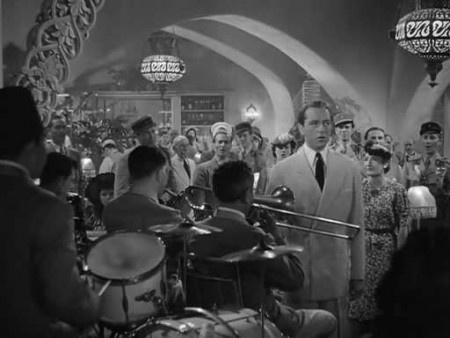
A pivotal moment in the film Casablanca (1942) occurs when Major Strasser and the other Nazis are drowned out in their singing of “Die Wacht am Rhein” by everybody else in the café singing “La Marseillaise.” It is a stirring scene, and one that never fails to bring some of us to tears. It has been reported that the much of cast in that scene were brought to tears as well. In one of those almost supernatural moments when art really does reflect life, the desperate European refugees in the café were played by actors who actually were European refugees. It is a spine-tingling moment of reality in an otherwise not very realistic film.

We revisit Rick’s Café Americain with the bulk of this essay having been previously posted on this blog in 2007, the first year of Another Old Movie Blog.  A great deal has changed in the world since then, though the most comforting aspect of our love of classic films is that the world we explore in them never changes.  We can visit a place and time and it is ever the same, and ever fresh.

Casablanca has become larger than life for us, a film whose reputation has grown with the decades. It will likely always be a favorite for its witty dialogue, its charismatic actors, and its fast-paced plot. It has the irresistible veneer of glamour in an otherwise dark and frightening time.

But, even those of us who love the film cannot overlook the fact that Victor Laszlo and Ilsa Lund would not have played a cat-and-mouse game of hidden threats over cocktails with Nazi officers in French-occupied Africa. The Nazis would have taken both of them into custody the moment they arrived in Casablanca, tortured them, and filmed their corpses with newsreel cameras. The movie would have been over in ten minutes. No cocktails, no white dinner jackets, no game of hide and seek with omnipotent “papers” that will set them free.

In this respect, Casablanca could be called an escapist film, because it gives us heroism and hope, redemption, a fairy tale of intrigue. The most fanciful scene in the movie, carrying this fairy tale along, is the scene with “La Marseillaise” trumping “Die Wacht am Rhein.”

And in that same scene, ironically, we see the real truth of the film, not always recognized, but there. S.Z. Sakall, who plays Carl, fled Hungary in 1939. His three sisters didn’t make it and died in a concentration camp, along with other relatives.

Madeleine LeBeau, pictured above, who played Yvonne, who pines for Rick and who is fought over by the Nazi soldier and the French soldier; and her then real-life husband Marcel Dalio, who played Emil, the gambling room croupier, both escaped from Nazi-occupied France through Lisbon, just as in the film. Reportedly, the visas they obtained for Chile were forgeries, but they managed to arrive in the U.S. through hastily arranged temporary Canadian passports.

Curt Bois, who played the pickpocket, fled Germany in the early 1930s. Helmut Dantine, who played the young Bulgarian man losing at the gambling tables, whose wife beseeches Rick to help them, fled Austria. Dantine was an Austrian who was put into a concentration camp after the Anschluss. He was arrested for leading an anti-Nazi youth movement. He was then nineteen years old.

Mr. Leuchtag, who practices his English by asking his wife the time, “What watch?” was played by Ludwig Stössel, another Austrian who fled after the Anschluss.

Ilka Grünig, who played Mrs. Leuchtag and replies “Ten watch,” escaped Germany in the early 1930s after the Nazis came to power.

Even the Nazis were played by actors who escaped real Nazis. Richard Ryen, who played Colonel Heinze, was a Hungarian-born actor who was actually expelled by the Nazis from Germany. Hans Twardowski, who played the Nazi officer who fights with the French soldier over Yvonne, fled Germany in the early 1930s.

Even Major Strasser, played by Conrad Veidt, escaped the SS, who pursued him for anti-Nazi activities, and he fled to England where he became a British citizen and supported Britain’s war effort with his salary.

There were actually very few American-born actors in the cast of Casablanca and not all of the rest were refugees, but a good many of them were. This gives the film a legitimacy that certain fanciful elements of the script did not.

When you watch the “La Marseillaise” scene, think of the refugee actors with genuine tears in their eyes, and remember that the Nazi regime had not yet been defeated at the time this film was made. It was not known then if they would be.

It was certainly never imagined that we’d be fighting them in our own country in the next century.  This is why we must vote on Tuesday.  At the very end of the “La Marseillaise” clip, Madeline LeBeau shouts, “Vive la démocratie,” and it is almost drowned out by the jubilant crowd triumphing over the smug, cruel Nazis in a nightclub songfest.  But it’s there, and it’s the whole point of the song.  

Vote for every Democrat on the ballot next Tuesday, in all local, county, and national categories.  Voting is no longer an expression of political opinion in this country; it's a chess game.  The politicians know that, and so do the pundits.  The voter has yet to realize how we are being played, and we must use our vote -- while we still have it -- to block the machinations of our impending doom.  Halting the progress of a corrupt and vile administration that now controls the executive branch, both legislative houses, and the Supreme Court can only be done now by making the Republican Party, which has ceased to be the Republican Party, fear more for their jobs than they fear the evidently powerful influence of a shameless grifter, the NRA, and the Russians from whom they have accepted bribes, and indeed, several corrupt members of their party, whom they’ve chosen to embrace and blindly support in the unholy name of holding power.  


When I think of the “La Marseillaise” scene in Casablanca, I also think of my father, who, still in his early twenties, left his wife and baby and fought in the South Pacific during World War II for over three long years.  No furloughs, no coming home until it was over.  When I was young, we watched Casablanca together, and he surprised me by belting out the French national anthem during this scene in his powerful, resonant bass voice.  He really had a very good voice, sounding a lot like Tennessee Ernie Ford only with a New England accent, but we used to tease him because he could not remember the words to anything. But like an automaton, he launched into “La Marseillaise” without any effort, and I think he even surprised himself that he remembered it.  

He explained, in that somewhat reluctant way all men of his generation did when talking about the war, that when he was stationed for a bit in that island-hopping campaign on the French colony of New Caledonia, they were required to stand at attention for the raising of the French flag and playing of their anthem in camp, as well as the American.  He also related the mournful tradition of answering roll call in their memory for pals who had just been killed.  The Vichy government was chased off the island and like the struggle in Casablanca, became Free French. Their symbol is on the paper money above, a souvenir my father brought home.

My father and his surviving comrades; and my mother, who was Rosie the Riveter in a war plant making parts for PT boats, thought their job was done on V-J Day.  

I mourn as much for the memory and the inspiration of that generation as I do for the future of this country if we do not remember the lesson that was so easily absorbed in Hollywood films of the 1940s:  The authoritarian fascists were the bad guys.  Frank Capra explained that to us, if we didn’t know already, in Prelude to War (1942).

How many Trump supporters and apologists would root for Bogart, Henreid, and Bergman today?  How many would look at those refugees with loathing that filled the Café Americain?  How many would turn Madeleine LeBeau away at the border today?


We already know from surveys done that many Millennials cannot even name who fought in that war and on which sides.  Right and wrong has become lost, and history, which should be a compass, has become a muddle.

Fans of classic films inevitably adore them for a world that is, among other things, rife with moral clarity.  We have lost that in our society, probably for many reasons, but one of the things I admire most about classic films is the courageous idealism.  It seemed to stream from the directors.  Frank Capra, a conservative Republican such as they used to come in this country, gave us Meet John Doe.  William Wyler, who gave us Mrs. Miniver; and the man who directed Casablanca, Michael Curtiz, were refugees, as was Billy Wilder.  John Ford, like Wyler and Capra, served in the military during World War II.  They had no patience for Nazis.  Ford would have punched them in the face.

Frank Capra & John Ford

The word Nazi is not bandied about carelessly when it is used correctly.  It is the word Republican that has lost its meaning.  The Grand Old Party surrendered and became complicit to survive in a more vicious environment, like the capitulating French Vichy government.  

When you vote on Tuesday, remember that Hitler was elected to office, and that was the last election.  He killed democracy in Germany.  Putin is angling for the same result here  by remote control and he has already lined the pockets of several Republicans to that end.  Unlike the troubled conquered countries in World War II, we will have no one to save us.  We have to do it ourselves.  There have never been higher stakes than this coming election.

Vote Democrat on Tuesday.  If the Republican Party regains its soul in having lost the election, that will be for the benefit of all of us, because nobody, including intelligent Liberals, want a one-party government, even one of Liberal Democrats. We need the vibrancy of differing opinions and perspectives.  

But first, we have to rid ourselves, democratically, of the traitors to our democracy who gerrymander precincts; who scrub voters off the registration lists; who cheat to deny the vote to African Americans, Mexicans, and Hispanics and other minorities; who attack the free press and shout that truth is not the truth, who praise Nazis and even become them. Vote Democrat.

Vive la démocratie.  Long live democracy.


Thursday, October 18, 2018

Book sale at fall craft fair!


I’ll be selling my books at the Knights of Columbus Hall, Granby Road in Chicopee, Massachusetts, on this coming Sunday, October 21, 2018.

I’m very happy to be taking part in the St. Joan of Arc School P.T.O. Fall Craft Fair. 

There will be a variety of vendors selling their craft items for the upcoming holiday season, and my twin brother John and I will have a table for our books.  Please come down and say hello, have a look around, and maybe even get a jump on your holiday shopping.  There will also be a raffle, and lunch options and baked goods will be available.  Come out and help the P.T.O. support the students!

The event runs from 9 a.m. to 3 p.m., Sunday, October 21st.  The K of C Hall is at 460 Granby Road, Chicopee, Massachusetts.

See you there!

Thursday, October 11, 2018

Buttons - 2018

A new movie titled Buttons with a wonderful cast, including no less than Angela Lansbury and Dick Van Dyke, will appear in select theaters in December.  Though I normally do not discuss modern films on this blog, this one seemed worth mentioning -- especially since proceeds for ticket sales will be donated in support of those living with autism.

From the press release:

"Buttons is a new musical fairy tale film, much like the old MGM classics. During a time of robber barons, mills, and rising industry, two orphan children meet two unexpected visitors (Dick Van Dyke & Angela Lansbury) who turn the tide of events and change their lives forever.

It includes an amazing cast, with narration by Robert Redford and Kate Winslet.  The film also features actors Abigail Spencer, Jane Seymour, Roma Downey, Ioan Gruffudd, Katie McGrath, Robert Picardo, Charles Shaughnessy, Paul Greene, John de Lancie, and "Nova" a song written by Sir Paul McCartney.

There is another special treat! Following the film, there is a one of a kind tribute to legendary dancer, director, and choreographer Gene Kelly, hosted by Kelly’s wife and biographer,  Patricia Ward Kelly.

The proceeds of the film will go to benefit Kate Winslet's Golden Hat Foundation, helping those living with autism.

It premieres this December 8th at 12:55 PM in theaters nationwide for one showing only.  

Tickets go on-sale this Friday, October 12th at fathomevents.com."


Thursday, October 4, 2018

The 1930s - then and now Part 5 - Make Way for Tomorrow - 1937


Make Way for Tomorrow (1937) is a poignant and devastating film. Its simplicity of storytelling, and the decency of the elderly married couple, thrust shafts of conscience on us with the sharpness of a sword and the sweetness of a kiss.

This is the final part of our series on films from the 1930s and their lessons for today, and this one probably has more resonance for our current era than any of the others we discussed. Those movies include Gentlemen Are Born (1934), Our Daily Bread (1934), Wild Boys of the Road (1933) and Girls of the Road (1940) and One Third of the Nation (1939).

The movie begins with one of those introductory written paragraphs that is meant to set us up with a point we’re supposed to take away from it, but which we tend to forget by the end of the film. Not so this time. The message of this movie is subtly present in every scene. The movie begins, “Life flies past us so swiftly that few of us pause to consider those who have lost the tempo of today...”

We are reminded also, from Scripture, to Honor Thy Father and Thy Mother, but the “life flies past us so swiftly...” is a double reminder that what is past is prologue. The story of the elderly couple may well be our story one day, and currently is for many elders across the United States. Other cultures may not subject their elderly to the same conditions we do, so I would not say the problems of the story are universal, except that aging is universal, and it is also universal that most young people do not imagine themselves as ever being elderly.

Beulah Bondi and Victor Moore play a retired couple about seventy years old. Our first shot of their family homestead is of a cozy little cottage in a winter scene, looking something like out of a Currier and Ives print, the nostalgic idealism which may have been an ironic gesture on the part of the director, Leo McCarey. All is not well here. Their grown children have come to visit them, but this is more of a business trip because they have been summoned by their parents to discuss an important matter.


Their grown children are played by Thomas Mitchell, one of the most versatile “workhorse” character actors of the era; Elisabeth Risdon; Mina Gombell, who we earlier saw in this series as the gun moll auntie in Wild Boys of the Road; and Ray Mayer. There is another daughter who lives in California who is spoken of, but who never appears in the movie.

Victor Moore, who had a career on stage and in the movies playing stumblebum characters of some innocence, was around sixty-one at the time this movie was made. He is good-natured, humorous, a kindly codger with an independent streak, devoted to his wife, played by Beulah Bondi.


Beulah Bondi also had a long career on stage including Broadway, and was actually only about forty-eight years old at the time of this movie, but she is made up to play older. Most of the aging process is really Miss Bondi’s luminescent magic and what she does with her voice and with her body, and you believe every word she says. She came to the movies quite late, about forty-three years old, and spent most of them playing mothers (she was James Stewart’s mother in four different movies). She lived to be ninety-one years old, and it is a tribute to her prodigious talent that late in her life she won an Emmy for "Outstanding Lead Actress" for an appearance on The Waltons in 1976.

Beulah Bondi does most of the heavy lifting in this movie. She is the heart and soul of it, and she glows, absolutely glows, whenever the camera is on her. Even if she stands in the background, she has our full attention. Hollywood in this era had many, many character actors we came to identify and love, but few of them could be a character actor with the magnetism of the star player and that is what Beulah Bondi was. She utterly charms us in this movie, and tears our hearts out. Rather than overplay the stereotyped mannerisms of an old lady, her portrayal is subtle and real, every gesture is one benevolent understanding on the part of a much younger actress for the character she is playing.

The couple have called their children together to announce that in a week the bank is taking their home. Mr. Moore had stopped working five years previously when he was about sixty-five years old. We may assume he retired at that time, we are told only that he hasn’t worked in five years. We may assume that he stopped working about 1932, the Depression was at its worst, and probably wouldn’t have had many working opportunities anyway, even if he were a young man.

Their grown children are shocked, of course. Their parents had known this was going to happen for six months, but they did not want to tell their children because they hoped something good would come along, and obviously, always being independent, they were embarrassed about their financial problems. Whatever money they saved for their golden years is gone.

We have a clue to their children’s other reaction to this news, at the very beginning of the film when Thomas Mitchell enters the home and his father, greeting him joyfully, remarks, “I haven’t seen you since...” The parents have not seen their children in a long time. Their children do not bother to keep in touch.

Their preeminent reaction to their parents’ financial distress is worry about getting stuck with them. The two daughters and two sons struggle with appropriate replies and excuses. The two daughters are married.  Miss Risdon’s husband is out of work. Miss Gombell’s husband is in business, but struggling, so she says. Ray Mayer is single, the youngest of the group, a joking, jovial prankster, but because he is single, and doesn’t show up again until the end of the movie, we assume, as does his family, that being single means he doesn’t have to take care of his parents.

Thomas Mitchell, who is married, lives in a New York City apartment and has one daughter, is a likely candidate to take in his parents and it is he who feels the most guilt. But he can’t take both of them at the moment. His teenage daughter, played by Barbara Read, will be attending college in several months. Mitchell suggests that his mother stay with him, share the daughter’s room until he can take both of them. Elisabeth Risdon will take her father until such time as Barbara Read leaves for college and then their father can join their mother in Thomas Mitchell’s extra room.

It is awkward, it is hasty, but they all agree that it won’t be forever.

So the loving couple is split up, temporarily, and it is like an adventure, just a visit, not meant to be a permanent arrangement and that soothes everybody’s nerves, the fact that it is not meant to be permanent.


Most of their possessions are sold off with the house, but Beulah Bondi gets to bring her rocking chair and a large framed portrait of her husband to her son’s New York apartment. She doesn’t fit in with her son’s family. Fay Bainter plays Thomas Mitchell’s wife, a mannered society woman who conducts classes in the playing of bridge in her apartment. For these evenings, all the guests dress formally and play at card tables, so it is as much a social evening as it is a class. She earns “a few extra dollars” doing this. Beulah Bondi’s attempt at cozying into her son’s family’s life is funny because she is naturally an irritant without meaning to be. She talks to the guests when she is not supposed to, even kibitzing a little at the cards. Their daughter Barbara Read is more put off by Grandma, and doesn’t want to bring her friends home anymore because Grandma talks to them. Apparently, grandmas are not supposed to talk; it weirds everybody out.


They have a maid, played by Louise Beavers, who is also put off by Beulah Bondi because when Thomas Mitchell and Fay Bainter go out on the town, she cannot have her evenings free anymore, she must stay with the old lady.


There are many scenes that have a deft, dual comic/sad effect.  One is when Beulah Bondi receives a phone call from her husband in the middle of the bridge class. She speaks on the phone very loudly and the other people cannot help but overhear. In another moment, they have suspended their play and they have all turned in their chairs to watch her on the phone. Mitchell and Fay Bainter are embarrassed, but the guests are touched at this old lady talking to her husband whom she clearly misses very much, and they are engrossed by the scene.

We will see throughout this movie that strangers are much kinder to the old couple than their children.

Beulah Bondi remarks into the phone, “Must’ve cost you a lot to call me.” She listens and then responds, distressed, “You could’ve bought yourself on nice warm scarf for that.” Her eavesdroppers feel sorry. “Goodbye…,” and her voice trails off with a frail, “My dear.”

Fay Bainter begs her daughter, “If you love me,” take Grandma to the movies with you and get her out of the house. Barbara Read gets Grandma settled in her theater seat and then sneaks out on a date. She sneaks back into the theater afterwards and asks the usherette to fill her in on the plot. She is played by Fritzi Brunette – a really great name – in a funny standout comic moment when she explains the plot of the movie. Fritzi was one of those uncredited actresses who played in many films, beginning in 1912 in the silents, but died only six years after this movie was released at forty-seven years old.  She adds, excitedly, “There’s a newsreel and Betty Boop!”

Beulah Bondi catches Barbara Read sneaking out on her date but promises not to tell the parents and the bond grows between granddaughter and grandmother.


Victor Moore is faring no better. He is clearly unwelcome in his daughter’s home and must sleep on the couch in the living room. He visits his friend, the local storekeeper played by Maurice Moscovitch. He broke his glasses so Mr. Moscovitch reads to him his latest letter from Beulah Bondi. The shopkeeper lives with his wife in the back of the store; his children are grown and moved away, too. He remarks, “You can’t give them as much as other children, they’re ashamed of you. And when you give them everything, put them through college, they’re ashamed of you.”

In the letter, Beulah Bondi remarks that Fay Bainter and Thomas Mitchell have brought her to visit a home for the aged because there are people there her own age she could talk to, but she thinks it is a dismal place. She thinks perhaps that they want to deposit her permanently in such a place. Victor Moore wants desperately to find a job keep his wife from that fate. 

When he leaves, Mr. Moscovitch is so rattled from Beulah Bondi’s letter, he calls anxiously for his own wife, played by Ferike Boros, another familiar face in many films in bit roles, and when she shows up in the midst of her chores, irritated, wanting to know what he wants, he says with love and relief, “I just wanted to look at you.” It is another one of those touching and heartbreaking moments.

Back at Thomas Mitchell’s New York City apartment, Barbara Read, the somewhat spoiled daughter, is going out on the sly with a thirty-five-year-old man. Beulah Bondi cautions her against it. In turn, Barbara cautions her about expecting that her husband is going to be able to get a job, “He’s much too old.” She tells her grandmother to face facts.


Beulah Bondi gently replies, that for the very old, their enjoyment, “is pretending there aren’t any facts to face.” The girl is touched, and kisses Grandma on the head. But she stays out too late, doesn’t come home by morning, and the parents are angry at Grandma for not telling them about Barbara’s boyfriend. It is the last straw.

Inevitably, Beulah Bondi notices a letter addressed to Fay Bainter from the home for aged women and she knows that it’s all over. She will be placed there soon, against her will. She has no other options. 

Victor Moore has caught a cold and his doctor decides he needs a warmer climate, so the kids decide that the daughter in California is going to take care of Dad for the winter. Before he goes, and before Beulah is dumped into the home for aged women, their children allow them one last visit. Victor Moore will come to New York City and he and his wife of fifty years will be allowed to have five hours together.

Beulah tells her son Thomas Mitchell that she will willingly go to the home for aged women but she wants him to promise her not to ever tell his father about it. She wants to spare that hurt to her husband.

Another poignant moment is when we see Louise Beavers pay a warm tribute to Beulah Bondi by sharply telling the moving man to handle her rocking chair gently.

The film picks up as Beulah Bondi and Victor Moore get one last adventure together in New York City where, as it happens, they went on their honeymoon fifty years earlier.

They walk a great deal and talk and Victor Moore mourns that he has been a failure. Not only about not having enough money to live on, but on how little regard their children have for them. Beulah commiserates and she feels like she also, “slipped up someplace.”

They walk past a store that has a “help wanted” sign and Victor Moore leaves her on the sidewalk for a moment while he slips in, saying he wants to buy something but we know, and she knows, he wants to apply for the job, one last Hail Mary pass to keep them together and obtain their independence. He comes out and says it was the wrong size.

But he was the wrong age.

Now more strangers step in to be kindly to them. A car salesman sees them staring at an expensive auto and he thinks they are well-heeled, so he takes them on a test drive. They sit in the back of his roadster and they reminisce to each other about their honeymoon in New York City. He listens and enjoys their time together and takes them to the hotel where they stayed at when they were honeymooning. He realizes they are not going to buy a car but he doesn’t care, he’s perfectly willing to be nice to them for the sake of being decent.

At the hotel, where they had stayed in the 1890s, it has been modernized, but the people there are just as respectful of old customers as new. The hotel manager pays for their drinks and their dinner and spends time sitting with them and chatting.

They are funny together, arguing about whether they did something on their honeymoon on a Thursday or on a Wednesday, talking about the things they did, such as going to the theater, going to the museum. She has never had an alcoholic drink before and they drink Old Fashioneds and she gets a little tipsy but she is sweet. He teases her again that her old beau is now the bank manager and she blushes like a girl. He says jovially, “I’ve got his girl, but he’s got my house.”

They are two old people in love and she recites a poem and they almost kiss, but with propriety she looks around and holds back because they are in public.


They go to the dance floor where a waltz plays, but it ends and a rumba starts to a modern tune, and before they can leave the dance floor in confusion and discomfort, the kindly orchestra conductor stops, and in deference to them alone, begins the old waltz from their youth, “Let Me Call You Sweetheart.” The dance begins and the old couple waltzes and the younger people see them and pull away and watch. It is a moment of kindliness, but not only that; it is a moment of tribute to them.

Then it is 9 o’clock and they must leave the party like Cinderella and go to the train station because Victor Moore is being sent to California to stay with his other daughter.

There have been many goodbyes at train stations in the old movies, but I don’t think there was ever one more devastating than this.

Their children, gathered to have a final dinner with them, are annoyed to be stood up, but son Ray Meyer quips, “We’ve known all along that we were the most good for nothing bunch of kids that were ever raised, but it didn’t bother us much till we found out that Pop knew it too.”

The old couple at the train station put on a pretending act together, pretending as if they will be together soon, that they will see each other again, and yet at the same time they say what are actually final goodbyes, knowing that they are final. They kiss a few times and Beulah Bondi says, “It’s been lovely, every bit of it, the whole fifty years.”

If you’re not sobbing by now, you’re dead.


He gets on the train and as it pulls out, she blows a kiss to him. Then she stands, slightly hunched, very still, a hollow look in her eyes, as if she is trying to process what has just happened:  A final goodbye to her husband, and is trying to keep herself together. Then she turns abruptly away from the camera.

The end.

And this is possibly the most shocking thing about the movie, because now we realize it really is the end. They are never going to see each other ever again.

When we lose someone in death it is obviously a heartbreak, but even the finality of knowing we will never see that person again, it is somehow easier to accept thinking, as we may in time, that they are “in a better place,” that they are “not suffering,” or any other thing we tell ourselves to heal. But when we lose someone we will never see again but they are still living, there is an unfinished aspect and our grief will never heal. We will always imagine them somewhere hurt, ill, needing us, or missing us as much as we do them. The thought of their continuing pain and heartbreak is more difficult to bear than the thought of them being at peace. Some people really do think more of other people than they do themselves, and that is always a shock for people who don’t.

For those of us who cared for our parents in their final years, it is a matter of deep disgust for those who don’t. And though this movie is about grown children who choose not to care for their parents, or who do it grudgingly, there are other stories out there of elderly people who simply have no other recourse. It is not that their children won’t care for them; it is that their children can’t for any number of reasons, or perhaps they have no children.

What, then, is the ultimate fate of millions of elderly?

This couple has five children who pass their parents among themselves, and Thomas Mitchell, at least, can afford to send his mother to an old age home. In an era before social safety nets, the only other option for this couple would have been the "Hoovervilles" in a park, in a town dump, or under a highway bridge.

Only about two years before this movie was released, President Franklin Delano Roosevelt’s first Social Security plan as part of his New Deal was passed. The first monthly payout did not begin until 1940 and the person received $22.54. It would have been enough to pay rent on a cheap apartment at the time. The poverty rate for seniors was extremely high in those years and actually would continue as Social Security was established and modified. At first, it only covered workers and their survivors who were in manufacturing and commerce. A domestic worker, such as Louise Beavers played in the movie, was not eligible to receive Social Security. Disability benefits were also not part of the original program. 

It is been estimated that in the decades afterwards, seniors below the poverty line fell from 40 percent to 10 percent.

With the establishment of disability benefits, Medicare, Medicaid, more help has been provided to millions of people than existed for the elderly couple in this movie.  However, cuts to what conservatives call “entitlements” have left a weaker support system.  Though Paul Ryan and other crackpot followers of the crackpot Ayn Rand cult, including Trump's proposed cuts for the program for 2019, did not get as far as they would have liked so far in destroying these programs, there is an ongoing danger of the disability and the old age funds paying out less in the future.  A generation has come along that fears not having Social Security, and another generation is coming of age sure that their economic futures are already doomed.

The old and young are meeting up in strange places these days:  In campers, or in their cars, in parking lots because they cannot afford rents, and work several part-time jobs because they cannot obtain full-time jobs with adequate pay or medical benefits.  We do live in interesting times.  2017 saw the first rise in homelessness since 2010.

“Life flies past us so swiftly that few of us pause to consider those who have lost the tempo of today...” This is what director Leo McCarey had to say to us in script scrawled on the screen at the start of the movie. 

The tempo of today is chaos.  If we could backtrack a bit and look in the rearview mirror about where we’ve been, we might be able to catch the rhythm again, or at least rediscover empathy for others; one of these days, we may badly need it ourselves.

The title is prophetic: Make Way for Tomorrow.  It's tomorrow. The world we live in now, and its measures of coping with unemployment, healthcare costs, and old age benefits, is our legacy of the suffering of millions of people in a peculiar decade some eighty years ago.  


Thank you for joining me in this series on films of the 1930s and their message for today.

Part 1 - Gentlemen Are Born (1934)

Part 2 - Our Daily Bread (1934)


Part 4 – One Third of the Nation (1939)

Thursday, September 27, 2018

1930s Then and Now Part 4 - One Third of the Nation (1939)


One Third of the Nation (1939) is a window on the world of the late 1930s where the view is clear only because some of the grime has been rubbed off the pane with our fist, allowing us to look out. Some of what we saw then, we see today. The clothes and the speech may be out of date, but the problem isn’t, and neither is the desperation.

Classic film buffs recall 1939 as a marvelous extravaganza, an abundance of well-made and well-loved films, running the gamut between The Wizard of Oz and Gone with the Wind and a list as long as your arm of other Oscar nominees. One Third of the Nation is far down in the pack; it doesn’t sparkle much as a social message film with its lukewarm hero and a pat ending and the heroine that seems to drift emotionally (which may echo our national malaise after a decade of Depression). It is not as well-remembered, perhaps, as the giants that the studios produced in that year, but its roots are legitimate and its theme has lasted and it is more relevant today than most of the most beloved films of 1939.


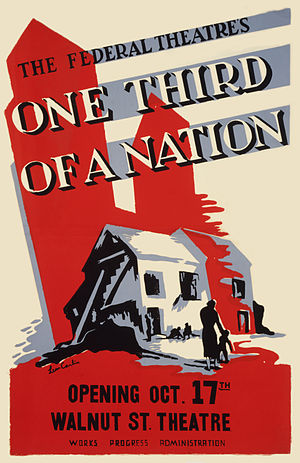
It began as a stage play, one of the experimental works produced by the Federal Theater Project in 1938. Written by Arthur Arent, it was part of the Living Newspaper series which dramatized conditions of the day, this one with a message of the common man versus the big men, including the landlords, about the slum conditions in New York City, how they came to be, how they are maintained, and who profits from them.

Along with its New York run, the play was produced in several other cities across the nation and garnered a great deal of publicity and praise, except by congressional conservatives who were offended by its message. Conservatives were not fond of funding the Federal Theater Project as they regarded it as an incubator of left-wing ideas and dangerous messages—dangerous to them, one presumes—but though it’s been reckoned that actually something like less than 10 percent of its play productions had a left-wing message, nevertheless, Congress decided to quit funding the Federal Theater Project in 1939, and that exciting experiment that kept writers, actors, and directors working during those terrible years in the Depression and that spawned such important works, was killed.

The title of the play, adapted for the movie in 1939, comes directly from the line in President Franklin Delano Roosevelt’s Second Inaugural address in January 1937: “I see one-third of the nation ill-house, ill-clad, ill-nourished... The test for progress is not whether we add more to the abundance of those who have much; it is whether we provide enough for those who have too little.”

We’re still grappling with that idea.

The movie’s plot diverges a little from the stage play in that it has a less experimental presentation (except for a few scenes when the boy has a conversation with the firetrap tenement that he lives in, but we’ll get to that in a minute). Instead, it follows a more conventional line of the damsel in distress, a hero who comes to her aid, and a happy ending.


The film opens on the East Side of New York with kids playing in the streets, turning on fire hydrants and being chased away by the cops, overshadowed by tenements. We get inside views of one particular building with the walls falling apart so that we are able to see the exposed lathing, of trash in hallways, of railings that need to be repaired. A fire starts in the basement of this tenement building. It quickly spreads and its residents attempt to escape in all directions, stumbling out of doors, scrambling out of windows, from fire escapes that will not hold their weight, screaming. A crowd gathers in the street, the fire department arrives, and we see a line of dead bodies already covered on the sidewalk waiting for the morgue.

As the fire rages, at the top of the building we see a boy climbing a fire escape to try to reach the roof because he is blocked from getting to the ground. The ladder on which he is clinging breaks and he falls to the ground. It is a sickening scene, and through the crowd his sister rushes forward in horror. She is played by Sylvia Sidney, fresh off her gig in a similar environment in Dead End (1937).  Miss Sidney had the chops to play fearless dames, but her sophisticated appearance, maybe just her distinctive beautiful eyes set wide in her porcelain face, left her an aura of glamour no matter what setting.


In the back of the crowd, we see a man in an automobile and his snide, wisecracking best friend, rubbernecking at the tragedy. Leif Erickson plays the hero of the piece, and Hiram Sherman is his pal who, not even before the movie is half over, we want to strangle for his smug, sophomoric arrogance. It was Sherman’s only film, then he went on to a lot of TV and theatre. It’s interesting to note that a lot of players in this movie had few movie credits, but had more career traction in TV and theatre.

Leif Erickson reaches Sylvia Sidney as supposedly helpful people are picking up her brother, who is unconscious, probably suffering from head and neck injuries, and handle him like he was a sack of potatoes.  If nothing else, our ideas about first aid have certainly changed for the better over the decades.

Erickson offers to drive him to the hospital and Sidney is very grateful and goes along. She thinks he means that they will take her brother to City Hospital which is for poor people, but he is taking him to the better Surgeons Hospital. Appalled, she asks “Isn’t that just for swells?”


Leif Erickson is rich. He tells her not to worry, and it is not until after the operation when they find out that her brother will survive but will be crippled that she discovers that Erickson has paid all the bills. She is grateful, of course, but intends to pay him back, though she has no idea how.

She is furious at the slumlord who owns the building but will not repair it or keep it maintained. She asks Erickson “Isn’t that murder? Shouldn’t a man like that be in jail?” Erickson agrees, but he will soon learn from his trusted family business manager that he owns the firetrap building. A large slum area of New York has been in his family’s possession for decades.


Mr. Erickson is not the only man in Sylvia Sidney’s life these days; Myron McCormick plays Sam, her longtime beau she cannot marry yet because they have no money. She says of him smiling, “He's sort of left, if you know what I mean.” Sam does not appear to be an agitator or an anarchist, but he is an intelligent and fearless thorn in the side of Erickson and anyone will he thinks makes a profit off other people’s misery.  Miss Sidney’s remark tells us that, like many of the poor, she has no political convictions, and is only concerned with the landlord that won’t fix the light in the hall or the boss that won’t offer a raise; her social concerns are largely about herself.  McCormick seems airy to her because he sees the big picture; Sylvia’s driven by her own personal needs.  The very rich and the very poor aren’t always too far apart in ideology.

There is a brief inquiry with Otto Hulett playing the assistant DA, and Erickson manfully stands up and takes responsibility, against the expressed wishes of his business manager played by Percy Waram and his obnoxious sister, played by Muriel Hutchison. They are intent on protecting the family name and the family dough.

At one point in the hearing, one of the tenants is questioned about the conditions of the building, but it is difficult for him to give an objective report because he lost his wife and children in the fire and he is too shocked, too broken up to want to even discuss the matter. He is an immigrant and whimpers “My little babies.” He is gently told that he can go now.

He looks up astonished, “Where?”

It seems that the rich family of Leif Erickson is legally off the hook because this tenement was built before 1901 and therefore it does not need to adhere to new safety regulations. We are given an insight to the inefficient and bungling bureaucracy which allows this system and we get facts and figures almost like a docudrama in parts. We are told that such firetraps where low-income people live are not rare in the city, that there are over 67,000 of them.

Sylvia Sidney is angry and wants Leif Erickson interrogated on the stand, and he is only too happy to discuss the situation because he has thus far been ignorant about what kind of property his family owns. He has never really been involved in the business. His business manager, Mr. Waram, explains that Sylvia Sidney’s family would have to pay more – mother, father, younger brother, and herself all live in a one-room apartment – which goes for $10 a month rent. If Erickson did all the repairs and upkeep that she demands, they would have to be charged at least $25 a month rent.

Such rents for 1939 actually seem remarkably low for a city like New York. Other towns certainly, but I would’ve thought New York, even its most rundown apartments, would have charged at least $30 a month.

Nevertheless, we see that Sylvia Sidney’s situation is compounded by the fact that she is kind of the Winnie Winkle the Breadwinner of the group. (For those of you familiar with the old comic strip, Winnie supported her mother, her younger brother, and her shiftless father, which is why she was called the Breadwinner.)

I have a Winnie Winkle coffee mug on my desk that I keep pens in. It was a gift. I always had a soft spot for Winnie Winkle the Breadwinner.

Her father played, by Charles Dingle, whom most probably remember as the conniving elder brother in The Little Foxes (1941), is not working and it seems inferred that he is not looking too hard, either.

Erickson comes to Sylvia Sidney’s tenement to see what conditions are like for himself, runs into her boyfriend Myron McCormick, who slugs him and when Erickson falls through a rotten railing, it occurs to him that the place really is a rattrap.

The film takes an interesting turn when her young brother is released from the hospital. He looks hale and hearty, but he walks with crutches and he will for the rest of his life. He is played by Sidney Lumet.

This was young Sidney Lumet’s only movie, though he did small roles in one TV show and a bit part in a movie many decades later, but we know him best as the director of over eighty films. He was certainly a talented filmmaker, but just from this one film he seems a very talented child actor.


We see the slum through Lumet’s eyes more than anyone’s. His friends welcome him home but then they are cruel to him because he is a "cripple." They tease him, they won’t let them play their games; he is too slow for them and the boy begins to spend a lot of time on his own. He sits on the pier watching the other boys swim in the river, he broods outside on the steps of his building. He does not want to go into the building on his first day home, he stays out until quite late because he is afraid and depressed. We know the fire has left him emotionally scarred and he does not want to enter a building which he knows he can be trapped in at any time, especially now that he is not able to walk easily and less able than before to escape in an emergency.

But his anguish is more than that. His troubled soul is absorbing the despair of this neighborhood and the people who live in it, in that building that has seen so many generations of despair. He talks to the building. He tells the building that he hates it and in his imagination the building talks back to him with an eerie voice.

He tells the building, “Look what you done to me.”

The building taunts him and gloats that it has made victims of its residents for decades. We have a brief foggy flashback to the 1870s when the building was younger, but no less dangerous. We see people in clothes of the time period, a doctor’s visit and the whispered dreaded word: Cholera! The screams of the dying from cholera and their terrified families, which was very common in the nineteenth century in crowded buildings with poor sanitation. The factory town I grew up in had a cholera epidemic, and maybe yours did too.

Lumet threatens the building, “I’ll get you some day. I’ll get you – just wait.”

The scenes with Sidney Lumet staring up at the building, he stares directly into the camera – are haunting and unnerving, his piercing, fevered expression of a child half-crazed with the superior knowledge of someone who knows personally how grim the stakes are. For a kid without a whole lot of screen experience, he’s pretty impressive.

Unfortunately, there are no resources to help, medically, emotionally, not from the city, not from charities, not from his own family. The real burden of poverty is that one is essentially alone.

Leif Erickson struggles with his conscience. Sylvia Sidney struggles with the idea of paying him back for the hospital bill. Erickson’s family struggles with trying to distract him away from what they regard as his naiveté.

At last Erickson wants to make a move to tear down the houses in that section and put up new housing – we assume he means for the selfsame low-income residents, but historically in such cases, usually it’s to gentrify the area and jack up the rents.

Sylvia Sidney believes that he is going to give them a shiny new neighborhood and she is thrilled, and her young brother Sidney Lumet taunts the building, his worst enemy, “They’re gonna tear you down. How do you like that, old stinkpot?”

Unfortunately, Erickson has to humor his sister and he confesses to Sylvia Sidney that it will take time to put these plans into motion. Her disappointment in Erickson is such that she loses all hope and rants to her little brother about her desperation and how things will never change. It is a cruel thing to do to a young boy who is obviously emotionally and psychologically brittle, but nobody is paying attention to him

It puts him over the edge and he sets fire to the building. It goes up like a torch and another crowd gathers and the firemen come and the same old scene is repeated. This time, the building kills the kid brother.

In the dim, gray aftermath, Myron McCormick commiserates and Erickson answers, “The time may come when men like you all realize that men like me are human beings, just the way that I’ve begun to suspect that you are.”

The building is torn down, McCormick and Sylvia Sidney plan to pool their resources as best they can and get married, not wanting to wait any longer. Erickson may be the hero of the piece but he’s not going to play Prince charming to Cinderella and take her out of the ashes, literally. He's still going back to his own kind.

We have a montage scene of new buildings being constructed with playground areas. We are meant to understand that the people living in them will experience a kind of poverty Shangri-La, with the cleanliness and privacy and community spirit with all of them pitching horseshoes and raising their children in the sunlight. It’s not suburbia – nobody predicted suburbia yet – but for a city dweller in a firetrap tenement, it might very well have seemed like the next best thing to paradise. At least the producers thought so.


One segment of the Franklin Delano Roosevelt Monument in Washington, D.C. is devoted to his “one third of a nation” speech.  It is depicted here above in this photograph in the collection of the Library of Congress.

The bronze statues by George Segal, are titled The Rural Couple and The Breadline located in Room Two of the memorial.

We have another legacy: Today, one of the main reasons why people continue to struggle financially and even live in poverty are the cost of healthcare and the cost of housing. We have revisited young Sidney Lumet’s nightmare on a much grander scale. Though most of us who enjoy classic films enjoy the nostalgia of them – we spend a lot of time looking at the furniture, the clothes, the music, the speech expressions as evidence of a long-ago world – for those who are not fans of classic films it is probably more important not to concentrate on these things, but to concentrate on the heart of the message, on the emotion of the story, and thereby finding in these, whom they might regard as hokey characters, a lot more in common than they thought possible.


Come back next Thursday when we conclude this series on the 1930s and their messages for today with Make Way for Tomorrow (1937), and an elderly couple whose retirement has left them helpless, homeless, and dependent on grown children. Take a look at those spinning headlines – they’re from today.

 *****
1930s series:
Part 1 - Gentlemen Are Born (1934)
Part 2 - Our Daily Bread (1934)
Part 3 - Wild Boys of the Road (1933) and Girls of the Road (1940).

*********

Jacqueline T. Lynch is the author of Ann Blyth: Actress. Singer. Star. and Memories in Our Time - Hollywood Mirrors and Mimics the Twentieth Century. Her newspaper column on classic films, Silver Screen, Golden Memories is syndicated nationally.


Related Products