IMPRISON TRAITOR, PEDOPHILE, AND CONVICTED FELON TRUMP.

Thursday, December 4, 2014

Babes on Swing Street, and Bowery to Broadway - 1944


Babes on Swing Street and Bowery to Broadway, both released in 1944, are examples of the old studio system as both an incubator for talent, and a factory assembly line devoted sometimes more to quantity than quality. They were the last two musicals Ann Blyth would appear in for many years as her career took a sharp dramatic turn with far more challenging roles. It is astounding to think after Bowery to Broadway, in which she appeared only a few minutes at the end of the film, that her next project would be Mildred Pierce for Warner Bros., and an Academy Award nomination.

We covered her first two films under her new Universal contract, Chip off the Old Block and The Merry Monahans, also released in 1944, here. Lightweight musical comedies featuring teen stars, they were a good start for the young Ann Blyth, new to pictures, though she was coming to Hollywood with the impressive pedigree of a prestigious Broadway show under her belt, Watch on the Rhine. It was likely this reputation as a serious child dramatic stage actress, the prestige of that show, her own prettiness and demure demeanor that caused the casting directors to launch her film career in the persona of a sophisticate, a rich girl, a nice girl, or all three. Another factor to her being cast as the all-American girl everyone wanted as a friend or daughter was her soprano singing voice.

Jack Ano, in his introduction to Hollywood Players: The Forties aptly puts it:

The Hollywood definition of “class” knew no boundaries and there was nothing ritzier at the time than a soprano. Gloria Jean, Mary Lee, Ann Blyth, Susanna Foster, Kathryn Grayson, and Gloria Warren, at various times, served as the junior league Deanna Durbins…

As mentioned in a previous post, though MGM grabbed the “lion’s” share of attention when it came to so-called “backyard musicals,” it was really Universal that produced more teenage talent. When Deanna Durbin abandoned ship, the void was filled not by a single replacement, but by a cadre of young adults. The ritzy sopranos listed above were joined by Grace MacDonald, Donald O’Connor, and Peggy Ryan, and The Jivin’ Jacks and Jills. We’ve noted in the post on Chip off the Old Block and The Merry Monahans that the dance/comedy team of O’Connor and Ryan was something special and couldn’t be beat.

By the time Ann Blyth arrived at Universal to make the duo a trio, several movies were put into production at once to use Donald O’Connor as much as possible before he entered the army. It was a quick splash into movie making for the newcomer, but Ann felt, “It was an incredible and enriching experience.”


Babes on Swing Street (a cheeky coincidence but no relation to MGM’s Babes in Arms, Babes on Broadway, etc.), starred Peggy Ryan and Ann (sans Donald). Except for the old one-reeler comedies with Zasu Pitts and Thelma Todd (or others), I can’t think of a female team given top billing together. To be sure, this was more B movie than A list, and the predominantly youthful cast and focus on ambitious teens “making good” (are young people encouraged to “make good” anymore or just make money?), the critics who bothered to review the film dismissed it as “one of those minor league musical affairs…”

Directed by Edward C. Lilley, the movie lasts just over an hour, and though brief, is stuffed with songs, gags, and a plot somewhere in there if you look hard enough. Peggy Ryan is the president of kids’ club at the local settlement house where teens meet to play ping pong and get off the streets.

They are also all very talented singers, musicians, and tap dancers, and want to “make good.” A music academy (headed by our old pal Ian Wolfe) will give ten of them partial scholarships if they can come up with the rest of the tuition.

Ann hangs out at the settlement house, too, but she’s a rich girl who lives with a domineering aunt, played by Alma Kruger, and befuddled uncle, played by Leon Erroll. Her attempts to help the kids are constantly rebuffed by the resident heartthrob played by Billy Dunn, who resents her for her wealth. Why she’s stuck on this unpleasant boy, and why he suddenly turns around and falls for her at the end is never really clear. He just does. Probably because she’s the soprano.

Ann uses the word, “solid” as a compliment to prove she is hep, as do others in the movie to remind us these teens are in the groove. They’re not groovy; they’re just in the groove.

The gang decides to open a nightclub for teens to raise the funds. Ann donates her aunt’s empty rental property, a hall, and the kids scramble getting tables, food, aided by swell grownups Kirby Grant, Ann Gwynne, and Andy Devine, who plays Peggy Ryan’s father. We mentioned in this previous post on Ann’s stage career that Mr. Devine played her pop, Cap’n Andy, in Showboat on tour in the 1970s.

June Preisser has a flashy role as the eye-rolling junior vamp (which was her stock in trade, no matter what studio she roamed or what teen couple she tried to break up), and demonstrates astounding skill, as usual, in her ability as an acrobat and contortionist, with rolling flops on stage that seem to indicate she was without vertebrae. June was actually older than the other kids, something like 23, already a wife and mother when she made this film, some eight years older than Ann Blyth, but with her cute looks and cherubic grin, she played young. Her junior Mae West number: “I’ve Got a Way with the Boys.”

She is Ann’s rival for Billy Dunn’s affections, but, interestingly, nobody is paired with Peggy Ryan, despite her being the lead. A comedienne hardly catches a romantic break, though she could do much more than comedy. (I like her handling of the line, “Lay off the sarcastics.”

“You mean sarcasm.”

“I like sarcastics. It sounds more…sarcastic.”)

Peggy, with three dance numbers, is showcased more than the other kids. Her routines here are not quite as athletic as her slam-dunk partnerships with Donald O’Connor, but demonstrate her really fine versatility in balletic, tap and comic novelty dancing.

One number she sings and dances is a parody of a Russian folk dance, in deference perhaps to our wartime allies. Why critics seemed to write off this prodigious talent as mere clowning, or why Universal didn’t widen her range of roles, I don’t know, but Peggy Ryan was one of the most talented performers of the era.

Ann sings “Peg O’ My Heart” backed by a male chorus, demonstrating a pretty voice, but nowhere near the range or power she developed down the road. We don’t see much of the other acts, which are filler, except for Sidney Miller as a wise guy emcee who does imitations of Hollywood stars, including Katharine Hepburn, complete with calla lily.

The movie ends with the finale and everybody on a stage much too large to accommodate this rented hall, and this must mean the kids have “made good.”

You can see the entire movie free on the Vimeo site here. Below, the trailer.


Bowery to Broadway turns the reins over to the grownups, though Susanna Foster, Peggy Ryan, Donald O’Connor, and Ann Blyth all have brief roles in specialty acts. Jack Oakie and Donald Cook are the stars. They are competitors and later partners in producing shows from…the Bowery to Broadway. You’ll remember Donald Cook as Ann’s father in Our Very Own (1950), covered here.

It’s a passing parade of years story of vaudevillians and impresarios stealing acts from each other, spanning from about 1900 to about 1930. Everybody on the Universal lot showed up for a scene or two in this one: Maria Montez, Leo Carrillo, Andy Devine, Evelyn Ankers, Thomas Gomez (our old favorite, who appeared with Ann in Swell Guy here and who squires around Louise Allbritton as Lillian Russell), Snub Pollard, Walter Tetley—who, like Ann, performed on the Coast to Coast on a Bus radio show as achild in New York, see our intro post.


Most reviews were disparaging. Syndicated columnist Harold V. Cohen:

Universal has put a lot of people into Bowery to Broadway and virtually nothing else. In talent, or at least in the abundance of talent, it goes sky-high. In originality and imagination, it hits rock-bottom.

Buck Herzog of the Milwaukee Sentinel thought the movie:
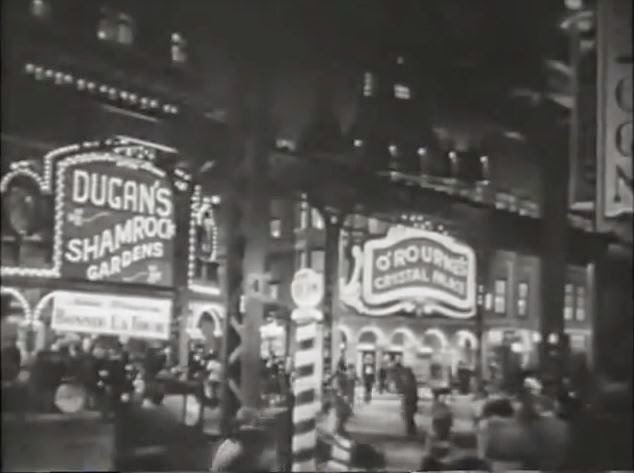
…is a rambling musical…there can be little in the story that can termed refreshing, much of it being a rehash of shopworn cinema situations. But there is music, glittering production scenes…

It is a hodgepodge, and the material is familiar, but I think that is what makes the movie enjoyable. These are the good old days, even the sad times, and nostalgia works when parody is teasing, but not mean or condescending. Most of these theatrical show movies are really valentines to the art and era, and especially poignant when you know that many of the actors in such movies began in vaudeville. Or even, like Ann, had hit “the big time” on the legitimate Broadway stage. They are, in a sense, paying homage to their own roots.

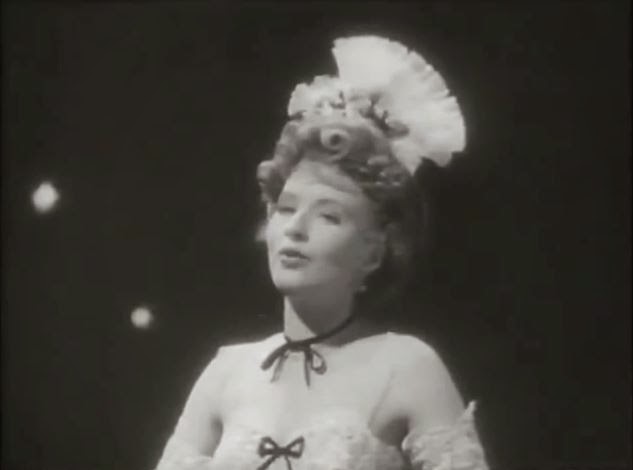
A charming scene were Lillian Russell leads an impromptu sing-a-long with “Under the Bamboo Tree,” and another bright spot in the film is the comic patter between Ben Carter and Mantan Moreland, whose fortunes rise to become owners of a Harlem night club. In a really funny routine, their old vaudeville act really, they finish each other’s sentences with impeccable timing. At one point when Donald Cook and Jack Oakie are down and out, and Mr. Carter and Mr. Moreland offer to loan them money, flush with success and driving their own big convertible, a rare scene for African American performers in a movie from this era.


Susannah Foster was riding a crest of popularity from her best role as Christine opposite Claude Rains in the 1943 Phantom of the Opera, but her film career would be brief, and after taking time to study in Europe to improve her operatic voice, an expected and desired comeback never happened.


We get a little bit of everything here: the footlights, the neon, the headlines from Variety and Billboard, the Lambs Club, the star treatment, the bum’s rush, a tossed garter, a tragedy. Frank McHugh and Rosemary DeCamp are a pair of hoofers, who struggle for years to make “the big time.” They never make it. In one of the most poignant scenes, they overhear a producer for whom they’ve auditioned call them “old hat—they don’t belong here.” Dejectedly, they ponder the lights of Broadway out a window in an empty hallway, when an elevator operator asks them,

“Going up?”

Frank McHugh shakes his head, “Going down.”


We see them next struggling to run a children’s dance school in their apartment. One little girl is particularly terrible. She has no rhythm and does everything opposite to what the other kids do. She’s about as coordinated as an elephant. She’s their daughter.

You have to laugh. The one thing they want more than being on Broadway is seeing their kid succeed, but a pirate with a peg leg is a better dancer. But the husband-and-wife team of McHugh and DeCamp is really the spirit of the movie, the joy of performing and the broken hearts that result from rejection. At one point Jack Oakie, on the outs with his partner, is fed up with producing shows because he has been shoved into the position of bean counter, and the gloss of the modern shows has no heart like the old time variety. Rosemary DeCamp puts his misery succinctly, “It’s just business, not show business. Not the part that gets under your skin. The all-night rehearsal, the put it together, pull it apart.”

But the years pass, and finally Oakie and Cook decide to reunite and stage a new show, nothing high falutin’ or artsy, just good old fashioned entertainment, (I love the line, “It’ll make Blossom Time look like a one-night stand.” The Sigmund Romberg hit ran a year and a half in the early twenties.) They have a new singer they found in some theater amateur hour and give her a chance. She turns out to be McHugh and DeCamp’s ungainly daughter, now grown up and pretty as a picture—and not a dancer at all, but a singer. She is Ann Blyth.

Mom and Pop are fit to bust with pride to see their kid’s name in lights, even if still chagrined that she can’t dance. You’ll remember, by the way, that Rosemary DeCamp also played her mother in The Merry Monahans.
Also appearing in their great new show are Donald O’Connor and Peggy Ryan performing the parody of a Gay Nineties cad and the tragically duped woman lured by his promise of wealth, “He Took Her For a Sleigh Ride in the Good Old Summertime.” It’s a funny and fun number, but the dancing is merely just a gentle soft shoe here. O’Connor is especially humorous with his careful rolling R diction as a “mellerdramer” villain, complete with waxed handlebar mustache.

Ann is given the spotlight in the finale with the frothy production number, “Sing What’s in Your Heart.” She enters on a throne, with a chorus of springtime nymphs around her.

An interesting scene shows Jack Oakie and Donald Cook in the plush lobby of the Broadway theater in which their big show is going on, and as they head up a grand staircase, we see large portrait paintings of whom we might assume to be great theatrical headliners of the past.


Look closely. One is of Donald O’Connor, and one is Ann Blyth, which looks like a version of one of her publicity stills of the time.

Bowery to Broadway had been on YouTube for a time, and a possibly gray market DVD might be found, otherwise you’re out of luck.

Interestingly, Ann is billed with the stars and ahead of others in the cast with larger roles (she’s really only in this movie for a matter of minutes), which I think signals the fact that Universal, in disbanding their Jivin’ Jacks and Jills youth unit, were putting all their chips on Ann as someone who could grow beyond a teen performer. Three movies were released one after another in successive months: The Merry Monahans in September 1944, followed immediately by Babes on Swing Street in October, and the last, Bowery to Broadway in November.

Then she had a screen test over at Warner’s for a new Joan Crawford movie: Mildred Pierce. The leap from teen nice girl soprano to the glossy Noir and one of the screen’s most nasty characters is astounding, and we can attribute it to Ann’s tenacious and insightful agent named Al Rockett who got her a screen test; an indulgent star who offered to make the test with her: Joan Crawford; and that screen test.

According to an article in Photoplay, January 1956, Mr. Rockett fought for the test and told Warner’s “Throw the toughest scene you have at her.” It was the confrontation scene where Ann slaps Joan.

The director, Michael Curtiz, was convinced. Ann won an Academy Award nomination for the role of Veda Pierce, at seventeen years old, the youngest person to receive the honor up until that time.

Twelve years later, Ann did another screen test for Michael Curtiz, also for Warner Bros. She was not considered a likely candidate for this role, either, perceived as being too sweet, but agent Al Rockett came through again, and she was allowed to test. Lightning struck twice, and Ann blew everybody away with her screen test. She won the lead in The Helen Morgan Story. It would be her last movie.

We’ll talk about it next Thursday.


©Jacqueline T. Lynch, 2007-2014. All rights reserved. If you're reading this on a site other than Another Old Movie Blog, please be aware that this post has been stolen and is used without permission.

*******************************
Ano, Jack, introduction to Hollywood Players: The Forties by James Robert Parish and Leonnard DeCarl (New Rochelle, NY: Arlington House, 1976), p. 14.

Dick, Bernard F. City of Dreams – The Making and Remaking of Universal Pictures (University Press of Kentucky, c. 1997) pp. x, 129

Milwaukee Sentinel, December 23, 1944, review by Buck Herzog, p. 6; February 16, 1945 review by Buck Herzog, p. 6.

Photoplay, January 1956, “Her Guardian Angel Kissed Her” by Maxine Arnold, p. 82.

Pittsburgh Post Gazette, December 25, 1944, review by Harold V. Cohen.

********************************
THANK YOU....to the following folks whose aid in gathering material for this series has been invaluable:  EBH; Kevin Deany of Kevin's Movie Corner; Gerry Szymski of Westmont Movie Classics, Westmont, Illinois; Ivan G. Shreve, Jr. of Thrilling Days of Yesteryear; and actor/singer/author Bill Hayes.  And thanks to all those who signed on as backers to my recent Kickstarter campaign.  The effort failed to raise the funding needed, but I'll always remember your kind support.
Delete
****************************
UPDATE:  This series on Ann Blyth is now a book - ANN BLYTH: ACTRESS. SINGER. STAR. -
*********************
The audio book for Ann Blyth: Actress. Singer. Star. is now for sale on Audible.com, and on Amazon and iTunes.

Also in paperback and eBook from Amazon, CreateSpace, and my Etsy shop: LynchTwinsPublishing.


 "Lynch’s book is organized and well-written – and has plenty of amusing observations – but when it comes to describing Blyth’s movies, Lynch’s writing sparkles." - Ruth Kerr, Silver Screenings

"Jacqueline T. Lynch creates a poignant and thoroughly-researched mosaic of memories of a fine, upstanding human being who also happens to be a legendary entertainer." - Deborah Thomas, Java's Journey

"One of the great strengths of Ann Blyth: Actress. Singer. Star. is that Lynch not only gives an excellent overview of Blyth's career -- she offers detailed analyses of each of Blyth's roles -- but she puts them in the context of the larger issues of the day."- Amanda Garrett, Old Hollywood Films

"Jacqueline's book will hopefully cause many more people to take a look at this multitalented woman whose career encompassed just about every possible aspect of 20th Century entertainment." - Laura Grieve, Laura's Miscellaneous Musings''

"Jacqueline T. Lynch’s Ann Blyth: Actress. Singer. Star. is an extremely well researched undertaking that is a must for all Blyth fans." - Annette Bochenek, Hometowns to Hollywood


Ann Blyth: Actress. Singer. Star. 
by Jacqueline T. Lynch

The first book on the career of actress Ann Blyth. Multitalented and remarkably versatile, Blyth began on radio as a child, appeared on Broadway at the age of twelve in Lillian Hellman's Watch on the Rhine, and enjoyed a long and diverse career in films, theatre, television, and concerts. A sensitive dramatic actress, the youngest at the time to be nominated for her role in Mildred Pierce (1945), she also displayed a gift for comedy, and was especially endeared to fans for her expressive and exquisite lyric soprano, which was showcased in many film and stage musicals. Still a popular guest at film festivals, lovely Ms. Blyth remains a treasure of the Hollywood's golden age.

***************************
A new collection of essays, some old, some new, from this blog titled Movies in Our Time: Hollywood Mimics and Mirrors the 20th Century is now out in eBook, and in paperback here.


Thursday, November 27, 2014

Red Canyon - 1949


Red Canyon (1949) was Ann Blyth’s first Technicolor picture, first and only big-screen western, first time she received both top billing and name above the title.  She was 19 years old and had hit her stride.

It was a pinnacle of a kind, and the beginning of new trail.  After a string of six heavy dramas that gave her intense roles to prove herself a major up and coming actress, her last film before Red Canyon, Mr. Peabody and the Mermaid, which we covered here, was a complete change that charmed the public and clued-in the studio that Ann was also athletic, and that her beauty was as much an asset to selling a film as her acting skill.  Her trim body, also, could lend itself to more than posing in a crisp Noir wardrobe. 

It also reminded studio that she was young.  In those dramas, from Mildred Pierce through Another Part of the Forest, Ann’s characters were increasingly poised, knowing, sophisticated, and wore a mantle of worldly experience even though in real life she was still some years away from being old enough to vote.  Her characters were restless, mean, sad, tragic.

Mr. Peabody and the Mermaid, because of her fanciful character and its exotic costuming, her silent communication through her expressive face, and the joyful silliness of the plot, actually managed to re-set the clock on her screen sophistication.  She was suddenly much younger again.  For the next several films she would play more innocent ingénues, most of them in comedies, and this one western.

In Red Canyon, she plays the spirited tomboyish daughter of George Brent on a late nineteenth century homestead in the west.  Brent is a self-made man who runs a stagecoach line and a prosperous ranch, where he breeds and trains bloodstock for racing.  His prize horse is a great white stallion, his hope for winning an upcoming race, and he won’t let Ann near him, which infuriates her.  She wants to ride him.

George Brent has third billing here, and in that inevitable bittersweet Hollywood turnstile, no longer playing the romantic lead.  That job goes to Howard Duff, pulled away from a string of Noirs for his first romantic lead, and also his first western.  There would be many more westerns for him after this.  (Ann would have to wait for TV’s Wagon Train, in which she appeared in five episodes—we’ve discussed them all this year—to appear in more western stories.)

Mr. Duff plays a saddle tramp trying to capture a wild black stallion hereabouts known as Black Velvet (which was the film’s original working title).  Duff travels under an assumed name to distance himself from his no-account relatives.  That would be our old friend John McIntire, who played in so many of Ann’s films, as Duff’s wily outlaw pa.  Lloyd Bridges is his sneering no-account brother.  

Their gang steals horses, and many years ago made a raid on George Brent’s ranch, which resulted in the shooting death of his wife.

Jane Darwell, fussy and bossy as ever, plays George Brent’s sister, who has helped to raise Ann and is determined to make a lady of her, “If I have to break every bone in your ornery body to do it.”

We open on Ann’s birthday, when her pa and auntie present her with a gift of women’s duds.  Ann examines them with a wariness borne of not wanting to be changed by anybody, and a genuine fear of that metal rat-trap-looking thing called a bustle.  One look at the whalebone corset, and she bolts, climbing out the window.

Later, at the barbecue to celebrate her birthday, Ann appears in her feminine finery to the general approval of the crowd, including several would-be suitors.  They present her with an armload of gifts—the kind she likes—lariats, riding crops, saddles, bullwhips.

Bullwhips?

Catch the scene where she enters the outdoor party by walking down a flight of simple wooden stairs from her second-floor veranda, as the hem of her dress ripples down the steps and she gains confidence with every compliment.  By the time she’s reached the bottom step, she’s the belle of the ball.  As we’ve stated before on other films where the lady makes her entrance on a staircase, this is really the way to join a party.  A much-used device for showing off the heroine, but dang, it works every time.

Ladies, if you’re going to try this at home, all you need is an open staircase and a killer dress.  But make sure you don’t trip and take a header down the flight of stairs; it puts a damper the whole effect.

James Seay, another horse breeder and potential suitor for Ann, remarks she is “Prettier than a string of blue-nosed trout.”

This is apparently a compliment, because she is pleased.  One of the fun things about this movie is it is chock-full of euphemisms of the kind our western pioneers were evidently so fond.  Jane Darwell cracks off a string of them, starting with “flapdoodle” to describe the layers of feminine undergarments to which she introduces Ann.

About the only one in the movie who does not use euphemisms is George Brent, probably because, as we are told, he is originally from Massachusetts.  We in Massachusetts are not imaginative enough to compare a pretty young girl to a string of blue-nosed trout. 

We prefer cod, anyway.

The champion user of euphemisms in a particularly cussed manner is Edgar Buchanan, who plays Brent’s stagecoach driver.

The cod is the state fish of Massachusetts.

Mr. Buchanan is as big a teller of tall tales, and vain a man as you can get, trying to cover his nearsightedness, which will prove a danger to him and others. 

Cape Cod is in Massachusetts.  Oh…forget it.

Buchanan’s speech is so tangled up in the most outlandish and complicated blustering euphemisms that I’m surprised he could remember half his lines.  I’d love to see the outtakes; they're real tongue-twisters and he had to have messed up sometimes.

Tired of driving the stagecoach for Mr. Brent, Buchanan invites himself to be Howard Duff’s partner in catching the wild stallion, and voila, we have instant comic sidekick.  He is of no help, as comedy relief seldom is.

Ann’s first meeting with Mr. Duff is contentious, were he leaves her without a horse in the desert, and she catches up to him at a pond, coyly suggests they strip off and go swimming, and then steals his clothes and his horse.  Not a promising start to the romance, but gradually they each find something in the other they can respect. Duff stands up to her father, which she admires.  Ann is a better trainer for Black Velvet than Duff.  His bullying tactics to train the horse, once he’s caught him, only get him thrown off and lying in the dirt with a wrenched back, and the horse escapes from him.  Ann finds Black Velvet on the trail, where he is caught by a rope snagged on a limb.  The sudden jerk brings the poor horse crashing to the ground.

Ann’s gentle manner with Black Velvet goes over big with the horse.  She frees him, and leads him back to Duff, the horse trotting along beside her, happy as a puppy because she’s so purty and talks nice to him.  Duff’s astonishment is a hoot, but, to his credit, he lets her take over the job of training the horse without any ego.  He later tells her, “I would have been whipped.  Black Velvet’s too tough for me.”

Ann has an ulterior motive, she wants to ride Black Velvet in the upcoming horse race and beat the pants off her father, who won’t let her ride his white stallion, and says things, like, “You’d better realize you’re a girl,” as if that were a bad thing. 

Ann looks well on a horse and her confident riding is impressive.  She looks quite skilled and comfortable, even in the exciting shots where she is riding at a speedy gallop, leaning over the horse’s great neck, her hair flying.  I suppose we must credit the Hollywood studio training system for teaching a girl from Manhattan to ride like that. 

Since this is a Technicolor film, her hair has been lightened to a reddish brown.  I guess dark hair is only for black and white films.  For a tomboy, she wears a most vivid shade of red lipstick, similar in hue to the big red first letters in the words of the title.  You can’t waste Technicolor, you’ve got to make the most of it.  Likewise, the title Black Velvet becomes Red Canyon.

Westerns are really meant for color film stock, anyway.  A city scene artfully filmed in black and white can evoke a strong range of powerful emotions, but with an open range of small scrub, a gray palette does not distinguish detail as well as color.  Outside a closed set, there is less ability for the cinematographer to manipulate conditions.  In black and white, the western prairies look as desolate as the moon, but color film brings out depth and warmth to the rugged landscape, stark, challenging to the body and soul, and utterly majestic.

Howard Duff displays a quiet strength in this film, a virile self-confidence with an absence of swagger; he looks comfortable.  A likeable loner; if we never get to know him well it is not because he is complicated, but because he keeps his own counsel.  He faces down his conniving outlaw father and treacherous brother, as well as George Brent, who dismisses him as a saddle tramp.  Though his romance with Ann is tentative; there are no fireworks between them, in part due his reticence about getting involved with the girl who was made motherless by his outlaw family—nevertheless, their scenes together are genuine and reticence is natural to both their characters.  He is living down the burden of his family name; she is discovering her womanhood.  

Duff (in real life some 15 years older than Ann Blyth, but doesn't seem it) looks like he belongs to this landscape, as if he is a part of it.  George Brent does not; he still carries the aura of a transplant.  That, too, is natural.


Possibly the biggest star of the film are the uncredited horse wranglers.  The two great, spirited stallions, and especially the herd of wild horses under the lead of Black Velvet must have taken an extraordinary amount of handling. The camera work, too, is very good, with long and close shots sweeping over the backs of the galloping herd of wild horses.

One scene is a bit unsettling, when Howard Duff captures Black Velvet by forcing him to leave the refuge of a small, narrow canyon by starting a brush fire.  No wonder the horse doesn’t like him. 

By the end of the film, we have a horserace, a showdown, and a shootout.  Most surprisingly, Howard Duff and Ann Blyth decide to return the horse to the wild, and our last shot is not the usual happy couple pressing their cheeks together, but of a magnificent black horse tearing across the open range, rejoining the wild herd of which he is the leader.

The movie was filmed at Kanab, Utah, which was enjoying what was touted in the local press as the birth of a Hollywood-rival in location shooting.  (Howard Duff’s film with Yvonne DeCarlo Calamity Jane and Sam Bass (1949), which we covered here, with the same director and producer: George Sherman and Leonard Goldstein, would use the same racecourse and scenery the following year.).  Locals appeared as extras.  The Deseret News noted in October 1948:

During the past summer, southern Utah hotels, eating houses, stores and workmen reaped a rich harvest from the movie people on location around Kanab and Cedar City.  At the former site, Ann Blyth, Jane Darnell [sic] and George Brent captivated the citizens during their stay while filming Black Velvet.

The excitement of seeing Hollywood stars in their midst was accompanied by the thrill of knowing their part of world was getting attention, as the Deseret News recorded at the time of the film’s premiere in March 1949:

Red Canyon is a picture that’s worth thousands to Utah in the form of publicity.  Many who see the film when it is shown in theaters across the country will want to visit the region in which it was made…

Whether tourists thereafter clamored to get to the Kanab region, or only occasional film companies looking for sagebrush and scenery, but for one afternoon and evening in March 1949, Salt Lake City held the spotlight for the premiere of Red Canyon.


On the morning of Wednesday, March 16th, stars Ann Blyth, Howard Duff, Edgar Buchanan and Chill Wills, along with producer Leonard Goldstein, arrived at the train station on the Union Pacific Streamliner.  The mayor welcomed them, and they appeared on a live radio broadcast right there on the depot platform for the Breakfast in Hollywood program.  Among their personal appearances was to ride in parade through town the next afternoon along with the Downtown Days Queen—part of the Downtown Days festival run by the Retail Merchants Bureau of the Salt Lake Chamber of Commerce.

The evening of the 17th was capped by the premiere showing of Red Canyon at the Utah Theater, with an overflow crowd going to the Capital Theater.  After the movie, the stars appeared on stage, with Chill Wills acting as emcee.  Ann sang.  The Deseret News commented:

The little Blyth girl especially won the plaudits with three songs which showed she is versatile in several fields of entertainment.  She left little doubt of her singing ability after she sang “Galway Bay” as her final selection.

Well, it was St. Patrick’s Day, after all.

If any of our readers attended that event, or know someone who was an extra, I'd love to hear from you.

The next day, the afternoon of Friday, the 18th, it was the train back to Hollywood for the actors, leaving Salt Lake City with only its Downtown Days queen to maintain the magic of celebrity.

For Ann, the following week brought another celebrity experience when she attended the Academy Awards as a presenter, handing out the Sound Recording award.  The host was Robert Montgomery, with whom she was now working in Once More, My Darling, which we covered here.

It was her second appearance at the Academy Awards; you’ll remember her first was three years earlier as a Best Supporting Actress nominee for Mildred Pierce.  She had been a newcomer then; and if presenting the Sound Recording award was less exciting than being nominated, it signaled that she was part of the Hollywood establishment now. 

As you can see by the screen caps, this was recorded off the Encore Westerns channel.  I don't believe Red Canyon was ever released in VHS or DVD, but you can probably find a gray market copy. Please correct me if I'm wrong.

Come back next Thursday when we return to Ann Blyth’s first year of filmmaking, before any thought of Oscars, and the 1944 release of her final two teen musicals from Universal: Babes on Swing Street and Bowery to Broadway.


To all our American readers:  Happy Thanksgiving.

©Jacqueline T. Lynch, 2007-2014.  All rights reserved.  If you're reading this on a site other than Another Old Movie Blog, please be aware that this post has been stolen and is used without permission.
***************************
Bonham Daily Favorite (Bonham, Texas) – November 18, 1951-  “Tiny Ann Blyth Proves Durable in Film Roles,” p. 2.

Deseret News, October 1, 1948 – “Movie Makers Turn Eyes to Utah” by Olive W. Burt, p. M1; March 18, 1949, “Red Canyon and Stars Win Plaudits at Premiere,” p. F-3; March 2, 1949, p. B1; March 17, 1949, p. B1; March 15, 1949, p. A8; November 11, 1948, “Kanab Runs Hollywood Close Second of Movies,” p. F-3.

Wiley, Mason and Damien Bona. Inside Oscar - The Unofficial History of the Academy Awards. (NY: Ballantine Books, 1986), p. 187.
************************

THANK YOU....to the following folks whose aid in gathering material for this series has been invaluable:  EBH; Kevin Deany of Kevin's Movie Corner; Gerry Szymski of Westmont Movie Classics, Westmont, Illinois; and Ivan G. Shreve, Jr. of Thrilling Days of Yesteryear.  And thanks to all those who signed on as backers to my recent Kickstarter campaign.  The effort failed to raise the funding needed, but I'll always remember your kind support.
Delete
****************************
UPDATE:  This series on Ann Blyth is now a book - ANN BLYTH: ACTRESS. SINGER. STAR. -
*********************
The audio book for Ann Blyth: Actress. Singer. Star. is now for sale on Audible.com, and on Amazon and iTunes.

Also in paperback and eBook from Amazon, CreateSpace, and my Etsy shop: LynchTwinsPublishing.


 "Lynch’s book is organized and well-written – and has plenty of amusing observations – but when it comes to describing Blyth’s movies, Lynch’s writing sparkles." - Ruth Kerr, Silver Screenings

"Jacqueline T. Lynch creates a poignant and thoroughly-researched mosaic of memories of a fine, upstanding human being who also happens to be a legendary entertainer." - Deborah Thomas, Java's Journey

"One of the great strengths of Ann Blyth: Actress. Singer. Star. is that Lynch not only gives an excellent overview of Blyth's career -- she offers detailed analyses of each of Blyth's roles -- but she puts them in the context of the larger issues of the day."- Amanda Garrett, Old Hollywood Films

"Jacqueline's book will hopefully cause many more people to take a look at this multitalented woman whose career encompassed just about every possible aspect of 20th Century entertainment." - Laura Grieve, Laura's Miscellaneous Musings''

"Jacqueline T. Lynch’s Ann Blyth: Actress. Singer. Star. is an extremely well researched undertaking that is a must for all Blyth fans." - Annette Bochenek, Hometowns to Hollywood


Ann Blyth: Actress. Singer. Star. 
by Jacqueline T. Lynch

The first book on the career of actress Ann Blyth. Multitalented and remarkably versatile, Blyth began on radio as a child, appeared on Broadway at the age of twelve in Lillian Hellman's Watch on the Rhine, and enjoyed a long and diverse career in films, theatre, television, and concerts. A sensitive dramatic actress, the youngest at the time to be nominated for her role in Mildred Pierce (1945), she also displayed a gift for comedy, and was especially endeared to fans for her expressive and exquisite lyric soprano, which was showcased in many film and stage musicals. Still a popular guest at film festivals, lovely Ms. Blyth remains a treasure of the Hollywood's golden age.

***************************
A new collection of essays, some old, some new, from this blog titled Movies in Our Time: Hollywood Mimics and Mirrors the 20th Century is now out in eBook, and in paperback here.

Thursday, November 20, 2014

One Minute to Zero - 1952

One Minute to Zero (1952), like most war movies, isn’t “timeless,” which is a label critics so often paste on their reviews of a film to indicate a particular quality of excellence, more than of immortality.  It is locked, perhaps hamstrung, by its singular event of the Korean War—whose ambiguous political and military result is, not surprisingly, reflected in the film’s ambiguous and even ambivalent message.

The film, for many months up until its release in August 1952 was referred to in the press by its original (if unoriginal sounding) title: The Korean Story.  Produced at RKO by Edmund Grainger under the auspices of Howard Hughes, suffering delays due to severe weather on location in Colorado and the loss of its lead actress, Claudette Colbert, due to pneumonia she contracted there in the bitter cold.  The movie carried the reputation of a jinxed picture long before the crew limped back to Hollywood.  With several of the film’s cast and crew down sick, lead actor Robert Mitchum’s brawl with a serviceman, and the cooperation of the military up in the air with Howard Hughes over a scene the government preferred to be censored, the only bright spot in the lumbering affair seemed to be the popular, if unlikely, young actress Hughes hired at the eleventh hour to step into the female lead.  She also raised eyebrows due to her youthfulness compared to the other actresses hired, or considered for the role (Colbert, and also Joan Crawford), and speculation as to how the “little lady” of Hollywood would fare in a testosterone-infused war picture against bad boy Robert Mitchum.

Ann Blyth had just turned 23 years old when she belatedly joined the cast of what would eventually be called One Minute to Zero.  She told interviewer Eddie Muller in her 2006 appearance at the Castro Theater in San Francisco (in the transcript as posted by The Evening Class blog here):

I found myself in Howard Hughes' office with my agent—I didn't really want to go by myself; I'd heard stories—anyway, he was very nice to me, sat off in the corner…

According to a column by Louella Parsons, who visited Ann on the set of The World in His Arms, which we covered here, Ann was due to head out to location shooting in Colorado Springs for Hughes’ war picture “at the break of dawn the next day,” with no break between pictures. She told the gossip columnist that 1951 had been the most memorable and exciting year for her, in which she traveled to England for I’ll Never Forget You, visited relatives in Ireland for the first time, and saw the release of four very different films: the murder mystery Thunder on the Hill discussed here, exotic historical costume picture The Golden Horde, I’ll Never Forget You, and The Great Caruso, discussed here, which helped to launch her into MGM musicals.  Her versatility evident, there seemed to be no reason not to put her into a war picture, even if the script had to be altered to reflect a much younger woman in the role.  

From a syndicated article by Hugh Heffernan: 

This embattled outfit, headed by director Tay Garnett, has been filming The Korean Story on location sites near Denver for the last three months – and overcoming one rugged and discouraging hardship after another.…First of all, Joan Crawford pulled out from the star role after the company had been shooting there for several weeks awaiting her arrival.  Jane Greer was then announced as the replacement and there was more stalling until it became apparent that she could not be released from a previous commitment.

After two weeks of dealing, Claudette Colbert agreed to leap into the breach.  Claudette actually reported, but within a few days, was stricken…Meanwhile, the outfit kept on shooting with what it could, which wasn’t much.

Today they’re working with their fourth leading lady...but before Ann could take over, the heroine role had to be revamped almost in its entirety.

Too many excursions in Hollywood companies have been suffering torturous location pains recently and The Korean Story miseries may prove to be the straw that breaks the Hollywood jaunting budget.

Director Tay Garnett mentioned the troubles in his autobiography, Light Your Torches andPull Up Your Tights:

When we arrived in Colorado, the trees had just come into full leaf.  When we finally locked up the last can of film, we had wired alien branches to the denuded aspens so as to match the stuff we shot in the spring.

Our initial difficulty was that, three-fourths through the location shooting, Claudette Colbert came down with a four-star case of pneumonia.  She was game, but 104-degrees of fever hospitalized her…

He developed a “short sequence of pneumonia,” too, and was hospitalized.

H.H. suggested that I fly to Hollywood, because he wanted me, personally, to discuss the Colbert role with Joan Crawford.

Joan was represented at the time by Lew Wasserman (then head of the MCA talent agency, and now president of Universal Studios).  I’ve always felt that, because the male roles were dominant in Zero, Lew advised Joan against taking the lone female part.  I was disappointed.  I had known Joan for years and had always wanted to direct her.  She brings a brilliant talent onto the set, and I’m convinced she would have been great in the Zero role.

In Hollywood, I reported the situation to Mr. Hughes (by telephone) and was told to return to Colorado Springs the next morning, because Ann Blyth had been signed for the part.

ANN BLYTH?

Somewhat earlier, Ann had played (superbly) Joan Crawford’s daughter in Mildred Pierce; obviously our entire script had to be rewritten to accommodate the younger casting.

Ann managed to complete the assignment without getting pneumonia, and also got along with her bad-boy co-star.  She recalled in Eddie Muller’s interview noted above:

“…he was a terrific man to work with.  I loved working with Bob.  He was terrific.  He loved to play gags.  We had one scene one day—it wasn't too serious a scene so I guess he thought he could get away with this—and he got together with the prop department and he said, ‘Now, in this scene I want you to—up in the rafters—have a rubber chicken.’  In the course of the scene—and of course he always had his buff body—he said, ‘In the middle of the scene I'm going to aim up there and I want you to throw the chicken down.’  So we started the scene and—as I say—it was a fairly serious scene, rather melodramatic, and we were going along nicely when I hear this bang and this chicken comes down.  I kept right on going with my lines.”

Also, in 2006 she told interviewer Tavo Amador for The Bay Area Reporter:

“Bob Mitchum was a favorite.  I loved Bob.  He was a big man, with boyish charm.  And an underrated actor.  He’s so frightening in the original CapeFear, which was much better than the remake.”

She would continue to defend him when more alleged brawls gave his reputation a black eye in the years after she worked with him. 

“...when I worked with him, he was a perfect gentleman.  He always knew his lines.  He has the nicest manners and always was considerate of me.

“Every time he sees me.  He always comes right over and asks about my new baby, Timmy,” she beamed.  “I think he’s wonderful.”

Nor did she apparently mind climbing on a five-inch-high box for their kissing scenes.

Their most intriguing scene together, however, is playing sitting opposite each other at a kitchen table after she has made supper for him at her apartment in Japan, their first date.  The candles burn down, and both, slightly slumped over the table, he with his chin on his hand, give the impression of being all talked out.  A soothing, lazy tune, in a delicately Asian style, penetrates their silence, coming, we are told in quick camera shot from a record on a portable record player.  Suddenly, Robert Mitchum begins to sing along to the tune, in Japanese.  Catch Ann’s expression of surprised delight.  She is glued to his face, watching him sing, fascinated by him. It opens the door to their romance.  She sees there is more to him than just a blustering alpha male, dismissive of her opinions on the war.

In this story, Mr. Mitchum is a career U.S. Army officer stationed in Korea as tensions build with the communist uprising in the north.  Ann Blyth is a United Nations health worker.  He represents the male warrior and she is the female pacifist, (the yin and yang of this arrangement, I think, is more coincidental on Howard Hughes’ part than an artful use of Asian philosophy) and their first encounters are combative, a mixture of bad first impressions and a Cliff Notes version of geopolitics in 1951.  She puts her faith in the United Nations in curbing aggression; he feels the U.N. will be useless in stopping aggressors.  Both will bend somewhat in these opinions, but the conclusions are lost in a burst of new weaponry: jet airplanes firing rockets, and scouring the hills with napalm. 

We’ll go back to the war in a minute.  First, we return to that candlelight dinner.  As Robert Mitchum lazily smokes a cigarette (his trademark sleepy performance punctuates pretty nearly everything he does in this movie), he coaxes Ann, who confesses she knows only the English words to that tune, to sing.  Bless him.

So now it’s her turn at bat, and Ann sings an English verse of “Golden Moon.”  It is low, quiet, and lovely, and the really neat thing about this scene (correct me, please, if I’m wrong) is that they both appear to be singing “live.”  I don’t believe they’re lip-synching to a pre-recorded track.  It’s easier to keep the flow of singing and dialogue in this quiet, moody setting by having them do it live.  What we get is a very casual, natural, and intimate moment.

When they get up to move to the living room to have their coffee, Mitchum whistles another tune that becomes their romantic leitmotif, and we will later call it, “When I Fall in Love.”  It will swoop down upon us in a glorious wash of violins whenever they want each other, hurt each other, or just see each other.  For what is really a fairly pedestrian war movie, it’s unusual and quite charming to have such a moving love song be used so frequently and with such power.

The song was recorded by many through the decade, Doris Day and Nat King Cole both released very popular versions.  Unfortunately, Ann Blyth did not, and I don’t know who dropped the football here.

Thanks for “Golden Moon,” Howard, but why in Aunt Mary’s knickers didn’t Blyth sing the bloody theme song?

Pardon my French.

By the way, Ann gets to speak a little French in the movie too.

 Later in the film, when they’ve gotten serious, he proposes marriage, but she turns him down, bitterly showing him the box of medals, including the Medal of Honor, that had been awarded to her late husband, killed in World War II.  

“The President shook my hand,” she whimpers, not with pride, but brokenheartedly to the Medal of Honor, sifting the ribbon in her fingers.  That was another war, and another lifetime ago.  

We see this reality, too, in the modern weaponry the film displays.  This is isn’t your older brother’s war.  With Howard Hughes’ involvement with the aviation industry, it’s no wonder the fighter jets are the real stars of the movie, including a look at some Australian planes coming to the rescue of Mitchum and his infantry platoon at one point.  The footage of the military planes is impressive, even if the Australian accent from the pilot speaking over the radio is atrociously fake.

The picture also liberally uses genuine combat footage with the cooperation of the government. (The movie was filmed at Fort Carson, using troops of the 148th Field Artillery.)  It’s hard to say whether the footage is used successfully.  It is, certainly, a realistic view on war that takes us out of the back lot, and farther away than Colorado, but as often happens with interspersing other footage—say, as with rear-screen projection—the cuts are pretty obvious and we are not fooled into thinking the image we see is part of the scene.  We can easily tell what is government combat footage.  There are times when a soldier looks off to the side, we see a flaming tank, and it looks as if he is suddenly watching a newsreel and not a real tank beside him.  We are jerked out of the scene.

Another problem is the footage used, much of which is gratuitous—the enemy seared by flame-throwing and napalm, with screams added to the soundtrack for effect, pitiful refugees, and scores of dead American soldiers.  They seem to be used for shock effect and not for storytelling.  All these images are part of the reality of war, and to understand our participation in a war we should see them, but I think they are more effectively used in a documentary, or at least used in a fictional story with a greater skill.  After one removes these combat footage splices from One Minute to Zero, what is left is a standard Hollywood type war picture, with a squad of regular joes trying to maintain their position.  Some of the dialogue is pretty hokey.

We have the smart alecks, the comically naïve dumbbell, played by Alvin Greenman, who you’ll remember as the young janitor, Alfred, in Miracle on 34th Street (1947).  Charles McGraw plays the gruff, but hero-worshiping sidekick sergeant of Robert Mitchum.  You’ll remember gravelly voiced McGraw from Once More, My Darling (1949) here, where he played the chauffer of oddball socialite Ann’s wealthy eccentric father.  He also stars in one of my favorite train noirs, The Narrow Margin (1952) here.  They stumble through the Korean countryside, kill and are killed, are kind to Korean children and teach them how to blow bubbles with bubble gum.

Richard Egan is the captain of the lost squad.  It’s really quite an accomplishment for the film to juggle so many subplots: the guys in battle, the air force pilots who fly over from their base in Japan, including Mitchum’s longtime pal William Talman, whom many of us remember as the perpetually losing attorney on TV’s Perry Mason.  Their wives are with them, and that, too, makes this war strangely different from the Pacific Theater of World War II.  They show up at the airbase to watch their men come back from a mission, and count to see which ones don’t come back.

And then, a romance with Ann Blyth, who pops in and out of Robert Mitchum’s very busy life in Korea.  Perhaps the oddest and most uncomfortable subplot in the movie, the scene for which the film is most remembered, is when Mitchum orders his men to fire upon a long file of refugees approaching his checkpoint.  Innocent men and women, small children, and frail elderly, are massacred.

It is this scene to which the Department of Defense objected, and asked Hughes to remove from the film. (According to Transforming the Screen, 1950 to 1959 by Peter Lev, Mr. Hughes first ascertained whether defying the ban would hurt his defense contracts for his Hughes Aircraft.  He was told it wouldn’t.  He went ahead, apparently despite his promise not to film the scene.)  

It is based on an apparent actual incident from 1950 where American troops fired on Korean civilians, the facts of which are still cloudy.  In the movie, a long column of refugees, moving away from battle areas to safety, approach Robert Mitchum’s platoon, which is maintaining a defensive position.  Mitchum gives the order to fire warning shots from artillery to scare them away, to force them to go back to an area where the military will drop food and supplies to them.  The refugees ignore the warnings and continue to walk toward Mitchum’s outpost.

We are shown, in a rather melodramatic and heavy-handed way that many of the refugees are being prodded forward by enemy soldiers, who are using them as, in the modern term, “human shields.”  Mitchum knows this, and he will not allow the enemy infiltrators approach.  He fires more artillery, this time a little closer to the people.  They still proceed forward.

It is a showdown, and ultimately, Mitchum gives the orders to fire the artillery directly into the long column of people, massacring them.

At this moment, Ann Blyth, on duty with her U.N. health unit, shows up in a jeep, watches with horror, and tearfully, hysterically confronts Mitchum on the monstrous thing he has done.  Of course, he slaps her because that's what you do with women who cry and shout in your face.

By the end of the film, William Talman will take her aside and show her (through the inevitable clip of government footage) a temporary morgue in a bombed-out village where lie the corpses of many American soldiers, whose deaths, many of them slaughtered with their hands tied behind their backs, are the result of those enemy infiltrators sneaking into U.S. lines by way of refugees.

The end of the movie tries to switch back to patriotic World War II movie-mode and shows Ann in a bombed-out church praying for forgiveness for misjudging Mitchum, and praying for his safety.  When she finally catches up to him, as he is going off to more fighting, she says she wants to be his wife.  He tells her, without a trace of romance, but rather like he is acknowledging a salute from one of his men, “You will.”  And the columns of men leave us with Ann's patriotic voiceover.

This scene, after the daring move of showing the horror of war with ugly combat film, the political murkiness of our involvement, and even the ambivalence of the men and officers, seems forced and ersatz.  The movie drifts awkwardly between comforting us that this is just like World War II, and “we did it before and we can do it again”—and an eerie, unsettled frankness that tells us we are in a completely different ballgame and nobody knows the future.

Regarding the massacre, we may acknowledge that a scene of this sort would never have been shown in a World War II-era Hollywood movie, even to justify it.  U.S. military personnel didn’t massacre civilians, that would be the message.  (Even in a future war, information on the Mỹ Lai massacre in Vietnam was censored by the U.S. government.)

But, the boldness of this scene is weakened by the way the audience is supposed to feel sympathy for the stoic, if mentally anguished, Robert Mitchum for having to do his duty by firing on civilians.  We may, indeed, feel sorry for him, as making such a decision and then having to live with it must be terrible.  However, we cannot, in all conscience or logic, feel more sorry for him than we do for the innocents who were murdered in the name of weeding out the bad guys.  The idea that we must feel worse for Mitchum than the refugees is ludicrous, but that is what the film tries to accomplish in order to build up the hero.  Since everybody in this movie has been hero-worshipping Mitchum, talking about his character, his guts and his excellent military record, we don’t need to be hammered over the head that anything he does is for the greater good.  The scene would have been more powerful if it were Mitchum in the bombed-out church praying for forgiveness.

As propagandist as the World War II movies were (to an extent, all war movies are propagandist), the hero in those films never demanded, or even asked for our pity.  He might have earned it, but he didn’t ask.  

Perhaps we were so scared we’d lose that war, he didn’t have to.  Everything he did was jake with us.  But we didn’t feel Korea was a threat to our existence, and if many regarded it as an ideological threat, that was not enough.  It became, almost the moment it started, “The Forgotten War.”

Bosley Crowther, our old acerbic friend from The New York Times remarked of the film:

Plainly, One Minute to Zero is a ripely synthetic affair, arranged to arouse emotions with the most easy and obvious clichés.  And, although some of the battle talk sounds faithful and the inter-cut news shots are sincere, neither the story nor the performances of the actors, including Miss Blyth and Mr. Mitchum, rings true.  Here is another war picture that smells of grease paint and studios.

His last line is, I think, particularly telling.  War movies were old hat.  We’d seen them all before.  For whatever propagandist hue Howard Hughes tried to paint in this film to make it earnest for the military whose cooperation he needed to supply troops and equipment for the movie, and palatable to an apparently bored and war-weary audience, it didn’t create a big splash.   

But One Minute to Zero remains for us as a unique slice of history told, not in the grand scale Hughes was apparently reaching for, but in the detail of the reconnaissance plotting of the officers at the base in Japan, in the procedural tactics practiced with dull repetition by the little family of grunts that make up Richard Egan’s forlorn squad, and in the stolen moments between Robert Mitchum and Ann Blyth, whose courtship is sporadic under the “rules of engagement” the Korean War has allowed them.  

I can’t imagine their characters ever settling down in suburbia together.  Maybe that’s where the audience of 1952 was really headed, in minds and hearts as well as physically, leaving the Korean War behind.

Ann Blyth, having long established a routine of donating whatever time she could to charity singing engagements, as we discussed in this post, also made time to visit military bases in the U.S. and territories to entertain the troops, just as she had as a teen during World War II. 

She toured several bases in the territory of Alaska in 1952, as we discussed on this post on The World in His Arms (1952) and performed with Jack Benny at the White Sands Missile Base in New Mexico in 1951.  She visited former Ford Ord Army Base on the Monterey Bay in California also in September 1952, where she was named the Queen of the 20th Regiment and apparently helped the young GI David Janssen to join Special Services, a unit that was involved in entertainment and sports activities on the base.  What clout she might have had, or how she was able to do this is unknown to me at the present time, but David Janssen gave her input a fair degree of importance, feeling that it might have kept him from being sent into battle in Korea, and he was always grateful to her.  A website devoted to Janssen posts a letter he apparently wrote October 13, 1952 to his mother from Fort Ord after Ann Blyth’s visit there in September mentioning his writing a thank you letter to Ann Blyth, as well as Frank McFadden of Universal's publicity department.

Ann received quite a bit of fan mail from military personnel, and it was reported in a syndicated column by Armand Archerd in 1951 that some 2,000 letters per month came to her from GIs, about three-quarters of all her mail.  Perhaps Howard Hughes knew about this when signing her to the role.

When the film finished, she went right into her next movie without a break, right into being 12 years old in Sally and Saint Anne (1952), which we discussed here.

But Howard Hughes wasn’t quite finished with her.  In appreciation for her stepping in when the clock was running out on his shooting schedule, he gave her a new Cadillac, and a trip to Hawaii.  Ann took her uncle and aunt, with whom she lived, with her in the spring of 1952.

U.S. Navy photo

Where, in April she performed for the troops at Fort Shafter, Honolulu with Bob Hope, and on Easter Sunday, she visited the USS Wisconsin and sang for the crew.

Come back next Thursday, our Thanksgiving post, for an on-location shoot not quite as arduous, when Ann appears in her first and only big-screen western, her first movie in color, with Howard Duff and George Brent in Red Canyon (1949)


**************************
The Bay Area Reporter, July 20, 2006, by Tavo Amador – “The Real Veda Pierce: a Serene Ann Blyth.

Court, Darren and the White Sands Missile Range Museum.  White Sands Missile Range – (Charleston, SC; Chicago, Portsmouth, NH; San Francisco: Arcadia Publishing, 2009) pp 121-122. 

David Janssen.net website - http://davidjanssen.net/chron06.htm

Deseret News November 28, 1951 p. 2F – see article by Hugh Heffernan; December 9, 1951, by Sheilah Graham. 

 
Garnett, Tay.  Light Your Torches and Pull Up Your Tights (NY: Arlington House, 1973), pp. 282-283.

Kentucky New Era, February 9, 1951 – by Armand Archerd “Home Girl, Not Cheesecake, Pit Top Requests of GIs.”  

Lev, Peter.  Transforming the Screen, 1950 to 1959.  (University of California Press, 2006)

Milwaukee Sentinel, November 14, 1951, column by Louella Parsons part 1, p.8.

New York Times, September 20, 1952, review by Bosley Crowther.  

The Register-Guard (Eugene, Oregon) January 24, 1955, p. 5B  “Friends to the Defense of Robert Mitchum.”

St. Joseph News-Press (Missouri), December 16, 1951, column by Louella Parons, p. 4D.
USS Wisconsin website: USSWisconsin.org. http://www.usswisconsin.org/Pictures/famous.htm
************************

THANK YOU....to the following folks whose aid in gathering material for this series has been invaluable:  EBH; Kevin Deany of Kevin's Movie Corner; Gerry Szymski of Westmont Movie Classics, Westmont, Illinois; and Ivan G. Shreve, Jr. of Thrilling Days of Yesteryear.  And thanks to all those who signed on as backers to my recent Kickstarter campaign.  The effort failed to raise the funding needed, but I'll always remember your kind support.
***************************
TRIVIA QUESTION:  I've recently been contacted by someone who wants to know if the piano player in Dillinger (1945-see post here) is the boogie-woogie artist Albert Ammons. Please leave comment or drop me a line if you know.

mel said...


I consulted David Meeker's authoritative and exhaustive book "Jazz On The Screen - a Jazz And Blues Filmography" (2008) and Albert Ammons is not mentioned as performing in Dillinger (1945).
So my educated guess is a negative.
November 7, 2014

Thanks, Mel.
Delete
****************************
UPDATE:  This series on Ann Blyth is now a book - ANN BLYTH: ACTRESS. SINGER. STAR. -

*********************
The audio book for Ann Blyth: Actress. Singer. Star. is now for sale on Audible.com, and on Amazon and iTunes.

Also in paperback and eBook from Amazon, CreateSpace, and my Etsy shop: LynchTwinsPublishing.


 "Lynch’s book is organized and well-written – and has plenty of amusing observations – but when it comes to describing Blyth’s movies, Lynch’s writing sparkles." - Ruth Kerr, Silver Screenings

"Jacqueline T. Lynch creates a poignant and thoroughly-researched mosaic of memories of a fine, upstanding human being who also happens to be a legendary entertainer." - Deborah Thomas, Java's Journey

"One of the great strengths of Ann Blyth: Actress. Singer. Star. is that Lynch not only gives an excellent overview of Blyth's career -- she offers detailed analyses of each of Blyth's roles -- but she puts them in the context of the larger issues of the day."- Amanda Garrett, Old Hollywood Films

"Jacqueline's book will hopefully cause many more people to take a look at this multitalented woman whose career encompassed just about every possible aspect of 20th Century entertainment." - Laura Grieve, Laura's Miscellaneous Musings''

"Jacqueline T. Lynch’s Ann Blyth: Actress. Singer. Star. is an extremely well researched undertaking that is a must for all Blyth fans." - Annette Bochenek, Hometowns to Hollywood


Ann Blyth: Actress. Singer. Star. 
by Jacqueline T. Lynch

The first book on the career of actress Ann Blyth. Multitalented and remarkably versatile, Blyth began on radio as a child, appeared on Broadway at the age of twelve in Lillian Hellman's Watch on the Rhine, and enjoyed a long and diverse career in films, theatre, television, and concerts. A sensitive dramatic actress, the youngest at the time to be nominated for her role in Mildred Pierce (1945), she also displayed a gift for comedy, and was especially endeared to fans for her expressive and exquisite lyric soprano, which was showcased in many film and stage musicals. Still a popular guest at film festivals, lovely Ms. Blyth remains a treasure of the Hollywood's golden age.


***************************
A new collection of essays, some old, some new, from this blog titled Movies in Our Time: Hollywood Mimics and Mirrors the 20th Century is now out in eBook, and in paperback here.


Related Products