IMPRISON TRAITOR, PEDOPHILE, AND CONVICTED FELON TRUMP.

Wednesday, May 4, 2011

Union Pacific - 1939


“Union Pacific” (1939) is a Cecil B. DeMille spectacle on the joining of the transcontinental railroad, making this great big country a little smaller, or as it is said, uniting the country “with a wedding ring of iron”.

No longer did passengers need to suffer the dangers of a prairie crossing in a Conestoga wagon, or round Cape Horn in a six-month sea journey around South America to get to the west coast of the U.S. It seems we have Barbara Stanwyck and Joel McCrea to thank.

Miss Stanwyck plays the daughter of a train engineer on the Union Pacific. She holds court in the caboose as the postmistress for the workers laying track. She reads their letters to Irish immigrants, like Regis Toomey, who are illiterate.

As it is said of her, “She belongs to the railroad, although you’d think the railroad belonged to her.”  She uses an Irish accent in this film, which is pretty credible when she holds onto it, but she seems a bit self-conscious in this movie, as if trying to hold onto that accent is taking all her concentration.  She seems much less natural and relaxed than in other performances.

One of the film’s stunning images comes at the very beginning when we see her standing precariously atop the car of firewood on the moving train, bringing her engineer father, played by J. M. Kerrigan, his dinner pail. They lovingly verbally abuse each other in the manner of Irish families.

Our first glimpse of McCrea is a dramatic ride on horseback to catch up to the moving train, leaping onto the platform.  His character doesn't go through a lot of change or development in this movie, but his low-key heroism is always a pleasure to watch.

Joel McCrea is the other “Captain Butler” of 1939, an ex-soldier from the Civil War now on security duty for the railroad, keeping crooks like Brian Donlevy in order. Robert Preston is McCrea’s old army buddy, who is now in league with the evil Mr. Donlevy.

Preston is years, maybe light-years we could say, away from his future movie stardom as a happy go lucky flim-flam man, but he has his roots here as the charming ne’er do well in a pencil-thin mustache. He competes with Mr. McCrea for Miss Stanwyck’s affections.

One of the fun things about this movie is spotting (or at least reading credits on the IMDb site) all the minor characters and extras who found a job, for only minutes, on this movie. They include Ward Bond, Lon Chaney, Jr., Monte Blue, Will Geer -- who most of us remember more as the grandfather in “The Waltons” television series, Anthony Quinn -- the director was his father-in-law, Evelyn Keyes, and Bert Stevens, who was Barbara Stanwyck’s real-life brother.

Better known character actors like Lynne Overman and Akim Tamiroff play Joel McCrea’s sidekicks. They supply a bit of comedy relief, but with an unusual courage and capability not often granted to sidekicks in the movies. They are shrewd, sensible, and protect McCrea’s back on repeated occasions. He would be dead several times over if it weren’t for them.

Henry Kolker plays the crooked banker whose plans to scuttle the Union Pacific provide much of the plot. He played a lot of bankers, and you might remember him as Katharine Hepburn’s stuffy banker father in “Holiday” (1938).

Nameless are the scores of real-life Navajos playing the Indians who contemplatively watch the smoke-belching iron horse tear across the wide open landscape, who in other scenes, attack the beast with ineffectual courage against the passengers who fire at them with rifles. In a one scene they wreck a train and pillage its contents, causing anxiety for McCrea, Stanwyck, and Preston, who are trapped inside trying to hide. The idea that these three could send a Morse code message by tapping an electrified wire on the barrel of a shotgun pre-dates any of “MacGyver’s” antics by decades.

I’ll not do a play-by-play on the plot. Cecil B. DeMille was a showman, and what is most powerful about this film are the showman’s images, not necessarily the story (which has so much action and so many arcs it seems like a several-part serial shown all at once). We pretty much know who the good guys are, who the bad guys are, and in the mire of stereotypes, there really aren’t too many surprises.

Oh, the train wrecks are startling, but not really surprising. I think we expected them.

The images tell stories all on their own, quite apart from the plot. Those Native Americans watching the train thunder by, the one warrior on his pinto pony that rears up at the precise moment. It reminds one of those 1940s or 1950s magazine advertisements for the Santa Fe “Chief”.


Though the movie was filmed in many western locations, much of the interior work in the cars was obviously shot in the studio, though the rear-screen projection of the desert with distant rocky spires and buttes that slides on by us out the train windows is done pretty well. The train cars rock and sway as Barbara Stanwyck walks through and tenderly replaces the bonnet on a sleeping woman, and the top hat on a snoozing gent, careful to tuck his train ticket in his hatband.

The scene with the heard of bison roaming around Stanwyck’s and McCrea’s solitary handcart looks a bit more artificial, technically. Unlike the Sioux that look so picturesque watching the train from their ponies, there is no sense of foreshadowing of doom for the bison, though we know most of them were decimated by white hunters shooting them for sport, often right from trains.

There is instead the distasteful scene when one of Donlevy’s henchmen, played by Harry Woods (not Robert Barrat, thank you Caftan Woman), takes up a bet with Anthony Quinn that he can shoot an Indian for sport out the window of the train.

The warrior who rides along the train waves, and we see him smile, as if he is playfully challenging the train to a race. The bad guy takes his rifle, and, shockingly, murders the happy rider instantaneously. There is much less destruction in this instant than the later train wreck(s), and yet it is more heartbreaking. We hear the sounds of shock and anger from other passengers, the disdain over their complaints from the bad guys, “What’s one more dead Indian, more or less.”

Joel McCrea slugs it out with the murderer, while his sidekicks keep boss Donlevy and the other henchman at bay. Mr. Tamiroff is pretty handy with a bullwhip.

The murderer falls off the train platform. We see him roll in the dirt, and the train pulls off into the sunset, becoming smaller and smaller while the land gets bigger and wider, with the lone figure standing in the foreground. He is made small and insignificant in the shot, now that the train has pulled away, and tension builds as he is also probably in danger from the warrior’s tribe when they catch up with him, alone and unprotected.

The train is a world unto itself, and when it leaves in the distance, it takes civilization, protection, and companionship with it. But, the is not a very comfortable world, the hard train seats, the soot and smoke, the days on end of riding a swaying, narrow wooden box across an enormous wilderness.

The train heads for “end of track” where still another world is set up. Donlevy’s gambling house and saloon is there to lead the track workers astray. The supplies for track building, and everything needed for a temporary town, are hauled in, and Stanwyck sets up her post office in the caboose. End of Track is like Oz, but a whole lot less pretty and dream-like.

Back to the train wreck that imprisoned McCrea, Stanwyck, and Preston -- another dramatic image is when Stanwyck turns her back to the gentleman to pray for their salvation, and McCrea points his pistol at the back of her head, ready to do a mercy killing to keep her from getting captured or tortured by the Indians. A very eerie shot.

At the final moment, they are saved -- by another train. Trains are the real heroes in this movie, Joel McCrea notwithstanding. Even the U.S. Cavalry that comes to their rescue arrives by train.

In this world where the train is everything, the most iconic image, of course, is the final Golden Spike scene, where a bit of humor is injected when conniver Henry Kolker, having been forced by Tamiroff and Overman to pay for his evil deeds by driving spikes with a sledgehammer until he’s surprisingly gotten very good at it, does the honors.

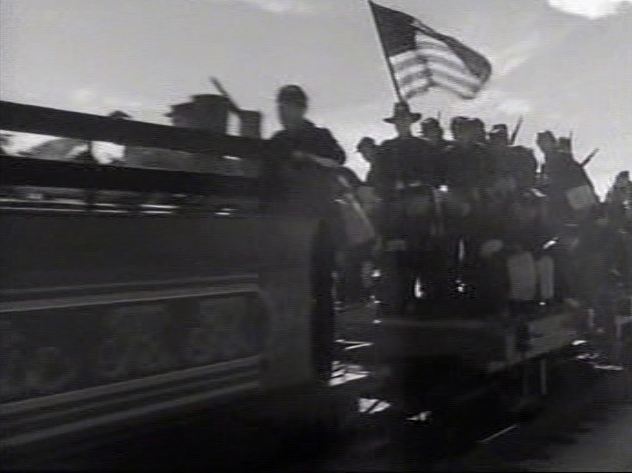
The two trains meeting nose to nose is as familiar as any image we have of 19th century America, of the West, and of the post-Civil War era when uniting North and South seemed more troublesome than uniting east and west. The throng of people climbing on the engines, the dignitaries in their top hats, the photographer and his bulky camera on a tripod to catch what everyone at the time knows is going to be the most historic event of their lives.

I first remember seeing this movie when I was quite young, perhaps as young as 8 or 9 years old, and as the movie played, tracing with my finger the route of the Union Pacific on a map of the U.S. Some place in Nebraska called Omaha to another place in Utah called Ogden, about four inches away. I sat on the floor with the coffee table as my desk. I think it was a Saturday afternoon, and I can still recall the play of afternoon sunlight, with one strong beam splashing on the map from the window behind me, so strong a light I could see the dust in the air.

I understood nothing of the history or the politics in the plot of the movie (even Ulysses S. Grant shows up at one point), but the images were easy enough for even a child to grasp. Maybe that’s what Mr. DeMille really excelled at, a simplified but still dramatic image. Most of his epics have more splash than depth, but they are eyecatching.

This post is part of our celebration of National Train Day, this Saturday May 7th. The train has an unusually iconic place not just in our history, but in classic films. This movie, throughout the jumble of carnival showmanship, imagines how important the train was to a 19th Century America with growing pains. It also shows Hollywood’s love of the train as a set, as a metaphor, and as a plot device.

It ends with a swell of patriotic music and a shot of a modern streamliner roaring past the camera.

Trains would continue to be important to America in the first half of the 20th Century, and to the movies for the first several decades of the film industry. Come back Thursday when we’ll have a look at “The Narrow Margin” (1952), which shows the other end of the romantic timeline of the train in American history and American film. It’s a sleek, modern train, faster and more elegant. There are no pioneers on this trip, even though it’s heading west to California, but there is plenty of danger, and almost all of it is on board.

And have a look here for National Train Day this coming Saturday.

Monday, May 2, 2011

A Moment of Gratitude


Our scheduled post on "Union Pacific" (1939) will be delayed for a couple days until Wednesday.  Most of you by now have heard the news of the death of the terrorist Osama Bin Laden at the hands of U.S. special forces, by order of President Obama.  For now, a moment of gratitude that there is one less monster in the world.

Thursday, April 28, 2011

National Train Day - intro


This is to announce our celebration next week of National Train Day, Saturday, May 7th.

Not an official holiday, you say? Only because I am not running the world, my friends.

Oh, there so many fun things to do on the train. You can eat at a table, with a tablecloth, with real plates and cutlery. Like a civilized person. Really.


You can mistake your berth for somebody else’s.


You can kiss somebody in the corridor.

You can watch the names of famous cities fly by in movie subtitles.


You can eat some more.


You can view this magnificent country in a way you just can’t by plane or on the interstate. To celebrate our movie connections with trains, we’ll have a look at “Union Pacific” (1939) on Monday, and “The Narrow Margin” (1952) on Thursday. The first film takes us to the beginning of the transcontinental railroad when the country was united, east and west. The second film takes us to the final years of the glamorous heyday of rail travel, in one of the most suspenseful cops and robbers movies you’ll ever see.

Have a look at this website for more information on National Train Day, and join us, all, aboa…rr…rr…dd.


Monday, April 25, 2011

Palace Theatre - Manchester, New Hampshire


The Palace Theatre of Manchester, New Hampshire was modeled after the Palace in New York City, and like that famous theater, brought vaudeville to eager audiences from its 1915 opening to about 1930, when “the talkies” replaced vaudeville as the most popular entertainment.

An elegant theater in a grand age of theater construction, the Palace boasted “air conditioning” when fans blew over large blocks of ice placed under the stage. Some of the performers who played that stage were Bob Hope, The Marx Brothers, Harry Houdini, Red Skelton, and Jimmy Durante, as well as the resident stock company The Palace Players.


Then movie era lasted until the early 1960s, and after that as with many theaters of that era, the decline began. At one point, X-rated films were shown. Then, closed to the public. In the early 1970s, the community took action, and renovations were made. The Palace opened again for live theater.

Have a look here at the website, and this season’s schedule. It takes a village to save a theater, and sometimes it really happens.

Thursday, April 21, 2011

Life with Father - 1947


Oh, GAD! It is with only a little tongue in cheek that I wish those who celebrate Easter a pleasant holiday by discussing a movie about a man who refuses to get baptized.

From the first glimpse in the stereopticon images to the opening theme swelling with a rhythm that suggests the clip-clop of trotting horses, “Life with Father” (1947) sweeps us back to a simpler time that is part history, and part parody.

One could categorize this film along with some of the others in the post-War era that seemed to soothe our raw nerves from the experiences of wartime with gentle nostalgia, a family of films that would include “I Remember Mama” (1948), “Good News” (1947), “Cheaper by the Dozen” (1950). But, “Life with Father” has its own pedigree.

The film is based on the famous stage play that, at the time, had been the longest running show on Broadway. On my New England Travels blog this week, we have a look at the Lakewood Theater in Skowhegan, Maine, where this premiered in 1939. A young Teresa Wright, before she came to Hollywood, played the role taken by Elizabeth Taylor in the film.

Like “Mama” and “Cheaper by the Dozen”, “Life with Father” began as a book. In each case, the authors wrote humorous and heartwarming reminisces about their parents. Opposite of the angst-filled, vitriolic, tell-all books popular today, it’s interesting to think that Mama, and Frank Gilbreth, and Clarence Day could be manufactured by their children into characters in American literature.

Perhaps they are not so well known characters these days, but there was a time when at least a couple of generations of readers claimed familiarity with them. Have a look at this post where we discussed popular novels turned into films.

The movie, with sets painted in those pleasing, soft colors we’ve noted in some other post-War color films, takes us back to 1883 New York City, where irascible Clarence Day, a Wall Street financier, domineers his family not so much with sternness as with overpowering confidence that his own judgment is unfailingly right.  The first glimpse we get of the great man is of his shadow on an upstairs hall landing.  It's a great entrance.

William Powell plays Mr. Day in a performance that deservedly earned him an Oscar nomination. His tolerant wife is played by Irene Dunne. These two, at the sunset of their film careers, are charming in their roles. She would earn her own Oscar nomination the following year for “I Remember Mama”.

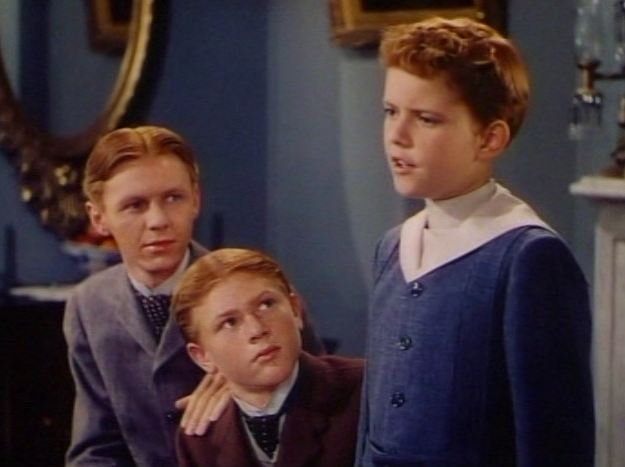
They have a family of four sons, played by Jimmy Lydon, best known for his portrayal of Henry Aldrich (“Coming, Mother!”) in a series of B-movies; a tall 15-year-old Martin Milner in his first film. We last saw Martin here in “I Want You” (1951). Johnny Calkins is next in line, and little Derek Scott plays the youngest. All the boys, like their father, are redheads. Martin Milner reportedly mused that of all the cast, he was the only natural redhead of the bunch.

Monte Blue, from silent film days, gets a brief role as the cop. Zasu Pitts, like Mr. Powell and Miss Dunne, a veteran of Hollywood’s heyday, plays a visiting cousin, but though her role is chipper and chatty, she does not get to display here her tremendous gift for slapstick comedy that we noted in this post on “Bargain of the Century” (1933). It is almost something of a shock to see her act like a regular person, and not that lovable but almost tragically obtuse comic character she created so many years before in Mack Sennett shorts. There’s something vaguely disappointing about Zasu Pitts being normal.  I miss the Olive Oyl warble in her voice, and those hysterical expressions that despite their goofiness seemed to indicate a superior knowledge of the human condition.

Miss Pitts comes to town with a young Elizabeth Taylor. With a handful of films already under her belt, Elizabeth plays her ingenue role with confidence. Much has been written lately in the aftermath of Miss Taylor’s passing about her beauty, her iconic image, and her power as an actress. I can’t refute any of that, but I would note that one scene in this film has always stood out for me, and perhaps it’s because it shows the possibility of an alternate future for Elizabeth Taylor.

I mean the scene where she and oldest boy, the Yale-bound Jimmy Lydon attempt a violin-piano duet on “Ye Servants of God”. She does not recognize the tune, though she is familiar with the words of the hymn on the sheet music. The Day family are Episcopalian, and Elizabeth confesses that she was raised a Methodist. The tune is different in the Methodist church. They make several false starts and struggle badly through the piece.

“It was my fault,” Mr. Lydon gallantly states, but Elizabeth, like a 19th Century Juliet unable to socially bond with her Victorian Romeo:

“No, you’re the Episcopalian.” She then remembers that her father had been baptized in the Episcopal church, but joined the Methodist church when he married her mother.

She was the Methodist,” Elizabeth says, as if she is calling her mother something vile, and it is a sparkling moment of deft comedy. It makes one wonder if Elizabeth Taylor could handle comedic timing so well, so young, what would her career have been like had she not also been so beautiful? Her chirpy voice is an affectation of the moment, but might she have blossomed into a less iconic leading lady, but with a larger range of roles had audiences been allowed to identify with her more and deify her less.

The question of religious affiliation drives a good part of the film, beginning with third son Johnny Calkins constantly seeking help to practice his catechism for his upcoming Confirmation. Still troubled by the “mixed marriage” of her parents, Elizabeth Taylor asks William Powell if he had been baptized Episcopalian, and Mr. Powell jovially confesses he was never baptized at all.

Irene Dunne nearly pops her corset in shock, deeply upset both by Powell’s cavalier insistence that it’s not important, and by the thought that he will not join her in heaven, that they are not really married in the eyes of the church, and that her children are quite possibly illegitimate.

Though she has taken great pains to accommodate the master of the house in all things from scaring away nervous Irish servants, to banishing her new rubber plant, to maintaining accurate household accounts (mostly), she is unrelenting about the horror of his not being baptized and insists he get the ceremony done immediately.

He insists, with what we might consider a quite modern outlook, that he will be a Christian in his own way.

“They can’t keep me out of heaven on a technicality!”

Of course, among Christians, the idea of being a Christian in one’s own way is nothing new. If this were not the case, there would never have been any Methodists or Episcopalians, Lutherans, Quakers, or Baptists, etc. Re-defining, honing perhaps, the essentials of religious practices seems to be part and parcel of what it is to be a Christian.

The movie has a lighthearted grip on this irony, as well as on the elements of Victorian society that also pit tradition versus change. In a scene where Jimmy Lydon asks his father about women, we have William Powell sitting down to tell his son the facts of life, only to sputter about wrong his mother is over her stubborn beliefs. When Lydon wants clarification on men’s relationships with women, Powell turns back into the Victorian father and sternly remarks, “Gentlemen don’t discuss such things.”

Edmund Gwenn plays the gentle minister who makes Powell squirm in his pew (which Powell informs his wife has lost property value in two years - “If the market ever goes up, I’m going to unload that pew.”), by sermonizing on the perils of not being baptized.

“I don’t go to church to be preached at as if I’m some lost sheep!” Powell blusters.

Eventually, Mr. Powell takes his troubles directly to God when Irene Dunne becomes ill. Powell, in a funny, but moving prayer, hollers at the Deity, “Have mercy, I say!” and promises to become baptized if she is spared.

She gets well. It’s time for Powell to pay up, but he still refuses, and it takes a bit more cajoling to get him to the font. It’s another humorous touch that one of the motivating factors that makes him decide to proceed with getting baptized is that the cab Irene Dunne has hired for that purpose is costing him $2 an hour just waiting outside.

One of the sweetest moments in the film is a scene of domestic bliss between Mr. Powell and Miss Dunne, when they sit together, their discussion fading off into a soft duet of “Sweet Marie”. We knew Dunne could sing, but Powell is charming. The camera pans back and we see the stillness, the orderliness of the drawing room with the only movement a slight billowing of the lacy curtains at the window, sifted by the summer breeze. It is a cameo image of the 19th Century.

Michael Curtiz directs this film with his customary economy, but moments like these make one think of Vincente Minnelli.

Another memorable moment is when Jimmy Lydon, wearing one of his father’s old cut-down suits, is unable to kneel in church, or sit with a girl on his lap, or do anything his father wouldn’t do in this suit. The suit seems to control him. When Elizabeth curls up to him, he growls helplessly, “Get up! Get up!” What bigger insult can a young lady have?

The boys try to raise money, and Jimmy Lydon offers his “piece of John Wilkes Booth’s finger” to Martin Milner.

When Irene Dunne laments the newspaper article about a wreck on the old New Haven railroad line because it would disturb Wall Street and therefore her husband: “I do wish the New Haven would stop having wrecks. If only they knew how it upset your father.”

There is, above all, the glorious, just short of scene chewing mastery of William Powell, with his pince-nez glasses on a ribbon, his colossal ranting, and his clear, helpless devotion to his wife. His flirty, “Shall I leave the room?” when Zasu Pitts wants to show Irene Dunne her purchases of intimate apparel.

The horse-drawn streetcar, the quiet country lane that once was Madison Avenue in New York City, and the stereopticon pictures. It’s a feast for the eyes.


And could be a better visual feast if only the film was restored, but it is now in public domain and has become an orphan. (Oh, GAD!)   If you’d like to see it right now, here’s a link where you can watch the whole thing, interrupted by a few commercials. It’s not the best way to see this delightful movie, but even Clarence Day couldn’t argue about the price.

Monday, April 18, 2011

Una Merkel's Roadside Tribute


This is a roadside marker from Covington, Kentucky.  Una Merkel, screen comedienne we might remember as the wisecracking best friend from "42nd Street" (1933), or the wisecracking housekeeper from "The Parent Trap" (1961), or a number of wiseacre roles in between in movies and on TV, was born here.
Nominated for an Oscar for "Summer and Smoke" (1961), she also had a handful of Broadway credits, and won a Tony Award in 1956 for "The Ponder Heart".   I have to wonder, though, if this simple sign, as earnestly detailed as possible in what space it allows, is a more glorious tribute than even the Tony.  That your hometown would care to remember you long after you'd left it, and hitched it's civic pride to your humble existence in an entertainment industry where you represent little more than a footnote, is something special indeed.

Who says historical markers are just for famous pioneers, generals, and presidents?  Get out of the car and take a picture of the family by Una Merkel's roadside marker, and take your hats off a good ol' sassy peroxide blonde.

Related Products