One of the first things people do when visiting the stars’ handprints and footprints in cement out front of the (now) Mann’s Chinese Theater is to put their own hands in those famous indentations. It is especially tempting with Clark Gable’s because his paws were so large.
“To Sid who is a great guy,” he wrote into the cement. Sid, of course, refers to showman Sid Grauman, who owned the (then) Grauman’s Chinese Theater, among others. The date was January 20, 1937, the same day President Franklin Delano Roosevelt was being sworn into his second term of office and frankly announcing, “I see one third of our nation ill-housed, ill-clad, and ill-nourished.”
It was also the same day director W. S. Van Dyke, II got to put his hands in cement at Grauman’s as well. I don’t know if there was a tie-in (Van Dyke had directed Gable a few years previously in “Manhattan Melodrama”), or if this was just the chance way the scheduling came together. “One-take Woody” directed “After the Thin Man”, which had been released the previous month, and his “Personal Property” with Jean Harlow and Robert Taylor would be released in another two months. He turned them out like clockwork.
Gable’s next picture to be released would be “Parnell” in June, which in a way dovetails us into Thursday’s St. Patrick’s Day post. It won’t be “Parnell” this time, about the 19th century Irish politician, a role for which most people agree Gable was probably not the best choice. Instead, we’ll look at another film tackling Irish politics and “The Troubles” -- “Beloved Enemy” (1936).
For more on the Chinese Theater, have a look at this website.
IMPRISON TRAITOR, PEDOPHILE, AND CONVICTED FELON TRUMP.
Monday, March 14, 2011
Thursday, March 10, 2011
Cadmium Yellow, Blood Red
This is to announce my latest novel “Cadmium Yellow, Blood Red”, available as an e-book on Amazon.com, Smashwords,and here at Barnes & Noble.
Here’s the story:
A post-World War II “cozy” mystery about a museum heist, a missing child, a murder, a recent ex-con and an even more recent widow.
In Hartford, Connecticut, 1949, Juliet Van Allen, a museum administrator, discovers that her artist husband is having an affair with another woman. Just a wee bit shocked, Juliet slips unseen back to her office to mull over her options and wish the earth would swallow her, when she meets an intruder. Elmer Vartanian, recently released from prison for a museum robbery, is coerced into helping scout the museum for a heist by a gang that has kidnapped his daughter. When her husband is found murdered, Juliet becomes the prime suspect, and Elmer is her only alibi.
Juliet, the rebellious only daughter of a wealthy financier, and Elmer, a lower-class ex-convict who has educated himself in prison, must partner to solve their separate crises. She is Elmer’s guide to a post-war world that has changed so much since he entered prison. He feels guilty for having missed his daughter’s childhood, for being safe when friends were killed in World War II, and is bewildered over atomic energy, Modern Art, ballpoint pens, and frozen orange juice concentrate.
Juliet is not sure she believes Elmer’s story. Elmer is not sure she didn’t kill her husband, yet they are compelled to work together, dogged by the scandal-monger newsman, the shrewd police detective, and scrutinized by the even more judgmental eye of Hartford’s elite in world where Modern Art meets old-fashioned murder.
The novel is offered for a limited time only at 99 cents.
However, I will offer the book free for the next month to any blogger willing to review the book (Or just give it a mention and a link. I’m not fussy.) on his/her blog. Just email me at: JacquelineTLynch@gmail.com with your blogsite url, and I will email you back with the special coupon code to download “Cadmium Yellow, Blood Red” FREE from Smashwords.com.
Note, on the Smashwords site you can download the book in any format that can be read by Kindle, Sony, Nook, any other kind of e-readers, and can also be downloaded to be read right on your computer. You do not need an e-reader.
When purchasing an ebook from Amazon, also note that you can download the Kindle program to your computer, so you can read books on your computer.
Here’s the story:
A post-World War II “cozy” mystery about a museum heist, a missing child, a murder, a recent ex-con and an even more recent widow.
In Hartford, Connecticut, 1949, Juliet Van Allen, a museum administrator, discovers that her artist husband is having an affair with another woman. Just a wee bit shocked, Juliet slips unseen back to her office to mull over her options and wish the earth would swallow her, when she meets an intruder. Elmer Vartanian, recently released from prison for a museum robbery, is coerced into helping scout the museum for a heist by a gang that has kidnapped his daughter. When her husband is found murdered, Juliet becomes the prime suspect, and Elmer is her only alibi.
Juliet, the rebellious only daughter of a wealthy financier, and Elmer, a lower-class ex-convict who has educated himself in prison, must partner to solve their separate crises. She is Elmer’s guide to a post-war world that has changed so much since he entered prison. He feels guilty for having missed his daughter’s childhood, for being safe when friends were killed in World War II, and is bewildered over atomic energy, Modern Art, ballpoint pens, and frozen orange juice concentrate.
Juliet is not sure she believes Elmer’s story. Elmer is not sure she didn’t kill her husband, yet they are compelled to work together, dogged by the scandal-monger newsman, the shrewd police detective, and scrutinized by the even more judgmental eye of Hartford’s elite in world where Modern Art meets old-fashioned murder.
The novel is offered for a limited time only at 99 cents.
However, I will offer the book free for the next month to any blogger willing to review the book (Or just give it a mention and a link. I’m not fussy.) on his/her blog. Just email me at: JacquelineTLynch@gmail.com with your blogsite url, and I will email you back with the special coupon code to download “Cadmium Yellow, Blood Red” FREE from Smashwords.com.
Note, on the Smashwords site you can download the book in any format that can be read by Kindle, Sony, Nook, any other kind of e-readers, and can also be downloaded to be read right on your computer. You do not need an e-reader.
When purchasing an ebook from Amazon, also note that you can download the Kindle program to your computer, so you can read books on your computer.
Monday, March 7, 2011
Strange Bargain - 1949
Strange Bargain (1949) is film noir stepping out of the shadows and into the living room. It’s a great example of what happens when middle America adopts a new fad, tames it, and makes it into something quick, convenient, easily digestible, and appropriate for family audiences. Noir as mainstream entertainment.
It’s not the first time we have suburban America as a scene of the crime and a haven for criminals, Alfred Hitchcock’s Shadow of a Doubt (1943) is a great example of this. Strange Bargain doesn’t have the eeriness, or the humor of Shadow, but it’s not meant to copy Hitchcock; it’s meant to cash in on a powerful new tide in moviemaking of the day.
No back alleys, no dames or molls, no whackos or mobs, or lonely car trips on deserted highways, here. Oh sure, we’re in Los Angeles, but not that Los Angeles. The movie begins innocuously with a paperboy riding his bike down a cozy suburban street, flinging the newspaper at a smiling Jeffrey Lynn, the master of the house on his sunny front porch. It looks like Andy Hardy’s neighborhood. All is right with the world. Not for long.
We quickly meet Mr. Lynn’s family at breakfast: the supportive homemaker wife played by Martha Scott who never gets to sit down and eat, the precocious son who wants a new bike but can’t have one because Pop doesn’t make enough money and they’re behind the bills.
The boy is played by Michael Chapin, whose know-it-all chatter gets on one’s nerves after about 30 seconds. Younger daughter, played by Arlene Gray, who never made a movie after this, is easier on the ears, and she gives her annoying big brother some fantastic glares.
Martha Scott tells Jeffrey Lynn he should ask the boss for a raise. When he gets up the nerve and does, he gets fired.
Jeffrey Lynn, so even-tempered in this role, comes off as an extremely passive character, but there are moments when his quiet reactions are quite moving. The first is when he asks for the raise, fingering the telephone cords on the two phones on his boss’s desk nervously, and then, sitting in a chair to hear the bad news, his shocked expression and low, hoarse “Fired?”
Here is a footnote to the character and a signpost to the era: “I’ve been with the firm 12 years. I guess I expected to spend the rest of my life here.” It’s a sentence both pitiable and enviable, from our economic perspective.
But the horrors are not over this day for our Mr. Lynn. The boss takes him for drinks after work, and we see that he did not intend to fire Mr. Lynn out of animosity or poor job performance. The company is broke. The boss is broke. But, he has a plan to help them both. The boss is played by Richard Gaines, who we last saw as the hysterical boor Mr. Pendergast in The More the Merrier. He also played an officious snob, but less comical, in The Enchanted Cottage which we reviewed here. Gaines was just as good at drama as he was at comedy, but his role is small in this film.
He dies.
Mr. Gaines’ plan, as laid out to his horror-stricken employee Jeffrey Lynn, is to kill himself for his insurance money. That will get his family out of debt and provide for his widow and high-school-aged son. Gaines asked Lynn’s help to make his suicide look like murder, so the insurance company will pay off. He offers Lynn $10,000 to do this.
Of course, Lynn refuses, but later that evening the boss calls him at home, tells him the plan is going into action. Jeffrey Lynn rushes over to the boss’s mansion to try to talk him out of it. Too late. Body on the floor. He has no choice now. He must make it look like murder or the widow and son will be left with nothing.
Here we have the film noir element of a man caught in a web of deceit and treachery which he did not devise, but to which he consented, and he must try and backpedal his way out. Except he just gets deeper and deeper.
Where we part company with more edgy film noir movies is the constant reminder Jeffery Lynn is not a stranger in a strange land; he is on home turf. He is as rooted to his suburban community as the tree in his front yard. He is not alienated from society; he is society. I like the mention of his kids going to the neighbors’, who have a TV, to watch wrestler and early TV superstar Gorgeous George. It’s also a cute bit when the daughter, lying on the living room rug, playing with her movie star trading cards, “I traded Cary Grant to Mary for a Dick Powell and Jane Greer. Gee, I hope I didn’t make a mistake.”
Meanwhile, the boy kneels in front of his dad’s chair, reading the back side of his dad’s newspaper. I remember doing that. Young Michael is fascinated by murder and delights in the thought of the police giving the murderer, “a one-way ticket to the gas chamber.”
His wife and his know-it-all boy play a Greek chorus, innocently haunting Lynn about how terrible the event is, and how the famous police detective will hunt down suspects and find the truth. (Later she passes a kinder judgment on her husband, “You’re a man and men are always making mistakes.” And then to soften the blow, adds, “Even women make them, sometimes.” Quite a concession on her part; that’s not something we women usually let on.)
Jeffrey Lynn’s expression of horror has long since turned to one of sickening dread. It’s a race to see if he can keep from falling completely apart before the end of the movie. Every sound, every passing headlight makes him flinch. The cat jumping off a shelf just about gives him a heart attack. Grimly, he wipes the blood off his hat brim, his steering wheel, his hands.
The famed, dogged police detective is played by Harry Morgan, and in a coincidence that has to make anybody smile, is named Lt. Webb.
We are not-too-subtly set up from the beginning of the movie that Lynn is falling into the no-way-out of most noir films, but gradually the film turns a different direction and becomes a traditional mystery. This occurs from clues we are allowed to discover partly through Harry Morgan’s interviews with everybody who is associated with the deceased, and party through Jeffery Lynn’s own open and sympathetic personality that makes everybody come to him with their concerns.
He becomes a surrogate father figure to the boss’s son, who has a piece of information he withheld from the police. The widow wants Lynn to run the firm, even though he is only an assistant bookkeeper, because she distrusts the boss’s business partner. The business partner also latches on to Mr. Lynn and offers him a promotion.
We discover hidden motives, and lies, and most importantly…and most surprisingly…we discover it wasn’t suicide. The boss really was murdered.
Jeffery Lynn, despite his passive demeanor, is a noble, staunch Samaritan in his sympathy and his unwillingness to finger any of the usual suspects. He worries about everybody, even though he is suspect number one.
We slide back into the realm of traditional noir with the traditional flashback telling the solution.
But the solution didn’t stick, evidently. Some of you Murder She Wrote fans will remember the episode from 1987 called “The Days Dwindle Down” where Jessica Fletcher solves a continuation of this case. Among the notable guest stars in this episode were Jeffrey Lynn, Martha Scott, and Harry Morgan reprising their roles from 38 years previously. Like true film noir, the flashbacks, and the trouble, never ends.
It’s not the first time we have suburban America as a scene of the crime and a haven for criminals, Alfred Hitchcock’s Shadow of a Doubt (1943) is a great example of this. Strange Bargain doesn’t have the eeriness, or the humor of Shadow, but it’s not meant to copy Hitchcock; it’s meant to cash in on a powerful new tide in moviemaking of the day.
No back alleys, no dames or molls, no whackos or mobs, or lonely car trips on deserted highways, here. Oh sure, we’re in Los Angeles, but not that Los Angeles. The movie begins innocuously with a paperboy riding his bike down a cozy suburban street, flinging the newspaper at a smiling Jeffrey Lynn, the master of the house on his sunny front porch. It looks like Andy Hardy’s neighborhood. All is right with the world. Not for long.
We quickly meet Mr. Lynn’s family at breakfast: the supportive homemaker wife played by Martha Scott who never gets to sit down and eat, the precocious son who wants a new bike but can’t have one because Pop doesn’t make enough money and they’re behind the bills.
The boy is played by Michael Chapin, whose know-it-all chatter gets on one’s nerves after about 30 seconds. Younger daughter, played by Arlene Gray, who never made a movie after this, is easier on the ears, and she gives her annoying big brother some fantastic glares.
Martha Scott tells Jeffrey Lynn he should ask the boss for a raise. When he gets up the nerve and does, he gets fired.
Jeffrey Lynn, so even-tempered in this role, comes off as an extremely passive character, but there are moments when his quiet reactions are quite moving. The first is when he asks for the raise, fingering the telephone cords on the two phones on his boss’s desk nervously, and then, sitting in a chair to hear the bad news, his shocked expression and low, hoarse “Fired?”
Here is a footnote to the character and a signpost to the era: “I’ve been with the firm 12 years. I guess I expected to spend the rest of my life here.” It’s a sentence both pitiable and enviable, from our economic perspective.
But the horrors are not over this day for our Mr. Lynn. The boss takes him for drinks after work, and we see that he did not intend to fire Mr. Lynn out of animosity or poor job performance. The company is broke. The boss is broke. But, he has a plan to help them both. The boss is played by Richard Gaines, who we last saw as the hysterical boor Mr. Pendergast in The More the Merrier. He also played an officious snob, but less comical, in The Enchanted Cottage which we reviewed here. Gaines was just as good at drama as he was at comedy, but his role is small in this film.
He dies.
Mr. Gaines’ plan, as laid out to his horror-stricken employee Jeffrey Lynn, is to kill himself for his insurance money. That will get his family out of debt and provide for his widow and high-school-aged son. Gaines asked Lynn’s help to make his suicide look like murder, so the insurance company will pay off. He offers Lynn $10,000 to do this.
Of course, Lynn refuses, but later that evening the boss calls him at home, tells him the plan is going into action. Jeffrey Lynn rushes over to the boss’s mansion to try to talk him out of it. Too late. Body on the floor. He has no choice now. He must make it look like murder or the widow and son will be left with nothing.
Here we have the film noir element of a man caught in a web of deceit and treachery which he did not devise, but to which he consented, and he must try and backpedal his way out. Except he just gets deeper and deeper.
Where we part company with more edgy film noir movies is the constant reminder Jeffery Lynn is not a stranger in a strange land; he is on home turf. He is as rooted to his suburban community as the tree in his front yard. He is not alienated from society; he is society. I like the mention of his kids going to the neighbors’, who have a TV, to watch wrestler and early TV superstar Gorgeous George. It’s also a cute bit when the daughter, lying on the living room rug, playing with her movie star trading cards, “I traded Cary Grant to Mary for a Dick Powell and Jane Greer. Gee, I hope I didn’t make a mistake.”
Meanwhile, the boy kneels in front of his dad’s chair, reading the back side of his dad’s newspaper. I remember doing that. Young Michael is fascinated by murder and delights in the thought of the police giving the murderer, “a one-way ticket to the gas chamber.”
His wife and his know-it-all boy play a Greek chorus, innocently haunting Lynn about how terrible the event is, and how the famous police detective will hunt down suspects and find the truth. (Later she passes a kinder judgment on her husband, “You’re a man and men are always making mistakes.” And then to soften the blow, adds, “Even women make them, sometimes.” Quite a concession on her part; that’s not something we women usually let on.)
Jeffrey Lynn’s expression of horror has long since turned to one of sickening dread. It’s a race to see if he can keep from falling completely apart before the end of the movie. Every sound, every passing headlight makes him flinch. The cat jumping off a shelf just about gives him a heart attack. Grimly, he wipes the blood off his hat brim, his steering wheel, his hands.
The famed, dogged police detective is played by Harry Morgan, and in a coincidence that has to make anybody smile, is named Lt. Webb.
We are not-too-subtly set up from the beginning of the movie that Lynn is falling into the no-way-out of most noir films, but gradually the film turns a different direction and becomes a traditional mystery. This occurs from clues we are allowed to discover partly through Harry Morgan’s interviews with everybody who is associated with the deceased, and party through Jeffery Lynn’s own open and sympathetic personality that makes everybody come to him with their concerns.
He becomes a surrogate father figure to the boss’s son, who has a piece of information he withheld from the police. The widow wants Lynn to run the firm, even though he is only an assistant bookkeeper, because she distrusts the boss’s business partner. The business partner also latches on to Mr. Lynn and offers him a promotion.
We discover hidden motives, and lies, and most importantly…and most surprisingly…we discover it wasn’t suicide. The boss really was murdered.
Jeffery Lynn, despite his passive demeanor, is a noble, staunch Samaritan in his sympathy and his unwillingness to finger any of the usual suspects. He worries about everybody, even though he is suspect number one.
We slide back into the realm of traditional noir with the traditional flashback telling the solution.
But the solution didn’t stick, evidently. Some of you Murder She Wrote fans will remember the episode from 1987 called “The Days Dwindle Down” where Jessica Fletcher solves a continuation of this case. Among the notable guest stars in this episode were Jeffrey Lynn, Martha Scott, and Harry Morgan reprising their roles from 38 years previously. Like true film noir, the flashbacks, and the trouble, never ends.
********************
Jacqueline T. Lynch is the author of Ann Blyth: Actress. Singer. Star. and Memories in Our Time - Hollywood Mirrors and Mimics the Twentieth Century. Her newspaper column on classic films, Silver Screen, Golden Memories is syndicated nationally. Her new book, a collection of posts from this blog - Hollywood Fights Fascism - is available here on Amazon.
Thursday, March 3, 2011
Fourth Anniversary
Just a brief note to mark (tomorrow) the fourth anniversary of Another Old Movie Blog. Thank you for reading, and for commenting.
What amazes me about the past four years of blogging on old movies is not how many films we’ve discussed, but how many films, and actors and actresses I have either given only slight mention to, or have yet to mention at all. There are always films I mean to get to and haven’t, and it is, I suppose, some comfort that I’ll never run out of topics. I know I’ll never get tired of it.
The community of classic film bloggers is an especially enriching association of which I was ignorant when I began blogging. I’ve learned so much from reading other old movie blogs. I find myself these days, when watching a film, wondering what the other bloggers would think about it.
Thanks for having the patience to endure what I think about it.
What amazes me about the past four years of blogging on old movies is not how many films we’ve discussed, but how many films, and actors and actresses I have either given only slight mention to, or have yet to mention at all. There are always films I mean to get to and haven’t, and it is, I suppose, some comfort that I’ll never run out of topics. I know I’ll never get tired of it.
The community of classic film bloggers is an especially enriching association of which I was ignorant when I began blogging. I’ve learned so much from reading other old movie blogs. I find myself these days, when watching a film, wondering what the other bloggers would think about it.
Thanks for having the patience to endure what I think about it.
Monday, February 28, 2011
Deception - 1946
“Deception” (1946) has a melodramatic plot of unexpected twists, and is guided by the very strong characterizations of the three principle figures. Mood and atmosphere play an equal hand in the telling of the story, and may be the most fun thing about it.
Rest easy, no plot spoilers this time. There’s not much to pluck apart when it’s all handed to us with grandiose panache on a platter.
Bette Davis discovers her long-lost lover, played by Paul Henreid, in a small university concert hall in New York City where he is featured playing the cello. They had been music students together years before in Europe, but were separated during the war. She thought he had died, and their reunion is a joyous miracle. She takes him to her loft apartment, tells him to make himself at home, literally by making closet space for him. We are made to understand they want to take up where they left off many years ago, and be married as soon as possible.
Perhaps the censors were distracted from her plain insistence they live together until such a time as their troths are plighted by Mr. Henreid’s sudden baffled curiosity as he notes her stylish apartment, her furs in the closet, the sculpture and artwork. A grand piano. She has lamented that she is still a struggling musician, but this opulence clearly indicates to him she is being kept by someone.
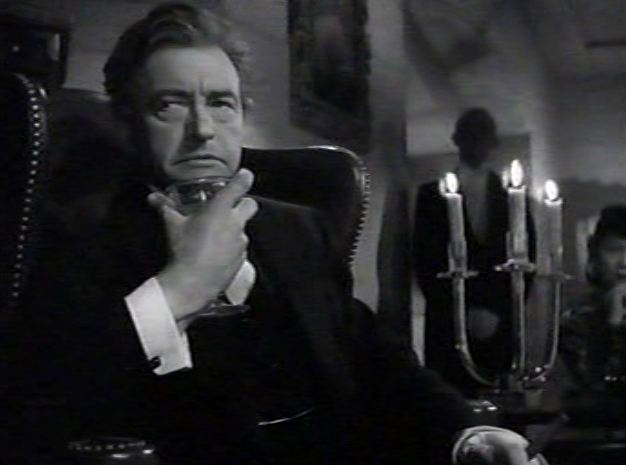
That someone is Claude Rains, a composer and conductor, a maestro of larger than life appetites, a mercurial temperament, and formidable arrogance. Bette spends the rest of the movie telling lies, and surfing the moods of two very jealous men, until her best motives bring about disastrous events.
Does it seem that the immediate post-War period led Hollywood on a rather moody exploration of the sinister possibilities of the arts? In the same year as this film, 1946, we have “Humoresque” with Joan Crawford and John Garfield, and in the next year we have “Night Song” with Dana Andrews, “Song of Love” with Katharine Hepburn, and we were taken out of the concert hall and into world of ballet with “The Unfinished Dance” and in 1948, “The Red Shoes.” The backwash of the war seemed to have us convinced there was no safety even in a quieter world among man’s most creative endeavors.
“Deception” provides a wealth of great music, including Wagner, Schubert, Haydn, and Beethoven. One of the luxuries of the film is that the classical music gets a long, leisurely treatment. Bette Davis plays Beethoven’s “Appassionata” piano sonata in one telling scene that sets up the jealously of the two men in her life, and provides a glimpse into a world where music is not staid or the dominion of polite elite society, but rather a bare, passionate expression of human greatness, and weakness, and pleasure, and torture.
I like the way she is reflected in the shiny piano lid as she plays. And the way the men grip their champagne glasses while listening to her, as if they were strangling someone’s throat.
The characters display a passion for their work, a passion for life, and also for revenge.
But not all the music in this movie is so grand. Curiously, as Bette is walking Paul Henreid to her apartment for the first time, they cross a city street where a Salvation Army band is thumping out “What a Friend We Have in Jesus”, and in another scene, she listens to a cheesy radio commercial jingle. What director Irving Rapper meant to suggest with these bits is a mystery to me, except to keep things off kilter, which is the engine of suspense.
The dialogue is crisp, witty, and with innumerable flourishes by Claude Rains. He is matchless in this film, his intellectual bullying, his mind games, his petulance are something magnificent. He doesn’t steal scenes so much as always commands any scene he is in. It’s his movie.
A few interesting scenes: When he takes them out to dinner and makes a grand production ordering the food, irritating them both and putting Paul Henreid, who is to audition for him after dinner, extremely on edge. One of the more delightfully over-the-top remarks by Mr. Rains when he orders, “A nice brook trout, not too large, from a good stream.”
Another off-kilter scene is when Miss Davis goes to his home to have it out with him, and he lies in bed reading the Sunday funnies. This man who dismisses everything as not his equal, evidently has time for Dick Tracy and Terry and the Pirates.
We have scenes of disguised threats and vengeful accusations, of suspicions declared, and self indulgent tantrums that takes us smoothly from concert hall to Rains’ uptown mansion, to cab rides in the rain, and many times returning to Bette Davis’ loft studio apartment.
The apartment is my favorite thing in this film, almost like another character in the movie, with its modern furniture and sparse elegance, and the enormous window that seems to carve out a great big chunk of the gray city with its buildings and bridges, and plunks it right down in her living room.
We get to look out that window at night, in the morning, and follow the traces of raindrops that make a design around the heads of Bette Davis and Paul Henreid.
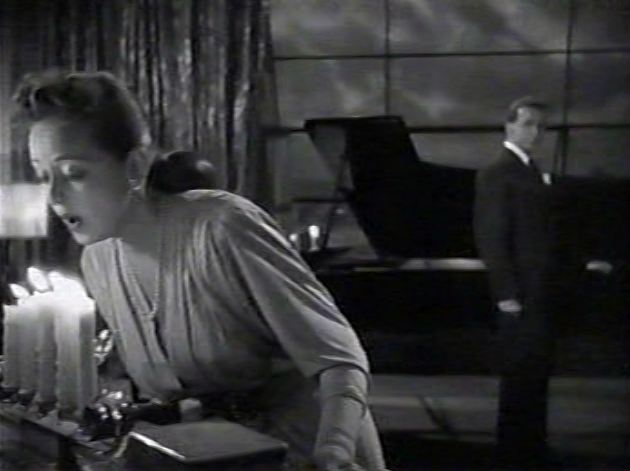
A scene where she blows out several candles placed around her apartment while keeping up the fancy footwork of defensive conversation with Paul Henreid in between blowing out another candle.
A scene where she and Henreid talk to each other from opposite ends of a hallway leading to the bathroom, where she primps before the mirror, and we can hear the hollow echo of her voice bouncing off the cement block walls.
The apartment seems to be neither a haven nor a cage, but a statement on the price one has to pay to make dreams come true.
Rest easy, no plot spoilers this time. There’s not much to pluck apart when it’s all handed to us with grandiose panache on a platter.
Bette Davis discovers her long-lost lover, played by Paul Henreid, in a small university concert hall in New York City where he is featured playing the cello. They had been music students together years before in Europe, but were separated during the war. She thought he had died, and their reunion is a joyous miracle. She takes him to her loft apartment, tells him to make himself at home, literally by making closet space for him. We are made to understand they want to take up where they left off many years ago, and be married as soon as possible.
Perhaps the censors were distracted from her plain insistence they live together until such a time as their troths are plighted by Mr. Henreid’s sudden baffled curiosity as he notes her stylish apartment, her furs in the closet, the sculpture and artwork. A grand piano. She has lamented that she is still a struggling musician, but this opulence clearly indicates to him she is being kept by someone.
That someone is Claude Rains, a composer and conductor, a maestro of larger than life appetites, a mercurial temperament, and formidable arrogance. Bette spends the rest of the movie telling lies, and surfing the moods of two very jealous men, until her best motives bring about disastrous events.
Does it seem that the immediate post-War period led Hollywood on a rather moody exploration of the sinister possibilities of the arts? In the same year as this film, 1946, we have “Humoresque” with Joan Crawford and John Garfield, and in the next year we have “Night Song” with Dana Andrews, “Song of Love” with Katharine Hepburn, and we were taken out of the concert hall and into world of ballet with “The Unfinished Dance” and in 1948, “The Red Shoes.” The backwash of the war seemed to have us convinced there was no safety even in a quieter world among man’s most creative endeavors.
“Deception” provides a wealth of great music, including Wagner, Schubert, Haydn, and Beethoven. One of the luxuries of the film is that the classical music gets a long, leisurely treatment. Bette Davis plays Beethoven’s “Appassionata” piano sonata in one telling scene that sets up the jealously of the two men in her life, and provides a glimpse into a world where music is not staid or the dominion of polite elite society, but rather a bare, passionate expression of human greatness, and weakness, and pleasure, and torture.
I like the way she is reflected in the shiny piano lid as she plays. And the way the men grip their champagne glasses while listening to her, as if they were strangling someone’s throat.
The characters display a passion for their work, a passion for life, and also for revenge.
But not all the music in this movie is so grand. Curiously, as Bette is walking Paul Henreid to her apartment for the first time, they cross a city street where a Salvation Army band is thumping out “What a Friend We Have in Jesus”, and in another scene, she listens to a cheesy radio commercial jingle. What director Irving Rapper meant to suggest with these bits is a mystery to me, except to keep things off kilter, which is the engine of suspense.
The dialogue is crisp, witty, and with innumerable flourishes by Claude Rains. He is matchless in this film, his intellectual bullying, his mind games, his petulance are something magnificent. He doesn’t steal scenes so much as always commands any scene he is in. It’s his movie.
A few interesting scenes: When he takes them out to dinner and makes a grand production ordering the food, irritating them both and putting Paul Henreid, who is to audition for him after dinner, extremely on edge. One of the more delightfully over-the-top remarks by Mr. Rains when he orders, “A nice brook trout, not too large, from a good stream.”
Another off-kilter scene is when Miss Davis goes to his home to have it out with him, and he lies in bed reading the Sunday funnies. This man who dismisses everything as not his equal, evidently has time for Dick Tracy and Terry and the Pirates.
We have scenes of disguised threats and vengeful accusations, of suspicions declared, and self indulgent tantrums that takes us smoothly from concert hall to Rains’ uptown mansion, to cab rides in the rain, and many times returning to Bette Davis’ loft studio apartment.
The apartment is my favorite thing in this film, almost like another character in the movie, with its modern furniture and sparse elegance, and the enormous window that seems to carve out a great big chunk of the gray city with its buildings and bridges, and plunks it right down in her living room.
We get to look out that window at night, in the morning, and follow the traces of raindrops that make a design around the heads of Bette Davis and Paul Henreid.
A scene where she blows out several candles placed around her apartment while keeping up the fancy footwork of defensive conversation with Paul Henreid in between blowing out another candle.
A scene where she and Henreid talk to each other from opposite ends of a hallway leading to the bathroom, where she primps before the mirror, and we can hear the hollow echo of her voice bouncing off the cement block walls.
The apartment seems to be neither a haven nor a cage, but a statement on the price one has to pay to make dreams come true.
Thursday, February 24, 2011
The Bargain of the Century - 1933
“The Bargain of the Century” (1933) is one of a series of Hal Roach shorts featuring Zasu Pitts and Thelma Todd, surely one of the most endearing comedy teams Hollywood ever produced. They were “Laverne & Shirley” before there was a Laverne & Shirley, but they also were equal parts Laurel & Hardy, and some sweetness all their own that went beyond mere clownish self protection in a rough world.
Charley Chase, whose comedic talent as an actor and writer gives him a slapstick slant as director for this short film, which begins with a car chase. Zasu and Thelma -- they played themselves -- are rushing to get to a department store sale, and they knock over a traffic cop in their Model A in the process. A motorcycle cop gives chase -- through city streets, over trolley tracks, loses them when they drive down what appears to be a subway entrance below the sidewalk and finally catches up to them with a sarcastic,
“Pardon me, but could you spare me a moment of your time?”
The ladies get out of the car, Thelma half dragged by the cop played by James Burtis, and attempt to explain, flatter, and flirt their way out of a ticket. Thelma Todd, a beautiful, and typical platinum blonde of the era, is the more street savvy of the two. Zasu Pitts, while not exactly a dummy, is more naïve and passive, which makes it funny that Thelma is always urging Zasu to do the flirting so that she herself can make with the fast talk.
Zasu, whose on-the-surface expressions of worry, befuddlement, and wonder, as well as the warble in her voice and her repetitious “oh, dear!” will probably instantly remind you of Olive Oyl. There’s a reason for that. Mae Questel, the originator of Olive Oyl’s distinctive voice, was imitating Zasu Pitts.
Flirting is a tough chore for the well-meaning but socially inept Zasu, however she’s a game girl and does her job as best she can, with hilarious results. In real life, Miss Todd was about 12 years her junior, but in this series, the girls are shown as being contemporaries with Thelma Todd taking a protective manner over Zasu. To be sure, they are always there for each other.
They worm their way into the cop’s good graces when Thelma tells him Zasu is the daughter of the police superintendent. They were driving like maniacs because they desperately need to get to a department store sale to buy three sets of bed sheets. But, since the 67 cent-sheets are only one to a customer, the cop agrees to go along and by the third set for them.
Yes, he’s not that bright, but he’s a good egg.
The opening of the store reminds one of those horror stories of Wal-Mart opening early on Black Friday, with crowds trampling people to get in first. Fortunately, the only one trampled here is the store manager, so that’s okay. A couple of interns with a stretcher scoop him up.
There is some rib-tickling, punching, and close-quarter contact to wrestle the sheets from other customers -- and a cute spot where Zasu ends up cuddling a chubby fellow in an effort to reach around him, and he gives her his phone number:
“MEtropolitan4000, and ask for Elmer”.
But, the charade is over when the real police lieutenant shows up, and the cop is fired. In the interrogation, poor Zasu keeps getting referred to as a “palooka”.
The girls feel badly for causing the cop to lose his job. And, as they do pretty much in all their shorts, they turn their energies to helping those less fortunate. They take him into their home. When they trudge home from work, he is there in an apron, like a houseman, not a very good houseman, but somebody who earnestly tries to pay his way. He sets up a series of Rube Goldberg-type alarms to ward off intruders, because after all, they are girls living alone. A siren screams when they open their door. A Morris chair is rigged to dump a person on his head.
In the funniest gag, Thelma opens the closet door, and a boxing glove mounted on the end of an extending scissors arm belts her in the side of the head. Yes, it’s crude, but the unexpected cartoonishness is a hoot.
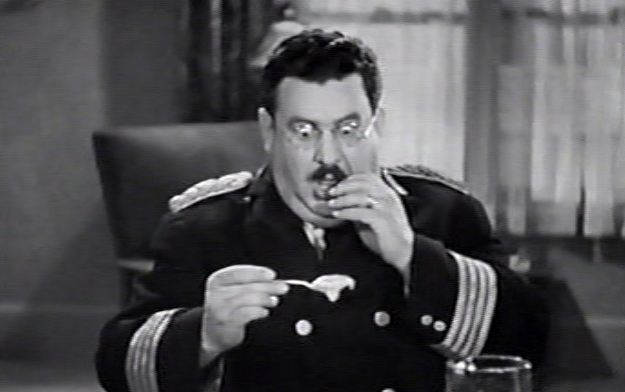
But, the cop is not a reliable cook, for all his inventiveness, and Zasu is sent to fetch some grub from the deli downstairs. Here she meets Billy Gilbert, dressed in a sea captain’s uniform.
Billy, eating a banana at the time, of course, tosses the banana peel on the ground, and Zasu takes a spectacular fall. Of the two ladies, Zasu appears to be the more athletic, and though she was something like 39 years old when this film was made, demonstrates the suppleness, though not the grace, of a 14-year-old Romanian gymnast.
Billy carries her back to the apartment. Since she thinks he is not a sea captain, but a police captain, she and Thelma hope to butter him up to get their cop friend his job back. Billy is invited to join them for ice cream.
But, since this is 1933, nobody heads for Ben & Jerry’s at the store -- Zasu is sent to the kitchen to make some. Meanwhile, the ex-cop, trying to entertain the guest, pulls the old “pretending to destroy the watch” trick, while the Billy Gilbert’s real watch gets mistakenly ground up by Zasu in the ice cream maker. They end up pulling bits of watch works out of their mouths with each spoonful of vanilla.
Billy throws one of his patented fits and practically destroys the place, and they put the cop’s inventions to use to subdue him. The police arrive and the cop gets his old job back because Billy Gilbert is not just a sea captain, he is a wanted smuggler.
Though the ladies are backed up with all the elements of a Hal Roach production, and reliable character actors like Billy Gilbert, the charm of the duo is really their equal support of each other and their fellow man. Others got through the Depression with high adventure and sophisticated wit. These girls just stumble along until payday. For all the contrived boxing glove devices coming out of closets, this single motive makes them far more realistic than the grittiest Warner Bros. gangster movie.
Charley Chase, whose comedic talent as an actor and writer gives him a slapstick slant as director for this short film, which begins with a car chase. Zasu and Thelma -- they played themselves -- are rushing to get to a department store sale, and they knock over a traffic cop in their Model A in the process. A motorcycle cop gives chase -- through city streets, over trolley tracks, loses them when they drive down what appears to be a subway entrance below the sidewalk and finally catches up to them with a sarcastic,
“Pardon me, but could you spare me a moment of your time?”
The ladies get out of the car, Thelma half dragged by the cop played by James Burtis, and attempt to explain, flatter, and flirt their way out of a ticket. Thelma Todd, a beautiful, and typical platinum blonde of the era, is the more street savvy of the two. Zasu Pitts, while not exactly a dummy, is more naïve and passive, which makes it funny that Thelma is always urging Zasu to do the flirting so that she herself can make with the fast talk.
Zasu, whose on-the-surface expressions of worry, befuddlement, and wonder, as well as the warble in her voice and her repetitious “oh, dear!” will probably instantly remind you of Olive Oyl. There’s a reason for that. Mae Questel, the originator of Olive Oyl’s distinctive voice, was imitating Zasu Pitts.
Flirting is a tough chore for the well-meaning but socially inept Zasu, however she’s a game girl and does her job as best she can, with hilarious results. In real life, Miss Todd was about 12 years her junior, but in this series, the girls are shown as being contemporaries with Thelma Todd taking a protective manner over Zasu. To be sure, they are always there for each other.
They worm their way into the cop’s good graces when Thelma tells him Zasu is the daughter of the police superintendent. They were driving like maniacs because they desperately need to get to a department store sale to buy three sets of bed sheets. But, since the 67 cent-sheets are only one to a customer, the cop agrees to go along and by the third set for them.
Yes, he’s not that bright, but he’s a good egg.
The opening of the store reminds one of those horror stories of Wal-Mart opening early on Black Friday, with crowds trampling people to get in first. Fortunately, the only one trampled here is the store manager, so that’s okay. A couple of interns with a stretcher scoop him up.
There is some rib-tickling, punching, and close-quarter contact to wrestle the sheets from other customers -- and a cute spot where Zasu ends up cuddling a chubby fellow in an effort to reach around him, and he gives her his phone number:
“MEtropolitan4000, and ask for Elmer”.
But, the charade is over when the real police lieutenant shows up, and the cop is fired. In the interrogation, poor Zasu keeps getting referred to as a “palooka”.
The girls feel badly for causing the cop to lose his job. And, as they do pretty much in all their shorts, they turn their energies to helping those less fortunate. They take him into their home. When they trudge home from work, he is there in an apron, like a houseman, not a very good houseman, but somebody who earnestly tries to pay his way. He sets up a series of Rube Goldberg-type alarms to ward off intruders, because after all, they are girls living alone. A siren screams when they open their door. A Morris chair is rigged to dump a person on his head.
But, the cop is not a reliable cook, for all his inventiveness, and Zasu is sent to fetch some grub from the deli downstairs. Here she meets Billy Gilbert, dressed in a sea captain’s uniform.
Billy, eating a banana at the time, of course, tosses the banana peel on the ground, and Zasu takes a spectacular fall. Of the two ladies, Zasu appears to be the more athletic, and though she was something like 39 years old when this film was made, demonstrates the suppleness, though not the grace, of a 14-year-old Romanian gymnast.
Billy carries her back to the apartment. Since she thinks he is not a sea captain, but a police captain, she and Thelma hope to butter him up to get their cop friend his job back. Billy is invited to join them for ice cream.
But, since this is 1933, nobody heads for Ben & Jerry’s at the store -- Zasu is sent to the kitchen to make some. Meanwhile, the ex-cop, trying to entertain the guest, pulls the old “pretending to destroy the watch” trick, while the Billy Gilbert’s real watch gets mistakenly ground up by Zasu in the ice cream maker. They end up pulling bits of watch works out of their mouths with each spoonful of vanilla.
Though the ladies are backed up with all the elements of a Hal Roach production, and reliable character actors like Billy Gilbert, the charm of the duo is really their equal support of each other and their fellow man. Others got through the Depression with high adventure and sophisticated wit. These girls just stumble along until payday. For all the contrived boxing glove devices coming out of closets, this single motive makes them far more realistic than the grittiest Warner Bros. gangster movie.
Monday, February 21, 2011
Happy Presidents Day
Happy Presidents Day, for those of us in the U.S. Happy retail sales. Happy day off.
Others are more reverent. Here, Connie Milligan, clearly a Lincoln groupie, celebrates her favorite Commander-in-Chief all year long with a modest shrine. Below. Fred, Majorie, and a resentful Bing, pay homage to One Number in a pastiche of Washington clichés and American history via Irving Berlin.
(Remember to scroll down to the bottom of the page to mute the music so you can hear the video.)
Others are more reverent. Here, Connie Milligan, clearly a Lincoln groupie, celebrates her favorite Commander-in-Chief all year long with a modest shrine. Below. Fred, Majorie, and a resentful Bing, pay homage to One Number in a pastiche of Washington clichés and American history via Irving Berlin.
(Remember to scroll down to the bottom of the page to mute the music so you can hear the video.)
Thursday, February 17, 2011
February is Children's Dental Health Month
February is National Children’s Dental Health Month. Most small children have some idea of what the tooth fairy looks like, but most would be wrong. She looks like this:
Jane Wyman in an off-the-shoulder evening gown with white opera gloves, wearing diamond earrings and a choker necklace. Simple, but elegant. Grabbing your teeth right out of your head, in this case Beverly Washburn's head.
It is important to encourage proper tooth brushing and oral hygiene among children, who may not understand how vital this is to their general health. Many Hollywood stars brush their teeth.
Here, Gary Cooper demonstrates his own special technique, which he devised to reach those tough spots right in the front teeth and gums. Notice how his left hand is cupped to hold the tooth powder. Tooth powder was discontinued because it too closely resembled cocaine, which caused much embarrassment at debauched Hollywood parties.
Here, Bette Davis shows us how to carefully lean low over the sink so as not to splurt spit and dribbling flecks of toothpaste onto her blouse. This is most useful if you happen to brush your teeth at work, or in between courses at elegant restaurants.
Jean Arthur, whose craving for the taste of peppermint led to an unfortunate toothpaste addiction, and was known to just stand there all day brushing her teeth, nevertheless shows that even a bad habit can lead to good oral hygiene.
Celebrate Children’s Dental Health Month with a new toothbrush and brush your teeth like the movie stars do. If you do not, Jane Wyman will come to your home and yank your rotten teeth out with her nimble gloved fingers.
This has been a public service announcement from Another Old Movie Blog -- “Serving your old movie and dental health needs since 2007”.
Jane Wyman in an off-the-shoulder evening gown with white opera gloves, wearing diamond earrings and a choker necklace. Simple, but elegant. Grabbing your teeth right out of your head, in this case Beverly Washburn's head.
It is important to encourage proper tooth brushing and oral hygiene among children, who may not understand how vital this is to their general health. Many Hollywood stars brush their teeth.
Here, Gary Cooper demonstrates his own special technique, which he devised to reach those tough spots right in the front teeth and gums. Notice how his left hand is cupped to hold the tooth powder. Tooth powder was discontinued because it too closely resembled cocaine, which caused much embarrassment at debauched Hollywood parties.
Here, Bette Davis shows us how to carefully lean low over the sink so as not to splurt spit and dribbling flecks of toothpaste onto her blouse. This is most useful if you happen to brush your teeth at work, or in between courses at elegant restaurants.
Jean Arthur, whose craving for the taste of peppermint led to an unfortunate toothpaste addiction, and was known to just stand there all day brushing her teeth, nevertheless shows that even a bad habit can lead to good oral hygiene.
Celebrate Children’s Dental Health Month with a new toothbrush and brush your teeth like the movie stars do. If you do not, Jane Wyman will come to your home and yank your rotten teeth out with her nimble gloved fingers.
This has been a public service announcement from Another Old Movie Blog -- “Serving your old movie and dental health needs since 2007”.
Monday, February 14, 2011
The Prowler - 1951 - Film Noir Blogathon
We have come to expect certain stylistic attributes in film noir, though film buffs often argue about whether a particular film belongs in this category. “The Prowler” takes this genre, but seems to step just a little beyond it by carving out its own world, and playing by its own rules, just as the main character does, played by Van Heflin.
Van Heflin is a marvel in this film. He plays a man capable of being both a lowlife, and yet one who captures our fascination, perhaps even our admiration for his dogged grasping at his idealized goals, and certainly at times, our pity for his helpless bungling of his life based on his miserable inability to understand that integrity would save him in a way purchasing or stealing respect, or killing for it, cannot.
The movie plays out as an intriguing puzzle where layer upon layer peels away until we at last see the characters as bare and raw in the harsh glare of the desert landscape of their final showdown. Being film noir, the movie appropriately begins by putting the characters and us, in the dark…in Southern California, probably Los Angeles, at a Spanish-style home in a wealthy neighborhood in the wee hours of the night.
Evelyn Keyes is the wife whose husband works as a nighttime DJ. Home alone, she emerges from her bath to discover a peeping tom at her window. Two cops respond to her call, one older, genial, who tells her to pull her window shade down when she’s bathing. Duh.
The other is younger, somewhat bored, with smirking arrogance, played by Van Heflin. After his shift is over, he returns to her home by himself, just to follow-up, he says. But we see very quickly his nervy attitude as he makes himself at home, and we piece together, though it is never said in the film, that he was the peeping tom. She has no idea. Instantly this breaks the Code rule that police should not be shown in a disrespectful light. Bullying cops or crooked cops are one thing, but a cop pervert is more evil. What is amazing is how we gradually learn more about him so that he does not seem like such a danger, even when he is.
Evelyn Keyes is quick to invite him to stay, but though we may think her foolish, there is such subtlety to her performance that she walks a fine line between being a naïve victim and a woman simply going after what she wants.
She responds to his intrusive questions and insinuating conversation with the haughty defense that she is happily married, and we see she devotedly listens to her husband’s radio program at night. Her name is Susan, and he signs off with his trademark, “I’ll be seeing you, Susan.”
While her husband spins his 78’s, whatever alarm bells she may feel at the cocky cop’s leering attitude seem to dissipate instantly when they discover the coincidence of their both growing up in Terra Haute, Indiana, where he was the star of the rival high school’s basketball team. This is the only accidental device used in the film, and their winsome dual reminiscence of high school days is so genuine, it does not seem as contrived as it is.
It also lays the groundwork for his character. He was a gifted athlete, but lazy and not a team player. Because of his unwillingness to put himself out or work with others, he is bounced off the roster and loses his college scholarship. He laments this as a raw deal done to him, taking from him the eventual cushy high-paying job that he thinks a college degree would have given him. He came to California, (though we are not told how or why) and fell into a job on the police force, which he dismisses with disgust, though we might also believe he must have felt the uniform, and the gun allowed him an outlet for his swagger.
Another layer is peeled back, and they are companionably visiting on successive evenings while her husband is on the radio. She offers Heflin cigarettes, but says her husband keeps them locked in the desk, and allows Heflin to try to pick the lock with a hairpin. Lots of Freud here, but I think we get it. Her husband’s will is also in the desk, and later we learn that when her back is turned, Mr. Heflin reads it and discovers her husband’s worth, which is considerable.
Another layer peeled back. Her husband is older, and only works as a DJ for a lark. He is possessive, locks up his things, and her. She married him after a failed acting career because he seemed decent and could offer her security. She also wanted children, but he could not give her that.
While Keyes and Heflin talk, the large console radio plays in the living room, and it represents her husband’s presence. His voice follows them like a conscience. In this atmosphere, Van Heflin’s rough attempt at seduction fails and she orders him out, but we see she is less disturbed about him than she is about her own desire. He senses this too, and cleverly returns the next night apologetic, kindly, and they talk about good old high school days again, and high school dances. They dance in her living room to the record her husband plays.
This time, Heflin’s seduction is successful, and we have the panning shot from them cozy on the couch, to his police officer’s cap resting jauntily on top of the radio console. Her husband announces the song title, “Stolen Fun.”
Things move faster, start to become slightly chaotic, when Mr. Heflin invites her to join him on his two-week vacation in Las Vegas. He tells her there is a motor court there he always visits, hoping to own it himself one day. She tells him she won’t go with him because she feels guilty, her husband suspects, and she breaks it off.
Next we see Van Heflin in his dingy one-room apartment, and on the wall, a police gun range target he was presumably allowed to keep as a trophy, because he won a medal in marksmanship. The target is the silhouette figure of a man with a clump of bullet holes at his heart.
Evelyn calls him on the phone a couple times, desperate to see him, but he seems uninterested now. There’s a nice bit where as Van Heflin speaks to her, he scratches his cheek with the mouthpiece of the candlestick telephone, brooding and bored. He wants to break off with her. Or, is he just reeling her in? She shows up shortly afterward, telling him fearfully that she asked her husband for a divorce, and he refused. Her husband says he will kill her before ever divorcing her.
But Heflin staves her off with gentle, noble logic that they’re not good for each other and that he thinks they should break it off for the good of everyone. They stand side by side, gripping the footboard of his bed, holding onto it like a railing for support, as they say their goodbyes while absently staring down at his bed.
When she leaves, resigned to her unhappy marriage, he flops on his bed and tosses a clump of paper into the bowl-shaped ceiling light fixture with a light heart and a sense of victory, like when he was a high school basketball star. Two points!
Is he glad to be rid of her? Or does he have a plan?
Another layer is peeled away. He shows up at her house in the middle of the night and sets a crime scene as if a prowler had been trying to get into the house. The noise lures her husband outside, in his bathrobe and carrying his own gun, which Heflin anticipates. The marksman kills the DJ.
At the inquest, Miss Keyes is distraught and confused, and with a sense of guilt over her affair, dramatically accuses Mr. Heflin of murder, but she withholds from the court her relationship with him. He is found not guilty, by reason of shooting in self defense.
His plan is thus far successful, but it’s not over. Now he has to woo her, and her husband’s money, back. He takes the interesting route of appealing to her brother-in-law, who is a local pharmacist. Van Heflin pretends to be grief stricken, tells him he has quit the force, and offers his financial help to the grieving widow, asks that the brother-in-law relay this message to Miss Keyes. The dead DJ’s brother, played by Emerson Treacy, is impressed with Heflin’s phony integrity, and sets up a meeting between them.
Mr. Treacy’s wife, by the way, is played by Madge Blake, who among other minor film and TV roles you may best remember as Larry Mondelo’s hapless, forever fretting, and hilarious mother on “Leave It to Beaver.”
Mr. Treacy does one other thing for Mr. Heflin, and us -- he confides that the marriage between Miss Keyes and his brother was not a happy one, and reiterates that his brother was not able to sire children. This is planted for us to remember later on.
In another marvelous and quite long scene, Van Heflin appeals to her in her living room, while the records play from her husband’s vast collection, and convinces her that the shooting was an accident and he is remorseful, that he cannot even bear to look at a gun again.
They are married. It didn’t really take much convincing.
For the honeymoon in Las Vegas, they head to the very auto court he once dreamed of owning. Now, thanks to her husband’s money, he does.
He is vastly pleased with himself, boyishly enthralled with his combination new business and home. It represents easy money to him, and also respectability in the community. It is a fine combination of comedy and pathos that a man so slick and conniving could be so in love with a cheaply built post-War motel on a highway where traffic barrels outside his door day and night, and the lurid glare of the vacancy sign blinks in the window. This is earthly bliss to him. A man who wants class, and has no idea what it is. A man who wants respectability, and has no notion of integrity. A villain we grow to pity.
His pleasure in this setting is one of the twists and turns of this film that keep us glued and amazed. Van Heflin is not just the creep he seemed at the beginning of the film. He is that, but he’s also vain, resentful, charming, ruthless, and tragically yearning for his days as a high school hero.
Evelyn Keyes is almost as big a collection of contradictions. We may marvel that she was fooled by this guy at every turn. We may find it odd that she would come from a fine home in a wealthy neighborhood, albeit leaving behind the memory of an unhappy marriage, to seemingly share Heflin’s joy and triumph in a manager’s apartment in a motel. She is many things, naïve, lustful, and human, and there are times when we suspect she must be the jaded female, or the femme fatale because that would make sense and explain her actions, but she never quite reaches that, and I think that is what makes her character sympathetic. In her way, she is as much a dreamer and a bungler as he is.
Then she drops a bomb on him. It is their wedding night, and she is four months pregnant.
At first, his reaction is sweet and emotional. He looks humble and pleased, and clutches her, and cries. Another layer is peeled.
Then after a moment, he pulls away, and we see a duality to the tears. His mind is working. He realizes, and eventually she does, too, that it will become known that they were lovers while she was still married, because it is known by others that could not have gotten pregnant by her late husband. She lied at the inquest and said she had never seen Heflin before. He lied, too. The investigation would probably be re-opened and they would both face the consequences of perjury. He would face the gas chamber for murder. Suddenly, a siren blares by on the highway, and they shudder. It is only an ambulance for someone else, but it’s a moment of conscience.
They toss around ideas about what to do, then decide to leave the auto court in the hands of the gum-chewing front desk receptionist, and take long honeymoon, say about five months, out in a lonely desert ghost town.
His former police partner, played by John Maxwell, is a rock hound on his time off, and has described for Heflin trips he has taken with his wife in the desert to hunt for geologic specimens. Mr. Heflin remembers something about an old ghost town where they can hide.
The final scenes of the film take place in a wind-ravaged, sun-bleached barren landscape, where Mr. Heflin and Miss Keyes set up housekeeping in a tumbledown shack. Here, the movie reminds me very much of a kind of “Twilight Zone” setting. Like an episode about the end of mankind except for a modern-day Adam and Eve surviving a nuclear holocaust.
But, they are just on the lam, and they seem strangely contented, as if this dirty shack in the middle of nowhere offers them a chance to start a new life better than the motel would.
She putters at housekeeping in her maternity top. He wipes the dust off his new Cadillac, as if he were a suburban husband Simonizing the car in the driveway of their three-room ranch. It is comfortably familiar, and yet very, very strange. They are away from civilization, that thing that makes life complicated and lousy, and yet they bring civilization with them. It is only natural.
He rigs up the portable record player to a car battery, and they have their music. While the record plays, they stroll contentedly out a few yards from their shack and admire their vast, barren, and private world.
Then they hear her dead husband’s voice.
It is a demo record he made of his radio show that got mixed up with the albums. Heflin and Keyes are horrified, and she runs back to grab the needle off the groove, but too late. He gives his signature sign-off in his announcer’s oily voice,
“I’ll be seeing you, Susan.”
It is a truly creepy moment.
He’s not the only one to interrupt their honeymoon. Van Helfin’s former police partner shows up like a busybody neighbor. Keyes goes into labor. Heflin is genuinely frightened for her, and though they had planned to deliver the baby themselves without help, he panics and brings back a doctor. The lonely desert is suddenly busier than Grand Central.
Keyes, not really a femme fatale, and not really a naïve fool, and not really in love with her late husband, becomes something definite, finally. She sees Van Helfin has brought his old service revolver, this man who said he was sick of guns, and the penny drops. She knows he will kill the doctor to prevent him from reporting the birth, or his suspicions to the police about the odd couple in the desert.
She decides to get off the merry-go-round, and becomes a hero. When the doctor shoos Van Heflin out of the room (it’s the 1950s and a husband can’t be present for the birth of his child), she takes the moment to spill the beans to the doc, tells him to high tail it out for his own safety, and take the baby with him.
Which he does, and when an astonished Van Heflin sees the doc has escaped and his wife has betrayed him, he frantically searches for another way out before the police get here. He bitterly defends himself to his wife with tears in his eyes:
“So what? So, I’m no good. But I’m not worse than anybody else. You work in a store, you hock down on the cash register. A big boss, the income tax. Ward heeler, you sell votes. Lawyer, take bribes. I was a cop. I used a gun.”
The stuff of film noir. Bad mistakes. Getting trapped. Disillusionment. No way out.
Perhaps not so coincidentally, the three men most responsible for this story were similarly disillusioned and looking for escape. Dalton Trumbo, the gifted screenwriter who in just a couple years would turn out the enchanting “Roman Holiday”, but would do it under a fake name, had taken himself off to Mexico to wait out the frightening years of the Black List. One of the infamous “Hollywood Ten”, Trumbo served several months in prison for contempt of Congress, and took himself and his family out of Hollywood for the better part of the next decade, but still slipped scripts over the transom, so to speak, under other names. His name was left off the credits of this movie when it opened. His presence lingers, though. That’s his voice you hear as the DJ husband on the radio.
The other screenwriter for this film, Hugo Butler, also took it on the lam to Mexico when he was blacklisted. The director, Joseph Losey, fled to England to avoid being questioned by the House Un-American (such an ironic name for this group) Activities Committee.
Film noir is a style sometimes replicated today, but in its heyday served as an illustration of post-war societal fears and repression, angst and disillusionment that shows us a bit of our own popular culture and history. The Film Noir Foundation’s mission is “to find and preserve films in danger of being lost or irreparably damaged, and to ensure that high quality prints of these classic films remain in circulation for theatrical exhibition to future generations.” We can thank them for the restored issue of “The Prowler”.
You can thank them some more, and continue their work on other noir films, by donating to the Film Noir Foundation. And visit the other blogs participating in this noir blogathon. You’ll find a list of them at The Self-Styled Siren, and Ferdy on Films.
Subscribe to:
Posts (Atom)