IMPRISON TRAITOR, PEDOPHILE, AND CONVICTED FELON TRUMP.

Thursday, February 28, 2008

Gary Cooper's Gleaming White Smile


Here is a magazine ad for Calox Tooth Powder featuring Gary Cooper from September 1945. It mentions that the product is one again available in a metal can. World War II materials rationing would have affected even cans of tooth powder. It also shows how pervasive was Hollywood’s influence over marketing.

Lots of other stars promoted Calox Tooth Powder in the 1940s, including Bing Crosby, Rita Hayworth, Veronica Lake, either willingly or unwillingly. One wonders if they signed separate contracts through their agents and managers for these side deals, or if the studios simply farmed out their names and likenesses without the stars even knowing about it or sanctioning it.

No lucrative deals for endorsing clothing lines, sports drinks, credit cards or life insurance as with celebrities of today. They grinned with capped teeth over the joys of tooth powder.

Here is a collector’s site where you can actually buy vintage tins of Calox and Pebeco (I always thought the rather wildly grinning gleaming white smile of the cartoon Pebeco Pete rather frightening) and other kinds of tooth powder. Pretty much replaced in the industry by paste and gel, I wonder if tooth powder is even sold anymore?

If you’ve been hankering to add to your collection of vintage tooth powder cans, have a look at this site.

Monday, February 25, 2008

That Was Then; This is Now

This blog devotes itself to examining old movies in the context of the times in which they were filmed. Easy enough to say, but not always easy to do.

We are rooted in our environment, our own time, no matter how imaginative we are or knowledgeable, or sensitive to the time machine we climb into when we watch an old film. Some stuff, oddly the more shocking stuff, like racism and sexism one is almost able to easier put aside with a “that was how it was then” attitude. The lesser important stuff seems to grab us by the ankles sometimes and won’t let us go.

I wrote on “Vertigo” (1958) last week. In that essay I did not mention that while watching the slow chase of James Stewart following Kim Novak in the winding drives around San Francisco, mesmerized by Bernard Herrmann’s penetrating music, my mind drifted away from the mystery plot and instead I was foolishly preoccupied with how much gasoline they were wasting. I stopped thinking about the characters and instead become rather tense over how much it would cost to fill up her enormous Rolls-Royce and his huge Plymouth, and over the carbon footprint they were leaving.

Me, I wouldn’t have tailed Madeleine around all day without combining other errands to make the trip more gas efficient. Say, pick up my dry cleaning on the way to the art museum, or drop off my library books and pick up some groceries on the way to the Golden Gate Bridge.

I might even have approached Kim Novak, tapped on the window of her car and said, “Um, Madeleine? I’ve been hired by your husband to follow you. So, as long as we’re going in the same direction, how about we just take one car? Move over, I’ll drive.”

But not James Stewart. He just drives and drives, and follows her for miles, and I am fixated on fuel consumption.

Our friend Laura over at Laura’s Miscellaneous Musings had a similar reaction to a pregnant woman smoking in the waiting room of her OB-GYN’s office. (See her blog entry here.) We can believe any make-believe fantasy the old movies throw at us, except when something jolts our present-day sensibilities. Then it slaps us hard in the face and reminds us yet again that people were living their lives under different laws of the jungle long before we came around.

The movie “The Out Of Towners” (1970) is still an extremely funny movie to me no matter how many times I see it, but as the years pass I find it becomes more and more remote. I may smile at Sandy Dennis’ white gloves (Surely 1970 must have been the last time women would not leave the house before putting on white gloves), but the sight of her and Jack Lemmon proceeding through an airport terminal without any kind of airport security actually makes me rather tense. The final joke of the film when they discover their plane has just been hijacked has long since lost all humor for me. In such an instance, we may look on a film like this with a sad reflection of our former innocence.

Those of us who enjoy old movies, despite our tastes, have one thing in common, and that is the ability to pick out what is eternal about the human experience, no matter the style of clothes or the dialogue. It is thrilling when young fans of old movies seem to understand this. I am deeply touched when they do.

Going back for a moment to “Vertigo”, here is a link to a music video on YouTube. I don’t usually enjoy most music videos, but this one is striking for the creator’s ability to latch on to what is classic, what is universal, and tie it in to a modern sensibility. It has been said that the modern young generation is more oriented to graphics than to the written word. This video is as eloquent to me as any written analysis of the Scottie-Madeleine-Judy triangle in “Vertigo” I have ever read, including my own.

Thursday, February 21, 2008

Dish Night at the Movies - Depression Glass


Depression glass was brightly colored, cheaply manufactured, with bubbles and seams and flaws in the heavy glass. The distortions and imperfections which made the glassware an inexpensive premium as an inducement to attracting patrons to movie theaters in the Great Depression, which made them so easily tossed out when replaced by more affluent families with better incomes in the 1950s. Incongruously, they are valuable collectors’ pieces today.

Also called carnival glass, these platters and cups and bowls came usually in pastel tinted colors of pink and yellow, green and blue. Manufactured from around the middle of the 1920s to the around the end of World War II, they are most commonly identified with the theater-going experience of the Great Depression. For many young and struggling families, the one-piece-at-a-time dinner set was the first dinnerware they owned. “Dish Night” was a distinctive part of the experience of going to the movies in the 1930s.

For more information on Depression glass, see this website of the National Depression Glass Association.

Monday, February 18, 2008

Vertigo (1958)

“Vertigo” (1958) is called director Alfred Hitchcock’s masterpiece these days, but received criticism at its release. It might be coincidental to the original unpopularity that this is a film so rich in imagery it takes more than one viewing to catch everything. In a sense, you could say this is one of those classic films saved by television, VHS and DVD, where multiple viewings are possible. For years this film was unseen due to copyright restrictions.

Then again, it might not be coincidence that it takes many viewings to appreciate the film. That is the way with works of art. The first time seeing the film one is absorbed by the mystery. On subsequent viewings, one is diverted more by the colors and reflections, and the artistry of the film. A film with an abrupt, disjointed ending, it becomes on subsequent viewings less a suspense story and more a character study with unanswered questions. We are left not so much with an unresolved story, but a story with an ending of our choosing.

Any discussion of Alfred Hitchcock films invariably becomes an analysis of the psychosexual quirks of Hitchcock himself; of his use of blonde actresses both idealized and humiliated, of domineering mother figures, of mirror reflections and double images, of impotence. Perhaps no other director’s films takes on his own personality so intimately. I humbly confess to being ill-qualified to psychoanalyze the Master of Macabre, so I will keep this essay on his “masterpiece” to the qualities about it I find most arresting even after you’ve seen the film a few times.

James Stewart and Kim Novak give what are among the best performances of their careers. Mr. Stewart, able to play the good guy, with a wry comic delivery and a bit of goofy charm throughout his younger years, never lost this boyish appeal as he aged, but he also had the ability to play on man on the edge of sanity. Hitchcock used him in a few films probably for this reason. Underneath his “aw shucks” personality, Stewart could appear shockingly desperate and sickeningly afraid. It is used sparingly and has a far greater effect than the most violent scene played by a more brooding actor. It can be said that the creepiest part of the film is not the murder mystery, but the way Stewart’s personality changes as he become more obsessed with Kim Novak’s role as Judy, trying to remake her as Madeleine. His domination of her to the point of choosing her clothes is what we least expect from the average Joe with a fear of heights that we meet at the beginning of the film.

Kim Novak plays a person imitating another person, so her role is not exactly dual as it is layered. You don’t catch this on first viewing when you really think she is playing two people. It’s after you’ve seen the film again, knowing the ending, that one can really appreciate the depth of her fine performance.

The location shots in and around San Francisco, with sweeping rooftop views of the city and the bay, the iconic image of the Golden Gate Bridge, the sharp, steep hills, all create the texture of this film. It is a city of jagged fault lines. The music by Bernard Hermann, particularly with its Spanish suggestion of castanets is subtle and contemplative in the art museum, and during Stewart’s nightmare, becomes grotesquely exaggerated and frightening. It follows us in one variation or another all through the film, just as James Stewart tails Kim Novak.

One could make a game counting all the mirror reflections and shots in profile, and patterns of swirls and spirals. Beautiful Miss Novak looks especially striking in profile, and it is obviously reflective that we are never shown a full picture of who Madeleine is, who Judy is, because neither are as important as what James Stewart wants them to be.

We are also never told who Midge is. Played by Barbara Bel Geddes, Marjorie, with the less glamorous sounding nickname of Midge, is Stewart’s friend from college days. She appears in pastel sweaters and skirts, as if perennially the college girl. We are told they were once engaged, but their relationship now is more of camaraderie, and he teasingly refers to her mothering him. We get only a brief, concerned glance from Midge, and the suggestion that perhaps though it is she who broke off their engagement, she still loves him. When he climbs a stepstool to challenge his fear of heights, a disability which made him recently retire from the police force, he becomes dizzy and faint, and falls into her arms. Her embrace is indeed motherly, comforting, supporting.

We discover late in the film that Stewart’s fear of heights is why the murderer chose him as a ruse to set up his crime, but we see another aspect to Stewart’s character that makes him the perfect chump for the murderer’s scheme. Stewart, seeming emasculated by his vertigo, and appearing to keep an emotional distance from the old girlfriend who mothers him, is immediately attracted by Miss Novak’s vulnerability. Here is a person more lost and vulnerable than he is, and it is a boost to his ego that, at first hired to observe her, he soon becomes her protector.

We are teased throughout the film by red herrings. Kim Novak’s character of Madeleine at first seems to be the victim of possession by the ghost of a tragic ancestor. Then the ghost story appears to become one of the old movie cliché of hereditary insanity. Each of these story lines is gradually ruled out. Stewart, the cynical ex-cop, does not believe in demonic possession. After he falls in love with Madeleine, he also rules out insanity and substitutes a gentler diagnosis of her merely being obsessed with a sad family story, a lonely woman who needs reassurance and comforting.

We are never really shown the moment Stewart falls in love with Madeleine. In his apartment, when they both reach for a cup and their hands touch, the moment is erotic. In an earlier scene, Stewart’s character and Midge are chummily conversing in her studio apartment where she works at a drawing board as an illustrator of women’s undergarments. They examine a bra together like two children looking at a keen model airplane. There is a humorous lack of eroticism. (The blinds and configuration of her windows reminds me of “Rear Window”. He even asks her how her love life is, the same question Grace Kelly asks James Stewart in that film.)

Yet all it takes is his hand to touch Novak’s over a cup of coffee and the moment becomes electric. When he tells her his name is John Fergusson, she comments that it is “a good strong name.” Just this sentence helps him begin to shed the humiliation of his vertigo and his resentment at being mothered.

However, Stewart’s obsession must have started before this. When Madeleine, in her melancholy trance, leaps into San Francisco Bay in a suicide attempt, he rescues her. In the very next scene, he is back in his apartment. We are given a peek at her clothes hanging in the kitchen as if to dry, and then the camera pans over to through the open door of his bedroom, where Novak’s naked shoulder exposed from the blankets tells us on one sweeping movement he has chosen to take her home with him, undressed her while she was unconscious and most vulnerable.

We might have been given an intervening scene which would show his indecision as to what to do, a scene which showed him making this choice. Giving us a point at which he has fallen in love. But Hitchcock leads us on with a scene that is as sexy as it is senseless. A street-wise cop would not take a suicidal woman, unconscious and suffering from hypothermia back to his apartment, strip her naked and put her in his bed. One would assume he would know there might be legal ramifications to this.

It does not occur to him either to take her to her own home and back to her worried husband, or to a hospital. One might argue that in bringing her to his home he was attempting to protect his client with discretion. But Hitchcock never argues this. He just shows it to us and lets our own confusion be his toy. We do not realize that Stewart is being set up until much later.

When Miss Novak awakes, she remains enigmatic, with few words and minimal, if graceful movement. She slips on the robe he has left her, and sits down obediently on the cushions he has tossed on the floor for her. She does not glance around, wondering if a female on the premises removed her wet clothing, no wife or girlfriend, or housekeeper, no visiting old maid aunt. She seems to accept the situation and demurely thanks him. She apologizes for being a bother.

A later outing together walking among a dark and Wagnerian redwood forest deepens her dependence as she unburdens herself to him, and when the waves crash behind them and she begs him not to let her go, what else can he do but kiss her? We know by now he has completely forgotten about his client, her husband, and wants her for himself. Not only he is going to comfort her anxiety, he is now going to cure it, and brings her to the fateful scene at the mission.

When his vertigo prevents him stopping what appears to be her suicide, his guilt sends him on a psychedelic nightmare, which sends him to a sanitarium. There, even motherly Barbara Bel Geddes is unable to comfort him this time, and she walks down the long gray corridor in her long gray coat and out of the film. We never are told the beginning of their story together, and we are shown no goodbye. One wonders why it does not occur to Stewart that young women who hide behind enormous eyeglasses and wisecracks might also be concealing their vulnerability.

Many months pass, and when we next see James Stewart, he is roaming the familiar venues of 1950s San Francisco, still haunted by his lost love. He sees similarity to her in Judy, as Judy, a dark-haired shop girl stands for a moment, in profile of course, before him on the street. He follows her, and strikes up a friendship with this girl who though favors Madeleine, is not an exact replica. She dresses more colorfully, with a lack of Madeleine’s sophistication and taste. She speaks in a harder Midwest accent, not the cultured eastern finishing school, slightly English-sounding tones which Madeleine spoke. Judy wears her hair differently, wears heavier makeup. She is a more coarse person, and we may wonder what it is exactly about her that attracts James Stewart. Perhaps it is the same wistful sadness. It is one thing, besides the actress playing them, that the two characters have in common.

Miss Novak is particularly effective as the downtrodden Judy, so desperate to be loved by the man she duped, but helplessly fell in love with, that she agrees to let him make her over into the image of his lost love. Never is good guy Stewart so harsh and disgusting as when he whines, cajoles, and bullies her into her new clothes, stares at her feet in her new shoes like a man with a fetish, and orders that her brown hair be dyed blonde.

But when he sees his creation emerge and his expression shatters into a look of wonder, heartache and unspeakable joy, we are still sorry for him. The 360-degree shot of their climatic kiss was reportedly not trick photography with scenes of the fateful carriage house appearing suddenly in her drab hotel room, but an actual set on a turntable.

Mention should be made as well of the “vertigo affect” by cinematographer Robert Barks that will actually give you vertigo if you haven’t got it already. Robert A. Harris work on the 1996 restoration of this film is marvelous, and should also be noted.

At this point, Mr. Hitchcock does the unthinkable in a murder mystery and tells us the ending before the end of the movie. We see Judy and Madeleine are the same person, and that Stewart was a dupe to a murder arranged by his client. It is a striking moment when Stewart discovers this himself when he notices the necklace Judy wears is the same one in the infamous portrait that had mesmerized Madeleine. However, it may strike the audience as incongruous that so carefully planned a murder would be fouled by coincidence. That the murderer would have allowed Judy to keep both the famous gray suit and the necklace when the rest of his plan was so meticulous seems unlikely. That she would have remained in San Francisco and not be sent away after the crime seems unlikely. That she would have been recognized and pursued by James Stewart makes a wonderful tale of eerie fantasy, but it is based on mere chance which seems unlikely.

Most unlikely of all is when Judy leaps to her death at being startled by the approach of a nun when Stewart, having conquered his vertigo, angrily drags her up the bell tower. The murderer gets off free, and the cycle of death by falling, and guilt, is repeated.

It is a film with no beginning, as we come into it in the middle of a rooftop chase, and Stewart dangling from a drainpipe. It ends with the plot dangling. One can see why the critics and the audience in 1958 might have felt that the movie lacked a complete story and the end was missing.

But repeated viewings show us a different film. Like the paintings in the art museum Madeleine frequents, the film is a painting, not of the ghostly Carlotta or even a series of postcards of San Francisco, or cartoonish parody like the painting Midge does of herself as the portrait of Carlotta. The film might be a little bit of all those things, but it is also in and of itself, a painting.

Sometimes a painting will tell a story, but sometimes it will only suggest moods, meanings that might add up to many different stories. We when we look at paintings we are seeing color, and patterns, and brush strokes if we look really close. We may see different things each time we look at it. That’s what happens when you watch “Vertigo.” The ghost story that is really about insanity, that is really about love, that is really about obsession, that is really about vindication, that is really about a murder mystery where the murderer gets away, is a movie about all these things. The next time you see it, you may notice something else.

Thursday, February 14, 2008

Valentine's Day with Pepe Le Pew

Valentine’s Day is for lovers, and Hollywood has given us the ultimate romantic hero back in the days when love was the usual four-letter word we heard on screen. That screen idol is, of course, the dashing Pepé le Pew.

His Oscar-winning cartoon, “For Scent-imental Reasons (1949) establishes his romantic character and the glory of the chase with the time-honored movie device of mistaken identity. This amorous male skunk mistakes a cat splashed by white hair dye for a female skunk. She desperately tries to avoid him as he seduces her with a mangled combination of French and English, proving again, as Peter Sellers would someday learn, there are few things funnier than a really bad French accent.

Mel Blanc, who did most of the voices for the Warner Bros. cartoon division, is in rare form as the posturing gendarme, the distressed owner of the despoiled perfumery, and the libido-driven Pepé.

With Charles Boyer as inspiration, director Chuck Jones, writer Michael Maltese, and Mel Blanc came up with a skunk, who despite the arrogance of his assumption of his irresistibility, is anything but offensive. He is the hero of his own little world, perhaps because no one else will have him, and that is as sad a thought as it is funny.

“Un smelle voux finay,” has got to be one of the funniest and best-delivered lines ever to come out of a Hollywood studio.

The tables are turned when the lady cat falls into a water barrel, loses her faux skunk stripe, and gets a cold. When Pepé is accidentally covered in blue paint, disguising perhaps both his skunk-appearance and his odor, the kitty becomes attracted to his Gallic charm, and he repulsed by her disheveled looks.

“Pardon me, Grandmamma,” he desperately tries to stall her advances, not recognizing the former object of his affection, “Control yourself, Madame!”

But how can she control herself? How could any woman? Pepé, as he knew all along, is every woman’s romantic fantasy. They just don’t draw them like that anymore.

Monday, February 11, 2008

The Dark Angel (1935)

“The Dark Angel” (1935) is perhaps one of the first films set during World War I that does not carry themes of the wastefulness of war or the tragedy of the political failings of that war, despite the tragic experiences of the leading men, two soldiers. It does not present the soldiers of that war as dupes or victims of heartless or corrupt governments. It seems to be one of the first films that depicts the soldiers of that period as romantic heroes, and that war as a romantic and noble gesture, albeit a doomed one.

The Lillian Hellmann screenplay tells the story of three friends from childhood, a winsome girl growing up in a genteel English country home, and the two boys who are her playmates. The two boys are cousins, and she has a crush on one of them, leaving the other to quietly nurse his own crush on her.

Years later they grow up to be Merle Oberon; Fredric March as the boy she loves; and Herbert Marshall as the boy who wishes he were Fredric March.

The cinematography is all stock Hollywood images of what the English countryside should be: picnics in a sheep meadow, a breeze playing at the curtains, a roaring fire, mannerly servants, and a sense of noblesse oblige.

Then the Great War breaks out and the two young chaps (played by much older actors) manfully take up their duty as officers. Mr. March is still in his matinee idol period of his career, still exuberantly boyish and occasionally mugging. It is a wonder to consider that in ten years’ time he will be the tired, war-weary middle-aged American sergeant returning to his family in “The Best Years of Our Lives” (1946).

Home on leave, Fredric March and Merle Oberon decide to wed. Herbert Marshall, with his stiff-upper-lip is particularly moving as he congratulates them while stifling his own sense of rejection. A quick wedding is made impossible when the boys are recalled to the frontlines. Merle Oberon accompanies Fredric March on a secret tryst to spend one last night with him at a seaside inn. It is interesting in scenes like these, in films like these, to observe the delicate balance Hollywood struggles to keep when deliberately trying to create an atmosphere of romantic desire and yet maintain an aura of innocence. As the night grows on, and sense of dread increases as they sit in a darkened room hours later, cuddling by a window with distant sounds of cannon fire, we are left to imagine for ourselves whether or not they have consummated their love. The Code of the day decrees that while such an occurrence could be suggested for minor characters even if not graphically shown, nevertheless it could not even be suggested if the happy couple are to remain the film’s hero and heroine. It is an amusing and cowardly bit of fence sitting.

A snide gossip later jokes about Mr. March’s romantic last night with some woman, to a shocked Herbert Marshall, who is appalled that March would take up with another woman while being engaged to Merle Oberon. There is a split between them, doubt, suspicion and resentment grows while we are given the iconic image of English World War officers boarding a fog-enshrouded transport ship in their trench coats. (The trench coat was named for the place where English officers wore their all-weather long coats - the trenches.)

So miffed is Herbert Marshall with what he perceives is his junior officer Fredric March’s swinish behavior, he denies him temporary leave, after which March, spitefully volunteering for a dangerous mission, is lost on the battlefield after a big explosion, and presumed dead.

Marshall blames himself, confesses his guilt to Merle Oberon, who in turn confesses that it was not some trollop that Fredric March chose to amuse himself with his last night on English soil, it was her.

The movie could have ended here with this O. Henry type ending and we could have had a different story, but a further melodrama is added when Fredric March turns up in a hospital, blind.

After his rehabilitation, he chooses not to return home and be an object of pity, but hides out in a country inn where his suicide attempt is aborted by three nosy children who have never seen a blind man before. (Fay Chaldecot plays the engaging little girl with a charming natural quality.) From his encounter with the kids, and subsequent afternoons amusing them by telling them stories, he becomes a successful children’s book author. Not as successful as J. K. Rowling, but enough so that he can buy a little cottage of his own in the country and grow roses.

Meanwhile, Mr. Marshall and Miss Oberon, who comfort each other after the loss of their friend, get engaged. By this time it is more or less foregone that they will meet with Fredric March again, and Miss Oberon will dump Mr. Marshall for her old love. Poor old Herbert Marshall. His quiet nobility and silent pain is more affecting than all the romantic promises and occasional overacting both by boyish Mr. March and the lovely Miss Oberon.

More Hollywood England is applied with a trowel for good measure: a fox hunt, teatime, the strains of World War I songs, a benign village vicar. All we are missing is a blustering retired “Major” and a Cockney chimney sweep.

“The war did something to me. I’ve changed,” Fredric March tells us, no less a fact for not being very original. What is poignant about the film is that the sense of resentment for the war, the rueful disgust, is not displayed here as it is famously illustrated by films like “All Quiet on the Western Front” (1930), and most other films made from the end of World War I to the early 1930s.

In three years after this film was made, the Nazis would invade Poland and begin World War II. Already the seeds were being sewn in Spain and Ethiopia, and Manchuria and Korea. You can almost sense in this film the new era to come. Even if one were not able to predict the coming war, there was evidently a atmosphere, as evident in this film, of rehabilitation over the former resentment of War I, and even a sense of wistful nostalgia for the romantic past of 20 years ago. Even men who were really were victims of war, like the character played by Frederic March, blinded in battle, would no longer be seen as dupes and victims, but as romantic heroes.

This is also one of the first films which shows a man with a physical impairment not being an object of pity. He is shown here living independently on his own, earning his own living, and still the preference of the woman he loves. Contrast this with the sweet but utterly helpless blind World War I vet played by David Manners in “The Miracle Woman” (1931), who is more dependent on those around him.

Another irony to the film is that Herbert Marshall, whose character is unscathed by the war, actually served in the British armed forces in World War I and lost a leg. His film career, like his previous stage career, was performed, unknown by most audiences of the day, on a prosthetic leg.

Thursday, February 7, 2008

Follow the Bouncing Ball - Sing-along Short Subjects

“Sing-Along” musicals are finding a wave of popularity as blockbuster type musicals such as “The Sound of Music” (1965) are being shown in theaters with the lyrics on screen to encourage the audience to sing with the film. It’s kitschy today, but in the early days of film sing-along shorts were extremely popular.

This form of entertainment actually has its roots in silent films, when the piano player or organist kept the audience entertained between reels by playing popular songs, with the lyrics being projected as slides on the screen. In 1924, Max Fleischer devised an early sound technology which allowed the music and the animated words to be put together on screen. Mr. Fleischer created the “bouncing ball” which flitted over each written syllable to encourage the audience to sing. Decades later, Mitch Miller’s “Sing Along With Mitch” television show used the same “follow the bouncing ball” gimmick.

Back in Fleischer’s day, famous popular entertainers would be featured in these sing-along shorts, like singer Rudy Vallee. Popeye also starred in a sing-along which featured his own theme song, “Popeye the Sailor Man.” Later on in 1942, after Paramount took over Fleischer’s studio, the sing-along cartoons were produced under the auspices of Famous Studios, and were called “Screen Songs.”

These cartoons of the late 1940s did not feature well-known performers or even popular cartoon stars like Popeye. There was no real plot or storyline to the cartoons, just a brief setting created to serve as a backdrop for the song.

In “The Golden State” (1947), a kind of animated travelogue on California history and tourist attractions leads us to sing “California, Here I Come.”

In “Winter Draws On” (1948), woodland creatures are beset upon by winter snows and the birds decide to fly south. One bird invites us to sing with her, “Alabamy Bound.”

In “Shortin’ Bread” (1950) the song is, of course, “Shortin’ Bread” as baked goods in a bakery come to life and go to a circus where a doughnut dives into a cup of coffee.

One is struck by the seemingly unending verses of these songs. By the cartoon’s finish, we have been drilled through several choruses and if you don’t know the song by heart when it’s over, you must be an idiot. It would be a miracle if you are not still singing it days later.

By the early 1950s the sing-alongs had apparently lost their appeal to younger generations, at least until Mitch Miller revived them on his show in 1961. Evidently, their current re-birth as additions to already well-known movie musicals must be some indication that the community aspect of going to the movies, in the form of group singing, is still a draw.

Here is “The Emerald Isle” (1949), a parody of a travelogue on Ireland featuring the song, “McNamara’s Band.” Enjoy. And don’t forget to sing.

For more on Max Fleischer’s innovations in sing-along cartoons, have a look this website.

Monday, February 4, 2008

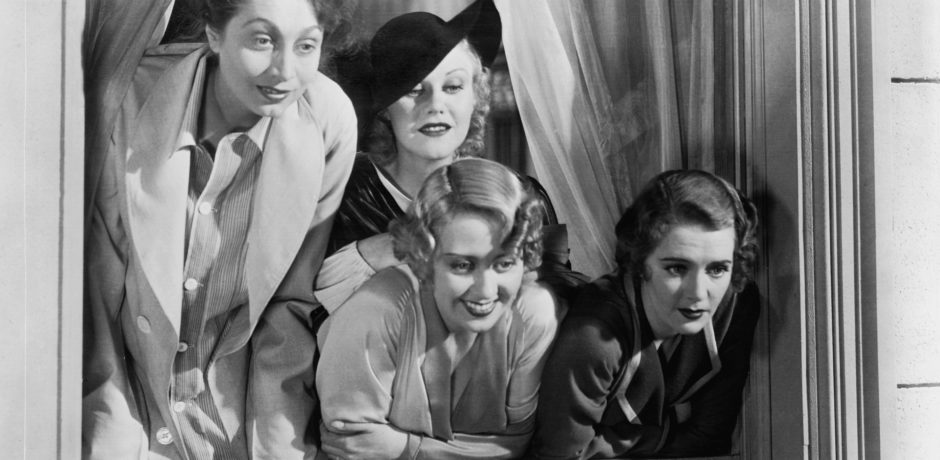
Gold Diggers of 1933


Gold Diggers of 1933
(1933) is kind of a shock to the system. A quintessential “Depression” movie, it actually aspires to be a Depression movie with no claim to be anything else, an in-your-face comment on current events.

The film begins with a barrage of blonde chorus girls singing “We’re in the Money,” in a frenzy of fantasy that must have been fascinating to moviegoers in 1933, the depths of the Great Depression. When you consider that many of those moviegoers had to scrimp for the purchase price of the ticket, probably anywhere from 10 cents to 25 cents depending on where they saw it, whether it was an evening performance or matinee, the sight of women swathed in gold coins placed in strategic places on their bodies must have been nothing short of obscene. Not in a sexual manner (though there is plenty of naughtiness in the movie as well), but obscene in the way you don’t eat a three-course dinner in front of a starving man. It’s cruel.

Choreographer Busby Berkeley, with his customary surreal and eye-popping musical scenarios, gave the crowd more than 10 cents' worth of fantasy, but there is a strange dichotomy between fantasy and cold, hard reality in this film. Warner Bros., as always, had a bead on the grim reality of the 1930s and fixed its reputation on socially relevant films. Gold Diggers of 1933 is a cross between a socially relevant film and lemon meringue.

Joan Blondell stars as the tough-talking chorus girl. Aline MacMahon and Ruby Keeler are her pals, and Ginger Rogers has a featured role, opening the film in the “We’re in the Money” number. The bit where she sings a chorus in pig Latin was put in, as she notes in her autobiography, Ginger, My Story (Harper Collins, 1991), by producer Darryl F. Zanuck after he heard her clowning around with the song and doing a verse in pig Latin during a rehearsal.


The girls are thrown out of work when the Broadway show they are in is shut down by creditors because Ned Sparks, the producer/director, can’t pay the bills. We see the girls struggling in their run-down apartment, stealing milk from the neighbors, and when they hear a rumor that a new show is going to be cast, they pool their clothes for one good outfit for Joan Blondell to wear to go check it out. When she calls them to relay the good news that a new show is on and they might all get jobs, she is crying on the phone. It is one of those real moments that breaks through all the wisecracks and reminds us, more that it does the audience of the day, that this was the Depression. Nostalgia buffs need to remember that for many people it was a nasty time to be alive. Or, as when one of the chorines complains of their hard luck, Ginger Rogers comes back with the world-weary remark, “The Depression, dearie.”

Dick Powell plays a young composer who lives in the apartment across the way. He is sweet on Ruby Keeler. He is also a wealthy playboy in disguise, so he comes up with the money to fund the new show. The show, as Ned Sparks envisions it, is going to be about the Depression, and featuring a number about “the forgotten man,” a 1930s euphemism for unemployed World War veterans. Sparks crows about his inspiration, “Men marching, marching…jobs… JOBS! Gee, don’t it get ya?”

It must have got everybody.

The rehearsals for the new show carry the fun of the typical backstage world the movies occasionally give us a glimpse of, just to remind us that there is hard work behind the magic.

We have some character actors who have very brief time on screen but give the film its quirky personality. Clarence Nordstrom plays the middle-aged “male juvenile” of the show, (we see him as well in the “Shuffle Off to Buffalo” number in 42nd Street) whose sudden attack of lumbago forces Dick Powell into the starring role on stage. Nobody seems to have lumbago anymore. It went the way of “the ague” and “the vapors,” I think.

It is another hard slap reminder that the wolf is at the door when, as Dick Powell first refuses to go on stage, Aline MacMahon chastises him with the information that all the cast will be out of work again, and perhaps some of the starving actresses will “have to do things I wouldn’t want on my conscience.” It brings the wealthy playboy to hard reality, and us, too.

Billy Barty plays the naughty “baby” in the strange “Pettin’ in the Park” park number. Sterling Holloway, future “Winnie the Pooh” voice among other roles, plays a delivery man, and ever dependable, ever-present Charles Lane has a brief spot as a reporter. Mr. Lane played curmudgeonly types in just about every film ever made in Hollywood and most TV shows in the 1950s through the 1990s. When he died at 102 years old, he was still working.

Warren William plays Dick Powell’s older brother, who tries to get Powell away from the clutches of Ruby Keeler, whom he sees as a gold digger. He views all actresses as gold diggers, and in his scheme to separate them, he unwittingly falls for Joan Blondell. He is a stuffed shirt, who grows more likable if only for his helplessness among the streetwise gold diggers, with family retainer Guy Kibbee in tow.

Ruby Keeler undoubtedly appeared very cute and sweet on screen, but her questionable range of talent made her no match for Joan Blondell. Particularly in the striking “Forgotten Man” number, Miss Blondell displays such intensity and commanding screen presence that is it surprising she did not enjoy a longer career as a leading lady, always cast in second leads. Perhaps Hollywood already enjoyed an embarras de richesse when it came to tough-talking blondes and felt it didn’t need another one.

We see a few pre-Code influences in the “Pettin’ in the Park” number with its undressing chorines drenched by rain pouring down on the multi-level “park” set that goes through different seasons.


“The Shadow Waltz” number, where even Ruby Keeler sports blonde finger waves, is typical Busby Berkeley fare, with overhead kaleidoscope shots of the girls in dresses with corkscrew hoops that spring and bounce as they play violins that are eerily lit by neon tubing. One wonders about the expense and the possible safety issues.

The film concludes abruptly with “The Forgotten Man” number, a stark street set where Joan Blondell speaks the first verse of this song about downtrodden World War vets. Only the year before, a “bonus army” of vets were routed by the Army with General Douglas MacArthur at its head and burned out for camping in protest in Washington, D.C., over the issue of their service bonuses.

“Remember my forgotten man.
You put a rifle in his hand.
You sent him far away.
You shouted hip hooray.
But look at him today.”

Etta Moten takes a verse in her rich contralto as the camera pans across the poverty-beaten wives of the jobless forgotten men. Miss Moten made only three films in Hollywood, all in this same year of 1933, but went on to a long career on stage and as a radio journalist. She is reported to be the first African-American performer to be invited to the White House, when the Roosevelts hosted her.

Much of this song is pantomimed, with many extras dressed as World War soldiers marching off to the war jubilantly, crowds waving. The rain beats down on them as they continue to march, now wounded, with a defeated attitude, home from the war, then shuffling in civilian clothes in a breadline with hollow eyes and bleak faces.

When a cop tries to roust a homeless guy sleeping on the sidewalk, Joan Blondell wordlessly comes to his rescue by turning over his coat lapel showing his Medal of Honor, and gives the cop a glare that would kill.

To us today this is a reminder that the Great Depression was not all waltzing with neon-lit violins and romantic fantasies. In 1933, they already knew that. Perhaps Warner Bros. felt the public wanted affirmation of their problems, some legitimacy granted their desperation.

The movie ends, or just slams shut, on this dour note, the complete opposite of how it began with “In the Money.” Both musical numbers are stunning, especially in that they show opposite sides of the “coin.”

   ********************

Jacqueline T. Lynch is the author of Ann Blyth: Actress. Singer. Star. and Memories in Our Time - Hollywood Mirrors and Mimics the Twentieth Century. Her newspaper column on classic films, Silver Screen, Golden Memories is syndicated nationally.  Her new book, a collection of posts from this blog - Hollywood Fights Fascism - is available here on Amazon.

Thursday, January 31, 2008

May Robson

May Robson was another one of those remarkable character actresses whose work in film increased as they grew older, and when they eventually died, they died with their boots on.

Miss Robson was from a different world. Born n 1858 in Melbourne, Australia long before the separate Australian colonies became the Commonwealth, she married young, and when widowed young, took up any work she could find to support her three children. The job that stuck was acting. She had never intended to become an actress, but that was the road that life presented her, and she took it.

She appeared in stock and Broadway, and came to Hollywood for silent films, but it was the sound era of the 1930s where her career flourished. In 1933 she was nominated for a Best Actress Academy Award for Frank Capra’s “Lady for a Day”, the earliest-born person ever to be nominated for an Oscar. She lost out to Katharine Hepburn.

As noted in the previous post, playing Aunt Etta she had some of the best lines in “Four Daughters” and the other succeeding Lemp family films, which she delivered with wry humor and charming spirit. She was the quintessential old lady, with the cameo broach pinned at the throat of the high-necked ruffled blouse. Hollywood had a curious habit of depicting elderly women as if they had never left the Victorian era of their girlhood. From Maria Ouspenskaya to the character of Granny in the Tweety Bird cartoons, these old girls eschewed modern dress for the look of the 19th century. Since most elderly women of the late 1930s dressed in the manner of the late 1930s and not the 1890s, we could take this as further evidence of the studios’ reliance on the convenience of stereotyped caricature to establish minor characters. It was done so often with race, ethnicity, with physical impairment. Giving an elderly woman the look of another time and place somehow sets her apart from the other actors, as if she is from another world.

May Robson handled the modern world with smart-mouthed panache as Aunt Etta in the “Four Daughters” series. But she really was from another world different to the one of the young actresses playing her nieces. She was 83 years old when the final film in the series, “Four Mothers” was released in 1941. She died the following year.

For a bit more on May Robson, have a look at this website.

Monday, January 28, 2008

"Four Daughters" (1938) and Sequels

“Four Daughters” (1938) and the sequels which followed, “Four Wives” (1939) and “Four Mothers” (1941) was a brief but successful series featuring three actual sisters, the Lanes, who through their individual stage work and musical careers with big bands brought them separately to Hollywood.

Priscilla, Lola, and Rosemary Lane worked separately before and after this series of films, but along with Gale Page, who played the fourth sister, were ever afterward identified with the Lemp family portrayed in these films.

The first film in the series, “Four Daughters” is the best, and was nominated for several Academy Awards, including Best Picture. It’s mix of supporting actors, from the always terrific Claude Rains as their father, to the handsome young Jeffrey Lynn, to the ever dependable Frank McHugh, Dick Foran, and especially May Robson (who will be the topic of Thursday’s blog), lends a lot to the film. Most striking, however, is the debut of John Garfield, who was nominated for his role.

The dialogue is fast and funny. Rains plays the father, the director of a local music academy. The girls are all musicians. Aunt Etta, their father’s sister, lives with them, runs the house, and acts as surrogate mother. The film starts out being a wholesome Andy Hardy type outing, light and funny, particularly when the girls’ beaus are brought home for the first time to meet father, subjected to the usual discomfort of trying to impress and fit into this army of females. As anyone from a big family, or marrying into a big family will tell you, it’s difficult for outsiders to join in to what appears to be an impregnable wall of familial affection, inside jokes, and a tight-knit past that has nothing to do with the newcomer. These scenes are done well, first with Frank McHugh running the gauntlet as the new boyfriend. His discomfort is acute and sweet.

Dick Foran plays the shy, stumbling neighbor they’ve known forever, and Jeffrey Lynn charges into the scene as a happy-go-lucky young musician, bouncy as a puppy, who all the girls immediately fall in love with, but when he eventually chooses Priscilla Lane for his love, there is a rollercoaster dip in the tenor of the film. When the two announce their engagement, the quick close-ups on the other girls showing disappointment is quietly intense.

The real fireworks begins when John Garfield enters the picture as a self-pitying, bitter musician at first sarcastic towards this close family, and then sadly desperate to join it. When Priscilla leaves Jeffrey Lynn at the altar for Garfield, it is meant as a sacrifice to release Lynn to marry her sister. The light and funny outing is over for this family, and the film increasingly becomes more serious and somewhat sinister, with delicate romantic triangles and unrequited love. Though she has agreed to marry Garfield, Priscilla still loves Jeffrey Lynn, and there is an intense scene at a Christmas reunion where all are stiff and mannerly, but anguished in each other’s company. Priscilla gets Jeffrey’s coat for him when he leaves, and takes a moment to gently run her hands on the shoulders and back of the coat and hold it a moment before bringing it to him.

The film then turns tragic as Garfield performs what he must regard as the ultimate sacrifice for his unhappy wife. There is a simple but evocative foreshadowing shot of his wet shoe on the accelerator of the car he is driving, and an unusual shot of his stony face from the floor of the car through the steering column, and we know he is going to kill himself in that car. When he speeds up and turns off the windshield wipers, letting the windshield fill with snow, it’s almost sickening.

Director Michael Curtiz does some interesting things with pacing in this film, and his repetition of themes, like the squeaky swinging front gate and several establishing shots of items in the house and the flowering tree outside. The final shot is of the gossipy neighbor lady, intrigued with the young lovers swinging on the gate, finally stealing a moment to try it herself. Her astonished expression of bliss is a quirky and delightful way to end the film.

Most remarkable I think is the use of music in this film. It’s not strictly a musical, but there is a great deal of classical music played and sung by this family, from pieces of “Lohengrin” by Richard Wagner, to Brahms, Mendelssohn, and a long, lazy rendition of “Serenade” by Franz Schubert that opens the film and is reprised in the sequels. Rosemary Lane, the aloof sister with the dry humor, does the singing, and she appears to be the only Lemp sister who plans a professional career as a performer. To have classical pieces and German lieder given such space in a film made about four attractive, modern sisters in the height of the era of Big Band music, and not have them portrayed as glasses-wearing intellectual freaks, is unusual. They handle these classical pieces with natural ease and with evident pleasure, even if they occasionally madden their father by teasing him with swing renditions of his revered Beethoven.

This film was followed by “Daughter’s Courageous” reunited all the cast, but was not about the same Lemp family as in “Four Daughters”. An unusual move and evidently the studio felt it was more profitable to go back to the well and do more movies about the original family, so “Four Wives” and “Four Mothers” were released carrying the further adventures of the girls into marriage and motherhood. The second film, “Four Wives” is more maudlin, and third had more to do with the family’s financial ruin than with motherhood. We are afforded only brief glimpses of the baby daughters, another generation of girls.

The second film “Four Wives” has an even longer musical segue as a so-called “Symphonie Moderne” is staged. This piece was actually composed by Max Steiner. The camera slowly pans the orchestra conducted by Jeffrey Lynn, to the hospital bed of Priscilla and her new baby, the child of her deceased husband John Garfield who appears through flashback, and to her family listening to the radio at home. Such a lot of time spent on the piece might make those not interested in classical music fidget a bit, but director Curtiz’s use of it remains intriguing. I like the slow pace in this part of the film, and the tour of the emotions on which the camera takes us.

Also, the manner in which all the sisters and their separate stories are shown through the course of the three films is one of brief scenes and using small nuances to symbolize larger themes. There is no single star of the films, though Priscilla Lane’s and Jeffrey Lynn’s characters change the most, from silly and carefree, to deeply hurt and sorrowful. It can’t have been an easy job either for the writers or the director to use such a large cast in equal proportions, which is pretty much what happens.

“Four Daughters” was remade as “Young at Heart” (1954), and both films were coincidently shown on TCM last night. The original series probably could have been extended, with the war and a new set of tribulations facing the sisters as a backdrop, but perhaps neither the Lanes nor Gale Page wanted to be stuck with playing the Lemp sisters for too long. Only Gale Page would continue her acting career in later decades; none of the Lane girls ever made a film beyond the 1940s.

Thursday, January 24, 2008

Fred and Ginger - Four Dances

Fred and Ginger. Not Astaire and Rogers or Rogers and Astaire for that matter, but always Fred and Ginger, as if we know them. Ironically, the romance that occurs between their characters in the dance, the thing that draws these two rather aloof characters together and draws us to them, does not really make Fred and Ginger more approachable. They are still a world apart from us, their own world, perhaps.

“Top Hat” (1935) gives us the quintessential Fred and Ginger routine, Fred in white tie and tails, and Ginger in a flowing gown, in this case the famous ostrich feather number. Her blonde hair is tightly pinned up, and sophisticated seduction is the order of the day as the song they dance to is, of course “Cheek to Cheek.”

They begin first as only another pair of dancers on a crowded floor, and she is at first cold to him because of the customary plot device of mistaken identity, but soon they ascend stairs, and then a garden terrace and they are alone, dancing slowly, closely, with gentle swirls and twirls, a slight ruffling of the ostrich feathers. They are filmed in a full body shot always, never close-ups, because their expression of attraction is in their body movements and we’re not supposed to miss it with a distracting quick shot to the eyes.

The sweeping dips, the light-as-air steps, and the dance finally finishing as they lean upon the garden wall, calm and quiet as a lake on a summer evening.

“Cheek to Cheek” is so ethereal it is practically a dream sequence, but it is delightfully contrasted by another dance number earlier in the film, when Fred and Ginger dance in a gazebo taking refuge from a thunderstorm. The song, “Isn’t It a Lovely Day to be Caught in the Rain,” and this time Ginger is in riding jodhpurs and tweed coat, and Fred in a suit. This has more taps to it. The customary aloofness is ratcheted up a notch in this dance, as they barely touch each other. They face off, a challenge, a dare. She puts her hands in her pockets and mimics his movements. This part of the dance was ad-libbed by Ginger Rogers. As she notes in her autobiography, “Ginger, My Story” (Harper Collins, 1991), and as also noted elsewhere by director Mark Sandrich, Ginger contributed a great deal to the choreography of their dances together. Fred would work out the basics with choreographer Hermes Pan, and then Ginger would come in and put in a few finishing touches.

As Miss Rogers notes in her autobiography, “I had more fun rehearsing than in actually performing. Inspiration comes during the preparation as you seek a better turn, step, or jump. In performance, you do it once and that’s it. The time for improving is over.”

The two would rehearse their dance numbers for eight hours a day, for six weeks, prior to filming. You had to love it.

According to Miss Rogers, it was her suggestion that they do the “Let’s Call the Whole Thing Off” number in “Shall We Dance” (1937) on roller skates. This is a remarkable dance routine. The scene it set in New York’s Central Park (obviously a set), and they enter the scene with somewhat weary attitudes on roller skates. Again, they are not quite a couple, and the strain of avoiding publicity hounds who think they are a couple is getting to them. They stumble to a bench, sit, and begin to sing “Let’s Call the Whole Thing Off.”

At first we might think they will spend the whole number on the bench, but without warning they stand, with a long glide into a dance that is quite amazing. The roller skates, incidentally, are the kind you used to clamp onto your shoes, so there’s no supportive safety boot here. Arm in arm at first, they stroll, and tap a little, and fake a stumble, and recover with panache. Then in unison, then in tandem, there are Olympic ice dancers who aren’t this good. The dance ends with a kind of Roller Derby bit where Ginger skates behind Fred who leads them around in a circle, picking up speed, when finally they end by stumbling off the walk and throwing themselves onto a grassy embankment.

All Ginger remarks in her book is, “The roller skating number was a ball to do.” In his autobiography, “Steps in Time” (Harper and Brothers, 1959) Mr. Astaire says even less. Neither describes in detail about the rigors of their dance choreography, and yet their dances were all about detail. Astaire was known in particular for being a perfectionist. Perhaps like some artists who shy away from analyzing their work too much, they feel it loses some of its magic if you pick it apart.

Finally, we have the “Bouncing the Blues” number from “The Barkleys of Broadway” (1949), Fred and Ginger’s last film together after not having made a film together for a decade. As Miss Rogers notes, “to get back into your dancing shoes after ten years is not the simplest thing to do.” And yet, she remarks, “Once Fred and I began rehearsing in earnest, the ten years melted away.”

In this number, Ginger is wearing black slacks, a white blouse, and appears to be a copy of Fred, who wears grey slacks and a pink shirt; both are wearing scarves around their waists and at their necks.

In the weeks when they used to rehearse their numbers, Ginger would wear pants for their ease of movement in the rehearsal stage, and switch to the dress and shoes she would wear for the film only at the end. This number, “Bouncing the Blues” gives us a look at how Fred and Ginger might have appeared while rehearsing, not only by their casual clothes, but by their casual attitudes. There is no aloofness here. Nor is there especially romance. There is a sweet camaraderie, a perfect timing between two people who have a long history of knowing each other moves.

The jazz piece begins with rippling cymbals and then gushes into a flood of taps and twirls, all in unison. They are smiling, and we are allowed for once, or perhaps just finally noticing, their expressions. They are grinning like fools. Her loose hair bounces on her shoulders as they throw themselves into a high-stepping trot, their arms about each other’s waists. They really look like they are having a ball, in their own little world.

Monday, January 21, 2008

Betty Boop and the Production Code

Betty Boop suffered the indignity of lewd and lascivious employers groping her and threatening her for sexual favors. Then the hapless creature suffered the indignity being called naughty by the Code.

The cartoon heroine with the giant head with its coy rolling eyes burst from the Fleischer studio in the early 1930s and made full use of what the new sound technology had to offer. Mae Questel, who voiced Betty, did a Helen Kane impersonation, and “boop-oop-a-doop” became a catch phrase.

An interesting evolution of Betty and the Fleischer manner of production is noted in “Serious Business” by Stefan Kanfer (Scribner, 1997), which notes that unlike the Disney studio which recorded the dialogue before creating the cartoon, a method which continues today, Fleischer did it the other way around. Max Fleischer had the cartoon created first, a kind of stream-of-consciousness storytelling on the part of the cartoonist (which led to some pretty weird dream-like scenarios for Betty and her crew), and then the sound came afterwards.

Mae Questel was reportedly very good at ad libbing, as this is what she was required to do in the recording session after the cartoon was filmed. The actors watched the cartoon and then invented lines to go with what was happening on the screen. (A technique which led to Popeye, another Fleischer production, noted for its humorous extemporaneous patter of dialogue.)

Some of Betty’s earliest outings have been called by some critics, including Leonard Maltin, as a kind of “cartoon noir” because of the menacing shadows and looming backgrounds, and the inanimate objects that spring to life in threatening manner. Betty started as a guest in “Bimbo’s Initiation” (1931). Bimbo and Ko-Ko, a clown, were the Fleischer stars through the 1920s. By the time Fleischer’s “Snow White” was released in 1931 (not a bit like the Disney’s version), Betty was established as the star of Fleischer Studios.

From “Stopping the Show”, “Betty Boop’s Bamboo Isle” both from 1932 we get Betty singing, stripping, and pouring her heart out. Naiveté was never so suggestive. The cartoons always had at least one song, and the scenarios were usually risqué.

Cab Calloway’s dance steps were Rotoscoped on the body of Ko-Ko, and he wailed “St. James Infirmary.” Betty imitated Fanny Brice and Maurice Chevalier. It was raucous, and riotous, and freewheeling.

Then the Code, and Betty had to clean up her act, or rather, the Fleischers did. Glimpses of her underwear were no longer allowed. Her dress was lowered to cover the garter, and the neckline was raised. Pals Bimbo and Ko-Ko were pushed aside for a cute puppy, a cute nephew, and Grampy, who never leered at Betty.

The run-down houses and apartments were Betty struggled to keep up like everybody else did the Depression became cozy cottages and swanky digs. Betty was doing well. But her saucy underdog persona suffered.

She became matronly, where she no longer appeared as a race car driver or circus performer, but sang songs about housecleaning. Finally, Betty no longer starred, but was the supporting player to the new cast. Though Betty had always been a black and white cartoon, now she was truly colorless.

A new cast member in a minor role, a guy named Popeye, broke free from the mundane polite menagerie and became a star on his own. “Boop-a-doop” may have been outlawed by the Code, but bashing somebody’s skull in, as Popeye and Bluto repeatedly did to each other, was good clean all-American fun. Fortunately for Miss Questel, she took on the job of Olive Oyl’s voice, and continued to ad lib while watching a cartoon, and doing a splendid job.

Decades later we see Betty again in “Who Framed Roger Rabbit” (1988) in the nightclub scene where she is a lowly and somewhat forlorn cigarette girl making small talk with Bob Hoskins. But nobody is pinching Betty, or even noticing her, despite that she is portrayed in black and white in a room packed with cartoon characters in full color. There is something poignant in her down and out manner of telling Mr. Hoskins that work for her has been, “kinda slow since cartoons went to color.” But it wasn’t color that got our Betty. It was the Code, as omnipotent a master as one of her old lecherous employers.

“I still got it,” Betty pitifully jokes, boop-a-dooping once more. Mr. Hoskins gently agrees that she does, but his response is only an act of kindness to a worn out dame who’s seen better days.

But she does still have it, or she must, or we wouldn’t see her on mugs, T-shirts, novelty clocks and radios, depicted as a biker chick on the backs of leather jackets, still coy, still innocent, still suggestive, but less a victim of sexual harassment than an assertive modern woman. Yeah, I got your Code right here, buddy. Betty lives, in full color, in the world of merchandizing. Max Fleischer might well be amazed.

Perhaps Betty’s plight is best assessed by the sexy Jessica, voiced by Kathleen Turner in “Roger Rabbit.” Protesting her own innocence she remarks, “I’m not bad. I’m just drawn that way.”

Related Products