IMPRISON TRAITOR, PEDOPHILE, AND CONVICTED FELON TRUMP.

Thursday, October 18, 2012

Caught - 1949


“Caught” (1949) is one of those movies that reminds us, deliciously so, that what the story is about is sometimes not as important as how it is told. After all, there are just so many different plots. Director Max Ophüls (or Opuls) achieves intimacy with his characters in small, very telling ways that in the hands of another director might be cliché, in a story that could have been very melodramatic.


The story is about false values and how we surrender to them. Illusions we create to trick ourselves. The movie is a morality play without getting preachy, because we can understand how lead actress Barbara Bel Geddes is lured into an unhappy situation. It could happen to anybody, and does, every day. For her, it is the goal of marrying a wealthy man. For others, it might be falling under the thumb of credit card debt or backstabbing fellow employees to get the corner office, any number of horrid scenarios in which basically good people lose themselves in the struggle for what we imagine is the good life.

Fans debate over whether it is true film noir. For my money, it is, and not just because of all those table-height shots (which are quite important to the telling of this story - more about that later). I would call it noir for more than the stark cinematography, but rather for the self-imposed sentence of doom the principle characters endure. Even the weak ending to the story, which seems some sort of compromise, does not negate that most of the film is a dark journey into wretchedness caused by the characters themselves.

The movie lulls us into the mindset of false values from very beginning. Over the opening credits, we see lush magazine ads from some high-tone publication. Ladies’ gowns, jewels. The camera pans back, and we see two young women, ogling the expensive merchandise, pretending what they would buy if they were rich. It’s a normal scene, people do this all the time. Nothing nefarious about two girls drooling over a picture of a mink coat, smoking their cigarettes on a chenille bedspread. The mink coat image is going to play a big part in this movie.

By the way, a mélange of spoilers ahead. Discreetly look away if this troubles you.

And this one is going to be long. Go long. I’ll hit you in the end zone.

Barbara Bel Geddes (what a great name) is a young carhop who wants to marry well. She is encouraged to do so by her roommate, played by Ruth Brady, who insists that Barbara must better herself and go to school. We might agree, but then we understand she means go to charm school. “Without a social education, you’re never going to meet a real man.”

Before we think charm school too frivolous, which in these days most people probably do, we need to recall that there once was a real emphasis on the social graces to getting ahead in society and in business. Not undeservedly so, (I wish a few more people today would go to charm school. I’m not talking about you. They know who they are. Maybe.), though this movie shows us the dark side of putting importance only on the appearance and not the substance of a human being.

Have a look here at one of my favorite blogs, Shopping Days in Retro Boston for a post on the charm and etiquette classes department stores offered for young ladies that were popular right up until the early 1970s. As blogger “Charles Boston” relates:

“Charm schools, etiquette classes or fashion guidance seminars were offered by most of the once great Boston stores. Beginning gently in the 1930’s R.H. White’s offered a short course from a visiting expert in the “field of charm” and then by the 1940’s Jordan Marsh began the Marsha Jordan Fashion Board (also called “fashion council” in some years) and Chandler’s began the Junior Charm School for young ladies.

The Jordan Marsh Marsha Jordan Contest phenomenon was a huge success for pre-teen and teenage girls and carried on well into the 1970’s.”

So Barbara Bel Geddes’ foray into the charm school run by Natalie Schafer (Mrs. Thurston Howell, III, to you), is nothing at which to snicker. Lessons in the social graces were considered to be ammunition for making your way in the world. Today...not so much.

Director Ophüls makes some interesting decisions. We see Miss Bel Geddes first in rolled up jeans, a girl dreaming of pretty things money can buy. Ruth Brady sits at their card table and figures out the finances. The folding card table that could be bought from any discount store is an image of their poverty and social level.

Tables seem to be of great importance in this movie. When we see the girls at charm school sitting at a table, enacting a practice scene of social introduction between ladies, we may not notice at first that the table, a sturdy wooden prop, is actually quite scratched and worn. It is an unmentioned, scruffy reality behind a sham presentation.  This rented office Natalie Schafer uses is a stark contrast to her elegant clothing and white gloved practice handshakes. Like Kathleen Freeman, the comic vocal coach in “Singin’ in the Rain” (1952), Miss Schafer exhorts the girls to “speak out, full tones.”

With her new education, Bel Geddes gets a job as a store model, wearing what else? A mink coat. Well-heeled ladies finger her garment, including Beaver’s mom, Barbara Billingsley.

Another customer eyes her goods. He’s Curt Bois, whom you may remember from “Casablanca” (1943) as the pickpocket, “Vultures, vultures everywhere.”

Here, he’s Robert Ryan’s slimy toady, who picks up girls for Ryan. Nice scene where Bel Geddes, who is onto Mr. Bois, opens her coat one side at a time at his request to see the lining. She reveals her figure, which was what he really wanted to see, and then he invites her to a party on Ryan’s yacht.

Her roommate, of course, urges her to go because Mr. Ryan is richer than rich, and that is their object. Miss Bel Geddes is reticent and replies, “I resent the whole setup.”

It’s the last bit of integrity we see from her for the rest of the film. She goes to the party, and though Ryan sweeps her away from it to do business in town, leaving her to fall asleep alone in his convertible, she links herself to this fellow and her own downfall quite willingly.

Robert Ryan is masterful in this movie. It could be such a mustache-twirling role, but instead of playing at villainy or going over the top as another actor might, Ryan attacks the character just as the character attacks life. He makes us believe that he is genuine. That is what is so frightening about his character. He believes in himself.

He’s handsome, rugged, educated, lives in a mansion, owns everything, and is supremely wealthy. We cannot really blame Bel Geddes for marrying this man when everybody from her roommate, and all of society is telling her she’s nuts if she doesn’t. The newspapers call her the carhop and emphasize how lucky she is. One headline quotes her proud mother saying she always knew her daughter would be a success. She’s the Cinderella girl.

When Ruth Brady visits her at her husband's mansion, she thrills at the fairyland wonder of being rich, and bellies up to the lifestyle like a pig at a trough.

Our Cro-Magnon ancestors would have understood. The female early human, just like a female animal, received only the strongest male, and became his prize. Despite the Renaissance notion of romantic love giving us a lot of lovely poetry, we see that for Barbara Bel Geddes, the 20th century harkens back, in its confounding commercialism, to those ancient days when “a real man” as Ruth Brady puts it, was the alpha male.


Robert Ryan is a terrific alpha male, with something skewed that the director lets us in on right away. Shortly after he and Barbara meet, we see him visiting his psychiatrist. They have a sparring relationship. Ryan is impatient, irritated, annoyed with the doctor’s assessment of Ryan as a man who likes to have his own way, to the childish extent of developing psychosomatic illness if he does not. Ryan believes his angina attacks are because of a bad heart. The psychiatrist, played with wonderful world-weary frankness by Art Smith, tells him he only gets these attacks if he doesn’t get his way. Like a spoiled child’s tantrum. Ryan is paranoid about his money to the extent, as the doc says, of never wanting to marry because he believes a woman would only be after his money.

Ryan, in a child’s you’re-not-the-boss-of-me mode, picks up the phone and calls his toady to get that girl -- he cannot recall her last name -- and make arrangements for quickie wedding in Yuma. There, he showed that doctor a thing or two.

The idea might seem ridiculous, but the scene is quite chilling. We see at once what lengths Ryan will go to not to be topped. He has no feelings for Barbara Bel Geddes, except to use her.

As his wife, her life becomes a series of insults, humiliation, and psychological abuse. He tests her loyalty by making her stay up until the wee hours of the morning to act as hostess for his impromptu business meetings. She is bejeweled and coiffed, and wearing gowns, and that coveted mink, but she is a prisoner in a cage. Her only companion is Bois, who is his master’s stooge. Bois, irritating and concerned only with his own self-preservation, expresses no sympathy for her, only wheedles her into doing what the boss wants. But the boss is never pleased.

Ryan works his mind games on her and makes her feel unworthy. In another interesting table scene, the camera is level with the pool table in one of cavernous rooms in his mansion. She sits bewildered, overtired, on a low stool while he conducts a miserable tirade of insults and accusations in a cool, firm voice. He is as authoritative as he would be in a business meeting. The only thing that betrays his sociopathic obsession is the way he continuously rolls billiard balls on the table, grasping them one by one, tightly, and then firmly shoving them across to carom off the sides. In other scenes, he will clench his fists as he talks, as if trying to suppress an obsessive tic. (Though the story is based on a novel by Libbie Block, screenwriter Arthur Laurents and the director flavored the character with personality traits of Howard Hughes.)

We might well wonder why on earth she doesn’t leave Ryan, clearly a bully and master of manipulation. That answer is supplied later on in the film by James Mason. He plays a doctor in a struggling practice on the lower east side of New York. He will eventually tell her that she married Ryan for the security, the goods, the money and not because she loved him. She tells herself, and others, that she loves him, but she is fooling herself. She does not want to feel guilty or admit that she is wrong.

This is another noir element to the film. Bel Geddes may be a victim, but she’s hardly honest. She is a golddigger.  James Mason is the hero who will rescue her, but he’s no knight in shining armor for all his ministering to poor patients as a pediatrician. In one scene, a child nearly dies because he has ignored important symptoms. But he accepts his mistake and learns from it.

Miss Bel Geddes walks away from Robert Ryan and takes a job as the receptionist in the office shared by Mason and the terrific Frank Ferguson, who is an obstetrician. Ferguson is one of those fellows who we may recognize in bit parts in a zillion TV shows and movies. I wonder if this was his largest role? He is my favorite character in the movie. He stumbles in and out of his office, vest unbuttoned, kindly and patient, but always exhausted. Because he delivers babies at all hours, he takes odd moments in the office to shine his shoes, or shave himself. There’s something really quite endearing about his character.

Bel Geddes, who never pursued anything of worth, or put any effort into it, is a lousy receptionist and Mason bawls her out. But his criticism is not like Ryan’s. He does not diminish or humiliate her. Rather, he calls her out on flaws that she’s smart enough to fix if she weren’t so lazy. Mason is exasperated with her mink coat and foolish sense of values. Even the nurse, when Bel Geddes applies for the job asks her, “I hope you’re looking for work and not a husband.”

In the mindset of the times, one can hardly blame her suspicions.

Or blame Bel Geddes if she was just looking for a doctor husband.

Bel Geddes is lost, and vulnerable. Robert Ryan shows up at her shabby one-room apartment, contrite. The only thing more humiliating than him berating her is him feeling sorry for her living conditions, with the noisy L track outside her window. We see, too, that she has reverted to using a card table for her meals and to practice her typing. The most gallant thing Ryan ever does in this movie is help her to fold it up.

When he asks her out, she slips her hand into the closet covered only by a drab curtain, and pulls out her mink coat.

Next is the morning after scene. She’s in their bed in the mansion, one strap of her negligee artfully slipped down off her shoulders as the toady Bois wakes her. Ryan wants her up and at ‘em in an hour. He and his business colleagues are touring his plants across the country. She has to come along for appearances.

She’s had it. She goes back to her reception work for the doctors, and really applies herself this time, taking shorthand lessons, studying medical terminology and office procedures. She’s finally making good.

But we are not entirely surprised when she comes into the office early to greet Frank Ferguson just back from a late-night call. It occurs to us when she timidly taps on his door…he’s an obstetrician.

The last night of passion with Ryan has resulted in pregnancy. We know she’s pregnant by the way she steps out from behind the screen and buttons her blouse; we know it before the test results have come back.

Her dilemma now is more than just carrying the child of a man she loathes. She also makes a friend in Mason. He sees her without a warm coat on a cold day (she has put aside her mink) and buys her a cloth coat. A touching moment of ironic gratitude when she accepts, as if he has given her diamonds.

They struggle through a crowded dance floor on their first date, and we see her laugh for the first time. On their first date, he proposes.

Habit and the force of what a commercial society has told her from puberty is too strong for Bel Geddes, and she goes back to Ryan, the alpha male, so that her baby can grow up with all the good things.


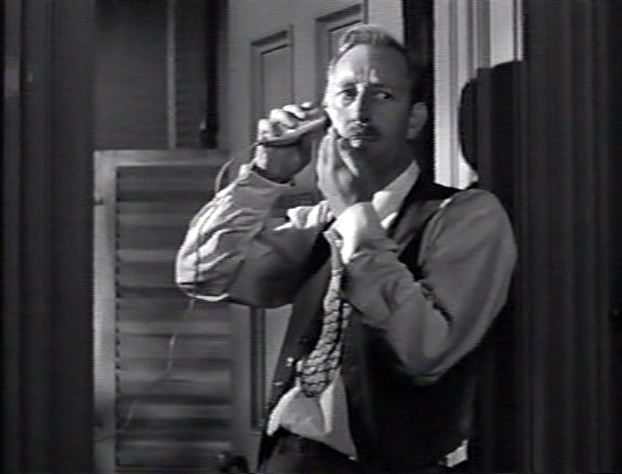
Possibly my favorite scene in the movie is when Mason and Ferguson are alone in their office late at night discussing Bel Geddes’ disappearance. Here is where the director steps in again and tells the story in an intimate, artful way. The camera settles on Ferguson, standing in his office doorway, laconically shaving himself with an electric razor, enjoying a quiet moment before the next medical call.

The camera slowly swings across the empty desk where Bel Geddes usually sits, over to the office doorway of James Mason. He leans against the doorframe, puzzling aloud why Barbara has left them. The camera goes quietly back and forth between them. On the corner of her desk are empty in-boxes for each doctor with his name on it.

Bel Geddes isn’t in this scene, yet she’s all over this scene in the image of the unoccupied desk. She fills the room.
Neither doctor knows Bel Geddes, who used her maiden name with them, is the wife of the rich guy. Ferguson knows she’s pregnant, and assumes she's run off to conceal her pregnancy because she is an unmarried woman. His taciturn behavior is touching. He keeps her confidence and does not tell Mason what he knows. Today we might call it observing the HIPAA rules, but he’s just being ethical and gallant because that’s his nature.

When Mason tells him of their first date, Ferguson asks, carefully, if that was their only date. He wonders if Mason is the father.

Mason eventually finds his way to the mansion and confronts both Ryan and Bel Geddes. Torn, she plops on the running board of one of their many cars to think about the crisis. As we discussed in this previous post, there’s nothing quite so romantic as a running board.

Bel Geddes elects to stay with Ryan, and he continues to treat her badly, to the point of finally upsetting toady Curt Bois. We can imagine Bois has been with him for years, lured to a life of bitter, demeaning servitude to this rich horse’s ass because he’s just as guilty of greed. But when he sees this pregnant girl growing sicker and exhausted, he’s had enough. He quietly tells Ryan he wants to go back to being a head waiter. Ryan calls him a dirty parasite, and tells him to bring down his wife.

Bois quits, with the calm, soft utterance, “You know you’re a big man, but not big enough to destroy that girl.”

Today, he is a man.

And launches Ryan into one of his most serious faux angina attacks.

We may have forgotten that these attacks are not real, and when Bel Geddes, in a trance of indecision, looks right at the camera when she discovers Ryan lying under his pinball machine (boys and their toys), moaning for water, we might almost cheer when she leaves him there. Sort of like Bette Davis and the dying Herbert Marshall in “The Little Foxes” (1941).

Okay. Here’s the ending. Don’t get excited, it’s not that great.

Miss Bel Geddes, who does not look at all several months pregnant, goes into premature labor. The baby is stillborn. Mr. Mason rallies her with the exuberant message that now she is free from Ryan.

It’s a very strange way to the end the movie for several reasons. First, it gives that unsatisfying deus ex machina feel to it, that fate intervened and took away all their problems. Stories are more meaningful if the characters solve their own problems, even if imperfectly.

Second, it feels unsettling to have a baby being born dead as a cause for relief and even celebration. True, the pregnancy was unwanted and the father was most certainly intending to destroy both mother and child (which he did not believe was his anyway). Though regretting a pregnancy is human, to be glad the baby has died, as both Mason and Bel Geddes demonstrably are, may just make this another reason to call it noir. It’s a twist.

Third, if the child had lived it would have added to the conflict to the story and might have led to a more exciting and interesting ending. Her severance from Ryan would have taken more work, especially since he could have used his immense wealth to accuse Mason of being the father and ruined both him and Bel Geddes.

But, the movie has to end sometime, doesn’t it? I’d like to know how the novel ended. Novels have a lot more time to sort these things out.

There is a strong melodramatic element to the movie, or could be, but the smooth underplaying of Barbara Bel Geddes makes her a believable character. She may not exactly be a heroine or a victim, but she could be somebody you know. While it is uncomfortable watching Robert Ryan’s cruelty to her, the sureness of his acting is strong point to this movie. He’s a monster, but he’s also believable in a way many movie villains are not. He conveys that arrogant and even bitter disdain some holders of extreme wealth display to those whose incomes are inferior. Ironically, the only person who can dislodge him from his psychological king of the mountain game is himself and his paranoia.

Sly, quick moment to catch: when Bel Geddes steps out of Ferguson’s office after her gynecology examination, the nurse, just entering the office quips, “You don’t look it.”

Meaning she doesn’t look tired even after working late last night. It gives Bel Geddes a start. Paranoia has different levels.


Monday, October 15, 2012

More Odds and Ends


Catching up with a few items on the bulletin board today. First up, congratulations to Moira of The Skeins, Silver Screen Oasis, and TCM's Movie Morlocks, who will be a guest programmer on Turner Classic Movies on November 30th. Moira and three other Morlocks will visit with Robert Osborne to discuss their film choices. Moira’s pick is crime drama, “Touchez Pas Au Grisbi” (1954). Moira is also a member of the Classic Movie Bloggers Association (CMBA), and knows more about classic film than most of us. I’m really looking forward to Moira’s film for the evening and her always intelligent comments.

Next up: Last month I blogged here about the Warner Theatre of Torrington, Connecticut. Also in one of the photos you can see the Yankee Pedlar Inn across the street. Recently a reader, Mr. Jeffrey (have a look at his blog jdbrecords), commented that the Yankee Pedlar was the location for director Ti West’s horror film “The Innkeepers” (2011). Apparently at least some of the movie was shot in Torrington, but unlike the hotel in the movie, the Yankee Pedlar is not closing down. You can stay there any time. Especially if you like ghosts. That part is true.

Actually, the Warner Theatre is supposed to be haunted, too.

Actually, not to be ho-hum about it, but New England is chock-full of haunted places. You can’t spit without hitting a ghost.

But it’s still pretty in the fall.

Actually, there is more than one Yankee Pedlar Inn in New England, too. Probably all haunted.

Half the McDonald's in New England are haunted.

I'm only kidding.

Where was I?

Boo!!!

Scare you?  Relax, its only me.

Next up: Thank you to another reader who recently emailed me regarding this past post on the movies filmed at the Long Beach Airport in California. Apparently, they’ve done some renovating lately and revealed some interesting tile on the floor after pulling up the carpet. You can see here on their Facebook page.

Next up: Just a brief preview of coming attractions. I’ll be tackling “I Married a Witch” (1942) for Halloween, and am hoping to cover a couple football films in November. Next month I also expect to cover the Delmar Davies tobacco-growing soap opera “Parrish” (1961) with particular emphasis on the location shooting. This was done in my neck of the woods.

Also in November, "Mr. Smith Goes to Washington" (1939).

Late November, early December I’m going to try a series on movies about women in the armed services. We’ll be looking at “Keep Your Powder Dry” (1945), “Never Wave at a WAC” (1953), “Skirts Ahoy” (1952), and “Cry Havoc” (1943). One of these things is not like the others. To coin a phrase.

I dropped the ball this summer when I wanted to cover “The Long, Hot Summer” (1958), to conclude a trio of Martin Ritt-directed films. The other two I covered in the spring were “No Down Payment” (1957) and “Casey’s Shadow” (1978). I messed up a couple chances to record the movie. I’ll just put that one on the back burner for now and get to it as soon as I can.

Finally, I’ll be signing books and speaking on my novel Beside the Still Waters at the Chicopee Falls Women’s Club meeting this Thursday, October 18th at the American Legion on Exchange Street in Chicopee.

And I’ll see you here this Thursday as well for a look at “Caught” (1949) with Barbara Bel Geddes, Robert Ryan, and James Mason.


Thursday, October 11, 2012

I Wake Up Screaming - 1941


“I Wake Up Screaming” (1941) is fun noir. I think my favorite line happens in the nightclub when Allyn Joslyn, with a wry smirk, asks snooty, soon-to-be murder victim Carole Landis, “My I have the next mazurka?”

It’s the oddball moments in this movie that make it a quirky delight. Since even a cursory plot description is a minefield of spoilers, I’m not going to discuss the plot, just mention a few oddball elements I like.

First, the title, which has nothing to do with anything, except it’s deliciously lurid.

The gag when Betty Grable, hoping to send a cop on the wrong trail, points to a door through which Victor Mature may have escaped, only to have a Murphy bed fall on the confused flatfoot.

Victor Mature, whom we saw last week in "Captain Caution" (1941),  is being chased by an even more clever police detective played by Laird Cregar. Sadly, Cregar’s life was cut short only three years after this film was made. His work in this movie is the most riveting of all the actors, a complex character with more to his back story than just your routine dogged detective. Early on he pins the murder on Victor Mature, and spends the rest of the film tracking him, playing a cat and mouse game, when Mature slips through his fingers. I love the scene where they ride together in the car, and Mr. Cregar, as he speaks, playfully fashions a noose with string in his busy fingers.

But along the way we are introduced to a menagerie of the usual, or unusual suspects to make us question who really committed the murder. Alan Mowbray and Mr. Joslyn are along as society gossips and as sellers of information.  Joslyn has a loaded gun in his beside table.  We've mentioned before how anyone in an old movie can pull open a drawer to find a loaded gun.

The effortlessly weird Elisha Cook, Jr., with his big round eyes and childlike gaze creeps us out and makes us suspicious.  But Mature is the prime suspect, a fast-talking promoter who was selling Miss Landis as a Bright New Talent.

Betty Grable is her grieving sister, in a non-singing role this time (though I guess she did film a number that was cut from the movie).

Grable and Mature form an uneasy alliance at first, both looking for the murderer, but soon they get to be more than that, probably dating from the moment she sees him in his 1940s form-fitting bathing suit. Oh, my, yes. A vision of manly grace and considerable attributes.

Going on a date to an indoor swimming pool in the middle of the night, in the middle of a noir murder mystery. Hmm. I looked hard for Esther Williams, but she must have been in the ladies’ room.

Whenever Mature and Miss Grable are together, we heard the sometimes soft and lilting, sometimes jazzy rendition of “Over the Rainbow”. It has a strangely eerie effect in this movie, just another delightful oddball element.

And the loving, smitten way she saws off his handcuffs with a hacksaw on their first date.

And when he sticks a Tootsie Roll in the detective’s back, pretending it’s a gun.

The way Carole Landis gets to perform a song, but only as an image on a screen the cops show to Mowbray to make him crack.

And who sent all those flowers to Landis while she was alive, and keeps sending them to her grave after her murder? Florist Charles Lane -- that’s right, that sexy heartthrob Charles Lane, gives hints but will not mention the name aloud.

I recognized the theme over the opening credits to be Alfred Newman’s “Street Scene,” but how many of you, like me, immediately thought of the theme song to the old time radio show “My Friend Irma”?

Notice that the guy cheering at the prize fight, sitting in front of Victor Mature and Betty Grable (ah, the days of bringing your date to a boxing match) is an African-American gentleman? He’s blocking Mature’s view. He’s dressed in a suit and nothing about him is stereotyped or makes him in any way different from the audience of cheering white actors around him. Only because of that, and because this is move from an era where such innocuous, color-blind characterizations were rare, does that make him stand out like a beacon.

A brief, really nice beacon.

But perhaps just another unusual throwaway moment in an oddball noir.

By the way, at least two characters that I can think of get awakened in the middle of the night by strangers in their rooms.  It's pretty freaky.  But nobody wakes up screaming.

Monday, October 8, 2012

In Search of FMPU


This photo of a giant sunflower has no other purpose than to distract you, and because it just makes me happy. I had a forest of some 12-plus feet high sunflowers this summer in my garden. The blooms were over a foot wide. At the end of the season, as I was standing with my back to it, one toppled over and smacked me in the head.


They pack a punch. I saw stars. Not Cary Grant or Rita Hayworth, just stars.

I thought I heard it snicker, and softly mumble, “Tag! You’re it!”

Enough stalling, I’m come before you today requesting help. I’d like to put out an all-points bulletin for a documentary that I’ve been wanting to see.

I’m looking for an AMC (remember when that was the old movie buff’s pal before it went to the dark side?) TV documentary about the First Motion Picture Unit of World War II. The FMPU was part of the Army Air Corps and produced many training films and documentaries. Frank Capra’s “Why We Fight” series was produced as part of this unit.

The unit was comprised entirely of technicians, directors, writers and actors from Hollywood’s movie industry. Captain Ronald Reagan was a personnel officer here at one time. James Steward and Clark Gable were briefly connected with the unit.

AMC’s made-for-TV documentary called “Hollywood Commandos” was produced in 1997. I don’t believe it is available for sale, either in VHS or DVD.

If anybody recorded this when it was broadcast (I don’t know if it has been repeated, or shown only once), but I want to track it down. I’m hoping someone has it in his private collection. I’m happy to pay for a copy. Or, swap for something in my collection, if so desired.

Spread the word. Release the hounds.

Thanks.

Thursday, October 4, 2012

Captain Caution - 1940


“Captain Caution” (1940) gives us a chance, if nothing else, to mark that this year is the 200th anniversary of the War of 1812.  It was a puzzling, disjointed little war and this is a puzzling, disjointed little movie.  Victor Mature would rather not fight the war, and he seems to be the only one in this movie with any sense.
The year this movie was made, Great Britain was struggling for survival against Nazi bombing raids, and the US, still officially neutral in the early years of World War II, had not even started slipping aid through the Lend-Lease program, signed into the law the following year.  We just stood by and watched.  The War of 1812 was the last time Great Britain was our enemy, and though movies should be allowed to stand apart from current events as purely art, they often do not, intentionally.  A scene at the end of the film where a British sea captain agrees to a personal truce with Victor Mature’s crew so that they may join together to fight a common enemy might have been a convenient, palatable ending, or it might have been in the original novel.  I don’t know, but it is convenient.  Our real-life sympathies for Great Britain in their predicament were beginning to gnaw at us.
Victor Mature is First Mate on “The Olive Branch”, a symbolic enough name for a merchant ship sailing back to its home port of Arundel, Maine.  Robert Barrat is captain and owner of the ship.  His daughter, played by Louise Platt, is on board to keep the ship’s log on her beautiful lady’s finishing school handwriting, and to plague Victor Mature.  They were childhood friends, and now they are battling sweethearts.  One wonders what he sees in her, because she’s as petulant a shrew as ever sailed the seven seas.
A crew of lovable miscreants huddles below decks and swings in hammocks.  El Brendel is one of them, who plays a lute and sings very sweetly of the seaman’s sweetheart “Hilda”.
It is August, 1812, and they have been sailing from China for over 100 days.  They do not know that President James Madison declared war against Great Britain in June.  So, it comes as quite a shock when a British war frigate comes along sides, shoots cannonballs at them, and takes them all prisoner, except for the captain, who is killed.
Captain Caution is a bitter nickname Louise Platt tags on Victor Mature because he advises surrender and negotiation to get the men back home.  Especially since they are not armed to fight sea battles. 

Now that her father is dead, Miss Platt vows vengeance on the British and she’s willing to take up with anybody who will help her, including Bruce Cabot, who has an unsavory reputation as a slave ship captain.  He will do anything for money.
When they are rescued from the British by an American war frigate, Bruce Cabot joins the crew as Miss Platt’s First Mate.  She declares herself captain, and her brief scenes striding about the deck giving orders are the most interesting aspects of her role, however far-fetched they might be.  There were pirate queens back in the day who mastered their own ships, but Louise doesn’t seem to be the type who can suddenly adopt authority and a thorough knowledge of seamanship when she has spent her time before that pouting and shrieking.
Other newcomers on deck include Leo Carrillo, who we last saw in “History is Made at Night” (1937).  He plays his trademark bumbling, bombastic sidekick with the funny, over-the-top accent. 
Vivienne Osborne is his jealous coquette of a wife.
A young J. Pat O’Malley has his first movie role as a fishmonger; blink and you miss him.
Clifford Severn is the British drummer boy who is taken captive by Victor Mature’s band and has become such a mascot that by the end of the movie, he joins his new American friends.  Clifford and several of his siblings were child actors in many films, and you may recall his brother Christopher as Toby in “Mrs. Miniver” (1942).
Alan Ladd has a small role as an American sailor held captive on another British warship.  He helps Carillo and Mature to orchestrate an escape.  It wouldn’t be too long before he had starring roles and you can see why in this movie.  Ladd has a magnetic screen presence and he delivers his lines in a passionate manner.  Interestingly, he shows more emotion here than he would in his more famous roles when his characters were usually more buttoned up.
It is an occasionally odd movie, but there are two powerful elements going for it.  First, there are some good hand-to-hand combat scenes on fog-shrouded decks, with cannonball-splintered spars falling around them, tearing into square sails, and frigates on fire. 
Second, the trio of Victor Mature, Bruce Cabot, and Alan Ladd have got to be the most handsome set of fellows ever to eat hardtack.  You can’t keep your eyes off them.
Mr. Cabot is quite mesmerizing.  We know he’s the villain, his record speaks for itself, but usually villains are presented as ugly, creepy, mustache-twirling types.  Cabot is manly, rugged, intelligent, and has guts.  If he weren’t so evil he’d be a great guy to have on your side.  Mr. Ladd, despite a small role, comes off as a romantic hero with his abundant wavy hair and flashing eyes.  And Victor Mature is charming in a role unlike his usual sneering, haunted noir outings.  He’s funny and thoughtful.  He is careful and judicious, Captain Caution, as it were, but saves the day at the end when he makes a bold move. 
The only fault I can see in him is his love for Louise Platt.  He’s too good for her.  There’s a lot that's clunky in this movie, but as Leo Carillo hopefully says, “Nothing is impossible if it’s possible.”
Arundel, by the way, though an old place name for this area of Maine, was part of Kennebunkport when novelist, and Kennebunk boy Kenneth Roberts wrote “Captain Caution”.  He specialized in historical novels, (he also wrote Northwest Passage) often with New England slants.  A popular novelist of his day, after the last of his series Chronicles of Arundel was finished, the community was officially re-named Arundel in 1957.
Have a look at my New England Travels post this week for more on the War of 1812, and the USS Constitution.

Monday, October 1, 2012

Answers to "Who's Cookin'?"


Wash your hands; we’re just about to have supper. Here are the answers to last Thursday’s “Who’s Cookin’?” screen cap trivia:


A - Clark Gable cooks  a couple enormous steaks in “Any Number Can Play” (1949).

B- Alexis Smith in “The Sleeping Tiger” (1954).

C - Barbara Stanwyck learns the culinary arts in “Remember the Night” (1940).

D - Jean Arthur cutting “Shane-sized” wedges of pie in “Shane” (1953).

E - Marjorie Main slings hash for boss Judy Garland and a mob of actors in “Summer Stock” (1950).

F - Joan Crawford in “Mildred Pierce” (1945).

G & H - Martha Scott in “Strange Bargain” (1949).


Related Products