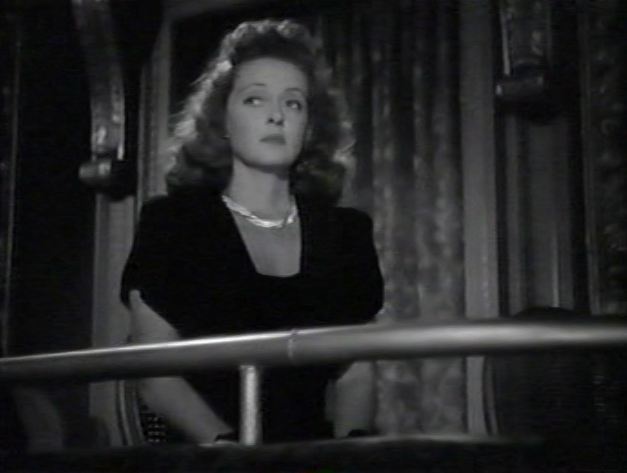
“Mildred Pierce” (1945) is film that should be shown to people who say they don’t like to watch black and white movies. The cinematography here is so good that it is a living thing quite apart from the story and the acting performances, and yet the black and white photography here enhances both story and performances.
I wonder who first came up with the idea to “noir-up” James M. Cain’s novel “Mildred Pierce”? It wasn’t written that way. To be sure, Mr. Cain’s other novels that were later made into the films
“Double Indemnity” 1944 (see this former post), and “The Postman Always Rings Twice” (1946) -- are noir stories even on the page. But “Mildred Pierce” was not written as such. It’s more a character study of a woman who indomitably struggles against privation, and whose Achilles’ heel is her greatest passion, her daughter. In the hands of the Warner Bros. studio, this story, rather than a weepy so-called “woman’s picture” becomes first class Noir.
Largely, this is due to the cinematography.
I’m not going to do a play by play on the plot of this movie, but there are going to plenty of spoilers anyway, so turn back now if you want. Go outside and water my garden. But close the storm door good because the air conditioning’s on.
Now then.
As to those poor souls who won’t watch a black and white movie, I can only say that is something akin to not wanting to view Da Vinci’s “Mona Lisa” because it was painted in oils and not drawn with a Sharpie on a lined pad. Black and white, the uneducated need to learn, was merely a medium, like acrylic or clay. Some cinematographers were masters at the art, and “Mildred Pierce” (1945) is a great example of what style can do to add, or even substitute at times, for substance.

The novel begins with Mildred’s ineffectual husband tending the garden. It is a slow start to slow-paced book. Those of us who are familiar with the plot know their marriage fails, Mildred supports herself and two daughters by becoming a waitress, and then owning a chain of restaurants. Another marriage to a playboy, a lot about her business ventures, but overall the prevailing motive in Mildred’s life is to make her older daughter love her. Her daughter is a spoiled brat, and turns into a nasty young woman. Mildred’s brand of mother love is like a mental illness.
The novel was made into a TV miniseries last year, and done very well. The performances were great, and the story followed very closely Cain’s novel. Some might say the 1945 movie starring Joan Crawford, which strays from the novel here and there, was re-shaped to make Joan Crawford a heroine, which in movies of that era, for a woman of a certain age, meant depicting her as long-suffering and self-sacrificing.
That may be a valid observation, but should not be used to dismiss this movie as merely a vehicle for Joan Crawford and her dramatically padded shoulders. The real star here is Ernest Haller, who was director of photography on this movie. Michael Curtiz directed. The writers were a team of eight, including William Faulkner and Margaret Buell Wilder. How they managed to craft something so sharp and cohesive with too many cooks amazes me. Who decided on noir?
The movie starts quite shockingly with a murder that did not happen in the book. We see Zachary Scott, one of the best charmers and villains of the day, facing us with a stunned expression as he is mowed down by gunshots seemingly coming from us.
He topples directly into the camera. As he flops on the floor of his beach house, a gun is tossed from our direction onto the body, and we hear a door slam. He groans, “Mildred.” What could have been a weeper has started off the blocks as a murder mystery.
So, this is what film noir looks like on a big budget. Purists may feel that noir is best in a low-budget environment just as revenge is best served cold, but in this movie it is sublime for its meticulous homage to the beauty of black and white photography.
The beach house, Art Deco-cum-Post Moderne, its interior half lit by flickering firelight in the dark night. Joan Crawford, who plays Mildred, wandering a damp pier with perhaps the intention of throwing herself off to commit suicide. She brings Jack Carson, who plays her business associate and would-be romantic pursuer back to the beach house. He displays that savvy, slimy, good-hearted charm as only Jack Carson can. She locks him in with the corpse and leaves him there.
Shots of his panic when he can’t get out, and discovers the body. His shadow on the wall as he runs from room to room. Like a fun-house nightmare.
Look at the typical noir shots that are taken from either the floor or table-level and look up to the ceiling. I think it was film noir that gave us ceilings.
Eventually, of course, we get to the inevitable flashback, also a film noir staple, where we are taken back to the premise of the novel and see Mildred’s story from the beginning. Her husband, played by Bruce Bennett, is unable to support his family, and is seeing another woman on the sly. He seems like a weak character, except that he tells Mildred straight off she’s ruining older daughter Veda, played with venial relish by Ann Blyth, with all her spoiling. Bruce Bennett may be a failure in business, but he’s no dope. He’s clearheaded and has seen what Joan Crawford fails to see through this entire movie, that she’s creating a monster.

If the movie were just about that, I don’t think it would hold my interest. Both Mildred and her daughter seem stuck in their faults, do not change, and are almost one-dimensional for it. However, as tiresome as these qualities are, I cannot say that the two characters are not realistic. They are. Many of us have known parents who make their children feel as if they are the center of the universe and then the children become nasty young adults and peculiarly unable to cope with life without their parents financial or emotional support.
Many of us have known people like the Ann Blyth character who are solidly self-absorbed and quite histrionic about it. The characters of Mildred and Veda may be tiresome, but they are real enough.
What really makes this movie is not the story -- but the telling of it. It’s just a lot of fun to watch. Scenes are introduced through a close up on a small item, such as the shot of Jack Carson’s hand manipulating a soda dispenser as he makes drinks for the scene where he first comes on to Joan Crawford.
The shot of Miss Crawford as they converse as a restaurant table through wafting cigarette smoke. Unusual in that neither of them are smoking in this scene; it comes from another table.
The shot of Crawford rummaging through keepsakes in a desk drawer and finding the inevitable loaded handgun. Ever notice how many handguns are in desk drawers in the old movies? There’s nothing interesting like that in my desk drawer. Just some dried up Wite-Out and some highlighters, and erasures. There’s a letter opener, I suppose I could kill somebody with that.
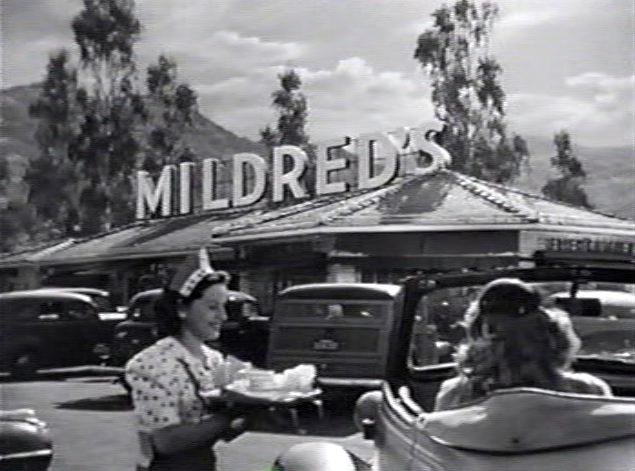
We move to a variety of lush scenes, from Mildred’s ever-expanding restaurant empire, to the fabulous homes. Some enterprising old movie buff should open a chain of restaurants called Mildred’s. I’d eat there every night.
We catch a glimpse of a carhop taking an order over the tray mounted on the car door.
Have a look here at our previous post about movie carhops.
The movie isn’t all shadows. Here’s a well-torsoed Zachary Scott peeling off his sweater to go swimming with Joan. Oh, those form-fitting, high-waisted men’s bathing suits of days gone by. They made every man with a halfway decent body look like Johnny Weissmuller. The baggy knee-length clown pants men wear today sagging too low off their hips are enough to make a woman weep with disappointment.
Eve Arden, a graduate of the Ruth Donnelly School of Wisecracking Sidekicks is on hand to be a sounding board for Joan, and to provide occasional comic relief, such as when she teases the fuddy-duddy accountant who barks at her for interrupting their meeting.
“It’s only because I want to be alone with you. Come here and let me bite you, you darling boy.” Then she woofs at him like Curly in The Three Stooges.
I also like the way she refers to Zachary Scott, whose oily charm doesn’t fool her a bit -- she knows a bad egg when she sees one -- as “laughing boy”. Bugs Bunny, famous for using the term, was also a stalwart member of the Warner Bros. stable, though I’m sure the studio did not have a copyright on the term.
But I think the funniest moment goes to young Jo Ann Marlowe, who plays Joan’s younger daughter. She does a Carmen Miranda imitation that’s a hoot, though all Miss Crawford can do is smirk and then grow irritable, telling her to wash the makeup off her face. Jo Ann had a brief career, but cut an impression as the young Josie in “Yankee Doodle Dandy” (1942) and as young Louise in
“Roughly Speaking” (1945) discussed here.
Butterfly McQueen’s on hand as Joan’s maid. It’s a less flashy role than her famed “Prissy” in GWTW, but even her lack of guile here does not keep her from seeing what a tyrant Ann Blyth has become. Only Joan is blind.
Bess Flowers shows up as a restaurant patron, but really, that is to be expected. She's a walk-on in everything. I noticed her in one of my old vacation videos. She played Loud Woman Who Sat Behind Me on Train.
One of the most luxurious shots is when Joan discovers Mr. Scott and her daughter kissing. Joan enters unobserved, and we see Scott holding Miss Blyth, her back arched over their home bar. Her long formal skirt is luminous in the foreground light, while their upper bodies are darkened in silhouette. Sometimes I feel like installing a bank of Fresnels on my living room ceiling just to make me look good when I enter the room.
When they see they are not alone, Ann Blyth steps out of the embrace and a pin spot reveals her smirking expression. In another moment, Zachary, who is Joan’s second husband, leans forward and his face becomes lit as well, prolonging of the suspense of discovering who she was with, in case we hadn’t already guessed. It’s a great bit of lighting choreography, like a dance.
I love his wary expressions as he lets Ann Blyth do the talking. You can see the wheels in his mind turn. He is looking for a way out. Scott, who had such depth, is excellent at this. Any other villain would just paste a sneer on his face.
By the way, look at the background. The drapes match the couch.
See our previous post here on this movie phenomena.
The novel, as well as the 2011 TV miniseries, shows a different scene. Mildred catches them in bed together, and Mildred’s playboy husband shrieks defensive protests. The 1945 movie may be less titillating, but it is more visually stunning.
Joan Crawford, of course, won her Oscar for this role, but I don’t usually keep score on a movie by Oscars. Her performance is fine, but I think only really great when at the end when she must accept that her daughter is going to prison. The whimper, the sick groan of despair in her voice is heartbreaking.
Unfortunately, Ernest Haller did not take home an Oscar for his cinematography (Ann Blyth and Eve Arden were both nominated for Best Supporting Actress).
The movie is really his.
And yes, every time I watch this movie I think of the Carol Burnett parody. It even mocks the ocean surf that luridly washes over the opening credits. But it's not in black and white.


 Andrews’s voice is what fascinates me most. He speaks his lines with his chin sunk into his chest, pushing the dialogue out of his body with a sound somewhere between growling and weeping. I know he was supposed to have a fine bass singing voice, but I never heard it. I can believe it listening to the fullness of his speech in this performance.