IMPRISON TRAITOR, PEDOPHILE, AND CONVICTED FELON TRUMP.

Monday, May 21, 2012

Secretariat (2010) & Casey's Shadow (1978)


This week we’re going to talk about horses. Four movies, three horses, two blog posts, and one blogathon. More about that later.

In this season of thoroughbred horseracing where every two weeks we have another event -- the Kentucky Derby, the Preakness Stakes, and coming up, the Belmont Stakes -- most of us follow these events on television. I watch them every year, mainly because of the excitement that I still remember as a child watching one horse called Secretariat win each one of them, one by one.

I was reminded of that thrill several months ago when flicking channels I caught a few minutes -- only a few minutes -- of the film “Secretariat” (2010). I want to say it was more than the rush of nostalgia that came over me for those days, but I really had the strangest feeling of time travel and being in the moment once again. It had something to do with the race announcer shouting his incredulous superlatives at Secretariat’s speed, and partly having to do with the frocks and neck scarves of Diane Lane, but for a few moments I was there. That’s where the idea for this series began.

Horse races take only a couple minutes, but reading this post is going to take up your whole lunch hour. Another Long Post from Another Old Movie Blog.

This two-part series is about a sense of personal nostalgia, but also the way the movies take this idea of nostalgia and use it as a device for storytelling. We’ll be comparing films made in particular eras -- in this case the 1930s/40s and the 1970s -- and contemporary films set in those eras which always tends to clean up the past a little. We remember things a little brighter than they were.

We’ll be talking about horses insofar as how we project our thoughts and our feelings and our greatest desires upon them. The horses here are champions, and we like to think they like to be champions. But, despite all the horse whispering that goes on, we really don’t know what they think. We love them, and we manipulate them.

Today we’re going to discuss “Secretariat”, and “Casey’s Shadow” (1978) that take us to the 1970s. Friday we have “Seabiscuit” (2003) and “The Story of Seabiscuit” (1949) that take us to the 1930s. We’ll conclude on Friday, rather than the usual Thursday post, so we can latch onto the horse blogathon sponsored by Page over at My Love of Old Hollywood.

Secretariat and Seabiscuit were real horses. Casey’s Shadow is a fictional character, and that film is based on a short story by John McPhee that was originally published in the New Yorker magazine April 29, 1974. It is about a real race, however, the Ruidoso All-American Futurity held in New Mexico, which is called the richest horse race in the world. Secretariat and Seabiscuit were thoroughbreds, but Casey’s Shadow is a quarter horse, which excels at shorter races under a quarter of a mile. It is the most popular breed of horse in America, and they can be found anywhere from racecourses, to working ranches.

We hear a lot about breeding in these movies. Breeding, and training, and heart, a sense of courage in the horse, and the jockey, and sometimes in the owner. There’s also lot about money changing hands.

When Secretariat won those three important horse races in 1973, the Kentucky Derby, the Preakness and Belmont which together are called the Triple Crown, he was the first horse to do it in 25 years. (At this time, I’ll Have Another just won the Preakness, and so with a Kentucky Derby win already under his belt, he may be the first horse in 35 years to win the Triple Crown. We’ll have to wait and see next weekend. The last horse to win was in 1978. There were three winners that decade.)

Secretariat became a rock star, featured on magazine covers and the talk of everyone everywhere. Even for those of us who grew up in suburbia and had very little contact with horses knew his name. Children sped on their bikes down the street pretending they were riding Secretariat.

The early 1970s was an age where sports heroes began to take off in popular culture. I’m not sure if it was because of the disillusionment with Vietnam War, Watergate, or the general cynicism that began to creep into our society, but we looked to sports for heroes, and they came by the bushel full in the 1970s. Tennis stars became household names, and Muhammad Ali of course, and baseball players began to garnish fabulous salaries. The Super Bowl started becoming an event in popular culture and not merely a sporting event, giving birth to the Super Bowl Party and the end cap display of nachos in grocery stores. Sports moved from the back page of the newspaper to the forefront of our consciousness.

And then there was the mighty Secretariat, no less a hero because he was a horse.


“Secretariat” (2010), put out by the Disney studios, carries that familiar tone of Disney films as a feel good movie. The early 1970s looks cleaned up a bit, and some of the dialogue with “feeding” lines and clichéd keep your chin up speeches sounds a bit clunky here and there. Still, the movie catches enough of a flavor of the era to remind someone who remembered it firsthand of the excitement of that horse’s victories.

But I’m not sure it packs enough of a punch to instill this sense of understanding for someone too young to remember. “Seabiscuit”, which we’ll talk about on Friday, does.

When we are young we soak ourselves in popular culture: TV, music, commercials, everything is grist to the mill of our development. The older we grow, the less influenced we are by popular culture, the less we even care about it.

It is a true story of owner Penny Chenery Tweedy, a woman in a male-dominated sport -- the sport of Kings. She is a Denver housewife and mother of four, whose father owns a horse farm in Virginia. She grew up in a world of orderly stables, green pastures set off by neat white fences, a grand house with a dark paneled den laced with photos of horses on the walls, and shelves and mantles lined with trophies. Her elderly parents die, and she must dispose of their estate. Her brother, who is a university professor and has no interest in the horses, wants her to do this quickly. He fears a six-million dollar estate tax. We should all have such worries.

But she does care deeply about the horses and her family heritage. Mainly from sentiment, and being her father’s girl, she plays hooky from housework off and on for the next three years and raises a new colt, putting off the sale of the farm until she can race him. Diane Lane plays Penny in a warm and sympathetic manner. She is gutsy, but every inch a lady, a southern gentlewoman -- with no trace of Virginia in her speech -- who is trying to be supermom to everybody. She is full of pep talks, and a little horse whispering.

We are involved more with the people around Secretariat than the horse. John Malkovich plays the French-Canadian trainer who dresses colorfully and speaks colorfully, and lapses into French when provoked. He’s a thin-skinned bundle of neuroses, a great character to play. Though he occasionally berates the jockey, he wishes him “Bon chance” when he mounts to ride.

I think my favorite is Margo Martindale, who plays Elizabeth Ham, the secretary to Diane Lane’s father, whom Miss Lane has also inherited. Martindale gives Eve Arden a run for her money in the supportive and wisecracking friend category. It is she who gives Secretariat his name.

Fred Thompson and James Cromwell are among the wealthy gentlemen horse farm owners who cross paths with Diane Lane, and Nestor Serrano as a less genteel rival.

We get snatches of Miss Lane’s family life, her ersatz hippy daughter (though to be fair, most teens in the late 1960s and early 1970s if they aspired to the hippy counterculture really were ersatz, only playing at the game), and her lawyer husband who wants his wife home and out of the horse business. After a few wins and some feel good speeches, her husband comes around and the kids see what a great mom they have because she’s doing her own thing, which is groovy, and being successful at it, which is groovier still.

A cute bit where she and Nelsan Ellis, who plays the groom, Eddie Sweat, wash the horse to the background of “Oh, Happy Day”. This is reprised at the very end of the film when we see the final burst of glory that the amazing horse gave when he won his third race, clinching the Triple Crown.

He rounds the final turn. Along with a reprise of Lane’s voiceover of the Book of Job (39:22) which introduces the film -- “He laughs at fear, afraid of nothing...he cannot stand still when the trumpet sounds…” -- we get the joyous burst of “Oh, Happy Day” and that magnificent horse wins, just as he did in 1973, by an astounding 31 lengths. His speed records at the Kentucky Derby and the Belmont still stand.

I especially like that the end credits give us cameos on the what happened to the characters (though they do not mention Penny Chenery Tweedy’s divorce the following year from her husband), and show the real Penny, an elderly, but still spirited lady, sitting as an extra in the stands.

The crowd scenes in these movies show how important these shots can be to the tone and “reality” of a movie. In “Secretariat” the crowd scenes are shot very tight, in small groups. After all, hiring numerous extras and CGI are expensive. To maintain “1973” we have to shoot carefully chosen setups with a small group of actors in appropriate costumes and hair styles. The crowd scenes in “Secretariat” feel very tightly controlled. They seem stagy.

The horse racing scenes of necessity must be controlled, but this is done fairly well. We get our share of thundering hoof beats and panting, snorting horses, though most of the drama in the movie is centered on Diane Lane.

Among Penny’s speeches: “Our father came from nothing. And his legacy to me isn’t money. It’s the will to win, if you can, and live with it if you can’t.” A fine and sensible legacy, but her brother wants none of it, “If you stumble and fall, you don’t just make us fools, you make us beggars.”

And her husband, played by Dylan Walsh, “When your horse people call the house they don’t ask for Mrs. Tweedy. They ask for Ms. Chenery. Is that who you’ve become?”

We may have grown tired of the chauvinist streak in characters who today sound like cartoons for doing it, but we have to remember that the women’s movement was in its early days. His sentiment is genuine. What did not sound genuine to me was a reporter’s marveling at another horse “turning in awesome workouts,” and her daughter commenting on seeing Lane on TV, “Mom looks awesome.” This was years before we turned “awesome” into a meaningless word parroted with unrelenting foolishness.

She should have been "far out".

A favorite shot: when a little girl takes Secretariat’s picture. She’s holding one of those 110 Kodak cameras with the flash bar on top. How many of you had one of those?


“Casey’s Shadow” (1978) is both brisk in its 1970s reality -- it was after all filmed in the era it depicted so there’s nothing artificial here -- and strangely lulling in the direction of Martin Ritt, who takes us on the journey of another horse to both victory and tragedy, and dealing with each with a shrug. There are no platitudes here, and this is not a “feel-good” movie. There is humor, tinted by the 1970s cynicism that grew even stronger the farther we get away from the sight of Diane Lane in her formal gown, complete with opera gloves, talking to her horse.

The pace is slow -- the movie’s pace, not the horse’s -- and this reflects the original short story, which is quite long and leisurely. Movies are not made this way anymore, and neither are short stories. Our attention span has taken a hit in the last 30 years or so.

The story is set in the back Cajun country of Louisiana, where Walter Matthau plays a horse trainer, who drifts in and out of his Cajun accent, and sometimes goes by the nickname of Coonass.

His wife has left him. We don’t know exactly when or why, but he seems little disturbed by it. The youngest of three boys, Casey, mopes about and gets into trouble with great regularity. Casey needs somebody to look out for him, and Papa Walter’s not doing the job.

Neither Casey, played by Michael Hershewe, nor his middle boy, have southern accents, though his eldest son, Buddy, played by Andrew Rubin, does attempt one.

Rubin is good in his role as the 20-something lad following in his father’s footsteps as a trainer of quarter horses. Happily for the family, he has a far greater sense of responsibility than his dad, and Buddy is one who looks out for Casey, and tries to get meals on the table. He warns his father there is no food in the house. The gentle young man bears the weight of the world on his shoulders. He blows his stack when the others do not do their chores and the house looks like a pigsty.

Actually, pigsties are neater than their tumbledown house. No neat white fences here. Both the house and the barn look like they’re about to fall down.

In “Secretariat” we are introduced to the idea of breeding through sires and dams, and how important bloodlines are to determine not just the health of a horse, but the spirit. We get more lessons on breeding in “Casey’s Shadow”, but not just about quality horses. What makes a quality human is also explored.

Alexis Smith plays Sarah Blue, a southern gentlewoman who owns and breeds champion quarter horses. Breeding quality is her mantra. Unlike Diane Lane, Miss Smith manages a credible soft southern accent. But, we do not see her even once in opera gloves. First, because we are in the late 1970s now, and styles changed with alarming swiftness. Elegance has been replaced by leisure suits. This I remember, too, from childhood.

Second, Sarah Blue is a hands-on owner. She has a reputation for sometimes sleeping with her prize horses in the stable, and spoiling her favorite horse with Milky Way bars. Smith makes her entrance in the film riding on a horse, accepting with dignified nods the men who respectfully call out, “Mornin’ Miz Blue” to her. She had made many “slinky walk” entrances in movies, but never on a horse. In her jeans and cowboy hat low over her eyes, she looks like a cross between Queen Guinevere and Paladin.

Another difference that distinguishes her from the dainty Miss Lane is a surprising yuk, yuk, yuk chuckle that sounds like Mortimer Snerd. At first I thought she meant to inject the flavor of cornpone in her character, but then it struck me that possibly this was close to how Alexis Smith really laughed.

Director Martin Ritt, whose “No Down Payment” we covered a few weeks ago, had a style of direction that leaned toward introspection and a natural feel for his characters and setting. “Casey’s Shadow” is shot with this leisurely sense of a natural setting, there is very little manufactured drama in terms of camera shots or lighting. Indeed, most of the film is shot outdoors.

Alexis Smith’s performance in this movie is probably the most natural and unaffected she ever gave, so it stands to reason Ritt would allow Smith’s own ridiculous laugh to rip out of her.

In his “Everything Was Possible - The Birth of the Musical ‘Follies'” (Alfred A. Knopf, NY, 2003), author Ted Chapin called Smith’s laugh a cackle. Columnist Louella Parsons referred to “…that devastating laugh of hers,” (syndicated in Milwaukee Sentinel, May 27, 1948). “I haven’t known a girl to laugh like she does since Carole Lombard.”

I also got a chance to hear a clip of a 1980 radio interview where she does, indeed, rip out a maniacal giggle in between intelligent and ladylike remarks. It seems this was a goofy side of her Warner Bros. decided not to show in their carefully groomed ice princess.

Smith has the job in this movie of being the moral counterpart to Walter Matthau. He falls from grace big time, and his own code of ethics, which is simply, “Never run a hurtin’ horse.”

But he is only human, and greed is a very human failing.

Eldest son Andrew Rubin comes home with a new horse for their boss, Calvin Lebec, played by Harry Caesar. Mr. Caesar is at first disgusted because he wanted Rubin to buy a nice young colt to race, but what he came home with was an old mare. However, like Jack, who sold the cow for some magic beans, there’s a hidden opportunity here. The mare foals, and the colt that is born is the son of Alexis Smith’s famous champion horse.

In quarter horse breeding, artificial insemination is allowed (it’s not in the breeding of thoroughbreds), and through some shady deal, the semen is sold without Miz’ Blue’s control. And when it comes to breeding her horse, she is a bit of a control freak.

She hears about the young colt, and comes to buy him, but Walter has his own plans. He wants to take the colt, called Casey’s Shadow, to the Ruidoso race in New Mexico and win, and go to Tahiti “where the women don’t wear no tops.”

They strike a deal where she can buy the colt after the big race.

But events conspire to challenge Matthau’s single code of ethics: “never run a hurtin’ horse.”

First, Casey, who roams backwoods race courses looking for someone to con and beat at pool or matching pennies -- he is his father’s son -- twice injures the horse in foolish demonstrations and a race for money. Walter’s ready to kill him, but we begin to see it’s not just because the boy has done a cruelty to the animal; it’s because the animal is their fortune and the kid is blowing it.

As much as we want to throttle Casey for his shiftless and thoughtless behavior, the little boy also breaks your heart. His mother ran out of him, and his adored older brother Buddy will go away soon because Alexis Smith has hired him to be her new trainer. A rival trainer kills his pony (accidentally -- he had intended to kill Casey's Shadow).  Everybody leaves Casey. Walter pays little attention to anything but his beer.

By the way, though we watch the colt grow to a big, strong horse, the boy stays the same size over a period of two years. I think we’re not supposed to notice that.

They patch up the horse and he’s sound enough to run. They truck him from Louisiana to New Mexico in a horse trailer pulled by Matthau’s broken down pickup. Casey’s Shadow wins a qualifying heat. They’re one step away from going to Tahiti.  Where the women don't wear no tops.

But the horse hurts his leg. He’s limping a little bit. If Walter pulls out of the finals, Alexis Smith will still buy the injured horse. They’ll get $50,000 just for not running him. Walter will lose nothing.

His sons do not want him to race Casey’s Shadow, and neither does owner, Harry Caesar.

Walter is obstinate. He tells them, “This horse is my only chance. You see Sarah Blue offer ME a job, or Ted Patterson or anybody?”

He tries to explain his shift in values.

“I had my beer, farm, you kids. Seemed like enough to me. More than enough…then he come along.” He wants to, “Get my name in the record books…right up there along with Sarah Blue and God. I know it’s wrong to run a hurtin’ horse, Buddy, but I got to do it.”

Alexis plays high stakes, but the money means little to her. I wanted to know more about her character. Is she married, widowed, divorced? Does she have children? We see only that she is a woman of few words, runs her racing stables alone and does not seem to have the difficulty Diane Lane did of being a woman in a male-dominated sport.

When they saddle up the horses for the big race, Matthau and his team are stoic, all business, tightening, fastening, poking and prodding the horse like he is a boxer in the locker room getting ready for a match. Alexis Smith, however, combs her fingers through her horse's forelock, wipes his face, runs her hand over his eyes, carefully slipping on the blinkers, looking like she is dressing her child for school.  Any minute you expect her to lick her fingers and smooth down his hair.  She smiles at him.  Her pride and joy.  One senses she is simply more comfortable with horses than people.

When she sits in Walter’s pigsty of a kitchen talking business, she does not bat an eye over the mess around her. When his eldest son, in an endearing gesture, nervously plunks down what looks like a plate of Oreo cookies for their guest, she snatches one when she leaves because a real lady fits in anywhere.

Buddy is very careful about standing and taking off his hat in her presence, but he needs to remind Walter to do this. Walter sometimes does and sometimes doesn’t. Especially when he’s drunk.

Matthau’s character is laconic, and larger than life despite his low-key amusement at hustling suckers at country racecourses. He is incorrigible, lovable somehow despite his lack of grace. But when this choice comes up that he has to make -- race an injured horse or not, this is where we determine the kind of man he is.

He races the horse.

The crowd scenes that show the limitations of filming in “Secretariat” here are grand shots. The cameras are brought to actual race days at Ruidoso, so the enormous crowd of onlookers are not actors. They are natural, in their own clothes and habits, paying attention or not paying attention, gabbing and drinking. We see people laying down their money at the betting booths, and scooping it up if they win. We hear the loudspeaker announcements. It’s like a documentary about racing.

It’s very absorbing, except for the scene where Casey’s Shadow wins the race and we see Walter Matthau hoot and holler and run onto the track. I couldn’t help but think of him as a movie star who plays a scene in front of a crowd who were told by the announcer, “We’re going to hold the sixth race for a few minutes so a movie can be shot. When Walter Matthau runs across the track, everybody cheer and clap.”

It looks artificial despite its ironically very natural setting.

Just like John Malkovich wishes, “Bon chance” to the jockey in “Secretariat”, Walter and Buddy wish “Bon chance” to the middle son who is the jockey on Casey’s Shadow. We never get to know much about him, except he’s girl crazy.

Then, after the jubilation of the win, they discover the horse is lame. For good. The vet recommends he be euthanized.

There’s no real loss here, in business terms. Alexis Smith will not buy the lame horse now, the deal is off, but she is not disappointed about that; there will be other horses. She is angry because Walter willingly destroyed a horse for his own personal gain.

“You knew this would happen,” she says. He did. It was never a matter of IF the horse got permanently injured. He knew it would be.

The horse is no longer needed now the race has been won and Walter's got the money and his name in the record books.  The animal is disposable.

His sons are disgusted with him, and the younger ones want to go with Andrew Rubin to his new job as Alexis Smith’s trainer. She takes them all in.

The last we see of her is when the boys are clambering over her horse trailer and she pokes Casey in the belly saying, “Welcome aboard, cowboy.”  We never get to find out if she turns into a surrogate mother.  Walter comes to apologize, and tells them that he has spent some of the winnings to get the horse an operation on his leg.

In the final scene, the boys go home with their father. Blood may be thicker than water, but one can’t help but feel they’d be better off with Miz Blue. She runs a tight ship, and they’d get three square meals a day with her.

Walter’s paying for the horse’s operation is not entirely altruistic. The horse will never race again, however as a champion it will earn high stud fees. No loss. Except to the horse, perhaps, who now must endure a long, painful ride home to Louisiana and perhaps pain the rest of his life. We don’t know.

We only see lovable scamp Walter Matthau and his three aimless boys going home together. It should be enough, and it’s not, even though these are the cynical years of the late 1970s where the kind of platitudes we see Diane Lane spout are too unrealistic, perhaps too embarrassing to hear anymore.

Perhaps this is what made an otherwise interesting film founder at the box office.


From a review by Robert H. Newhall syndicated in the Bangor Daily News, March 27, 1978, “…as a father he is a cipher, for he gives his sons no direction, no uplift at all…it is difficult to warm to Matthau.” He has kinder words for Smith, “As this upright woman, Miss Smith, always a Junoesque beauty, brings a class to the screen that is sadly lacking these days. Even in her small role, she is credible, giving the film an affirmative bias.”

Alexis Smith, interviewed by Ed Blank of the Pittsburg Press December 17, 1978, noted that she enjoyed working with Walter Matthau and admired Martin Ritt, “He brought out really human qualities in all in all of us. It was one of my best working experiences.”

In the New York Times of November 11, 1978, she noted that there were three directors in her film career from whom she felt she learned the most. These were Edmund Goulding, who directed her in “The Constant Nymph” (1943) see this previous post here, Frank Capra, who directed “Here Comes the Groom” (1951) see post here, and Martin Ritt of “Casey’s Shadow.”

I get a chuckle out of the ice princess, clad in jeans, strolling into a crowded bar for a business meeting to the background sound of “Ramblin’ Man” by The Allman Brothers Band.

TCM is showing “Casey’s Shadow” Friday, June 1st at 8:00 a.m., if you want to have a look. Let me know what you think.

Come back Friday for more horse racing, and two very different movies about the same famous champion, Seabiscuit, as part of Page’s Horseathon.


Thursday, May 17, 2012

Gathering of the Movie Stars

Have a look below at this gathering of movie stars in 1974 for the festivities surrounding the release of "That's Entertainment".  They are introduced alphabetically to take a bow.

I think what moves me most is the big hand bit actor Marjorie Main receives, how all the big stars applaud her, help her onto the stage, the way mega-star Myrna Loy holds onto Marjorie Main with affection and to physically support the frail older woman. 

All dressed to the nines, coiffed, in their 1970s glamour, maxi dresses, gowns and ruffled shirts, perhaps defying the notion that they are merely to be put on display as products of 1970s nostalgia craze.  It is a moment for the present, not the past, because they really cannot recreate the Golden Age of Hollywood.  They know that better than we do.  We movie buffs will look at this with warm smiles and soft eyes for regret of days gone by-- that most of us do not remember.  They, however, are living firmly in the here and now as it was the night of this banquet.  They are on the town.

"Do not go gentle in that good night...rage, rage against the dying of the light," poet Dylan Thomas said.

Marjorie Main was something like 84, and would die the following year.

How many of your favorites are here? 

(Don't forget to scroll down to the bottom of the blog and mute the music so you can hear the video.)


I'd love to know what you think about this clip.

Monday, May 14, 2012

North by Northwest - 1959


“North by Northwest” (1959), a forerunner of James Bond-type spy action flicks, a witty who-done-it-and-where-is-he, is also, at times, a comedy with style, elegance, sexual innuendo, and trains, sometimes all at once.

It’s the train we’re going to discuss today, now that I’m in withdrawal from my favorite holiday - National Train Day.

And we’ll also talk about the sex. Never have the two been so closely linked.

Today’s post is our contribution to the For the Love of Film: The Film Preservation Blogathon III. This year, the intrepid host trio of Farran Smith Nehme of Self-Styled Siren, Marilyn Ferdinand of Ferdy on Films, and Roderick Heath of This Island Rod are raising funds for the National Film Preservation Foundation's project, The White Shadow, directed by Graham Cutts -- which was “written, assistant-directed, and just generally meddled with in a number of different ways by the one and only Alfred Hitchcock”.


Please visit the three blogs of our hosts for lists of other blogathon participants and contribute if you can to the National Film Preservation Foundation.

In “North by Northwest”, Cary Grant is an advertising executive caught in a web of cold war intrigue and murder when he is mistaken for somebody else. His wit and his charm make for easy transitions to the moments of the film that are by turns elegant, mysterious, and even quite funny. Director Hitchcock and writer Ernest Lehman skillfully blend all these elements in a delightful way.

There is of course another element, one of suspense, of danger if not outright terror to Grant’s character, who through the course of the film is kidnapped, nearly killed several times, chased by the police as a suspected murderer himself, and dance partner to a homicidal crop duster.

The terror, I think, would be stronger if someone like James Stewart were in the role. Mr. Stewart had the ability, greater than Grant’s, I believe, to convey panic and psychological torment. If Stewart had been the man on the run, we’d worry more about him. Cary Grant, however, has that panache, that confidence in himself that makes us have confidence in him. We somehow know all along he’ll be fine.

He is, however, more fitting for the erotic train sequence than Mr. Stewart, whose vulnerability was part of his own particular charm. Grant shuttles us into the sexy 1960s.  He's more swinger than victim.

In “North by Northwest” the train, though often a place of mystery and even terror in Hitchcock films, instead becomes a safe haven, a place of romance, and at the end of the film is revisited for a happy ending.

Mr. Grant, on the run, and on his way to Chicago, slips aboard the 20th Century Limited in New York. Have a look at our previous trip aboard this famous train in “Twentieth Century” (1934).


The stowaway bumps into Eva Marie Saint in a corridor, where she smoothly diverts the cops who are chasing him. We might wonder why, since they are strangers and she seems not to care that he is wanted by the police. We soon learn she is not all she seems to be. For now, her mystery, like a delicate perfume, fills the train car and that is enough. We are in no great hurry, and neither is she.

Grant encounters her again in the dining car, where their ordering of brook trout invariably invokes for me the scene of Claude Rains’ petulant ordering of brook trout in “Deception” (1946) discussed here.

When you’re in a train dining car today, you still get the tablecloth, the bud vase with the flowers, but if you want a chance encounter with someone like Cary Grant, you’ll have to arrange that beforehand.

Which, it seems, is what Eva Marie Saint and her cohorts did.

Thorough planning is the sure way to a more pleasurable trip.

Though Cary Grant’s patented suaveness leads us to expect a tryst with the lady, it is really Miss Saint who controls the scene with such leisurely, and serene, seduction.

“It’s going to be a long night…and I don’t particularly like the book I’ve started…You know what I mean?”

“Tell me, what do you do besides lure men to their doom on the 20th Century Limited?”

She cups his hand when he lights her cigarette, drawing his fingers close to her lips so she can blow out the match.

We cut to her compartment where he is stuffed into the closed upper berth, hiding while the cops inspect her room. They spend the night together, without us. She will hide him a third time the next morning when she disguises him as a redcap carrying her luggage.

We are always aware of the threat against Grant, racing from the cops, racing against time, but the mystery and the threat is diminished on the train because we are distracted -- by Eva Marie Saint, and by the scenery, some of it quite lovely, passing outside the train. The looming Hudson River following us, the industrial backyards of steel and soot, and the blinding red sunset into which we are flying. Rather than leaving behind the outside world, it comes along for the ride.

Other locations in the movie, the mansion, the hotel rooms, the United Nations Building, even the Mt. Rushmore National Memorial are interesting and evocative -- but they are all mostly sets, and rear screen, and stagy looking. The train, with its controlled closed environment and rear screen scenery, is oddly natural looking, the only part of the film where we find dependable reality. However, here the familiar and ordinary is made exotic with the introduction of sex.

So powerful is the train in this movie that later in the film, when Grant and Saint are clinging to the rocky cliffs in South Dakota, about to plunge to their deaths, he says, “If we ever get out of this alive, let’s go back to New York on the train together…”

“Is that a proposition?” she replies.

Oh, yeah. Trains and romance. It’s the best kind of proposition.

Our final scene, he pulls her up to their awaiting upper berth, once more in the safety, but irresistible intrigue of the train.

“This is silly,” she says.

“I know. I’m sentimental.”

The last shot has the train entering a tunnel. Yes…well. Obvious and sophomoric perhaps, but at least symbolic and not graphic. Hitchcock may lead us around by the nose, but he still expects us to have an imagination.

Have a look at the other blogs participating in this worthy event, and please make your donation below to the National Film Preservation Foundation.


Thursday, May 10, 2012

It Happened to Jane - 1959


“It Happened to Jane” (1959) leaves you with a warm, fuzzy feeling about small towns, lobsters, and trains. The leads Doris Day and Jack Lemmon are delightful in their chemistry, their comedy, and their ability to convey poignancy in their seemingly hopeless financial -- and romantic -- situation. Ernie Kovacs gives a tour-de-force performance as a greedy railroad owner with the aplomb of Snidely Whiplash.


The real star, many would agree, is the location shooting. Set in the fictional coastal Maine town of Cape Ann, it was really shot in the Connecticut River Valley town of Chester, Connecticut. Have a look at my Tuesday’s New England Travels blog for photos of what shooting locations in the movie look like today. Not a lot has changed in 50 years.

By the way, in this movie they sometimes refer to a nearby town called High River. In reality, Chester’s neighbor is Deep River.

In Dan Widener’s “Lemmon - A Biography” (NY: Macmillan Publishing Co., 1975), Jack Lemmon is quoted as recalling “It Happened to Jane” as “…a charming picture made when you could still do charming films.” (p.162).

This comment boils down, I think, the essence of the appeal this movie has for viewers today. It seems to document a time for us when childhood summers were lush and long, and Norman Rockwell-type towns were idealized.

It also documents for us, unwittingly, the beginning of the age when railroad companies began to cut down their service in an effort to force passengers away so that they could eventually drop passenger service as being less profitable than carrying freight. We discussed this on Monday’s post in “The Out of Towners” (1970) -- which graphically demonstrates the hell of train travel when it hit rock bottom in the last days when railroad companies were privately owned and bent on scuttling themselves. What happened next was the founding of Amtrak, and a new era in passenger train service.

This Saturday the 12th marks the 5th annual National Train Day in celebration of our national railroad. Have a look here for events and information.

The beginning of the end of private railroads -- that led to Jack Lemmon’s and Sandy Dennis’ hysterically horrible train ride -- all starts, it seems, over ten years earlier with Doris Day and her lobsters.

She has a mail order lobster business, and ships her stock -- via train -- to restaurants and country clubs in big cities far away. She receives the disastrous news that her latest shipment of lobsters never reached their destination because the railroad company suddenly cut back on staff to receive and process them. They are shipped back, dead by this time, to her small village.

Among the villagers you may recognize the voice, if not the face, of Parker Fennelly, who plays Homer the depot agent. He grew up in Maine, so his Down East accent is authentic. He was Titus Moody on Fred Allen’s “Allen’s Alley.”

Mary Wickes has a too-small role as the town switchboard operator and want-to-be “newspaperman”. I think my favorite line of hers is when she gets up in the middle of the night to answer a call on the switchboard with the greeting, “I’m warning you, Stupid!”

It’s Jack, frantic, and trying to reach Doris for the 100th time.

Doris Day is a widow with a small son and daughter. Her son is played by Teddy Rooney, Mickey’s boy in real life. Jack Lemmon is her childhood friend and would-be boyfriend. Their relationship is warm, sweet, and supportive, but there is a wall between them that is quite subtle and beautifully played.

As kids, they were a trio -- the third member being the lively, spirited boy, Hank, who grew up to marry Doris. Jack, we hear, was the first to propose -- when they were 12. But Hank, who could charm the birds out of the trees, beat his time. Her husband, now deceased, still casts a long shadow over Jack. One senses the shy boy never got over Doris, and never got over being second best to a more colorful, more dynamic, more charming pal.

Jack is the local small-town lawyer and routinely defeated candidate for selectman. He becomes Doris’ ally and advocate when she attempts to sue the railroad for damages.

The railroad is personified for us by the ramshackle steam train, “the Old 97”, and by the less cozy and not at all darling image of Ernie Kovacs, who plays the miserly mogul bent on squeezing every last dollar he can find. He’s terrific in the role, and one suspects it must have been a part he really enjoyed. He huffs and puffs and threatens to blow everyone’s house down. He bullies his enormous staff, who desert him one by one when his strong-arm tactics to revenge himself on a certain Maine widow with two children becomes too much to stomach. He brandishes cigars, calls women “broads” and is so much a railroad man that he sleeps in a bedroom nook that looks like a sleeper compartment.

One of his flunkies is Casey Adams, who’ll you’ll remember as the goofy husband in “Niagara” (1953) covered here. In later years, Adams went by his real name, Max Showalter. Like the rest of the cast, he was quite taken with the Chester, Connecticut filming locations. He eventually came back and settled in the Chester area in an old farmhouse.

(Goodspeed Opera House on the Connecticut River, photo by JT Lynch)

When he died, he left his collection of film and theatre memorabilia to the famed Goodspeed Opera House (pictured here just up the river in East Haddam) and the newly established Max Showalter Center for Education in Musical Theatre.

Doris Day thought that Chester was a “regular Garden of Eden” -- in an interview with Joe De Bona in the Bridgeport, Connecticut Sunday Herald of July 29, 1962 -- “…although there were too many lobsters in the picture to suit me.

“I don’t like lobsters much, and in that picture with Jack Lemmon and Ernie Kovacs, I was in the lobster business. When they -- the lobsters -- looked at me with those beady eyes! Ugh! But I sure am crazy about Connecticut.”

Doris and Ernie wrangle legally about the railroad’s responsibilities until he cuts off service to the town, leaving them stranded. Though Mr. Kovacs’ character is obviously a silly cartoon, we note in Monday’s post on the train sequence in “The Out of Towners” (1970) and the establishment of Amtrak, that it was the goal of privately owned railroad companies to diminish passenger service in favor of more profitable freight lines.

“You can’t continue to run roughshod over the consumer,” he is advised. Oh, yes, he can.

“Every time one of your crummy commuters gets on my train it costs me four cents!”

Mr. Lemmon has a good line which he says with all the cynicism of his later character in “The Out of Towners” - “The distance between the right and the practical is a shame to the human race.”

The news about the lobsterwoman and the railroad magnate spreads in the media. Steve Forrest, a reporter from New York, is sent to get her story. She takes him on a tour of her town, and we get a history lesson on the composite past of small-town New England, in and around actual historic buildings in Chester, Connecticut, the stand-in for her fictional Maine village. A tour inside the quiet church, inside the town Meeting House, where we later return for town meeting. Actual Chester residents play the townspeople.

“Do you know where you are?!” Jack chastises the townspeople for abandoning the good fight in support of Doris, reminding them of their forefathers, who believed in Revolution.

When they need coal to run the train, they all scavenge some from their own coal bins. You may recall that in mid-20th century most homes and businesses in this country were heated by coal.

Steve is big city boy, a smooth operator and he falls for Doris. She is charmed by him, and flattered by the attention. The dazed, sickened expression on Jack Lemmon’s face when it hits him that he’s in a recurring nightmare of losing Doris to another man is really quite sad.

Another fun aspect to the film is the several real-life celebrities who get cameos when Steve brings Doris to New York. His scheme is to get her on the then popular TV game shows and panel shows to raise money for her legal defense against Mr. Kovacs.

Dave Garroway plays himself, as does Robert Paige of the “The Big Payoff, and Garry Moore, host of “I’ve Got a Secret”. His panel of Bill Cullen, Jayne Meadows, Henry Morgan and Betsy Palmer try to guess Doris’ secret, which flashed on the screen is “I’m Fighting the Meanest Man in the World.”  This segment of the movie cements the slower-paced 1950s world with a dose of real popular culture.

Meanwhile, Jack, left at home with the kids, is flipping out of his mind with jealousy. So frustratingly chaste is his relationship with Doris, that when he sleeps over her house to mind the kids while she’s gone, he fidgets for sleep on her couch. Apparently occupying her bed even when she’s not there is too forward for Jack. Or the censors.


We note the real-life locations in Tuesday’s New England Travels, but here we catch a clue to our Connecticut location with the presence of the television crew from WTIC- Channel 3, the CBS Hartford station.

Jack eventually comes into his own as the hero of the day in a last-minute suspenseful train run on “Old ‘97”, Doris is a genuine heroine to the nation of TV fans, and even Ernie turns out to be a hero in the end.


Despite Miss Day’s dislike of lobsters, I like their family pet, Sam the Lobster, who watches TV with the kids.  Mr. Lemmon makes a mad dash a couple of times to get him back to the water and his holding pen before he dies. He’s right up there with the seagull from “This Happy Feeling” and Samantha the Goose from “Friendly Persuasion” as my among my favorite animal actors. Lassie is all well and good, but I’ve always been more interested in character actors than stars.

Have yourself a happy National Train Day this Saturday. Make your next trip by train, and support the future of passenger rail service in this country.

(The blogger spends some quality time with an old friend.)


Or, just celebrate by cuddling up to a train.

One that isn’t moving.

Monday, May 7, 2012

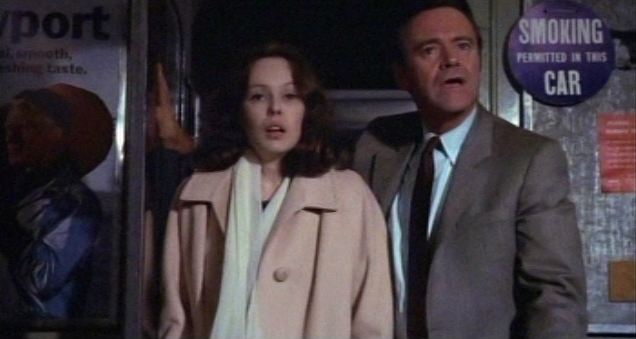
The Out of Towners - 1970


“The Out of Towners” (1970) is historically important. Yeah, I said it. Historically Important. Maybe not like the Declaration of Independence, but in its own way it shows us a moment frozen in time, a movie whose plot is driven by cause-and-effect circumstances that -- unknowingly -- will lead to an unexpected future for rail travel in the US.

Those of us interested in history, I mean REALLY interested are not so much fascinated by what happened the day the Bastille was stormed, or the day Pearl Harbor was bombed -- but what happened the day before -- of what it was like in  a world about to change  We like to look for clues in the wind of what we know happened next. “The Out of Towners” shows us what happened, almost literally, the day before the United States established a national railroad, called Amtrak.

(Springfield, Mass, photo by JT Lynch)

Welcome to our annual love-fest of all things trains as related to movies. This year’s 5th annual National Train Day is this coming Saturday the 12th. Today we’ll have a look at the train sequence from “The Out of Towners”, and Thursday we’ll cover “It Happened to Jane” (1959). Both movies feature Jack Lemmon in starring roles, and both show us what happened to train service in this country in the late 1950s and 1960s to lead to its collapse -- and the final rescue by an (unusually) bipartisan Congress to save the day and save passenger rail service in this country.

(If you look really hard down those tracks heading east you can see Boston.  Look harder.  They're waving at you.  I swear, you need glasses.  You can't see 80 lousy miles?  Photo by JT Lynch.)

It’s a very important story and a modern phenomenon of politics and popular culture. Of course, these movies are not documentaries, so what they reveal to us is largely unintended, which I think makes that revelation all the more natural and valuable. If you really want the nuts and bolts history lesson of a nation that was built on trains and finding itself on the brink of losing them, have a look at the very informative video “Amtrak - The First 40 Years - 1971-2011” directed and produced by Richard W. Luckin, 2011. The first few minutes of this film is currently on YouTube here.

“Run, Gwen, Run!”

“The Out of Towners” is a hoot, start to finish. Jack Lemmon and Sandy Dennis are a couple from Ohio flying to New York City where Mr. Lemmon is to have a job interview, expecting to be transferred to the New York office of his company. Their travel is disrupted all along the way by the most outrageous incidents. For now, we’ll just stick to the train sequence.

Which is best appreciated when you understand what was happening to rail travel in the 1960s. Passenger service declined for many reasons, but foremost of which:

It was allowed to decay, purposely, by the railroad companies.

Passenger service increasingly became less profitable for the railroads, which were all privately owned before Amtrak. Freight and mail contracts helped pay for passenger service, to a degree, but by the late 1950s and early 1960s, railroad executives wanted to get rid of their passenger service as unprofitable. They were not allowed to just stop it, the Department of Transportation would have had a few things to say about that, so they purposely refused to invest in maintenance and upkeep, they limited service, and cut out amenities. Train travel in the late 1960s, on most railroads, was a far cry from the glory days of the 1930s through the 1950s. Service was unreliable, cars were in disrepair, food was not so great, in an effort by the railroad executives to drive passengers away. They made train travel miserable, so that they could report there was not enough ridership to continue providing passenger service.

Private industry does not always have the public’s best interest at heart. Have you noticed?

Push came to shove, and the American public pulled off a grass roots drive to force the issue in Congress, demanding that passenger service be saved. Congress, fearful of the eventual necessity of “socializing” freight travel, never mind passenger service, enthusiastically responded. Signed into law by President Richard M. Nixon, it was the birth of Amtrak.

The first decade was rough, as a lot of traditional routes had to be scrapped in an effort to focus money and attention on the handful of routes that could be saved. Gone was the City of Los Angeles, gone was the Midnight Special from Alabama to Ohio, gone was the Montreal Limited and a number of routes. Equipment was hodgepodge and funding was an annual battle.

All transportation in this country is subsidized by the government. Airports, highways, they do not pay for themselves. There is no profit. They have the benefit of a solid trust fund to support them. Amtrak, however, must fight for funding constantly.

Four decades later, more routes have been added, train cars are climate controlled, quiet, comfortable, and the food is good. Trains connect not just cities in the northeast, but downtowns. Trains reach areas in the Midwest and West that are not easily accessible by airports, or sometimes even by highways. A single high-speed route, the Acela, is top notch and growing in popularity.

Trains are the most economically efficient, and most environmentally advantageous way to move large numbers of people. Though we are still far behind Europe and Asia in the development of high speed rail service and commuter rail, this is where our future lies, because with the rising cost of fuel, and the congestion of highways and airspace, we have no choice.

We old movie buffs tend to wax nostalgic about trains as we see them in 1940s movies, but trains are no longer just a nostalgic image. They are the (rail) road to the future.

Which makes Jack Lemmon’s travails in “The Out of Towners” so ironic. This movie was released the year before Amtrak came into being. The movie, directed by Arthur Hiller, written by Neil Simon, shows a grittiness in its urban shots, both in Boston and in New York. We are entering a less colorful, more cynical modern world, yet the grittiness contrasts with how the travelers appear, not just Mr. Lemmon and Miss Dennis, but the sea of extras around them. Take a good look. All the men in suits. The ladies in dresses, and white gloves. More ladies, like Sandy Dennis, are going without hats, and many of the men are, too, but most people still dressed for travel. People in this film are slow to let go of their formality, have not become as inelegant as their train service.

Their flight to NYC is diverted, because of fog, to Boston. It is night, and Mr. Lemmon needs to be in NYC by early the next morning for his important business meeting. They grab a cab to South Station and try to get the next train to New York.

They just miss it, and one of my favorite lines is when Jack, panting, hollers, “Did you see that train?”

Sandy replies, “I didn’t see anything. I was running.”

A laconic red cap with the typical stereotyped “ayuh” New England accent informs them they can catch the train at the next stop in Longview. Back for another cab ride, and they finally get on board the train by the skin of their teeth.

Notice the logo on the side of the train. In this last year before Amtrak, the trains are still privately owned, and this one is the good old New York, New Haven, and Hartford Railroad. We had a brief visit on this train when we covered “This Happy Feeling” (1958) here. The NY, NH & H had actually merged with Penn Central in 1968, but the Penn Central went bankrupt in 1970, the year this movie was released. It joined Amtrak in 1976.

The train is monstrously overcrowded, and they must wait two hours in line to get to the dining car, where all the food is gone. All that’s left is peanut butter sandwiches and nothing to drink except clam juice and tonic water, “But they ain’t cold.”

I once heard a joke, something about clam juice being what New Englanders drink when they’re hung over. I can’t vouch for that. I’ve never had clam juice, and I’ve never been hung over.

(Note guy sleeping in luggage rack to the right.  Now that's an overcrowded train.)

The conductor, punching tickets, replies to Jack, with a typical stereotyped New England “ayuh” accent, “This train runs empty six nights a week, ‘cept when the New York airport is fogged in. Then they fly ‘em up to Boston. Then we could use four more cars.”

“Why don’t you put on four more cars?” Lemmon asks.

“Ain’t got four more cars. Nobody takes the train anymore. Everybody’s in a hurry.”

The state of American railroads in the late 1960s boiled down in a couple of lines of dialogue.

The cheerful waiter who seems bothered by nothing, even amused by the chaos, is played by Johnny Brown, whom you might remember from “Rowan & Martin’s Laugh-in.”

Conductors, I am happy to report, still wear those neat hats and still punch tickets. Some of them still sing, “Worcester-Albany-Buffalo and all points we-est. All bo-a-a-rd!.” You know you’re on a northeast train when they pronounce Worcester properly. I’ve heard it butchered south of DC.

You also know you’re getting closer to New England if New England clam chowder is on the menu. I once had a discussion in a dining car with an elderly gentleman from upper New York state about Manhattan vs. New England chowder. He was for the former. We agreed to disagree.

Check out the regional menus here.   Chicken Tortilla soup on the Texas Eagle run. Southern catfish on the City of New Orleans.

We get a look at a less than resplendent South Station in Boston, likewise a run-down, dark and dirty Grand Central in NYC. The stations, like the train service, were falling apart, not maintained by the railroads. Grand Central was due to fall to the wrecking ball, a prize sought by developers, until some New Yorkers, Mrs. Jacqueline Kennedy Onassis among them, fought to save and restore the Grand Central Terminal. Today, it is as magnificent a train station as you will ever see. (Though it does not currently serve Amtrak, which goes to Penn Station across town. Grand Central serves the commuter lines like Metro North.)

(Washington, D.C. - Union Station, JT Lynch photo)

Many train stations, like the train routes of old, have undergone a renaissance in the past few decades, among them Washington D.C.’s Union Station and the Union Station in Los Angeles.

(Cincinnati - Union Station, JT Lynch photo)

Here’s some shots of the magnificent station in Cincinnati, with its beautiful Art Deco façade and inside, an enormous mural surrounding the dome in vivid colors.


(Cincinnati - Union Station, photo by JT Lynch)

Most of these re-born stations have shops and services, and in the case of Cincinnati, a city historical museum inside. They have become more than just a place to pick up a newspaper or book a ticket.


(Cincinnati - Union Station, photo by JT Lynch)

But Jack Lemmon and Sandy Dennis trudge through a man-made hell of run-down infrastructure that is as horrifying as it is terribly funny. The future of train travel, or indeed, any kind of travel, looked bleak in “The Out of Towners”. It just goes to show, past is always prelude, but not always revealing of what is going to happen next.  What happened next was Amtrak.

Come back Thursday when we discuss “It Happened to Jane”, which shows us the beginning of this era of railroad decline. Jack Lemmon is a bit younger here, much more idealistic, and helps Doris Day fight off greedy railroad executive Ernie Kovacs to save the train that serves their coastal Maine village.

This movie was actually shot in Chester, Connecticut, as well as in Hartford. Visit my New England Travels blog tomorrow for photos of what the locations in the movie look like today.

(The blogger waits to board.  Photo by JT Lynch)


Thursday, May 3, 2012

Trains, Blogathons, and Other Stuff


I have a few odds and ends to catch up with today.


(Cartoon by my twin brother, John)

First, next week we’ll be celebrating my favorite holiday, National Train Day, which falls this year on Saturday, May 12th. It’ll be a week of trains and Jack Lemmon. On Monday, a look at his train scenes from “The Out of Towners” (1970), which brings us to a discussion of the decline of rail service in the 1960s and leads us to “It Happened to Jane” (1959) on Thursday, a delightful comedy about the disruption of train service to one small New England community, filmed in and around Chester, Connecticut. On next Tuesday the 8th, come to my New England Travels blog for a look at those same sites used in the movie as they look today.

The following Monday the 14th, we take part in the For the Love of Film Preservation blogathon with a look at the train sequence in Alfred Hitchcock’s “North by Northwest” (1959).


Next, a photography exhibition showcasing the work of Gretje Ferguson has opened at the Wellesley Free Library in Wellesley, Massachusetts for the entire month of May. The title of this exhibit is called “Authors Among Us”. Black-and-white fine art portraits of 15 Massachusetts writers are included in the show. One of them is yours truly.

Next Wednesday, a reception celebrating Ms. Ferguson’s exhibition will be held, free and open to the public as an opportunity to meet the photographer and authors. I’ll be there, too, and if any reader of this blog in the Wellesley area can make this event, I’d love to meet you.

Time: Wednesday, May 9, 6:30 - 8:30 p.m.

Place: Wellesley Free Library, Wakelin Room
530 Washington Street
Wellesley, MA
781-235-1610 781-235-1610

Featured authors: Robyn Bradley, Lilian Cheung, Kyle Darcy, Steve Elman, Anita Diamant, Juliette Fay, Bob Halloran, Dello Iacono, Daphne Kalotay, Kathleen Burns Kingsbury, Jacqueline T. Lynch, William Martin, Peter H. Reynolds, Neal Sanders, Katrin Schumann, Alan Tolz, Gail Van Kleeck, Raffi Yessayan

See you there.

Finally, best wishes for a quick recovery to fellow classic film blogger Dawn at Noir and Chick Flicks, who recently announced her battle with breast cancer. Please visit her blog here, and consider donating to the Breast Cancer Society.


Related Products