IMPRISON TRAITOR, PEDOPHILE, AND CONVICTED FELON TRUMP.

Thursday, May 10, 2012

It Happened to Jane - 1959


“It Happened to Jane” (1959) leaves you with a warm, fuzzy feeling about small towns, lobsters, and trains. The leads Doris Day and Jack Lemmon are delightful in their chemistry, their comedy, and their ability to convey poignancy in their seemingly hopeless financial -- and romantic -- situation. Ernie Kovacs gives a tour-de-force performance as a greedy railroad owner with the aplomb of Snidely Whiplash.


The real star, many would agree, is the location shooting. Set in the fictional coastal Maine town of Cape Ann, it was really shot in the Connecticut River Valley town of Chester, Connecticut. Have a look at my Tuesday’s New England Travels blog for photos of what shooting locations in the movie look like today. Not a lot has changed in 50 years.

By the way, in this movie they sometimes refer to a nearby town called High River. In reality, Chester’s neighbor is Deep River.

In Dan Widener’s “Lemmon - A Biography” (NY: Macmillan Publishing Co., 1975), Jack Lemmon is quoted as recalling “It Happened to Jane” as “…a charming picture made when you could still do charming films.” (p.162).

This comment boils down, I think, the essence of the appeal this movie has for viewers today. It seems to document a time for us when childhood summers were lush and long, and Norman Rockwell-type towns were idealized.

It also documents for us, unwittingly, the beginning of the age when railroad companies began to cut down their service in an effort to force passengers away so that they could eventually drop passenger service as being less profitable than carrying freight. We discussed this on Monday’s post in “The Out of Towners” (1970) -- which graphically demonstrates the hell of train travel when it hit rock bottom in the last days when railroad companies were privately owned and bent on scuttling themselves. What happened next was the founding of Amtrak, and a new era in passenger train service.

This Saturday the 12th marks the 5th annual National Train Day in celebration of our national railroad. Have a look here for events and information.

The beginning of the end of private railroads -- that led to Jack Lemmon’s and Sandy Dennis’ hysterically horrible train ride -- all starts, it seems, over ten years earlier with Doris Day and her lobsters.

She has a mail order lobster business, and ships her stock -- via train -- to restaurants and country clubs in big cities far away. She receives the disastrous news that her latest shipment of lobsters never reached their destination because the railroad company suddenly cut back on staff to receive and process them. They are shipped back, dead by this time, to her small village.

Among the villagers you may recognize the voice, if not the face, of Parker Fennelly, who plays Homer the depot agent. He grew up in Maine, so his Down East accent is authentic. He was Titus Moody on Fred Allen’s “Allen’s Alley.”

Mary Wickes has a too-small role as the town switchboard operator and want-to-be “newspaperman”. I think my favorite line of hers is when she gets up in the middle of the night to answer a call on the switchboard with the greeting, “I’m warning you, Stupid!”

It’s Jack, frantic, and trying to reach Doris for the 100th time.

Doris Day is a widow with a small son and daughter. Her son is played by Teddy Rooney, Mickey’s boy in real life. Jack Lemmon is her childhood friend and would-be boyfriend. Their relationship is warm, sweet, and supportive, but there is a wall between them that is quite subtle and beautifully played.

As kids, they were a trio -- the third member being the lively, spirited boy, Hank, who grew up to marry Doris. Jack, we hear, was the first to propose -- when they were 12. But Hank, who could charm the birds out of the trees, beat his time. Her husband, now deceased, still casts a long shadow over Jack. One senses the shy boy never got over Doris, and never got over being second best to a more colorful, more dynamic, more charming pal.

Jack is the local small-town lawyer and routinely defeated candidate for selectman. He becomes Doris’ ally and advocate when she attempts to sue the railroad for damages.

The railroad is personified for us by the ramshackle steam train, “the Old 97”, and by the less cozy and not at all darling image of Ernie Kovacs, who plays the miserly mogul bent on squeezing every last dollar he can find. He’s terrific in the role, and one suspects it must have been a part he really enjoyed. He huffs and puffs and threatens to blow everyone’s house down. He bullies his enormous staff, who desert him one by one when his strong-arm tactics to revenge himself on a certain Maine widow with two children becomes too much to stomach. He brandishes cigars, calls women “broads” and is so much a railroad man that he sleeps in a bedroom nook that looks like a sleeper compartment.

One of his flunkies is Casey Adams, who’ll you’ll remember as the goofy husband in “Niagara” (1953) covered here. In later years, Adams went by his real name, Max Showalter. Like the rest of the cast, he was quite taken with the Chester, Connecticut filming locations. He eventually came back and settled in the Chester area in an old farmhouse.

(Goodspeed Opera House on the Connecticut River, photo by JT Lynch)

When he died, he left his collection of film and theatre memorabilia to the famed Goodspeed Opera House (pictured here just up the river in East Haddam) and the newly established Max Showalter Center for Education in Musical Theatre.

Doris Day thought that Chester was a “regular Garden of Eden” -- in an interview with Joe De Bona in the Bridgeport, Connecticut Sunday Herald of July 29, 1962 -- “…although there were too many lobsters in the picture to suit me.

“I don’t like lobsters much, and in that picture with Jack Lemmon and Ernie Kovacs, I was in the lobster business. When they -- the lobsters -- looked at me with those beady eyes! Ugh! But I sure am crazy about Connecticut.”

Doris and Ernie wrangle legally about the railroad’s responsibilities until he cuts off service to the town, leaving them stranded. Though Mr. Kovacs’ character is obviously a silly cartoon, we note in Monday’s post on the train sequence in “The Out of Towners” (1970) and the establishment of Amtrak, that it was the goal of privately owned railroad companies to diminish passenger service in favor of more profitable freight lines.

“You can’t continue to run roughshod over the consumer,” he is advised. Oh, yes, he can.

“Every time one of your crummy commuters gets on my train it costs me four cents!”

Mr. Lemmon has a good line which he says with all the cynicism of his later character in “The Out of Towners” - “The distance between the right and the practical is a shame to the human race.”

The news about the lobsterwoman and the railroad magnate spreads in the media. Steve Forrest, a reporter from New York, is sent to get her story. She takes him on a tour of her town, and we get a history lesson on the composite past of small-town New England, in and around actual historic buildings in Chester, Connecticut, the stand-in for her fictional Maine village. A tour inside the quiet church, inside the town Meeting House, where we later return for town meeting. Actual Chester residents play the townspeople.

“Do you know where you are?!” Jack chastises the townspeople for abandoning the good fight in support of Doris, reminding them of their forefathers, who believed in Revolution.

When they need coal to run the train, they all scavenge some from their own coal bins. You may recall that in mid-20th century most homes and businesses in this country were heated by coal.

Steve is big city boy, a smooth operator and he falls for Doris. She is charmed by him, and flattered by the attention. The dazed, sickened expression on Jack Lemmon’s face when it hits him that he’s in a recurring nightmare of losing Doris to another man is really quite sad.

Another fun aspect to the film is the several real-life celebrities who get cameos when Steve brings Doris to New York. His scheme is to get her on the then popular TV game shows and panel shows to raise money for her legal defense against Mr. Kovacs.

Dave Garroway plays himself, as does Robert Paige of the “The Big Payoff, and Garry Moore, host of “I’ve Got a Secret”. His panel of Bill Cullen, Jayne Meadows, Henry Morgan and Betsy Palmer try to guess Doris’ secret, which flashed on the screen is “I’m Fighting the Meanest Man in the World.”  This segment of the movie cements the slower-paced 1950s world with a dose of real popular culture.

Meanwhile, Jack, left at home with the kids, is flipping out of his mind with jealousy. So frustratingly chaste is his relationship with Doris, that when he sleeps over her house to mind the kids while she’s gone, he fidgets for sleep on her couch. Apparently occupying her bed even when she’s not there is too forward for Jack. Or the censors.


We note the real-life locations in Tuesday’s New England Travels, but here we catch a clue to our Connecticut location with the presence of the television crew from WTIC- Channel 3, the CBS Hartford station.

Jack eventually comes into his own as the hero of the day in a last-minute suspenseful train run on “Old ‘97”, Doris is a genuine heroine to the nation of TV fans, and even Ernie turns out to be a hero in the end.


Despite Miss Day’s dislike of lobsters, I like their family pet, Sam the Lobster, who watches TV with the kids.  Mr. Lemmon makes a mad dash a couple of times to get him back to the water and his holding pen before he dies. He’s right up there with the seagull from “This Happy Feeling” and Samantha the Goose from “Friendly Persuasion” as my among my favorite animal actors. Lassie is all well and good, but I’ve always been more interested in character actors than stars.

Have yourself a happy National Train Day this Saturday. Make your next trip by train, and support the future of passenger rail service in this country.

(The blogger spends some quality time with an old friend.)


Or, just celebrate by cuddling up to a train.

One that isn’t moving.

Monday, May 7, 2012

The Out of Towners - 1970


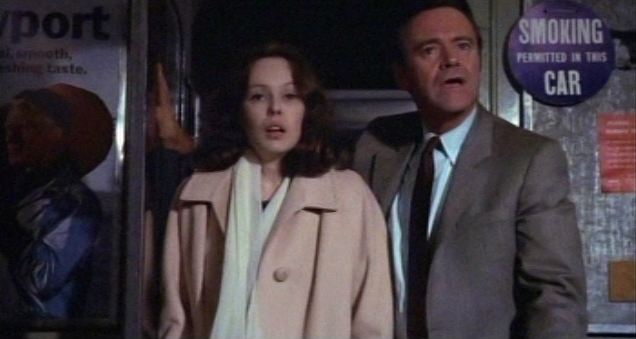
“The Out of Towners” (1970) is historically important. Yeah, I said it. Historically Important. Maybe not like the Declaration of Independence, but in its own way it shows us a moment frozen in time, a movie whose plot is driven by cause-and-effect circumstances that -- unknowingly -- will lead to an unexpected future for rail travel in the US.

Those of us interested in history, I mean REALLY interested are not so much fascinated by what happened the day the Bastille was stormed, or the day Pearl Harbor was bombed -- but what happened the day before -- of what it was like in  a world about to change  We like to look for clues in the wind of what we know happened next. “The Out of Towners” shows us what happened, almost literally, the day before the United States established a national railroad, called Amtrak.

(Springfield, Mass, photo by JT Lynch)

Welcome to our annual love-fest of all things trains as related to movies. This year’s 5th annual National Train Day is this coming Saturday the 12th. Today we’ll have a look at the train sequence from “The Out of Towners”, and Thursday we’ll cover “It Happened to Jane” (1959). Both movies feature Jack Lemmon in starring roles, and both show us what happened to train service in this country in the late 1950s and 1960s to lead to its collapse -- and the final rescue by an (unusually) bipartisan Congress to save the day and save passenger rail service in this country.

(If you look really hard down those tracks heading east you can see Boston.  Look harder.  They're waving at you.  I swear, you need glasses.  You can't see 80 lousy miles?  Photo by JT Lynch.)

It’s a very important story and a modern phenomenon of politics and popular culture. Of course, these movies are not documentaries, so what they reveal to us is largely unintended, which I think makes that revelation all the more natural and valuable. If you really want the nuts and bolts history lesson of a nation that was built on trains and finding itself on the brink of losing them, have a look at the very informative video “Amtrak - The First 40 Years - 1971-2011” directed and produced by Richard W. Luckin, 2011. The first few minutes of this film is currently on YouTube here.

“Run, Gwen, Run!”

“The Out of Towners” is a hoot, start to finish. Jack Lemmon and Sandy Dennis are a couple from Ohio flying to New York City where Mr. Lemmon is to have a job interview, expecting to be transferred to the New York office of his company. Their travel is disrupted all along the way by the most outrageous incidents. For now, we’ll just stick to the train sequence.

Which is best appreciated when you understand what was happening to rail travel in the 1960s. Passenger service declined for many reasons, but foremost of which:

It was allowed to decay, purposely, by the railroad companies.

Passenger service increasingly became less profitable for the railroads, which were all privately owned before Amtrak. Freight and mail contracts helped pay for passenger service, to a degree, but by the late 1950s and early 1960s, railroad executives wanted to get rid of their passenger service as unprofitable. They were not allowed to just stop it, the Department of Transportation would have had a few things to say about that, so they purposely refused to invest in maintenance and upkeep, they limited service, and cut out amenities. Train travel in the late 1960s, on most railroads, was a far cry from the glory days of the 1930s through the 1950s. Service was unreliable, cars were in disrepair, food was not so great, in an effort by the railroad executives to drive passengers away. They made train travel miserable, so that they could report there was not enough ridership to continue providing passenger service.

Private industry does not always have the public’s best interest at heart. Have you noticed?

Push came to shove, and the American public pulled off a grass roots drive to force the issue in Congress, demanding that passenger service be saved. Congress, fearful of the eventual necessity of “socializing” freight travel, never mind passenger service, enthusiastically responded. Signed into law by President Richard M. Nixon, it was the birth of Amtrak.

The first decade was rough, as a lot of traditional routes had to be scrapped in an effort to focus money and attention on the handful of routes that could be saved. Gone was the City of Los Angeles, gone was the Midnight Special from Alabama to Ohio, gone was the Montreal Limited and a number of routes. Equipment was hodgepodge and funding was an annual battle.

All transportation in this country is subsidized by the government. Airports, highways, they do not pay for themselves. There is no profit. They have the benefit of a solid trust fund to support them. Amtrak, however, must fight for funding constantly.

Four decades later, more routes have been added, train cars are climate controlled, quiet, comfortable, and the food is good. Trains connect not just cities in the northeast, but downtowns. Trains reach areas in the Midwest and West that are not easily accessible by airports, or sometimes even by highways. A single high-speed route, the Acela, is top notch and growing in popularity.

Trains are the most economically efficient, and most environmentally advantageous way to move large numbers of people. Though we are still far behind Europe and Asia in the development of high speed rail service and commuter rail, this is where our future lies, because with the rising cost of fuel, and the congestion of highways and airspace, we have no choice.

We old movie buffs tend to wax nostalgic about trains as we see them in 1940s movies, but trains are no longer just a nostalgic image. They are the (rail) road to the future.

Which makes Jack Lemmon’s travails in “The Out of Towners” so ironic. This movie was released the year before Amtrak came into being. The movie, directed by Arthur Hiller, written by Neil Simon, shows a grittiness in its urban shots, both in Boston and in New York. We are entering a less colorful, more cynical modern world, yet the grittiness contrasts with how the travelers appear, not just Mr. Lemmon and Miss Dennis, but the sea of extras around them. Take a good look. All the men in suits. The ladies in dresses, and white gloves. More ladies, like Sandy Dennis, are going without hats, and many of the men are, too, but most people still dressed for travel. People in this film are slow to let go of their formality, have not become as inelegant as their train service.

Their flight to NYC is diverted, because of fog, to Boston. It is night, and Mr. Lemmon needs to be in NYC by early the next morning for his important business meeting. They grab a cab to South Station and try to get the next train to New York.

They just miss it, and one of my favorite lines is when Jack, panting, hollers, “Did you see that train?”

Sandy replies, “I didn’t see anything. I was running.”

A laconic red cap with the typical stereotyped “ayuh” New England accent informs them they can catch the train at the next stop in Longview. Back for another cab ride, and they finally get on board the train by the skin of their teeth.

Notice the logo on the side of the train. In this last year before Amtrak, the trains are still privately owned, and this one is the good old New York, New Haven, and Hartford Railroad. We had a brief visit on this train when we covered “This Happy Feeling” (1958) here. The NY, NH & H had actually merged with Penn Central in 1968, but the Penn Central went bankrupt in 1970, the year this movie was released. It joined Amtrak in 1976.

The train is monstrously overcrowded, and they must wait two hours in line to get to the dining car, where all the food is gone. All that’s left is peanut butter sandwiches and nothing to drink except clam juice and tonic water, “But they ain’t cold.”

I once heard a joke, something about clam juice being what New Englanders drink when they’re hung over. I can’t vouch for that. I’ve never had clam juice, and I’ve never been hung over.

(Note guy sleeping in luggage rack to the right.  Now that's an overcrowded train.)

The conductor, punching tickets, replies to Jack, with a typical stereotyped New England “ayuh” accent, “This train runs empty six nights a week, ‘cept when the New York airport is fogged in. Then they fly ‘em up to Boston. Then we could use four more cars.”

“Why don’t you put on four more cars?” Lemmon asks.

“Ain’t got four more cars. Nobody takes the train anymore. Everybody’s in a hurry.”

The state of American railroads in the late 1960s boiled down in a couple of lines of dialogue.

The cheerful waiter who seems bothered by nothing, even amused by the chaos, is played by Johnny Brown, whom you might remember from “Rowan & Martin’s Laugh-in.”

Conductors, I am happy to report, still wear those neat hats and still punch tickets. Some of them still sing, “Worcester-Albany-Buffalo and all points we-est. All bo-a-a-rd!.” You know you’re on a northeast train when they pronounce Worcester properly. I’ve heard it butchered south of DC.

You also know you’re getting closer to New England if New England clam chowder is on the menu. I once had a discussion in a dining car with an elderly gentleman from upper New York state about Manhattan vs. New England chowder. He was for the former. We agreed to disagree.

Check out the regional menus here.   Chicken Tortilla soup on the Texas Eagle run. Southern catfish on the City of New Orleans.

We get a look at a less than resplendent South Station in Boston, likewise a run-down, dark and dirty Grand Central in NYC. The stations, like the train service, were falling apart, not maintained by the railroads. Grand Central was due to fall to the wrecking ball, a prize sought by developers, until some New Yorkers, Mrs. Jacqueline Kennedy Onassis among them, fought to save and restore the Grand Central Terminal. Today, it is as magnificent a train station as you will ever see. (Though it does not currently serve Amtrak, which goes to Penn Station across town. Grand Central serves the commuter lines like Metro North.)

(Washington, D.C. - Union Station, JT Lynch photo)

Many train stations, like the train routes of old, have undergone a renaissance in the past few decades, among them Washington D.C.’s Union Station and the Union Station in Los Angeles.

(Cincinnati - Union Station, JT Lynch photo)

Here’s some shots of the magnificent station in Cincinnati, with its beautiful Art Deco façade and inside, an enormous mural surrounding the dome in vivid colors.


(Cincinnati - Union Station, photo by JT Lynch)

Most of these re-born stations have shops and services, and in the case of Cincinnati, a city historical museum inside. They have become more than just a place to pick up a newspaper or book a ticket.


(Cincinnati - Union Station, photo by JT Lynch)

But Jack Lemmon and Sandy Dennis trudge through a man-made hell of run-down infrastructure that is as horrifying as it is terribly funny. The future of train travel, or indeed, any kind of travel, looked bleak in “The Out of Towners”. It just goes to show, past is always prelude, but not always revealing of what is going to happen next.  What happened next was Amtrak.

Come back Thursday when we discuss “It Happened to Jane”, which shows us the beginning of this era of railroad decline. Jack Lemmon is a bit younger here, much more idealistic, and helps Doris Day fight off greedy railroad executive Ernie Kovacs to save the train that serves their coastal Maine village.

This movie was actually shot in Chester, Connecticut, as well as in Hartford. Visit my New England Travels blog tomorrow for photos of what the locations in the movie look like today.

(The blogger waits to board.  Photo by JT Lynch)


Thursday, May 3, 2012

Trains, Blogathons, and Other Stuff


I have a few odds and ends to catch up with today.


(Cartoon by my twin brother, John)

First, next week we’ll be celebrating my favorite holiday, National Train Day, which falls this year on Saturday, May 12th. It’ll be a week of trains and Jack Lemmon. On Monday, a look at his train scenes from “The Out of Towners” (1970), which brings us to a discussion of the decline of rail service in the 1960s and leads us to “It Happened to Jane” (1959) on Thursday, a delightful comedy about the disruption of train service to one small New England community, filmed in and around Chester, Connecticut. On next Tuesday the 8th, come to my New England Travels blog for a look at those same sites used in the movie as they look today.

The following Monday the 14th, we take part in the For the Love of Film Preservation blogathon with a look at the train sequence in Alfred Hitchcock’s “North by Northwest” (1959).


Next, a photography exhibition showcasing the work of Gretje Ferguson has opened at the Wellesley Free Library in Wellesley, Massachusetts for the entire month of May. The title of this exhibit is called “Authors Among Us”. Black-and-white fine art portraits of 15 Massachusetts writers are included in the show. One of them is yours truly.

Next Wednesday, a reception celebrating Ms. Ferguson’s exhibition will be held, free and open to the public as an opportunity to meet the photographer and authors. I’ll be there, too, and if any reader of this blog in the Wellesley area can make this event, I’d love to meet you.

Time: Wednesday, May 9, 6:30 - 8:30 p.m.

Place: Wellesley Free Library, Wakelin Room
530 Washington Street
Wellesley, MA
781-235-1610 781-235-1610

Featured authors: Robyn Bradley, Lilian Cheung, Kyle Darcy, Steve Elman, Anita Diamant, Juliette Fay, Bob Halloran, Dello Iacono, Daphne Kalotay, Kathleen Burns Kingsbury, Jacqueline T. Lynch, William Martin, Peter H. Reynolds, Neal Sanders, Katrin Schumann, Alan Tolz, Gail Van Kleeck, Raffi Yessayan

See you there.

Finally, best wishes for a quick recovery to fellow classic film blogger Dawn at Noir and Chick Flicks, who recently announced her battle with breast cancer. Please visit her blog here, and consider donating to the Breast Cancer Society.


Monday, April 30, 2012

No Down Payment - 1957


No Down Payment (1957) is an unblinking, fly-on-the-wall look at 1950s suburbia. This depiction has a sharp and beguiling quality of self-awareness, which one senses was careful and deliberate. There are issues raised, but no real messages that are not tempered the by the characters’ helplessness to be anything other than what they are.

The very examination of suburbia as a topic might be considered dated, as dated as the copper Jell-O molds on Sheree North’s kitchen wall, but the outlook of the movie is bravely modern. In some respects, issues discussed here, like the precarious financial balancing act in a credit-powered economy, are still strangling us today.

Long post. Spoilers ahead.

Just about four years ago we covered the movie Strangers When We Meet (1960) here. I wish I had known about “No Down Payment” at the time I wrote about that movie, because they would have made great companion pieces. They are both about suburbia in Southern California, the car culture, a young post-war population coming of age as the 1950s “Silent Generation”. They also have in common the actress Barbara Rush. In “Strangers” she plays the wife of Kirk Douglas, a woman comfortably settled in her suburban kitchen, but ambitious for her husband to excel and obtain even more for them. She is devastated to learn of his extramarital affair.

In No Down Payment, Barbara Rush is the more settled wife of Pat Hingle, who is a more modestly successful owner of an appliance store. They appear to have a happy marriage, though not without stress. The two movies have a couple of important differences, however. One is that “Strangers” is in color and has a more glossy look to it, a more soap-opera storyline. It is focused more tightly on the extramarital affair of Kirk Douglas and Kim Novak. The other characters are like satellites that bounce off their relationship.

No Down Payment was directed by Martin Ritt, who had a particular knack for introspective films. He was one of those directors who ran up against blacklisting in the 1950s (a couple of the screenwriters on this project were blacklisted), and we'll be covering at least two other Ritt-directed movies this summer.

This is an ensemble piece. The acting is very good, and the writing is excellent. It has a quiet, black and white look, and being the earlier picture by three years there is a less cynical view of the suburban jungle. However, the examination of this world is refreshingly straightforward, and manages to take what is a familiar landscape a turn it into a strange new world. The so-called Silent Generation may have been less political and more secretive about its anxieties, but we can see that there was a lot of self evaluation going on.


The film begins with a shot of interstate highways all forming a tangle of knots on which the flow of traffic is never ending. Jeffrey Hunter and Patricia Owens are a new a couple coming to live the in a housing development called Sunrise Hills, which is advertised on a billboard as “a better place for better living”. A moving van follows them. I love how they pass several billboards for several different kitschy-sounding housing developments, all promising bliss.

He is a young engineer, she is an attractive young wife for whom being an attractive young couple is very important. The veneer is what appeals to her.

It is Sunday, this moving day. They drive by a modern-looking church where the homogenous congregation, their new neighbors among them, file out into the morning sunshine. Mr. Hunter and Miss Owens beam at each other. Truly, they have come to the promised land.

Pat Hingle and Barbara Rush are solid, steady, nice people, who introduce our first set of cracks in the veneer of Sunrise Hills. Miss Rush brings their children home from church, annoyed to see Mr. Hingle washing their car where everyone can see him. He does not attend church with them and his son wonders if his father is going to hell.

Another couple is played by Tony Randall and Sheree North. He is a used car salesman. They have one son. Tony Randall is a man deeply dissatisfied with his luck, who wants to be Somebody, meaning Somebody Rich. He cares nothing for real achievement but wants the glitz and the gloss as fast as possible. He is also a charming and irritating alcoholic. Mr. Randall is a marvel in this movie. His work here is excellent. He is a desperate extrovert and a tragic loser, still possessing his comic vulnerability of the characters he played in Doris Day movies, but here it takes a darker spin.

Randall’s money troubles are a major theme for the 1950s suburban couple and hence the title of the movie.

“No money down. Nothing to lose. Just change your name. Go away. Hide. Quit your job. And the finance company will never know where you are…. We’re only 25 years in debt.”

Pat Hingle affably consoles Hunter on the worry of a mortgage, "Nobody in this housing development is allowed to own a home they can actually afford."

And these houses are cracker boxes.  What would they have thought of today's McMansions?

This is meant to be humorous party conversation but there’s also a very strong indictment against the new 1950s economy, which has implications today. Jeffrey Hunter, the new guy on the block, marvels “Twenty years ago none of us could have afforded a house like this. I think we were born in the right time.”

Pat Hingle has another viewpoint, maintaining that the Greatest Generation was perhaps the generation behind the eight ball. He talks of their youth of poverty, of going on relief in the Depression, “I don’t call that being born at the right time.”

But he concedes, “I guess we do have more security than our parents ever had,” and, “there’s not many guys that have to sweat for a living, not anymore, not in the States.”

Jeffrey Hunter, a GI-Bill college graduate is involved in automation, a science which involves inventing things to make fewer employees necessary, and about which he feels guilty. That is his cross to bear. He will have others before the film is over.

He fixes Tony Randall’s son’s radio, pulling out a screwdriver from his inner suit coat pocket -- must be a trait of engineers -- and tinkers with something magical called a transistor. No microchips yet, but we’re getting there.

We old movie buffs love to watch classic films as an insight to a particular era gone by, but most of these films, whether it’s a movie about the 1930s or the 1940s or any era, are not self aware or self-conscious about that era. When Buster Keaton chases a streetcar he is not saying to the camera “look -- it’s the 1920s and there are not going to be streetcars in another 20 years.” “No Down Payment” is totally, deliciously conscious of its era. It’s almost as if they are picking things out of the air on purpose and putting them in the box and saying, “This is what we’re going to seal up in a time capsule to tell people what we’re like in 1957.”

The floor plan in the houses is identical, right down to where they choose to put their television sets. Their children sit in front of the TVs like zombies.  Ten years later they will "tune in, turn on, drop out," but that Zen-like self indulgence and self absorption all began cross-legged in front of the TV when they were kids.

Tony Randall spends money he does not have to buy his son a bike, because every new thing his son gets is a trophy to announce to others his own success.

The wives welcome the new neighbors with the manta that their development is a “A great place to raise children.” It truly is an incubator of sorts.

When Hunter and Owens tour the empty rooms of their new home, which is situated cheek-by-jowl with other houses on the street, they see the last couple of the group, played by Cameron Mitchell and Joanne Woodward -- through their large windows, cuddling in their bedroom. The scene reminded me of a passage in William Manchester’s narrative history of the 20th century, The Glory and the Dream (Bantam Books:NY, 1974) p. 782 - “Picture windows became windows for looking in.”

Much later in the movie, when preparing for bed, Patricia Owens meticulously pins their bedroom drapes closed.

Cameron Mitchell and Joanne Woodward are, in a sense, almost for what passes like the “wrong side of the tracks” couple in this housing developing that has no tracks and therefore supposed to be egalitarian. They are both originally from Tennessee and came out to Southern California during the war. (Tony Randall even teasingly refers to them as Daisy Mae and Li’l Abner.) Mitchell is a highly decorated World War II vet, who saw action in the Pacific theater. He runs a gas station in their community, but he has ambitions to be their village chief of police.

At home, he fills the walls of his garage with his memorabilia from the war, Japanese flags and swords and his medals pinned to a board. He misses being in uniform and having authority. Joanne Woodward displays again her remarkable facility for displaying a character almost as if she were a holding up her adopted personality like glass ball and we can see right through it all sides. Her ability to thoroughly crawl into the skin of her characters might make her a candidate for being called the Meryl Streep of her day. Except that I think Meryl Streep’s process for developing a character is entirely cerebral, whereas Joanne Woodward’s seems to be an intuitive and playful sense of the emotional palette of her characters.

Her character has no children, desperately wants children, and is so much like a child herself, the babysitter of the children in the neighborhood. She is bouncy, joking and goofy. Like her husband she has very little education, and like him, she is sensitive about that. She is delighted that the upwardly mobile and beautiful Patricia Owens befriends her. She feels unworthy. We are told that she had a child before they were married, but at his insistence she gave it up for adoption. We later discover that he believed that the child was not his.

When we first see them, they appear happy with each other, but later on his dissatisfaction with his life manifests itself into dissatisfaction with her.

The new neighbors are introduced at a barbecue, the suburban tribal ritual. The men check out each other’s wives, and check out each other’s wartime service.

A subplot to the movie involves one of Pat Hingle's employees named Iko, played by Aki Aleong. Like the other men in the neighborhood, he is a former GI, but because of his Japanese ancestry, he is discriminated against in this restricted neighborhood. Housing developments restricted to whites only was common as dirt in the 1950s. Iko has a wife and children, and a television set, too, but he wants more. He wants to live closer to his job, and upward mobility like everyone else. He appeals to Hingle to help him make an application to the council and here we see Hingle’s greatest conflict. He likes Iko. Hingle and his wife have had dinner at Iko’s house. He wants to help, but he hesitates.

So torn by the issue, and perhaps upset with himself more than anyone, he picks a fight with his wife about racial prejudice. She likes Iko and his family as well, but echoes the same concerns about breaking conformity that Hingle has but doesn’t want to admit.

"How can you call yourself a good Christian and speak like that?" he shouts, still mad at her for wanting him to go to church.

"Don't you bring the church into this."

"What good is the church if it can't teach a person to lend a helping hand to some human being that really deserves it." She throws the prejudice right back in his face where it belongs. The problem of racial prejudice may exist in society, and it may exist in the town council, but first and foremost, he must wipe it out in himself and have the courage of his convictions. First one must have courage, and then one must have convictions.

Another passage of William Manchester, who refers to the Alexis de Tocqueville’s 19th century assessment of a young America,

“Though Americans took great pride in talking about their individualism, he [de Tocqueville] noted, their special genius -- and the source of their greatest potential weakness -- lay in their ways of cooperation with each other…creating a dictatorship of the majority. ‘In times of equality,’ he wrote, ‘no matter what political laws men devise for themselves, it is safe to foresee that trust in common opinion will become a sort of religion, with the majority as the prophet.’”

Though social conformity is a strong force, the money angle is what drives them more fiercely. Tony Randall, tragic with a drink in his hand and a smile on his lips and that wonderfully giddy giggle, "what this country needs is easy credit. No man should have to pay cash for anything. No money down is the secret to prosperity...if only the banks would loosen up, every man could have anything he wants, not when these old and washed up -- now, when he's young and washed up."

Interesting that at their backyard barbecue they first dance to a song on a hi fi called “Something's Got to Give,” a 1940s swing number here in a more sedate arrangement. These people are not kids. Rock n’ roll is not their era. However, later on in the movie they dance to a “rock” number called “The Drive-in Rock.” Car culture and rock n’ roll in one flick of the switch by the director.

They march into each other’s homes, dance with each other’s wives, open each other's refrigerators. There is a sense of community and camaraderie. A very interesting scene when a seed is planted for later plot development -- Tony Randall dances with Jeffrey Hunter's wife, and gets a little smarmy because he's been drinking. Hunter stands by watching, angry but does nothing. He is passive, looking for some social clue as to how to behave in this new setting.

It is Cameron Mitchell who takes over and comes to the rescue in a manly and authoritative way. He cuts in on Tony Randall and begins to dance with Patricia Owens himself, a proper and gentlemanly dance. She is grateful and thanks him, and his “Not at all, Ma’am,” is a sign of his Southern courtliness. He has saved her, and at the same time humiliated Hunter by taking action. Later on however, flushed with his success and how good being a hero has made him feel, he begins to pursue Patricia Owens on his own.

More observations on contemporary society by Joanne Woodward who recalls a little brother who died of pneumonia, "Just think, today he could've taken one shot of penicillin and he could've gotten over it like a cold."

No babysitters. They leave their kids with each other or leave them alone. Tony Randall gets into trouble with a shady business deal and runs away in the middle of a party at his house, and his wife and Pat Hingle follow. The party continues in their home without them, their neighbors unconcerned about their absence. Their little boy gets up and wants a drink so the presiding grownups give him a bottle of Coke.

Today we might hesitate over a myriad of legal repercussions of staying in a neighbor's home, unasked, with their child unattended by the parents. Today we would hesitate giving 8 ounces of sugar and caffeine in the middle of the night to a small child, knowing we would have to probably scrape him off the ceiling.

Sheree North has finally had it with Tony Randall and tells him to get a steady job and stop his get rich quick schemes. "You're never going to make a million, so stop dreaming about it!" It is the worst thing she can ever say to him, the cruelest thing and yet the kindest thing. She is effectively telling him and us the American dream is not for everybody. We cannot all be rich. Some of us will just be lucky if we can pay our bills.

Cameron Mitchell is turned down for the job of chief of police, and he becomes surly. He has no college degree. Instead of trying to step up into society, he now declares it his enemy. He also goes after Patricia Owens.

Hingle makes a prescient remark, "Pretty soon a guy’s going to have to have a master's degree to clean toilets."

Mr. Mitchell also kicks in the TV tube. Now we know that the earth is cracking. When you've destroyed your TV, your whole world is shot.

When Hunter is away on a business trip, Cameron Mitchell comes calling on Patricia Owens, and we are meant to conclude that he has raped her. She runs not to the police, but to the neighbors. Hingle immediately wants to call the police, but she tells him not to. Barbara Rush suggests they call her doctor, but Owens refuses that as well. They let her stay the night and offer comfort and protection, but there is no suggestion of seeking justice.

By the way, another subtle point being made by the scriptwriter and director: the little daughter of Hingle and Rush interrupts while they are trying to comfort and get the story out of Patricia Owens. She refers to the new neighbor lady by her first name. Author William Manchester also had an observation on this:

“The term ‘polite society’ fell into disuse because society wasn’t polite any more. The increasing use of first names was extraordinary. Once it had been limited to family and friends…the suburbanite who arrived home to find her bathroom being used by a strange boy might be greeted, ‘Hi, Doris.’ In suburbia, this was looked upon as just friendliness. Any objection to it would be regarded as snobbish and resented.” (pp.782-783.)

When Jeffrey Hunter learns of the attack he tries to avenge her, unsuccessfully. He tries also to comfort her in a nice speech about sharing each other's burdens. For the 1950s this was probably a very loving and affirming scene. He reminds her that she need not be ashamed or feel defiled. Today, however we might look at it with a different viewpoint. Instead of telling her she has the right to feel angry and the right to seek justice for the crime of violence done to her, it looks as though she is merely being forgiven by a loving husband for being damaged goods.

No charges are brought against Cameron Mitchell. Instead, the old stock movie solution of having him be killed. This is so much more convenient in movie terms. Her shame is not brought out into the open with a public trial, and he goes away. It is a disappointment, but great strides have been taken in this movie to explain the 1950s, so perhaps we can't expect them to be too forward-looking. It is enough to deal with the problems of the present.

Hingle considers all of this, Randall’s alcoholism and his money problems chasing the dream, Cameron Mitchell's violent reaction to not measuring up in post-war society, the racial prejudice that faces Iko.

"I guess owning a house with a deep freeze is not the answer." He wants to know how they got to be where they are. "Whatever it is that makes us afraid to help Iko. That makes Jerry afraid that he's not going to make it big. That makes Troy afraid he's going to be a nobody unless he's wearing some kind of uniform. Afraid, afraid. Now if we can find out what that is, I think we've got the answer."

We are escorted out of Sunrise Hills on another lazy Sunday, watching new widow Joanne Woodward moving out of her home. At the church we see that Pat Hingle has finally joined his family, and that Iko and his family are new parishioners. It's all lovely and homogenous. If you don't look too hard for the cracks.

I would have like to have seen the effort Hingle made in council to get Iko accepted. I would like to know what denomination this now less homogenous congregation represents. I’d like to know where Joanne Woodward is going, as her taxi speeds by the billboard for Sunrise Hills and up the exit ramp to the interstate.


*********
Jacqueline T. Lynch is the author of Ann Blyth: Actress. Singer. Star. and Memories in Our Time - Hollywood Mirrors and Mimics the Twentieth Century. Her newspaper column on classic films, Silver Screen, Golden Memories is syndicated nationally.

Monday, April 23, 2012

Answers to More Typists

Some great guesses for these movie typists.  The answers are:

1.  Allen Jenkins ponders his next sentence as Errol Flynn's secretary/chauffeur in "Footsteps in the Dark".

2. Burt Lancaster in "Mister 880".

3. Bing Crosby in "Here Comes the Groom".

4. Jean Arthur in "A Foreign Affair".

5.  Kim Novak in "Middle of the Night."

6.  Jean Arthur, again, in "More Than a Secretary" - Jean seems to be giving Barbara Stanwyck a run for her money as Hollywood's most prolific typist.

7.  Bing Crosby and Jane Wyman in "Here Comes the Groom" about to tap out a chorus on the typewriter.

Thanks for playing along.  No post this Thursday, but I'll see you next Monday

Related Products