IMPRISON TRAITOR, PEDOPHILE, AND CONVICTED FELON TRUMP.

Thursday, April 19, 2012

More Movie Typists

1

Administrative Professional's Day is next Wednesday.  Can you name these typists and the movies?

2


3


4


5


6


7


Monday, April 16, 2012

Titanic - 1953


“Titanic” (1953) shows that the most successful storytelling is based on what your audience provides in imagination. Other versions of this tragic tale have provided more technically thorough stories. None are as empathetic in the telling, or draw such empathy from the audience, as this version.

One hundred years ago today people were waking up to the news that the RMS Titanic sank on its maiden voyage in the wee hours of the 15th.

This movie was released some 41 years after the sinking of the RMS Titanic. Coincidentally, it was probably 41 years ago that I first saw this movie. I can’t be sure of the exact year but it’s a pretty good guess. I was a child, knowing nothing about the history of the story I was watching, and what I remember most vividly was the very last scene. Clifton Webb stood on the deck of the ship along the rail with many other men, all staring blankly out at the ocean. There were tears in Webb’s eyes. A little boy, his son, stood next to him on the deck. The son had all the energy and confidence of youth. He was probably only a little older than me.

The stark contrast between the sorrowful father, and that little boy, happy to be with him, confused me. I can remember asking an older sibling what was happening, what did this mean? I was told that the boy was going to drown along with his father, that he went back to the ship when he shouldn’t have, so now he was going to drown.

I think I must have assumed that at the last minute another boat would save them, so this news that their deaths were inevitable shocked me. More shocking was that this smiling boy’s fate was sealed by his eagerness. I wondered then if he knew he was going to die? His demeanor did not seem to indicate that he knew. He suggested to his father that they might swim for it.

I think this scene captures the essence of this remarkable movie. It was filmed on a set, so we are not dazzled too much by technological wizardry. But we are drawn into the consequences of the Edwardian (yes, I know George V was on the throne, but eras do not have air brakes) era-cum-dawn of the 20th century, through the splendor, costumes, values and customs, which all lead to consequences.

We have a little name-dropping. There are Guggenheims among the passenger list and of course, John Jacob Astor. He is played here by William Johnstone, whom you might remember as the radio voice of the Shadow, replacing Orson Welles. His wife is played by the lovely Frances Bergen, the wife of ventriloquist Edgar Bergen and mother of actress Candice Bergen.

One name they decided to drop literally was the “Unsinkable” Molly Brown. Her character here is played by Thelma Ritter with her customary earthy gusto, but the name is given as Maude Young.

A big, beautiful ship filled with beautiful people. We are given a hint as to what it’s like to travel in steerage, but we are not hammered too much on the injustices of third class travel. We are given credit for knowing - we or our parents likely traveled to America that way. 

We are given credit for knowing, too, about the era’s dignity, grace, inequity, and hypocrisy. After all, 41 years isn't even one lifespan, and not so much needs to be explained.

We are shown Richard Basehart as a recently defrocked priest returning home to America in disgrace because of his alcoholism. When the disaster happens, he redeems himself. Conversely, we are given Allyn Joslyn as the inevitable human being who disregards his humanity in the very human desire to live.

Look for Mae Marsh in a small role as the lady in the lifeboat to whom the boy, played by Harper Carter, gives up his seat.

The story and the tragedy is played out for us not so much in special effects but by two particular characters who carry with them the style and the consequences of the era. In a sense, Barbara Stanwyck and Clifton Webb as the estranged couple have the entire story resting on their shoulders.

She is an American woman returning to her Middle West roots after years of an unhappy marriage in Europe. She brings their teenage daughter and young son to the US because she does not want them to grow up to share the same meaningless, empty, shallow life which her dandy husband Clifton Webb pursues was such self superior conceit. Both Miss Stanwyck and Mr. Webb are fantastic in this movie. Stanwyck convincingly conveys the dual quality of this woman, one who was able to feel cowed under her husband’s superior birth and social set, and yet still have the mettle to want to save her children. Her Gibson girl hairstyle is very becoming to her in this movie. She wears her costumes well. Stanwyck always did look good in period pieces.

Clifton Webb is a marvel. One might chalk up his work here as standard Clifton Webb material, a fastidious man, the intellectual giant disdainful of all the lesser creatures around him. He played it well.  But there's more to him here, and he undergoes the greatest change of any character in this movie.

One of my favorite lines is when he puts down Stanwyck, “Twenty years ago I made the pardonable mistake of thinking I could civilize a girl who bought her hats out of the Sears Roebuck catalog.”

In one scene, after her confession of an adulterous tryst which resulted in the birth of her son, she drops her purse. Webb’s refusing to stoop to pick it up is his telegraphing to her, and to us, that she has dropped off the charts in respectability. If she were a lady, it would be beneath him not to pick it up. She is not a lady anymore. 1912 Etiquette 101.

But there are two sides to the coin, and Webb also shows a man deeply wounded. It is a devastating scene, his pride and his conceit shattered when he learns that the son of whom he is so proud is not his.

Stanwyck’s part in this scene is also amazing. But perhaps the real credit should go to director Jean Negulesco. The husband and wife face off over his refusal to let her take his son back to the United States.

“No court, no power under heaven will force me to give up my son.”

“He’s not your son.” She replies in the most eerily calm manner, shocking in its very everyday tone of voice almost as if she had said, “it’s time for dinner.”

The camera shows her turn around and walk out of the stateroom. We see her back and his back. We don’t need to see his expression.

In vengeance, he ignores his son for the remainder of the trip, hurting the boy who loves and admires him.

We are prepared by now to think him a monster, but we finally see a deeply courageous Clifton Webb, sensitive to the needs of others when the iceberg hits. It is such a turnabout transformation of his character, and yet, an extension of it. He is, after all, a gentleman. This is what a gentleman is supposed to do. When he learns the ship is sinking he hustles his family into life vests, not telling them of the real danger, keeping up a happy front. He gets them to the top deck.

Then he goes down to third class and hustles out the Basque family with whom he had boarded. The father of the family sold him his ticket, and Webb boarded the ship pretending to be this woman’s husband. He hustles them all into lifeboats, saving their lives. Then he helps others on the ship.

A young Robert Wagner plays a callow college student who is sweet on their daughter played by Audrey Dalton. And oh, the scores of extras. I love me a movie with lots of extras. One of them is Bert Stevens, Barbara Stanwyck’s brother.

Though we have these back stories, this is a movie of about greater things. Larger issues and devastatingly small details. Captain Brian Aherne conducts the Sunday services in the grand salon. A drunken Richard Basehart tries unsuccessfully to send a telegram home of explanation to his family. The crisp, crackling dialogue between Webb and Stanwyck in this most literate script.

I have only one minor, petty complaint. When Robert Wagner and his pals sing college fight songs, one of which is about Lord Jeffrey Amherst and Amherst College -- please, the H in Amherst is not pronounced. I don’t know how Lord Jeff of French and Indian War fame pronounced his surname, but those of us in western Massachusetts, where Amherst College is located, do not say the H. Accent on the first syllable - AM-erst.

I suspect folks from Mackinac, Michigan, might protest at that pronunciation in this film, too.

This has been a public service announcement. (Yes, I’m kidding. I realize there are far more important historical inaccuracies with which to take umbrage.)

The movie does not attempt to shock us or surprise us, rather just as it expects us to understand the mores and conventions of 1912, it also expects us to remember every moment that we are on a collision course with death.  We start the film with a shot of the iceberg.  We have a brief foreshadowing when Robert Wagner, cheered by the prospect of Audrey Dalton’s companionship, throws his soft cap into the ocean. It lands among chunks of ice floating by.

The band plays, first the Londonderry Air - better known to some of us as “Danny Boy”. And eventually we get around to “Nearer, My God, to Thee”. It has never been confirmed absolutely that this was played when the Titanic sank, but the legend has grown partly because of this movie.

Young Harper Carter scrambles out of the lifeboat to give his seat to Mae Marsh and joins his father on the deck because after all, he is now wearing long pants and so he is a man. This is what gentlemen do, give their seats to ladies and risk death. His explanation to his father as to why he returned to the ship is simply, “I’m wearing long trousers.”

Neither did that need to be explained to us in 1953, but I wonder if it might in 2012. I don’t mean just about boys wearing shorts and not wearing long trousers until they’re in their teens. I mean that essence of manhood that comes when one decides to be a man, i.e., to take responsibility. Steinbeck wrote, “A boy becomes a man when a man is needed.”

There are 12-year-old men, and there are 30-year-old boys.


Clifton Webb, heart breaking for his son and especially that he had ever denied his son, puts his arm around him and with tears in his eyes addresses the ocean waves “Whatever happens, I love you very much. I’ve been proud of you every day of your life. Never more than at this moment. I feel tall as a mountain.”

And yet it is not maudlin. It is a simple statement of fact, like the line “I’m wearing long trousers.”

When I watch the movie now, I see that these characters standing on the deck of the doomed ship clearly are not waiting for rescue. They are awaiting death. It is devastating in its theatricality. I can never watch it without being reminded of the first time I saw it, and could not quite comprehend then what was happening. In a way I still can’t believe it. That is the power of film, and especially of this film.

Barbara Stanwyck recalled in this oft-repeated quote:

"The night we were making the scene of the dying ship in the outdoor tank at Twentieth, it was bitter cold. I was 47 feet up in the air in a lifeboat swinging on the davits. The water below was agitated into a heavy rolling mass and it was thick with other lifeboats full of women and children. I looked down and thought: If one of these ropes snaps now, it's goodbye for you. Then I looked up at the faces lined along the rail - those left behind to die with the ship. I thought of the men and women who had been through this thing in our time. We were re-creating an actual tragedy and I burst into tears. I shook with great racking sobs and couldn't stop."

So powerful was this film that it inspired another young person, Edward S. Kamuda, who saw it in his family run theater, The Grand, in Indian Orchard, Massachusetts when it came out in 1953. Mr. Kamuda established the Titanic Historical Society, which is the home of a unique collection of artifacts from the RMS Titanic and from the decades of storytelling about this event. Please see my New England travels blog here for my original post on the Titanic museum and for update on the tribute to two Springfield, Massachusetts, victims of the Titanic.
http://newenglandtravels.blogspot.com/2012/04/titanic-centennial-memorial-springfield.html
Also, have a look here at this previous post on the recycling of the grand salon set of  "Titanic". You’ve seen it before.

There are a couple of other recent posts on “Titanic” (1953) I recommend, this on the blog Book Talk and More, and this, a beginning of a series on Titanic movies, from Matthew Coniam over at Movetone News. Great reading.

Thursday, April 12, 2012

Robert L. Surtees, Cinematographer - Roadside Marker


Covington, Kentucky does right by its famous sons and daughters. Here, the uncommon tribute of a roadside marker to Robert Surtees, an Academy Award-winning cinematographer.

Actress Una Merkel got the same “star” treatment from Covington in this previous post.

Mr. Surtees began his career as an assistant cameraman to the great Gregg Toland. In the 1930s he worked for a few years in Germany, then returned to Hollywood where over the next several decades his work was nominated 16 times for Best Cinematography for such pictures as “”Okalahoma!” (1955), “The Graduate” (1967), “The Sting” (1973). He won the Oscar for “King Solomon’s Mines” (1950), “The Bad and the Beautiful” (1952), and “Ben-Hur” (1959).


Hurray for Covington for remembering the artists.

Monday, April 9, 2012

Dive Bomber - 1941


Dive Bomber (1941) is a pretty, pretty movie.

The dainty mix of its color schemes and the rather feminine sensibility of its Technicolor palette is a strange but pleasing contrast to the macho world of naval pilots putting themselves in great danger.

So, too, is the interesting, although I’m sure coincidental use, of cigarette smoking as a male bonding ritual. Usually in classic films we’ve come to view the sharing of cigarettes, the dramatic pause in the middle of dialogue to light up, the smoke that curls from one’s lips and over the shoulders of one’s partner as a kind of foreplay between a romantic couple. Here, it’s all part of being one of the guys. It shows comradeship, good will, a "safe" way to demonstrate (or mask) deeper emotions.  Ultimately, a cigarette case, as trophy and mark of identity becomes heartfelt tribute.

And this is such a pretty, pretty movie.

It's also going to be a long post.  Please keep your arms and legs inside the ride at all times.

This is a buddy picture, but the pairing of buddies changes like partners in a square dance throughout the film. First we have Fred MacMurray, Louis Jean Heydt, and Regis Toomey as three veteran naval fliers who are so skilled that the Navy sometimes sends them on promotional tours such as at the famous Akron air speed races.  They are known as the three top hats. At the very beginning of the movie we start our male bonding with cigarettes as the three of them take out their smokes from identical gold cigarette cases with a graphic of a black top hat on them. They are stationed in Honolulu, Hawaii and their training squadron has black top hats painted on the fuselage of their airplanes.

According to the AFI website the movie was filmed between March and May of 1941. The United States would not enter World War II until the end of that year, but the war was already a year and a half old. There are only a couple of small references to the war raging in the rest of the world, but there is still that underlying tension to the shenanigans of the peacetime pilots with their devil-may-care attitude towards war and women and the dangers of flying.

Of course, all this is more deeply sensed today than it was by audiences in 1941. Many Americans back then felt it was likely we would go to war, but did not know when. We know now what, when, where, and how awful it was, and that it began for us only three months after this movie premiered in August 1941.

Much like our look here in this previous post at Navy Blues (1941), which shows an even more lighthearted frolicking among gunnery trainees, yet there is still a sense of foreboding for us.

Part of what gives Dive Bomber an edge over other films of this sort, is the very realistic and at times quite magnificent aerial photography shot in cooperation with the U.S. Navy. The actual ships we see are the USS Enterprise and the USS Saratoga. These were two of only three aircraft carriers that survived the war. The Enterprise would be the highest decorated U.S. ship in WWII, earning 20 battle stars. It was steaming from Midway to Pearl Harbor when the Japanese attacked.

We see shots of Honolulu and of the naval air base at San Diego. There is official footage, all in color, of planes landing on the aircraft carrier deck and the deck crew guiding them in. Some of this provides background in later rear-screen projection shots.

The film begins with a military review, planes flying in formation with Busby Berkeley-like precision. This film was directed by Michael Curtiz. It is shot beautifully. The flying sequences are leisurely and long, nothing is rushed. Perhaps the omnipresent drone of the plane engines might irritate you after awhile, but it’s a visually pleasing film. Planes with bright yellow wings and shiny fuselages, and many of them actually biplanes. They look like those model airplanes you might remember from childhood from Revell kits. They look so much like shiny toys.  (Do kids still make plastic model kits, or was that a Boomer thing?)

Airplanes with yellow wings, floating in an azure sky, the rich chocolate brown bomber jackets, and the myriad of Easter egg pastels that will parade later on in civilian dress…one pretty movie.

In this opening flyover, Louis Jean Heydt’s plane crashes. First on the ground to come to his aid is Navy doctor Errol Flynn, who may be the prettiest thing in this movie. Unlike some of his other swashbuckling roles, where not only is Flynn’s physical prowess displayed but he gets to exhibit a dashing and extroverted personality, here he is an earnest and humble man, passionate only about research into the problem of high altitude sickness and pilots’ blackouts. He takes the brunt of criticism from the men in the ranks, and his superiors in the lab, and we might feel sorry for him for most of the movie.

Flynn muses to his assistant, and everybody’s habitual sidekick, Allen Jenkins, “We represent the uncertainty of life for those pilots. No wonder they don’t love us.”

When he reaches Mr. Heydt, he gets him into an ambulance and, like a good doctor, offers him a cigarette. When Heydt dies on the operating table Mr. MacMurray and Mr. Toomey blame Errol, and they spend the rest of the movie insulting him.

They are all transferred to the naval air base in San Diego, where Toomey and MacMurray are assigned the job of teaching Flynn to fly. More harassment. Add to this Ralph Bellamy, who plays a curmudgeonly research physician. Flynn becomes his assistant and receives his sarcasm, which he returns in kind.

They train in pretty yellow biplanes, the engines of which have to be hand cranked. Hard to believe we’re going to go up against Messerschmitts and Japanese “zeros” pretty soon isn’t it?

Ralph Bellamy is especially good in his role. A commanding presence, he seems genuine and mature where some of the other men in their roles merely seem cocksure. Eventually Flynn and Bellamy become allies and we know this because they share a cigarette together. One offers a match, the other cups his hands around the other’s hand to receive the flame.

Some of the other pilot trainees and grounds crewmen you may spot in this movie, although I admit I didn’t, are DeWolf Hopper, and Alan Hale, Jr. - the future skipper on Gilligan’s Island, and Creighton Hale.  Herbert Anderson has a few lines, he later went on to a featured role opposite the wonderful Ann Sheridan in the above-mentioned Navy Blues.

Charles B. Smith who we might remember from The Shop Around the Corner (1940) in this previous post here plays a bellboy.

Another young man who had made a handful of B movies would be enjoying a small role in this film, his first major movie, was Craig Stevens. Look at this shot of him. Isn’t he pretty?

When he first arrives as a civilian, he and Errol Flynn have a minor fender-bender car accident that evolves into a fistfight. Later on in the film Stevens becomes one of the handful of guinea pigs for the experiments conducted by Ralph Bellamy and Mr. Flynn. Apparently, according to IMDb, so did Gig Young, but I missed him.

Likewise another newcomer to the Warner Brothers studio, who had made a handful of walk-ons in B movies, would be enjoying her first featured role in a major movie was Alexis Smith. Miss Smith and Mr. Stevens had no scenes together in this movie -- the movie was actually completely filmed when the producers decided they needed a girl. Her scenes were added afterwards.  They also each appeared in bit parts in Affectionately Yours early that year.  Dive Bomber was huge leap up to the big leagues for Smith and Stevens.  After this movie was shot, they were paired in another B movie (back to the minors) called Steel Against the Sky (1941) with Lloyd Nolan, but this time in starring roles and playing characters who fell in love.  Third time's the charm, so to speak. They became engaged a year later, and were married from 1944 until her death in 1993.

One might add that Alexis Smith is also, like the yellow airplanes, and the bomber jackets, and Errol Flynn, and Craig Stevens, very pretty. I was struck by these Technicolor shots of her in her suit and hat at a house party, because they look very much like some old Kodachrome slides a shutterbug uncle of mine took during the war. We sometimes muse on the outrageous outfits of actresses in classic films, but here she looks very much like several of my female relatives of that era.  She could be my mother. (I really like the house party scene.  It's quite brief, not necessary to the plot, but there's something so in-the-moment about it, so 1941.  There is a sense of well, here we all are, but where are we going now?)

In this shot, her first close-up in the big leagues, she is immediately thrust into the role of the sophisticate, a part she would play for the rest of her life.  In reality, she is just a girl of 19. That jug-eared bellboy is older than she is.

It was also her first romantic pairing of four with Errol Flynn, some twelve years her senior. She caused a minor stir in the press for refusing to kiss Errol in this movie.  The story made the rounds, but here it is from The Spokesman-Review (Spokane, Washington) , April 25, 1942:

"...she was supposed to jump up from a table, rush forward joyously and buss Mr. Flynn's astonished mouth.

"'That won't do at all.' she told the director, 'It's not in character.'  And she argued so convincingly, the scene was cut."  This from a girl who refused to start her contract at Warners until she completed her last college course.  And would not allow the studio to change her unusual first name and all-too-common last name.  This girl was trouble in an upsweep hairdo.

Here’s that previous post on the tall girl.  Again.

Another character actor fun to see is Robert Armstrong. You will remember him from these previous posts of The Most Dangerous Game (1932), and King Kong (1933). The rascal of the 1930s here is the more knowing and somewhat more tired middle-aged man. He plays an engineer whose job is to help redesign and refit aircraft to match the specifications that are the result of Ralph Bellamy’s research. Robert Armstrong and Ralph Bellamy may not be terribly pretty like just about everybody else, but it’s great to see him.

I have to mention when all the pilots graduate in a ceremony at San Diego, I wondered why the band played “Semper Paratus,” which is the Coast Guard march, not the Navy’s?

Eventually Fred MacMurray and Regis Toomey help out in the experiments to solve the problem of blackouts, partly as a tribute to their deceased friend. A crisis arises when Regis Toomey is found to have pilot fatigue. Ralph Bellamy and Errol Flynn ground him. Toomey is not happy about this, and quits the Navy. He joins the Royal Air Force, and while there are small references to the big job going on in Europe, the main reason for his joining the RAF is for the money. He cannot afford to be grounded, and there’s a great deal to be made in ferrying planes across the Atlantic from Canada to Great Britain.

Toomey visits the men, landing in San Diego in a British fighter plane. (I wonder how likely this is?) The other men tease and congratulate him over his new blue uniform, with his rakish overseas cap (I believe the Brits and Canadians called it a "wedge cap"), and silk scarf tied in a dashing Ascot.  Someone calls to him “Aren’t you pretty?”

He is. He is very pretty. But, he’s still got pilot fatigue even though he’s trying to hide it, and when he leaves to fly his British plane to Canada, he crashes. MacMurray, in a moving scene - he looks as though he has been crying - volunteers as a guinea pig for Bellamy’s tests. We get to watch what seem to be very primitive experiments, but no less frightening because of their apparent technological crudeness.

The men are put in a chamber that will replicate the low pressure of high altitude and the lack of oxygen. Errol Flynn listens to their heartbeats. Craig Stevens, suffering oxygen deprivation, actually looks as if his skin turns slightly bluish. It is an amazing color in this Technicolor film, though I must say it is not pretty.

Some electronic gadget with a neon blinking sign that looks like it belongs in Frankenstein’s lab illustrates their irregular heartbeats. There is no EKG. They all receive X-rays of their knees and elbows to look for gas bubbles in the joints, open X-rays with no protection against radiation to anyone around them.

They still haven’t found the problem of how to fly very high and not suffer illness. The men and the doctors are severely stressed.

To break up the leaden atmosphere -- and the conflict in the script which by nature does not involve a lot of physical action, even if it does involve physical daring do -- we have a few comedy relief moments to lighten up the plot. Allen Jenkins’ wife, played by Dennie Moore, keeps showing up for her allotment checks and he keeps trying to avoid her, aided by double-talking Cliff Nazarro. MacMurray and Flynn take some time to socialize, and we see that in these pre-war days servicemen are allowed to wear civilian clothing off base.

Though many civilians at this time might have privately felt or wondered if time was running out for them, peacetime that is, still this scene seems to illustrate that the spring of 1941 was a leisurely respite, a calm before the storm. Yellow flowers, a pink dress. A nightclub with mauve walls, and the girl singer Jane Randolph singing the new hit, “What’s New,” a lazy, romantic song of wistful parting that somehow does not foreshadow all the partings that would come in the months ahead.

Look at the outfits of the ladies, muted peach and blues, the turquoise, lime green, cream-colored shirts.  You could show this as an Easter movie if there weren't so many gol-darned plane crashes.  Pretty.

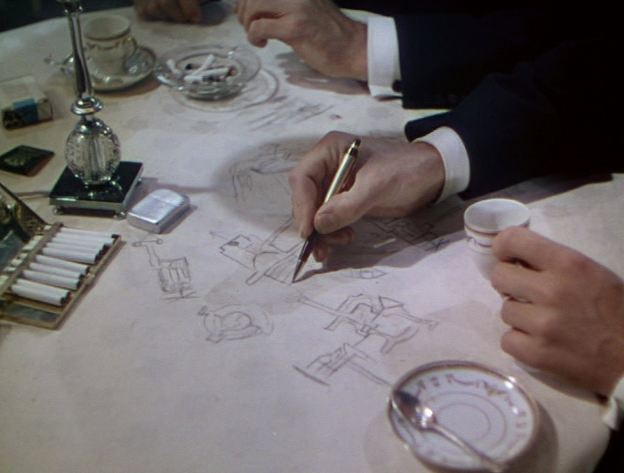
MacMurray and Flynn ignore their dates Alexis Smith and Ann Doran. They are instead preoccupied with a new idea for a pressurized suit to wear in an airplane, something like what a deep-sea diver would wear. They draw plans on the tablecloth. They smoke.

In a way it reminds me of the movie Apollo 13 (1995) where the crisis of the space capsule being unable to return to earth must be solved by the men on the ground with very rudimentary methods. All solutions begin in the human mind.

And by drawing on the tablecloth. And playing with Alexis’ lipstick.

Errol and Fred are really excited about the lipstick screw function. More male bonding. Not usually done over lipstick, but I like to think I’m open-minded.

The lipstick is a very pretty shade of red.

Both Flynn and MacMurray take to the air in some very scary dive sequences. Fred MacMurray eventually succumbs to pilot fatigue and he is grounded. He is consoled in what is one of the few foreshadowing moments of our involvement in the war, “Kind of tough to be yanked out of a ring when the main event may be about to start.”

But, one more test must be performed before their invention can be approved. MacMurray takes it on himself to fly the test.

MacMurray performs his test successfully, but crash lands and is killed. (Yeah, spoiler-schmoiler.) In the final scene we see Errol Flynn flying off to join a squadron with the Pacific Fleet. We know he is going to Pearl Harbor, and we know what will happen there. It is with poignancy and sadness that we realize he does not.

In tribute to his pal, he drops MacMurray’s gold cigarette case, which he retrieved from the crash, into the ocean, tossing it out of the cockpit of his airplane.

The last shot of the squadron flying towards the rays of the sun is brilliant enough to make you want to shield your own eyes.


Who says macho can’t be pretty?


*********

Jacqueline T. Lynch is the author of Ann Blyth: Actress. Singer. Star. and Memories in Our Time - Hollywood Mirrors and Mimics the Twentieth Century. Her newspaper column on classic films, Silver Screen, Golden Memories is syndicated nationally.


Thursday, April 5, 2012

A Holiday Musical Interlude...


Louis Armstrong jazzes it up a little, but reverence can still be heard in that horn. Please scroll down to the bottom of the blog to mute the music so you can hear these videos.

Below, we have Jeannette MacDonald in “San Francisco” (1936) and “The Holy City”.


A blessed Passover, Easter, and Orthodox Easter to all who celebrate them.

Monday, April 2, 2012

NOW IN PAPERBACK...

My post-War II "noir novel", "Cadmium Yellow, Blood Red" is now available in paperback.  Are you getting tired of these sales pitches?  I am.

The book will shortly by offered online at Amazon, and in the weeks to come by Barnes&Noble and other distribution outlets.  The book is immediately available through CreateSpace.  Right here.

Or, you can order the book directly from me.  There are two ways:

Method number one:  Just scroll all the way down to the bottom of this blog...no, farther.  ALL the way down to the cellar where I keep the music that plays when you hit this blog, and my summer clothes, and the Christmas decorations.  And the furnace.  All the way down.  There you'll see a box where you can order the book through PayPal and credit cards.  The price is $12 (but for subscribers to my newsletter, $10), plus postage.  There's a blank for a name if you want me to inscribe it to somebody.

Method number two:  If you want to pay by check or money order, just send your request to JT Lynch, PO Box 1394, Chicopee, MA  01020.  Either in your order or by email, send me the subscriber's code in your recent newsletter if you're paying the discounted price.

Also, let me know in your order or by email (JacquelineTLynch@gmail.com) if you want a signed copy.  If you also want it inscribed to someone ("To Sam", "To Shirl", "To Grandma Teitelbaum", to "Chief Inspector Dave"), just let me know.  Please restrict the inscriptions to names only.  I prefer not to address books to "Pooky Bear" or more intimate derivations thereof.   Please remember I am a New Englander and terms of endearment therefore embarrass me.

THIS JUST IN....

My sincere thanks to Rich over at Wide Screen World for bestowing on me the 7x7 Award.  Instead of participating and passing it along to another seven, I'm just going to sit this one out.  I'm very grateful he thought of this blog.  Please go have a look at Rich's great blog here. 

We now return you to your regularly scheduled blog.

Related Products