IMPRISON TRAITOR, PEDOPHILE, AND CONVICTED FELON TRUMP.

Monday, April 9, 2012

Dive Bomber - 1941


Dive Bomber (1941) is a pretty, pretty movie.

The dainty mix of its color schemes and the rather feminine sensibility of its Technicolor palette is a strange but pleasing contrast to the macho world of naval pilots putting themselves in great danger.

So, too, is the interesting, although I’m sure coincidental use, of cigarette smoking as a male bonding ritual. Usually in classic films we’ve come to view the sharing of cigarettes, the dramatic pause in the middle of dialogue to light up, the smoke that curls from one’s lips and over the shoulders of one’s partner as a kind of foreplay between a romantic couple. Here, it’s all part of being one of the guys. It shows comradeship, good will, a "safe" way to demonstrate (or mask) deeper emotions.  Ultimately, a cigarette case, as trophy and mark of identity becomes heartfelt tribute.

And this is such a pretty, pretty movie.

It's also going to be a long post.  Please keep your arms and legs inside the ride at all times.

This is a buddy picture, but the pairing of buddies changes like partners in a square dance throughout the film. First we have Fred MacMurray, Louis Jean Heydt, and Regis Toomey as three veteran naval fliers who are so skilled that the Navy sometimes sends them on promotional tours such as at the famous Akron air speed races.  They are known as the three top hats. At the very beginning of the movie we start our male bonding with cigarettes as the three of them take out their smokes from identical gold cigarette cases with a graphic of a black top hat on them. They are stationed in Honolulu, Hawaii and their training squadron has black top hats painted on the fuselage of their airplanes.

According to the AFI website the movie was filmed between March and May of 1941. The United States would not enter World War II until the end of that year, but the war was already a year and a half old. There are only a couple of small references to the war raging in the rest of the world, but there is still that underlying tension to the shenanigans of the peacetime pilots with their devil-may-care attitude towards war and women and the dangers of flying.

Of course, all this is more deeply sensed today than it was by audiences in 1941. Many Americans back then felt it was likely we would go to war, but did not know when. We know now what, when, where, and how awful it was, and that it began for us only three months after this movie premiered in August 1941.

Much like our look here in this previous post at Navy Blues (1941), which shows an even more lighthearted frolicking among gunnery trainees, yet there is still a sense of foreboding for us.

Part of what gives Dive Bomber an edge over other films of this sort, is the very realistic and at times quite magnificent aerial photography shot in cooperation with the U.S. Navy. The actual ships we see are the USS Enterprise and the USS Saratoga. These were two of only three aircraft carriers that survived the war. The Enterprise would be the highest decorated U.S. ship in WWII, earning 20 battle stars. It was steaming from Midway to Pearl Harbor when the Japanese attacked.

We see shots of Honolulu and of the naval air base at San Diego. There is official footage, all in color, of planes landing on the aircraft carrier deck and the deck crew guiding them in. Some of this provides background in later rear-screen projection shots.

The film begins with a military review, planes flying in formation with Busby Berkeley-like precision. This film was directed by Michael Curtiz. It is shot beautifully. The flying sequences are leisurely and long, nothing is rushed. Perhaps the omnipresent drone of the plane engines might irritate you after awhile, but it’s a visually pleasing film. Planes with bright yellow wings and shiny fuselages, and many of them actually biplanes. They look like those model airplanes you might remember from childhood from Revell kits. They look so much like shiny toys.  (Do kids still make plastic model kits, or was that a Boomer thing?)

Airplanes with yellow wings, floating in an azure sky, the rich chocolate brown bomber jackets, and the myriad of Easter egg pastels that will parade later on in civilian dress…one pretty movie.

In this opening flyover, Louis Jean Heydt’s plane crashes. First on the ground to come to his aid is Navy doctor Errol Flynn, who may be the prettiest thing in this movie. Unlike some of his other swashbuckling roles, where not only is Flynn’s physical prowess displayed but he gets to exhibit a dashing and extroverted personality, here he is an earnest and humble man, passionate only about research into the problem of high altitude sickness and pilots’ blackouts. He takes the brunt of criticism from the men in the ranks, and his superiors in the lab, and we might feel sorry for him for most of the movie.

Flynn muses to his assistant, and everybody’s habitual sidekick, Allen Jenkins, “We represent the uncertainty of life for those pilots. No wonder they don’t love us.”

When he reaches Mr. Heydt, he gets him into an ambulance and, like a good doctor, offers him a cigarette. When Heydt dies on the operating table Mr. MacMurray and Mr. Toomey blame Errol, and they spend the rest of the movie insulting him.

They are all transferred to the naval air base in San Diego, where Toomey and MacMurray are assigned the job of teaching Flynn to fly. More harassment. Add to this Ralph Bellamy, who plays a curmudgeonly research physician. Flynn becomes his assistant and receives his sarcasm, which he returns in kind.

They train in pretty yellow biplanes, the engines of which have to be hand cranked. Hard to believe we’re going to go up against Messerschmitts and Japanese “zeros” pretty soon isn’t it?

Ralph Bellamy is especially good in his role. A commanding presence, he seems genuine and mature where some of the other men in their roles merely seem cocksure. Eventually Flynn and Bellamy become allies and we know this because they share a cigarette together. One offers a match, the other cups his hands around the other’s hand to receive the flame.

Some of the other pilot trainees and grounds crewmen you may spot in this movie, although I admit I didn’t, are DeWolf Hopper, and Alan Hale, Jr. - the future skipper on Gilligan’s Island, and Creighton Hale.  Herbert Anderson has a few lines, he later went on to a featured role opposite the wonderful Ann Sheridan in the above-mentioned Navy Blues.

Charles B. Smith who we might remember from The Shop Around the Corner (1940) in this previous post here plays a bellboy.

Another young man who had made a handful of B movies would be enjoying a small role in this film, his first major movie, was Craig Stevens. Look at this shot of him. Isn’t he pretty?

When he first arrives as a civilian, he and Errol Flynn have a minor fender-bender car accident that evolves into a fistfight. Later on in the film Stevens becomes one of the handful of guinea pigs for the experiments conducted by Ralph Bellamy and Mr. Flynn. Apparently, according to IMDb, so did Gig Young, but I missed him.

Likewise another newcomer to the Warner Brothers studio, who had made a handful of walk-ons in B movies, would be enjoying her first featured role in a major movie was Alexis Smith. Miss Smith and Mr. Stevens had no scenes together in this movie -- the movie was actually completely filmed when the producers decided they needed a girl. Her scenes were added afterwards.  They also each appeared in bit parts in Affectionately Yours early that year.  Dive Bomber was huge leap up to the big leagues for Smith and Stevens.  After this movie was shot, they were paired in another B movie (back to the minors) called Steel Against the Sky (1941) with Lloyd Nolan, but this time in starring roles and playing characters who fell in love.  Third time's the charm, so to speak. They became engaged a year later, and were married from 1944 until her death in 1993.

One might add that Alexis Smith is also, like the yellow airplanes, and the bomber jackets, and Errol Flynn, and Craig Stevens, very pretty. I was struck by these Technicolor shots of her in her suit and hat at a house party, because they look very much like some old Kodachrome slides a shutterbug uncle of mine took during the war. We sometimes muse on the outrageous outfits of actresses in classic films, but here she looks very much like several of my female relatives of that era.  She could be my mother. (I really like the house party scene.  It's quite brief, not necessary to the plot, but there's something so in-the-moment about it, so 1941.  There is a sense of well, here we all are, but where are we going now?)

In this shot, her first close-up in the big leagues, she is immediately thrust into the role of the sophisticate, a part she would play for the rest of her life.  In reality, she is just a girl of 19. That jug-eared bellboy is older than she is.

It was also her first romantic pairing of four with Errol Flynn, some twelve years her senior. She caused a minor stir in the press for refusing to kiss Errol in this movie.  The story made the rounds, but here it is from The Spokesman-Review (Spokane, Washington) , April 25, 1942:

"...she was supposed to jump up from a table, rush forward joyously and buss Mr. Flynn's astonished mouth.

"'That won't do at all.' she told the director, 'It's not in character.'  And she argued so convincingly, the scene was cut."  This from a girl who refused to start her contract at Warners until she completed her last college course.  And would not allow the studio to change her unusual first name and all-too-common last name.  This girl was trouble in an upsweep hairdo.

Here’s that previous post on the tall girl.  Again.

Another character actor fun to see is Robert Armstrong. You will remember him from these previous posts of The Most Dangerous Game (1932), and King Kong (1933). The rascal of the 1930s here is the more knowing and somewhat more tired middle-aged man. He plays an engineer whose job is to help redesign and refit aircraft to match the specifications that are the result of Ralph Bellamy’s research. Robert Armstrong and Ralph Bellamy may not be terribly pretty like just about everybody else, but it’s great to see him.

I have to mention when all the pilots graduate in a ceremony at San Diego, I wondered why the band played “Semper Paratus,” which is the Coast Guard march, not the Navy’s?

Eventually Fred MacMurray and Regis Toomey help out in the experiments to solve the problem of blackouts, partly as a tribute to their deceased friend. A crisis arises when Regis Toomey is found to have pilot fatigue. Ralph Bellamy and Errol Flynn ground him. Toomey is not happy about this, and quits the Navy. He joins the Royal Air Force, and while there are small references to the big job going on in Europe, the main reason for his joining the RAF is for the money. He cannot afford to be grounded, and there’s a great deal to be made in ferrying planes across the Atlantic from Canada to Great Britain.

Toomey visits the men, landing in San Diego in a British fighter plane. (I wonder how likely this is?) The other men tease and congratulate him over his new blue uniform, with his rakish overseas cap (I believe the Brits and Canadians called it a "wedge cap"), and silk scarf tied in a dashing Ascot.  Someone calls to him “Aren’t you pretty?”

He is. He is very pretty. But, he’s still got pilot fatigue even though he’s trying to hide it, and when he leaves to fly his British plane to Canada, he crashes. MacMurray, in a moving scene - he looks as though he has been crying - volunteers as a guinea pig for Bellamy’s tests. We get to watch what seem to be very primitive experiments, but no less frightening because of their apparent technological crudeness.

The men are put in a chamber that will replicate the low pressure of high altitude and the lack of oxygen. Errol Flynn listens to their heartbeats. Craig Stevens, suffering oxygen deprivation, actually looks as if his skin turns slightly bluish. It is an amazing color in this Technicolor film, though I must say it is not pretty.

Some electronic gadget with a neon blinking sign that looks like it belongs in Frankenstein’s lab illustrates their irregular heartbeats. There is no EKG. They all receive X-rays of their knees and elbows to look for gas bubbles in the joints, open X-rays with no protection against radiation to anyone around them.

They still haven’t found the problem of how to fly very high and not suffer illness. The men and the doctors are severely stressed.

To break up the leaden atmosphere -- and the conflict in the script which by nature does not involve a lot of physical action, even if it does involve physical daring do -- we have a few comedy relief moments to lighten up the plot. Allen Jenkins’ wife, played by Dennie Moore, keeps showing up for her allotment checks and he keeps trying to avoid her, aided by double-talking Cliff Nazarro. MacMurray and Flynn take some time to socialize, and we see that in these pre-war days servicemen are allowed to wear civilian clothing off base.

Though many civilians at this time might have privately felt or wondered if time was running out for them, peacetime that is, still this scene seems to illustrate that the spring of 1941 was a leisurely respite, a calm before the storm. Yellow flowers, a pink dress. A nightclub with mauve walls, and the girl singer Jane Randolph singing the new hit, “What’s New,” a lazy, romantic song of wistful parting that somehow does not foreshadow all the partings that would come in the months ahead.

Look at the outfits of the ladies, muted peach and blues, the turquoise, lime green, cream-colored shirts.  You could show this as an Easter movie if there weren't so many gol-darned plane crashes.  Pretty.

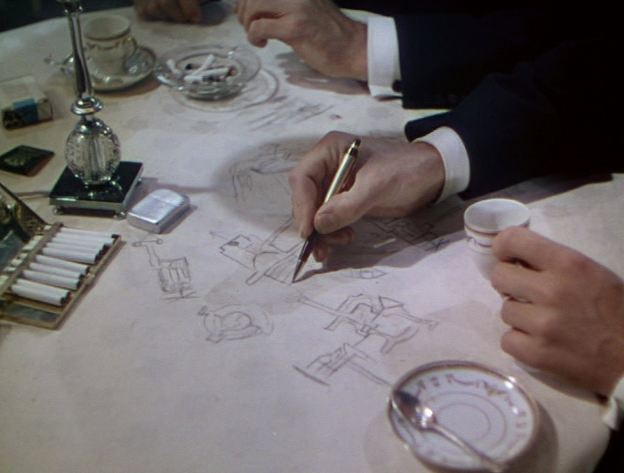
MacMurray and Flynn ignore their dates Alexis Smith and Ann Doran. They are instead preoccupied with a new idea for a pressurized suit to wear in an airplane, something like what a deep-sea diver would wear. They draw plans on the tablecloth. They smoke.

In a way it reminds me of the movie Apollo 13 (1995) where the crisis of the space capsule being unable to return to earth must be solved by the men on the ground with very rudimentary methods. All solutions begin in the human mind.

And by drawing on the tablecloth. And playing with Alexis’ lipstick.

Errol and Fred are really excited about the lipstick screw function. More male bonding. Not usually done over lipstick, but I like to think I’m open-minded.

The lipstick is a very pretty shade of red.

Both Flynn and MacMurray take to the air in some very scary dive sequences. Fred MacMurray eventually succumbs to pilot fatigue and he is grounded. He is consoled in what is one of the few foreshadowing moments of our involvement in the war, “Kind of tough to be yanked out of a ring when the main event may be about to start.”

But, one more test must be performed before their invention can be approved. MacMurray takes it on himself to fly the test.

MacMurray performs his test successfully, but crash lands and is killed. (Yeah, spoiler-schmoiler.) In the final scene we see Errol Flynn flying off to join a squadron with the Pacific Fleet. We know he is going to Pearl Harbor, and we know what will happen there. It is with poignancy and sadness that we realize he does not.

In tribute to his pal, he drops MacMurray’s gold cigarette case, which he retrieved from the crash, into the ocean, tossing it out of the cockpit of his airplane.

The last shot of the squadron flying towards the rays of the sun is brilliant enough to make you want to shield your own eyes.


Who says macho can’t be pretty?


*********

Jacqueline T. Lynch is the author of Ann Blyth: Actress. Singer. Star. and Memories in Our Time - Hollywood Mirrors and Mimics the Twentieth Century. Her newspaper column on classic films, Silver Screen, Golden Memories is syndicated nationally.


Thursday, April 5, 2012

A Holiday Musical Interlude...


Louis Armstrong jazzes it up a little, but reverence can still be heard in that horn. Please scroll down to the bottom of the blog to mute the music so you can hear these videos.

Below, we have Jeannette MacDonald in “San Francisco” (1936) and “The Holy City”.


A blessed Passover, Easter, and Orthodox Easter to all who celebrate them.

Monday, April 2, 2012

NOW IN PAPERBACK...

My post-War II "noir novel", "Cadmium Yellow, Blood Red" is now available in paperback.  Are you getting tired of these sales pitches?  I am.

The book will shortly by offered online at Amazon, and in the weeks to come by Barnes&Noble and other distribution outlets.  The book is immediately available through CreateSpace.  Right here.

Or, you can order the book directly from me.  There are two ways:

Method number one:  Just scroll all the way down to the bottom of this blog...no, farther.  ALL the way down to the cellar where I keep the music that plays when you hit this blog, and my summer clothes, and the Christmas decorations.  And the furnace.  All the way down.  There you'll see a box where you can order the book through PayPal and credit cards.  The price is $12 (but for subscribers to my newsletter, $10), plus postage.  There's a blank for a name if you want me to inscribe it to somebody.

Method number two:  If you want to pay by check or money order, just send your request to JT Lynch, PO Box 1394, Chicopee, MA  01020.  Either in your order or by email, send me the subscriber's code in your recent newsletter if you're paying the discounted price.

Also, let me know in your order or by email (JacquelineTLynch@gmail.com) if you want a signed copy.  If you also want it inscribed to someone ("To Sam", "To Shirl", "To Grandma Teitelbaum", to "Chief Inspector Dave"), just let me know.  Please restrict the inscriptions to names only.  I prefer not to address books to "Pooky Bear" or more intimate derivations thereof.   Please remember I am a New Englander and terms of endearment therefore embarrass me.

THIS JUST IN....

My sincere thanks to Rich over at Wide Screen World for bestowing on me the 7x7 Award.  Instead of participating and passing it along to another seven, I'm just going to sit this one out.  I'm very grateful he thought of this blog.  Please go have a look at Rich's great blog here. 

We now return you to your regularly scheduled blog.

Thursday, March 29, 2012

Murder on the Blackboard - 1934


“Murder on the Blackboard” (1934) keeps the teachers after school to find the killer when one of the staff is murdered. This is the second appearance of the superb Edna May Oliver as amateur sleuth and full-time teacher Hildegarde Withers. James Gleason is back as her foil and friend, Inspector Oscar Piper. They first teamed up for “Penguin Pool Murder” (1932), and would be back again for “Murder on a Honeymoon” (1935). Later entries in the series would feature Helen Broderick and Zasu Pitts in the role.


Caricatured by Hollywood cartoons for her weak chin and long face, but never as expertly as when she caricatured herself in every patented facial flinch and body English, Miss Oliver was perfectly cast in this role, bringing humor and depth, as she always did whatever part she played. One gets the sense she never considered any line a throw-away. Everything, like a good vaudevillian, was milked, every opportunity in script, in props, in gestures, was used to her advantage.

In this story, a young woman who was a fellow teacher is murdered in her New York school, and the cast of suspects includes two other teachers played by the ruggedly handsome Bruce Cabot, and by Gertrude Michael. They are in love, and secretly planning to marry. When Miss Michael is questioned, Mr. Cabot heroically comes to her defense. Miss Oliver responds,

“I like you for that, young man, but the police, though they may be fools, are not sentimental fools.”

She gets the best lines, and as usual in these stories, the cops are not as good at detective work as she is. A young Regis Toomey is James Gleason’s assistant. Gleason, though sometimes two steps behind Edna May, is no fool, and the repartee between them is funny, argumentative, and even awkwardly flirtatious. They are meant for each other.

One comic bit between them: He is about to help her through a trap door, and standing behind her, he grasps her underarms. She whoops and wiggles like a girl being fondled under the bleachers and remarks, “Oscar, this is no time for fooling.”

Annoyed at her misinterpretation, he drops her through the trap door like a sack of cement.

Gleason’s detective style is a bit more direct than Miss Oliver’s. He tells the principal, “Do you talk, or do I let the boys go to work on you?”

The smarmy principal, played by Tully Marshall, who chased the murder victim behind his wife’s back, is also under suspicion; as is the sloppy drunk janitor.

The title comes from a set of musical notes written on the blackboard by the murder victim, who taught music. One of the funny elements to the movie is that Edna May whistles the short series of notes to everyone she meets to try to judge their reaction and determine their guilt. They all look at her as if she is loony.

She sometimes comes off that way even to Gleason, who we see has great respect for her abilities. When they are in the hospital room of an injured police detective, the coroner, played by Gustav von Seyffertitz (who I have to mention just because I love his name so much) -- in the striking combination of wing collar and laboratory apron -- bows low and kisses Miss Oliver’s hand with European courtesy. They animatedly begin to discuss the details of the murder victim’s autopsy. The squeamish wounded policeman protests, and Gleason responds, “What do you care? You’re lucky they’re not both in bed with you.”

It is a movie that starts slow, but picks up with several excursions from the upper floors of classrooms to the cellar, where Edna May’s fluttering hands and occasional nervous nipping at from whatever bottle comes her way tell us that she is not yet hardened to this police work. However, when she knows the answer, she victoriously shouts “Eureka! I’ve got it!”

It’s a quick and neat little mystery, but the real charm is Edna May Oliver and James Gleason, most especially because they look like they’re having fun.

Monday, March 26, 2012

Let's Do It Again - 1953


“Let’s Do It Again” (1953) gives us a last look at a frivolous musical comedienne Jane Wyman before a long stretch of more “soapy” roles. To be sure, she had her serious talents already explored in her Oscar-winning performance in “Johnny Belinda” (1946), and “The Lost Weekend” (1945) with Ray Milland, with whom she’s teamed again in this movie.

It’s a different matter to take on a frothy role after one is already established; we see her character is not like the old ditzy chorus girls she used to play when she was younger. Her dignity, partly due to age and party due to simply paying her dues, helps her stand out in this otherwise lightweight movie.

I'll bet your house parties look like this.  I know mine do.   

The film will be inevitably compared (unfavorably) with the original comedy “The Awful Truth” (1937) with Cary Grant, Irene Dunne, and Ralph Bellamy. Most remakes, a lot of us would agree, are disappointing. I wouldn’t look at this as a do-over, though. It’s just another take on a scenario, only with music and set in a 1950s bubble bath. Step right up here, we got your modern furniture, we got your off-the-shoulder gowns. You say you want opera gloves? Sister, we got opera gloves.

Ray Milland is a Broadway composer who, much to the chagrin of his wife, Jane Wyman, spends much of his time on the town carousing without her. She is a former musical star who retired to be a wife. She attempts to make him jealous with a tall tale about staying out all night with his rival composer, played by Tom Helmore. When Milland balks at her story about spending the night with Mr. Helmore in a motel, she, completely unruffled, comforts him, “Darling, don’t look so worried. It was approved by the auto club.”

She plays the scene well, and we see Wyman has not lost her flare for comedy. As their fight moves briskly to the bedroom, she does a does a modest striptease, a few cheesecake poses, singing and never spoiling her perfect makeup in the shower.

Ray Milland gets a few funny bits, especially one later on in the film with Helmore as they discover they have the wrong hats, but for the most part it’s Miss Wyman’s movie. She sings, she dances (Milland is dubbed), and looks great.  Her best scene, when she tries to win him back after he dumps her for another lady, is when she crashes a party for his fiancée and her parents. She pretends to be Milland’s sister, a world-traveling chanteuse and anthropologist.

Her performance in this scene is terrific, purposefully over-the-top, and a 180-degree turn from the prim, pouting neglected wife. Her suddenly low, husky voice announces for us a bawdy extrovert, sexually charged, and swinging a long cigarette holder like a drum majorette with a baton. She greets her “brothers” Ray Milland and Leon Ames with a sensual kiss on the mouth, and asks Leon, “The thing been giving you any trouble lately?” Her slang-infused repartee is hysterical.

Then, with little provocation, she launches into a song and “interpretive” dance taught her (and sung earlier) by nightclub singer Valerie Bettis. Wyman refers to it as the Zambezi Puberty Ritual. Here it is below.

Please remember to scroll down to the bottom of the page and mute the music so you can hear the video.


Aldo Ray is a rich uranium miner from Alaska who has long had a crush on Miss Wyman back in her performing days. He is cute here, a clean-cut boy, a country bumpkin who can do a mean mamba dance, and who romances Wyman in anticipation of their honeymoon, “this time next month we’ll be moose hunting."

Aldo Ray, with his whiskey-rasp of a voice had better roles ahead of him, but was one of those actors who never seemed to get real breaks. Here’s a great commentary on his work over at Where Danger Lives.

Mary Treen plays the maid (of course), one of Hollywood’s most stalwart supporting actresses, who still did occasional TV roles in her later years. Have a look here at this earlier post on Mary Treen.

Trivia for you younger folks: with the advent of mp3, the term of a music “album” is probably used less these days, last used for CDs, but it came from the days -- as we see when Jane Wyman plays a record -- when 78rpm records were issued in an album set. That is, a bound book with five or six sleeves to hold as many records. In this case, Miss Wyman holds an album of several song hits by popular singer Dick Haymes. Broadway cast albums (I think “Oklahoma” was the first to be issued) held the entire show, two songs per record, several records for a whole show, in the many sleeves of a rather heavy photo album-type bound book.

You think mp3 revolutionized the industry? You have no idea what 33 1/3 long-playing records did for the industry (especially as regards classical music). Long playing (LPs) were introduced to the general market in 1948, and according to this article from Billboard magazine (August 2, 1952), the year before “Let’s Do It Again” was released, they (along with 45’s) had accounted for half the sales -- 78s were still hanging in there.  Only for a couple more years.


Here’s a cast album from the Broadway hit “Brigadoon” in 78rpm (the paperboard album long since has fallen apart after moldering in someone’s cellar for decades) and also in LP. Would we have the patience today to wait for “side 10” to hit the spindle?


One last look at Jane Wyman’s musical talent, and off-the-shoulder gown, and opera gloves.

Thursday, March 22, 2012

Matching Drapes and Couch


This shot from “More than a Secretary” (1936) intrigued me when I first saw it. No, not because of Jean Arthur, although she is swell in anything she does. I mean the drapes behind her. Plaid drapes in 1936. We seem to be unconsciously foreshadowing the war years.

You know what I mean. Never mind the men in uniform or the patriotism. War-time movies really stand out because of those plaid drapes. Here we are in “Since You Went Away” (1944).


The drapes in this movie are to decorate the wide arch between the living room and the hall, and between the living room and the dining room.


But -- and here is the kicker -- they match the cushions on the couch.


Look at the back of this chair in the foreground. The chair matches the plaid pattern as well.


A 1940s fashion? Look here at “My Reputation” (1946). More plaid drapes and matching couch.


The fashion was tweaked a little bit at the end of the decade for “Tension” (1949), where we see a checkerboard pattern Richard Basehart’s apartment.


Not only do couch and drapes match, but the easy chair and desk chair match as well.


Yes, this is why I watch old movies.  I care nothing for acting or story line; it's the drapes.  It was always all about the plaid drapes. 

Can you think of other examples?

Monday, March 19, 2012

This and That

Catching up on a few odds and ends today. First, special thanks to Dorian of “Tales of the Easily Distracted” for including me in her list of recipients for the “7x7” award. I appreciate her thinking of this blog. However, instead of answering the seven questions about myself and picking seven others to receive the award, I’m just going to sit this one out. Have a look here on Dorian’s other pics for this award, and for her interesting answers in the game.


Next up, this is to announce that my ebook “Cadmium Yellow, Blood Red” is being re-issued in a second edition with a new cover by Casey Koester. You know her better as fellow classic film blogger Noir Girl.

Terrific artist, isn't she?  Have look at Casey’s blog here.

I've decided to commit to turning this into a series ("Double V Mysteries") featuring our two unlikely amateur sleuths, and the next book will be published this summer.  It will be called "Speak Out Before You Die".  Lurid-sounding, isn't it?  It's actually a line in a poem by Alfred, Lord Tennyson.  More on that later.

Casey's "Cadmium" cover, and future covers for this series will have a stylized "noir" look suggestive, but not imitative, of the pulp novels of the era in which these stories take place. I hope to carry these stories right up through the 1950s.

Casey's own unique style represents a fresh approach to nostalgia-inspired graphic art, and I am pleased and privileged to have her work associated with mine. 

“Cadmium Yellow, Blood Red” is a “cozy” mystery set in Hartford, Connecticut in 1949. Here’s the blurb:

Juliet Van Allen, a museum administrator, discovers that her artist husband is having an affair with another woman. Elmer Vartanian, recently released from prison for a museum robbery, is coerced into helping scout the museum for a heist by a gang that has kidnapped his daughter. Juliet’s husband is found murdered. Elmer signs on as her alibi in exchange for something he wants. Together, dogged by the scandal-monger newsman, the shrewd police detective, and scrutinized by the even more judgmental eye of Hartford’s elite, the rich widow and the ex-con try to outrun them all in a 1948 Lincoln Cosmopolitan, in a world where Modern Art meets old-fashioned murder.

YES, IT’S NOW AVAILABLE IN PAPERBACK. “Cadmium Yellow, Blood Red” will be available as a print book in paperback beginning in April. Amazon, Barnes & Noble, and other online shops will carry the book, but I’m not sure how wide the distribution will be yet. I may also offer it on my own personal website and through this blog. I haven’t worked that out yet. This is all kind of a new experiment for me.

You can read the first chapter in this previous post here.


Finally on the docket today, I’d like to pass the word along, if you haven’t heard already, that the For the Love of Film Blogathon is once again gracing the blogosphere. The dates are May 13-18th, hosted by the dynamic duo of Self-Styled Siren and Ferdy on Films, ably assisted by This Island Rod.

The theme this year is Hitchcock, and the goal is to help the National Film Preservation Foundation stream "The White Shadow" (1923), free for us to see for four months and record the score. As Marilyn Ferdinand so ably puts it, the “For the Love of Film Blogathon to raise that money so that anyone with access to a computer can watch this amazing early film that offered Hitchcock a chance to learn his craft, with a score that does it justice.”

Hop on board the effort to raise money for this worthy cause or just keep on the lookout for the blogs participating in this event. I’ll be posting on “North by Northwest” (1959) on Monday, May 14th.

I think that’s it. We return you to your regularly scheduled blog.

Thursday, March 15, 2012

Storm Center - 1956


Storm Center (1956) asks the question -- what is the meaning of the phrase free public library? Bette Davis plays a widowed librarian who defends free speech against the town council, and the town, that is uncomfortable with it. We have several shots of the library where she works, on which is chiseled in stone FREE PUBLIC LIBRARY. Director Daniel Taradash wants us to remember this.


The library, by the way, is an old friend to us movie buffs. You may recognize it is the same library where Teresa Wright bolted in the night to get information from newspapers on her sinister uncle in Shadow of a Doubt (1943). Both movies were filmed in Santa Rosa, California.


 Teresa Wright in Shadow of a Doubt

Another shot from Shadow of a Doubt
 The movie starts out with a bold title sequence and music theme that, like the movie we discussed on Monday, Trial, seems forward-looking and carries a hint of a turmoil of the early 1960s. The title sequence is by Saul Bass, another favorite among old movie buffs.

Similar in style to the title sequence of Vertigo (1958), we have a face, in this case a pair of eyes superimposed over the typeface of a book. The eyes are eagerly reading the pages as if searching for some information. We hear the ominous sound of the kettle drum and soon the words and the blinking eyes are enveloped in flames. It is a premonition of things to come.

The movie has an interesting premise. Bette Davis carries a book in her library about communism. It is a kind of manifesto on the idealized communist society. We don’t really know too much about the book, except that we are told it is propaganda. Bette Davis admits herself that it is propaganda, and she believes it is a foolish book. We are told from the beginning that she is an open-minded guardian of free speech. She keeps the book in her library not because she agrees with its premise, but because she believes it will educate that the communist way of life is unappealing, false, and inevitably strips the citizens of such a society of their freedoms.

The film wants the viewer to know this right off about her to have no doubts about her sincerity (or her being a nice person), and the film is not very subtle in pointing out who the good guys are and who the bad guys are. The film’s chief problem is its lack of subtlety. The other problem is that the movie was not made earlier. As noted in Monday’s post, by 1956, the worst years of the communist witch hunts both in Hollywood and in America had begun to fade by this time, when people began to wise up that repression is repression whether its imposed on us from other nations or home-grown. It would have been better had this movie been made in 1950, that certainly would have been a bold move. Hollywood is famous for concocting films as an afterthought.

Bette Davis’ work in this film is interesting in two respects. First, we see again her admirable willingness to work as a character actor. She found character parts far more interesting and this probably gave longevity to her career. On the other hand, this is one movie where Bette Davis performs at her most heavily mannered. Her prim and proper intonation becomes somewhat grating after a while. I think her finest scene in this film is towards the end where she breaks down under the heartbreak of having lost the affection of the town’s children.

Her character has been widowed many years. She lost her husband early in their marriage when he was killed in World War I. She never remarried, she never had children. We are meant to see that the kids in town, on whom she dotes, are like her surrogate children. When the children follow their parents’ example and shun Miss Davis, she falls apart. It gives the film a needed human touch to it, because for most of the time we are dealing with very intellectual matters. Freedom of speech, civil liberties, repression, and taking a stand politically is often based on airy notions rather than gut wrenching and heartfelt responses to a social issue. Her emotional scene here reminds us that she is not just an intellectual middle-aged woman fighting for some intangible belief like freedom of speech; she’s a lonely woman who lived for her town and is now an abandoned by it.

Another nice scene, very brief, is when she is discussing her plans for a new children’s wing for the library with Paul Kelly, who is a local judge and a longtime friend. We last saw Kelly in Split Second in this post. Kelly often played villains but in this film he plays a man on the fence, a decent man who was caught in the spokes of a wheel being turned by others. They stand together in the stacks, (for anyone who has never worked in a library, the stacks are the rows of bookshelves) and as he talks she stands behind him and picks lint off his shoulders. It is a nice homey touch.

Later on in the film Kelly gets a monologue where he seems to give us a hint of their youth, that perhaps he regrets that her husband was the one who won her.

Brian Keith is an up and coming young city official who leads the movement to have this book removed from the library, and when Bette Davis refuses, he heads the movement to remove her. Keith is good in this role; he was in any role he took. Bette's chief nemesis is not played by a stereotyped close-minded ignorant bigot. Keith is intelligent, smooth and professional. We know he has political ambitions, but he never comes off as a man who willingly would destroy the lives of others for his own purpose, even though that is what happens. He does not seem hypocritical or insincere. When he talks about the book’s propaganda message, he says we’re in a war, and we can believe that he means it. It would be nice to know more about his character, but we really don’t see too much of him.

Much of the story is devoted to a young boy who becomes a symbol of what intolerance can do in a community, and becomes the catalyst for change in a tragic event. The boy is played by Kevin Coughlin, who was about nine or 10 when he did this film. This was his first movie. Before this he worked for four years as a minor character, T.R. Ryan, on the TV show Mama, which was taken from the book and film I Remember Mama. Young Kevin makes a big impression in this movie. I would not say that he was a terrific child actor, indeed his performance is almost as stilted and mannered as Bette Davis’ is. However, he plays a boy who is high strung and obsessive. He throws an extreme amount energy in just about every scene he plays. Whether he is happy, tired or pleased, frightened or angry it all pretty much comes out the same way, like a burst of uncontrollable agitation. One wonders if the little guy was exhausted by the time filming was over. Again, it’s not a great performance technically, but you have to admire the energy with which this boy attacked this part. He gave it all he had.

Kevin’s dad is played by Joe Mantell, an average palooka in a loud shirt who wishes his son would get his nose out of a book and act like the other boys. Bette Davis, who apparently counsels parents on the side, tells him, “Stop wishing Freddie were somebody else…we put far too much stress on conformity in this country.” That’s something, to hear that in the middle of the 1950s.

She tells him to value his son’s differences, forward thinking surely, but when Bette Davis recommends to Freddie a book called “Stories from the Bible”, we know we are being told by the director and the producer, and the studio, that even though she thinks conformity is lousy she still has “real” American values. We’re being condescended to. For the audience, it’s a little like being made to ride a bicycle with training wheels. We’re big kids and we don’t need training wheels.

Kim Hunter plays Bette Davis’ assistant at the library. Miss Hunter is also Brian Keith’s girlfriend. He wants to marry her, but she is reticent because she has been married previously and is afraid of making the same mistakes. Whether or not she had ever been married before has nothing to do with the story, so it’s interesting that they chose to put that in.

Kim is a defender of Bette Davis.  When Brian Keith complains that Miss Davis is being stubborn by not taking that book out of the library, Hunter explains that Davis is a proponent of civil liberties and intellectual freedom, just a harmless old lady set in her ideas. The phrase “civil liberties” strikes a chord in Brian Keith and he gets the germ of an idea. He tries a new tactic.

In a smooth and almost sinister manner he asks Miss Davis about organizations to which she has belonged or to which she has donated money, and he rattles off the names of a few of them. It seems that many of these organizations later turned out to be communist fronts. She says that she knew that and that is why she no longer belongs to them. Mr. Keith’s interrogation is not hysterical or barking the way Joe McCarthy conducted his public events, and for that reason it is all the more eerie because of his controlled manner. He makes no accusations, he only asked questions that are veiled insinuations, and these begin to turn the minds of the fellow council members. They all start to feel uncomfortable with this little old lady librarian. When she walked in the door she was their old friend, but now she’s a spy for the Kremlin.

Bette Davis defends her decision again about the book by saying she also kept Mein Kampf in the library. She says it made her sick to her stomach to see people take it out, but that it did not lead to the spread of "Hitlerism" in this country, because people were able to read for themselves that nazism was monstrous. She believes that given a choice, intelligent people will always decide intelligently.

But, intelligent people often lose their intelligence when gripped by fear and paranoia.

They fire her.

The rest of the film is meant to take place over a series of months as Bette Davis is slowly shunned by townspeople and then finally by the children. What she does for an income is not explained. Kevin Coughlin begins to obsess more and more on what his father has told him about the librarian. Joe Mantell recalls her remark about there being too much conformity in this country, and he calls that “Pinko talk”. Freddie becomes increasingly hostile to people and to books, which he once loved. He feels that he has been betrayed.

Some of her old friends are torn by what has happened to Bette Davis and begin to feel guilty that they did not stand by her, Paul Kelly included. Look for Kathryn Grant, who would marry Bing Crosby the following year, the mayor’s daughter. She is one who supports Bette Davis. The movie has a very large collection of people in minor roles and in bit parts. The whole town shows up for the dedication ceremony of the new children’s wing of the library.

A pair of identical twin sisters, interestingly named  Dora Dee and Laura Lee Stansauk, sing a hymn to the library.  I think this was their only film. They sing well, and one wonders how they came to be in the film, if perhaps they were Santa Rosa locals, much as the standout Edna May Wonacott in Shadow of a Doubt? If any reader knows more about them, please give us a shout.

Bette Davis pretty much gives up her protest about free speech and prepares to slink away from town. Not before Paul Kelly decides enough is enough and brings her to the dedication ceremony. Young Kevin confronts her and calls her communist, his shrieking echoing in the loudspeaker.

She is so rattled by his repeated shouting, that she slaps him several times in the face. It is a very weird scene, and one today is inclined to laugh. A wee bit over the top, yes indeed.  And one wonders why no one in the crowd objects to the ex-librarian hitting this young boy in the head and shaking the stuffing out of him. One can only assume that they are tired of Kevin’s shrillness as well. By this time we all need a break from Kevin.

Kim Hunter breaks up with Brian Keith because she’s pretty sick of the whole mess. She’s got a nice piece here:

“Whatever was the issue? Do you remember? A stubborn woman was fired. The council blew itself up with civic virtue. The city got something to buzz about. I got a better job. You got a platform.”

Keith is offended and responds, “You make it sound like a grab bag.”

“What do you think it was? Patriotism?” A great scene of weary sarcasm, disgust, and despair.

Okay spoiler time.

Kevin burns down the library.

You still with me? Should I have given you more warning? Sorry, I was only talking to myself and I forgot you were there.

No sir, not subtle at all, this movie. We have a close-up on the titles of several books that are burning, including Shakespeare, Alice in Wonderland, and The Story of Jesus.

The townspeople are now contrite that they have fired a nice old lady and driven a high-strung little boy to lunacy. Bette’s lesson is that she should have stood her ground and fought back.

Hard lessons, easy platitudes. Both Trial and Storm Center reflect on a dark era in our history, but do it from a safe distance. Both raise interesting questions, but sometimes handle them clumsily. Nevertheless, the films give us a taste of the turmoil of those years. It is very easy to decry extremism, whether it be left wing extremism or right wing extremism. The trouble is it’s always the other guy who’s the extremist. We rarely recognize it in ourselves. In this respect, these films remain quite timely. Particularly in an election year when slapping labels on people is an easy way to get attention.

That impressive old brownstone library in Santa Rosa I believe no longer exists. Maybe some readers can tell us more about that.

Related Products