IMPRISON TRAITOR, PEDOPHILE, AND CONVICTED FELON TRUMP.

Monday, February 14, 2011

The Prowler - 1951 - Film Noir Blogathon

“The Prowler” (1951) was restored by the Film Noir Foundation. This post is part of the Film Noir Blogathon hosted by The Self Styled Siren and Ferdy on Films. The proceeds raised will be in support of the Film Noir Foundation. More on that at the end of this post.

We have come to expect certain stylistic attributes in film noir, though film buffs often argue about whether a particular film belongs in this category. “The Prowler” takes this genre, but seems to step just a little beyond it by carving out its own world, and playing by its own rules, just as the main character does, played by Van Heflin.

Van Heflin is a marvel in this film. He plays a man capable of being both a lowlife, and yet one who captures our fascination, perhaps even our admiration for his dogged grasping at his idealized goals, and certainly at times, our pity for his helpless bungling of his life based on his miserable inability to understand that integrity would save him in a way purchasing or stealing respect, or killing for it, cannot.

The movie plays out as an intriguing puzzle where layer upon layer peels away until we at last see the characters as bare and raw in the harsh glare of the desert landscape of their final showdown. Being film noir, the movie appropriately begins by putting the characters and us, in the dark…in Southern California, probably Los Angeles, at a Spanish-style home in a wealthy neighborhood in the wee hours of the night.

Evelyn Keyes is the wife whose husband works as a nighttime DJ. Home alone, she emerges from her bath to discover a peeping tom at her window. Two cops respond to her call, one older, genial, who tells her to pull her window shade down when she’s bathing. Duh.

The other is younger, somewhat bored, with smirking arrogance, played by Van Heflin. After his shift is over, he returns to her home by himself, just to follow-up, he says. But we see very quickly his nervy attitude as he makes himself at home, and we piece together, though it is never said in the film, that he was the peeping tom. She has no idea. Instantly this breaks the Code rule that police should not be shown in a disrespectful light. Bullying cops or crooked cops are one thing, but a cop pervert is more evil. What is amazing is how we gradually learn more about him so that he does not seem like such a danger, even when he is.

Evelyn Keyes is quick to invite him to stay, but though we may think her foolish, there is such subtlety to her performance that she walks a fine line between being a naïve victim and a woman simply going after what she wants.

She responds to his intrusive questions and insinuating conversation with the haughty defense that she is happily married, and we see she devotedly listens to her husband’s radio program at night. Her name is Susan, and he signs off with his trademark, “I’ll be seeing you, Susan.”

While her husband spins his 78’s, whatever alarm bells she may feel at the cocky cop’s leering attitude seem to dissipate instantly when they discover the coincidence of their both growing up in Terra Haute, Indiana, where he was the star of the rival high school’s basketball team. This is the only accidental device used in the film, and their winsome dual reminiscence of high school days is so genuine, it does not seem as contrived as it is.

It also lays the groundwork for his character. He was a gifted athlete, but lazy and not a team player. Because of his unwillingness to put himself out or work with others, he is bounced off the roster and loses his college scholarship. He laments this as a raw deal done to him, taking from him the eventual cushy high-paying job that he thinks a college degree would have given him. He came to California, (though we are not told how or why) and fell into a job on the police force, which he dismisses with disgust, though we might also believe he must have felt the uniform, and the gun allowed him an outlet for his swagger.

Another layer is peeled back, and they are companionably visiting on successive evenings while her husband is on the radio. She offers Heflin cigarettes, but says her husband keeps them locked in the desk, and allows Heflin to try to pick the lock with a hairpin. Lots of Freud here, but I think we get it. Her husband’s will is also in the desk, and later we learn that when her back is turned, Mr. Heflin reads it and discovers her husband’s worth, which is considerable.

Another layer peeled back. Her husband is older, and only works as a DJ for a lark. He is possessive, locks up his things, and her. She married him after a failed acting career because he seemed decent and could offer her security. She also wanted children, but he could not give her that.

While Keyes and Heflin talk, the large console radio plays in the living room, and it represents her husband’s presence. His voice follows them like a conscience. In this atmosphere, Van Heflin’s rough attempt at seduction fails and she orders him out, but we see she is less disturbed about him than she is about her own desire. He senses this too, and cleverly returns the next night apologetic, kindly, and they talk about good old high school days again, and high school dances. They dance in her living room to the record her husband plays.

This time, Heflin’s seduction is successful, and we have the panning shot from them cozy on the couch, to his police officer’s cap resting jauntily on top of the radio console. Her husband announces the song title, “Stolen Fun.”

Things move faster, start to become slightly chaotic, when Mr. Heflin invites her to join him on his two-week vacation in Las Vegas. He tells her there is a motor court there he always visits, hoping to own it himself one day. She tells him she won’t go with him because she feels guilty, her husband suspects, and she breaks it off.

Next we see Van Heflin in his dingy one-room apartment, and on the wall, a police gun range target he was presumably allowed to keep as a trophy, because he won a medal in marksmanship. The target is the silhouette figure of a man with a clump of bullet holes at his heart.

Evelyn calls him on the phone a couple times, desperate to see him, but he seems uninterested now. There’s a nice bit where as Van Heflin speaks to her, he scratches his cheek with the mouthpiece of the candlestick telephone, brooding and bored. He wants to break off with her. Or, is he just reeling her in? She shows up shortly afterward, telling him fearfully that she asked her husband for a divorce, and he refused. Her husband says he will kill her before ever divorcing her.

But Heflin staves her off with gentle, noble logic that they’re not good for each other and that he thinks they should break it off for the good of everyone. They stand side by side, gripping the footboard of his bed, holding onto it like a railing for support, as they say their goodbyes while absently staring down at his bed.


When she leaves, resigned to her unhappy marriage, he flops on his bed and tosses a clump of paper into the bowl-shaped ceiling light fixture with a light heart and a sense of victory, like when he was a high school basketball star. Two points!

Is he glad to be rid of her? Or does he have a plan?


Another layer is peeled away. He shows up at her house in the middle of the night and sets a crime scene as if a prowler had been trying to get into the house. The noise lures her husband outside, in his bathrobe and carrying his own gun, which Heflin anticipates. The marksman kills the DJ.

At the inquest, Miss Keyes is distraught and confused, and with a sense of guilt over her affair, dramatically accuses Mr. Heflin of murder, but she withholds from the court her relationship with him. He is found not guilty, by reason of shooting in self defense.

His plan is thus far successful, but it’s not over. Now he has to woo her, and her husband’s money, back. He takes the interesting route of appealing to her brother-in-law, who is a local pharmacist. Van Heflin pretends to be grief stricken, tells him he has quit the force, and offers his financial help to the grieving widow, asks that the brother-in-law relay this message to Miss Keyes. The dead DJ’s brother, played by Emerson Treacy, is impressed with Heflin’s phony integrity, and sets up a meeting between them.

Mr. Treacy’s wife, by the way, is played by Madge Blake, who among other minor film and TV roles you may best remember as Larry Mondelo’s hapless, forever fretting, and hilarious mother on “Leave It to Beaver.”

Mr. Treacy does one other thing for Mr. Heflin, and us -- he confides that the marriage between Miss Keyes and his brother was not a happy one, and reiterates that his brother was not able to sire children. This is planted for us to remember later on.

In another marvelous and quite long scene, Van Heflin appeals to her in her living room, while the records play from her husband’s vast collection, and convinces her that the shooting was an accident and he is remorseful, that he cannot even bear to look at a gun again.

They are married. It didn’t really take much convincing.

For the honeymoon in Las Vegas, they head to the very auto court he once dreamed of owning. Now, thanks to her husband’s money, he does.

He is vastly pleased with himself, boyishly enthralled with his combination new business and home. It represents easy money to him, and also respectability in the community. It is a fine combination of comedy and pathos that a man so slick and conniving could be so in love with a cheaply built post-War motel on a highway where traffic barrels outside his door day and night, and the lurid glare of the vacancy sign blinks in the window. This is earthly bliss to him. A man who wants class, and has no idea what it is. A man who wants respectability, and has no notion of integrity. A villain we grow to pity.

His pleasure in this setting is one of the twists and turns of this film that keep us glued and amazed. Van Heflin is not just the creep he seemed at the beginning of the film. He is that, but he’s also vain, resentful, charming, ruthless, and tragically yearning for his days as a high school hero.

Evelyn Keyes is almost as big a collection of contradictions. We may marvel that she was fooled by this guy at every turn. We may find it odd that she would come from a fine home in a wealthy neighborhood, albeit leaving behind the memory of an unhappy marriage, to seemingly share Heflin’s joy and triumph in a manager’s apartment in a motel. She is many things, naïve, lustful, and human, and there are times when we suspect she must be the jaded female, or the femme fatale because that would make sense and explain her actions, but she never quite reaches that, and I think that is what makes her character sympathetic. In her way, she is as much a dreamer and a bungler as he is.

Then she drops a bomb on him. It is their wedding night, and she is four months pregnant.

At first, his reaction is sweet and emotional. He looks humble and pleased, and clutches her, and cries. Another layer is peeled.

Then after a moment, he pulls away, and we see a duality to the tears. His mind is working. He realizes, and eventually she does, too, that it will become known that they were lovers while she was still married, because it is known by others that could not have gotten pregnant by her late husband. She lied at the inquest and said she had never seen Heflin before. He lied, too. The investigation would probably be re-opened and they would both face the consequences of perjury. He would face the gas chamber for murder. Suddenly, a siren blares by on the highway, and they shudder. It is only an ambulance for someone else, but it’s a moment of conscience.

They toss around ideas about what to do, then decide to leave the auto court in the hands of the gum-chewing front desk receptionist, and take long honeymoon, say about five months, out in a lonely desert ghost town.

His former police partner, played by John Maxwell, is a rock hound on his time off, and has described for Heflin trips he has taken with his wife in the desert to hunt for geologic specimens. Mr. Heflin remembers something about an old ghost town where they can hide.

The final scenes of the film take place in a wind-ravaged, sun-bleached barren landscape, where Mr. Heflin and Miss Keyes set up housekeeping in a tumbledown shack. Here, the movie reminds me very much of a kind of “Twilight Zone” setting. Like an episode about the end of mankind except for a modern-day Adam and Eve surviving a nuclear holocaust.

But, they are just on the lam, and they seem strangely contented, as if this dirty shack in the middle of nowhere offers them a chance to start a new life better than the motel would.

She putters at housekeeping in her maternity top. He wipes the dust off his new Cadillac, as if he were a suburban husband Simonizing the car in the driveway of their three-room ranch. It is comfortably familiar, and yet very, very strange. They are away from civilization, that thing that makes life complicated and lousy, and yet they bring civilization with them. It is only natural.

He rigs up the portable record player to a car battery, and they have their music. While the record plays, they stroll contentedly out a few yards from their shack and admire their vast, barren, and private world.

Then they hear her dead husband’s voice.


It is a demo record he made of his radio show that got mixed up with the albums. Heflin and Keyes are horrified, and she runs back to grab the needle off the groove, but too late. He gives his signature sign-off in his announcer’s oily voice,

“I’ll be seeing you, Susan.”

It is a truly creepy moment.

He’s not the only one to interrupt their honeymoon. Van Helfin’s former police partner shows up like a busybody neighbor. Keyes goes into labor. Heflin is genuinely frightened for her, and though they had planned to deliver the baby themselves without help, he panics and brings back a doctor. The lonely desert is suddenly busier than Grand Central.

Keyes, not really a femme fatale, and not really a naïve fool, and not really in love with her late husband, becomes something definite, finally. She sees Van Helfin has brought his old service revolver, this man who said he was sick of guns, and the penny drops. She knows he will kill the doctor to prevent him from reporting the birth, or his suspicions to the police about the odd couple in the desert.

She decides to get off the merry-go-round, and becomes a hero. When the doctor shoos Van Heflin out of the room (it’s the 1950s and a husband can’t be present for the birth of his child), she takes the moment to spill the beans to the doc, tells him to high tail it out for his own safety, and take the baby with him.

Which he does, and when an astonished Van Heflin sees the doc has escaped and his wife has betrayed him, he frantically searches for another way out before the police get here. He bitterly defends himself to his wife with tears in his eyes:

“So what? So, I’m no good. But I’m not worse than anybody else. You work in a store, you hock down on the cash register. A big boss, the income tax. Ward heeler, you sell votes. Lawyer, take bribes. I was a cop. I used a gun.”

The stuff of film noir. Bad mistakes. Getting trapped. Disillusionment. No way out.

Perhaps not so coincidentally, the three men most responsible for this story were similarly disillusioned and looking for escape. Dalton Trumbo, the gifted screenwriter who in just a couple years would turn out the enchanting “Roman Holiday”, but would do it under a fake name, had taken himself off to Mexico to wait out the frightening years of the Black List. One of the infamous “Hollywood Ten”, Trumbo served several months in prison for contempt of Congress, and took himself and his family out of Hollywood for the better part of the next decade, but still slipped scripts over the transom, so to speak, under other names. His name was left off the credits of this movie when it opened. His presence lingers, though. That’s his voice you hear as the DJ husband on the radio.

The other screenwriter for this film, Hugo Butler, also took it on the lam to Mexico when he was blacklisted. The director, Joseph Losey, fled to England to avoid being questioned by the House Un-American (such an ironic name for this group) Activities Committee.

Film noir is a style sometimes replicated today, but in its heyday served as an illustration of post-war societal fears and repression, angst and disillusionment that shows us a bit of our own popular culture and history. The Film Noir Foundation’s mission is “to find and preserve films in danger of being lost or irreparably damaged, and to ensure that high quality prints of these classic films remain in circulation for theatrical exhibition to future generations.” We can thank them for the restored issue of “The Prowler”.

You can thank them some more, and continue their work on other noir films, by donating to the Film Noir Foundation.  And visit the other blogs participating in this noir blogathon. You’ll find a list of them at The Self-Styled Siren, and Ferdy on Films.

Thursday, February 10, 2011

Our Miss Brooks - 1956


Our Miss Brooks (1956) is probably one of the earliest, if not the earliest, movie spinoff of a successful television show. It pales in comparison to the string of TV-to-movie hits (or flops as the case may be) that we’ve been subjected to for a few decades now. This movie is much less flashy and not at all campy. However, it serves a simple purpose: to re-unite us with old friends.

The prosaic adventures of high school English teacher Constance Brooks were first told on radio from 1948 through 1957, an extremely successful nine-year run that coincided with a foray into a television series from 1952 to 1956, and finally, this movie when the TV show ended. Hitting all media, and winning all kind of awards and tributes, Eve Arden finally slipped out of the second banana billing of her film career, and became the star she deserved to be.

The original radio cast included the incomparable Gale Gordon as the blustering Principal Conklin; Richard Crenna’s adenoidal whine voiced nerdy student Walter; Jane Morgan as the scatterbrained landlady Mrs. Davis; Leonard Smith as the dimwitted Stretch Snodgrass, whose malapropos and mangled English gave Connie Brooks a chance to show off her English teaching skills; and Jeff Chandler as the shy, and unassuming biology teacher Philip Boynton. He was later replaced by Robert Rockwell in the role. Gloria McMillan plays Harriet, the principal’s typical teen daughter with the rapid-fire giggle.

The cast was so tight and smooth, that they worked with precision radio screwball comedy for the better part of a decade, and probably the chief interest in this 1956 film, then and now, is for fans of the radio show to see what the characters looked like. The plot doesn’t offer much else. Strangely, the movie “introduces” us to Connie and the gang at the beginning of their all meeting at Madison High School. It makes for an awkward leap, when we already know the characters so well.

A sub plot involves Eve Arden making a special effort to reach a troubled, angry boy in her class, played by Nick Adams. His rich publisher father, played by Don Porter, ignores him, and Miss Arden, while fending off the romantic advances of the father, must bring these two together.

This aspect of the story deepens the tone of the film and shows Miss Brooks as a selfless, compassionate teacher. All well and good, and there should be more such teachers in the world, but what was really special about Connie Brooks wasn’t her deeper qualities, but her superficial ones. The radio Connie was always in financial arrears -- she makes several jokes about a teacher’s salary -- and buys everything on time. She pines for a romantic relationship with Mr. Boynton, and gets herself entangled in embarrassing situations because of it. She is more fallible on radio, and more loveable.

Also missing from the film are Mrs. Davis’ inedible breakfasts, with running gags about MixMasters and Rye Crisp. The movie Mrs. Davis is far more cunning and on the ball than the radio landlady.

The archetypal teens, Walter, Harriet, and Stretch get much less play in the film, and the boys are clearly men by this time, despite their perfect voices that would hide the fact on radio.


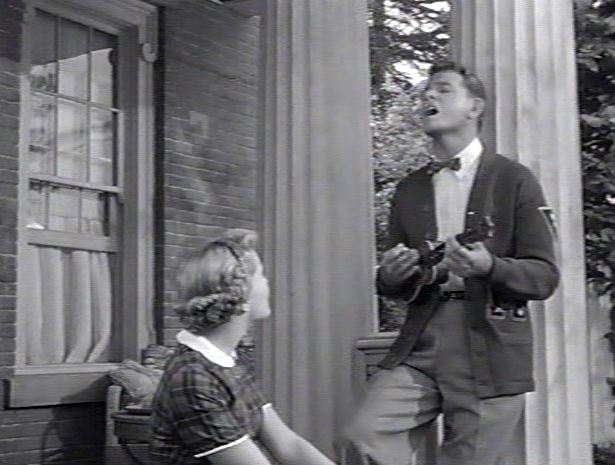
One of the funniest scenes in the movie is when Walter croons the Doris Day hit, “It’s Magic” to his lady-love. I love his unselfconscious flaunting of that tortured voice.

Chiefly missing is the snappy pace of the radio show dialogue and plots. The movie drags its feet here and there. The viewer is bludgeoned with awkward facial reactions and double takes to emphasize a line or joke. They did not have need such visual emphasis on the radio.

Radio also offers a wider screen, if you will. Gale Gordon’s blow-ups or snide retorts are magnified in our imagination when we hear them. When Miss Brooks steps on his glasses, the crunch is funnier for hearing it. The vision in our minds of disastrous surprise parties, indelible Easter egg dye on their faces, Miss Brooks being hoisted down a second-story ladder so that Mr. Boynton can practice being a volunteer fireman, or Miss Brooks, Mr. Boynton, and Mr. Conklin sinking in a rowboat on the radio are hard to top  by this weak, but well-meaning movie.

One radio episode, which involved them driving out of town to attend an “away” school football game is like a Seinfeld episode where “nothing happens” but everything that could possibly happen, happens.

It was a perfect match of witty writing to a suitable medium. We will never see the like again.

The Our Miss Brooks radio episodes are all in public domain now. Listen, or download them here from the Internet Archive website.

The movie is pleasant, but it is really more of a curtain call, or victory lap for the TV show. The radio show would actually run another year, truly surpassing the other two versions.

********************

Jacqueline T. Lynch is the author of Ann Blyth: Actress. Singer. Star. and Memories in Our Time - Hollywood Mirrors and Mimics the Twentieth Century. Her newspaper column on classic films, Silver Screen, Golden Memories is syndicated nationally.  Her new book, a collection of posts from this blog - Hollywood Fights Fascism - is available here on Amazon.

Monday, February 7, 2011

Colonial Theatre - Canaan, Connecticut


When this photo was taken in October 2010, the Colonial Theatre of Canaan, Connecticut was in its last days of operation. It’s currently closed and up for sale.

The wood frame construction is not as flashy as, say, Art Deco, but its staid Georgian-inspired columns and respectable gray clapboard with white trim is certainly an example of what the closest thing to a “downtown” would look like in a remote New England village.

Built in 1923, this old movie house is on the National Register of Historic Places. Weathering the decades and changes in film, and audience, the Colonial was closed in 1997, but later re-opened to include live theatre as well as movies. Have a look here at this website more photos, including the nifty interior, and at this website for more history on this theater. Hopefully somebody will see possibilities for the future while respecting its past.

Thursday, February 3, 2011

The Dark at the Top of the Stairs

“The Dark at the Top of the Stairs” (1960) gives us a curious mix of cozy nostalgia skewed with a foreboding modern world of alienation.

Thanks to Kate Gabrielle over at Silents and Talkies, I was able to finally see this movie. It doesn’t seem to play on TV much, and I don’t think it’s out on video or DVD. Maybe some of our readers can fill in the blanks on that info.

The film, set in the early 1920s, resonates today with problems of technology eliminating jobs, and the strain on marriage caused by the struggle for money, a lack of communication, and a lack of satisfying sex. But mostly money.

Robert Preston plays the middle-aged traveling salesman whose world is crashing down upon him. His products are horse harnesses and accoutrements, but even he, like most of his customers these days, are driving flivvers. The horse-drawn conveyance business is drying up, and here in small-town Oklahoma, a new world is on the horizon, literally. Oil rigs are going up on lonely farms, and a new era in transportation, and in the American economy, is beginning. Mr. Preston is laid off.

There are a few elements that make this quiet film, based on William Inge’s stage play, quite compelling. One is the serendipitous fact that Robert Preston had just come off Broadway in another hit, “The Music Man”, and was slated to star in the film version. Preston’s indifferent career really took off after the “The Music Man” a role which he was offered apparently only because just about everybody else turned it down. It proved to be his making.

Because of his enormous success in that musical, which today we know continued with the film version, this other traveling salesman character he plays in “The Dark at the Top of the Stairs”, sandwiched between “Music Man” gigs, makes his role as Rubin Flood, downsized harness salesman, seem like a Bizarro World version of the larger than life scamp, Harold Hill. It is impossible not to compare them when watching this movie.

Here, Preston is married to Dorothy McGuire, a sensitive, genteel woman, a warm supportive mother, but whose serenity is shaken by her frustration at being trapped in a helpless situation. It’s the kind of role Dorothy McGuire could play with one hand tied behind her back. The other compelling aspect to this movie is the several strong female roles that give us the range of the “woman’s world” experience in 1920s small-town America. They are played with a vengeance by Miss McGuire, by Eve Arden as her pushy sister, and by Angela Lansbury as the local beauty parlor operator and “other woman”. I don’t suppose the business, as well as the art, of casting a movie is given enough attention by old movie buffs, but whoever made the decisions on putting together the lineup for this team hit a homer.

We might also consider that this movie made in 1960, a time when the “greatest generation” of film stars were losing job opportunities due to their regrettable habit of aging, gives us a chance to see experienced actors and actresses in meaty roles. Had the movie been set in 1960 and not 1920s, would they have still seemed appropriate (marketable) for their roles by the producers? One might wonder if since these stars were leftovers from the Golden Age of Hollywood, did that make them seem old-timey automatically?

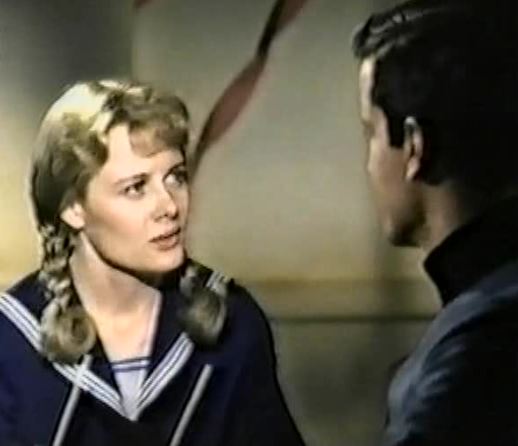
For the younger set, we have Shirley Knight, terrific as the shy, awkward daughter of Dorothy McGuire and Robert Preston, who is due to fall in love, and endure tragedy, the extreme highs and lows the movies tend to reserve for those who are young. But we see that highs and lows, falling in love and enduring tragedy belong to their elders as well.

One more note on the casting of Hollywood greats: Dorothy McGuire’s role was played by Teresa Wright on Broadway. The only member of the original Broadway cast to reprise his role in the film was Frank Overton, who plays the henpecked, morose husband of Eve Arden.

The plot seems episodic, and drifts in focus from one set of characters to another. Directed by Delbert Mann, there is a feeling about the cinematography and the pacing of the film that evokes a made-for-TV movie from the 1970s. We have a few outdoor shots, including our establishing shot of the turn-of-the century house with its big porch and gingerbread on the gables, though the paint is peeling here and there enough to keep us from assuming right off that we’re entering an idyllic world. Most of the scenes are interiors, maintaining the atmosphere of stage drama.

Robert Preston begins the film eager to head out on the road again, and Dorothy McGuire laments his frequent absences, clings to her shy daughter and her younger son, bullied by the other boys, in a stifling and over-protective manner, and complains about Preston controlling the purse strings in the family with a purse that doesn’t have much money in it. Shortly, Mr. Preston will learn he is fired, and all the petty annoyances of his life come crashing down on him like great big monsters.

He broods in the back room of the local drug store (the only place in small town Prohibition America where a fellow can get a drink -- because it’s a “prescription”), and angrily wonders “How does everyone else get rich?” Something plenty of us brood about today. Sitting next to him is the town rich guy, deeply troubled and guilty because his wealth came from an insurance scam.

Meanwhile, Miss McGuire fusses over daughter Shirley Knight and pushes the frightened girl into going to her first dance. “My only chance of staying young is through you,” she tells her.

By chance one afternoon, Shirley meets a wiseacre lonely boy from the local military academy, an outcast like her, and forms a bond with him. Later, when she reluctantly comes down the stairs in her home to meet her blind date, she discovers with delighted surprise it is him. It’s like a Cinderella moment.

But there are few magical happenings in this gentle, but realistic setting. Miss McGuire suspects her husband of philandering with the town beautician, Angela Lansbury. Beauticians, like librarians in old movies, seem to be geared to a certain stereotype -- in this case the world-weary, somewhat hardened female. Miss Lansbury doesn’t snap her gum, but she does smoke, so we know she’s been around the block. But, she has a heart of gold, can turn a deaf ear to the petty gossip she hears in the beauty parlor, which is literally her front parlor, and charges a dollar for a perm.

She and Preston are buddies, unusual in the old movies, particularly between traveling salesmen and hard bitten women who’ve been around the block, and Mr. Preston refreshingly acknowledges that she’s really one of his best friends. Partly, as we come to understand, he respects her because as a working woman she knows the value of a dollar, and he thinks his wife does not. Angela Lansbury is not a millstone around his neck.

In a touching scene that also manages to be rife with sexual tension, she talks about the happy marriage she once had, and how being a widow is tough on a woman with normal desires, including a very strong desire for him. The almost-seduction fails because Preston’s heart isn’t in it; he’s faithful to Dorothy McGuire. Miss Lansbury, like the pal she is, lets him off the hook. But when she confesses, without self pity, her loneliness and longing for a romantic relationship, Preston shoots her an expression of wonder, and sadness, and we see he clearly aches for his friend and wishes he could help, but he is no better at lending comfort than he is at finding a job.

The sad and depressing episode spurs him to trying again for a job, any job, and he humiliates himself by asking an old farmer friend to let him be a farmhand. The man tries to let Preston down easy, but must be frank that he’s too long in the tooth for that kind of heavy labor.

Meanwhile, Dorothy McGuire commiserates with sister Eve Arden, and we have yet another look at a broken marital relationship. Miss Arden is gloriously opinionated, funny in her very obnoxiousness, and her strong personality completely overshadows her quietly bitter husband’s moodiness. McGuire envies her a nice respectable dentist husband who works at home, while Eve Arden confesses her husband no longer makes love to her, that she never actually enjoyed sex, and her husband has long since pulled away from even any meaningful discussion with her. “God, I’d like a good fight. Anything would be better than this nothing,” she explodes.

While the grownups are bumbling through their errors, the younger set seem to have more promise. Shirley Knight’s young man, played by Lee Kinsolving, sweetly entertains her with a pretend scenario as he describes what it will be like for him to date her regularly, show up at her house and mow the lawn, being nice to her kid brother and her parents until he is “just like one of the family.” His own mother, a struggling actress in Hollywood, has nothing to do with him and he wants to belong to somebody.

Unfortunately, at the country club dance, we see, and Shirley Knight learns, what he has known all along: that he will never fit in for one reason or another. For tonight, it is because a society matron has decided that a boy named Samuel David Golden is Jewish and therefore does not belong in a restricted country club. He is more than humiliated; his romance and his daydream about fitting in are destroyed.

The film ends with an astonished, and sobered, Robert Preston getting a job as a traveling salesman for the oil corporation, selling drilling equipment about which he knows nothing. But, as he tells the smug young interviewer, he knows how to sell, how to talk to the common people hereabouts. The manager, an older man with enough experience about life to know about such things, decides that Mr. Preston talks horse sense. The job is his.

Becoming employed again does wonders for his marriage, but this is not a film of entirely happy endings. Other troubled lives we’ve seen are still unresolved, and Shirley Knight will carry the memory of a sad boy with her to whatever relationships she has in the future.

Robert Preston remarks with humble satisfaction about his new employment and starting over in his 40s in a new economy driven by new technology, “Now I’m a stranger in the land I was born in…but, I’m doing the best I can.”

A lot of us know the feeling.

Back to Harold Hill. It is irresistible to muse that this might have been the future of Harold Hill and Marian the Librarian 20 years down the line, after the final happy ending scene of “The Music Man”. Maybe they still heard the bells on the hill, but it might have taken more work to concentrate on them when things turned sour. The movie ends with Preston taking Dorothy McGuire’s hair down in the upper floor bedroom, the curtains billowing in the breeze, in the house with the gingerbread gables that need painting.

Monday, January 31, 2011

Snow...Snow...SNOW!

A tribute to those of you in the some 30 states who’ll be taking part in this week’s snow, slush, and ice festival…keep smiling.

(Scroll down to the bottom of the page to mute the music so you can hear the video.)


Thursday, January 27, 2011

Trivia Answers - Women in Men's Jammies

I'm impressed by how you folks notice the little things, and especially to our Caftan Woman, who certainly knows her PJs like nobody's business.  The answers to Monday's pictorial trivia are:


A - Jean Arthur, checking herself out in the full-length mirror as Ronald Colman watches.  They're his pajamas, and this is "The Talk of the Town" (1942).


B - Alexis Smith donning Bing Crosby's pajamas for a wrestling lesson in "Here Comes the Groom" (1951).  We talked about this movie a few weeks ago, and that's when the idea for this stupid trivia post occurred to me.


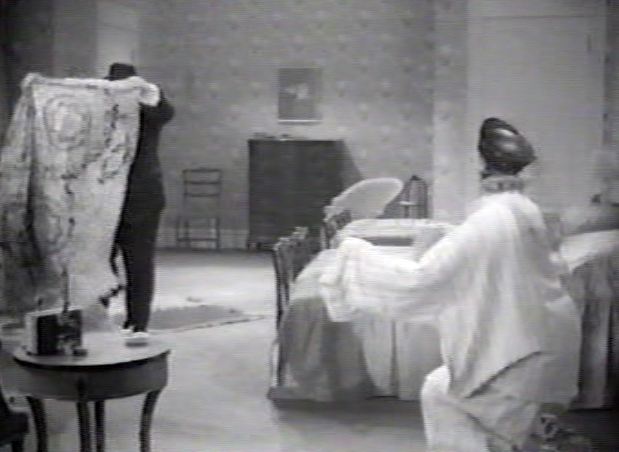
C - Patricia Ellis, wearing Oliver Hardy's jammies, but still maintaining her lady-like demeanor by not taking off her hat, in "The Block-Heads" (1938).  I have to hand it to you here, Caftan Woman, I thought this would be a difficult one.


D - Finally, we have Claudette Colbert in Clark Gable's pajamas from "It Happened One Night" (1934).  She's off to use the showers "and things".

Monday, January 24, 2011

Women in Men's Jammies

See how many ladies you can name, what films, and whose pajamas they're wearing.  Answers on Thursday.


A

B

C

D

Thursday, January 20, 2011

Sidewalk Elevator - "Hot Water" - 1924


It’s been a long time since we featured that wonderful invention and movie prop, the sidewalk elevator. Not seen since this post from nearly three years ago. Three years without another sidewalk elevator?! It’s been agonizing, hasn’t it?


I’ve been searching for one (high and low, you might say), and constantly came up empty time after time. Even “Shane”, from last week’s post, surprisingly, did not feature a sidewalk elevator.


At last, our dry spell is over. Here is the reliable Harold Lloyd in “Hot Water” (1924). The proud owner of a new auto, he takes it for a spin, and as you can see in this series of captures, accidentally parks on a sidewalk elevator.


Enjoy. Now I have to go look for another one.


Monday, January 17, 2011

TCM's "Moguls and Movie Stars"

Having heard little discussion on blogs about TCM’s original documentary series in December, “Moguls and Movie Stars”, I wondered if others were, like me, still working my way through the episodes I recorded because I didn’t have the time to watch them when they were broadcast.

I thought the series very well done, and the early decades especially were enlightening for much information I hadn’t known, particularly about the influence of female directors and writers. Does anybody else have any comments or opinions about the “Moguls and Movie Stars” series?

Related Products