IMPRISON TRAITOR, PEDOPHILE, AND CONVICTED FELON TRUMP.

Thursday, November 10, 2022

We're No Angels (1955)


We’re No Angels (1955) cheekily teases us about our own Christmas sentimentality with an unabashed romp of black humor and goofy good will toward men.  And a murder.


This is my entry into the Classic Movie Blog Association's "Movies are Murder" blogathon.  Have a look at the site here to see the other great blogs.


This post also serves as my intro to a countdown to Christmas coinciding with the launch of my newest book, Christmas in Classic Films.

It is Christmas Eve, 1895 in French Guiana, where three convicts have escaped from the prison at Devil’s Island.  They are Humphrey Bogart, Peter Ustinov, and Aldo Ray.  They do not shoot it out to escape, but rather employ playful charm and Boy Scout-like helpfulness to hide with the family of a local storekeeper until they can board a ship that will take them away back to France and freedom.  The only real weapon they have is their wits and Adolphe, a poisonous snake.

The storekeeper is Leo G. Carroll, befuddled and incompetent, who allows the convicts to repair his roof, not knowing they have escaped.  Joan Bennett is his flighty wife, and Gloria Talbot is his teenage daughter, who spends much of the movie fainting and being carried around by lecherous Aldo Ray.

Basil Rathbone is the wealthy owner of the store, who arrives with his son to take over the business because it is so badly run and unprofitable.  Rathbone is a delightfully first-rate villain, an obnoxious, arrogant, sneering scene stealer who forbids his son to have anything to do with Gloria Talbot, and breaks up their budding romance, not that the son seems to mind that much.  He knows which side his bread is buttered on.

The convicts step in to help Mr. Carroll’s family—they work as sales clerks, they artfully fix up his ledger, they arrange a magnificent Christmas dinner for the family with little luxuries they have stolen.  It’s not certain if they like Carroll’s family so much or just hate Basil Rathbone with a passion, but they stay to defend the family, even to the point of killing Rathbone and his son.

Well, they don’t actually do it.  Adolphe, the snake, bites them, but the convicts let him.


Some charming moments are finding Bogie completely at home cooking in the kitchen wearing a pink frilly apron as if to dare us to laugh, and the trio singing the hymn, “Three Angels,” which they perform for the family.

The dialogue is fast and witty, and very dark.  They frankly and disarmingly discuss their crimes, display a taste for violence with odd joie de vivre, and the film generally defies not only our usual expectations of Christmas sentiment, but our pedestrian need for logic. Director Michael Curtiz’s last movie before this was the tippity-top of all Christmas movies, White Christmas (1954).  Perhaps his own sense of irony required a palate cleanser.

When the family is safe and the opportunity presents itself for the convicts to catch their boat to freedom, they instead decide to return to prison, because it wasn’t so bad and people on the outside are not very nice.  Except for their new little family, which they decide they can always visit when they break out of prison next Christmas.  They walk away from the camera, and three halos are superimposed above their heads.  And over the little cage Aldo Ray carries that holds Adolphe.

But we know, they’re no angels.  Unless, of course, angels can be temporary manifestations when we need them.


Don't forget to check out the other blogs in CMBA's "Movies are Murder" Blogathon!

   ********************

Jacqueline T. Lynch is the author of Ann Blyth: Actress. Singer. Star. and Memories in Our Time - Hollywood Mirrors and Mimics the Twentieth Century and Hollywood Fights Fascism. TO JOIN HER READERS' GROUP - follow this link for a free book as a thank-you for joining.

Thursday, November 3, 2022

Christmas in Classic Films -- eBook launch TODAY!


My long-awaited (for me, anyway) launch of Christmas in Classic Films has finally come TODAY!  The eBook version is now available on Amazon exclusively, and for the first two days (today and Friday, November 4th) will be sold for $1.99!  Beginning Saturday, the price will be set to its regular $2.99, so save a buck and buy today or tomorrow.


The print version of the book will be available beginning Sunday, November 6th at its regular price of $11.99.  If you're looking for some paperback stocking stuffers this holiday season, you can't get any more Christmas-y than this.

The book is dedicated with love to the memory of our dear Paddy Nolan-Hall, aka The Caftan Woman.

  Here's where you can pre-order your eBook now!

     ********************

Jacqueline T. Lynch is the author of Ann Blyth: Actress. Singer. Star. and Memories in Our Time - Hollywood Mirrors and Mimics the Twentieth Century and Hollywood Fights Fascism. TO JOIN HER READERS' GROUP - follow this link for a free book as a thank-you for joining.


Thursday, October 27, 2022

Bing, the Headless Horseman, and Halloween...


Have a listen to this favorite at my house -- Bing Crosby's rendition of "The Headless Horseman" from the Disney cartoon The Legend of Sleepy Hollow, which is the second half of The Adventures of Ichabod and Mr. Toad (1949).  Here Bing performs it on his radio show on 
October 26, 1949, ably assisted by John Scott Trotter directing the orchestra and The Rhythmaires on background vocals. 

************

Next Thursday, we move abruptly to another holiday -- when my book, Christmas in Classic Films is published.  More on that next week.  Until then, enjoy your Halloween treats and, hopefully, no tricks.

Thursday, October 13, 2022

Angela Lansbury -- Requiescat in Pace


While we mourn the passing of Angela Lansbury, we also are moved to celebrate her long, loving, generous life and an extraordinary career of some 80 years.

Some of her film work has been mentioned on this blog previously, such as roles in The Dark at the Top of the Stairs (1960), her debut role in Gaslight (1944), as well as two episodes of her beloved television series Murder She Wrote:  "Reflections of the Mind" with Ann Blyth, and a mention of her clever "sequel" as Jessica Fletcher sorts out the solution from a 1949 movie Strange Bargain.

As a theatre fan, I always looked forward to her appearances at the Tony Awards (she won 5 Tonys).  Here's a reunion of Miss Angela and Bea Arthur reprising their roles from Mame.

She did it all.  She adapted to each era and each new audience.  Had there never been a 12-year run of Murder She Wrote on TV, or her voice work in animated features such as Beauty and the Beast where her rendition of the title song still charms and breaks the heart -- she would still have had a prestigious place in the history of film.  But she just didn't stop there, and there was no reason to.  She embraced all opportunities.  We should all be so lucky as to carry her sense of purpose and enjoyment of life.

She was just five days shy of her 97th birthday.  I wish there could have been at least one more adventure with Jessica Fletcher, but I'm glad I have some DVDs to visit my old friend from time to time.

Angela Lansbury doesn't require mourning from us; she deserves, rather, a standing ovation.

Thursday, October 6, 2022

FREE -- HOLLYWOOD FIGHTS FASCISM


Hollywood Fights Fascism, selected essays on classic films from this blog, is now available for the next four days for FREE in eBook form.  Get your copy from Amazon here.


Our greatest gift from the Greatest Generation was freedom from fascism. Relive, and celebrate, how evil was faced, discussed, dramatized...and fought. Classic films were the weapon.

The Greatest Generation received instruction, inspiration, and, of course, entertainment from a source that affected them perhaps even more than the greater technology of generations to follow: the movies.

     ********************

Jacqueline T. Lynch is the author of Ann Blyth: Actress. Singer. Star. and Memories in Our Time - Hollywood Mirrors and Mimics the Twentieth Century. Her newspaper column on classic films, Silver Screen, Golden Memories is syndicated nationally.  Her new book, a collection of posts from this blog - Hollywood Fights Fascism - is available here on Amazon.

Thursday, September 29, 2022

Christmas in Classic Films


I'm pleased to announce my forthcoming book, Christmas in Classic Films, is now available for pre-order as an eBook.  

It's a collection of essays on yuletide-themed movies, mostly from this blog.  The book will go on sale Thursday, November 3rd, and the print version will follow soon after.

For the first few months it will be available exclusively from Amazon, and afterwards from a variety of online shops.

Here's the blurb:

Christmas turns everyone who celebrates it into a classic film fan—at least for that special season.

The average person, unlike devoted classic film fans, may not recognize images of Clark Gable or know who James Wong Howe was, or be able to tell you why 1939 was such a spectacular year for films. But when yuletide rolls around, they rejoice with 
Miracle on 34th Street, It’s a Wonderful Life, and of course, White Christmas.

We find a vast treasure of Christmas scenes in films that were never meant to be “Christmas movies” but which are now part of the holiday canon, and this collection of essays spotlighting Christmas in classic films brings you all the warmth and memories that have become as dear a custom as decorating your home and holiday baking. You may even have one of these movies on in the background when you’re writing out your Christmas cards.

Unwrap this package and relive the moments and discover Christmas nostalgia anew, from Cary Grant’s mysterious angel in 
The Bishop’s Wife to poor Ralphie pining for a Red Ryder BB-gun in A Christmas Story.

There’s lots more here waiting for you under the tree.


Pre-order your eBook now, and it will be sent to your device on November 3rd!

I'll be contacting readers of my newsletter with the opportunity to receive an ARC (a FREE advance reader copy) of the eBook with the invitation -- but not the obligation -- to review the book.  If you're interested in receiving an ARC, sign on here.

If you're already on my readers' list, don't worry -- you'll get your offer of a FREE ARC in a few days!

    ********************

Jacqueline T. Lynch is the author of Ann Blyth: Actress. Singer. Star. and Memories in Our Time - Hollywood Mirrors and Mimics the Twentieth Century. Her newspaper column on classic films, Silver Screen, Golden Memories is syndicated nationally.  Her new book, a collection of posts from this blog - Hollywood Fights Fascism - is available here on Amazon.

Monday, September 19, 2022

John Greco - Harbor House and Other Dark Tales


John Greco, your friend and mine from the Twenty Four Frames blog, has released a new book that will raise the hackles on fans of horror and dark tales.  Harbor House and Other Dark Tales is a collection of 16 short stories, each with a twist you might not expect.

It's his seventh book of fiction.  In previous posts, I've featured his books Lessons in the Dark, a nonfiction collection of essays on film; and two other collections of sinister stories: Devious Tales here; and The Late Show and Other Tales of Celluloid Malice here. 

John's talent is not limited to writing; he is an exceptional photographer, and his art prints and photos, including many stunning shots of wildlife, can be purchased here at John Greco Art.

Harbor House and Other Dark Tales is available on Kindle and in paperback.  

*************

In the interests of transparency:  I received an ARC of John's book, with no requirement to write a review.

Thursday, September 15, 2022

Requiescat in pace - Marsha Hunt


Marsha Hunt left us last week at 104 years old, a sparkling human being of whom we can truly say had a life well lived.  There are fewer film actors from the 1930s left to us these days, so it is remarkable that the lady came to Hollywood -- and thereby to us classic film fans -- in 1935.

She played opposite everyone:  John Wayne before his stardom took off, John Barrymore, Mickey Rooney, Lana Turner, Laurence Olivier, Greer Garson...you name it.  Of the last two mentioned, we covered her work in Pride and Prejudice (1940) here.  Her role as Mary is some of the best moments of the film:  

"In Marsha Hunt we have one of the funniest Mary Bennetts on screen, with her broad, almost campy playing of the unattractive and dull sister, particularly in her too-eager reaction when her mother admonishes her to smile at a party. The sour note she hits in her performance of “Flow Gently, Sweet Afton” is priceless."

Mary has been played by others as awkward and foolish, dour and pompous, but Marsha Hunt captured the absurdity in the character that I think Jane Austen would have applauded. 

Marsha Hunt had a sense of humor and a sense of humanity, and she would need it.  In 1950, she was blacklisted and the Radical Right, by means of Hollywood, torched her career.  The blacklisting episode, an era that ruined the careers and lives of many liberals and progressives in the film industry, is what seems to have been most captured in the headlines about her passing.  We covered her work in the radio program Hollywood Fights Back here.

But she was more than someone who got thrown under the bus for her integrity.  She went to work in theatre, which is famously tolerant and wonderfully belligerent to those who are intolerant, and we mentioned her appearance at the LaJolla Playhouse.

She was, above all, a humanitarian, and worked on behalf of the poverty-stricken, the homeless, the hungry for many decades.  In her work, and in her life, she was a champion.

The 2015 documentary, Marsha Hunt's Sweet Adversity tells her story, and if it pops up again on TCM, which I expect it may in a tribute to her, don't miss it.

*************

Jacqueline T. Lynch is the author of Ann Blyth: Actress. Singer. Star. and Memories in Our Time - Hollywood Mirrors and Mimics the Twentieth Century. Her newspaper column on classic films, Silver Screen, Golden Memories is syndicated nationally.  Her new book, a collection of posts from this blog - Hollywood Fights Fascism - is available here on Amazon.


Thursday, September 8, 2022

FREE TODAY - HOLLYWOOD FIGHTS FASCISM


Free today at Amazon - Hollywood Fights Fascism.

Download your free eBook today only at this link.

Our greatest gift from the Greatest Generation was freedom from fascism. Relive, and celebrate, how evil was faced, discussed, dramatized...and fought. Classic films were the weapon.

The Greatest Generation received instruction, inspiration, and, of course, entertainment from a source that affected them perhaps even more than the greater technology of generations to follow: the movies.

Monday, August 15, 2022

Ann Blyth book on SALE!


The eBook version of my book on Ann Blyth's career: Ann Blyth: Actress. Singer. Star. will be on sale today and tomorrow in celebration of her 94th birthday on August 16th. A lady of stunning talent, her decades-long and multi-faceted career is explored in this book, which you can now purchase for $1.99 for the next two days.


Here are links to Amazon,
https://www.amazon.com/Ann-Blyth-Actress-Singer-Star/dp/1511801565

Barnes & Noble,
https://www.barnesandnoble.com/w/ann-blyth-jacqueline-t-lynch/1122119874?ean=2940158552816

And a universal link to Apple and several other online shops.
https://books2read.com/u/bQBw60

I hope you enjoy it.

Thursday, August 11, 2022

Confidence - 1933


Confidence (1933) stars Oswald the Lucky Rabbit, formerly of Disney but here in his Universal years.  Also featured are President Franklin D. Roosevelt (sans leg braces) and the Great Depression.  There's something really bold in black-and-white cartoons, daring and courageously surreal.

It's silly, poignant, and innocent, but the message of confidence is, while important, not really what got us through the Depression or what made this country great.

It's optimism.  Our forebears always looked to the future with optimism. Today we battle those consumed by its opposite: cynicism.  The cynics find no good in anything, certainly not in government by the people, and prefer to burn everything down.

I would imagine a cartoon is not going to solve that schism in today's society.  But I wish somebody would try.

It takes real guts to be optimistic when life is really rough, and your chickens are sick.

Friday, July 29, 2022

A League of Their Own - 1992


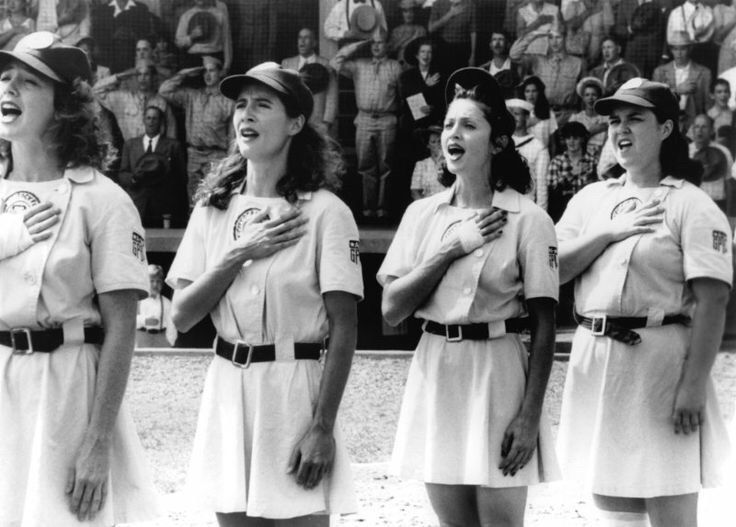
A League of Their Own (1992) is the best movie ever made about baseball.  It achieves this by also being about a lot of other things, and baseball is the conduit by which all those other things flow together.  Above all, it shows a love for the game that can only be displayed by a group of people so desperate to be allowed to play it for the joy and sense of freedom it gives them.

Though this blog is concerned primarily with classic films, I’ve always been interested in modern-day films set the past, especially with an eye towards telling the story with the style of classic films: the bold newspaper headlines, the montage of images to show the passage of time, and the gimmick of splicing in a few replica newsreel bits.  I’m a sucker for it.

This movie, beyond illustrating a period of history, actually makes history by resurrecting professional women’s baseball in the 1940s – something many people had forgotten about by 1992 and most did not know about at all.  I can recall reading a review of the movie at the time it was released by a dismissive reviewer who had no knowledge of the league and displayed very little appreciation of the movie because he did not understand the historical background.

A short-lived television series followed, and now on the movie’s 30th anniversary a new series is being launched next month, but in between 1992 and now there have been books about the subject, websites and Facebook pages created, a popular exhibit at the Baseball Hall of Fame, and merchandise promoting a league that no longer exists – including the iconic dress (literally, a dress) uniform sold as Halloween costumes.  It spawned the motto:  “There’s no crying in baseball!”


Director Penny Marshall filled this movie with heart, affection, courage, humor, and that love of baseball.   What particularly appeals to me, beyond the really excellent job of sets, costumes, script with topical references, are the smaller moments that represent something huge.

For instance, the African-American woman who catches the fastball, looks back at stars Geena Davis and Lori Petty with pride, nods, and walks away.  She will not be invited to play on the All American Girls Professional Baseball League because she is Black.  Here’s a link to the true-life story of how that lady, DeLisa Chinn-Tyler, came to be in that scene.  The scene was not in the script.  She was a terrific ballplayer, came down to try out for the movie, and like her character, was not utilized because of her skin color.  But Penny Marshall, with her great eye for telling a story, put her in this nonspeaking role for only  a few moments and left an indelible impression and told a huge chunk of history while she was at it.
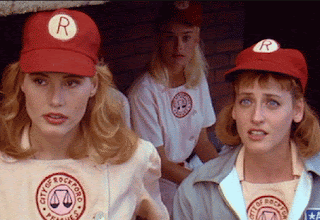

I love that Geena Davis, from the moment her character as an older woman must be prodded by her daughter to attend a reunion of the team, throughout the scenes of her joining the team for her sister’s sake and becoming its reluctant star, shows the awkwardness of many women of the day who, in many fields, feel they must conceal or restrain their talent or their joy in their talent because it is considered inappropriate to be competitive, athletic, to take time for oneself to play, or deserve to be paid for any work formerly done by a man.  Moreover, her love for her sister means that even though she nags her and is overprotective, she will not lament dropping the ball in the last scene to make her sister the star.  Did she drop it on purpose?  We’ll never know, and that is another beauty of the movie.

A League of Their Own (1992) exhibit at the Baseball Hall of Fame displaying the fictional Life magazine cover with star player Dottie on the cover. (photo JT Lynch)


Her daughter, in trying to get her to go to the league reunion, says, “Mom, when are you going to realize how special it was, how much it all meant?”  By the end of the movie, we know what it meant, and it seems Dottie does, too.

I love the grown Stilwell, who as a bratty child bedeviled the team (again, illustrating a situation common to women of that era – their husbands did not always take over babysitting chores), stands before his mother’s image on a poster exhibit at the Hall of Fame and we see how much he misses her.   Always makes me tear up.  We realize then that Evelyn’s not coming to the reunion. He says that he had to be there for the exhibit opening because, “She always said this was the best time she ever had in her whole life.”   We may mourn for Evelyn, played by Betty Schram, as well in the thought that her few years on the team was better than life at home.


The scenes showing the women having to attend charm school may seem condescending, but I can recall reading at least one memory of a former player who said she liked the classes because she had spent her childhood in poverty, had never been inside a restaurant, and was eager to learn what she was told were the social graces.  Remember the character of Shirley, played by Ann Cusak, who cannot read her own name on the roster because she is illiterate, and the girls teach her to read on long trips on the team bus.

Spot on is the radio program of the lady protesting the formation of a league of female ballplayers, her charge being that it would make them more masculine.  As silly as this sounds, this was exactly what WACs, WAVEs, SPARS, women Marines and any female volunteering to help with the war effort faced by society, carefully chaperoned by a military that needed them but did not want to offend the public.


We know that Rosie the Riveter, after being lauded for helping win the war, was summarily booted out of the factories when the war was over, and the movie includes a foreshadowing of this when Mr. Lowenstein, played by David Strathairn complains to Mr. Harvey, played by Garry Marshall when Marshall wants to end the league.   Marshall says, “We’re winning the war…we won’t need the girls next year.”

Lowenstein responds, “This is what it’s going to be like in the factories, too, I suppose…the men are back, Rosie, turn in your rivets.  We told them it was their patriotic duty to get out of the kitchen and go to work, and now when the men come back, we’ll send them back to the kitchen?”

“There is no room for girls’ baseball in this country once the war is over.”

The movie gives us plenty of action, to a swing and boogie beat, and as the crowds get bigger, the stakes get higher.


Tom Hanks plays the drunken manager, resentful at being forced to coach women, but by the end of the movie, he turns down a chance to coach Triple A to stay with his ladies.   They have all traveled far.  We almost gasp at the Hall of Fame scene to see his poster displayed with the date of his death.   He won’t be coming to reunion, either.

Marla, played by Megan Cavanaugh, the unattractive introvert who is the best hitter on the team transforms into a lovely young woman, marries before the season is over, promises to return next season, married or not, and we have the satisfaction of seeing her at the reunion enjoying an apparently happy retirement.

We don’t know what happened to the longsuffering team chaperone, Miss Cuthbert, played by Pauline Brailsford.  I feel bad for her for the mean tricks and insults she endured, but even she became one of the gang by the end.


Though I have read some reviews complaining of the modern-era bookends of the movie at the beginning and end, and the modern theme music played, particularly the one over the closing credits by Madonna, who plays “All the Way Mae,” as being a depressing closing to the film.

I disagree.  

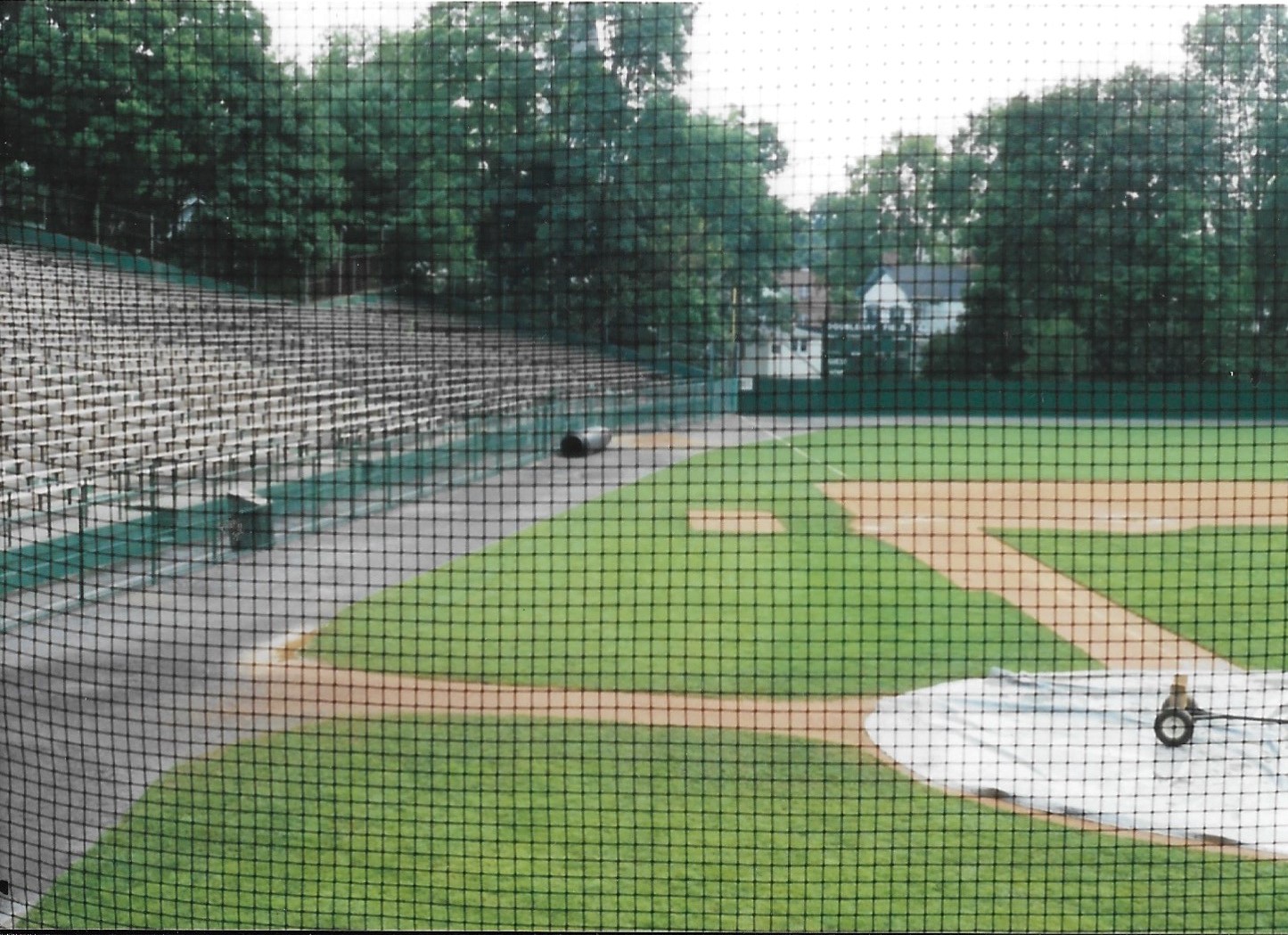
Above and below - Doubleday Field, Baseball Hall of Fame, Cooperstown, New York (photos by JT Lynch)


The movie is about memory and legacy as much as it is about action in the moment.  It is not just a cute story about a novelty female baseball team.  There is always some sadness in looking back, some sober reflection of how much age has changed us and our world.  We wish we could turn the clock back, but then again, we don’t.  “This used to be my playground,” as the lyrics intone in a somber refrain, is like a ghost telling us that the dream was not just a dream.  We’re waking up much older in a different reality.   It really happened, but everything is changed now and we can’t go back.  We are physically different, even if in our hearts we are still 20 years old.

It is delightful to see actual original players among the elderly ladies playing baseball in their AAGPBL sweatshirts at the end of the movie, the girls of October. 


Penny Marshall gave us a chunk of history that was lost for a few decades and that is a great achievement.  The movie itself is a cultural milestone.  “That’s what makes it great” as Tom Hanks says of baseball, because it is hard.


Here is a link to the AAGPBL website with more information.

And here’s a link to members singing the team song you’ll remember from the movie.

Here's a link to the Women in Baseball exhibit at the Baseball Hall of Fame, Cooperstown, New York.

     ********************

Jacqueline T. Lynch is the author of Ann Blyth: Actress. Singer. Star. and Memories in Our Time - Hollywood Mirrors and Mimics the Twentieth Century. Her newspaper column on classic films, Silver Screen, Golden Memories is syndicated nationally.  Her new book, a collection of posts from this blog - Hollywood Fights Fascism - is available here on Amazon.


Related Products