I was going to push on to "The Toast of New York" today, but I forgot I had to give the answers to Monday's trivia/screen cap fire sale. We'll talk about that movie next week.
We had some pretty good guesses, and I think Karen swept the most right answers. I'm especially amazed at guessing number 1, my favorite, from "The Narrow Margin" (1952). This sublime moment of chaos, as seemingly comic as it it intense, could be from any movie.
Number 2 is our old friend Zazu Pitts in "The Bargain of the Century" (1933).
Number 3 is James Cagney and the back of Gladys George's head in "The Roaring Twenties" (1939).
Number 4 is Jennifer Jones and John Garfield in "We Were Strangers" (1949).
Number 5 is -- Yes, Yvette! Kerwin Mathews (I never thought anybody would get that) and Brian Keith from "5 Against the House" (1955).
I'd also like to take a moment to announce that my latest novel "The Current Rate of Exchange" is now FREE at Amazon.com, available only as an ebook at this time.
Isn't this a beauty? One of our finest unused screen caps. Know what movie it's from? You tell me.
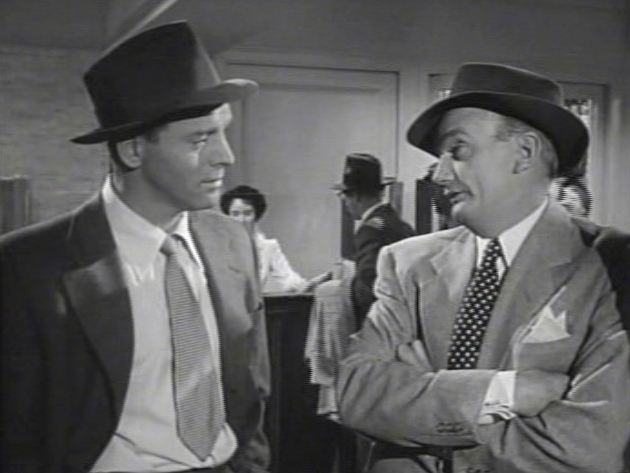
Here at the Another Old Movie Blog End of Summer/Fire Sale/Hurricane Sale -- we have a choice selection of unused screen caps that are sure to fit any budget. Not all are quite as dynamic as our number one pick, but I'm sure you'll find something useful here for any budget. Make me an offer, or just tell me what actors and what movies are represented here.
Take your time. And there's free punch, balloons, and face painting in the parking lot.
Mister 880 (1950) ties criminality to a degree of whimsy. A sense of effortless charm is what drives this movie -- essentially about moral dilemma, yet there is no villain. There is only what happens when three decent people clash because of their sense of what is necessary and what is right.
Mister 880 is a nickname given to a counterfeiter the Secret Service has been trying to nab for years, always unsuccessfully. He seems to get away with it because he prints only small bills, usually $1 bills, and uses them sparingly in cigar stores and automats. He is no big-time crook, has not gotten away with millions to be sure, but just the fact that he cannot be caught is what irks the Feds. Especially since his fake bills are so badly made, including words that are misspelled.
The movie takes an intriguing balancing act between a serious examination of the threat to society by counterfeiters, while at the same time parodying the danger of this kind of theft. The opening credits look like US currency, starting the movie off as if it were a lighthearted parody; and yet moments later we have a stern voiceover narration on the Secret Service, which we are told is a branch of the Treasury Department and its two main functions: to protect the President and to stop counterfeiters. It is as if the movie warns us that while it is okay to cheer a little for a rogue misfit counterfeiter, it is not okay to laugh at the Secret Service.
Burt Lancaster is our Secret Service agent, newly reassigned to New York to help catch Mister 880. He usually goes after much bigger fish and finds the whole failed investigation rather silly. We get a look at detective work without computers or modern forensics. We are immersed, as Burt Lancaster is, in an office with wooden furniture, and an immense wall of file cabinets. Investigation, it seems, is done in large measure through long nights of smoking under gooseneck lamps, turning the pages in the file folder that were typed on a manual typewriter, studying pins in maps on the wall.
We cut to a modest apartment house in a working class New York neighborhood. Edmund Gwenn plays a junk dealer, who lives in the shabby attic room. You might not recognize him at first. He is not the natty gentleman in spectacles with the upper class speech this time around, no soft-bearded Santa Claus, either. He is without spectacles, and his eyes are masked in a perpetual squint, and his face bears a gray shadow of having skipped his shave this morning. He also sounds as if he is missing dentures. Mr. Gwenn’s mumbled speech is always friendly, but being pre-occupied it is ever directed to some personal intention we cannot discern.
In certain scenes, his actions are accompanied by a tinny piano playing “Auld Lang Syne” like a funeral dirge, which labels him as an antiquated product from another era. Though he is meant to be an endearing character, there seems a leaden quality about Gwenn’s performance that walks the same fine line as the general tone of the movie -- what is heartwarming battles with some stern moral we are not allowed to miss. He is generally dismissed in his world by the other characters, having slipped under the radar by age and poverty, but when he catches their notice, they -- and we -- are forced to make a judgment about him.
He brings his latest junk find, a small replica of a spinning wheel, to his friend who lives in the apartment below. She is played by Dorothy McGuire, and we see she has a mutually protective relationship with the old gent. He is grandfatherly, and he brings her presents, and she tries to take care of him. When she slips him five bucks for the spinning wheel, he insists it’s not worth much, and put two dollars in change back into her purse. They are both proud.
Dorothy McGuire brings her special radiance to this role of an independent single woman in the big city. Interestingly, she is employed as French interpreter at the United Nations. She wears a fetching black beret over her early ‘50s “poodle” haircut, and that’s cachet enough.
The UN doesn’t really play a big factor in the plot of this movie (though there is an interesting clip of footage that shows the General Assembly in discussion), so I’m not sure why they didn’t just make her a secretary in some corporation. I can only assume that since the UN was still shiny new and seen as the best hope for world survival in the nuclear age, coupled with the idea that it gives Miss McGuire a kind of intelligent Liberal élan that makes her seem more genteel than secretaries were often portrayed -- that all this makes her moral dilemma more acute when confronted by making a choice between right and wrong. She is supposed to stand for justice, not look for ways to circumvent it.
Mr. Gwenn is Mister 880.
We learn that long before she does. When confronted by an overdue bill, Mr. Gwenn hauls out his small printing press, which he dubs “Cousin Henry” and prints a fresh laundry line of misspelled $1 bills. Because of his bad eyesight, he has accidently slipped two of them as change into Miss McGuire’s purse. When she starts passing them and the Secret Service can tell by the poor print job that this is Mister 880’s calling card, Burt Lancaster goes after her.
What could have been a slap-dash plot of spying on Dorothy McGuire actually becomes a delightfully sexy cat-and-mouse game, particularly when McGuire discovers she is under investigation.
It is most patiently set up for us. Millard Mitchell, that perennial jaded editor, gumshoe, etc., is Burt Lancaster’s partner. They stage a “meet” between Lancaster and McGuire when Mr. Mitchell pretends to be a masher from whom casual passer-by Lancaster must defend Dorothy McGuire. This all happens outside an art gallery. They are on the outside in front of the plate glass window, and we are on the inside, so the assault is all done in pantomime.
Then Lancaster and McGuire go for a drink, and he charms her with that magical smile of his. They have good chemistry, and she is intrigued by this friendly Sir Lancelot.
She is even more intrigued when she discovers their meeting was no accident, but was a set-up. At first uneasy, then determined to learn more about him we watch her own clear-headed and logical detective work until she traces Lancaster to the Secret Service. The possibility of being under investigation for passing phony money, when she knows she is innocent, is amusing to her, so she strings him along and pretends to be a big-time counterfeiter.
Though we might cringe at Lancaster’s fixing the lock on her apartment door so that Millard Mitchell can sneak in while they are out on a date -- search warrants mean nothing to the movies -- Lancaster quickly surmises she is not Mister 880. From here, their relationship, which is playful and flirtatious, expands and they fall in love. Though she is no longer under suspicion, the only impediment to their relationship remains Mister 880, in Lancaster’s dogged pursuit of him. He is like Inspector Javert, and at one point, McGuire muses, “I could very easily learn to dislike you.”
Lancaster, despite his friendly ease and charm is almost puritanical in the sacred mission of his job. He has ideals of his own, and they are not bright, airy platitudes, but rock-hard judgment between what is lawful and what is not lawful.
Miss McGuire’s apartment is, I think, an example of the home matching the personality of the character. Not that this was entirely rare in movies of the day, but so often we see Typical Female Apartment with lots of frills and white phones and grand pianos that it is a pleasant change to see a couple of low bookcases that look like real books and not wall paneling planted there for effect by an interior decorator, a small apartment where the bedroom is right off the living room, (with the bed teasing us through the open door), delicate, tasteful artwork on muted walls, the rattan shade under which we peek out at the building beyond (reminds me a little of Rear Window), and a hardly noticeable United Nations art poster in the corner. Not only does it look like someone lives here, it looks like Dorothy McGuire lives here.
Burt’s investigation heats up, but he is unaware that the kindly old codger friend of McGuire’s is his Mister 880. Talk about flying under the radar. They all end up at Coney Island on an outing, Burt and his men incognito to track their quarry, but Mister 880, though he has no idea he’s being pursued, still escapes.
Then comes the day Mr. Gwenn realizes the Feds are on his trail, though he does not know it’s his new pal, Burt Lancaster. He buries his printing press and vows to Sin No More. He won’t have to; Dorothy McGuire in the meantime arranges a janitor’s job for him because she worries about this guy in his 70s with no financial safety net. Safe under the radar, he prepares to enjoy the rest of his life free from suspicion or temptation.
Then it dawns on Dorothy McGuire that those two fake one dollar bills were put into her purse that night by Gwenn. Now she knows he is Mister 880.
She is crushed when she realizes he’s the criminal. He does not know she knows. Incongruously, he never tries to hide anything. He never lies or makes excuses. He simply lives in his own little world where he makes a conscious compromise to break the law in a way that will do as little damage as possible. Grim survival with a dash of benevolence.
Now Dorothy McGuire is the one who must make a conscious compromise between what is right and what is benevolent. She agonizes, and cannot bring herself to tell Burt.
She doesn’t have to. Smart guy, he figured it out himself. She and Burt exchange a silent, grim look of accusation between them when he passes by her to go up to the attic apartment. She does not stop him. She is weakened by her own culpability.
Edmund Gwenn submits to arrest with the same pleasant vagueness that has sustained him through his declining years. The tense scene is agony not for him, but for McGuire and Lancaster, whose consciences, and whose relationship, are on the line.
We have a trial scene, but unlike the famous trial scene in Miracle on 34th Street where Mr. Gwenn is freed on a comic deus ex machina, the ending here is more realistic. Just as the beginning of the movie is curious mixture of playful credits soberly contradicted by a grim voiceover, the ending of the movie is serious, tempered by warmhearted gestures.
It is brought up by Burt Lancaster, who goes to bat at the 11th hour for Mr. Gwenn, that Gwenn won a naval commendation in World War I. See the black photo-negative “Photostat” he presents to the judge in the days just before Xerox was printing out white paper xerographic copies. Some of you with fathers or grandfathers who served in World War II may have black Photostat copies of discharge papers, along with the typed original. This movie unconsciously documents for us the last days of the Photostat.
Edmund Gwenn’s character could have been portrayed as more elfin by another actor, but his stubborn honesty, his rambling reasoning, and his capacity for creating a nuisance of himself are far more realistic and much more appealing than merely playing a cherubic grandpa. There is no twinkle in his eye; none that we can discern through his unending squinting.
At the very end of the film, when court officers are leading Gwenn off, Dorothy McGuire, after releasing him from a hug, reaches out to comb down with her fingers a wisp of his white hair at the back of his head. It’s quite unnecessary, and quite charming. A final comforting gesture to the old gentleman, who may be entirely unaware of it as he shuffles away to face the wrath of the government of the United States.
This is to acknowledge and express my gratitude to Meredith at Forever Classics for passing along to me the "Irresistably Sweet" blogger award. Though I'm now required to list several interesting facts about myself and name 12 other bloggers to receive this award, I think I'm just going to step back from the podium with a simple thank you this time.
Along with award season, there have been numerous blogathons this summer, many of which I've missed due to other committments. I'm looking forward to participating in two that are coming up soon, from the Classic Movie Blog Association -- the "Guilty Pleasures" blogathon, September 18th through 20th....
A few years ago I drove the Florida Overseas Highway from the mainland out to Key West where Route 1 stops and we could go no further. At this point, Cuba is closer than Miami. A stunning scenic route unlike any other. For the motorist, a sense of freedom mixed with a strange sense of risk taking. I loved it. One of the reasons I always wanted to take this trip was the opening sequence of “Key Largo” (1948) where we see Humphrey Bogart’s bus venture out on a thin ribbon of cement over the immense ocean, the bus growing smaller and more vulnerable in a long shot. It represents escape and adventure at the same time. Freedom and risk taking.
Recently I went to see “Key Largo” on the big screen, and this scene on the highway over the ocean -- seen on the big screen -- seems to take the viewer down the road with the bus, rather than as a distant observer. The big screen embraces us, and we become isolated, too.
I love to read about other bloggers’ experiences seeing classic films in theaters, but this was a first for me. A few impressions:
I had seen “Key Largo” many times on TV, so every bit of dialogue was familiar, and yet I was fascinated by close-ups of Bogart and Edward G. Robinson looming down on me, which expressed power and power struggle that I had not noticed on the small screen. A downward glance from either seemed to fix me in their gaze. Facial flaws magnified, and greatness magnified as well. What was merely ugly became grotesque, and what was merely appealing became heroic.
The final scenes where Bogart is taking the gangsters to Cuba on the fishing vessel, and the fog seems to envelop us as well. We are not watching the boat; we are on the boat.
Claire Trevor’s breakdown, so brittle and yet so resilient, and Lauren Bacall’s open curiosity about the stranger Bogart, her telegraphed attraction. The doomed deputy’s face-off with Robinson, and the sheriff’s face-off with the captive, frustrated Lionel Barrymore over the Seminole fugitives. It seemed like a new movie to me, and, perhaps naively, I found myself thinking, “So, THIS is what John Houston meant.”
Other bloggers who’ve written about watching classic films on the big screen often remark on audiences who are sometimes less than appreciative, or openly ridiculing. The theater I attended was the Amherst Cinema, a small college town venue in rural central Massachusetts. Most of the audience appeared to be middle aged or older, with only a handful of college age kids that I could see. School hasn’t started yet, so I imagine there would have been more younger people were this shown in the fall.
Amherst Cinema, Amherst, Mass. - JT Lynch photo
It was converted from an old livery stable in the 1920s and has served as a movie theater for many decades before closing, and then re-opening after renovation about five years ago. It is not a “restored” period movie house, rather is it a modernized facility housing a couple of theaters in the building, small and modern, stadium seating. (The land upon which the theater was built was once the site of the 19th Century Amherst Academy, where Emily Dickinson attended school in her pre-recluse days, and also young Sylvester Graham, who gave us the Graham cracker.)
There were only a couple of chuckles from the audience over the gangsters, but I’m not sure if it’s because their speech sounded corny, or if the audience was just getting a kick out of film which was as familiar to them as it was to me. A little of both, maybe.
The only moment of audience reaction that really bothered me came from a couple of women sitting behind me, who were older than me, and bust out in guffaws when Lionel Barrymore described a hurricane that devastated the Keys. The gangsters are nervous about the approaching hurricane at this point in the film, and they ask him how bad the storm could get. Lionel describes trains wrecked and bodies tossed out to sea, and for weeks afterwards corpses drifting into the mangrove swamps.
These ladies thought that was an absolute hoot. I admit, I was ready to turn around belt them. It ruined an otherwise intense moment in the film.
Then I realized that because Lionel Barrymore holds the whip hand in this scene, they probably thought he was making it up, telling tales to scare the bad guys, since it was the only power he, an older, frail, wheelchair-bound man, had over them. It makes sense, and if that were really the case, then I agree the scene would be funny.
Islamadora Monument to victims of 1935 Florida hurricane - JT Lynch photo
Except the hurricane he describes really happened. The 1935 Florida hurricane was what we now think might have been a Category 5. Several hundred people were killed, including a trainload of World War I vets who arrived for promised relief work with the WPA during the Depression.
There have been generations of risk taking on this route.
Islamadora Monument to victims of 1935 Florida hurricane - JT Lynch photo
At one time, the only link from the mainland all the way out to Key West was not an overseas highway, but an overseas train route. After this horrific hurricane, what remained of the railroad tracks were paved over for the highway. That thin ribbon of cement we see in the opening and closing scenes of “Key Largo” was built (at least in part) because of the hurricane Lionel Barrymore describes.
This is another example of why a classic film will have much more meaning for us if we take the trouble to understand the context of the era. You’re not going to “get it” if you have no concept of what was going on in the real world at the time the film was made.
It’s like driving someplace in the fog. So, these women, surrounded in their own fog of ignorance, laughed.
But, you just can’t stand up in the middle of a movie theater and give a lecture on the 1935 hurricane, can you? Even if you’re struggling to suppress an asinine urge to give a history lesson.
That’s why I blog. I get so much off my chest. And you are the unfortunate victims.
At the end of the movie, however, everybody applauded, which I suppose was why they were there at all -- to share their appreciation with others who felt the same way. Even the ones who laugh at mangrove swamps full of corpses.
For another Big Screen Bogie experience, have a look at this great recent post by The Lady Eve at a stunning and unique presentation of “Casablanca” in her neck of the woods.
Having been handed the Liebster Blog award last week by our Caftan Woman, I am now given the opportunity to pass it on to others. This blog prize currently making the rounds seems to have originated in Germany, and is moved along to blogs we like. We acknowledge the blog from which it came, and we choose five others to get it next.
Always a tough decision, but here's a mix of blogs I've enjoyed for a long time, along withe new ones I've discovered recently. These award games give us a chance to find new and interesting blogs, and possibly new favorites.
1. Dear Old Hollywood - for it's fun posts on the locations where classic movie scenes were filmed.
2. Miss Ida Lupino - for the unique perspective on its devotion to this one extremely talented lady.
3. Classic Forever - I'm particularly looking forward to this young lady's posts on her recent annual trip to help out the folks in Sierra Leone.
4. Robert Frost's Banjo - John's always eloquent analysis, especially showcasing classic blues music.
5. Dave's Classic Films - Not just the A-list classic films, but the B-movies and short subjects, too.
My latest novel, "The Current Rate of Exchange" is now available (as I mentioned on Monday) on Amazon.com,Barnes & Noble.com, and Smashwords. For a limited time, the books is FREE on Smashwords, and currently at 99 cents through Amazon and Barnes &Noble, however I expect at some point those other two stores will match Smashwords' price and also make it FREE. For a limited time. (In fact you can help this process along by visiting the web page for "Current Rate" on Amazon and in the spot where it says "tell us about a lower price" - just put in this Smashwords link to let them know it's free elsewhere.
The novel is a little silly, a little serious, about an American woman's post-9/11 journey to New Zealand. Here's the blurb:
Rose, a tall, bumbling American woman, travels to New Zealand to re-establish ties with her late mother’s family, navigating the otherworldly tension of traveling in the months after 9/11. With an offbeat spirit of adventure and optimism, Rose discovers the better angels not only her nature, but in those around her.
Her ill-planned adventure turns her life around, and that of Nora, her New Zealand cousin, whose family problems immediately begin to involve Rose. Nora’s elderly mother, who broke off ties with Rose’s family; Nora’s unemployed husband who confides his dreams to Rose instead of his wife; and Nora’s brother whose emotional meltdown when losing the family farm all challenge Rose to face her family’s past and try to mend a bitter loss.
A sudden romance with the farm manager with the mysterious past of his own was not on her original agenda. She is anxious about continuing it lest she repeat mistakes her American father and New Zealand mother made. Armed with old family letters, Rose also manages to trace her mother’s footsteps as a World War II government agricultural worker, or Land Girl. In a moment of crisis, the information Rose learns from her mother’s letters might prevent a tragedy in Nora’s family.
Available through Amazon.com, Barnes & Noble.com, and currently FREE at Smashwords.
“Meet Me in St. Louis” (1944), Leon Ames, the head of the family, returns home from a hard day at the office, and wants to delay supper so he can soak in a cool tub of water for one solid hour this very hot day. I don’t know if he reads in the tub. One of the chief complaints detractors about e-readers like the Kindle and the Nook, etc., have is this reading in the tub business.
Fooled you. Today’s post is not going to be about an old movie. It’s about the revolution currently happening in the publishing industry. Since most classic film fans are also great readers, I wanted to address a few thoughts to you, because you are readers -- who may not be aware of the maelstrom occurring. To some, it represents Barbarians at the city gates; to others, a sense of freedom in the wake of revolution. I don’t think either faction is entirely correct.
There are plenty of other blog posts setting the Internet on fire wherein writers are hashing out the pros and cons of this self published e-book stuff with other writers. Literary agents are jumping ship, or adding e-publisher to their shingles. I have nothing of value to add to their discussion, it would only be preaching to the choir anyway. Instead, I wanted to address those swell people who email me and want to know when an e-book I’ve published is going to be available as a “regular” book.
We have all become classic film fans due to technology -- very few of us would ever have access to these films if it were not for TV, then the VCR, then the DVD, etc. Most of us do not simply want to watch favorite films (caught, if lucky, once in ten years, as used to be the case), we want to own them and have easy access to them.
Convenience is the chief motivator of technology. We’re always looking to make things easier, cheaper, and more convenient.
E-books were invented, and are each year taking over more and more of the market share of published fiction and nonfiction, because of their convenience and economy.
I won’t go into a whole history of publishing, or the industry-shattering changes taking place today -- you can find that with a quick Internet search (has anybody seen any encyclopedia salesmen, lately?), but one thing most readers may not know is that when a “regular” book is published, most of the copies that are printed are not sold. Bookstores order more than they need, and are allowed to return the ones that don’t sell back to the publisher. These returned copies can no longer be sold as “new”, lose market value, and most of the paperbacks, at least, are thrown in the proverbial dumpster out back. From printing press to landfill. Or back to the pulp mill.
It reminds me of that line from “The Best Years of Our Lives” (1946) when Dana Andrews remarks on the field of brand-new military planes that are no longer needed at the end of the war: “From the factory to the scrapheap.”
For people who prefer “regular” books because of the feel, or the smell, or taking in the tub, do not acknowledge that most of them are manufactured to be waste.
There are many such examples of what has driven the publishing industry to its knees in the past few decades, and I won’t list them. Suffice it to say, there are only a few major publishing companies left because they have been gobbling each other up for a long, long time.
For the writer, making a living in this structured system has always been difficult. Most novelists do not earn a living solely writing novels, even in the good old days. In the past few decades, more and more writers have been squeezed out of the publishing industry’s worsening constriction. There just isn’t enough room at the table. Unless you’re Snooki or some other no-talent celebrity.
The Internet option of self publishing e-books has in the space of only a few years, turned the industry upside down. What this means for the writer is earning a greater percentage of income on one’s books -- that will never go “out of print”. Established authors whose “regular” books have long gone out of print are scrambling to the get the rights back from the publisher, so they can turn them into self-published e-books.
What this means for the reader is a vast variety of books -- including obscure tomes that are being digitally formatted to have a new life -- to be accessed much more conveniently and cheaply. For someone like myself who does a lot of historical research, it means finding that 1867 memoir by a widget manufacturer (or what have you) right at my fingertips -- through my computer keyboard. I don’t have to fly down to East Cupcake, check into the Cheap Digs for Cheap Writers Motel, rent a car and drive to the University library and get permission to go down the cellar and find the only copy in existence.
And not having your own books go out of print -- lovely. If you’ve ever had that happen, you know how lousy it feels.
Interestingly, the elderly are among the early adapters of e-readers. The young, technologically savvy, as well, of course. But the middle aged folks, who comprise a lot of us old movie bloggers, are slower to respond.
I think we have a lot on our shoulders, caring for elderly, caring for our youngsters, and stuck in the middle, we are loathe to be dragged into a future for which we’re not ready. We’ve already got too much on our plates.
Especially if we’re the type that watch old movies as if they were a religious experience, and even listen to Old Time Radio, as many of us do.
Digitally re-mastered, that is.
Like the movies we love.
Like the music we purchase.
And now, like books.
Oh, it’s a slippery slope of compromise for us nostalgic types who want to preserve the past, but need modern technology to do it. Here’s a fun clip about an invention that combines the tradition of a typewriter with the flexibility of computer word processing:
I don’t know how many will sell, but I love that somebody worked on it.
On a recent trip, I noticed an elderly woman with a Kindle reading in a train station. She was traveling with a small group of other ladies, some club outing, I think. She was showing them her Kindle, how to use it, how to make the print bigger, etc., and they were oohing and aahing. She wouldn’t be without it, she says.
(I also saw a young Amish woman gabbing on a cell phone, but that’s another story.)
I don’t know how she came by the e-reader. I don’t know if she bought it herself, or if perhaps one of her children, stumped for an idea for a birthday present this year, thought, “Oh, well, if Mother doesn’t like it, we can always return it.”
But Mother likes it. A lot.
I knew an elderly couple who were voracious readers, this was before e-reader devices. At the end of their lives, the husband had such poor eyesight he could no longer read comfortably, even the large print books from the library weren’t doing it anymore. He finally got a device from the Commission for the Blind to magnify printed material and project it onto his TV set. He was a proud, belligerent sort of cuss, and wanted to maintain his independence. He didn’t want to be read to or give up his favorite hobby.
The wife, after a couple of operations for cataracts, had quite good vision. Her hands, however, were arthritic and holding a book, turning the pages became too painful. If she had needed large-print books, just holding one would have been agony, since they weigh more.
E-readers would have changed their lives.
Also the girl I know who has such severe allergies, she grew up in a bedroom that had to be dust-free. No wall of books for this kid. She couldn’t take it.
Empty nesters, moving to a smaller home, needing to conserve space. You can keep thousands of books on a wafer-thin tablet on your nightstand.
College kids no longer heaving 50 pounds of textbooks on their backs across the quad.
People will adapt to e-readers for their own specific reasons, but they will adapt. E-readers are not perfect, and are not traditional, they do not have that comforting familiarity that a book will have in our hands. But they are another choice.
I don’t expect “regular” books to become extinct, at least for a while. But e-readers, now that they’re here, are here for good. As a reader, I may regret the possible future loss of “regular” books, but as a writer, I am relieved to have another income stream.
That’s what it’s about for writers these days. Not banging slavish away in a garret on a great work of art. It’s all about product and income stream.
So, to answer that question about when my e-books are going to be printed as “regular” books -- I don’t know. I’d like to sometime, but it involves extra formatting, and extra expense both for me and the reader. Humbly speaking, I can’t see why a reader would pay some $15 plus postage for a book by me, an unknown writer, when they could try it out for a couple of bucks on their computer (you don’t really need to buy an e-reader, you can download books to read on your computer with e-reader software from Amazon, Barnes & Noble, etc., that is free).
Especially in this economy.
And for the writer, there is something exciting to be sure about becoming an entrepreneur in a new era. The movies we love were once derided as “flickers”. Lillian Gish told a funny story about when she and her sister were acting “on the legitimate stage” and felt sorry for Mary Pickford when they heard the gossip that young Miss Pickford was forced by family financial problems to work in the flickers.
Not too long after that Mary became “America’s Sweetheart” and moved into a Beverly Hills mansion. We should all have such hard luck.
Or, Old Time Radio fans, suppose you’re Jack Benny, working in vaudeville, and somebody comes up and says, “Hey, something called radio is starting up. It’s 1920 and the very first commercial station, KDKA in Pittsburgh is on the air. The customers don’t pay for the service; we get paid through advertising sponsors. Want to do a radio show?”
Now, do you say, “It’ll never last. It’s just not the same as vaudeville. No thanks.”
It’s an interesting decision to have to make, especially when you consider that in sight of 12 years, Jack Benny made his fame and fortune on his radio show that lasted a couple of decades -- before he went into that other new-fangled invention, television.
(Okay, OTR fans know that Jack Benny’s show was on NBC, and KDKA was a CBS station. I don’t mean that he was literally approached to work on that radio station.)
Well, folks, e-books are here. It’s 1920 and station KDKA is on the air. There’s no turning back now. Do you step in front of the mic, or go back to the burlesque theater?
Do you buy a radio, or do you say, “I’m not having one of those things in my house”?
Maybe Leon Ames is really reading on a Kindle in his bathtub before dinner. Ah, but he had another other technology woes, didn’t he? That new-fangled telephone in his dining room. And that string of electric lights beaming at the St. Louis World’s Fair at the end of the movie would surely threaten the nostalgic ambience of the gas-lighting in his home. Oh, the good old days, when a large house, an extended family, and a servant, could be supported on one income.
It’s okay to be teary-eyed over such things. But that doesn’t help you survive today.
By the way, I’ve just released my latest novel on e-book, “The Current Rate of Exchange” about an American woman’s post-9/11 journey to New Zealand. More about that on Thursday.
Well, you didn’t think you’d get away without a commercial, did you? This is America.
I’d like to know what you read. Do read more fiction or nonfiction? Do you buy most of your books, or do you get most of them from the library? What kinds of books interest you, what kinds of stories are your favorites? Do you read in the tub?
Those quesses to the trivia photos on Monday were very good. I should know better by now than to try to stump you people.
The answers are (drum roll):
1. Janet Leigh, "Holiday Affair" (1949)
2. Richard Gaines, "Strange Bargain" (1949)
3. Humphrey Bogart, "Conflict" (1945)
4. June Allyson, "Executive Suite" (1954)
5. Robert Keith, "Here Comes the Groom" (1951)
6. Jean Arthur, "The More the Merrier" (1943).
I like to notice phones in old movies. Do you? It surprises me that as late as 1945, a public telephone like the one Bogart is using would still have an old ear receiver, rather than a hand set that you would use to both listen and hear. I'm always surprised how those old candlestick phones were used long after more modern types were put on the market. Phones can serve as funny props at times. Do know when your family first got a phone?
Today we wrap up our Calamity Jane series (Part 1 and Part 2 are here) with a grand finale of sorts -- two major-league actresses in films with much bigger budgets than the B-westerns we discussed in Monday’s post. Calamity Jane swaggers, sings and dances, and shoots a little.
“The Paleface” (1948) is a Bob Hope vehicle that gave Jane Russell a good opportunity to do more than play a sultry sex object. Bob may do all the mugging, but it’s Jane’s withering looks that make him funnier.
And she still manages to be sultry in a kind of impatient, world-weary way. Of all the Calamity Janes, Jane Russell is the most invincible, whose character suggests power. Her statuesque figure, her glowering expression, not to mention her dark hair makes this character sort of Xena-Warrior Princess as Calamity Jane.
There are at least two scenes that show a slice of the real Calamity Jane. When we first meet Miss Russell, she’s in jail. (But not drunk. I don’t think we learn why she’s in jail.) The other scene is when she is released by government officials who want her to spy for them, and during the discussion she goes straight for the whiskey decanter. She takes only one shot, but she downs it in one gulp. It’s not for comic effect. It’s cold and businesslike.
Her only hope to stay out of prison is to take the offer the officials give her to help them find out who is selling guns to the Indians. She meets Bob Hope, a bumbling, cowardly dentist, and decides to use him for cover. She lures him into marrying her (and repeatedly bashes him on the skull with something heavy just when they are about to kiss), so that she may proceed into Indian country in his covered wagon as his homespun prairie wife without drawing attention to herself.
His ineptitude causes her to remark, “I think I married a mental case.”
She fights off an Indian attack with her gun, but Bob thinks he did it. This fills him with such conceit that he takes on all comers, and draws out the bad guys selling guns to the Indians who are now after him. I like his line, “Brave men run in my family.”
Bob also gets to sing “Buttons and Bows”, but when Jane Russell sang it at the Academy Awards ceremony, the song became hers by default. She gets to sing it in the sequel.
Bob has some funny scenes with his dentist’s laughing gas, and several stock gags. Jane and Bob get captured by the Indians, where Jane becomes contrite that she got the poor sap into this mess, and confesses her love for him. The tough gal with the mean stare has a soft spot for the hapless palooka. He clearly needs taking care of, and she’s just the gal.
Anytime they go somewhere in the wagon, she drives.
Jane (and her stunt double) get to do some climbing, running, and leaping onto horses in an exhibition of physical courage that seems to make this role fun for the various actresses who play Calamity Jane. Both Jean Arthur and Doris Day claimed their turn as CJ were among their favorite movies. If there is any message of feminism in the Calamity Jane saga, I think it has more to do with the delight of the actresses who played her in the movies of the mid-20th century than with the woman herself.
A note on one of the Indians keeping them captive: you may recognize Iron Eyes Cody. Though a much younger man here, he is still easily identifiable as the iconic Native American in those 1970s “Keep America Beautiful” TV commercials, who gazes on litter or some other environmental hazard and we see a single tear stream down his face.
Though he called himself a Native American perhaps ostensibly to get these roles, his real name was Espero De Corti. He was Italian-American, who on screen and evidently in his private life identified so with the Indians that he preferred to live under an assumed heritage along with his assumed name. A real-life example of be who you want to be.
“Calamity Jane” (1953) brings us to the end of our movies on the 19th century Queen of the Prairie, in a colorful and lively film, the most well-known of the Calamity Jane movies, but ironically, the one least realistic about her life.
Realism is not usually a prerequisite in musicals anyway, and the project was obviously intended to be tongue in cheek. We have CJ bellying up to the bar and ordering sarsaparilla. That alone tells us this is to be a good-natured romp, more parody than anything.
Doris Day plays “Calam”, who drives the stagecoach. Like Jean Arthur, she is far from physically resembling the real Calamity Jane. Like Miss Arthur, she’s got the Army kepi atop her blonde tresses. We’ve quoted Bosley Crowther of the New York Times on some of the other CJ movies, and here Mr. Crowther pans Miss Day and calls her exuberant performance “unnerving…She does everything but hit the ceiling in lashing all over the screen. This is not altogether entrancing.”
But, she sings purty, and some of the songs are quite sweet. “The Black Hills of Dakota”, which the cast sings while driving in open wagons to a dance in the twilight is a nice scene, and the real CJ might have echoed the sentiments. “The Deadwood Stage” is a rollicking opening number that establishes the setting and tone of the movie.
Doris Day’s speaking voice, lowered to a gravelly tone, is distracting for some of us. Interesting that decades later, Jane Alexander playing the role also used a very gravelly tone to her voice. I think it’s wrong to assume Calamity Jane swallowed sandpaper. But, as we’ve seen in this series, her life and character is open to many interpretations.
CJ’s mission in this movie is to fetch a singer from Chicago to perform at Deadwood’s Golden Garter Saloon. Doris discovers actress wannabe Allyn Ann McLerie in the star’s dressing room playing with costumes and pretending to be her. Doris assumes she’s the star, and books her for the Golden Garter. Miss McLerie, no fool at seeing opportunity, takes the job. When she falters and is found out, Doris becomes her protector and champion.
Miss McLerie is meant to replace poor Dick Wesson, the second banana at The Golden Garter who was drafted to don women’s clothes to fool the women-starved cowpokes and perform a song. With that bright red lipstick emphasizing his wide mouth, Wesson is a hoot in that scene, looking like one of Cinderella’s ugly stepsisters.
Calam shares her grungy cabin with McLerie, and they sing about “A Woman’s Touch” and the joy of housework. Faster that you can say Trip to Home Depot, they’ve got the place remodeled and fit for human habitation. Then Miss McLerie starts in renovating Doris, and turns her into A Real Woman.
Being a musical, this is a boy-meets-girl sort of scenario, where Doris has a crush on an Army lieutenant, played by Philip Carey. Wild Bill Hickok’s in town, too, played by Howard Keel, who unfortunately doesn’t get too much to do in this movie. Both men fall head over heels for Miss McLerie, which causes some friction and Doris threatens to blast her new best friend to smithereens. Come to think of it, Doris should have been paired off with Yosemite Sam. They have a lot in common.
But, as befits that peculiar, orderly Hollywood caste system of stars and second leads, Howard Keel discovers Doris is A Real Woman and they fall in love just like that. The second leads pair off, and we get instant double wedding.
A lot of pleasant fluff, but a couple things to admire as well, including Doris Day’s athleticism in her musical numbers. Leaping and sliding onto the bar, and being lifted by her arms up to the lodge in the saloon. Some of that looks like it was done in a single long take. Reportedly the song “Secret Love”, which became a bit of hit, was recorded in one take. Not too shabby.
The song echoed loudly, and then faded as the big 1950s musicals ran their course and died. We lost Calamity Jane in popular culture for a while. She popped up in cameos in TV westerns a couple of times, but was little more than a prop for the regular characters. Then the 1980s TV movies we discussed here in Part 3, telling more false stories.
A CJ reincarnation on HBO’s series “Deadwood” showed a gritty, profane, and manic Calamity Jane in Robin Weigert’s intense and compelling performance. It’s a gutsy attempt to bring a characterization of CJ closer to the mark; though it overshoots it a bit.
Long before HBO, an episode of “Have Gun - Will Travel” starring Richard Boone as Paladin the avenging gunslinger, featured Calamity Jane, played by Norma Crane, in “The Cure” shown May 20, 1961, an introspective examination that was unlike anything we’d seen before that. Paladin meets her on the downslide, drunk and tossed out of the wild west show. She is aging, and time is passing her by. He cleans her up and dries her out, and tries to counsel.
“I have heard of doctors who consider drinking a sickness,” he says to her. He chides her on measuring up to her legend, and she replies, “I think I preferred the legend anyway…I got to believing the stories myself, the Joan of Arc of the Dakotas, Calamity Jane.”
Afterwards, facing up to growing older, facing up to the legends, “Wild Bill never so much as gave me a second look.” In a heartbreaking, shamefaced moment she confesses, “Do you know what I said when Wild Bill was shot? I said, ‘Boys, who’ll buy me another drink?”
Being forced by the camera in any of these Calamity Jane movies or TV shows to see what was controversial about her -- the drinking in some, the gunplay or carousing in others; the promiscuity or profane language -- or just the swaggering woman in men’s clothes whether seen as a maverick or a buffoon -- we still are missing a key ingredient to CJ’s makeup. The camera flinches and won’t show us. Maybe because we flinch and won’t look.
It’s the poverty. She was an illiterate, poverty-stricken child and died the same way only 47 years later. In the 19th century, and still today, we have a rags-to-riches mindset. Horatio Alger stories of the newspaper boy who worked hard and one day owned the factory. The miners panning for gold. The frontier opened for people to bust the sod, drive the herd, and make their pile. Today, it’s casinos and lottery tickets and scratch cards at the convenience store.
You’re supposed to start out with nothing, that’s okay, it can even be a badge of honor, but if you end up the same way you’re as damned as if the Puritans had excommunicated you to the wilderness. Society just won’t look at you anymore.
We can look at the swagger of Calamity Jane and pronounce it quaint. We can talk of the alcoholism and call it tragic. Few want to discuss the woman who had no ability to pull herself up out of poverty, who was trapped her entire life by it, despite whatever independence she got from the bullwhacking and the buckskin. There is for many of us a lurid fascination with the failings and flaws of characters, fictional or real, but even for those of us attracted to the salacious or violent, poverty is just too plain ugly to look at. Even the most sophisticated filmgoer hasn't the stomach for it.
Author James D. McLaird, whom I’ve referred to extensively in this series, brings this to a fine point at the conclusion of his “Calamity Jane - The Woman and the Legend”.
“Her career, in fact, may offer the base case study of legend-making in the history of the American West simply because where was so little on which to build: she arrested no outlaws, robbed no banks, and killed no Indians. Instead, hers is the bleak story of poverty, alcoholism, and an unsteady domestic life. She worked as a dance-hall girl, prostitute, waitress, bartender, and cook; she lives with various men she called husbands and expressed affection for her children…most writers attempting to narrate Martha Canary’s life, however, have been so overwhelmed by her legend that they have been unable to acknowledge the commonplace conditions of her life. If it were not for her legendary fame as Calamity Jane, the story of Martha Jane Canary would hold little popular interest.” (p.269).
Paladin muses philosophically, “Jane, whatever happened to one of the great ladies of the west? Did the name get too heavy for you to carry?”