IMPRISON TRAITOR, PEDOPHILE, AND CONVICTED FELON TRUMP.

Thursday, April 10, 2014

The Year Joan Crawford Won the Oscar - 1963


“The Year Joan Crawford Won the Oscar” is the teasing title of an episode of Saints and Sinners, in which Ann Blyth guest starred as the anxious wife of a naïve hotel waiter.  He is wounded by a guest in the hotel, a big-shot entertainer, who tries to cover it up.  Reporter Nick Adams, series star, ferrets out the story.
The title of the episode is from a trivia question put to the star-struck waiter, who has an encyclopedic knowledge of Oscar-winning films.  One is inclined to guess that it is no coincidence that “the year Joan Crawford won the Oscar” was also the year guest star Ann Blyth was nominated for the same movie, Mildred Pierce, which we discussed here.  Other than that, the title has no great significance to the story.
Nick Adams stars as a roving reporter, the justice-seeking kind, and John Larkin is his scowling editor.  Set in New York City, the series ran only one season from 1962-63, and was cancelled due to poor ratings after only eighteen episodes.  Well written, the series was spun off from The Dick Powell Theater series the year before, an episode called “Savage Sunday,” which starred Adams in the same role as the crusading reporter, and Ann Blyth as a fellow reporter.  We’ll talk about that episode down the road.  Originally, Ann was slated to join the series when the pilot was picked up.
A UPI syndicated article in June 1962 reported:  “Ann Blyth will strike a blow for femininity next television season by starring in a weekly series playing a chic career girl…Her lines will be as smart and chic as her wardrobe.”

Her role was to be a Washington correspondent for this New York paper, a character called Lizzie Hogan.  It seemed like a new departure, a strong character and interesting woman for her to play, and something new for TV.

“Television actresses are limited to family situation comedies or western heroines,” she said, “and both have become clichés.”

For that reason it must have been an appealing role, but faced with the demands of a series versus having little time with her family, Ann Blyth turned down the part, preferring to make only guest appearances on television.  Lizzie Hogan, girl reporter, was gone, and in stepped Edith Berlitz, the simple wife of a gullible waiter.  (Before this episode was broadcast, she had another turn on WagonTrain in December 1962.)

She employs a soft Brooklyn accent here, easy and natural, and many may have forgotten she is a native New Yorker, after all.  Gentle Edith faces trauma and heartache when her husband Sidney gets involved with a fast crowd.

Sidney is played by Robert Elston, who had a handful of TV guest roles, more experience on stage and as an acting teacher.  He brings breakfast to a roughneck crowd of showbiz types: Robert Lansing commandingly plays a Sinatra-esque nightclub entertainer.  His flunkies include Leon Askin and Harvey Korman before his Carol Burnett sidekick days. 

They are yes-men to the big nightclub star, hangers on with their hands out for favors, a floozy among them for color.  Sidney is enchanted with them.

Kidding around with handguns, Sidney is accidently shot.  Horrified, the showbiz types hustle him out of the hotel, and into a sort of safe house “nursing home” where he can be treated by a less-than-reputable doctor and be paid to keep quiet. 

Ellen Corby, who gets a nice slow close-up, is a hotel maid who leaks the story to the press for a price.  Everybody’s out for a buck.

The story, with its payoffs, its misbehaving celebrities, its press who chase them, is as timely as if it were written today.  Of course, the script is a lot cleaner than if it were written today, and the language and the plot points are more direct, and the journalist is the crusading kind who wants truth and justice, but this was an era on television when progressive attitudes beamed out of cathode ray tubes and anything was possible when done with a noble heart. 

Ann is sweet, a bewildered housewife out of her element, but nowhere near as innocent as her husband is. She tries to talk sense to him, but Sidney is pleased with the attention the big shots are giving him, fawns over Robert Lansing, and wants to join them in their glamorous, swinging lifestyle. 

Ann, though the timid “little woman” when she braves the lions’ den of showbiz insincerity to visit her recovering husband, has more savvy about evil when she sees it than Sidney.
He thinks he can parlay his wound into some kind of assistant’s job, but the egotistical Mr. Lansing, whose charm is fleeing under the pressures of stardom, tells him to get lost. 
There are a couple of showdowns, one physical where a dressing room is wrecked, and one verbal, addressing the moral implications of what has been done and what is to be done.  It’s good dialogue.  Ann’s suspicion about the floozy, “that lady, if you’ll pardon the expression,” her shock at being kissed on the mouth by the creepy Mr. Lansing, and her devotion to her goofy husband—which does not prohibit her from calling him on the carpet—all make for an endearing character.  It's a kind of role she had not played before, a kind of slow-talking Edith Bunker with brains, and it's charming. 

The role of the press is called into question as well in how celebrities are courted, and persecuted. 
Look for syndicated entertainment columnist Army Archerd, who gets a cameo playing himself at work on the paper.
"The Year Joan Crawford Won the Oscar" was broadcast January 21, 1963.  It’s currently up on YouTube in four parts, starting here.  The video quality isn’t very good, but enjoy.

Come back this Sunday the 13th for a detour away from the Ann Blyth series for a special post participating in the "Diamonds and Gold" blogathon salute to truly "golden age" actors - that is actors in their senior years still performing in memorable roles.  It's being sponsored by Caftan Woman, handling the ladies, and Rich over at Wide Screen World is showcasing the gents.  My post is on Rosalind Russell in A Majority of One (1961), in which she plays an elderly Jewish woman whose narrow world grows and transcends her Brooklyn apartment, her family traditions, and her faith to include an adventure in Japan, and a Japanese suitor. 

Come back next Thursday when we return to the Year of Ann Blyth series and consider Ann's participation in religious programming on radio and TV, a special post for the upcoming Easter holiday.


**************************
Toledo Blade, Jun 4, 1962, p. 8.
Vancouver Sun June 23, 1962, UPI syndicated article, p. 6.
Youngstown Vindicator April 15, 1962, p.23.

**************************

THANK YOU....to the following folks whose aid in gathering material for this series has been invaluable:  EBH; Kevin Deany of Kevin's Movie Corner; Gerry Szymski of Westmont Movie Classics, Westmont, Illinois; and Ivan G. Shreve, Jr. of Thrilling Days of Yesteryear.

**************************
UPDATE:  This series on Ann Blyth is now a book - ANN BLYTH: ACTRESS. SINGER. STAR. -

*********************
The audio book for Ann Blyth: Actress. Singer. Star. is now for sale on Audible.com, and on Amazon and iTunes.

Also in paperback and eBook from Amazon, CreateSpace, and my Etsy shop: LynchTwinsPublishing.


 "Lynch’s book is organized and well-written – and has plenty of amusing observations – but when it comes to describing Blyth’s movies, Lynch’s writing sparkles." - Ruth Kerr, Silver Screenings

"Jacqueline T. Lynch creates a poignant and thoroughly-researched mosaic of memories of a fine, upstanding human being who also happens to be a legendary entertainer." - Deborah Thomas, Java's Journey

"One of the great strengths of Ann Blyth: Actress. Singer. Star. is that Lynch not only gives an excellent overview of Blyth's career -- she offers detailed analyses of each of Blyth's roles -- but she puts them in the context of the larger issues of the day."- Amanda Garrett, Old Hollywood Films

"Jacqueline's book will hopefully cause many more people to take a look at this multitalented woman whose career encompassed just about every possible aspect of 20th Century entertainment." - Laura Grieve, Laura's Miscellaneous Musings''

"Jacqueline T. Lynch’s Ann Blyth: Actress. Singer. Star. is an extremely well researched undertaking that is a must for all Blyth fans." - Annette Bochenek, Hometowns to Hollywood


Ann Blyth: Actress. Singer. Star. 
by Jacqueline T. Lynch

The first book on the career of actress Ann Blyth. Multitalented and remarkably versatile, Blyth began on radio as a child, appeared on Broadway at the age of twelve in Lillian Hellman's Watch on the Rhine, and enjoyed a long and diverse career in films, theatre, television, and concerts. A sensitive dramatic actress, the youngest at the time to be nominated for her role in Mildred Pierce (1945), she also displayed a gift for comedy, and was especially endeared to fans for her expressive and exquisite lyric soprano, which was showcased in many film and stage musicals. Still a popular guest at film festivals, lovely Ms. Blyth remains a treasure of the Hollywood's golden age.


The eBook and paperback are available from Amazon and CreateSpace, which is the printer.  You can also order it from my Etsy shop. 

If you wish a signed copy, then email me at JacquelineTLynch@gmail.com and I'll get back to you with the details.

Monday, April 7, 2014

Mickey Rooney - 1920-2014


One of the most talented members of his profession.  The little guy will always cast a long shadow.

Requiescat in pace et in amore.

Thursday, April 3, 2014

Once More, My Darling - 1949


Once More, My Darling (1949) is one of the funniest comedies of the era, and one of the most charming ever made.  I’m not sure why it’s not more well known because it deserves to be lumped with the greats, especially in the madcap heiress genre.  Perhaps because it is so deliciously offbeat, it requires, just as Robert Montgomery discovers, you have to accept certain things at face value.  Its humor is more gentle and subtle than broad, a kind of hybrid between the screwball comedies of the 1930s and a more wry, introspective humor.
The title comes from the speech star (and director) Robert Montgomery delivers on set as a struggling movie actor. 
It’s a funny scene, where he has trouble proclaiming his love to thin air, so the director gets him a body to talk to—a bored and uncomfortable movie grip played by Jack Overman.  Mr. Montgomery looks equally uncomfortable with this situation, but he plods ahead proclaiming his love to Mr. Overman, who is deeply affected.


Montgomery is actually a lawyer, from a noted family of lawyers, but is bored with the work and, now that the war is over (where he served in the Army in Europe as an investigations officer in the military police), he wants to pursue a fanciful dream of acting.  He is smart, savvy, a bit of a ladies’ man who doesn’t want to be tied down to anything—not a wife, not his family’s law practice, and not the Army.  Unfortunately for him, he’s still considered Reserve status, and is called back to uniform to help in the investigation of a jewel theft that happened late in the war.
When he is called into the colonel’s office, he firmly responds, “I will not go in without my mother.”
He immediately attracts the attention of everyone in the office.  His mother, standing with dignity beside him, is played by theatre great Jane Cowl.  She is an even better lawyer than Montgomery is, and he wants her there as his attorney to get him out of the army.  She doesn’t do it though, because she really wants him to give up this silly acting hobby, get married, and join the law firm.
The case to which Mr. Montgomery is assigned involves Ann Blyth, who plays the daughter of a wealthy American industrialist who spends his time between the US and South America.  The jewel thief, like a lot of shady characters in the post-war years, left Europe for South America, met Ann and attempted to woo her with the stolen jewels.  She is innocent about the heist, but she has publically worn the jewels, notably in a magazine advertisement for perfume she did as a lark.  The government wants Robert Montgomery to woo Miss Blyth himself to flush the jealous bad guy out of hiding so they can nab him.
It’s a simple plot that is carried along with effervescent silliness and beguiling charm.  Robert Montgomery smoothly straddles the savvy and in-control aspects of his character—and helplessly rides the crest of the completely goofy and out-of-control situations in which he finds himself.  He is not entirely a calculating straight man, like, say, Gregory Peck in RomanHoliday (1953), but not entirely a vulnerable and befuddled guy like Cary Grant in Bringing Up Baby (1938) who sometimes seems like a sap Katharine Hepburn culled from the herd for amusement.  Montgomery is more mature and adapts to the moment like the kind of good improvisational actor his character yearns to be.
Here Mr. Montgomery plays out the split personality of his character—a capable man able to think on his feet, but also a “romantic dreamer” as Ann Blyth calls him, who prefers dressing in costumes and acting, to a dull law practice.
Ann Blyth, in the role of the heiress he pursues, also has a duality about her character.  She is sure of herself, bursting with a courageous curiosity about the world, and yet utterly naïve.  I love how she plays this socially dysfunctional character, how she speaks and how she moves.  She leans into people, someone who has no concept of “personal space,” and has a slightly nearsighted squint as she navigates conversations, studying the faces of people to whom she speaks like someone who cannot read expressions 
Unlike Hepburn’s rapid-fire take-charge prattle in Bringing Up Baby, Ann enunciates her words carefully in a manner which illustrates perfectly the kind of young woman this is: someone who, having spent many years bouncing between North and South America probably learned English and Spanish together so that neither is her first language or her second language.  Her speech is formal, sounding as if she’s gleaned much of it from 19th century novels, sprinkled with bits of odd-sounding modern slang she’s probably picked up in off moments from the radio.  She’s likely spent the bulk of her lonely life in the charge of tutors.
She is socially awkward, but lacking shyness, charges into social situations like an excited child discovering new friends at kindergarten, and is completely oblivious to what an oddball she seems to others.  This is consistently hysterical, but also I think rather poignant.  She has no siblings, no friends, and has been sheltered in the care of a dismissive father.
He is played by Taylor Holmes, a veteran movie character actor since the silents of the ‘teens, when he wasn’t on Broadway.  Somewhat of an eccentric himself, her father has lately taken to dressing like his hero, Winston Churchill, and has taken up painting to emulate him.  When Robert Montgomery approaches Mr. Holmes for permission to get to know Ann, and accidently knocks over his easel, Holmes launches into a furious tirade in Spanish.  Ann and her father speak Spanish back and forth, she trying to appease him, flinching at his rage.  When Mr. Montgomery requests a translation, Ann replies, “My father wants to beat you up.”
Catch the reference to the pollsters’ recent infamous mistake on the Truman-Dewey election.
Their chauffer, played by my favorite gravely-voiced guy, Charles McGraw, is an ex-boxer, also very protective of Ann, whom he calls by her nickname: “Killer.”  She is an excellent tennis player, and proudly wears a short-sleeved sweatshirt with the name Killer on the front some vanquished opponents gave her because she has a killer forehand.
In her tennis duds is where she first meets Robert Montgomery, and with her hair tucked under her cap, sunglasses, and Killer across her chest, and he at first doesn’t realize this is his quarry.   She doesn’t look at all like the glamorous debutante photo in the perfume advertisement he was given back in the Colonel’s office, in which she wore an evening gown, with a jeweled pendant—one of the stolen jewels—glinting on her cleavage, and on which Montgomery blissfully concentrates when he is shown the ad. 
She was given gallons of the perfume for doing the ad, which she uses liberally ("I practically swim in the stuff") and there is a running gag about the strong scent.
So Montgomery does not recognize her when he first meets her in this tennis getup, but she is drawn to him immediately.  When she remarks, “I’m sorry there isn’t a puddle so I could take something off and spread it for you to walk on,” we might first think she is being sarcastic, as he does.  Very soon, however, it becomes apparent that this is the love-talk of somebody who doesn’t know how strange she sounds.
Some favorite moments in the film:  When Robert Montgomery, unwillingly, brings Ann home to meet his mother on the night his mother is hosting a party at home for some influential friends. 
Ann is clearly the oddball in this scene, and sweetly, and painfully, doesn’t know it.  She eagerly pounces on Jane Cowl, expressing her love for Mother Cowl’s boy Robert.  She announces that she intends to do "the right thing" by Robert and marry him, pleading that Jane be a mother to her, too, since she never had a mother.  Jane Cowl looks at her like she's got two heads.

I love when Ann, kneeling on the ottoman before Jane Cowl, sits back on her heels a moment and considers the company in the room, momentarily breathless, with a slight, self-satisfied wiggle, like kids do when they’re pleased.
The well-heeled society ladies and gents are astounded and don’t know what to make of her, but are clearly entertained, and all react comically to her strong perfume.  I love when the wallflower daughter of one them, a brainiac, played by Dee J. Thompson, Mother Cowl has been trying to set Robert up with, stands upon being introduced to Ann, and she towers over her, booming a basso profundo “How do you?”
Ann, the daughter of a wealthy and influential industrialist, is socially equal to everybody in the room, and probably wealthier than all of them put together, but her ignorance on how to fit in puts her at a disadvantage.
The only one she connects with is Mamie, the maid, wonderfully played by Lillian Randolph.  Miss Randolph has a stronger role in this film than most domestics, and not stereotyped.  She has a personality of her own, and is clearly amused and delighted with Ann.  She seems to be the only one who is not repelled by her perfume. 
It’s another telling aspect of Ann’s character that, rather than dismiss a servant without a second look as would most young ladies of her class, she befriends Mamie instantly upon meeting her, telling her a long, involved story about how she came to wear pajamas this evening in order to sneak out of the house.  Ann is a girl whose closest friend is her father’s chauffeur and doesn’t know the difference between the status of the maid and the lady of the house.
I love Montgomery’s discomfort through the party scene and his rising sense of panic: “I may start laughing and crying at the same time.”  As much as I admire Robert Montgomery’s dramatic roles, especially in Night Must Fall (1937) which we discussed here, he really was terrific at comedy, especially in a situation like this where he is a kind of victim.
Another marvelous aspect to the party scene is Ann Blyth’s skillful command of it, how she is the engine that drives the scene, and how strong she is against the veteran actors. 
Another favorite moment is her proposal of marriage to Montgomery in the restaurant.  At this point, we see clearly that she is wooing him, not subtly with coy, inviting feminine wiles, but boldly, probably much in the same manner she has read of the speech and actions of ardent lovers in books, of heroes wooing maidens, of the way the few men who have had access to her, like the jewel thief, have attempted to woo her, grandly and with flourish.  Her lovemaking is necessarily bluntly masculine because she hasn’t the sophistication to lure him any other way.
In this manner does she woo Robert Montgomery, regretting that she cannot give him a scene of orange blossoms like he deserves.  It’s spectacularly silly, and yet somehow touching that she apologizes that the force of her passion and her impatience to marry immediately that denies him, “a big church wedding with your mother and all your friends there.”
He stumbles for an appropriate response, stalling, “Well, yes, it is the most important day in a man’s life.  He gets to wear a cutaway and striped trousers, and then there are the presents…”
Montgomery’s reaction is in keeping with both his mission—to carry on a public romance with her and flush out the jewel thief—and his nature, to be a good actor.  So he goes with the flow on what seems to be an incredible inprov scene dropped in his lap and plays “blushing bride” to her ardent groom behavior.  "You've won me, Killer."
This culminates on a long drive to a wedding chapel in Vegas.  He drives slowly, trying to drag out the miles, hoping everybody from the jewel thief, to the Army, to his mother, to her father will catch up with them before he has to really marry this fruitcake.  She senses his growing anxiety.  Like any thoughtful and concerned groom, she gently asks him if he is nervous about the wedding night.
He responds, “Well, a little maybe.  No more than the average man, I guess.”
She delicately tries to reassure him, as if he were a virgin in a 19th century English novel about to faint in the clutches of a highwayman, “There’s nothing to be afraid of, dear.  I’ll be awfully gentle and tender.”
He shoots her an incredulous look, this devil-may-care bachelor having lost all control of the situation.
We are brought to a kind of Marx Brothers ending in a cheap motel bungalow, and then the final scene moves us to a posh hotel and gambling casino where, curtain call style, we encounter all of the characters one more time as Robert Montgomery searches out Ann Blyth to apologize. 
She is angry and hurt that their “romance” was nothing more than a military mission, but he succeeds in truly winning her at last with his old standby, his “Once more, my darling” movie speech.  Just like the grip at the beginning of the film, she is deeply moved, and he is rewarded by resounding applause by the cast.  It’s an off-beat ending, a romantic comedy that is more comedy than romance, but we have the feeling that these two, so deep in their own fantasies, are probably made for each other.
Another aspect to this film I love is the score by Elizabeth Firestone, a breezy, melodic refrain that I’m surprised was never developed into a popular song.  According to the IMDb site, this film is the first to be scored entirely by a woman.  Daughter of the Firestone tire magnate, Elizabeth Firestone, I believe, worked on the scores of only a couple other movies.
Jane Cowl spent the bulk of her impressive career in heavily dramatic roles on stage.  She died only the year after this movie was made, and came to Hollywood with trepidation.  It was her first movie role in 32 years since she took a brief stab at the silents.  In a New York Times article of May 1949, Miss Cowl confessed that working on this movie was “a terrifying experience.”  Arriving at 5:00 a.m. for makeup to arrive on set at 7:15, “she was as panicky and bewildered as a neophyte."
“'In those opening shots…I found myself almost helplessly clinging to Mr. Montgomery; to such an extent, in fact, that I actually upstaged him.  Luckily he was most kind and understanding.  Those being his scenes, he would gently take me by the wrist and put me where I belonged.  Finally, I told him, ‘If you catch me doing that again, just slap me down.’
“On the second day, still unable to adjust herself to such unfamiliar instructions as: Toe that mark; don’t look too much to the left; don’t look too much to the right—but be perfectly natural, Miss Cowl gave what she described as a ‘wild bleat’ and desperately announced she was taking the first train to New York.  But the next morning, however, she had recovered her accustomed poise…”
After One More, My Darling, Ann would move on to another comedy, Free for All, which we’ll discuss down the road.  That is a weaker film, and surprisingly, has a much weaker role for Ann as a straight-man to Bob Cummings, considering what a fine flare for comedy she exhibits in Once More, My Darling.  There seemed to be an inconsistency in the quality of scripts she was getting from Universal.  She was twenty years old when did this film, already her film career had covered a wide range of roles and genres, even if it was hit-or-miss, and she would continue to play roles roughly around her actual age, and, as far as the script allowed, she was able to display her splendid versatility.  Regina in Another Part of the Forest (1948), which we covered here, is about the same age as Killer Connell, but they could not be more different than night and day. 
I do not believe Once More, My Darling is currently available in DVD, but I hope someone will correct me.  You can find it on YouTube, at least for now.  Two years later, in January 1951, she reprised the role on radio in the Lux Radio Theater, playing opposite Van Heflin. I like him in the role, and he probably would have been great in the movie, but the radio version is not as silly a romp as the movie, partly because it is necessarily abbreviated, and partly because so much of the movie relies on physical comedy.  You can have a listen here at the Internet Archive website.  Just scroll down to the episode.
Come back next Thursday when we jump to 1963, when Ann appeared as a guest in the new TV drama series about New York City reporters, Saints and Sinners, in an episode with the teasingly tongue-in-cheek title, “The Year Joan Crawford Won the Oscar.” 

****************
The New York Times, article by J. D. Spiro, May 15, 1949, p. X5.
**************

UPDATE:  This series on Ann Blyth is now a book - ANN BLYTH: ACTRESS. SINGER. STAR. -

*********************
The audio book for Ann Blyth: Actress. Singer. Star. is now for sale on Audible.com, and on Amazon and iTunes.

Also in paperback and eBook from Amazon, CreateSpace, and my Etsy shop: LynchTwinsPublishing.


 "Lynch’s book is organized and well-written – and has plenty of amusing observations – but when it comes to describing Blyth’s movies, Lynch’s writing sparkles." - Ruth Kerr, Silver Screenings

"Jacqueline T. Lynch creates a poignant and thoroughly-researched mosaic of memories of a fine, upstanding human being who also happens to be a legendary entertainer." - Deborah Thomas, Java's Journey

"One of the great strengths of Ann Blyth: Actress. Singer. Star. is that Lynch not only gives an excellent overview of Blyth's career -- she offers detailed analyses of each of Blyth's roles -- but she puts them in the context of the larger issues of the day."- Amanda Garrett, Old Hollywood Films

"Jacqueline's book will hopefully cause many more people to take a look at this multitalented woman whose career encompassed just about every possible aspect of 20th Century entertainment." - Laura Grieve, Laura's Miscellaneous Musings''

"Jacqueline T. Lynch’s Ann Blyth: Actress. Singer. Star. is an extremely well researched undertaking that is a must for all Blyth fans." - Annette Bochenek, Hometowns to Hollywood


Ann Blyth: Actress. Singer. Star. 
by Jacqueline T. Lynch

The first book on the career of actress Ann Blyth. Multitalented and remarkably versatile, Blyth began on radio as a child, appeared on Broadway at the age of twelve in Lillian Hellman's Watch on the Rhine, and enjoyed a long and diverse career in films, theatre, television, and concerts. A sensitive dramatic actress, the youngest at the time to be nominated for her role in Mildred Pierce (1945), she also displayed a gift for comedy, and was especially endeared to fans for her expressive and exquisite lyric soprano, which was showcased in many film and stage musicals. Still a popular guest at film festivals, lovely Ms. Blyth remains a treasure of the Hollywood's golden age.


The eBook and paperback are available from Amazon and CreateSpace, which is the printer.  You can also order it from my Etsy shop. 

If you wish a signed copy, then email me at JacquelineTLynch@gmail.com and I'll get back to you with the details.

Thursday, March 27, 2014

Thunder on the Hill - 1951


Thunder on the Hill (1951) is a great stew of dark-and-stormy-night whodunit, character actor fest, and higher questions on what is faith and what is only fanatic assumption.  Some of these aspects, not entirely married in the stew, fall to the bottom of the pot, neglected, and some rise again and again to the surface with a little stirring.

Connie Gilchrist is the cook in this film whose constant guardianship over soups and stews makes one inevitably hungry for some, and is responsible for the above gastronomic paragraph.

The movie stars Claudette Colbert as a nun with tragedy in her past and a troubled drive for excellence that creates conflict with those around her. 

Ann Blyth is a convicted murderess on her way to the gallows, when she and practically the whole county of this rain-sodden chunk of England is forced to take refuge at the hilltop convent and hospital.
The movie was still tentatively titled Bonaventure, after the stage play by Charlotte Hastings from which the story is taken (Miss Colbert’s character name is Sr. Mary Bonaventure)—when a reporter allowed to observe a scene being filmed commented on Ann Blyth’s encounter with an on-camera breakfast.
“Spread before her is a dish of bacon and eggs, two slices of toast and a cup of tea.  As the camera rolls, Ann methodically consumes her last meal.
‘Very good,’ says Director Douglas Sirk, ‘The action of the extras in the background wasn’t all it could be, though.  I think we had better do it again.’
The prop man brings another helping of food from his portable steam table, and the scene is filmed again.  This time, something goes wrong with the sound—and again Sirk calls for another take.
As the shot is finally completed to everyone’s satisfaction, Ann slumps back in her chair and pushes away the third empty dish of bacon and eggs.
‘Now I know what they mean when they say, ‘the condemned man ate a hearty breakfast,’ she gasped.”
Unfortunately, Ann’s Herculean task of eating three helpings of bacon, eggs and toast was for naught.  The scene apparently ended up on the cutting room floor; you won’t see it in the movie.

It was filmed early in the year 1951 (the article was published in February), and by December of that year, columnist Louella Parsons noted, “Ann Blyth, bright-eyed and happy, told me that 1951 had been the most exciting year of her entire life.”

It was certainly a busy one.  Five of her films, the most in one year, were released in 1951, including I’ll Never Forget You (discussed here, and we’ll talk about it some more later on in the series), The Golden Horde, The Great Caruso, and Katie Did It (which I’m having a terrible time finding - UPDATE - FOUND IT!).  They represent a variety of roles and genres, and this was perhaps the greatest satisfaction for her.

There were also several more radio performances, including two scenes from this movie played out on the Lux Radio Theater by Ann and Claudette Colbert.  The episode covers eight films premiering in 1951.  Listen here at the Internet Archive website and scroll down to “Movietime USA”.  Their scene starts at 7:54 and afterwards is followed by a brief interview.
Ann Blyth was twenty-two years old when Thunder on the Hill was filmed, her name along with Miss Colbert’s above the title.  Her stature in Hollywood had been cemented at this young age by her talent and popularity, but top movies would prove to be a challenge to get as the changing film industry, and changing society, advanced further into the 1950s. 
Claudette Colbert, a major star for a couple decades, was a great example of both career excellence and longevity, but time and diminishing opportunities in a coming era when her "type" of the elegant and sassy woman was replaced by a new wave of younger gamines and sexpots.  Ann Blyth’s film career, despite her being much younger, would end before the decade was over for some of the same reasons.  They both represented an era of actresses who radiated class, intelligence, and dignity, but in the years would not find much of a place on film.
Author Lawrence T. Quirk in Claudette Colbert, AnIllustrated Biography, notes, “Ann Blyth recalled her work with Colbert as a delightful experience, mentioning that unlike other great stars she had appeared with…Colbert was a relaxed, down-to-earth, infinitely secure person, disciplined about the projection of her talent, gracious to all those about her.”

Gladys Cooper, who plays the Mother Superior in the film, he quoted, “Claudette is a professional, and even when the material is thin and rather pedestrian, as I thought that film unfortunately tended to be, she gives it her best efforts.”
That the plot of Thunder on the Hill seemed a “pedestrian” and standard English murder mystery, with all the suspects gathered in one place at the climax, is the most common observation on this film.  While that may be intended as a complaint, I don’t see the plot, simply because it is standard, is a downfall.  There are only so many stories out there, and none of them are new.
I would suggest that more could have been done to season the stew simply by paying more attention to ingredients that were on hand: including the superstitious and judgmental townsfolk who are uncomfortable with having a murderer take refuge with them from the storm—versus the images of clemency, salvation and redemption present in the Catholic icons of the convent and hospital.  I was quite surprised to read director Douglas Sirk, who specialized in glossy melodramas, dismiss the idea that the film should contain any reference to religion.  In an interview with author Jon Halliday in Sirk on Sirk, Mr. Sirk comments:
“I wanted this picture to have nothing to do with religion.  For me, there is one interesting theme in it: this girl (Ann Blyth) being taken to the gallows, the storm, the delay, and so on.  This should have been the only thing the picture was about.  There was no story in the Claudette Colbert part.  But for various reasons, including the fact that the producer blew most of the budget building that fantastic convent in Hollywood, when we could have gone on location somewhere, they kept pushing it towards religion the whole time.”
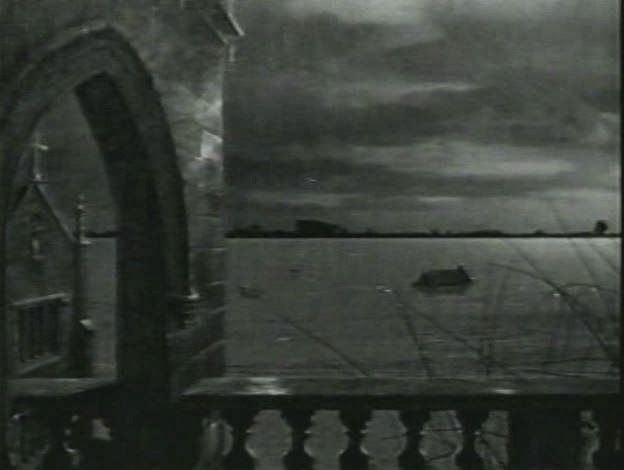
I think Mr. Sirk was missing the elephant in the room this time around.  The villagers are escaping a devastating flood and flee to the highest ground near them, on which sits a convent and hospital run by nuns.  They’re not going to the McDonald’s on the hill; they’re going to the convent on the hill.  Just the image of being on higher ground sets a symbolic tone to a brooding story about being right and being wrong, being guilty and being innocent, always with the image of a young woman, guilty or not, about to hopelessly face execution—and thereby face what most of the characters presume to be some kind of afterlife and further judgment. 
The director and writers would have done better to face the religious tones of the original script head-on, rather than shy away from them.  Religion is one of the most conflicting, controversial, and contentious elements of man’s experience--great kindness and great evil have been done in the name of religion--which can make it a forum for intense drama.  It becomes a forum for weak platitudes only when we let it be.
As for Mr. Sirk’s complaints about spending the budget on the set—for me, one of the best things about this movie is the magnificent set.  Though I can understand that filming on location could be more cost effective, and certainly realistic to the setting of films, I often prefer the sets Hollywood created.  I don’t regard them as artificial, but as art.
Have a look at the detail of this set, the gothic arches, the stonework.  I love how the stone steps are worn, uneven, as if they’d been trod upon for centuries.  That’s great detail.
We begin Thunder on the Hill with thunder.  On the hill.  And in the marshy lowlands where, through torrents of cold rain, a whole lot of extras got work that day sloshing through a winding muddy road, walking like desperate war refugees with carts of their belongings, and even farm animals.  It’s a dismal setting and nicely played against the opening credits that sets the eerie mood and leads us into our receiving line of characters.

Connie Gilchrist, so beloved as earthy, excitable, crusty but with a heart-of-gold types, plays the sister in charge of the kitchen.  She also becomes Claudette Colbert’s sidekick, and inevitably takes the lead in solving the mystery.  I’m not sure, but I think she gets more screen time here in this film than others she’s played. 

Gladys Cooper, who in her long stage and screen career was rarely anything less than magnificent, plays Mother Superior, dedicated administrator of this chaotic menagerie, whose fairness is a source of strength to the troubled Miss Colbert, but who also presents Miss Colbert’s greatest turmoil by challenging her conscience and accusing her of always needing to be right.

It is a complaint others in the hospital have of Colbert, including one particularly nasty nurse played by Phyllis Stanley.  Miss Colbert runs the hospital, and everything’s always got to be her way.

Robert Douglas plays the gentlemanly doctor on staff, who, like Claudette Colbert, doesn’t seem to get any sleep over the suspenseful couple of days the story plays out.  He's the kind of movie doctor who administers a lot of sedatives.  He is also worried about his wife, ill and anxiety-prone, for whom he has set up a bed his office at the hospital to keep her safe from the flood...and away from others.

She is played by Anne Crawford, and she has a tendency to wander around.

Gavin Muir is the stalwart detective sergeant who escorts the doomed Ann Blyth to the gallows, who clashes more than once with Colbert over her confounding attempts to be nice to the prisoner.

Norma Varde is the police matron who accompanies Ann Blyth everywhere, chain-smoking and generally trying to mind her own business.  She had a spectacularly long career, beginning in the early 1920s, but is most often seen, I think, in reruns of The Sound of Music (1965) as the housekeeper.

I especially like John Abbott as the officious and stuffy pharmacist.  We last saw him in his great role as Frederick Fairlie in The Woman in White (1948) here.

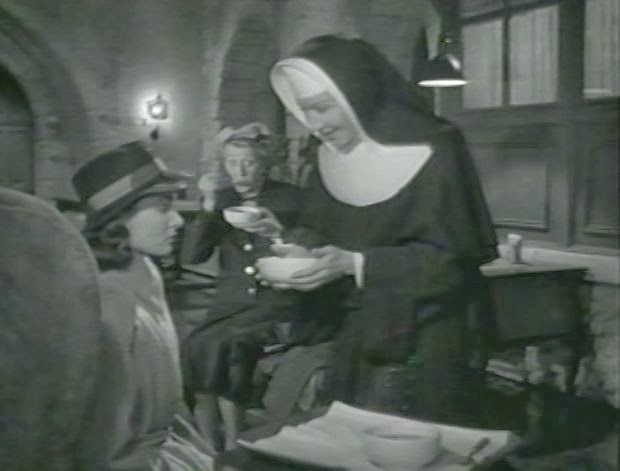
Miss Colbert, trying to micro-manage everybody, finally makes her way with bowls of soup for the condemned and her guards, and we meet Ann Blyth for the first time, rigid with bitterness, sarcastic, and utterly without any feeling for anybody or anything.  She is impervious to gestures of politeness as she is to feeling the cold damp of this sinister storm.
She is well known among the villagers: some remember her pleasantly in former days before she turned bad, some call her “the devil’s daughter.”  She was convicted of murdering her brother, a concert pianist and unsuccessful composer.  He had been languishing from a stroke, and she, his caretaker, poisoned him by giving him an overdose of his medicine.  He is described as mistreating her, bullying her and others, an alcoholic with a fearful temper.  Nobody’s sorry he’s dead.  Everybody writes Ann off as guilty, because not only did she have perfect opportunity and means to kill him, but nobody would blame her for doing it.

However, Ann comforts herself in the office of the Mother Superior by playing one of her brother’s compositions on a piano, and angrily tells Claudette Colbert how his talent was unappreciated.  This is one of the ingredients of the stew that sank to the bottom.  It would have been interesting for a little more on why she could still find beauty in her brother’s artistry and defend him though he was said to have treated her miserably.
Small point, but I like Ann’s piano technique.  Most likely, she is dubbed by an off-set pianist, but she actually looks like she’s engrossed in what she’s doing and is making all the proper movements.  We don’t usually see natural and realistic pantomime on faked playing in films of this era.  She’s really “in the moment” in this scene.
Ann Blyth manages a creditable English accent in this film, and Connie Gilchrist whips out her trusty Irish brogue.  All the others accents are genuine, except for Claudette Colbert, who does not attempt to sound like anything but the usual “mid-Atlantic” speech that worked for her in all her films.
Colbert sees something in Ann’s intense playing, in her defense of her brother, as clues to her innocence, and the thought that she cannot help this woman so shortly to die haunts her, bringing back an old and never-ending emotional torment: the suicide of her sister, despondent over the lover who Claudette would not let her see.  Claudette interfered in her sister’s relationship with a man we are led to believe was no good, but though her intentions were, she thought, for the best, it ended in tragedy.  Feeling guilty, Claudette left the outside world, joined the convent, and in a few years was running things.  She’s disciplined, and devoted to detail.  She has a need for control.
These qualities make her a bit of a fanatic, something against Mother Superior warns her.  They also make her a good person to have in your corner if you’re going to the gallows.
This being a mystery, I won’t do the play-by-play, but we soon discover that the principle people involved in Ann’s murder case, witnesses at her trial, all happen to be here—taking refuge from the storm.  Including Willie the handyman, played wonderfully by Michael Pate, who is the slow, so-called “half-wit” who, though awkward in the company of people, knows his way around a bog. 
He wrangles a rowboat and takes Claudette to the village to bring back Ann’s fiancé, played by Philip Friend.  Ann requested Colbert to fetch him in a sarcastic taunt to perform a miracle for her, refusing any spiritual comfort just as she refuses the steaming bowl of Connie Gilchrist’s soup.
There is a parallel here with Claudette’s refusal to allow her sister’s romance and the guilt she feels for it.  Her nighttime adventure through the flood with Willie is a way for her to take control of that guilt and re-create the moment she most regrets, to play it over and change it.  She once refused her sister to have contact with her lover.  So she braves the flood and brings Ann hers.  As they glide through the dry ice fog of the soundstage, you’d think the Phantom of the Opera was going to pop out any minute and start singing about the Music of the Night.
If you filmed that on location, it wouldn’t be half so mystical or fun to watch.
I like Willie’s description that the fog “be thick and ghost-like.”
The fiancé, played by Philip Friend, is relegated to a sort of dishwater role, and I’m not sure if the weakness is in his portrayal, the script, or the direction.  On the one hand, I think it’s a great device that he, though deeply in love with Ann, actually thinks that she’s guilty, because like everybody else, he wouldn’t blame her for bumping off her creep of a brother.  But his turmoil only takes the form of him drinking in a pub, drowning his sorrows, where Willie and Claudette Colbert find him.  To be sure, at the end of the movie he admirably comes to Claudette’s aid (she is attacked in the bell tower by the real murderer—shades of Vertigo), but I think we’re looking for someone less self-pitying so we can empathize with Ann’s loss of a future life with her beloved. 
Ann Blyth is relegated to a passive role simply because she is a prisoner and her reality is that she is unable to save herself, others must do it for her.  She can only wait for either rescue or hanging.  All she can do as an actress is maintain the intensity of her seething resentment, broken occasionally by waves of panic, and she does that very well.

The action is left to Connie Gilchrist and Claudette Colbert.  Miss Gilchrist is a hoarder, who never throws away newspapers.  She has papered every shelf in the convent and hospital with them, and I like her line about loving the  Sunday Times because, “It has such a nice gray effect on my shift.”  Sister Nancy Drew and Sister Miss Marple spend the spooky evening hunting through all the closets, retrieving newspapers to re-read the trial transcripts.  Other clues pop up, like a stolen letter, but Claudette Colbert’s sleuthing is halted by Gladys Cooper, who forces her in accusatory terms to examine her own conscience.  Does she really believe this girl is innocent because she wants her to be?  Is she just trying to manufacture a case so that, once again, she can be right and everybody else wrong?
A compelling argument, and it is late in the game when Connie Gilchrist, and the fuddy-duddy pharmacist, supply the final clue to raise the most suspicion.
There is a climactic violent scene in the bell tower.  I like that the murderer is apprehended and will face the same course of plodding justice that Ann Blyth faced in her trial and failed appeal.  Too often movies, then and now, use a quick instant death to remove the villain, and that is just lazy.  It is like a deus ex machina to take our troubles away from us when we should be solving them ourselves.
It is regrettable, however, that we have only a brief look of happiness shared between Ann and Philip Friend at the movie’s conclusion.  It would have been more dramatic for the audience to witness the moment Ann is told she has been vindicated.  It’s the miracle she had taunted Claudette Colbert about early in the film.  Despite the religious aspects to the script and setting that made director Sirk uncomfortable, he missed a few opportunities, as did the writers of the screenplay, to fan the drama that was already there, inherent in the story.  It’s not that drama wasn’t there; it’s that they turned away from it.  They should have taken Sr. Connie Gilchrist’s advice and not wasted anything.
Some favorite scenes:  When Ann appears jolted when she is told the dike has collapsed and they will not be able to take her to the gallows tomorrow.  It’s going to have to wait a few more days.  Rather than relief, she is horrified.  It only prolongs her misery.  Nothing in life has worked out.  She took care of her creepy brother, and this is the thanks she got.  The law failed her.  The community turned its back on her.  Her boyfriend thinks she’s guilty.  All she wants now is to leave this hilltop haven, head back out into the icy rain and end this miserable life.

Then she melts into hysterics when she realizes with black humor that her execution is going to be postponed because of rain—“Like a cricket match.”

The moment where Claudette Colbert brings Ann’s fiancé to her, and Ann, humbled and grateful, tells Colbert, “I want you to know you did this for an innocent woman.  I make you a gift of it, my innocence.”  (Not only does this make Colbert’s wanton act of obstruction of justice raised to a spiritual level—it makes her right.  We may smile and debate which is the more important to this nun.)
I like Willie’s devotion to those who are kind to him, and the gallantry he displays to ladies, except Nurse Philips, whom he has threatened to smack more than once.
I like this shot here where we see Connie Gilchrist from under the table telling Michael Pate as Willie not to eat like a pig.
An interesting scene where, after a difficult birth, a baby is being aspirated manually by the doctor and by Claudette Colbert by sucking gunk out of his throat with a straw.  I don’t know how effective, or accurate this is, but it’s another look at the medicine of the day.

The scene where Ann tells Philip Friend she knows he thinks she’s guilty, always knew it, and forgives him, tells him to go on and live his life and not memorialize her.  Only a moment later, she panics and recants, wanting desperately to live, jealous of anyone he may love in the future.

When Claudette prays for help, making the intimate confession to God, if to no one else, that she doesn’t what to do and it scares her.

Enjoyably atmospheric and moody, whether in the rain-soaked foggy bog, or under the glare of a naked light bulb peering at the Sunday Times in the middle of the night in the dark recess of an ancient abbey, Thunder on the Hill creates a little world where all take refuge, but some aren’t safe.  It is available on DVD, fortunately, and I’d love to hear your take on it.  Have some soup or stew while you’re watching it.  Or three helpings of bacon, eggs, and toast.
Come back next Thursday when we lighten things up considerably with what I think is one of the funniest comedies of the era.  Ann Blyth woos a nervous Robert Montgomery in Once More, My Darling (1949) directed by Robert Montgomery in one of his last screen roles.

Did you notice if this post was long?  I wasn’t paying attention.  You shouldn’t talk on your cell phone and blog at the same time.  That’s how accidents happen.

********************************
Dick, Bernard F. Claudette Colbert: She Walks in Beauty.  (University Press of Mississippi, 2008), p. 198.
Lux Radio Theater – “Movietime USA” episode September 24, 1951.
Quirk, Lawrence T. Claudette Colbert: An Illustrated Biography (NY: Crown Publishers, Inc., 1985) pp. 163-165.
Sirk, Douglas and Jon Halliday. Sirk on Sirk (Viking Press, 1972).
St. Joseph (Missouri) News-Press, syndicated article by Louella Parsons, December 16, 1951, p. 4D.
Toledo Blade, syndicated article, February 5, 1951, p. 35.

**********************************
UPDATE:  This series on Ann Blyth is now a book - ANN BLYTH: ACTRESS. SINGER. STAR. -

*********************
The audio book for Ann Blyth: Actress. Singer. Star. is now for sale on Audible.com, and on Amazon and iTunes.

Also in paperback and eBook from Amazon, CreateSpace, and my Etsy shop: LynchTwinsPublishing.


 "Lynch’s book is organized and well-written – and has plenty of amusing observations – but when it comes to describing Blyth’s movies, Lynch’s writing sparkles." - Ruth Kerr, Silver Screenings

"Jacqueline T. Lynch creates a poignant and thoroughly-researched mosaic of memories of a fine, upstanding human being who also happens to be a legendary entertainer." - Deborah Thomas, Java's Journey

"One of the great strengths of Ann Blyth: Actress. Singer. Star. is that Lynch not only gives an excellent overview of Blyth's career -- she offers detailed analyses of each of Blyth's roles -- but she puts them in the context of the larger issues of the day."- Amanda Garrett, Old Hollywood Films

"Jacqueline's book will hopefully cause many more people to take a look at this multitalented woman whose career encompassed just about every possible aspect of 20th Century entertainment." - Laura Grieve, Laura's Miscellaneous Musings''

"Jacqueline T. Lynch’s Ann Blyth: Actress. Singer. Star. is an extremely well researched undertaking that is a must for all Blyth fans." - Annette Bochenek, Hometowns to Hollywood


Ann Blyth: Actress. Singer. Star. 
by Jacqueline T. Lynch

The first book on the career of actress Ann Blyth. Multitalented and remarkably versatile, Blyth began on radio as a child, appeared on Broadway at the age of twelve in Lillian Hellman's Watch on the Rhine, and enjoyed a long and diverse career in films, theatre, television, and concerts. A sensitive dramatic actress, the youngest at the time to be nominated for her role in Mildred Pierce (1945), she also displayed a gift for comedy, and was especially endeared to fans for her expressive and exquisite lyric soprano, which was showcased in many film and stage musicals. Still a popular guest at film festivals, lovely Ms. Blyth remains a treasure of the Hollywood's golden age.


The eBook and paperback are available from Amazon and CreateSpace, which is the printer.  You can also order it from my Etsy shop. It is also available at the Broadside Bookshop, 247 Main Street, Northampton, Massachusetts.

If you wish a signed copy, then email me at JacquelineTLynch@gmail.com and I'll get back to you with the details.

Related Products