IMPRISON TRAITOR, PEDOPHILE, AND CONVICTED FELON TRUMP.

Thursday, November 28, 2013

How to Make Thanksgiving Dinner

A
 
Forty-three guests for Thanksgiving and you forgot how to roast a turkey?  Don't fall apart.  Listen to me.  Here's what you do.
 
B
 
First, get a grip.  Say a quick prayer.  Or just stand there wondering what that spot on the ceiling is.
 
C
 
Get the stuff out of the fridge.  Ignore the guy who just came in the kitchen, or else put him to work.
 
D
 
Sautee the onions and celery.  Come on, come on.  We haven't got all day.
 
E
 
Stuff the turkey.  Any way you can, even if it's not pretty.
 
F
 
See?  Nothing to it.  Now go change.  And do something with your hair.  They just pulled in the driveway.
 
Happy Thanksgiving, my fellow Americans.  Now tell me who these cooks are and from what movies?  Answers next week.


Sunday, November 24, 2013

Requiescat in pace et in amore.


Continuing our observation of the 50th anniversary of the JFK assassination, this noticed in a recent Twitter stream, tweet by Paula Ebben.   I grew up in an era when you could expect to see Jacqueline Kennedy on the cover of a magazine very often.  I don't think there was ever a photo of her more beautiful.  May she rest in peace and love.


Thursday, November 21, 2013

JFK - 50th Anniversary - The Weekend at the Movies


Today we draw our attention to the 50th anniversary of the assassination of President John F. Kennedy, but in terms of what our world was like with a view towards the movies that were playing in theaters at that time.
 
Most people who remember that awful four-day event of shock and mourning from Friday to Monday remember where they were and what they were doing, almost in detail.  Most, I suspect, were not at the movies.  Most were either at communal mourning services or firmly planted in front of their television sets watching a new era of chaos born from the weird and terrible string of events that occurred that weekend.  Television and radio took the lead and were the real chroniclers of our experience that weekend, not the movies, and perhaps the movies never would be again the forefront record of our popular history.  Radio and TV cancelled all regular programs and devoted the entire weekend to the national emergency and the protocol, newly learned for all of us, of national mourning.
 
 
We can see in these movie ads a lot of fluff, a lot of eager, daring attempts at sexual situations--which may seem somewhat sophomoric now, certainly more innocent than what was to come later. 
 
 
We look like a country that didn't take much seriously.
 
 
It was a world still of grand downtown movie palaces, such as the Loew's Poli in Springfield, Massachusetts.  It was a world where we still had plenty of drive-ins, though most would close in the northern parts of the country for the winter--and eventually for good.
 
 
This drive-in below even advertises electric heaters, which is a plus in November in New England, though exactly how that worked, I'm not sure.  I'd love to know.
 
There was still a Cinerama theater in Hartford, Connecticut at this time, a movie process and selling gimmick we should probably tackle someday.  As far as I know, there were only three Cinerama theaters in New England: including one in Boston, the other in Providence, Rhode Island.  If any reader can correct me or fill me in on more, please do.
 
 
For the most part, we see in these ads a lighthearted and superficial world that surely could not really have been. Perhaps we were blind to social strains and movements, a tense undercurrent that was there all along, unknown to us until we were forced to see.


If you remember what you were doing and who you were at that time, that weekend, I'd love to hear from you. 
 
 
The JFK anniversary is also discussed on my New England Travels blog this week.


Thursday, November 14, 2013

A Winner and some other stuff...

AND THE WINNER IS.....

Congratulations to Janet, who wins the paperback copy of my latest novel, DISMOUNT AND MURDER, the third in the "Double V Mysteries" series.  Thanks so much to everybody who entered the contest.
___________________________________________

SOME OTHER STUFF....

We visited the Leavitt Theatre in Ogunquit, Maine, here in this post. Recently, a drive has been started to help the Leavitt adapt to the new digital projectors that are so costly, and without which many small independent movie theaters, like the Leavitt, will go out of business.  Here's the press release that was sent to me.  I thought you might like to have a look, and help out if you can.
___________________
As many as 10,000 movie screens in North America could go dark by Dec 31st, 2013! http://www.rollingstone.com/movies/news/how-digital-conversion-is-killing-independent-movie-theaters-20130904
LEAVITT THEATRE KICKSTARTER: http://kck.st/HhQ8MO

Hello.

By Dec. 31st Hollywood will cease distributing films to all movie theaters on celluloid reels in favor of digital prints. America's movie screens have been forced to buy digital projectors that can cost as much as $100,000. An estimated 10,000 screens – one in every five screens in North America – will go dark because they can't afford to convert.


Over 1000 independent old-school, mom-and-pop-owned movie palaces in small towns are struggling to come up with the price of conversion. They lack the cash and resources of big chain cinemas.
And to make matters worse, the film companies are helping subsidize the large multiplexes' conversions but not the single screen movie houses.

The Leavitt Theatre in Ogunquit, Maine (est. 1923) is one of these theaters. A beautiful, classic, independent, family owned movie theater that has been showing first-run films for 90 years, they must go digital by Dec 31st or go dark!

Please click on the link below to find out more about a new KICKSTARTER drive. The Leavitt Theatre has just 25 DAYS (until Nov 30) to raise $60,000. They need help!
KICKSTARTER:http://kck.st/HhQ8MO

 Please spread the word, even if you are unable to donate.

Thanks everyone!

Article:
http://retroroadmap.com/2010/07/29/the-leavitt-theatre-ogunquit-me-youll-love-it/

Also on Facebook
https://www.facebook.com/pages/Leavitt-Theatre/99336197126?ref=hl

Thursday, November 7, 2013

WIN A FREE COPY of Dismount and Murder


This is to announce another giveaway for another book, this time my newest novel, Dismount and Murder.  Just send me an email to: JacquelineTLynch@gmail.com with the message I WANT THE BOOK.  I pick the winner's name out of hat, and then I email the winner and get the address where to send the paperback book.  No addresses or emails will ever be published on the this blog.

I'll pick the winner next Thursday morning, the 14th.

Dismount and Murder third in the Double V Mysteries series is now available in eBook, and paperback.  Elmer and Juliet continue their tentative relationship while investigating murder at a wealthy estate in Litchfield, Connecticut, in the summer of 1950, while a horse show on the grounds covers the tracks of a number of suspects.  Elmer, an ex-convict, is now off parole, the Korean War has just started, and television antennas are starting to spring up on rooftops all over the place. 

And then there's that missing corpse.

It's the dawn of a new, unsettling day.

The nifty cover is by your friend and mine, the talented Casey Koester, AKA Noir Girl.
 
Available in eBook and paperback online here:
And other online merchants.
 
You can find the two first books in the series, Cadmium Yellow, Blood Red and Speak Out Before You Die also at the above online shops -- and in all of them, except currently for Amazon, the first book -- Cadmium Yellow, Blood Red -- is FREE as an eBook for a limited time.


Thursday, October 31, 2013

The Smiling Ghost - 1941


“The Smiling Ghost” (1941) is one of those fast-paced scary/silly B-movies that the Warner Bros. studio could knock out in its sleep.  There’s a lot to amuse here, and a bit of a mystery, but mostly it’s a lot of scary house clichés as harmless as a handful of candy corn.
Unless you’re allergic to candy corn.

Or unless candy corn offends you.

There’s only one offense here in this well-intentioned free-for-all, and that’s the stereotyped character of Willie Best, who plays the longsuffering assistant of Wayne Morris.  To Mr. Best’s credit, he gets some good lines and his delivery is hysterical.  I think he probably gets more screen time than anybody in this movie except for Wayne Morris.


Wayne Morris, a befuddled victim/suitor who agrees to pretend to be engaged for one month to a jinxed girl for $1,000 (her former fiancés are all either incapacitated or dead), is a sweet fellow who really needs Willie Best to look after him.  I like how when they are called to the attorney’s office to set up the deal, the receptionist asks which gentleman is the client, not presuming that it’s the white guy and calling them both gentlemen.  Willie takes charge and speaks up, because it always takes poor slow Wayne a minute to sort things out: “The light-complected gentleman here.”


Alexis Smith is the “Kiss-of Death-Girl” who cannot hold onto her fiancés. We see how early in her career she’s been cast as the cool beauty, a template that would stay with her for many years.

Barbara Marshall is the sane and sassy girl reporter, because you just have to have a girl reporter in these things.
Alan Hale is the butler, but not in the Arthur Treacher mold.  He’s a regular Joe, who talks gruff and carries a gun.  He’s supposed to guard Wayne Morris, because Wayne is supposed to break the curse.  If he lives.


Helen Westley is the sharp old grandma who set up the caper, and Lee Patrick is a cousin who covets the family jewels.

And I have to smile at Renie Riano in a typically small, stereotyped and funny role as The Homely Woman.  She's a game gal.

Wayne Morris meets the dour extended family, including a crazy uncle, played by Charles Halton, who shrinks heads in his laboratory.  Mr. Morris settles into to a spooky night, oblivious to the fact he might be victim number four.
We have secret panels, cobwebs in the cellar, cobwebs in the family crypt, a fog-shrouded graveyard, and best of all, a thunderstorm during which we hear peals of “The Storm” from Rossini’s William Tell, which you will recognize from many, many Warner Bros. cartoons.


A murderer wanders the mansion, and though we get glimpses of a waxy face with dark, sunken eyes and a sickeningly fixed grin, the identity of the monster is withheld until the end.  He lends some excitement to the proceedings, but for my money, the scariest sight in this movie is the fellow, one of the former fiancés who lived, but who is now paralyzed—encased in an iron lung.  Jeez, those things were frightening. 


And if you think about it, just the shot of watching the patient through the mirror mounted on the top of the machine suggests a disembodied head.

 
You don’t have much time to think about the plot, even if you wanted to, because there’s too much going on, a few fistfights, a couple magnificent tumbles down a very long staircase, and a romantic triangle when the girl reporter and the Kiss-of-Death Girl become rivals for the hapless hand of Wayne Morris.

True love conquers all in the end, including one disgruntled smiling ghost.
One of my favorite lines, when the Justice of the Peace arrives to perform a midnight wedding, “The Justice of…stuff is here.”

 
Happy Halloween.


Thursday, October 24, 2013

Frankenstein Monster Woos Ann Blyth


In the spirit of the upcoming Halloween (or Samhein, for you Celtic types) festivities, we have one of those sneaky tabloid newspaper shots proving all those whispered rumors that the Frankenstein Monster had a torrid love affair with Ann Blyth. 

Or, maybe the big guy just felt like fish for dinner.  "Mermaid...g-o-o-o-d."

Or maybe Mr. Peabody and the Mermaid, in which Miss Blyth starred as the, well, mermaid, wrapped in late February 1948 just as Abbott and Costello Meet Frankenstein was in the middle of shooting.  Glenn Strange, as the Monster, and Ann Blyth, neighbors on the Universal studio backlot on this day, took a moment to clown around.

Makeup master Bud Westmore was responsible for the remarkable transformation of both of them. 

A match made in heaven.  Or just at the wrap party.

Next year, as announced a couple weeks back, we'll take a long, leisurely perusal of Ann Blyth's career on film, TV, radio, and the stage.  So far, from my research, I'm able to state confidently there was nothing romantic between her and Dracula or the Wolfman.  However, I did see an ad in Action Comics from 1949 (link to the image here) where Superman flies off with the mermaid in his arms in a little cartoon publicity for Mr. Peabody and the Mermaid. Clearly, we may note from these intimate encounters with Superman and the Frankenstein Monster, if the fella was tall, dark, and fictional, Ann couldn't keep her hands off him.

Next week, on Halloween, we'll take a look at The Smiling Ghost (1941), a B-comedy/horror that brought together Wayne Morris, Brenda Marshall, and Alexis Smith early in their careers.

Thursday, October 17, 2013

Beret Trivia Answers


A drumroll, please...the answers to last week's beret festival:

A - Grace Kelly in a very early TV drama from Studio One, an episode called "The Rockingham Tea Set" broadcast in January 1950.

B - Eve Arden in My Reputation (1946), which we covered here.

C - Jennifer Jones in Love Letters (1945), which we blogged about here.

D - Claire Trevor in Crack-Up (1946), discussed here.

E - Arthur Hunnicutt in The French Line (1954), discussed here.


If I'm ever in a classic film trivia contest, I want Caftan Woman on my side.

Maybe sometime I'll break down and tell you fine folks my coonskin cap story.   When I feel I know you better.

By the way, check out the smashing lineup of lurid noir B-movie posters at Mark's Where Danger Lives blog.  Here's a sample.  Please note the black beret on the woman of seemingly questionable virtue.  One size fits all.


Thursday, October 10, 2013

The Beret. Hat of the Stars. Really.


A

Now that the cooler months are setting in, it’s time to pay tribute to my favorite headgear—the beret. 
For many, many years, a black beret has been my chapeau of choice, mainly because they’re warm, they go with every coat you have, and they tend not to leave you with hat hair as much as, say, an acrylic knit hat when you pull them off.  And you don’t really have to take them off if you don’t want to.  This lady is perfectly chic sitting down to a highball with hers.
 
B
I have gotten many comments over the years on my beret—especially derisive comments from a sister who thinks I’m weird.  However, she brought back a Navy blue one from Paris for me once, so you can see even she’s a good sport about my fondness for the beret.
Although she claims to have been mortified when someone told her that she recently saw her sister. My sister asked, “Which one?” 

The lady said, “That one with the beret.”
 
C
I have received a few French greetings from time to time.  Though my first name is French and I wear a beret, my command of that lovely language is limited to counting to ten and knowing that when you're driving in Montreal, "Droit Suelement" means right only.
One fellow, opening a door for me at, I think, a bank, remarked, “Ooh-la-la!”  I like to think it was in reference to me and not the hat, but that may just be a pitiful fantasy.

Last spring, a family member was ill and I conferred with the doctor in the hospital corridor.  The next time I spoke with him he did not recognize me because, he said, the first time I was wearing a beret.

D

Once at church, a visiting priest from overseas broke ranks in the recessional and came over to me, saying in broken English, “I like you hat.” 
The blogger replied, “Thank you, Father,” genuflecting as he passed, and bit her lip so as not to laugh over the determined organist thumping out Holy God We Praise Thy Name.

Ah, yes, Ite Missa est.  You betcha.

So if you, too, live in a climate where it can get so cold your nose hairs freeze, I recommend a nice woolen beret.  A black one will go with every coat you have.
A white one?  Well, this debonair chap has his own style.
 
E

Tell me who these beret-wearing folks are and from what movies.  One hint, though, the first one is not from a movie, but from the old Studio One TV show.

***

Next Wednesday the 16th, I’ll be speaking at the Ames Privilege Community Room in Chicopee, Massachusetts for the Chicopee Historical Society on three fellows from the Ames Manufacturing Company during the Civil War.  I’ll have copies of my new book to sign.  It’s also available as an eBook from Amazon, Barnes & Noble, Kobo, Apple, and Smashwords.  It’s available in paperback currently from Barnes & Noble, CreateSpace and Amazon.


Thursday, October 3, 2013

And the Winner is...


AND THE WINNER IS....Rich! 

Thanks so much to everyone who emailed to enter the contest.  I'll be running another one next month.

***

I'll be speaking to the Chicopee Historical Society on the exploits of three guys from the same Northern factory during the Civil war: a Medal of Honor winner, a teenager who later worked with Augustus St Gaudens and other famous scupltors producing bronze statuary, and the owner of the company - James Tyler Ames. The ironies and coincidences that link them are a chapter of my forthcoming book, and I hope to have some copies on hand for the occasion. The event is at Ames Privilege Common Room, lower Springfield St, Chicopee, Mass., Wednesday, Oct. 16th at 6 p.m. Love to see you there.

***
 
 
I have a new project for this blog in the works for next year, an experiment of sorts.  I'd like to explore the career of Ann Blyth--movies, radio and TV appearances, and stage work.  I've been kicking this idea around for a couple months and what particularly interests me is examining the relationship between Hollywood, TV and theatre in the 20th century through the trajectory of one person's career.  Ann Blyth's own career path, the apparent fact that she hasn't had much play on most blogs that I can find (including mine), and that she is still with us and, as anyone who has seen the Robert Osborne interviews conducted last spring for the TCM Film Fest, is a most articulate and valuable representative of her industry.  We spend a lot of effort on our blogs to celebrate the work of so many greats who are long gone.  It's also important, when we find the opportunity, to celebrate those who are still with us.
 
 
I'll still blog on other topics and movies, and join in the occasional blogathon when I can, but for the most part, 2014 is going to be The Year of Ann Blyth.  I'll post more info on this in December.  The next few months will be the hunter-gatherer stage for me as I collect material.  I've seen probably a third of her films and some TV work, but I'd like to see all of them if I can.  Not all are easily available, so knocking them off my list is going to be a challenge. 
 
 
I'm hoping the series will generate some thoughtful discussion among us, as I appreciate your comments and value your opinions.

Thursday, September 26, 2013

Party Like It's 1904 - Book Giveaway


Oh, yeah, party like it's 1904.  Today I'm offering a free paperback copy of my novel Meet Me in Nuthatch to the lucky winner whose name I a draw out of a hat.  It's an Australian Akubra, actually, but that has nothing to do with it.  Just send me an email at JacquelineTLynch@gmail.com with the heading I WANT THE BOOK.  You have from now until next Thursday, when promptly (or as soon as I finish breakfast) at 8 a.m. Eastern Time, I shall draw the lucky winner and announce it on next Thursday's blog post.  Then I will email the winner on where to send the book.  No emails or addresses will ever be made public.

Here's the story:
A publicity stunt to attract tourists to a small dying town results in the entire community turning the clock back to 1904. It is local Christmas tree farmer Everett Campbell's idea, after watching the film Meet Me in St. Louis, his young daughter's new favorite movie. What begins as half practical joke and half desperate ploy initiates the rebirth of Nuthatch, Massachusetts. Tourists do come, along with the media. To Everett's dismay, his campaign to save their community results in also attracting representatives of a chain of theme parks who want to buy Nuthatch 1904. Everett now stands to lose his town in a way he never imagined, and the community is divided on which alternate future to choose. A local drug dealer, the longtime enemy of Everett, may hold their future in his hands unless Everett can pull off his most spectacular, and dangerous, practical joke.
 
It's poignant, it's silly, and it's got an old movie reference.  What more could you ask?   With the holiday season approaching (I know, nobody likes to be reminded of December in September), I'm going to be offering a few of my books, one a month in this manner.  Maybe you have a Great Uncle Herman who's difficult to buy for.  Maybe you need a gift for your Cousin Louise, who nobody in the family likes.  Get her this.  It would serve her right.
 
Remember, just an email with I WANT THE BOOK, and your gift-buying woes could be over.
 
See you next week

Saturday, September 21, 2013

-30- (1959)


-30- (1959) is a story of the gritty newspaper game played out entirely in the newsroom.  Unlike the spirited hijinks of The Front Page where a fugitive is hidden in a roll top desk and the smart aleck newshounds will do just about anything for a story, this movie is more mature, more world-weary, more soul-searching, and presents the journalists in a much more human light of both idealism and self-doubt.
This is our entry in the Breaking News blogathon  hosted by Comet Over Hollywood and Lindsay's Movie Musings. Have a look at these two great blogs for a list of the other swell blogs taking part.
Jack Webb, who directed and produced the movie, stars as the editor-in-chief, who, refreshingly, is not the usual barking kind of editor we see in movies about newspapermen.  He’s tough, cunning, but quiet, with a sense of humor and a wellspring of tenderness that is borne of daily reporting on an often unpleasant world, and from being haunted by his own past personal tragedy. 

The barking in this film is left to William Conrad, an editor whose war cry of, “Boy!” refers to the gang of 20-something copyboys on staff always looking for their big break as journalists, but always reduced to menial gofers. 
 
 
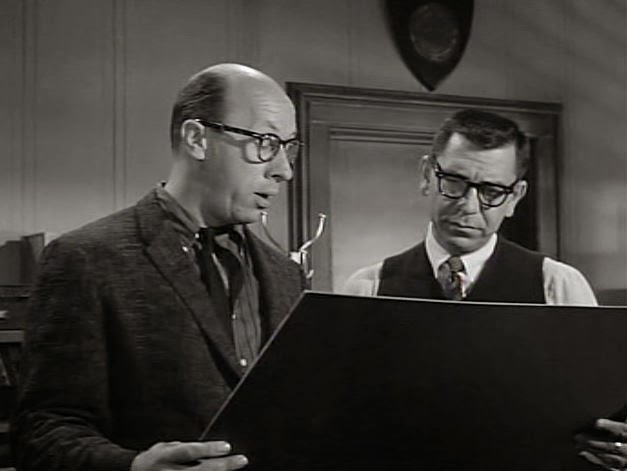
His chief irritant is David Nelson, who just can’t seem to please his boss.  Much of the film’s wry humor comes from the clashing in this newsroom full of oddball personalities: Richard Deacon, the frustrated staff artist whose talent and art education is wasted on retouching photos.  Another editor who is assigned to both real estate and religion, wishes he could cover the weather, and Jack Webb decides to let him do all three, proclaiming him editor of heaven and earth. 
Howard McNear aka Floyd the Barber shows up, too, as an editor, and it's neat the Mr. Webb has casted so many movie lesser knowns and bit players for featured roles in this film.


We have Louise Lorimer at the rewrite desk, an old vet of the paper, who follows on teletype the news of her grandson’s Air Force test flight, and Nancy Valentine, stuck doing obits, who wants her big chance at a story.

We see there are no restrictions on the ladies in this newsroom, as career opportunities in journalism have been a gateway to women since the days Nellie Bly was working as an investigative reporter in 19th century.  Jack Webb is supportive of the gals, and helps Nancy Valentine to get her big break when a big story happens.

They work the evening shift, preparing the morning paper.  The newsroom never closes in these days of big-city dailies that had both morning and afternoon papers, and any number of “extras” as the events permitted.  In 1959, print journalism was at a crossroads, and we see it here.  When the big story happens, they are competing with the new television media, and William Conrad jokingly laments, “Oh, why didn’t we all get together and stamp out TV when there was still time?”

Towards the end of the movie, when the paper goes to press, we can hear the hum of the huge presses rolling on a floor below.  We are past the days of Linotype in the composing room, but on the desks and light tables in the newsroom we see this is still an era of paste-up and layout, literally.  (This era continued, for me at least, into the 1980s, and it is a kick to see them work with blue pencil and rulers and rubber cement, and to crop photos, literally, by drawing margins, where figuring out column inches and percentages was done with math.)


There are other, less technical touches to this film that endear the viewer to this world of second-shift newspapermen and women.  The way William Conrad uses a piece of typing paper to wipe yesterday’s grounds out his small electric coffee percolator at the beginning of his shift, berating David Nelson, who stands before him with a tray of paper cups of water so Conrad can refill his pot.  I like the sweater vests, and the editor wearing the green eyeshade he probably put on with pride in his youth and never took it off. 

I like the back of the swivel desk chair we see behind Conrad with somebody’s name written on it, as if the owner was tired of having it swiped.

There is also the omnipresent rain, like the Day of Judgment.  We see it out the window over Jack Webb’s shoulder as he looks toward the neon sign of the diner across the street.  We hear it, and everybody who comes into the office is drenched.  The rain also plays an ominous role in the big story for this evening.
A little girl has crawled into an open storm drain.  She is lost somewhere in the sewer tunnels below the street, and the sewers are filling rapidly with the unrelenting rain.  It had been a slow news night, but nobody on staff is jumping for joy over this one.  They all approach the story with knots in their stomachs, but with a steely resolve to be emotionless.

In a sense, the same kind of “procedural” style Jack Webb used in his Dragnet series is employed here, as the movie shows us the nuts and bolts of what it takes to put out a newspaper edition, and here and there reminds us that there are people involved.  Their stories are subordinate to the Big Story, and this is the deal they entered into when they signed on to this kind of work.  So subordinate to the news are their personal lives that often when they engage in serious personal conversations with each other, their backs are to us, as if they cannot admit to us they have feelings.
But we do get a peek at a few of their personal stories.

 
Louise Lorimer’s grandson’s test flight turns to tragedy.  She keeps working through her shift to avoid going home alone to her empty apartment.  Eventually, we see she does not go home alone—Nancy Valentine takes her home to her apartment; the bonding of the sorority of young and old “girl reporters.”


Jack Webb, especially torn by the Big Story, ponders, “What those parents must be going through.  At least with me, it was all over before they told me.”  Here is his past tragedy.  His wife and son were killed some years previously, and he is not through grieving.  This night will bring his single greatest challenge.  His new wife of three years, played by Whitney Blake, wants to adopt a little boy.  At first Webb agreed, and the two-year process of adoption and the search for a child is over.  She’s found a little boy, but now Jack has cold feet.  He’s afraid to commit his heart to another child.
 
“The Speech” is given to William Conrad, as he bawls out David Nelson and another copyboy for wanting to quit.  His soliloquy, as he brandishes a rolled up sample of their life’s blood, is capped with, “It only cost ten cents, but if you only read the comic section or the want ads, it’s still the best buy for your money in the world.”

Despite the wisecracks and the cynicism, these are closet idealists who dream big and hurt deeply.

These were the days when the newspaper was the window to the world, something the whole family read, when people had personal loyalties to certain papers, and when a newspaper could be so much the conscience of a community that in later days when they began to close down, the community mourned.  When Jack Webb tears out the planned front page and inserts a new lead story, 72-point heading, with a huge photo of the storm drain, its open jaws threatening to eat us all, he warns the children readers to stay away from this awful thing.  The newspaper is for the whole family to read and discuss.
 
Nancy Valentine pulls off a coup by talking to the family and getting photos.  She has earned their trust.  Richard Deacon puts his art skills to work, finally, by drawing an illustration of the sewer system that is not only informative for the readers, but helpful to the news staff.  These people don’t just want to report on another dead body, they want to find that kid, and flesh out where and when and why and how.

Then through the night we get reports of injured rescue workers and it does not look good for the missing little girl.

Spoilers here.  Go to the water cooler for a minute if you don’t want to know.
The reporter on scene calls in, and it goes to Louise Lorimer, wearing her headphones to type, hunt-and-peck style, the rewrite.  (In these days, you didn’t automatically get a byline; you had to earn it.  Reporters with bylines were rock stars.)  She listens and types, and Jack Webb listens on the other line.  The staff looks up from their work, apprehensively.


The girl is saved.  The newsroom is quiet, only a sigh of relief and big smiles, and a few tears as one fellow mops his face with his handkerchief. 
 
Whitney Blake brings the little boy she wants to adopt to the newsroom to meet Jack. He’s still reticent to go through with it, but when the boy wanders into his office and asks what the noise is—he hears the loud presses running—Jack Webb is faced with his greatest nightmare: the prospect of loving another child.


In a sweet finale, Jack’s emotions are, again, subjugated to the newsroom.  It is his point of reference for everything.  He asks the boy, “Don’t you know what that is?”
The boy, a little scared, shakes his head.

“They’re printing the funny papers,” he says reassuringly. 
 
The little boy has wondered into the magical land where the funny papers come from!  Webb reduces the magnitude of the work and sorrow, tragedy-dwelling and corruption-sniffing of his profession to the simple, but profound level of a small boy who will grow from funny papers to sports page, to editorials and politics. 

Oh, the joy and bliss and magic of the funny papers.

We may wonder if the Big Story didn’t work out with a happy ending, would he still take this child in his arms?  Or would he head for the nearest bar?
As the movie ends, David Nelson passes out the copies of the newspaper they’ve been working on all night.  Very few of us get to see the results of our day’s work so immediately. 

The credits roll, the actors get their bylines.


“-30-” as we are told in the final title card means “the end.”  It comes from the old Western Union telegraph codes established in 1859, one hundred years before this movie was made, when the news was first transmitted over long distances.  The number 30 was telegraphed to mean there was no more news coming across the wire.  Kind of like “over and out.”  It was used by reporters and rewrite staff, and pressmen in the composing room for generations, long after the use became obsolete.  I don’t know if it’s used anymore to signal the end of an article, probably not.

But, with great fondness for the history of journalism and my own very small participation in it over the last few decades, and with a nod to my high school journalism teacher, to this day when I finish a first draft of anything I write—the draft nobody else sees—I end it with…

-30-


Related Products