IMPRISON TRAITOR, PEDOPHILE, AND CONVICTED FELON TRUMP.
Thursday, December 2, 2010
War Stories, Part 1 - Mrs. Miniver
“Mrs. Miniver” (1942) has an aura of greatness, or infamy, about it among classic film critics, perhaps rather in the same way its star, Greer Garson, remains a symbol of MGM royalty so long accepted that a second look seems irrelevant. It’s just an item in a curio cabinet of ephemera from a more glossy if naïve era.
This is due largely to the moniker of wartime propaganda pasted on this film, (covered in this earlier post), and partly due to the “glossy” aspect of this film. The movie, based on the series of stories, afterwards published in book form, by Jan Struther, tells of a British upper middle class family coping with the early days of World War II. We mentioned in the intro to this series that war stories that focus on the home front are in some ways more revealing of the greater struggles of mankind than battle films.
“Mrs. Miniver” is a perfect example of this. We are shown a western democracy/constitutional monarchy about to be threatened with invasion by the armed forces of a fascist dictatorship. We see the before, and the during, but we do not know the eventual outcome because that hasn’t happened yet, and that provides the greatest suspense to the film. It is current events.
The problem, as some critics see it, is the “glossy”. The movie was made in the studio and on the back lot. The film depicts an American romantic notion of British decency, honor, and pluck. It is current events, certainly, but it is not documentary. One wonders what the film would have looked like if it were a British production. Less glossy? More true? Closer to the book?
Possibly they would have never dreamed of filming it. Maybe they didn’t need to make a movie of it, but in a funny way from our safe distance across “the pond”, maybe we did.
If the movie seems ersatz in many respects, it was still lauded by Prime Minister Winston Churchill as the greatest motivator of U.S. aid to the British. More on that later, and on how this quite excellent film got hog-tied by its political usefulness.
Though this blog, and repeatedly in this series on “war stories”, you will be reminded that there is historical context to old movies that shouldn’t be discounted, this is a movie that, conversely, transcends needing to know every detail of those days, because the movie’s charm, as well as the formidable Greer Garson’s charm, lies in its winsome grace.
Directed by William Wyler, this is a film that is saved by Wyler’s easy touch. Another director might go for broke in the decent British people vs. Nazi monsters setting, and then the film would really have little left to it but forced propaganda strung along a weak storyline. Mr. Wyler creates images that are magical in their simplicity, and doesn’t lean too heavily on a linear storyline, probably because he did not have an ending to the story. We wouldn’t know the end for some years.
I’ll not go into this movie scene by scene (I’m afraid you’re going to get quite enough of that in our next post in this series about “The More the Merrier”). Instead, just a few highlights.
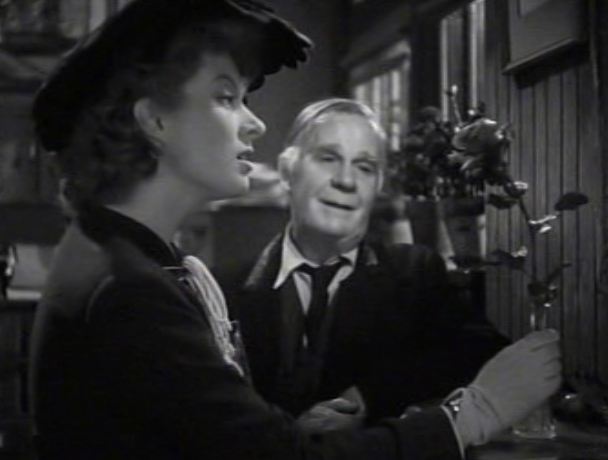
We see first the quiet orderliness of their lives in this English village on the back lot. Mrs. Miniver shops in town for a hat, and the local train station manager, played by Henry Travers, has named for her a rose he is growing in competition. A leisurely scene (fortunately, they are all leisurely scenes) when he takes her into his office and tells her about it, and I love the way we see his reflection in the mirror seeming to mimic Greer Garson’s enjoyment of the rose’s scent.
She heads home to a cozy Hollywood/British suburban house. Walter Pidgeon buys a new used car, and struggles with the decision. His small daughter Judy hammers on the piano during her lesson. His small son Toby lugs a cat around. Toby was played by Christopher Severn, who had a few uncredited roles after this, but “Mrs. Miniver” was the highlight of his brief career, where he left an indelible impression in a few key scenes.
Oldest boy Vin, played by Richard Ney, arrives home from university, and blathers on about new philosophies. As they drive home from the station in the new used car, I love the way Walter Pidgeon rolls his eyes and nods his head sarcastically in response to his son’s self-centered philosophical rants. Richard Ney is at an age when young men discover the world, but when such immense knowledge is still not quite useful without maturity. He’s a decent kid; he’s just got some growing up to do.
His impatient, “What IS it, Gladys?” to the maid trying to interrupt with a message shows he’s not quite so sensitive to the working class as he likes to believe. It’s a nice touch on Wyler’s part.
When Teresa Wright visits and debates with Mr. Ney about the realities of having a social conscience in the British class system, I love the looks that Greer Garson and Walter Pidgeon exchange. We see they are a well-married couple who are able to telegraph to each other wordlessly their amusement, and fascination, watching their son on that awkward road to manhood.
He will grow up sooner than they realize, with the first flush of romance with the sweet, ultra-decent Teresa Wright. A superior young actress nominated for Academy Awards for each of the first few movies she ever made (she would be nominated this year both for Best Actress in “Pride of the Yankees” and Best Supporting for “Mrs. Miniver”. She won in this latter category), Miss Wright adds a gentle poignancy to the role of the sole heir of Lady Belham, an aristocratic dragon played with her usual indignant aplomb by the Dame May Whitty.
Teresa Wright is also pretty much the only person in the movie who, when paired in a scene with Richard Ney, does not make him look goofy. Mr. Wyler is said to have auditioned a handful of men for the role of Vincent Miniver, and wanted a goofy looking kid. He chose young Mr. Ney as the goofiest of the lot.
So, while Ney stammers and declares his thoughts and feelings to the room, Miss Wright by virtue of her serenity seems to bring his character down to earth and makes you believe this young fellow is a really nice guy who could make something of himself.
The other maturing influence to come his way is the war.
We break into the war with a sudden announcement in church, and the congregation, as well as the audience, needs a moment to figure out what this all means.
A nice moment, and we all know Wyler’s films are full of them, of Richard Ney squishing little Christopher Severn against the pew in front of them as he strains to get a look at Teresa Wright over in her family pew. Poor Toby really gets pushed around in church, including by mother Geer Garson when she plants her hand on his head that has popped up over the head-bowed genuflecting of others. She pushes him down to a more referent posture. He bobs up again like a cork on the water. A couple of other “moments” follow in this church scene, when Christopher Severn as Toby asks loudly, “Are we going to be bombed?” Toby has the comical habit common to little kids of saying the wrong thing at the wrong time in the wrong place.
He is not afraid of the war, only curious. His curiosity also leads him to bang loudly the iron door knocker as his family leaves the church, disrupting conversations and startling everybody. In an interview done I believe in the 1980s (which might still be up on YouTube), Greer Garson mentions that Christopher had whapped this door knocker on the first take. He was not told to do this; he was just fidgety and playing. Director Wyler liked it, and repeated the scene several more takes (as was his habit), hoping the little boy would do it again. However (as also was his habit), he never told the boy to do it. He wanted it to be natural. After many takes of not doing it, finally, the little guy did it again, of his own accord, and that’s the take we see in the film.
Which makes me think that the scene when the Miniver’s maid, Gladys, serving in the dining room and wailing over her boyfriend about to leave for the Army, makes Christopher laugh with her boo-hooing is another of those spontaneous moments. His burst of chuckle is so natural that it does not seem forced or planned. Also, look at Greer Garson’s expression when he does it. For a moment it looks like she’s going to crack up, then quickly she puts on her disapproving mother expression.
Wyler eases us into this family’s war experiences so smoothly and under such “normal” circumstances that we find ourselves sharing their growing anxieties rather than simply observing them. Their grown son announces he will join the RAF, and Greer Garson and Walter Pidgeon exchange another glance, like throwing a dart, that conveys their fear and their equal determination to say nothing. After Ney has left the room, their only commiseration is Greer’s, “Isn’t he very young?”
“Yes. He’s young.” Walter Pidgeon speaks with resignation, finality, and without a trace of comfort.
This sets us up for what is one of the most shocking switcheroos in the movies. We are reminded in different scenes that Richard Ney is young and that time is precious. He may die in the war. He and Teresa Wright marry because the war will soon drive them apart. Miss Wright is grimly prepared, as her grandma, Dame May Whitty was, to live the rest of her life as a widow if only she gets to live life to its fullest in the meantime. Richard Ney’s pilot officer’s uniform is his death sentence.
But Teresa Wright is one with the Nazi tracer bullets in her body. Greer Garson drags her home in the blackout, leaves her sprawled on the floor while she tries to get help, and her young daughter-in-law dies, as Greer holds her and chokes, “Oh, God…oh, God.” It’s a powerful scene because of Garson, and because of its unexpectedness.
So much else in the before this was cute, from the first air raid drill when Toby wanted to know if the war was over when the all-clear siren sounded, and heartily shouts, “Good!” when he is told it is just the first day. Cute with Mr. Foley, the blackout warden and local grocer pushing sardines on everybody. Cute that the village flower show must continue, and that our gentle Henry Travers wins the top prize. Cute that Dame May gets a standing ovation from her villagers for being a good egg and giving it to him despite her immense pride.
Teresa Wright’s death is telling us to grow up. Life isn’t all about flower shows and shopping for new hats, not anymore it isn’t.
But we have a warning before the death of Teresa Wright’s character on all this intrigue with wartime, and how it becomes, as we might say today, “the new normal” when the Minivers and their two youngest children take to the backyard bomb shelter. (Called Anderson shelters.) We get a taste of the Hollywood-cum-British stiff upper lip when Walter Pidgeon admires the barrage in the distance and then asks if his laundry has come back. We get it when Greer Garson reads “Alice in Wonderland” to the kids by lantern light, and knits, and Mr. Pidgeon shows off the toxic gas detector on the roof of the shelter, like a man proud of his new stereo system. It’s a little surreal to us, and nothing’s even happened yet.
In a few moments, a series of bombs that shake the shelter and plunge it into darkness, a breathless scene with very little dialogue terrorizes the Minivers and terrorizes us. It’s capped, beautifully, by Toby’s, now earnestly scared, wail, “They nearly killed us this time, didn’t they?”
By the time the film ends, we are left with half their house bombed to rubble, Teresa Wright’s corpse laid out in an upstairs bedroom, the villagers gathered in the bombed-out church whose roof is exposed to the sky. We are told several villagers were killed in the raid, including our Henry Travers.
We see that Richard Ney, now a morose widower, has lost any chance of ever being young again.
Then the vicar gives us the Wilcoxon Speech. How could we not buy bonds and send aid to Britain after all this?
The Wilcoxon Speech, as mentioned in this previous post, was hammered out at the last minute by Wyler and Henry Wilcoxon, who played the vicar. The speech was praised by President Franklin D. Roosevelt, who ordered it printed in pamphlet form and scattered over Europe. This began the political usefulness of “Mrs. Miniver”, and perhaps locked it forever into a movie called “propaganda”, a message movie to show what William Wyler felt was the urgency of the war in Europe and what it might mean for Americans.
Wyler, as evidenced by this passionate movie, took the Nazis personally. When his movie swept the Academy Awards, he wasn’t there. He had already enlisted. When he returned from war, his next film was “The Best Years of our Lives” (1946). I’ve always felt that “Best Years” was, though certainly not a sequel, nevertheless the ending to the story began in “Mrs. Miniver”. The beginning of the war in 1939, and then the aftermath, and the link between two allied nations.
There are only two scenes which I think Wyler could have done better in this movie, and they overlap. One is the scene about Walter Pidgeon helping out at Dunkirk. At the Battle of Dunkirk, on the coast of France, the Germans had trapped Allied forces. The only hope of escape was by sea, and thousands of British, French, Belgian, Polish, and Dutch troops were rescued under heavy fire by the British Navy, and by civilians who were called upon to volunteer in small craft to scoop up as many men as they could and bring them back across the Channel to England. It took nine days. The evacuation was a remarkable event that could have been given more attention, but perhaps that would not be sticking to the home front parameters of the film.
Sticking to the home front parameters is what made the other weak scene in the film probably something that could have been left out entirely. This is when Greer Garson captures the wounded Nazi pilot. Invasion was a real threat, not an imagined one, but I don’t think this film really needed a Nazi to show us that threat, or to show Mrs. Miniver with her British pluck capturing him.
The only part of this scene I find interesting is that Helmut Dantine, who plays the German flyer, is about the same age as her boy Richard Ney, and when he discovers she has taken his gun, the sick look of hopelessness makes him seem less monstrous and more human. Perhaps Wyler wants us to look in the face of the enemy and see he’s not so tough. But the movie doesn’t really need this scene. It’s like Mrs. Miniver jumped the shark.
One British wartime experience not seen in the film (obviously, it wasn’t in the book, either, but then most of this film wasn’t in the book), was the evacuation of thousands of children from the London area to other parts of Great Britain, and to the U.S. Toby and his sister Judy being sent to America for the duration certainly would have made a dramatic episode.
What we today need to remember about this movie is that all these events, the air raids, Dunkirk, etc., were all familiar tales to the Americans, still safely guarded by two oceans at this time. We had listened to Edward R. Murrow’s impassioned broadcasts from London, where he described these events (with a command of language far greater than most television commentators you will hear today), and so this movie represented a reenactment of what we already knew. It was fascinating to see it dramatized above the radio transmissions and newspaper headlines.
We also need to remember, as far as the accusation of propaganda element goes, that the U.S. was extremely isolationist before our entry into World War II. We tend to remember only the gung-ho, self-sacrificing era after we got into the war. Until December 7th, as a nation we were anything but.
Director William Wyler had to fight MGM studio head Louis B. Mayer even to show a Nazi in this film, as Mayer was reluctant to show Germans as an enemy when we were not yet at war with them. Most studio owners (apart from the always daring Warner Bros.), preferred not to alienate a huge and profitable market in Germany. Studio owners of Jewish heritage were also loathe to appear to be war mongering, and possibly call down the wrath of middle America.
They had reason to fear. Almost immediately after the bombing of Pearl Harbor by the Japanese, conservative Republican congressmen accused President Roosevelt of orchestrating the disaster so that the U.S. would enter the war. If these powerful men, so sick with hatred for FDR, could pull that hideous accusation out of a hat, what could they do to a group of Jewish businessmen, whose religion automatically made them scapegoats?
Even a centrist, or a progressive Republican like Senator Gerald Nye (R-North Dakota), who had supported FDR’s “New Deal” programs, could form the America First Committee. Strongly anti-war, though he did not outright accuse FDR of being responsible for Pearl Harbor, he did insist that our entering the war because of it was a maneuver by Roosevelt to placate British national interests, of being a pawn of Great Britain. Many average citizens of similar viewpoint would agree that “Mrs. Miniver” was a message Hollywood was ramming down our throats.
We finally did enter the war against Germany and Italy, of course, but only after they declared war on us first.
All this was in background, behind the scrim, above the Fresnels, beyond the soundstage while “Mrs. Miniver” was being filmed. No wonder it was labeled with a propaganda badge, since it was created in a tense political environment.
When shooting began in the autumn of 1941, the U.S. was still at peace. By the time the picture was released, peacetime was only a memory, and Greer Garson became not only a symbol of British pluck to Americans, but an example of how brave we could be ourselves, should we ever find Nazis in our kitchen. One wonders would the film have been half so successful were we still at peace?
Along with the propaganda tag, other aftermaths stuck like flypaper to this film. Greer Garson, who really wanted to do comedy, was stuck with being The Queen of MGM for several years in dramatic, patrician roles.
She and Water Pidgeon, in this their second film together, were locked in the public’s mind, and the studio’s filming schedule, as a team for several more movies.
Greer Garson, soon after this movie was filmed, married Richard Ney, who played her son in the movie, which is pretty much all a lot of people can think about today when they see them together in the film. The marriage was short-lived.
In 1992, when unable to attend the opening of the new Greer Garson Theatre in her now home state of Texas, the British Ambassador to the U.S. sent a bouquet of flowers to Miss Garson along with a message from Queen Elizabeth II. Her Majesty wanted Greer’s theater patrons to know, “She is remembered with particular affection for her role in the classic wartime film ‘Mrs. Miniver’” which along with her philanthropy over the years “have made her an outstanding ambassador for Anglo-American friendship.”
To be still called a symbol of US-British friendship at 88 years old, long after the war and that movie is an interesting legacy. Author Michael Troyan noted the above quote in his biography of Greer Garson, A Rose for Mrs. Miniver - The Life of Greer Garson (University Press of Kentucky, Lexington, KY, 1999). He also notes that a year later in July 1993, Queen Elizabeth II made Greer an Honorary (because she had been a US citizen since the early 1950s) Commander of the Order of the British Empire, for “improving relations between England and the United States” as well as for her philanthropic and conservation activities. Still and forever a symbol of the alliance between two nations.
“Mrs. Miniver” ended up following Greer Garson the rest of her life.
Mr. Troyan also quotes Teresa Wright on the movie “Mrs. Miniver”, and we’ll give her the last word:
“We all felt, and sought to convey, the profound determination that dramatized those days. It was a picture produced in the shadow of headlines, and those of us who appeared in it never forgot it.”
Come back next Monday for another home front; this time in the U.S. where Jean Arthur, Joel McCrea, and Charles Coburn discover “The More the Merrier.”
Have a look below at a newsreel of the London bombing and some of the less “glossy” aspects of wartime Britain. (Remember to scroll down to the bottom of the page and mute the music so you can hear the video.)
Monday, November 29, 2010
War Stories - Intro
For the next two weeks we're going to be discussing three movies that tell war stories. By “war stories” in this case we mean what are typically called home front movies. I think that the term home front usually implies a lack of conflict or danger. During World War II, most home fronts around the world were in a very great deal of danger, except for the United States. Our conflict was internal.
Without wanting to be too pedantic about it, I’d like to emphasize that The War (one senses when a member of that generation speaks about it, it’s always in capital letters), was more than setting or timeframe in these films; it was another character, like The Fates proclaimed by an ominous Greek chorus back in the days of Aeschylus. One railed against it, plotted to deceive it, tried to escape it, but in the end, The War determined everyone’s fate.
A typical “war movie” that shows battle is its own milieu. There are many fine battle films we can cover at some time in the future. But battles, however dramatically staged, are still staged. I believe the home front movies are the “war movies” that really show with a degree of reality what The War did to define that era.
Hollywood’s interesting conundrum was to address The War through an industry that was largely devoted to fantasy and entertainment. Far from looked upon as good material from which producers could prospect for stories (too much political tightrope walking, too great a risk for offending the public), nevertheless Hollywood was forced to acknowledge the elephant in the room. But the movies interpreted The War on its own terms: the war as melodrama, the war as romance, the war as comedy.
This blog, because it examines old movies within the context of the times in which they were filmed, shovels around a lot of history, which I know may be off-putting for some old movie buffs who just want to reminisce about favorite films or actors. But, I think without the history background, a good chunk of the pleasure of watching old movies, i.e., really understanding context, is lost. Many plots and conflicts transcend time. Many just don’t, and to appreciate them we need to bend their way rather than require they conform to our modern understanding.
Imagine sitting down to eat a pizza, everything on it you like.
Now imagine you have no taste buds.
If you eat it, you’ll still get all the calories. You won’t feel hungry anymore.
But you will have tasted nothing. It will be like eating the box it came in.
Watching an old movie without “getting it”, is like eating a pizza when you have no taste buds.
Understanding the background is what puts the color in a black and white movie.
Almost every line of dialogue, every costume or set piece in any old movie you’ve seen was for calculated effect. This is especially poignant when we watch “war stories”.
These three films for the next three posts are: “Mrs. Miniver” (1942), “The More the Merrier” (1943), and finally “Love Letters” (1945).
“Mrs. Miniver” starts our home front experience in England in the early days of World War II. The United States was not involved in the war at the time of the setting of this movie or even when filming began. Yet by the time the movie was shot and in the can, we were at war. It is famously and repeatedly referred to as propaganda, though in another post we discussed that this label is not entirely fair or accurate. We'll get a little more into that on Thursday.
The next movie, “The More the Merrier”, finds us in Washington, D.C. during the middle of the war. This film is a romantic comedy, but it shows some enlightening aspects of wartime tension, and entertaining scenes of sexual tension.
We see a decidedly different skew on home front patriotism in this movie. Where “Mrs. Miniver” gives us a certain stiff upper lip British pluck, “The More the Merrier” shows a more quintessentially American attitude that was evidenced during World War II. It's not exactly laid-back, and it is certainly just as patriotic, but there's a more chip on the shoulder attitude. We get repeatedly, if subliminally, the message that strife is congenial and that real patriots don't whine. An attitude we might benefit from today.
Both attitudes, to some extent, were whistling in the dark.
The final movie, “Love Letters” takes us back to England in the later days of the war.
This is also a romantic movie, but it is not a comedy. It is a melodrama that involves amnesia, and mixed up identifies and murder all against the backdrop of that peculiar fatalistic weariness that happened at the close of the war when everyone was not so much looking not for victory, but for a little peace and quiet. These characters just want to go to sleep for a little while. And forget everything that happened.
So join us on Thursday for “Mrs. Miniver” and the other two movies following next week. You won't need to pack up your troubles in your old kit bag, but you will need to bring along your ration books, and your patience, and your empathy.
Without wanting to be too pedantic about it, I’d like to emphasize that The War (one senses when a member of that generation speaks about it, it’s always in capital letters), was more than setting or timeframe in these films; it was another character, like The Fates proclaimed by an ominous Greek chorus back in the days of Aeschylus. One railed against it, plotted to deceive it, tried to escape it, but in the end, The War determined everyone’s fate.
A typical “war movie” that shows battle is its own milieu. There are many fine battle films we can cover at some time in the future. But battles, however dramatically staged, are still staged. I believe the home front movies are the “war movies” that really show with a degree of reality what The War did to define that era.
Hollywood’s interesting conundrum was to address The War through an industry that was largely devoted to fantasy and entertainment. Far from looked upon as good material from which producers could prospect for stories (too much political tightrope walking, too great a risk for offending the public), nevertheless Hollywood was forced to acknowledge the elephant in the room. But the movies interpreted The War on its own terms: the war as melodrama, the war as romance, the war as comedy.
This blog, because it examines old movies within the context of the times in which they were filmed, shovels around a lot of history, which I know may be off-putting for some old movie buffs who just want to reminisce about favorite films or actors. But, I think without the history background, a good chunk of the pleasure of watching old movies, i.e., really understanding context, is lost. Many plots and conflicts transcend time. Many just don’t, and to appreciate them we need to bend their way rather than require they conform to our modern understanding.
Imagine sitting down to eat a pizza, everything on it you like.
Now imagine you have no taste buds.
If you eat it, you’ll still get all the calories. You won’t feel hungry anymore.
But you will have tasted nothing. It will be like eating the box it came in.
Watching an old movie without “getting it”, is like eating a pizza when you have no taste buds.
Understanding the background is what puts the color in a black and white movie.
Almost every line of dialogue, every costume or set piece in any old movie you’ve seen was for calculated effect. This is especially poignant when we watch “war stories”.
These three films for the next three posts are: “Mrs. Miniver” (1942), “The More the Merrier” (1943), and finally “Love Letters” (1945).
“Mrs. Miniver” starts our home front experience in England in the early days of World War II. The United States was not involved in the war at the time of the setting of this movie or even when filming began. Yet by the time the movie was shot and in the can, we were at war. It is famously and repeatedly referred to as propaganda, though in another post we discussed that this label is not entirely fair or accurate. We'll get a little more into that on Thursday.
The next movie, “The More the Merrier”, finds us in Washington, D.C. during the middle of the war. This film is a romantic comedy, but it shows some enlightening aspects of wartime tension, and entertaining scenes of sexual tension.
We see a decidedly different skew on home front patriotism in this movie. Where “Mrs. Miniver” gives us a certain stiff upper lip British pluck, “The More the Merrier” shows a more quintessentially American attitude that was evidenced during World War II. It's not exactly laid-back, and it is certainly just as patriotic, but there's a more chip on the shoulder attitude. We get repeatedly, if subliminally, the message that strife is congenial and that real patriots don't whine. An attitude we might benefit from today.
Both attitudes, to some extent, were whistling in the dark.
The final movie, “Love Letters” takes us back to England in the later days of the war.
This is also a romantic movie, but it is not a comedy. It is a melodrama that involves amnesia, and mixed up identifies and murder all against the backdrop of that peculiar fatalistic weariness that happened at the close of the war when everyone was not so much looking not for victory, but for a little peace and quiet. These characters just want to go to sleep for a little while. And forget everything that happened.
So join us on Thursday for “Mrs. Miniver” and the other two movies following next week. You won't need to pack up your troubles in your old kit bag, but you will need to bring along your ration books, and your patience, and your empathy.
Thursday, November 25, 2010
Happy Thanksgiving
On this day of Thanksgiving here in the U.S., may I wish the peace and benevolence of the season to you all. And a big nyuk, nyuk, nyuk.
Monday, November 22, 2010
Thanksgiving 101
For those of us in the U.S. about to celebrate Thanksgiving, we here at Another Old Movie Blog would like to help make your holiday preparations more successful. Last Thanksgiving was long time ago, and you’ve probably forgotten a lot about what to do.
Here is an informational film from our good friends at Instructional Films, Inc. to help you create the perfect feast and a most pleasant holiday. It was made in 1950. Take notes.
(Remember to scroll down to the bottom of the page and mute the music so you can hear the video.)
Here is an informational film from our good friends at Instructional Films, Inc. to help you create the perfect feast and a most pleasant holiday. It was made in 1950. Take notes.
(Remember to scroll down to the bottom of the page and mute the music so you can hear the video.)
Thursday, November 18, 2010
Roz Russell Leaves Her Mark
Rosalind Russell left her mark in cement at Grauman’s Chinese Theater, February 19, 1959. Above her name she wrote “Auntie Mame was here”, so even then perhaps she knew it would be her “signature” role. The movie “Auntie Mame” had been released about six or seven weeks before, in December 1958.
In this post we covered another honor for Roz, under much more harrowing circumstances that happened three years previously in her hometown of Waterbury, Connecticut. No cement then, just a lot of water over the bridge.
Monday, November 15, 2010
Superman's Early Fans
“Where is Superman?” Monty Woolley irritably rustles the pages of his newspaper in “Since You Went Away” (1944) - covered in this previous post, and we might answer rhetorically that in the 1940s, Superman was everywhere.
Above see the always-alluring Olive Oyl from “She-Sick Sailors” (1944), reading, and fantasizing, over a Superman comic book. We see her boyfriend Popeye, below, taking a break from swabbing the deck in “Fleets of Stren’th” (1942) to catch up on the latest adventures of the Man of Steel. And Popeye himself had been featured in newspaper comic strips since 1929. There’s nothing like the admiration of your peers.
Over the past several decades, Superman has firmly established himself as an American cultural icon. We’ve seen him in enough films, TV, toys, etc., to make him as common as the American flag.
What’s amazing is that it didn’t take long for Superman to achieve this exalted status. Created during the Depression by Joe Schuster and Jerry Siegel, Superman first reached large distribution when he debuted in Action Comics in June 1938. A year and a half later, he was a Macy’s Thanksgiving Day parade balloon. That’s a mighty leap.
By World War II, when we were looking for all the help against the Axis we could get, Superman was everywhere, and when he couldn’t be there, he was parodied by Bugs Bunny, Private Snafu, and anyone with a dishtowel cape. We mentioned in this previous post on “super” markets how Mighty Mouse began as a parody and developed his own following.
Below we have Charles Coburn and Joel McCrea reading the funnies out loud together from “The More the Merrier” (1943). We’re going to be discussing this movie in a few weeks, by the way. Bring a friend.
Mr. Coburn remarks in all seriousness, “I missed ‘Superman’ two Sundays in a row once, and I’ve never felt right since.”
Above see the always-alluring Olive Oyl from “She-Sick Sailors” (1944), reading, and fantasizing, over a Superman comic book. We see her boyfriend Popeye, below, taking a break from swabbing the deck in “Fleets of Stren’th” (1942) to catch up on the latest adventures of the Man of Steel. And Popeye himself had been featured in newspaper comic strips since 1929. There’s nothing like the admiration of your peers.
Over the past several decades, Superman has firmly established himself as an American cultural icon. We’ve seen him in enough films, TV, toys, etc., to make him as common as the American flag.
What’s amazing is that it didn’t take long for Superman to achieve this exalted status. Created during the Depression by Joe Schuster and Jerry Siegel, Superman first reached large distribution when he debuted in Action Comics in June 1938. A year and a half later, he was a Macy’s Thanksgiving Day parade balloon. That’s a mighty leap.
By World War II, when we were looking for all the help against the Axis we could get, Superman was everywhere, and when he couldn’t be there, he was parodied by Bugs Bunny, Private Snafu, and anyone with a dishtowel cape. We mentioned in this previous post on “super” markets how Mighty Mouse began as a parody and developed his own following.
Below we have Charles Coburn and Joel McCrea reading the funnies out loud together from “The More the Merrier” (1943). We’re going to be discussing this movie in a few weeks, by the way. Bring a friend.
Mr. Coburn remarks in all seriousness, “I missed ‘Superman’ two Sundays in a row once, and I’ve never felt right since.”
Thursday, November 11, 2010
Heroes for Sale - 1933
We mark Veterans Day today with the film “Heroes for Sale” (1933), which was produced in that era when Veterans Day was Armistice Day and the prevailing view of Armistice Day and World War I was pacifist. By the end of the decade, war returned and pacifist sentiments would be something akin to treason.
Gone finally, or overwritten at least, was that era, not innocent, but world weary, when the loss and the futility of war was still felt so keenly. Richard Barthelmess shows the many sides of being a veteran. This is not so much a welcome home story as it is a what do you do now story. We begin in the trenches, and we end on a long lonely road to nowhere.
Richard Barthelmess and Gordon Westcott are part of the platoon that is engaged in a raid on the enemy. We are with them in the mud soaked trenches. We crawl along the barbed wire of No Man's Land in the night, in the pouring rain with cannon fire all around us. Mr. Westcott perhaps reflects our sentiments more purely when he has a panic attack and refuses to continue. He hides in the trench, while Mr. Barthelmess moves forward and captures the enemy. He brings the German officer back to the trench, a valuable prisoner to be interrogated. But just after he gets the German officer to safety, Barthelmess is shot and collapses.
Westcott brings the German officer back to headquarters and is proclaimed a hero. This is a film that could have been divided into two or three different movies, because there's a lot happening that is very interesting in terms of the illustrating great demons we carry around. Mr. Westcott is a perfect case study. He is a poster boy for that old line from Shakespeare’s “Julius Caesar”, “cowards die many times before their deaths; The valiant never taste of death but once.” Westcott’s fear at being found out dogs him this entire movie.
The first time we think he might be exposed is when the German officer is being interrogated in German by an American officer, and the German glances at Westcott with a wry, mocking smile, as if he knows that this coward, who did not capture him, is getting the credit for being a hero. We wonder if the German will tell. Westcott suffers agonies wondering.
There are several times when someone could spill the beans and Westcott’s dirty secret will be out, which lends a great deal of dramatic tension as we wait for his inevitable humiliation. It also reminds us throughout the film that the War, and its various consequences, is never over for these vets.
Meanwhile the valiant that taste of death but once, Barthelmess, we discover is not dead. Westcott thought he was and we thought he was, but he was captured by Germans and he was brought to a hospital behind enemy lines.
Here we see another aspect in a war movie that we would not see again for many, many years, and that is a humanistic, if not exactly empathetic view of the enemy. We see the Germans have their hospital and they treat the enemy as they would their own soldiers. They are not the monsters we seen the World War I posters. They are overburdened and overworked and desperately trying to save lives.
After the Armistice there is a prisoner exchange, and the German officer in charge of the hospital tells Barthelmess that he may go home. He gives him morphine to take because Barthelmess still has slivers of schrapnel in his spine which causes him great pain. Barthelmess is thankful, respectful, and they part like gentlemen.
We see what is probably a newsreel shot of a troopship coming home. Here, Westcott meets up with Richard Barthelmess again unexpectedly. The sick expression comes over Westcott’s face and he knows that he will have to come clean with this secret he carries, if not with the world, at least with Mr. Barthelmess. He confesses what he did, but Barthelmess has a nonchalant attitude towards it and lets him off the hook. He doesn't care. He says, “I've been in the shadow of death so long. Nothing seems very important anymore.”
It is an admirable sentiment and probably common to most soldiers after seeing absolute hell. They've seen the worst in they are not looking for the best anymore, just a little peace.
In a cameo role on this troopship we see James Murray, who we last saw in this post on “The Crowd” (1928). We mentioned the unfortunate circumstances of both his career and his life that took place a few years after this film was made. Since “The Crowd” was a silent movie, this film is the first time I've heard him speak. I was surprised to hear he sounds something like George Brent.
Westcott the hero goes home to a hero's welcome and Barthelmess goes home with a dependence on morphine. Westcott is a rich boy; his father owns the bank. Barthelmess works as a teller, and we see him behind the bars of his teller's cage looking for all like he is in jail.
He is struggling at work, he needs a fix, and he sneaks out of the alley to see the drug pusher. But the pusher has raised his prices, and Barthelmess can't afford it. We think for a moment that he might steal from the bank, but he doesn't. He goes to a doctor and the doctor reports him to the public authorities. His boss is unsympathetic. When Westcott tries lamely to defend Barthelmess the boss says, “You fellows forget the war is over. It's time to quit beating the drum and waving the flag.” The boss wants to fire him for his “loathesome cowardly habit”.
We see how these words sting his son, who is the real coward. Barthelmess finally does hysterically spill the beans when he is cornered, about the son’s cowardice, defending his drug habit by saying he got wounded while his son did nothing.
For a moment we think Westcott is finally exposed, but his father won’t believe the accusation. Westcott won’t admit to it, either. He dismisses Barthelmess’s words as the “ravings of a dope fiend.”
Barthelmess is sent to the state narcotics farm for several months. When he is released, we see by his file card that his morphine habit is cured, and we see from Barthelmess’ stroll around the cemetery that his mother has died in the meantime.
Now he heads to Chicago for a new start, and now we have what could be a completely different movie. Some aspects of this film are very similar to Paul Muni's experiences in “I Was a Fugitive from a Chain Gang” (1932). One could make a lot of comparisons.
In Chicago, Aline MacMahon, who we last saw as a chorus girl in this post on “Gold Diggers of 1933”, and her father, Charley Grapewin, run a small hole-in-the-wall diner and a rent rooms upstairs. Aline is her usual sharp but nice girl with snappy dialogue and a heart of gold. A plain Jane in whom no one is interested romantically, but probably should be. When Barthelmess comes in asking for a room, she brings him upstairs and tests the mattress out for him by vigorously bouncing on it, while Barthlemess watches incrediously in one of those naughty/innocent moments.
Loretta Young, with her large pale eyes and enormous smile also rooms here, Barthelmess, no surprise, is smitten by her. Another roomer is a German Communist, played by Robert Barrat who was probably one of the funnier people in this movie.
He is one of the gang here, and he always rants about the doctrines of servitude in a capitalistic society. But nobody dislikes him for his political leanings; they take him with a grain of salt. He is an equal here, even if he is a “Red”. They see him only as an obnoxious loudmouth. He could be just a minor character in this movie, but he actually ends up having a pivotal role. Cleverly though, his presence is meant more for comic relief rather than to nail the audience on the head with a social message.
Loretta works in a laundry, and Barthelmess gets a job there. He starts at the bottom and works his way to the top. Grant Mitchell is his boss.
Life is good for a while for our Mr. Barthlemess, coming home to the rooming house where the gang, who have become like a family, await him. Especially Aline MacMahon, whom pa Charley Grapewin teases for looking like she’s primping for Barthlemess.
She says no, “just trying not to look like the family”. A great line, and a great delivery.
In a bittersweet scene, Loretta and Barthelmess are preparing to go out on the town and they ask Aline to come with them. She is excited about going out, leaving the drudgery of running the place and looking after pa for a few hours to be with people her own age.
She goes off to get her hat and coat, but she sees Barthelmess and Loretta hugging, and she closes her bedroom door in a private moment of agony, being tactful and noble and crushed all the same time. Three is a crowd. She tells them to go on without her, and we see that not only has she lost what she thinks might have been a romantic relationship with Barthelmess, she has lost their companionship as well. Miss MacMahon is very good, very subtle in this scene. She is clearly one of those actresses who can do a whole lot with very little. The director lets the camera linger on her while she works through her emotions.
Loretta and Barthelmess marry and they have a little boy. Barthelmess is a success in business. Communist Mr. Barrat, who is an engineer, invents a machine to use in the laundry business. It will increase production. He comes to Barthelmess for help to promote and to get investors. Both see this wonderful machine as a benefit for employees. They will have more leisure time, and their work will be easier. They sell this machine to Grant Mitchell, and he agrees that no one will be fired, no salaries will be cut. A little Depression-era message.
But the illusion of utopia is shattered when a new owner takes over and does what new owners do: fires employees because who needs them with this great new machine?
We get a shot of the factory. There are few people at work, and those that are working at menial jobs, which do not require their intelligence or their creativity. They push buttons.
A riot of unemployed workers breaks out. I've read where director William Wellman hired real hobos for the fight scene, which one can believe because it is very realistic. There is one shot of Loretta Young, trying to struggle her way through the crowd looks as if she's in real danger. Barthelmess tries to stop the riot. Loretta gets beaten and trampled to death in a shocking scene of implied violence hidden by some quick cuts. Several others are killed, and Barthelmess is sent to jail for five years for being an agitator.
Good old dependable Aline MacMahon takes his son and raises him and tells him his father is in Alaska. There is a sweet goodbye scene when the little boy, sitting on his lap playfully pokes Barthelmess's tear-streaked face. When Barthelmess is taken away by the police and the child comes fretful, Aline tells the little boy soldiers don't cry.
They don't get much of a break, either. After five years, Barthlemess is released, but in the meantime, the Communist has sold many of his machines to many laundries and has gotten filthy stinking rich. He doesn't care if people are being thrown out of work because of his invention. He's made an amazing and humorous change. He turns from Communist to capitalist.
Conversely, Barthelmess's conscience is weighed down by the idea of people being thrown out of work. But the Communist has proven a valuable and trusty steward, because he saved Barthelmess’ royalties for him in a bank account, and now Barthelmess has a nice nest egg for the rest of his life.
They do a nice job aging Barthelmess. He looks haggard, not so baby faced when he was a young soldier out of the trenches. It's not too much or overdone, but you can see the lines in his face, the dark circles under his eyes.
The Communist is now wearing a millionaire’s tuxedo and derby, and attending University Club suppers. All this time Aline has been taking care of the boy. And now it is the Depression, and she and Charley Grapewin run a soup kitchen. When they run out of soup, and they must close the door to the next people in line, men and women, old folks stare desperately through the window.
Barrat calls them lazy moochers. Barthelmess gives Aline his bankbook and tells her to run her soup kitchen with his money. But the Communists has no use for charity. He says it is like a snowball that keeps growing and growing. If you feed them once they will always return. He says, “If I was running the world I would kill anybody that needed anything.”
This character has made the most amazing transformation in the history of the movies since Scrooge became a good guy. Communist, to capitalist, to fascist. A little more movie message here, but couched in clownishness.
Barthelmess, an ex-convict now smeared as a Red for having been involved in the labor riot, becomes the target of vigilante squads, self-important bullies with too much time on their hands, who run him out of town and grab a few Italians, too, because most likely they are Reds. Proof is not essential when you hate.
Barthelmess leaves Chicago, and like many other hobos in the Great Depression, rides the rails from one hobo jungle to another. In one he meets up again with Gordon Westcott. The “hero” is just out of jail for bank fraud, and his father who had been stealing from the bank for years, has shot himself to avoid prosecution. Westcott explains his father's thievery “is just one of those things. When you start, you can't stop.” It is ironic, and we think of Barthelmess’ drug habit long ago.
Ward Bond has a small cameo as one of the hobos in the jungle. It is rainy and muddy, just like when they were in the trenches years ago. The end of the movie is like where they began. Westcott still carries on his shoulders the guilt of his cowardice. But Barthelmess no longer cares, and if Westcott ever gains any absolution it is in the way his long ago human act of fear no longer matters in a world where even the World War no longer matters.
Westcott glances around, the rain dripping off his battered fedora, and mumbles, “This country can't go on this way. It's the end of America.” How many times have we heard that?
But Barthelmess, though not exactly an optimist, has a more fatalistic and practical approach. He brings up FDR's inaugural address (President Roosevelt was just beginning his first term when this film was released), and thinks things will iron themselves out in the end. He thinks America will come back stronger than ever.
And when the police raid their hobo jungle and move them on farther down the road, Barthelmess looks up and notes happily that it has stopped raining. He has a soldier’s fatalism, the kind you get when you've seen the worst. And you don't expect the best anymore, just a little comfort will do.
As the movie ends, we look into the eyes of his son. A boy who idolizes his father, a distant figure who supports the soup kitchen where Aline is raising him. We look into the eyes of the future. He says he wants to be just like his dad.
We know he probably won't be, because the circumstances of his life will be different. The circumstances in which we live have a way of making all of us who we are, for better or for worse, some of us rise above it and some of us do not.
He will be old enough to fight in World War II, but they don’t know that yet, because this movie was made in 1933, and we all knew that there wouldn’t be any more wars after the War to End All Wars.
Gone finally, or overwritten at least, was that era, not innocent, but world weary, when the loss and the futility of war was still felt so keenly. Richard Barthelmess shows the many sides of being a veteran. This is not so much a welcome home story as it is a what do you do now story. We begin in the trenches, and we end on a long lonely road to nowhere.
Richard Barthelmess and Gordon Westcott are part of the platoon that is engaged in a raid on the enemy. We are with them in the mud soaked trenches. We crawl along the barbed wire of No Man's Land in the night, in the pouring rain with cannon fire all around us. Mr. Westcott perhaps reflects our sentiments more purely when he has a panic attack and refuses to continue. He hides in the trench, while Mr. Barthelmess moves forward and captures the enemy. He brings the German officer back to the trench, a valuable prisoner to be interrogated. But just after he gets the German officer to safety, Barthelmess is shot and collapses.
Westcott brings the German officer back to headquarters and is proclaimed a hero. This is a film that could have been divided into two or three different movies, because there's a lot happening that is very interesting in terms of the illustrating great demons we carry around. Mr. Westcott is a perfect case study. He is a poster boy for that old line from Shakespeare’s “Julius Caesar”, “cowards die many times before their deaths; The valiant never taste of death but once.” Westcott’s fear at being found out dogs him this entire movie.
The first time we think he might be exposed is when the German officer is being interrogated in German by an American officer, and the German glances at Westcott with a wry, mocking smile, as if he knows that this coward, who did not capture him, is getting the credit for being a hero. We wonder if the German will tell. Westcott suffers agonies wondering.
There are several times when someone could spill the beans and Westcott’s dirty secret will be out, which lends a great deal of dramatic tension as we wait for his inevitable humiliation. It also reminds us throughout the film that the War, and its various consequences, is never over for these vets.
Meanwhile the valiant that taste of death but once, Barthelmess, we discover is not dead. Westcott thought he was and we thought he was, but he was captured by Germans and he was brought to a hospital behind enemy lines.
Here we see another aspect in a war movie that we would not see again for many, many years, and that is a humanistic, if not exactly empathetic view of the enemy. We see the Germans have their hospital and they treat the enemy as they would their own soldiers. They are not the monsters we seen the World War I posters. They are overburdened and overworked and desperately trying to save lives.
After the Armistice there is a prisoner exchange, and the German officer in charge of the hospital tells Barthelmess that he may go home. He gives him morphine to take because Barthelmess still has slivers of schrapnel in his spine which causes him great pain. Barthelmess is thankful, respectful, and they part like gentlemen.
We see what is probably a newsreel shot of a troopship coming home. Here, Westcott meets up with Richard Barthelmess again unexpectedly. The sick expression comes over Westcott’s face and he knows that he will have to come clean with this secret he carries, if not with the world, at least with Mr. Barthelmess. He confesses what he did, but Barthelmess has a nonchalant attitude towards it and lets him off the hook. He doesn't care. He says, “I've been in the shadow of death so long. Nothing seems very important anymore.”
It is an admirable sentiment and probably common to most soldiers after seeing absolute hell. They've seen the worst in they are not looking for the best anymore, just a little peace.
In a cameo role on this troopship we see James Murray, who we last saw in this post on “The Crowd” (1928). We mentioned the unfortunate circumstances of both his career and his life that took place a few years after this film was made. Since “The Crowd” was a silent movie, this film is the first time I've heard him speak. I was surprised to hear he sounds something like George Brent.
Westcott the hero goes home to a hero's welcome and Barthelmess goes home with a dependence on morphine. Westcott is a rich boy; his father owns the bank. Barthelmess works as a teller, and we see him behind the bars of his teller's cage looking for all like he is in jail.
He is struggling at work, he needs a fix, and he sneaks out of the alley to see the drug pusher. But the pusher has raised his prices, and Barthelmess can't afford it. We think for a moment that he might steal from the bank, but he doesn't. He goes to a doctor and the doctor reports him to the public authorities. His boss is unsympathetic. When Westcott tries lamely to defend Barthelmess the boss says, “You fellows forget the war is over. It's time to quit beating the drum and waving the flag.” The boss wants to fire him for his “loathesome cowardly habit”.
We see how these words sting his son, who is the real coward. Barthelmess finally does hysterically spill the beans when he is cornered, about the son’s cowardice, defending his drug habit by saying he got wounded while his son did nothing.
For a moment we think Westcott is finally exposed, but his father won’t believe the accusation. Westcott won’t admit to it, either. He dismisses Barthelmess’s words as the “ravings of a dope fiend.”
Barthelmess is sent to the state narcotics farm for several months. When he is released, we see by his file card that his morphine habit is cured, and we see from Barthelmess’ stroll around the cemetery that his mother has died in the meantime.
Now he heads to Chicago for a new start, and now we have what could be a completely different movie. Some aspects of this film are very similar to Paul Muni's experiences in “I Was a Fugitive from a Chain Gang” (1932). One could make a lot of comparisons.
In Chicago, Aline MacMahon, who we last saw as a chorus girl in this post on “Gold Diggers of 1933”, and her father, Charley Grapewin, run a small hole-in-the-wall diner and a rent rooms upstairs. Aline is her usual sharp but nice girl with snappy dialogue and a heart of gold. A plain Jane in whom no one is interested romantically, but probably should be. When Barthelmess comes in asking for a room, she brings him upstairs and tests the mattress out for him by vigorously bouncing on it, while Barthlemess watches incrediously in one of those naughty/innocent moments.
Loretta Young, with her large pale eyes and enormous smile also rooms here, Barthelmess, no surprise, is smitten by her. Another roomer is a German Communist, played by Robert Barrat who was probably one of the funnier people in this movie.
He is one of the gang here, and he always rants about the doctrines of servitude in a capitalistic society. But nobody dislikes him for his political leanings; they take him with a grain of salt. He is an equal here, even if he is a “Red”. They see him only as an obnoxious loudmouth. He could be just a minor character in this movie, but he actually ends up having a pivotal role. Cleverly though, his presence is meant more for comic relief rather than to nail the audience on the head with a social message.
Loretta works in a laundry, and Barthelmess gets a job there. He starts at the bottom and works his way to the top. Grant Mitchell is his boss.
Life is good for a while for our Mr. Barthlemess, coming home to the rooming house where the gang, who have become like a family, await him. Especially Aline MacMahon, whom pa Charley Grapewin teases for looking like she’s primping for Barthlemess.
She says no, “just trying not to look like the family”. A great line, and a great delivery.
In a bittersweet scene, Loretta and Barthelmess are preparing to go out on the town and they ask Aline to come with them. She is excited about going out, leaving the drudgery of running the place and looking after pa for a few hours to be with people her own age.
She goes off to get her hat and coat, but she sees Barthelmess and Loretta hugging, and she closes her bedroom door in a private moment of agony, being tactful and noble and crushed all the same time. Three is a crowd. She tells them to go on without her, and we see that not only has she lost what she thinks might have been a romantic relationship with Barthelmess, she has lost their companionship as well. Miss MacMahon is very good, very subtle in this scene. She is clearly one of those actresses who can do a whole lot with very little. The director lets the camera linger on her while she works through her emotions.
Loretta and Barthelmess marry and they have a little boy. Barthelmess is a success in business. Communist Mr. Barrat, who is an engineer, invents a machine to use in the laundry business. It will increase production. He comes to Barthelmess for help to promote and to get investors. Both see this wonderful machine as a benefit for employees. They will have more leisure time, and their work will be easier. They sell this machine to Grant Mitchell, and he agrees that no one will be fired, no salaries will be cut. A little Depression-era message.
But the illusion of utopia is shattered when a new owner takes over and does what new owners do: fires employees because who needs them with this great new machine?
We get a shot of the factory. There are few people at work, and those that are working at menial jobs, which do not require their intelligence or their creativity. They push buttons.
A riot of unemployed workers breaks out. I've read where director William Wellman hired real hobos for the fight scene, which one can believe because it is very realistic. There is one shot of Loretta Young, trying to struggle her way through the crowd looks as if she's in real danger. Barthelmess tries to stop the riot. Loretta gets beaten and trampled to death in a shocking scene of implied violence hidden by some quick cuts. Several others are killed, and Barthelmess is sent to jail for five years for being an agitator.
Good old dependable Aline MacMahon takes his son and raises him and tells him his father is in Alaska. There is a sweet goodbye scene when the little boy, sitting on his lap playfully pokes Barthelmess's tear-streaked face. When Barthelmess is taken away by the police and the child comes fretful, Aline tells the little boy soldiers don't cry.
They don't get much of a break, either. After five years, Barthlemess is released, but in the meantime, the Communist has sold many of his machines to many laundries and has gotten filthy stinking rich. He doesn't care if people are being thrown out of work because of his invention. He's made an amazing and humorous change. He turns from Communist to capitalist.
Conversely, Barthelmess's conscience is weighed down by the idea of people being thrown out of work. But the Communist has proven a valuable and trusty steward, because he saved Barthelmess’ royalties for him in a bank account, and now Barthelmess has a nice nest egg for the rest of his life.
They do a nice job aging Barthelmess. He looks haggard, not so baby faced when he was a young soldier out of the trenches. It's not too much or overdone, but you can see the lines in his face, the dark circles under his eyes.
The Communist is now wearing a millionaire’s tuxedo and derby, and attending University Club suppers. All this time Aline has been taking care of the boy. And now it is the Depression, and she and Charley Grapewin run a soup kitchen. When they run out of soup, and they must close the door to the next people in line, men and women, old folks stare desperately through the window.
Barrat calls them lazy moochers. Barthelmess gives Aline his bankbook and tells her to run her soup kitchen with his money. But the Communists has no use for charity. He says it is like a snowball that keeps growing and growing. If you feed them once they will always return. He says, “If I was running the world I would kill anybody that needed anything.”
This character has made the most amazing transformation in the history of the movies since Scrooge became a good guy. Communist, to capitalist, to fascist. A little more movie message here, but couched in clownishness.
Barthelmess, an ex-convict now smeared as a Red for having been involved in the labor riot, becomes the target of vigilante squads, self-important bullies with too much time on their hands, who run him out of town and grab a few Italians, too, because most likely they are Reds. Proof is not essential when you hate.
Barthelmess leaves Chicago, and like many other hobos in the Great Depression, rides the rails from one hobo jungle to another. In one he meets up again with Gordon Westcott. The “hero” is just out of jail for bank fraud, and his father who had been stealing from the bank for years, has shot himself to avoid prosecution. Westcott explains his father's thievery “is just one of those things. When you start, you can't stop.” It is ironic, and we think of Barthelmess’ drug habit long ago.
Ward Bond has a small cameo as one of the hobos in the jungle. It is rainy and muddy, just like when they were in the trenches years ago. The end of the movie is like where they began. Westcott still carries on his shoulders the guilt of his cowardice. But Barthelmess no longer cares, and if Westcott ever gains any absolution it is in the way his long ago human act of fear no longer matters in a world where even the World War no longer matters.
Westcott glances around, the rain dripping off his battered fedora, and mumbles, “This country can't go on this way. It's the end of America.” How many times have we heard that?
But Barthelmess, though not exactly an optimist, has a more fatalistic and practical approach. He brings up FDR's inaugural address (President Roosevelt was just beginning his first term when this film was released), and thinks things will iron themselves out in the end. He thinks America will come back stronger than ever.
And when the police raid their hobo jungle and move them on farther down the road, Barthelmess looks up and notes happily that it has stopped raining. He has a soldier’s fatalism, the kind you get when you've seen the worst. And you don't expect the best anymore, just a little comfort will do.
As the movie ends, we look into the eyes of his son. A boy who idolizes his father, a distant figure who supports the soup kitchen where Aline is raising him. We look into the eyes of the future. He says he wants to be just like his dad.
We know he probably won't be, because the circumstances of his life will be different. The circumstances in which we live have a way of making all of us who we are, for better or for worse, some of us rise above it and some of us do not.
He will be old enough to fight in World War II, but they don’t know that yet, because this movie was made in 1933, and we all knew that there wouldn’t be any more wars after the War to End All Wars.
Monday, November 8, 2010
Victory Theatre - Holyoke, Mass. - A Tour Before Renovation.
This time not off topic, but certainly off blog. Another in our series of old movie houses takes us to the Victory Theatre in Holyoke, Massachusetts. The Victory was built about 1920 and showcased both silent films and vaudeville, until the early 1930s when it switched exclusively over to sound movies.
Like so many downtown movie houses of the day, the Victory has been closed and shuttered for decades, but it has not been demolished. There has been an effort, slow moving and complicated, and of long duration, to restore this theater.
Recently, our friend Tony of “In the Valley” took a tour of the Victory on a rare open house day, and includes fascinating pictures on his blog of what the interior of a nearly 100-year-old theater looks like when it’s left alone.
A strange combination of eerie, depressing, and intriguing. You can’t quite see the future possibilities of greatness for this house, but neither do you have quite a grasp on what the past might have been. It is stuck in a kind of limbo. It is in filthy disrepair, from the balcony to the stage, to whatever lurks under the stage. But, the architecture, of a grandeur we no longer see in our utilitarian theaters, shows a tantalizing peek at what has been.
Have a look here at the tour of the Victory Theatre at “In the Valley.”
Like so many downtown movie houses of the day, the Victory has been closed and shuttered for decades, but it has not been demolished. There has been an effort, slow moving and complicated, and of long duration, to restore this theater.
Recently, our friend Tony of “In the Valley” took a tour of the Victory on a rare open house day, and includes fascinating pictures on his blog of what the interior of a nearly 100-year-old theater looks like when it’s left alone.
A strange combination of eerie, depressing, and intriguing. You can’t quite see the future possibilities of greatness for this house, but neither do you have quite a grasp on what the past might have been. It is stuck in a kind of limbo. It is in filthy disrepair, from the balcony to the stage, to whatever lurks under the stage. But, the architecture, of a grandeur we no longer see in our utilitarian theaters, shows a tantalizing peek at what has been.
Have a look here at the tour of the Victory Theatre at “In the Valley.”
Thursday, November 4, 2010
Off Topic and Off Blog
Your friend and mine, John Hayes of “Robert Frost’s Banjo” is running an interview with me today. My sincere gratitude to John for showcasing my work and others on his "Writers Talk" series.
Bonus points: Who is in the above photo and what's she doing? I'll give you a hint. It's not me.
(Drop Page)
Monday, November 1, 2010
Jo Stafford - "The Gentleman is a Dope"
(Don’t forget to scroll down to the bottom of the page to mute the music so you can hear the video.)
Jo Stafford sings “The Gentleman is a Dope.” We discussed Jo’s career in this previous post. You can never have enough Jo Stafford.
Thursday, October 28, 2010
The War of the Worlds, 1938 and 1953
With the Halloween season in full force (despite the Christmas items the stores are already foisting on us), some movie buffs have favorite scary movies they like to watch on Halloween. My tradition is to pull out Orson Welles’ Mercury Theater radio recording of his very special version of “The War of the Worlds.”
Probably most of us know by now the story had its origins in the H.G. Wells novel published in the 1890s. The famous radio broadcast of October 30, 1938 is often called the “Martian Hoax” broadcast that caused a panic, but it was never a hoax. It was excellent drama, using the new medium of radio at its most imaginative.
The upshot is, the Orson Welles version took the novel and turned it into first-person experience (at least the first half of the show. The second half returns to traditional narrative storytelling). It was drama as intimate as good stagecraft, but the unique properties of radio gave it a reality it would not have had on film or on stage.
From the start, there were the standard announcements inviting listeners to stay tuned for “The War of Worlds," and several normal commercial breaks. The panic came from people who didn’t listen to the Mercury Theater on CBS. They were listening to the Chase and Sanborn Hour with Edgar Bergen and Charlie McCarthy over on NBC. When the first commercial came on, they channel surfed over to CBS. By then, the “The War of Worlds” program had already started, with screaming announcers describing what sounded like the end of the world.
One can’t entirely blame Mr. Welles for the channel surfers’ assumptions, nor can the channel surfers be ridiculed for their panic. These were the good old days of the Munich Pact Crisis when madmen were carving up Europe and we had constant bulletins about it on the radio. These were the good old days when one of the worse hurricanes that ever hit the US, hit where it wasn’t supposed to…New England, and killed nearly 700 people who had not the faintest clue it was coming. (More on the Hurricane of 1938 on my New England Travels blog: part 1, part 2, and part 3). Let’s just say, it had been a bad five or six weeks. And then October 30th, and Orson Welles goes, “Boo!”
The movie The War of the Worlds was made in a different era, a bit more sophisticated (as the film points out, we had developed the atom bomb in the meantime), but this film still reeks of a warm innocence.
Instead of Grover’s Mill, New Jersey, as in the radio version, the beleaguered community is in California. Except for cameos by the Orson Welles’ script characters of Professor Pearson and reporter Carl Phillips, all the others are new characters.
Gene Barry plays a scientist on vacation near the town where the Martians land. Ann Robinson is a young teacher who at first hero-worships him because of his reputation in his field, and then spends the rest of the movie either in his arms being comforted or just plain running away from the Martians. They bond quickly.
We are shown a lot of good-natured yokel types who investigate the site of what they think is a meteor, and then some of them are evaporated by heat rays from the Martians. The yokels cheerfully hollered, “Welcome to California” moments before, wanting to make peace. These may be square-dancing type folk, but they’ve been around. They know that Martians visit occasionally, “Happens every 18 or 20 years, they say.” Best to stay on their good side.
Before long, the military gets involved trying to stop the invasion. Gene Barry spends a good deal of time at first looking bored and slightly amused by everything, until he’s running for his life. Ann Robinson’s uncle, the Pastor, played by Lewis Martin approaches the Martian capsule reciting the 23rd Psalm (King James Version), but they blast him anyway.
Interestingly, he explains his desire to get closer to them because he considers them “nearer the Creator” because they are a more highly advanced species. One wonders if this sounded at all blasphemous to the more conservative audiences then, but it’s a remarkable take on aliens from outer space.
We get rocket launchers and bazookas, tanks, and that spectacular Flying Wing, but the creatures are immune to shellfire. They are not, however, immune to germs, and so we all know how it ends for our Martian guests.
Just as Orson Welles’ version was set in his time and reflected it by use of the radio, just as author H.G. Wells’ original story reflected London of the 1890s, so too, this film gives us a glimpse of the early 1950s, our innocence and our sophistication, our atom bomb and our Martian eye that is “an electric eye like a television camera.”
Paul Frees, whose voice you may remember from zillions of cartoons, is a radio reporter on the spot for the dropping of the atom bomb on the Martians. He speaks into a reel-to-reel tape recorder strapped to his hip. If you think that’s corny, take a look at the spectators hiding behind clumps of dirt to avoid the bomb blast and radioactive fallout.
We are in the Cold War, and we snuggle up to the A-bomb to protect us from the strangers. Better the devil you know.
It is also the era where the first UFO sightings were reported.
One of the fun things about this film is the cars. There are, of course, traffic jams on the new freeways, and all through this movie we get a good look at many cars from the era. It’s a classic car buff’s dream.
Also look for cameos by Ned Glass as a looter, and Alvy Moore as a yokel, who we last saw in a larger role in 5 Against the House (1955) here.
Especially good are the scenes of Gene Barry stumbling through empty city streets, littered with trash and debris, while the battle rages just outside of town. His isolation may give us more discomfort than the death rays, because isolation is real.
It is a very imaginative film, as good science fiction must be, but when you compare the radio version and the film version of this story, you see that the film must bring to life the imagination of the writers and director, and artistic director, and cinematographer. Your imagination doesn’t come into it. And that’s the thing about good science fiction. It needs you to make it real.
Turn out the lights and listen to the CBS Mercury Theater production of “The War of the Worlds.” It’s October 30, 1938. Let your mind, and your imagination, run wild.
And if you see a hideous Martian somewhere in the dark, just cough on him. Spread those germs.
(You can download the program free to your computer from Internet Archive.
*********
Jacqueline T. Lynch
is the author of Ann Blyth: Actress.
Singer. Star. and Memories
in Our Time - Hollywood Mirrors and Mimics the Twentieth Century. Her newspaper
column on classic films, Silver Screen, Golden Memories is syndicated
nationally.
Monday, October 25, 2010
Night Must Fall - 1937
“Night Must Fall” (1937), a psychological thriller, tingles with unexpected humor and steely glints of horror that unbalance seemingly normal lives. A literate script brought vividly to life by acting intelligent, bold, and skillful, and it seems somehow a shame to merely lump this one into the “creepy old house in a storm” movies, but it has this, too, and more.
Certainly by the opening credits we are already convinced this movie may be something of a standard fright flick: a score that sounds like shrill monster movie music, spidery credits with the suggestion of looming twilight in the background. Surely doom awaits us if we stay to watch.
In one scene, Kathleen Harrison, who has a way with sarcasm, replies to a police inspector when he is informed that the only visitors were the doctor and the district nurse, follows with a flat, “It’s been ever so gay.” She also describes a local woman as a “regular red hot mama.” When asked what that is, she replies, “Don’t you ever go the pictures?”
Roz is the repressed spinster. We know this because she wears glasses. Also, because Robert Montgomery makes a cutting remark that she is obviously repressed, in case we missed that.
Her soft, upper middle class English accent is also credible, but I read somewhere once that some movie mogul decided that New Englanders automatically were given English parts in Hollywood films because moviegoers in the Midwest thought they sounded British anyway and would not know the difference. If that’s true, it’s possible that Roz, Bette Davis, and Katharine Hepburn were taken as authentic automatically when they were placed into these roles. Not much of a challenge. Sometimes the moguls treated them less as skilled actors and more like chess pieces. Nevertheless, Miss Russell appears to have made a genuine effort.
Roz is not completely colorless, as her role might suggest. She has intelligence, an independent spirit that allows her to see through people, including her bullying aunt and the charming new manservant. Her main problem in life as she sees it, apart from her economic dependence on her aunt, is that she secretly yearns for more excitement, for a more passionate experience, and is so desperate for change she may even welcome danger.
This attitude of ignoring the alarm bells going on in her sensible mind puts her in very great danger. It also makes her overlook the handsome, quiet young solicitor who patiently waits for her to love him in return. He is played by Alan Marshal. He looks extremely virile in cricket whites. Roz not seeming to notice this is our first clue that she’s losing her good judgment.
But, it’s hard to blame her when Robert Montgomery enters the room. It’s really his movie. He saunters in every scene, a cigarette dangling from his lips, like he owns the place, sometimes bouncy as a schoolboy, other times sullen, threatening. He commands our attention by the full force of his overwhelming and complex personality.
The mystery of the story centers around a missing woman from the village. We soon begin to realize that she is probably murdered, and we are given broad hints that perhaps Robert Montgomery murdered her. What makes us come to this conclusion, beyond certain coincidental facts, is that we are allowed to see right from the start that he is two-faced.
He is enthusiastically charming with Dame May, and she begins to love him like a son. He is less charming with Roz, because he senses right off that she does not like him. Even more, she sees through him. She does not know he is a murderer, not yet, but she knows he is a phony and for her that is enough of a crime.
But she is fascinated by him. Perhaps it is the aura of danger about him, or perhaps it is just his way of living the fullness of life with a zest and carelessness that she envies that makes her attracted to him, even while she is repulsed.
He notices things. He is so very clever, and so manipulative. He makes a remark about her glasses, and she sneaks a look at herself in the mirror without them. He comments on her appearance, makes bold guesses as to what she is thinking, and we sense she feels undressed. As unaccustomed as she is to being made to feel this way, she is not completely sure she dislikes it. In her way, Roz’s performance is just as many layered as Mr. Montgomery’s, only her character calls for restraint. Her conflict is internal.
Robert Montgomery fusses over Dame May like a playmate, a nanny, and a son. He puts her to bed for her nap. He tickles her and makes jokes. He buys her a shawl and gives it to her, telling her it once belonged to his own deceased mother. Roz sees the store tag on it. Interestingly, rather than rat on him, she seethes in disgust, but snips the tag off for him before the old lady can see it. Slowly, Roz becomes his accomplice, despite her good sense.
Her transformation is delicate. Montgomery never completely forms a bond with her, even to acknowledge she is his accomplice. He usurps her position in the household and lords it over her. Roz hasn’t his charm, his social grace that allows him to leave his station in life so easily. Though we sense he is possibly a murderer, and see that he makes attempts to steal from the old lady, that he lies, we may wonder what is the particular crime he may commit against Roz?
She has nothing he wants, except perhaps the pleasure of penetrating her reserve. So to speak. We do not know how far he will go.
Then, the pace of the action increases when the body of the missing woman is found nearby.
Roz begins to suspect him, spurred mainly by her dislike of his vanity and arrogance, and her own jealousy, and searches his room. She discovers a locked hatbox.
Later, when it is revealed the body of the murdered woman was found without a head, Roz thinks she knows what is in the hatbox.
We have another funny scene, where publicity about the body being found in the garden brings a horde of shameless rubberneckers. Dame May is rolled about in her wheelchair by Mr. Montgomery rather like the Queen to guided tours of her garden. She is interviewed, and she likes the attention. I especially like the bored little boy in the sailor suit preoccupied with his cake.
Here the cook, Kathleen Harrison, has another standout spot telling her side of the story to the locals merely by repeating the word “grisly” several times in this scene, getting funnier and funnier. I think it’s my favorite part of the movie.
The comic interlude sets us off balance, but we focus in once more to the underlying tension at hand, when Roz and Montgomery have what begins as showdown and ends as confession. Montgomery, in a moment of panic now that the cops are closing in with their clues, admits his fear and torment. She displays sudden tenderness and sympathy for him.
When the inspector returns to examine his room, finds the hatbox, and asks Montgomery for the key, Roz comes to his rescue. She tells the inspector the hatbox is hers.
Perhaps even she does not know why she does it, but she sticks to the story, and Montgomery is free for a little while more. Keeping the scene off balance, he makes no overtures of friendship or gratitude toward her. He does not want to depend on her. He cannot make himself feel anything but contempt for others.
Dame May has a terrific scene where she goes into hysterics, and we may wonder where she gets the energy at her age. Perhaps it is from the chocolates she’s been eating throughout the movie. But, here is a real stage trooper at work and she grabs the spotlight the way a real trooper can.
That night, the storm. A gloomy old house. Another murder. All face their own mistakes, or are doomed by them.
Certainly by the opening credits we are already convinced this movie may be something of a standard fright flick: a score that sounds like shrill monster movie music, spidery credits with the suggestion of looming twilight in the background. Surely doom awaits us if we stay to watch.
Rosalind Russell is the dogsbody niece to Dame May Whitty, an irascible old lady in a wheelchair. Roz is financially dependent on her, which makes her the constant victim of the Dame May’s foul moods.
Robert Montgomery is a lower class stumblebum, a hail-fellow-well-met, who takes on the job of Dame May’s new manservant. He uses a surprisingly credible Welsh accent for this film. One of the joys of this movie is just listening to him speak.
The story has its pedigree in a successful Broadway run, and before that in London, with Dame May reprising her role for this film. (In Roz’s role as the niece, a young English actress named Angela Baddeley appeared with Dame May in the London and Broadway productions. Decades later, we came to know and love her as Mrs. Bridges on “Upstairs/Downstairs.”)
We have all the other elements of English country life so beloved by Hollywood: the roses growing by the cottage, the comical servants, the winding country lane. Mrs. Miniver probably lives down the road.
In one scene, Kathleen Harrison, who has a way with sarcasm, replies to a police inspector when he is informed that the only visitors were the doctor and the district nurse, follows with a flat, “It’s been ever so gay.” She also describes a local woman as a “regular red hot mama.” When asked what that is, she replies, “Don’t you ever go the pictures?”
Roz is the repressed spinster. We know this because she wears glasses. Also, because Robert Montgomery makes a cutting remark that she is obviously repressed, in case we missed that.
Her soft, upper middle class English accent is also credible, but I read somewhere once that some movie mogul decided that New Englanders automatically were given English parts in Hollywood films because moviegoers in the Midwest thought they sounded British anyway and would not know the difference. If that’s true, it’s possible that Roz, Bette Davis, and Katharine Hepburn were taken as authentic automatically when they were placed into these roles. Not much of a challenge. Sometimes the moguls treated them less as skilled actors and more like chess pieces. Nevertheless, Miss Russell appears to have made a genuine effort.
Roz is not completely colorless, as her role might suggest. She has intelligence, an independent spirit that allows her to see through people, including her bullying aunt and the charming new manservant. Her main problem in life as she sees it, apart from her economic dependence on her aunt, is that she secretly yearns for more excitement, for a more passionate experience, and is so desperate for change she may even welcome danger.
This attitude of ignoring the alarm bells going on in her sensible mind puts her in very great danger. It also makes her overlook the handsome, quiet young solicitor who patiently waits for her to love him in return. He is played by Alan Marshal. He looks extremely virile in cricket whites. Roz not seeming to notice this is our first clue that she’s losing her good judgment.
But, it’s hard to blame her when Robert Montgomery enters the room. It’s really his movie. He saunters in every scene, a cigarette dangling from his lips, like he owns the place, sometimes bouncy as a schoolboy, other times sullen, threatening. He commands our attention by the full force of his overwhelming and complex personality.
The mystery of the story centers around a missing woman from the village. We soon begin to realize that she is probably murdered, and we are given broad hints that perhaps Robert Montgomery murdered her. What makes us come to this conclusion, beyond certain coincidental facts, is that we are allowed to see right from the start that he is two-faced.
He is enthusiastically charming with Dame May, and she begins to love him like a son. He is less charming with Roz, because he senses right off that she does not like him. Even more, she sees through him. She does not know he is a murderer, not yet, but she knows he is a phony and for her that is enough of a crime.
But she is fascinated by him. Perhaps it is the aura of danger about him, or perhaps it is just his way of living the fullness of life with a zest and carelessness that she envies that makes her attracted to him, even while she is repulsed.
He notices things. He is so very clever, and so manipulative. He makes a remark about her glasses, and she sneaks a look at herself in the mirror without them. He comments on her appearance, makes bold guesses as to what she is thinking, and we sense she feels undressed. As unaccustomed as she is to being made to feel this way, she is not completely sure she dislikes it. In her way, Roz’s performance is just as many layered as Mr. Montgomery’s, only her character calls for restraint. Her conflict is internal.
Robert Montgomery fusses over Dame May like a playmate, a nanny, and a son. He puts her to bed for her nap. He tickles her and makes jokes. He buys her a shawl and gives it to her, telling her it once belonged to his own deceased mother. Roz sees the store tag on it. Interestingly, rather than rat on him, she seethes in disgust, but snips the tag off for him before the old lady can see it. Slowly, Roz becomes his accomplice, despite her good sense.
Her transformation is delicate. Montgomery never completely forms a bond with her, even to acknowledge she is his accomplice. He usurps her position in the household and lords it over her. Roz hasn’t his charm, his social grace that allows him to leave his station in life so easily. Though we sense he is possibly a murderer, and see that he makes attempts to steal from the old lady, that he lies, we may wonder what is the particular crime he may commit against Roz?
She has nothing he wants, except perhaps the pleasure of penetrating her reserve. So to speak. We do not know how far he will go.
Then, the pace of the action increases when the body of the missing woman is found nearby.
Roz begins to suspect him, spurred mainly by her dislike of his vanity and arrogance, and her own jealousy, and searches his room. She discovers a locked hatbox.
Later, when it is revealed the body of the murdered woman was found without a head, Roz thinks she knows what is in the hatbox.
We have another funny scene, where publicity about the body being found in the garden brings a horde of shameless rubberneckers. Dame May is rolled about in her wheelchair by Mr. Montgomery rather like the Queen to guided tours of her garden. She is interviewed, and she likes the attention. I especially like the bored little boy in the sailor suit preoccupied with his cake.
Here the cook, Kathleen Harrison, has another standout spot telling her side of the story to the locals merely by repeating the word “grisly” several times in this scene, getting funnier and funnier. I think it’s my favorite part of the movie.
The comic interlude sets us off balance, but we focus in once more to the underlying tension at hand, when Roz and Montgomery have what begins as showdown and ends as confession. Montgomery, in a moment of panic now that the cops are closing in with their clues, admits his fear and torment. She displays sudden tenderness and sympathy for him.
When the inspector returns to examine his room, finds the hatbox, and asks Montgomery for the key, Roz comes to his rescue. She tells the inspector the hatbox is hers.
Perhaps even she does not know why she does it, but she sticks to the story, and Montgomery is free for a little while more. Keeping the scene off balance, he makes no overtures of friendship or gratitude toward her. He does not want to depend on her. He cannot make himself feel anything but contempt for others.
Dame May has a terrific scene where she goes into hysterics, and we may wonder where she gets the energy at her age. Perhaps it is from the chocolates she’s been eating throughout the movie. But, here is a real stage trooper at work and she grabs the spotlight the way a real trooper can.
That night, the storm. A gloomy old house. Another murder. All face their own mistakes, or are doomed by them.
Subscribe to:
Posts (Atom)